Western Civilization
Foundations: Mesopotamia and Egypt
Everything that follows in this book — parliaments, cathedrals, laboratories, factories, constitutions — rests on a set of inventions made between roughly 9500 and 500 BCE by people who left no memoirs and never heard the word “Europe.” Farming. Cities. Writing. Bureaucracy. Kingship. Written law. Monumental architecture. Standardized weights, calendars, and interest rates. Two river valleys did most of that work: the Tigris–Euphrates floodplain of southern Iraq and the Nile corridor of Egypt. They were not the same place and did not solve their problems the same way, and the differences between them — unpredictable flood versus reliable flood, open plain versus protected valley, quarreling city-states versus a unified kingdom — shaped two very different political cultures. This chapter asks how and why those things emerged, what they cost the people who lived through them, and how a set of Afro-Asian innovations became the foundation of a story Europeans would later tell about themselves.
By the end of this chapter you can
- Explain the Neolithic Revolution and evaluate the trade-offs farming imposed on human health, labor, and social equality.
- Describe how irrigation agriculture on the alluvial plain of southern Mesopotamia produced surplus, specialization, and the world’s first cities.
- Trace the development of cuneiform from accounting tokens to literature, and explain why writing began as bookkeeping rather than poetry.
- Compare the city-state politics of Sumer with the territorial empires of Akkad, Assyria, and Babylon, and identify what each empire added to the toolkit of rule.
- Analyze the Code of Hammurabi as both a legal document and a piece of royal self-presentation, including its class-graded penalties.
- Explain how the Nile inundation shaped Egyptian agriculture, taxation, religion, and the ideology of ma’at.
- Distinguish the Old, Middle, and New Kingdoms of Egypt and account for the Intermediate Periods between them.
- Assess the causes and consequences of the Late Bronze Age collapse around 1200 BCE, acknowledging where the evidence is contested.
- Evaluate the claim that Mesopotamia and Egypt are the “origins of Western Civilization,” and articulate a more defensible version of that claim.
Section 1Before Cities: Farming, Sedentism & the First Big Buildings
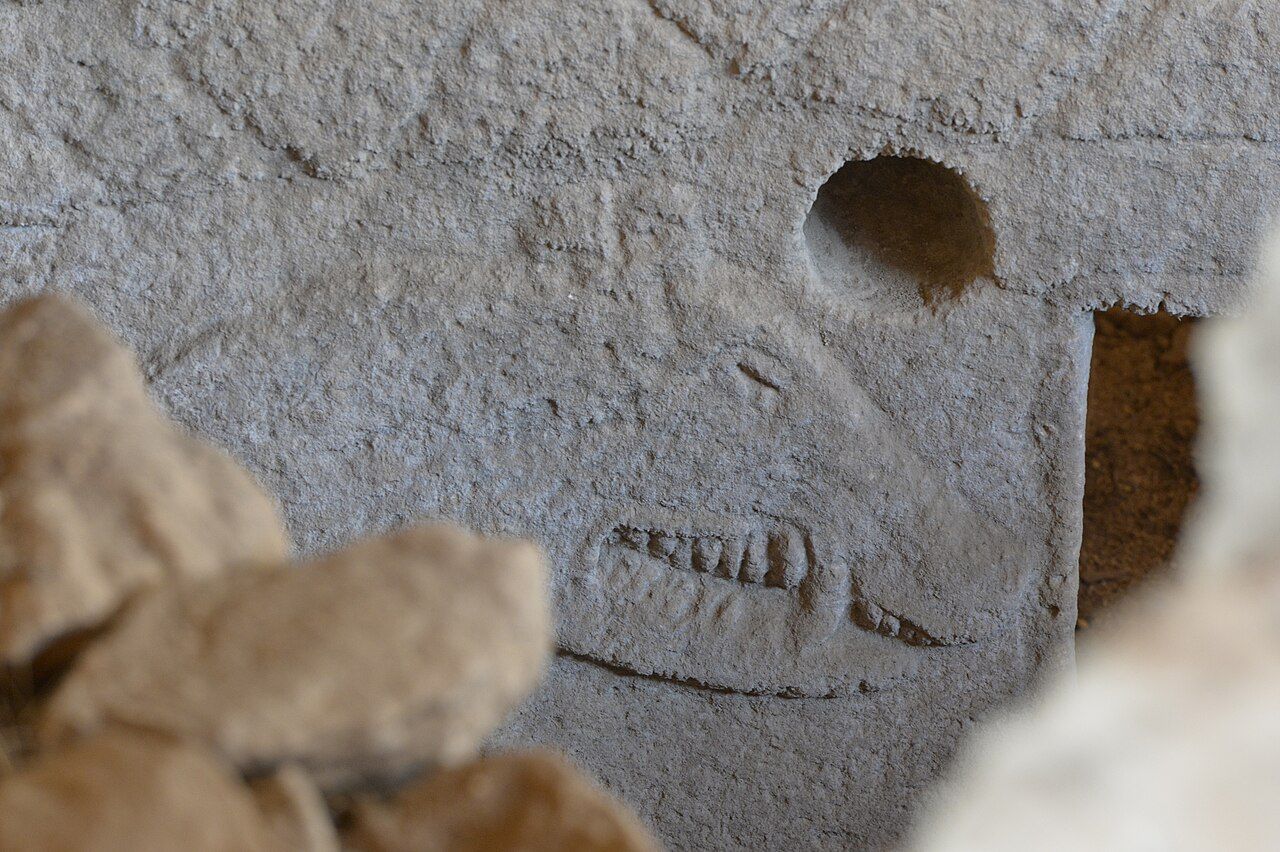
The bargain nobody negotiated
For roughly 95 percent of the time anatomically modern humans have existed, everyone lived by hunting, fishing, and gathering. Then, over a few thousand years beginning around 9500 BCE, populations in a crescent of well-watered hills running from the Levant north through southeastern Anatolia and down the Zagros foothills began to plant, harvest, and herd. Archaeologists call the region the Fertile Crescent, and the change the Neolithic Revolution — a misleading name, since it unfolded over some three thousand years, longer than the span from the founding of Rome to the present.
The Fertile Crescent got there first largely because of what grew there. Wild einkorn and emmer wheat, barley, lentils, chickpeas, peas, bitter vetch, and flax — eight founder crops — all occurred naturally within a few hundred kilometers of one another, and four of the world’s most useful domesticable large mammals (sheep, goat, pig, cattle) lived in the same neighborhood. That is not a statement about the genius of the people involved. It is a statement about a lucky biological inventory. Regions that lacked comparable species domesticated later or not at all.
Farming produced more calories per acre, and more calories meant more people. But it did not produce healthier people. Skeletal evidence from Neolithic sites across the Near East and beyond shows shorter stature than in the foraging populations that preceded them, more dental caries from starchy diets, more enamel hypoplasia signaling childhood nutritional stress, more iron-deficiency anemia, and more degenerative joint disease from repetitive grinding and hauling. Living beside domesticated animals in permanent settlements gave humans a new class of disease: measles, tuberculosis, smallpox, and influenza all have origins in or close relationships to animal pathogens. Sedentism plus livestock plus dense population plus contaminated water is the recipe for the epidemic.
Göbekli Tepe and the order of operations
The tidy old textbook sequence ran: farming creates surplus, surplus creates leisure, leisure creates religion and monuments. Then in 1995 Klaus Schmidt began excavating a hilltop in southeastern Turkey called Göbekli Tepe. He found circular enclosures ringed with T-shaped limestone pillars up to 5.5 meters tall and 10 tonnes in weight, carved with foxes, boars, vultures, scorpions, and snakes. The earliest layers date to roughly 9500 BCE — before domesticated crops and livestock are securely attested anywhere.
Schmidt argued that the sequence was backwards: gathering large numbers of people to build and feast at ritual sites created the demand for a reliable food supply, and farming followed. That strong version is contested. More recent excavation has found grinding installations, cisterns, and possible domestic structures at the site, suggesting the builders may have been more sedentary and more dependent on intensively harvested wild cereals than Schmidt first thought. The honest summary is that Göbekli Tepe demolished the simple causal arrow without yet replacing it with a settled alternative. Monumental construction and food production emerged together, entangled, over centuries.
Two other sites fill in the picture. At Jericho in the Jordan Valley, people built a stone wall and a solid stone tower roughly 8.5 meters high around 8000 BCE — the oldest known monumental architecture in a settlement. At Çatalhöyük in central Anatolia, occupied roughly 7100 to 5950 BCE, several thousand people lived in mudbrick houses packed so tightly that there were no streets; residents walked across rooftops and entered through the roof by ladder. They buried their dead under the floors of their own houses, plastered and repainted their walls dozens of times, and left no evidence of a palace, a temple precinct, or a chief. A large settlement, in other words, is not automatically a city, and density does not automatically produce hierarchy.
Agriculture was a slow, regionally lucky, and physically costly transition that fed more people while making the average person shorter, sicker, and busier — and monumental building may have helped drive it rather than merely following from it.
Section 2Sumer: Irrigation, the First Cities & the Invention of Writing
Mud, water, and the surplus problem
Southern Iraq is a hot, nearly rainless alluvial plain built from silt dumped by the Tigris and Euphrates. It has almost no stone, no metal ore, and no useful timber. What it has is deep fertile soil and two rivers — and if you can get the water onto the fields at the right time, the yields are spectacular. Barley returns on the southern floodplain in the third millennium BCE ran extraordinarily high by premodern standards.
Getting the water there was the catch. The Tigris and Euphrates flood in April and May, after the winter grain is already in the ground and too late for the crop that needs it — the opposite of the Nile’s helpful timing. Their flow varies wildly from year to year and their beds shift. Farming this plain therefore required canals, levees, weirs, and basins, and it required maintaining them: silt clogs a canal every season, and a canal serves many fields at once. Someone has to decide who digs, who gets water first, and what happens to the household that breaches a dike. Irrigation does not automatically create states, but it creates disputes that reward whoever can settle them.
Around 3500 BCE, Uruk in southern Sumer became something the world had not seen: a city. By roughly 2900 BCE its walls enclosed some 400 hectares and a population plausibly in the range of 40,000 to 50,000 — larger than any city in Europe would be for more than two thousand years. At its center stood the Eanna precinct, sacred to the goddess Inanna, and a high terrace supporting the whitewashed temple of An. Around it clustered specialists a village cannot support: potters using the fast wheel, metalworkers, weavers, brewers, scribes, priests, and soldiers.
From tokens to cuneiform
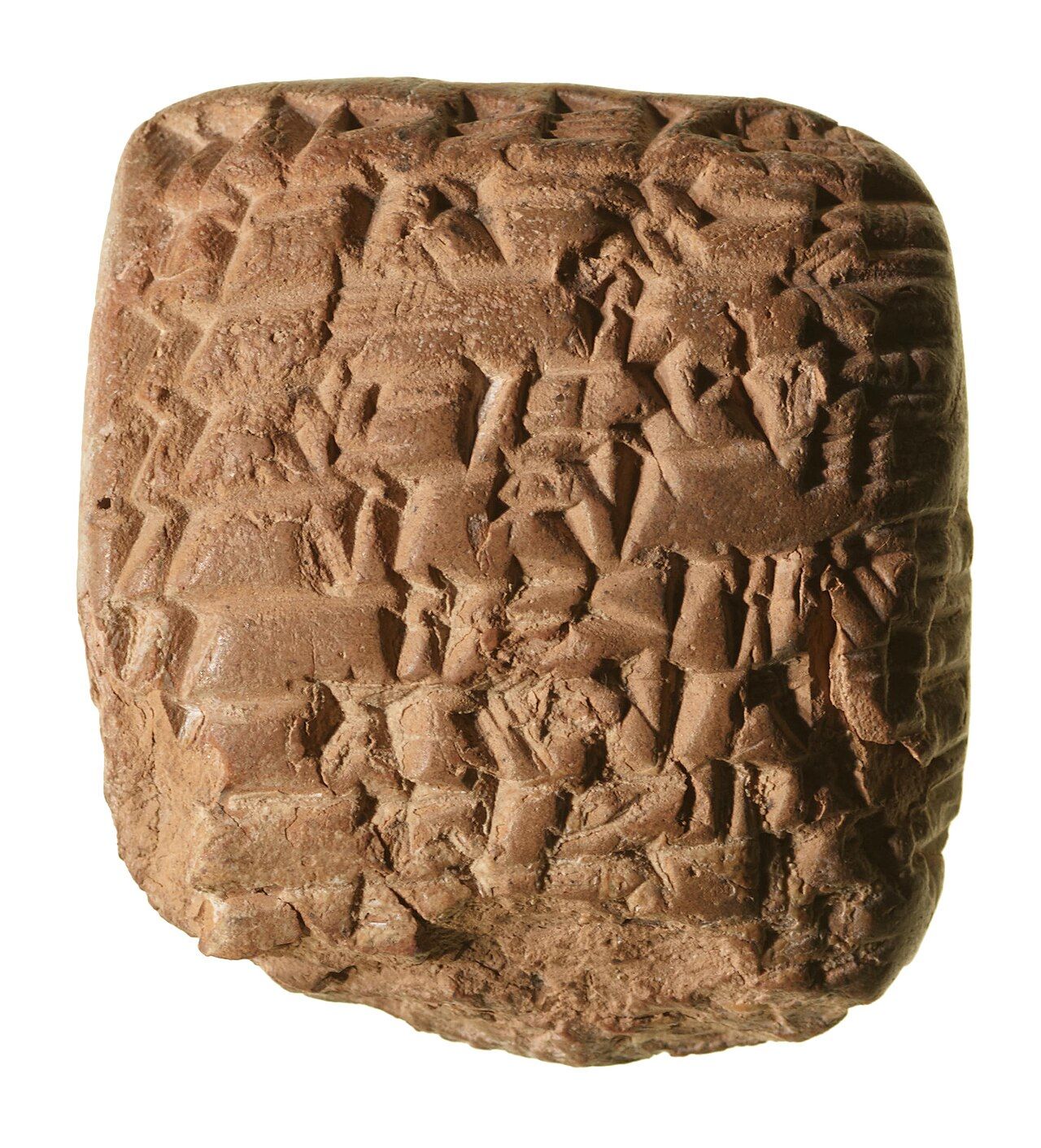
The oldest substantial writing in the world comes from Uruk, around 3300 to 3200 BCE. It is not a hymn or a chronicle. It is a set of clay tablets recording quantities of barley, beer, textiles, livestock, and labor rations. Denise Schmandt-Besserat proposed an influential lineage: for millennia Near Eastern accountants had used small clay tokens of standard shapes to stand for standard commodities, sealing them inside hollow clay envelopes and impressing the envelope’s surface to show what was inside. Eventually someone realized the impressions alone did the job. Specialists debate how much weight that particular story can bear, but the general point holds — writing grew out of accounting.
Early signs were pictographic. Over centuries scribes replaced curved strokes with wedge impressions made by pressing a cut reed stylus into damp clay, producing the script we call cuneiform (from Latin cuneus, wedge). The decisive breakthrough was phonetic: a sign could stand for a sound rather than a thing, which meant scribes could write personal names, verbs, prepositions, and abstractions. Once that happened, cuneiform could record Sumerian — a language isolate with no known relatives — and then be borrowed to write Akkadian, a Semitic language, and later Hittite, Elamite, Hurrian, and Old Persian. A writing system invented for one language became the diplomatic script of the entire Near East for two thousand years.
Literacy stayed narrow. Cuneiform in its mature form used several hundred signs, many with multiple readings, and mastering it took years in a school the Sumerians called the edubba, the “tablet house.” Scribal exercise texts survive that complain about beatings, tardiness, and sloppy handwriting. But out of that training culture came the first literature we can read: the Sumerian temple hymns and the Exaltation of Inanna, attributed to Enheduanna, daughter of Sargon of Akkad and high priestess of the moon god at Ur around 2300 BCE. She is conventionally called the first author in world history known by name, though some Assyriologists argue the attribution reflects later tradition rather than her own pen.
Kings, walls, and the Epic of Gilgamesh
Sumer was never one country. It was a dozen or so rival city-states — Uruk, Ur, Lagash, Umma, Kish, Nippur, Eridu — each with its patron deity, its temple, its walls, and its claim to disputed border canals. The long war between Lagash and Umma over the Gu’edena border strip is documented across generations of inscriptions and is the earliest well-recorded interstate conflict in history. Leadership titles evolved: the en was originally a priestly-civic office, the ensi a city governor, and the lugal — literally “big man” — a war leader whose temporary command hardened into hereditary kingship. War made kings.
All of this shaped the greatest surviving work of Mesopotamian literature. The Epic of Gilgamesh centers on a king of Uruk who may well have been historical, ruling around 2700 BCE. The Standard Babylonian version, arranged on twelve tablets and traditionally credited to the scholar Sin-leqi-unninni around 1200 BCE, follows Gilgamesh from tyrannical youth through friendship with the wild man Enkidu, through Enkidu’s death, and into a desperate, failed search for immortality. He returns to Uruk and, finding nothing else eternal, points to the city walls. It is a poem about accepting death, and it contains a flood narrative — the survivor Utnapishtim, the ark, the birds sent out to find land — that startled Victorian London when George Smith identified it on a tablet from Nineveh in 1872, because of its evident relationship to the flood story in Genesis.
| Period | Approximate dates BCE | What defines it |
|---|---|---|
| Ubaid | 5500–4000 | First permanent villages and temples on the southern plain; irrigation begins |
| Uruk | 4000–3100 | First true city; proto-cuneiform; cylinder seals; mass-produced pottery |
| Early Dynastic | 2900–2334 | Rival Sumerian city-states; Royal Tombs of Ur; kingship consolidates |
| Akkadian | 2334–2154 | Sargon builds the first territorial empire; Akkadian rises as a written language |
| Ur III | 2112–2004 | Sumerian revival; extreme bureaucratic record-keeping; Code of Ur-Nammu |
| Old Babylonian | 2004–1595 | Hammurabi unifies the south; law stele; mathematics and divination flourish |
| Neo-Assyrian | 911–609 | Iron-age military empire; deportation policy; Ashurbanipal’s library |
| Neo-Babylonian | 626–539 | Nebuchadnezzar II; destruction of Jerusalem; falls to Cyrus of Persia |
Dates follow the widely used “middle chronology.” Specialists disagree by roughly a century in either direction for the third and second millennia; treat early dates as approximate.
Sumer shows the whole package arriving together: irrigation created surplus, surplus supported specialists and temples, managing both required records, and records became writing — while competition among city-states turned war leaders into kings.
Section 3Empire & Law: Sargon, Hammurabi, Assyria
Sargon and the invention of empire
Around 2334 BCE a cupbearer at the court of Kish overthrew his king, defeated Lugalzagesi of Uruk, and made himself master of Sumer; a much later legend supplied him with a birth in secret, a reed basket set adrift on the river, and a childhood as a gardener’s foundling. Sargon of Akkad conquered city after city, tore down their walls, and installed his own governors and garrisons. He appointed Akkadian-speaking officials over Sumerian cities, standardized weights and measures across his territory, and put his daughter Enheduanna in the most prestigious religious office in the south — a shrewd fusion of family, religion, and administration.
What made this an empire rather than a large kingdom was that it ruled culturally distinct populations from a single center, extracted tribute, and moved goods and soldiers over long distances. It did not last. His grandson Naram-Sin took the extraordinary step of writing his name with the divine determinative and calling himself “god of Akkad,” and within a century the empire fell apart. Later Mesopotamian tradition blamed Naram-Sin’s impiety in a text called The Curse of Akkad. Modern researchers have proposed a severe multi-century drought around 2200 BCE, sometimes called the 4.2 kiloyear event, as a contributing cause; the paleoclimate evidence is real, but how directly it caused the collapse remains debated.
The Third Dynasty of Ur (about 2112–2004 BCE) rebuilt a smaller, tighter state under Ur-Nammu and his son Shulgi, and it produced one of the most obsessively documented bureaucracies of the ancient world — tens of thousands of surviving tablets recording livestock deliveries, dead animals, and labor days down to fractions. The dynasty also left the oldest surviving law collection, conventionally credited to Ur-Nammu though some scholars assign it to Shulgi, which mostly sets silver compensation for injuries rather than physical retaliation.
Hammurabi’s stele and what a law code is for
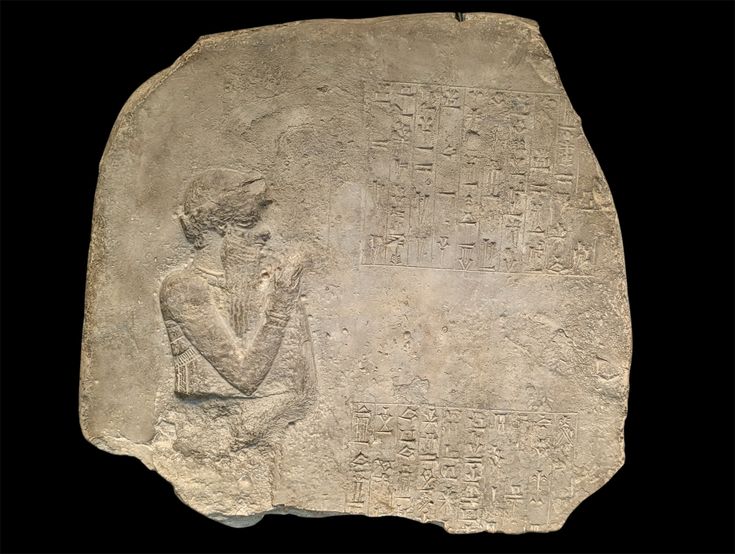
Hammurabi of Babylon (reigned about 1792–1750 BCE) spent decades as a middling king before a burst of campaigns in his last fifteen years made him master of Mesopotamia. He is remembered for a 2.25-meter pillar of black diorite carved with 282 legal provisions, framed by a prologue and epilogue in which the king declares that the gods called him “to cause justice to prevail in the land, to destroy the wicked and the evil, that the strong might not oppress the weak.” The stele was carried off as war booty to Susa in Iran and dug up there by a French expedition in 1901–02; it stands in the Louvre.
The provisions are casuistic — “if a man does X, then Y” — and famous for retaliation in kind, lex talionis: if a man destroys the eye of another man, his eye shall be destroyed. But that principle applies only between social equals, and the code is explicitly graded by status.
| Offense | If victim is an awīlum (free person of standing) | If victim is a muškēnum (dependent commoner) | If victim is a wardum (slave) |
|---|---|---|---|
| Eye destroyed | Offender’s eye destroyed | 60 shekels of silver | Half the slave’s market value paid to the owner |
| Bone broken | Offender’s bone broken | 60 shekels of silver | Half the slave’s value to the owner |
| Tooth knocked out (equal status) | Offender’s tooth knocked out | 20 shekels of silver | Not separately provided for |
The pattern is unmistakable: injury to a person of rank is answered with mirrored bodily harm; injury to a commoner or a slave is converted into money, and in the slave’s case the money goes to the owner, not the victim.
The code also reveals a society with regulated professions and real liability. A surgeon who successfully opened an abscess with a bronze lancet on a free man earned ten shekels; if the patient died or lost an eye, the surgeon’s hand was cut off. A builder whose house collapsed and killed the owner was put to death; if it killed the owner’s son, the builder’s son was put to death. That last provision — vicarious punishment — is one reason the code strikes modern readers as both recognizably legal and profoundly alien.
Assyria, Babylon, and the machinery of conquest
After 900 BCE the Neo-Assyrian Empire built the most effective military-administrative machine the Near East had yet seen. Iron weapons, siege ramps and battering rams, cavalry, and an integrated road-and-messenger system let Assyrian kings project force from northern Iraq to Egypt. Tiglath-Pileser III (745–727 BCE) reorganized conquered territory into provinces under salaried governors and systematized mass deportation: relocating entire populations hundreds of miles to break local identity and resettle depopulated land. Assyrian palace reliefs advertised the consequences of resistance in graphic detail — flaying, impalement, mounds of severed heads — because terror is cheaper than garrisons.
The same empire produced Ashurbanipal, who assembled a library at Nineveh of more than 30,000 tablets covering omens, medicine, mathematics, lexical lists, and literature. Most of what we know about Mesopotamian intellectual life, including the fullest text of Gilgamesh, comes from that collection. Nineveh fell in 612 BCE to a coalition of Medes and Babylonians; the fire that destroyed the palace baked the clay tablets hard and preserved them.
Babylon then had a brilliant final act. Nebuchadnezzar II (605–562 BCE) rebuilt the city with the glazed-brick Ishtar Gate and the ziggurat Etemenanki, campaigned in the Levant, and in 587/586 BCE destroyed Jerusalem and deported much of Judah’s elite — the Babylonian Exile, a catastrophe that reshaped Israelite religion. Babylonian scholars in these centuries kept systematic astronomical diaries from the seventh century BCE into the first, roughly six hundred years of nightly observation and the longest continuous scientific record known, and developed mathematical methods for predicting lunar and planetary positions that Greek astronomers later inherited. In 539 BCE Cyrus the Great of Persia took the city, and Mesopotamia became a province of somebody else’s empire for the rest of antiquity.
Mesopotamian rulers invented the working parts of empire — provincial governors, standardized measures, written law as royal advertisement, deportation, road systems, and tribute — and every later imperial state in this book borrowed from that toolkit.
Section 4Egypt: The Nile, the Pharaoh & the Order of Ma’at
A river that behaved
Herodotus called Egypt the gift of the Nile, and the phrase has survived because it is close to true. The Nile rises in the Ethiopian highlands and equatorial Africa and flows north through desert. Before the modern dams, monsoon rains in Ethiopia sent a flood down the valley every summer, rising from July, cresting in September, and falling away through October and November, spreading across the floodplain, soaking the soil and depositing a fresh layer of mineral-rich silt. The water receded in time for autumn planting; grain ripened in the mild winter and was harvested in spring.
Compare that to the Tigris and Euphrates and the political consequences follow almost mechanically. The Nile flooded at the useful moment, in a predictable season, along a narrow strip hemmed by cliffs and desert. Egyptian farmers used basin irrigation — earthen banks holding floodwater on a field until the soil was saturated — which is far less labor-intensive and less quarrelsome than maintaining a branching canal network in a hot, silt-choked plain. Egypt also enjoyed something Mesopotamia never had: defensible geography. Deserts east and west, cataracts to the south, sea to the north. The result was a civilization that was unified early, stayed unified for astonishing stretches, and produced an art style so stable that a statue carved in 2500 BCE and one carved in 700 BCE follow visibly the same conventions.
The Nile also ran the wrong way for a river’s convenience and therefore the right way for commerce. It flows north while the prevailing wind blows south, so a boat could drift downstream with the current and sail back upstream with the wind. That single accident of geography made the whole 1,000-kilometer corridor a functioning transport network and helped make political unification practical.
| Feature | Mesopotamia | Egypt |
|---|---|---|
| Flood timing | April–May, too late for winter grain | July–October, ideal for autumn planting |
| Flood reliability | Highly variable, sometimes destructive | Fairly regular; a low Nile meant famine |
| Irrigation | Large canal networks needing constant labor | Basin irrigation, largely local |
| Natural defenses | Open plain, exposed on all sides | Desert, cataracts, and sea |
| Typical political form | Rival city-states, then conquest empires | Unified territorial kingdom under one ruler |
| Building material | Sun-dried mudbrick (little stone) | Abundant limestone, sandstone, granite |
| Outlook in surviving texts | Often anxious; gods capricious, death bleak | Often confident; cosmic order restorable, afterlife desirable |
The state that built the pyramids
Egyptian tradition credited the unification of Upper Egypt (the southern valley) and Lower Egypt (the northern delta) around 3100 BCE to a king called Menes. The archaeological anchor is the Narmer Palette, a carved siltstone slab found at Hierakonpolis in 1898, showing a king wearing the white crown of the south on one face and the red crown of the north on the other. Whether it depicts a single conquest or commemorates a longer process is disputed, but the political idea it announces — one king, Two Lands — governed Egyptian self-understanding for three thousand years.
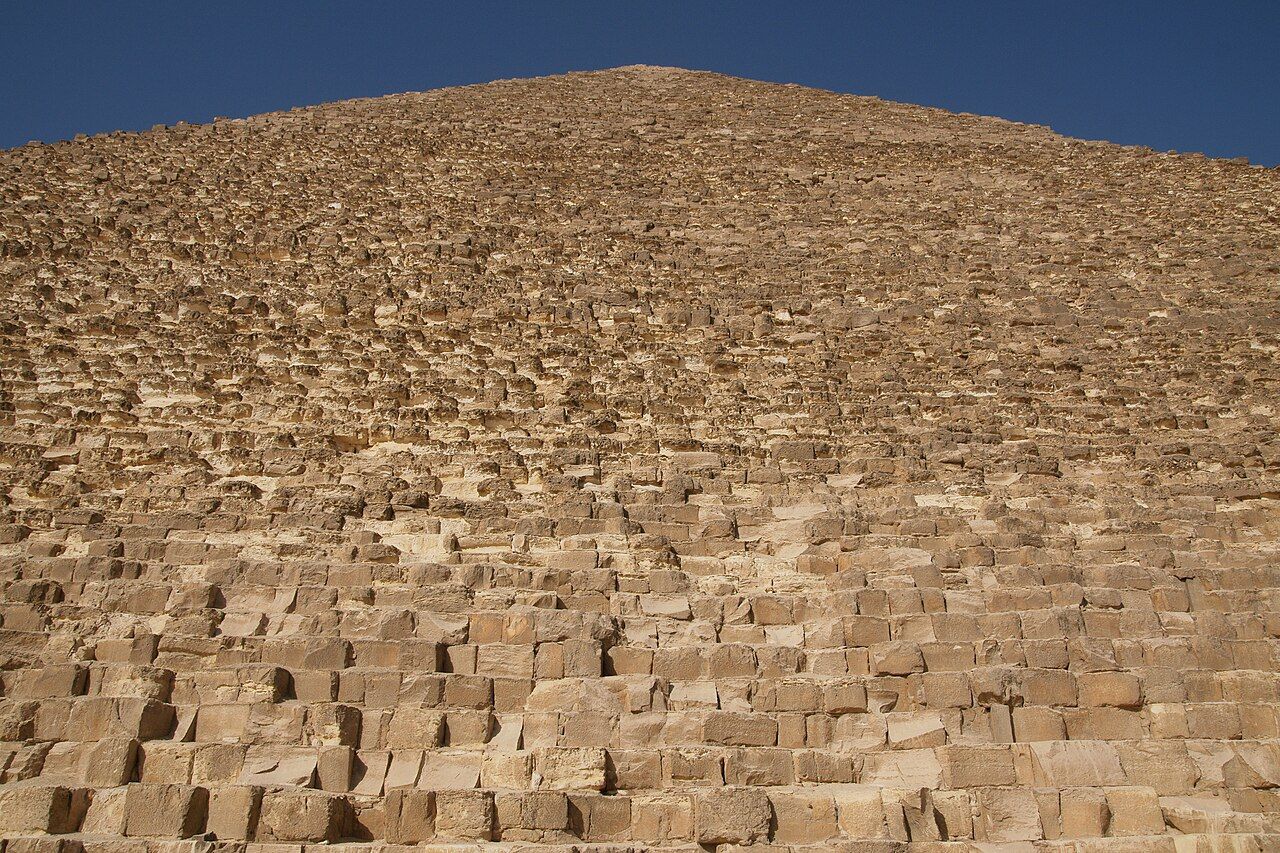
The Old Kingdom (about 2686–2181 BCE) is the pyramid age. Around 2670 BCE the architect Imhotep built Djoser a step pyramid at Saqqara, the earliest colossal building in dressed stone. Sneferu’s engineers, in three enormous attempts at Meidum and Dahshur, worked out the geometry of the true pyramid. His son Khufu built the Great Pyramid at Giza around 2560 BCE: roughly 2.3 million blocks, an original height of about 146.6 meters, sides aligned to true north within a fraction of a degree, and a base level to within a couple of centimeters. It remained the tallest structure on earth for about 3,800 years.
It was not built by slaves. Excavations by Mark Lehner and Zahi Hawass at the Giza workers’ settlement uncovered bakeries, breweries, dormitories, and cemeteries for laborers who were buried with honor near the monuments they raised, and whose skeletons show healed fractures treated with set bones — evidence of medical care. In 2013 archaeologists at Wadi al-Jarf on the Red Sea found the oldest inscribed papyri in the world, including the logbook of an official named Merer recording his crew ferrying fine limestone from the Tura quarries to Giza. It reads like a shipping manifest, which is exactly what makes it convincing. The workforce was conscripted and provisioned Egyptian labor, probably concentrated in the flood season when fields were underwater.
Ma’at, the afterlife, and Egyptian knowledge
The organizing Egyptian concept was ma’at — truth, justice, balance, and cosmic order, personified as a goddess wearing an ostrich feather. Its opposite was isfet: chaos, falsehood, disorder. The king’s essential job was to uphold ma’at, which is why royal art shows pharaoh smiting foreigners in the same stylized pose for millennia. That image is not a war report; it is a statement that chaos is being held at the border.
Ma’at also governed the fate of the individual dead. In the vignette from the Book of Coming Forth by Day (commonly called the Book of the Dead), the deceased’s heart is weighed on a balance against the feather of ma’at while Anubis adjusts the scales, Thoth records the verdict, and the composite monster Ammit waits to devour the heart that fails. Crucially, this judgment was moral and eventually available to non-royals — a democratization of the afterlife that spread after the Old Kingdom collapsed. Elaborate mummification followed from the belief that the person needed a preserved body; embalmers removed the viscera but famously discarded the brain, since the Egyptians located thought and feeling in the heart.
Egyptian practical knowledge was formidable. The Edwin Smith Papyrus, a copy of a much older text, describes 48 trauma cases in a strictly clinical format: title, examination, diagnosis, verdict, treatment — including the earliest known descriptions of the cranial sutures, the meninges, the brain surface, and a connection between head injury and contralateral paralysis. Several cases are honestly labeled “an ailment not to be treated.” The Ebers Papyrus mixes recognizable pharmacy with incantation. The Rhind Mathematical Papyrus, copied around 1550 BCE, works arithmetic, fractions, and area problems. Egypt also gave the world a 365-day civil calendar of twelve 30-day months plus five added days — drifting about a day every four years, but the direct ancestor of the calendar on your phone. Meanwhile Mesopotamian scribes bequeathed base 60: sixty seconds, sixty minutes, and 360 degrees in a circle are Babylonian fossils embedded in modern life.
| Era | Dates BCE | Signature developments |
|---|---|---|
| Early Dynastic | c. 3100–2686 | Unification; Narmer Palette; hieroglyphs; capital at Memphis |
| Old Kingdom | 2686–2181 | Step Pyramid; Giza pyramids; strong centralized bureaucracy |
| First Intermediate | 2181–2055 | Central authority fragments; regional governors rule; famine texts |
| Middle Kingdom | 2055–1650 | Mentuhotep II reunifies; classical literature; Nubian forts; afterlife broadens |
| Second Intermediate | 1650–1550 | Hyksos rule the delta; chariot, composite bow, new bronze technology arrive |
| New Kingdom | 1550–1069 | Empire in Syria and Nubia; Hatshepsut, Thutmose III, Akhenaten, Ramesses II; Valley of the Kings |
| Third Intermediate & Late | 1069–332 | Division, Libyan and Kushite dynasties, Assyrian and Persian conquest |
The New Kingdom deserves a closer look because it is where Egypt becomes an imperial power rather than an inward-facing kingdom. After expelling the Hyksos rulers of the delta around 1550 BCE — and adopting their chariots and composite bows — Egyptian kings campaigned into Syria and deep into Nubia. Hatshepsut (reigned about 1473–1458 BCE) ruled as king in her own right, had herself depicted with a royal beard, and sent a celebrated trading expedition to Punt; her successor Thutmose III won the meticulously recorded Battle of Megiddo around 1457 BCE. Akhenaten (about 1352–1336 BCE) attempted the ancient world’s most radical religious reform, elevating the sun-disk Aten above all other gods, closing temples, and moving the capital to a new city at Amarna; whether this counts as true monotheism or a form of exclusive royal henotheism is genuinely argued among Egyptologists. It collapsed within a generation, and his successors, including the boy king Tutankhamun, restored the old gods. Ramesses II (1279–1213 BCE) fought the Hittites at Kadesh in 1274 BCE, advertised it at home as a triumph despite an ambiguous outcome, and around 1259 BCE concluded with the Hittite king a treaty preserved in both Egyptian hieroglyphs and Akkadian cuneiform — the earliest surviving international peace treaty, complete with mutual defense and extradition clauses.
The Nile’s predictable flood and protective geography produced an early, durable, unified state whose ideology of ma’at made the king the guarantor of cosmic order — and whose surplus, once organized, could be spent on pyramids, empire, and one of the ancient world’s deepest bodies of practical knowledge.
Section 5Collapse, Alphabets & the Question of “Western” Origins
The Late Bronze Age world and its collapse
By 1300 BCE the eastern Mediterranean was an interconnected system. Egypt, the Hittite Empire in Anatolia, Assyria, Babylonia, Mycenaean Greece, Cyprus, and the Syrian port of Ugarit exchanged tin, copper, grain, textiles, glass, and royal daughters. The Amarna letters — nearly four hundred clay tablets from the Egyptian royal archive at Amarna, written mostly in Akkadian — preserve the correspondence of kings who addressed one another as “brother” and haggled over gifts of gold. The shipwreck at Uluburun off Turkey, dated to around 1320 BCE, went down carrying ten tonnes of Cypriot copper, a tonne of tin, Canaanite jars, Baltic amber, African ebony, and ostrich eggshells. Bronze itself required this network: copper from one region, tin from another, often thousands of kilometers apart.
Between roughly 1200 and 1150 BCE most of it broke. The Hittite capital Hattusa burned. Ugarit was destroyed and never reoccupied. Mycenaean palaces collapsed and Greek literacy in Linear B disappeared entirely for four centuries. Egypt survived but shrank, losing its Levantine empire. Ramesses III’s inscriptions at Medinet Habu describe repelling an invasion around 1177 BCE by groups the Egyptians named individually: Peleset, Tjeker, Shekelesh, Denyen, Weshesh. Modern scholarship lumps them together as the Sea Peoples, a nineteenth-century coinage rather than an Egyptian one.
Why it happened is one of the liveliest debates in ancient history. Older accounts blamed the Sea Peoples outright. Paleoclimate work — pollen cores from the Sea of Galilee, isotope records from the Dead Sea and Cyprus — now indicates a serious multi-decade drought across the region in exactly this window. Others emphasize earthquake sequences, or internal revolt against palace redistribution economies, or the fragility of a system in which the loss of any tin supply route could cripple everyone. The synthesis argued by Eric Cline and others is that no single cause suffices: a tightly coupled, specialized network failed the way complex systems fail, with drought, famine, migration, warfare, and trade disruption reinforcing each other. That is a lesson worth carrying forward, because you will meet the pattern again in later chapters.
Twenty-two letters and one god
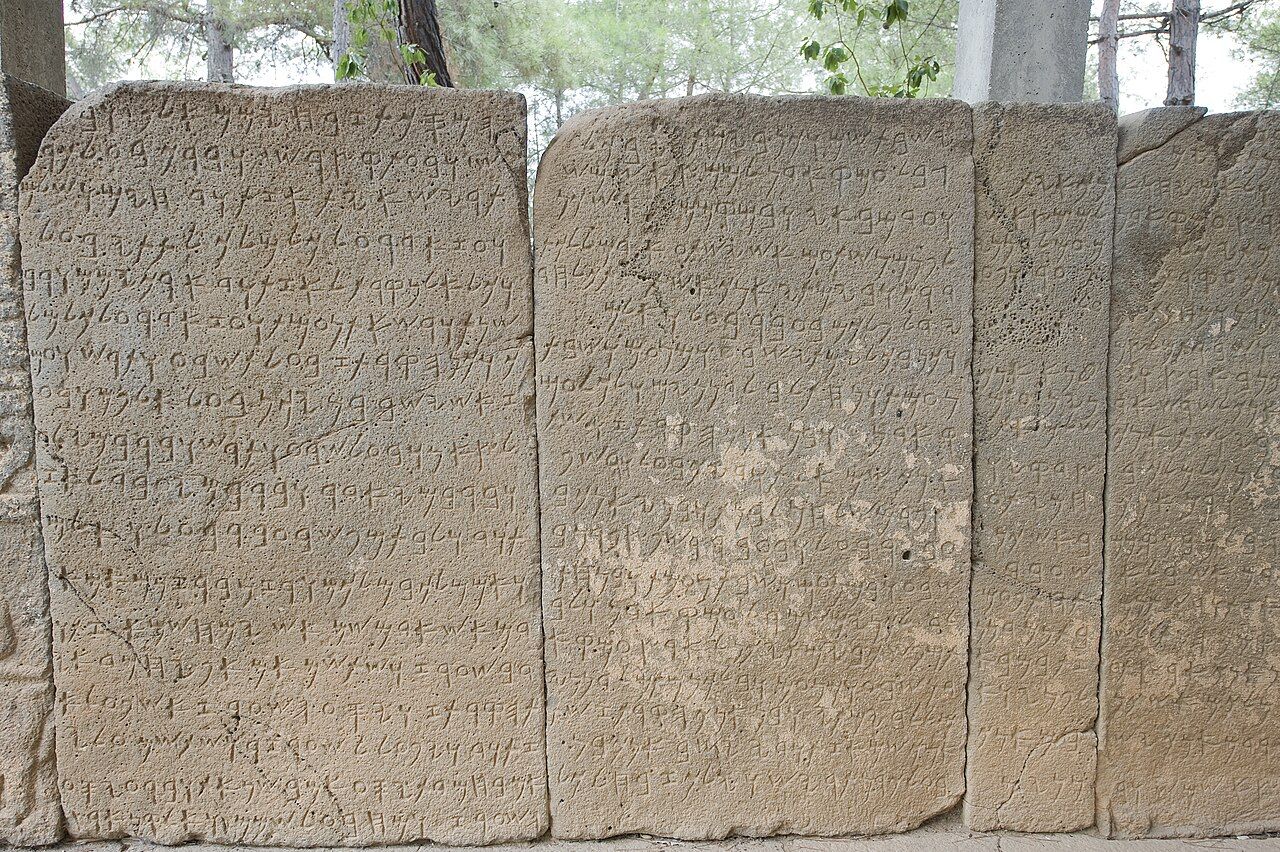
Somewhere around 1900–1700 BCE, Semitic-speaking workers in the Egyptian turquoise mines at Serabit el-Khadim in Sinai did something remarkable: they took Egyptian hieroglyphic signs and used them for the first sound of the Semitic word each picture named. An ox-head sign, ’alp, stood for the sound at the start of “ox.” A house sign, bayt, stood for “b.” This Proto-Sinaitic script collapsed a system of hundreds of signs into a couple of dozen. Its descendant, the Phoenician alphabet of 22 consonantal letters standardized around 1050 BCE, spread with Phoenician merchants across the Mediterranean. Greeks borrowed it, repurposed some unneeded consonant signs as vowels, and produced the first fully alphabetic script; the Etruscans passed a version to Rome; you are reading its descendants now, including the words “alphabet” (alpha, beta) and the letter A, which is still an ox-head turned upside down.
An alphabet lowers the cost of literacy in a way cuneiform and hieroglyphs never could: several hundred signs took years of school to master, while twenty-two letters can be learned in weeks. That did not make ancient societies literate — reading and writing stayed a minority skill for centuries afterward — but it did put writing within reach of merchants, soldiers, and local officials outside a professional scribal class, and scriptural religion and publicly posted law both grew in that soil.
The other durable inheritance from this corner of the world is the religious tradition of ancient Israel. The earliest reference to “Israel” outside the Bible is on the Merneptah Stele, an Egyptian victory inscription of about 1208 BCE, where it names a people rather than a place. How much of the biblical narrative before the monarchy is history is fiercely contested: scholars often described as maximalists argue for substantial historical memory behind the Exodus and the united monarchy of David and Solomon, while minimalists argue those texts are largely later literary constructions serving Judah’s political needs. What is far less disputed is that the Babylonian destruction of Jerusalem in 587/586 BCE and the exile that followed forced a religious reckoning — how could a defeated people’s god still be god? — and that the answer developed in that crisis, an exclusive monotheism in which one universal deity uses even foreign empires as instruments, became one of the most consequential ideas in world history. Later chapters pick it up.
What “the West” actually inherited
It is worth being precise about the claim in this book’s title. Mesopotamia and Egypt are not European. Sumerians did not think of themselves as ancestors of anyone in Paris or Philadelphia, and the category “Western Civilization” is itself modern — it took its familiar course-catalog shape in American universities around and after the First World War, beginning with Columbia’s 1919 “Contemporary Civilization” requirement, partly as a way to explain to students what the war had been fought to defend.
So the honest version is not descent but transmission. Greeks sailed to Egypt and came home with stone architecture, monumental sculpture, and geometry; Herodotus devoted an entire book of his Histories to Egypt. Greek astronomy runs on Babylonian observational data and Babylonian base-60 arithmetic, which is why we still measure angles in degrees and minutes. Roman and later European law worked with an idea already carved on Hammurabi’s stele: that rules should be published, fixed, and applied to cases. Judaism, Christianity, and Islam all grew from soil worked by these civilizations. Writing, the city, the state, the school, the archive, the contract, the calendar, and the interest-bearing loan are all Near Eastern inventions that the West received rather than made.
Keeping that straight does two useful things. It protects you from the bad argument that some inherent European genius produced modernity, and it protects you from the equally bad argument that borrowed ideas are somehow less genuinely yours. Cultures are almost entirely made of things they got from somebody else. What follows in this book is the story of what happened to these inheritances once they moved west and north — into a small, poor, quarrelsome peninsula that would ask an odd question the river valleys had rarely asked out loud: who, exactly, has the right to rule?
The Bronze Age system collapsed but its most portable inventions — the alphabet, iron, written law, monotheism, base-60 mathematics — survived and traveled, which is why “Western Civilization” is best understood as an inheritance from Africa and Asia rather than a European invention.
The chapter in one breath
Between about 9500 and 500 BCE, people in the Fertile Crescent and the Nile Valley assembled the equipment every later society in this book would use. Farming came first, slowly and at real cost to health and equality, and it fed populations that grew faster than the foragers around them. On the silty, rainless plain of southern Iraq, irrigation produced enough surplus to support priests, potters, soldiers, and scribes; Uruk became the first city; and the need to track barley produced cuneiform, which then learned to record names, laws, prayers, and finally Gilgamesh. Competition among Sumerian city-states made war leaders into kings, and Sargon of Akkad turned kingship into empire — a set of techniques Hammurabi, the Assyrians, and the Babylonians refined into provincial administration, published law, deportation, and tribute. Egypt, protected by desert and blessed with a punctual flood, unified early and stayed unified, spending its surplus on pyramids, empire, medicine, and a theology of cosmic order in which the king held chaos at bay. When the interconnected Bronze Age world broke apart after 1200 BCE, the wreckage released cheaper metal, a twenty-two-letter alphabet, and eventually a monotheism forged in exile — the portable inheritance that Greece, Rome, and Europe would build on.
Words worth knowing
| Term | What it means |
|---|---|
| Neolithic Revolution | The multi-millennium shift from foraging to farming and herding, beginning around 9500 BCE in the Fertile Crescent. |
| Fertile Crescent | The arc of well-watered land from the Levant through southeastern Anatolia to the Zagros foothills, home to the eight founder crops. |
| Alluvial | Made of river-deposited silt; describes the fertile, stoneless plain of southern Mesopotamia. |
| City-state | An independent city with its own government, patron deity, and rural territory — the standard political unit of early Sumer. |
| Cuneiform | Wedge-shaped writing pressed into clay with a reed stylus; invented for Sumerian, later used for Akkadian and many other languages. |
| Ziggurat | A stepped temple platform at the center of a Mesopotamian city, marking the god’s residence and the temple estate. |
| Lugal | Sumerian “big man”; a war leader whose emergency command evolved into hereditary kingship. |
| Akkadian | The Semitic language of Sargon’s empire and later of Babylonia and Assyria; the diplomatic language of the Late Bronze Age. |
| Lex talionis | Retaliation in kind (“eye for an eye”); in Hammurabi’s stele it applies only between people of equal status. |
| Stele | An upright inscribed stone slab or pillar used to publish a law, victory, or treaty. |
| Mass deportation | Neo-Assyrian policy of relocating conquered populations to break resistance and repopulate territory. |
| Babylonian Exile | The deportation of Judah’s elite to Babylon after 587/586 BCE, a crisis that reshaped Israelite religion. |
| Ma’at | Egyptian principle of truth, justice, and cosmic order that the pharaoh existed to uphold against chaos (isfet). |
| Pharaoh | The Egyptian king, understood as a divine or semi-divine guarantor of ma’at and the link between gods and people. |
| Hieroglyphs | Egypt’s monumental picture-based script, with cursive hieratic and later demotic used for everyday writing. |
| Papyrus | Writing material made from pressed reed strips; lighter than clay, which is why so much survives only in dry Egypt. |
| Intermediate Period | An era of divided or weakened central authority between Egypt’s Old, Middle, and New Kingdoms. |
| Late Bronze Age collapse | The cascading failure of eastern Mediterranean states and trade networks around 1200–1150 BCE. |
| Phoenician alphabet | A 22-letter consonantal script standardized around 1050 BCE; ancestor of the Greek, Latin, and modern European alphabets. |
| Monotheism | Belief in a single universal god; developed decisively in Israelite religion during and after the Babylonian Exile. |
Check yourself
Ancient Greece: Polis, Philosophy and Democracy
Greece is a poor country. Its soil is thin, its rain unreliable, its mountains slice the mainland into pockets too small to feed an empire. That poverty shaped everything. Because no Greek king could tax a Nile-fed grain surplus, no Greek king could pay a standing army or a permanent priesthood, and so Greeks organized themselves instead into hundreds of small, fiercely independent citizen-states. Out of that fragmentation came the loudest arguments in the ancient world: about who counts as a citizen, whether the many can govern themselves, what a good life is, and how we know anything at all. Greeks did not invent writing, law, monumental architecture or mathematics—Mesopotamia and Egypt got there first. What Greeks did was insist on giving reasons. This chapter follows that habit from Mycenaean palaces through Athenian assemblies, Spartan barracks, Socratic questioning and Alexander’s empire, and asks what survived and what did not.
By the end of this chapter you can
- Explain how geography and the collapse of the Mycenaean palace economies produced the polis rather than a territorial kingdom.
- Describe the hoplite phalanx and evaluate the argument that military change drove political change.
- Compare Sparta and Athens as answers to the same problem—how a small state survives—including the role of helots and of colonization.
- Trace Athenian constitutional development from Solon through Cleisthenes to the radical democracy of Pericles, naming the institutions of Ekklesia, Boule and dikasteria.
- Assess who was excluded from Athenian citizenship—women, metics, and the enslaved—and what that exclusion means for calling Athens a democracy.
- Analyze the causes and consequences of the Persian Wars and the Peloponnesian War, using Herodotus and Thucydides critically.
- Distinguish the projects of the Presocratics, the Sophists, Socrates, Plato and Aristotle, and explain why the trial of Socrates mattered.
- Characterize the Hellenistic world after Alexander, including Stoicism, Epicureanism and the science of Alexandria.
- Identify which Greek legacies passed intact to later Europe and which were reinvented and only labeled Greek.
Section 1From Palace to Polis: Collapse, Recovery and the Invention of the City-State
The Bronze Age world and its collapse
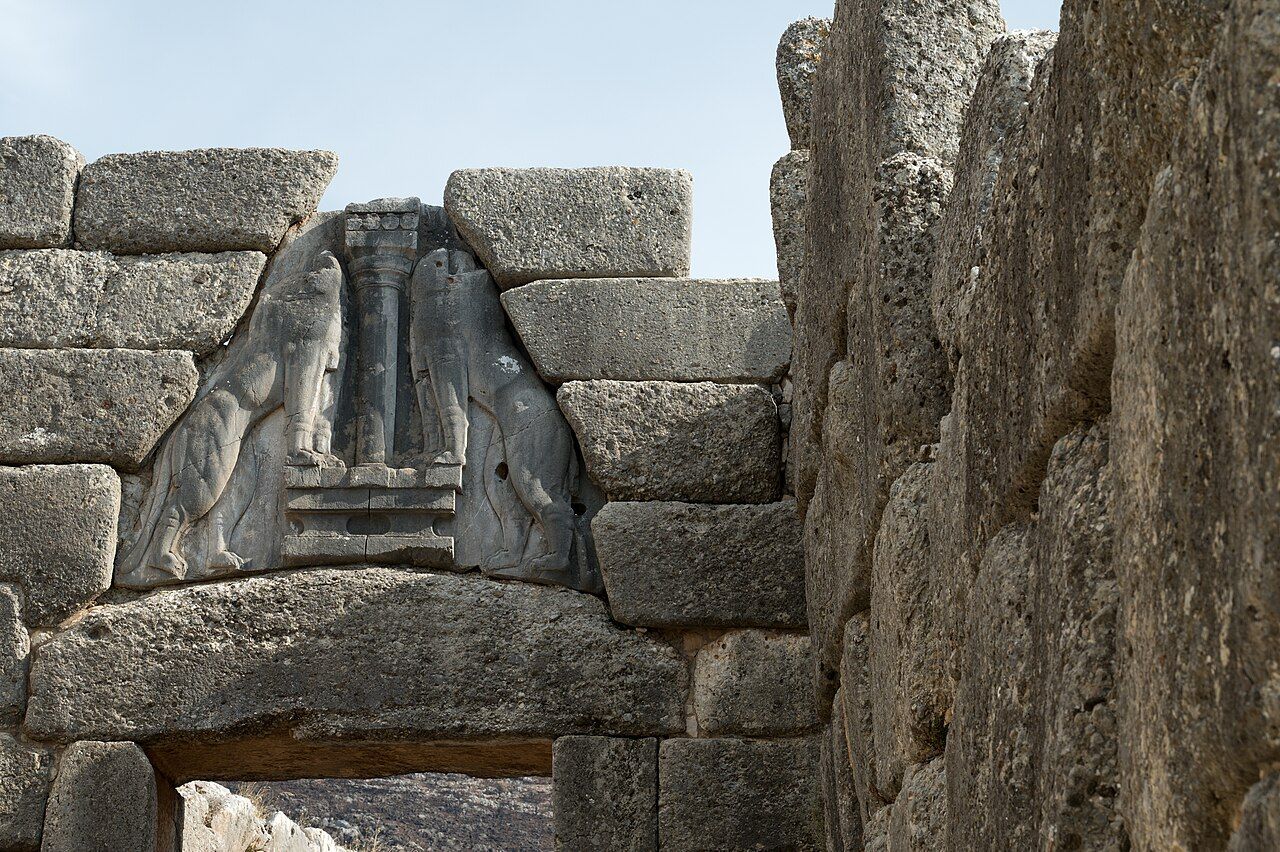
Before there were Greeks arguing in assemblies, there were Greeks living under kings. From roughly 1600 to 1200 BCE, fortified palace centers at Mycenae, Pylos, Tiryns and Thebes ran a redistributive economy that would have looked familiar to a scribe in Ur or Thebes-in-Egypt. Clay tablets written in a script called Linear B—deciphered in 1952 by Michael Ventris, an architect who built on the sign-grid analysis of the American scholar Alice Kober and proved the language was an early form of Greek—record sheep counts, bronze allocations, chariot wheels, rations for named workers. They are inventories, not literature. A king called the wanax sat atop this system. Crete’s earlier Minoan palaces at Knossos had supplied the model, and Mycenaeans seem to have taken over Knossos outright around 1450 BCE.
Then, between about 1200 and 1150 BCE, that whole eastern Mediterranean order came apart. The Hittite capital burned. Ugarit was destroyed and never reoccupied. Egyptian reliefs at Medinet Habu show Ramesses III fighting off seaborne coalitions that modern scholars lump together as the Sea Peoples, a collective label the Egyptians themselves never used. Every major Mycenaean center was burned or abandoned. Historians argue hard about why: raiders, earthquakes, drought recorded in pollen and speleothem data, systems collapse in which highly specialized palace economies could not absorb a shock, or—most plausibly—several of these compounding one another. No single explanation commands consensus, and honest textbooks should say so.
What matters for our story is the consequence. Writing disappeared from Greece for roughly four hundred years. Populations fell sharply; some sites lost most of their inhabitants. Long-distance trade thinned. Monumental building stopped. This stretch, roughly 1100 to 800 BCE, is conventionally called the Greek Dark Age, though archaeologists increasingly dislike the term because excavations at Lefkandi on Euboea revealed a huge tenth-century building with a warrior burial, gold, and an imported bronze urn—evidence that elites and contacts survived. Call it a reset rather than a blackout.
Why the polis and not a kingdom
When Greece recovered in the eighth century BCE, it did not rebuild palaces. It built something structurally new: the polis, a self-governing community of citizens centered on an urban core with a fortified high point (the acropolis), a public square for gathering and trade (the agora), and a surrounding stretch of farmland (the chora). By the classical period there were perhaps a thousand of them. Most were tiny. Modern estimates suggest the typical polis had a few thousand residents and territory smaller than a mid-sized American county; only Athens and Sparta controlled anything approaching a region.
Geography helps explain this. Mainland Greece is about eighty percent mountain, cut into small plains that drain separately to the sea. No river system unifies it the way the Nile unified Egypt, and no floodplain generates the enormous grain surplus that funds a bureaucracy. Hauling grain overland was ruinously expensive; hauling it by sea was cheap, which is why Greeks faced outward. But geography does not determine politics—the same landscape had held palace kingdoms four centuries earlier. The likelier decisive fact is that the collapse destroyed the institutional memory of centralized kingship, and the communities that reassembled did so around local landholding families who never let a single ruler recover monopoly power.
The Greeks themselves understood the polis as people, not place. Thucydides has the Athenian general Nicias tell his soldiers that men make a city, not walls or ships. When a polis founded a colony, it exported the whole package—cult, calendar, constitution—and the daughter city was independent from the start, tied to the mother city by sentiment rather than sovereignty.
Colonization, coinage and the alphabet
Between roughly 750 and 550 BCE Greeks planted settlements from Spain to the Crimea: Syracuse in Sicily (founded from Corinth in 733 BCE), Massalia at modern Marseille, Byzantium on the Bosporus, Cyrene in Libya, Naples in Italy. Cicero later wrote that the Greeks had sewn a fringe of settlements onto the shores of the barbarian lands. Motives were mixed and specific—land hunger after population recovery, political exile after a failed faction fight, trade, drought. The consequences were large: Greek cities became grain importers and oil-and-wine exporters, which made naval power and commercial classes matter.
Two technologies traveled with them. The Greek alphabet, adapted from Phoenician around 800 BCE, added signs for vowels, producing a compact set of two dozen-odd characters that could be learned in weeks rather than years—a genuine break from the scribal monopolies of Linear B and cuneiform. And coined money, invented in Lydia in Asia Minor in the late seventh century BCE and adopted quickly by Greek cities, made wealth portable, divisible and impersonal. Both technologies loosened aristocratic control of information and value.
The destruction of Mycenaean palace kingship, not Greek geography alone, cleared the ground for the polis—a small, fiercely independent community of citizens that became the basic political unit of Greek life.
Section 2Two Answers to One Problem: Sparta and Early Athens
The hoplite and the shape of citizenship
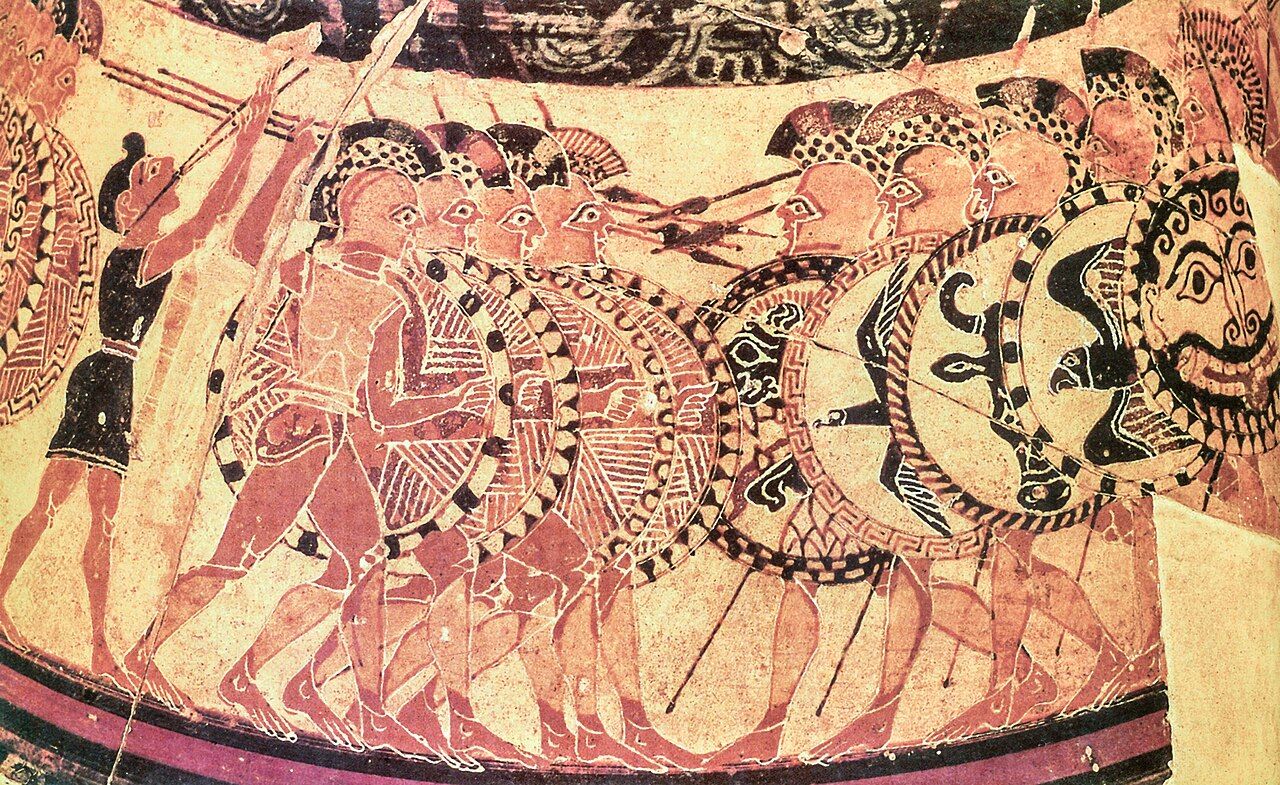
Around 700 BCE Greek warfare changed. Instead of aristocratic champions dueling before a crowd, cities fielded a phalanx: ranks of heavy infantry called hoplites, each carrying a thrusting spear and a distinctive round shield—the aspis, conventionally but probably wrongly called the hoplon—about ninety centimeters across, strapped at the forearm and gripped at the rim so that it covered the bearer’s left side and the exposed right side of the man to his left. That grip is the whole political argument in bronze. A phalanx works only if every man holds his place; the coward exposes the man beside him. Battles were short, brutal collisions decided by cohesion, not individual skill.
Hoplite equipment was expensive but not aristocratic—a prosperous farmer could buy it. The traditional “hoplite revolution” thesis argues that once the state’s survival depended on several thousand middling farmers rather than a few dozen horsemen, those farmers acquired political leverage they eventually cashed in for rights. Recent scholarship has complicated this. The phalanx probably developed gradually over a century rather than arriving as a shock, and the city with the most formidable hoplite army of all, Sparta, never became a democracy. The safer formulation: military participation and political participation tracked each other closely in Greece, and the direction of causation ran both ways.
Sparta: a state built on a conquered population
Sparta solved the land problem by conquest. In two long wars during the eighth and seventh centuries BCE, the Spartans took neighboring Messenia and reduced its population to helots—state-owned agricultural laborers bound to plots that supported Spartan citizens. Helots vastly outnumbered Spartiates, perhaps seven to one. Every year the Spartan magistrates formally declared war on the helots so that killing one carried no ritual pollution, and a secret police of young men, the krypteia, murdered those who seemed dangerous. Everything distinctive about Sparta follows from the need to sit permanently on top of that population.
Spartan boys entered the agoge at seven: communal barracks, deliberate hunger to teach foraging, endurance rituals at the sanctuary of Artemis Orthia. Adult male citizens, the homoioi or “similars,” dined nightly in common messes and were barred from trade and craft. The constitution mixed two hereditary kings (military commanders from separate royal houses), a council of elders called the gerousia, an assembly of citizens that shouted approval, and five annually elected ephors with sweeping executive power—a system Aristotle admired as a mixture and criticized as unstable. Spartan women, uniquely in Greece, exercised publicly, married later, inherited property, and by Aristotle’s day owned perhaps two-fifths of Spartan land. He considered this a defect. Most modern readers do not.
Sparta’s fatal flaw was arithmetic. Citizenship required contributing produce to a mess; a Spartiate who lost his land lost his status and could not regain it. The citizen body shrank from roughly eight thousand at the time of the Persian Wars to fewer than a thousand by 371 BCE, when Thebes broke Spartan power at Leuctra; roughly eighteen months later, in the winter of 370/369 BCE, a Theban army under Epaminondas invaded the Peloponnese, and Messene was refounded as a free city in 369 BCE. A society designed for one purpose could not replace its own members.
Athens before democracy: tension, tyranny and reform
Athens took a different road because it never conquered a helot population. Seventh-century Attica was instead being torn apart by debt. Poor farmers borrowed against their own persons; default meant enslavement, sometimes sale abroad. In 621 BCE Draco published the first written Athenian law code—harsh enough that “draconian” entered English—but writing law down was itself a concession, because unwritten law is whatever the aristocrat interpreting it says.
In 594 BCE the Athenians appointed Solon as archon with extraordinary powers to fix the crisis. He cancelled outstanding debts and the mortgage-stones that marked encumbered land (the seisachtheia, or shaking-off of burdens), banned lending on the security of a person, bought back Athenians sold abroad, and reorganized political rights by measured agricultural income rather than birth—four property classes, with the poorest, the thetes, gaining the right to attend the assembly and sit on juries even if they could not hold office. What he refused to do was redistribute land, which is what the poor had actually demanded. Herodotus and the Constitution of the Athenians report that he then left Athens for ten years so nobody could pressure him into revisions. In his surviving verse Solon notes that he satisfied neither the rich nor the poor and takes that as proof he held his shield over both.
Reform did not prevent tyranny. Peisistratus made himself tyrant for the third and lasting time in 546 BCE, two earlier attempts having collapsed. A Greek tyrannos was an unconstitutional ruler, not necessarily a cruel one, and Peisistratus was largely popular: he lent money to small farmers, expanded the Panathenaic festival and the City Dionysia (from which drama grew), built, and under his dynasty Athens began striking the silver owls that became the standard coin of the Aegean. His son Hippias turned repressive after his brother was assassinated in 514 BCE and was expelled in 510 BCE with Spartan help. The vacuum that followed produced Cleisthenes.
| Feature | Sparta | Athens (classical) |
|---|---|---|
| Economic base | Helot agriculture in Laconia & Messenia | Smallholding, olives & pottery, silver from Laurion, imported grain |
| Citizen body | c. 8,000 falling below c. 1,000 by 371 BCE | c. 40,000–60,000 adult males in 431 BCE; c. 30,000 by the fourth century |
| Unfree labor | Helots: state-owned, tied to land, could not be sold abroad | Chattel slavery: privately owned individuals, often purchased abroad |
| Decisive arm | Hoplite infantry | Trireme navy, rowed largely by poorer citizens |
| Executive | Two kings, five ephors, gerousia of 28 elders plus the kings | Ten annually elected generals; nearly all other offices by lot |
| Women’s position | Public athletics, property ownership, later marriage | Legally under a male guardian, secluded ideal, no property control |
| Attitude to outsiders | Periodic expulsion of foreigners (xenelasia) | Large resident-foreigner (metic) population, taxed and tolerated but never enfranchised |
Sparta and Athens faced the same shortage of land and labor and answered it oppositely—permanent conquest of a neighboring people versus debt reform, trade and overseas settlement—and those choices set their constitutions.
Section 3Athenian Democracy: How It Worked and Who It Left Out
Cleisthenes and the engineering of a citizen body
In 508–507 BCE Cleisthenes, an aristocrat who won a factional struggle by, in Herodotus’ phrase, taking the people into his party, redesigned Athenian society from the ground up. He abolished the political weight of the four old kinship tribes, which aristocratic families controlled, and created ten new tribes. The trick was in the construction. Attica was divided into about 139 demes—villages and city neighborhoods—grouped into thirty units called trittyes, ten each from the coast, the inland, and the city. Each new tribe received one trittys from each region. A tribe was therefore a deliberately artificial cross-section of Attica whose members had no shared ancestral loyalty to exploit.
Membership in your deme became hereditary and was the register of citizenship; Cleisthenes meant Athenians to be identified in public by deme rather than by father’s name, and although in practice both were used, the intent was a small revolution in identity. The Council, or Boule, now numbered 500, fifty from each tribe, chosen annually by lot from men over thirty, with a two-term lifetime limit. Each tribal contingent of fifty served as the standing executive committee for a tenth of the year, sleeping in the round tholos building; a chairman was drawn by lot each day and could serve only once in his life. That man—possibly a farmer who had never spoken in public—held the state seal for twenty-four hours. It is hard to imagine a system more hostile to professional politics.
The machinery of the radical democracy
By the age of Pericles, who dominated Athenian politics from about 461 to his death in the plague of 429 BCE, the institutions were these. The Ekklesia, the assembly of all adult male citizens, met about forty times a year on the Pnyx hill, a slope below the Acropolis holding perhaps six thousand men. It decided war, peace, treaties, taxation, grain supply and public building, by show of hands, after open debate in which any citizen could speak—the right called isegoria. The Boule set the agenda but could not decide. The courts, the dikasteria, seated juries of 201, 501, or in great cases 1,501 citizens over thirty, allotted—by the fourth century on the morning of the trial itself—through a slotted stone machine, the kleroterion, into which each juror’s bronze identity ticket was fed, specifically to defeat bribery. There were no judges and no lawyers; litigants spoke for themselves, timed by a water clock, and the jury voted by secret ballot without deliberating.
Almost every other office—perhaps 700 in all—was filled by lot for one year, on the principle that any citizen was competent to serve and that election favored the rich and famous. Aristotle states it flatly: selection by lot is democratic, election is oligarchic. The great exception was the board of ten strategoi, the generals, who were elected and could be re-elected indefinitely, because Athenians were willing to gamble on amateurs in the treasury but not on the battlefield. Pericles held that elected generalship year after year; his power was won by persuasion in the assembly, not by office. Pericles also introduced state pay for jury service, later extended to other offices, which made participation possible for men who worked with their hands—the change conservatives most resented and that made the democracy “radical.”
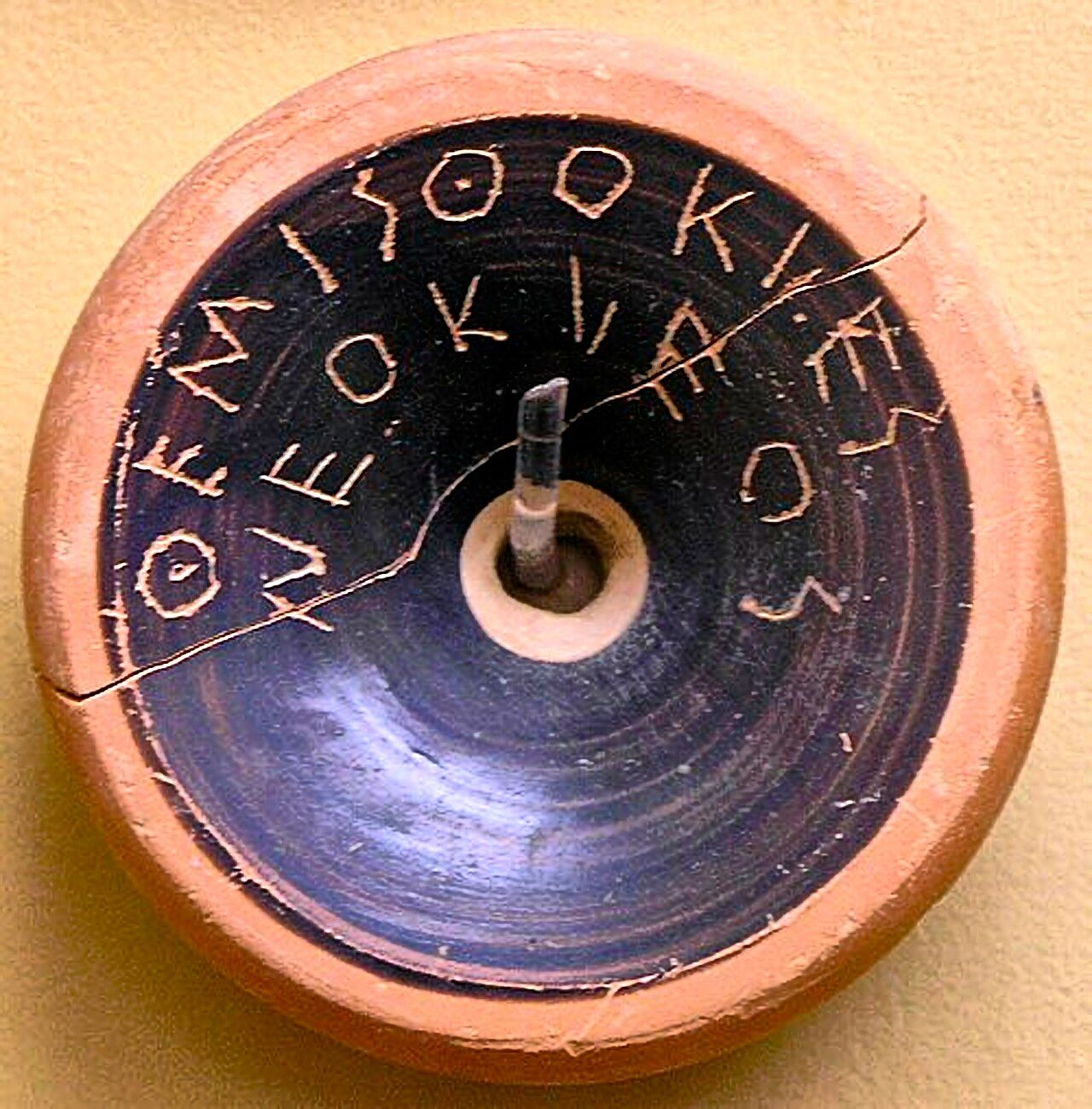
Ostracism completed the design. Once a year the assembly asked whether to hold one; if yes, citizens scratched a name on a pottery shard, and with a quorum of six thousand the leading name went into exile for ten years without loss of property or honor. It was not a punishment but a pressure valve, a way to resolve a deadlock between two powerful men without civil war. Thousands of ostraka have been excavated, including a cache of 190 bearing Themistocles’ name written in only a few hands—evidence that someone was mass-producing ballots.
The boundaries of the demos
Now the hard part. Attica in 431 BCE held perhaps 300,000 to 350,000 people; these are reconstructions from military and grain figures, not census data, and specialists disagree. Adult male citizens numbered somewhere between 40,000 and 60,000. Everyone else was excluded from political life. Women, whether rich or poor, could not vote, hold office, or represent themselves in court; a citizen woman acted through a male guardian, her kyrios. Pericles’ own citizenship law of 451 BCE tightened the boundary further by requiring both parents to be Athenian—which raised the status of citizen women as bearers of citizenship while narrowing the citizen body. Metics, free resident foreigners who might be wealthy bankers or philosophers (Aristotle was one), paid a residence tax, served in the army, and never voted. And a large enslaved population, variously estimated at 60,000 to 150,000, did domestic work, craft labor and, in the worst case, mining at Laurion, where the silver that funded the fleet was cut by men working in tunnels barely tall enough to kneel in.
Two conclusions have to sit together without cancelling each other. First, Athenian democracy was more direct and more participatory than any modern representative system: a randomly selected citizen actually governed, and the assembly actually decided. Second, it rested on the labor of people it defined as not-people, and its most famous defenders—Plato, Aristotle, the anonymous conservative called the Old Oligarch—did not think this needed justifying. Historians disagree about how much slavery was strictly necessary to the democracy’s functioning; they do not disagree that it existed on a large scale. Reading Athens honestly means holding the achievement and the exclusion in one hand.
| Institution | Who served | How chosen | What it did |
|---|---|---|---|
| Ekklesia (Assembly) | All adult male citizens, c. 6,000 attending | Open to all who came | Final vote on war, treaties, laws, finance |
| Boule (Council of 500) | Citizens over 30, max two terms in a lifetime | Lot, 50 per tribe, annually | Prepared the assembly’s agenda; daily administration |
| Prytaneis | The 50 councillors of one tribe | Rotation by lot, one tenth of the year | Standing executive; chairman drawn daily by lot |
| Dikasteria (Courts) | Citizens over 30, paid a daily wage | Lot on the day, via the kleroterion | Tried cases; also reviewed officials and laws |
| Strategoi (Generals) | Usually wealthy, experienced men | Elected, re-electable without limit | Commanded forces; in practice led policy |
| Areopagus | Ex-archons, for life | By past office | Reduced in 462 BCE to homicide and religious cases |
Athenian democracy governed by lottery, rotation and mass juries rather than by professional representatives—an extraordinary experiment in ordinary citizens’ competence, built on the exclusion of women, foreigners and tens of thousands of enslaved people.
Section 4Persia, Empire and the Peloponnesian War
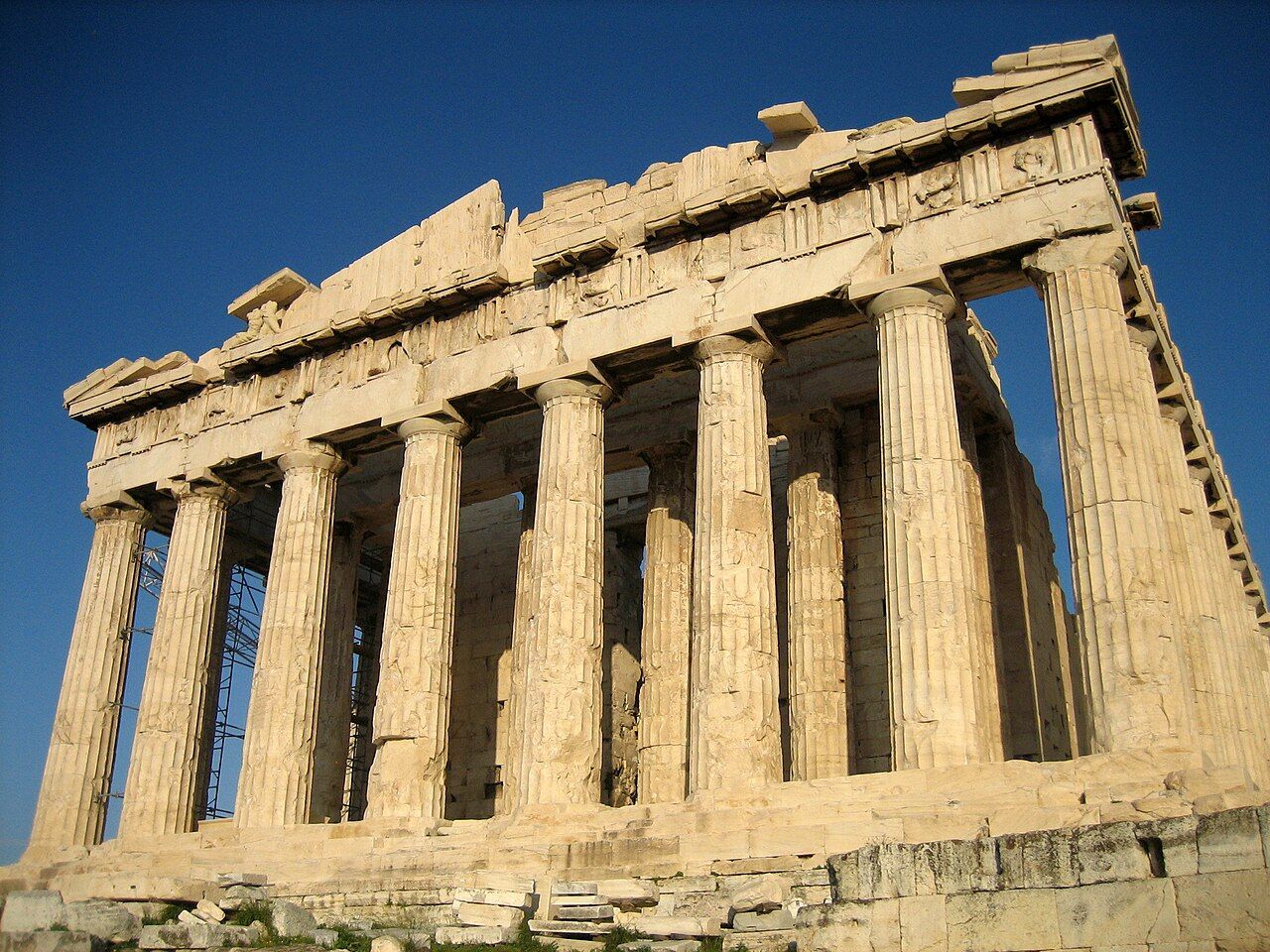
The Persian Wars, 499–479 BCE
The Achaemenid Persian empire under Darius I ran from the Indus to the Aegean—the largest state the world had yet seen, and by ancient standards a tolerant one. Greek cities on the coast of Asia Minor were its subjects. In 499 BCE they revolted, and Athens and Eretria sent modest help; Persia broke the Ionian fleet at Lade and sacked Miletus in 494 BCE, mopping up the rest the following year. In 490 BCE Darius sent a punitive expedition that landed at Marathon, twenty-six miles from Athens, where roughly 10,000 Athenians and Plataeans under Miltiades broke the Persian line. Herodotus reports 192 Athenian dead against thousands of Persians; the numbers are surely skewed but the outcome was not.
Ten years later Darius’ son Xerxes came with an army and fleet in overwhelming force. Herodotus’ figure of 1.7 million soldiers is impossible; modern estimates run from 80,000 to perhaps 300,000, still an enormous logistical feat requiring a pontoon bridge across the Hellespont and a canal cut through the Athos peninsula. In 480 BCE a Spartan-led force under Leonidas held the pass at Thermopylae for three days before a local man showed the Persians a mountain path; Leonidas and his 300 Spartiates died covering the retreat, along with 700 Thespians and several hundred helots. The Theban contingent, Herodotus says, surrendered. Persia burned Athens. But Themistocles had persuaded the Athenians in 483 BCE to spend a new silver strike at Laurion on 200 triremes rather than distribute it as a dividend, and that fleet, luring the Persian navy into the narrows at Salamis, shattered it. The following year the allied Greeks won on land at Plataea and at sea off Mycale, and the invasion was finished—though fighting with Persia went on in the Aegean for another generation.
The consequences outran the battles. Athens ended the war with the best navy in the Aegean and a conviction, expressed in tragedy and in stone, that free men fighting for their own laws had beaten a king’s subjects. That story hardened into an ideology of Greek versus “barbarian” that had not existed with the same force before 480 BCE—and that later Europeans would enthusiastically borrow.
From alliance to empire
In 478 BCE the Aegean states formed the Delian League to continue the war, with a treasury on the sacred island of Delos and Athens providing leadership. Members contributed ships or, increasingly, cash. Over three decades the alliance became something else. Naxos tried to leave around 470 BCE and was besieged into submission. Thasos revolted in 465 BCE and lost its fleet, walls and mines. In 454 BCE the treasury was moved to Athens, ostensibly for safety, and one-sixtieth of the tribute was thereafter paid to Athena—the records of those payments, inscribed on marble, are our best financial documents from the ancient world. A decree whose date is still disputed required allied cities to use Athenian coins, weights and measures, and major legal cases had to be brought to Athenian courts. Pericles spent tribute money on the Acropolis building program, and when critics said this was dressing Athens up like a vain woman with her allies’ money, he replied that the allies were paying for protection and had no claim on how the money was spent. Both halves of that exchange are true.
The Peloponnesian War, 431–404 BCE
Thucydides, an Athenian general exiled after failing to save Amphipolis, wrote the war’s history and framed its cause in a sentence that historians have argued about ever since: the truest cause, least openly stated, was that the growth of Athenian power frightened the Spartans and forced them to war. He distinguished this underlying cause from the immediate grievances—Corcyra, Potidaea, the Megarian decree—and the distinction between deep structural cause and proximate trigger is one of his lasting gifts to historical method.
The war ran twenty-seven years. Athens was a sea power, Sparta a land power, and neither could strike the other’s strength. Pericles’ strategy was to abandon the countryside, shelter the population behind the Long Walls to Piraeus, and let the fleet feed the city and raid the coast. Crowding brought catastrophe: a plague, probably arriving via Egypt in 430 BCE, killed perhaps a quarter to a third of the Athenian population, Pericles among them. Thucydides caught it, survived, and described the symptoms with clinical precision so that it might be recognized again—the earliest surviving attempt at a case definition. He also described the social collapse that followed: people spent freely, ignored law and burial custom, because neither punishment nor piety seemed likely to arrive in time.
After Pericles the war coarsened. At Melos in 416 BCE Athens demanded submission from a neutral island, and Thucydides stages a dialogue in which the Athenians say the strong do what they can and the weak suffer what they must; the Athenians then killed the adult men and enslaved the women and children. In 415 BCE the assembly voted an enormous expedition to Syracuse in Sicily, urged on by the brilliant, unstable Alcibiades, who was then recalled on a charge of religious sacrilege and defected to Sparta. The Sicilian expedition ended in 413 BCE with the fleet destroyed and the survivors dying in the stone quarries. Persia then funded a Spartan navy—the decisive intervention—and Lysander destroyed the last Athenian fleet at Aegospotami in 405 BCE. Athens surrendered in 404 BCE, pulled down its walls, and endured a brutal oligarchy, the Thirty Tyrants, before restoring democracy in 403 BCE with a general amnesty.
| Year BCE | Event | Why it mattered |
|---|---|---|
| 490 | Battle of Marathon | Athenians and Plataeans beat Persia without Sparta; huge boost to democratic confidence |
| 480 | Thermopylae and Salamis | Naval victory saves Greece and makes the poorer rowers politically weighty |
| 478 | Delian League founded | Alliance that becomes the financial base of Athenian empire |
| 462–461 | Ephialtes strips the Areopagus | Radical democracy begins; Ephialtes is assassinated |
| 454 | League treasury moved to Athens | Alliance becomes empire in fact |
| 431 | Peloponnesian War opens | Sparta acts on fear of Athenian growth |
| 430–426 | Plague of Athens | Kills Pericles and up to a third of the population |
| 415–413 | Sicilian expedition | Catastrophic overreach; fleet and army annihilated |
| 405–404 | Aegospotami; Athens surrenders | Persian-funded Spartan fleet ends the war |
| 403 | Democracy restored with amnesty | Shows the system’s resilience, not its death |
Athenian sea power built after the Persian Wars turned an alliance into an empire, and Spartan fear of that empire—funded at the end by Persian gold—produced a twenty-seven-year war that exhausted every Greek state that fought it.
Section 5Reason on Trial: Philosophy, Tragedy and the Hellenistic Aftermath
Asking what things are made of
Around 585 BCE, a man in Miletus named Thales reportedly predicted a solar eclipse and proposed that everything is ultimately water. Both claims matter less than the move behind them: he explained the world without invoking the will of a god. His successors argued with him rather than repeating him—Anaximander proposed a boundless indefinite substance and suggested humans descended from fish-like creatures; Anaximenes chose air, condensing and rarefying. These Presocratics disagree wildly, and that is the point. They established a tradition of publicly criticizing your teacher.
Others pushed harder. Pythagoras and his followers in southern Italy found that harmonious musical intervals correspond to simple whole-number ratios of string length and concluded that number is the structure of reality—a claim that runs straight through to modern physics. Heraclitus of Ephesus insisted that everything is in flux and that the world is governed by an ordering principle he called logos. Parmenides argued from pure logic that change is impossible and the senses deceive. Democritus, extending his teacher Leucippus’ answer to Parmenides, proposed that everything consists of indivisible particles—atomoi—moving in void. He was right for entirely the wrong reasons, which is a useful lesson about the history of science.
The turn to human things: Sophists, Socrates, Plato, Aristotle
Fifth-century Athens, rich and litigious, generated a market for teachers of persuasion. The Sophists—Protagoras, Gorgias, Thrasymachus—taught rhetoric and argument for fees. Protagoras’ famous line that man is the measure of all things, and his admission that he could not know whether the gods exist, made them look like relativists undermining traditional morality, and Plato’s hostile portraits fixed that reputation. Fairly read, they were the first people to insist that law and custom (nomos) are human conventions rather than facts of nature (physis), which is a genuine intellectual achievement even when the conclusions drawn from it were cynical.
Socrates (c. 469–399 BCE) wrote nothing, charged nothing, and claimed to know nothing except the extent of his ignorance. He cross-examined Athenians about courage, piety and justice until their confident definitions collapsed—the method called elenchus. In 399 BCE, five years after the defeat and the oligarchic terror, he was tried before a jury of 501 on charges of impiety and corrupting the young, convicted by a narrow margin, and executed by hemlock. The political subtext is hard to miss: several of his associates, including Critias and Alcibiades, had betrayed the democracy, and the amnesty of 403 BCE forbade prosecuting men for their conduct under the Thirty. It has been argued that Athens killed him for what his students did. Whatever the motive, the democracy executed a citizen for asking questions, and that fact permanently complicated the Western memory of Athens.
Plato (c. 428–348 BCE), Socrates’ student, founded the Academy around 387 BCE and wrote dialogues in which Socrates usually leads. His central claim is that the changing things we see are imperfect copies of unchanging Forms grasped by reason—beauty itself, justice itself—and that knowledge therefore is not sense experience. The allegory of the cave in the Republic makes ordinary opinion into shadows on a wall. Politically, Plato concluded from Socrates’ death that democracy is rule by the flattered ignorant, and proposed government by philosopher-rulers trained for decades and holding no private property. It is the earliest surviving systematic utopia and the earliest systematic argument against democracy, and both lineages are still with us.
Aristotle (384–322 BCE) studied under Plato for twenty years, tutored the young Alexander of Macedon, and founded the Lyceum in Athens. He rejected separate Forms: form exists in things, and knowledge starts with observation. He essentially invented formal logic, systematic biology—his marine observations at Lesbos were not surpassed for two millennia—literary criticism, and comparative politics, collecting 158 constitutions before analyzing them. His Nicomachean Ethics locates the good life in eudaimonia, human flourishing achieved through habituated virtue, a mean between excesses, exercised over a whole life. He also defended slavery as natural for some people and considered women deficient in deliberative capacity—errors that later Europeans quoted with enthusiasm precisely because his authority was so enormous.
Tragedy, history and the public examination of life
Philosophy was not the only place Greeks argued about first things. At the City Dionysia each spring, thousands of Athenians watched tragedies staged in competition and paid for by wealthy citizens as a public duty. Aeschylus’ Oresteia (458 BCE) traces blood vengeance until Athena replaces it with a homicide jury on the Areopagus—a founding myth of the rule of law, staged three years after Ephialtes had cut that same court back to precisely this jurisdiction. Sophocles’ Antigone sets divine obligation against the state’s command and refuses to make either side simply wrong. Euripides’ Trojan Women, produced in 415 BCE just after the massacre at Melos, shows the war’s victims as the victors watched. Aristophanes’ comedies mocked living generals and philosophers by name in front of the men they mocked. A society that funds its own criticism is doing something unusual.
History as a genre began here too. Herodotus of Halicarnassus set out to preserve the memory of great deeds and to explain why Greeks and Persians fought; he traveled widely, reported conflicting versions, and often declined to choose between them. Thucydides mocked storytellers and claimed to write a possession for all time based on eyewitness testing—while composing speeches according to what he judged the occasion demanded. Both are indispensable and neither is neutral.
Alexander and the Hellenistic world
The independent polis ended not by internal decay but by conquest. Philip II ruled Macedon, a northern kingdom most Greeks regarded as half-barbarian. He combined a longer pike, the sarissa, with heavy cavalry and siege engineering, and in 338 BCE defeated the allied armies of Athens and Thebes at Chaeronea. His son Alexander, taking the throne at twenty in 336 BCE, invaded the Persian empire in 334 BCE and broke it in four campaigning seasons—Granicus in 334, Issus in 333, Gaugamela in 331, then Persepolis—before driving on through Bactria to the Punjab, where in 326 BCE his exhausted army refused to go further. He died in Babylon in 323 BCE at thirty-two. His generals carved the empire into the Hellenistic kingdoms: Ptolemaic Egypt, Seleucid Asia, Antigonid Macedon.
That world was larger, wealthier and more cosmopolitan than the classical polis, and its thought shifted accordingly. When you are a subject of a distant king rather than a voting member of a small city, ethics turns inward. Stoicism, founded by Zeno of Citium around 300 BCE, taught that virtue alone is good, that a rational order pervades the cosmos, and that all humans share in reason—the seed of natural-law and human-rights thinking, later transmitted through Cicero and Roman jurists. Epicureanism taught that the good is freedom from pain and disturbance, that the gods do not interfere, and that death is nothing to us since when we exist death does not, a doctrine of consolation rather than indulgence. Meanwhile the Museum and Library at Alexandria funded the best science of antiquity: Euclid’s Elements, Eratosthenes calculating the earth’s circumference from shadow lengths at Syene and Alexandria (how close he came depends on which stade he used, but the method was sound and the answer was in the right range), Aristarchus proposing that the earth orbits the sun—a heliocentric model that convinced almost nobody for eighteen hundred years. Archimedes, working in Syracuse but formed by the same tradition, established the law of the lever and the principle of buoyancy.
| Thinker or school | Dates | Central claim | Long shadow |
|---|---|---|---|
| Thales & the Milesians | c. 600–530 BCE | Nature has natural causes | The premise of all science |
| Pythagoreans | from c. 530 BCE | Reality has numerical structure | Mathematical physics |
| Democritus | c. 460–370 BCE | Indivisible atoms in void | Revived by Epicurus, then by early modern chemistry |
| Sophists | fifth century BCE | Law and custom are human conventions | Rhetoric, legal argument, cultural relativism debates |
| Socrates | c. 469–399 BCE | The unexamined life is not worth living | Ethics as self-examination; the martyr of free inquiry |
| Plato | c. 428–348 BCE | Unchanging Forms are the objects of knowledge | Christian theology, idealism, critiques of democracy |
| Aristotle | 384–322 BCE | Knowledge begins in observation; virtue is a habit | Logic, biology, scholasticism, virtue ethics |
| Stoics | from c. 300 BCE | Virtue suffices; reason is shared by all humans | Natural law, Roman jurisprudence, modern resilience therapy |
| Epicureans | from c. 307 BCE | Absence of pain and fear is the good | Secular ethics; Lucretius; Enlightenment materialism |
Greek thought moved from asking what the world is made of, to asking how humans should live together, to consoling individuals inside vast kingdoms—and its methods of argument, not its conclusions, are the durable inheritance.
The chapter in one breath
When the Mycenaean palaces burned around 1200 BCE, Greece lost writing, kings and bureaucracy, and when it recovered three centuries later it built something without precedent: hundreds of small self-governing city-states in which armed farmers considered themselves each other’s equals. Scarcity pushed Greeks outward into colonies from Marseille to the Black Sea and inward into argument about who should rule. Sparta answered by enslaving Messenia and turning itself into a garrison; Athens answered with Solon’s debt reform, Cleisthenes’ artificial tribes, and finally a radical democracy run by lot, rotation and mass juries—an astonishing experiment resting on the excluded labor of women, metics and tens of thousands of enslaved people. Victory over Persia gave Athens a navy, the navy gave it an empire, the empire frightened Sparta, and the resulting twenty-seven-year war ruined the winner along with the loser. Through all of it Greeks did something rarer than any battle: they demanded reasons—from Thales to Aristotle, from tragedy to Thucydides. Macedon ended the independence of the polis at Chaeronea in 338 BCE, and Athenian democracy itself in 322. The habit of argument outlived both, and Rome would inherit it.
Words worth knowing
| Term | What it means |
|---|---|
| Polis | A self-governing Greek city-state: an urban center, its farmland, and above all its body of citizens. |
| Linear B | The syllabic script of Mycenaean palace records, deciphered in 1952 and shown to encode an early form of Greek. |
| Hoplite | A citizen heavy infantryman who supplied his own armor and fought shoulder to shoulder in the phalanx. |
| Phalanx | A dense rectangular formation of hoplites whose effectiveness depended on every man holding his position. |
| Helot | A member of the conquered Messenian and Laconian population held in state servitude by Sparta. |
| Agoge | Sparta’s compulsory state upbringing for boys from age seven, designed to produce disciplined soldiers. |
| Ephor | One of five Spartan magistrates elected annually with power to oversee, and even prosecute, the kings. |
| Seisachtheia | Solon’s “shaking off of burdens”: cancellation of debts and the ban on enslaving Athenians for debt. |
| Tyrannos | A ruler who seized power outside the constitution; not necessarily cruel, but never legitimate. |
| Deme | One of about 139 local Athenian villages or wards; hereditary membership defined citizenship after Cleisthenes. |
| Ekklesia | The Athenian assembly of adult male citizens, meeting on the Pnyx and holding final decision-making power. |
| Boule | The Council of 500, chosen by lot, that prepared business for the assembly and ran daily administration. |
| Dikasteria | Athenian people’s courts staffed by large allotted juries of citizens, with no judges or professional lawyers. |
| Ostracism | A procedure the assembly could vote to hold each year: citizens named a prominent man on a potsherd, and the leading name went into ten-year exile without loss of property. |
| Metic | A free foreigner resident at Athens who paid a special tax, could serve militarily, but never voted. |
| Delian League | The 478 BCE anti-Persian alliance led by Athens that hardened into the Athenian empire. |
| Sophist | A paid fifth-century teacher of rhetoric and argument who treated law and custom as human convention. |
| Elenchus | Socrates’ method of cross-examination that exposes contradictions in a person’s stated beliefs. |
| Forms | In Plato, the unchanging realities—justice itself, beauty itself—that reason grasps and the senses cannot. |
| Hellenistic | The period and culture from Alexander’s death in 323 BCE to Roman dominance, marked by large kingdoms and cosmopolitan Greek culture. |
Check yourself
Rome: Republic to Empire
Rome began as an unremarkable farming town on a muddy bend of the Tiber and ended as the only Mediterranean state that mattered. That is the puzzle this chapter takes apart. How did a community with no natural harbor, no philosophical tradition to speak of, and no obvious advantage over its neighbors absorb the Etruscans, the Samnites, Carthage, Macedon and Egypt within roughly four centuries — and then find that the machinery of conquest had broken the government that built it? The thread running through what follows is the Roman constitution: aristocratic in origin, widened by the Struggle of the Orders, corroded by land, slaves and loyal armies, and finally rebuilt by Augustus into a monarchy that insisted it was a restored republic. Along the way: what Roman law actually did, who counted as a citizen, how the empire governed people who had never seen Rome, and why its collapse in the West took three centuries rather than an afternoon.
By the end of this chapter you can
- Distinguish the legendary founding of Rome from the archaeological and Etruscan evidence, and explain why Romans told the stories they told.
- Describe the institutions of the Roman Republic — consuls, Senate, tribunes of the plebs, the assemblies — and explain how the Struggle of the Orders reshaped them.
- Explain how Rome’s treatment of defeated peoples, especially the graded rights of the Latin League settlement, converted conquest into manpower.
- Analyze the causes and consequences of the three Punic Wars, including the rise of the latifundia and the displacement of small farmers.
- Trace the collapse of the Republic from the Gracchi through Marius, Sulla, Caesar and the Second Triumvirate, identifying the structural causes beneath the personalities.
- Explain how Augustus constructed the Principate and why calling it a restoration was politically necessary.
- Evaluate the Pax Romana using concrete evidence — roads, aqueducts, urbanization, the Constitutio Antoniniana — and its costs.
- Explain the Crisis of the Third Century and assess the reforms of Diocletian and Constantine as responses to it.
- Weigh competing explanations for the fall of the western empire and account for the survival of the eastern half.
Section 1From Village to Republic
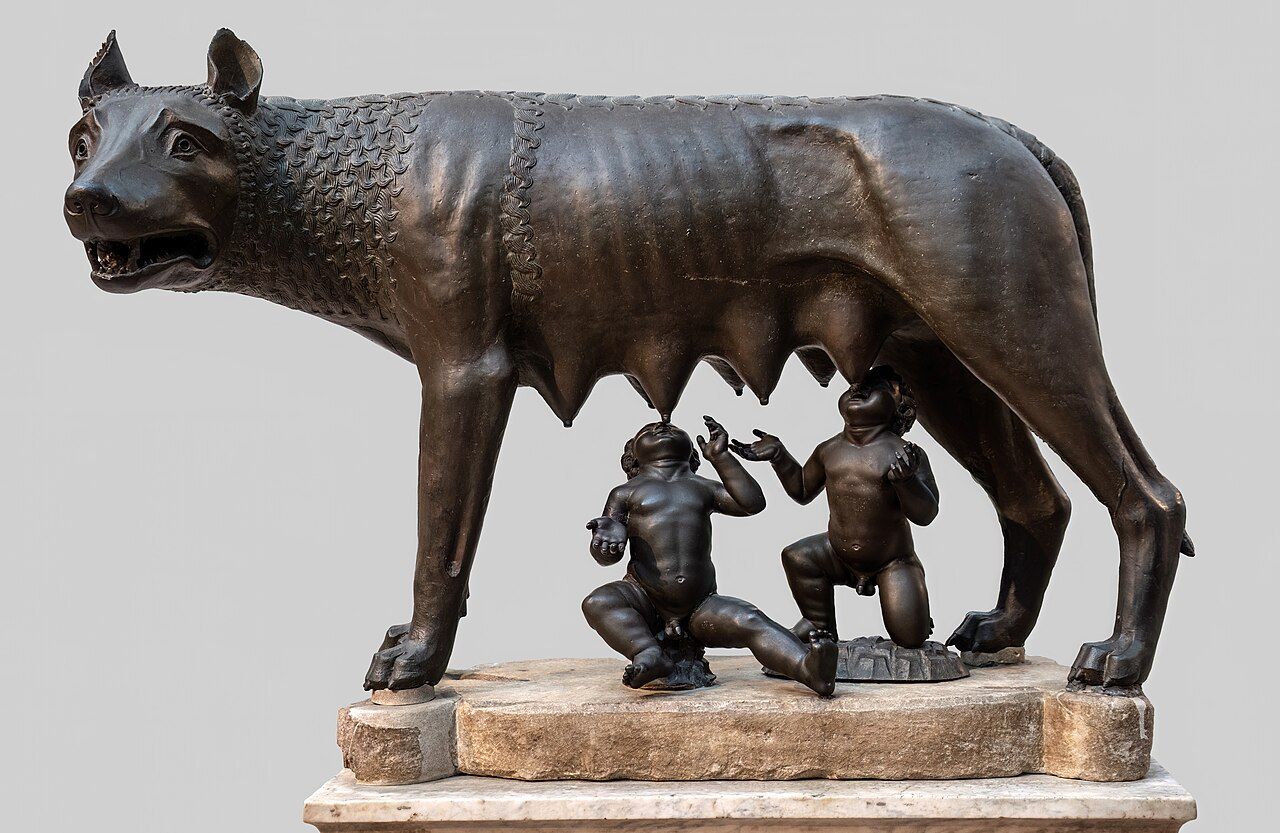
The site and the story
Rome sits about fifteen miles inland on the Tiber, at the lowest point where the river could be forded, on a cluster of hills that were defensible and malarial in roughly equal measure. That geography explains more than any legend. The ford made the site a crossroads between Etruria to the north and Campania to the south; the hills made it survivable; the inland position kept it safe from the pirates who plagued coastal towns. Archaeology shows huts on the Palatine from around the tenth century BCE and a recognizable town by the seventh, when the marshy low ground between the hills was drained and paved to become the Forum.
The Romans themselves told a different kind of story. Romulus and Remus, twin sons of Mars, exposed as infants, suckled by a she-wolf, growing up to found a city in 753 BCE — a date the scholar Varro calculated in the first century BCE and Romans thereafter treated as fact. Romulus kills Remus over the placement of a wall. Virgil, writing under Augustus, spliced this onto an older Greek thread: Aeneas fleeing burning Troy, carrying his father on his back, to found the line that would produce the twins. None of this is history. All of it is evidence — of what Romans thought Rome was. The stories insist on divine parentage, on fratricidal violence at the founding, on refugees and outsiders as ancestors, and on piety toward family and gods as the trait that made Romans win.
Rome’s early kings were real enough as an institution, whatever the individual names. Seven kings are named in the tradition, and the last three — Tarquinius Priscus, Servius Tullius and Tarquinius Superbus — were remembered as Etruscan. This matters. The Etruscans, occupying the region north of the Tiber, had cities, writing, metalwork, engineering and a religion of divination that Rome absorbed wholesale. The toga, the fasces (a bundle of rods around an axe, carried before magistrates as a symbol of power over life and limb), gladiatorial combat at funerals, the practice of reading the will of the gods in the livers of sacrificed animals — all Etruscan or transmitted through Etruria. Rome was, in its formative century, a provincial town in an Etruscan cultural world.
The Republic and its offices
Roman tradition dates the expulsion of the last king, Tarquin the Proud, to 509 BCE. The trigger in the story is the rape of the noblewoman Lucretia by the king’s son and her subsequent suicide — a tale that says a great deal about Roman ideas of honor, the female body as a marker of family status, and the tyrant as a man who takes what he wants. Historians treat the date as approximate and the narrative as later construction, but the outcome is solid: monarchy ended and Rome became a res publica, literally the “public thing.”
What replaced the king was designed with a single obsession: never again should one man hold permanent power. Two consuls shared the king’s executive authority, each able to veto the other, each serving one year only. Below and beside them grew a ladder of offices — the cursus honorum — with minimum ages and a required sequence. Every office was collegial (held by two or more) and annual. The one designed exception proved the rule: in a genuine emergency the Senate could authorize a dictator with sole authority for six months maximum. For three centuries dictators laid down power on schedule, which is why the office was so shocking when Sulla and Caesar abused it.
The Senate was formally only an advisory council of ex-magistrates, holding office for life. In practice it was the state. It controlled finance, foreign policy and the assignment of provinces, and its collective prestige — auctoritas — meant that its advice was rarely refused. Its decrees, senatus consulta, were technically recommendations. Almost nobody treated them that way. Meanwhile the citizen assemblies elected magistrates and passed laws, but they voted in blocs, and the blocs were weighted so that the wealthy voted first and, in the most important assembly, effectively decided outcomes before poorer citizens were called at all.
A common misconception: the Roman Republic was not a democracy in the Athenian sense, and Romans never claimed it was. Citizens voted, but only on proposals put to them by magistrates, in blocs weighted toward wealth, with no right of debate from the floor. Rome was an oligarchy with popular ratification — which is precisely why the office of tribune, discussed next, mattered so much.
The Struggle of the Orders
Early Rome was split between patricians, a closed hereditary aristocracy of some fifty clans, and plebeians, everyone else — a category that included the desperately poor and also wealthy families excluded from the charmed circle. Patricians monopolized the priesthoods, the magistracies and the interpretation of law, which was unwritten and therefore whatever they said it was. The plebeians had the numbers and, critically, they were the infantry.
Their weapon was the secession of the plebs: a collective walkout from the city, leaving the patricians with no army. Tradition records the first around 494 BCE and several more over the next two centuries. Each produced concessions. The plebeians won their own officers, the tribunes of the plebs, whose persons were declared sacrosanct and who could veto any act of any magistrate with a single word — veto, “I forbid.” Around 450 BCE the law was written down and posted in the Forum as the Twelve Tables, so that it could no longer be conjured to order. The Lex Canuleia of 445 legalized patrician–plebeian intermarriage. The Licinio-Sextian laws of 367 opened the consulship to plebeians. Finally the Lex Hortensia of 287 BCE made resolutions of the plebeian assembly binding on the whole citizen body.
On paper, this looks like two centuries of steady democratization. Look closer and the result is subtler. The men who benefited were rich plebeians, who married into patrician families and merged with them into a new governing class — the nobiles, defined not by birth but by having a consul in the family tree. The poor got legal protections and a tribune to appeal to; they did not get land, and they did not get power. Rome had swapped a closed aristocracy of blood for a slightly wider aristocracy of office. That unfinished business would come due in the second century.
Rome replaced monarchy with a system engineered against one-man rule, then spent two centuries widening its ruling class just enough to keep the plebeians fighting for it — without ever resolving the economic grievances underneath.
Section 2Conquering Italy and the Mediterranean
The Italian system
Rome’s conquest of Italy took roughly two hundred years and was neither swift nor inevitable. The Gauls sacked the city itself around 390 BCE, an event that scarred Roman memory permanently. The Samnites, a tough confederation in the central Apennines, fought Rome in three wars between 343 and 290 BCE and inflicted a humiliation at the Caudine Forks in 321 where an entire Roman army surrendered and was made to pass under a yoke of spears. Rome lost battles constantly. What it did not do was quit.
The real innovation came after victory. Most ancient conquerors either destroyed a defeated city or extracted tribute from it. Rome did something stranger: it offered graded membership. After crushing the Latin League in 338 BCE, Rome dissolved it and dealt with each community separately. Some got full Roman citizenship. Some got civitas sine suffragio — citizenship without the vote, meaning full private-law rights and the obligation to serve. Some held the Latin right, a middle tier carrying rights of trade and intermarriage with Romans and a path to full citizenship. Others became socii, allies who kept their own laws and government but surrendered foreign policy and supplied troops. Rome also planted colonies of citizens at strategic points and connected them with roads: the Via Appia, begun in 312 BCE, ran south toward Capua and eventually to Brundisium.
The consequence was arithmetic. Every defeated Italian people became a source of soldiers rather than a garrison requirement. By the time of the war with Hannibal, Rome could draw on a manpower pool that Polybius estimated at over seven hundred thousand infantry across Italy. Rome could lose an army — and it lost several — and field another. No Hellenistic kingdom could do that. This, more than tactics or virtue, is the mechanical explanation for Roman success.
| Status | Vote at Rome? | Military obligation | Local self-government |
|---|---|---|---|
| Roman citizen | Yes | Legionary service | N/A — governed from Rome |
| Citizenship without suffrage | No | Legionary service | Partial local magistrates |
| Latin right | Limited, if resident at Rome | Auxiliary contingents | Yes, with trade and intermarriage rights |
| Italian ally (socius) | No | Contingents under own officers | Yes, own laws and constitution |
| Provincial subject (after 241 BCE) | No | Auxiliary levies | Varied; taxed and governed by a Roman official |
Carthage and the Punic Wars
Carthage, a Phoenician foundation on the North African coast near modern Tunis, was the great commercial power of the western Mediterranean: a maritime empire built on trade, tribute and mercenary armies. Rome and Carthage had signed treaties and had no obvious quarrel until both became interested in Sicily. The First Punic War (264–241 BCE) began over a squalid dispute involving a band of Campanian mercenaries who had seized Messana, and turned into a twenty-three-year naval slog. Rome had essentially no navy. It built one, reportedly copying a wrecked Carthaginian warship, lost fleets to storms with staggering casualties, and built again. Carthage lost Sicily, which became Rome’s first province, and then lost Sardinia and Corsica to a piece of naked opportunism three years later.
The Second Punic War (218–201 BCE) was the closest Rome came to destruction. Hannibal Barca, operating from a Carthaginian power base in Spain, marched an army with war elephants over the Alps and into Italy, and proceeded to annihilate Roman armies at the Trebia, at Lake Trasimene, and above all at Cannae in 216 BCE, where his double envelopment destroyed a Roman force that ancient sources put at fifty thousand or more in a single afternoon. Cannae is still taught in military academies. And it did not win the war. Most of Rome’s Italian allies stayed loyal — the payoff of the graded-citizenship system — and Rome refused to negotiate. Fabius Maximus adopted a strategy of shadowing Hannibal without engaging, earning the nickname Cunctator, the Delayer, and the contempt of Romans who wanted a battle. It worked. Meanwhile Scipio Africanus took the war to Spain, then to Africa, forcing Hannibal’s recall and defeating him at Zama in 202 BCE.
The Third Punic War (149–146 BCE) was not a war in any meaningful sense. Carthage, disarmed and paying indemnities, had recovered commercially, which was intolerable to a faction at Rome led by Cato the Elder, who allegedly ended every speech regardless of topic with the demand that Carthage be destroyed. Rome issued escalating demands until it reached one no city could accept — abandon your site and move inland — and then besieged Carthage for three years. The city was razed and its surviving population enslaved. The story of salt sown in the fields appears in no ancient source and is a modern invention, but the destruction itself was real and deliberate.
Rome did not conquer the Mediterranean according to a plan. Each war generated the conditions for the next: Sicily required a navy, the navy required bases, bases in Spain provoked Hannibal, defeating Hannibal required intervention in Greece against his ally Philip V of Macedon, and intervention in Greece produced permanent commitments there. Historians debate whether Rome was defensively reactive or predatory — the honest answer is that Roman elites gained enormously from war and rarely looked for a reason to avoid one.
East to Greece and Asia
Between 200 and 146 BCE Rome dismantled the Hellenistic kingdoms with disorienting speed. Philip V of Macedon was beaten at Cynoscephalae in 197. The Roman commander Flamininus then stood at the Isthmian Games in 196 and proclaimed the Greek cities free, to wild acclaim — and the Greeks discovered over the following decades what Roman freedom meant in practice. Antiochus III of the Seleucid empire was crushed at Magnesia in 190. Macedon was defeated again at Pydna in 168 and abolished as a kingdom. In 146 BCE, the same year Carthage fell, Rome sacked Corinth as a warning to Greece. In 133 Attalus III of Pergamum simply left his kingdom to Rome in his will, and Rome accepted.
Wealth on this scale changed Rome faster than Rome could absorb it. Direct taxation of Roman citizens in Italy was suspended in 167 BCE because provincial revenue made it unnecessary. Greek art, Greek tutors, Greek philosophy and Greek slaves flooded the city. Cato the Elder railed against the corruption of ancestral custom, the mos maiorum, while the poet Horace later observed that captive Greece had taken its savage conqueror captive. Both were describing the same thing: a farming republic’s culture being rewritten by an empire it had acquired almost absentmindedly.
Rome won the Mediterranean less through tactical genius than through a political system that turned defeated enemies into soldiers and an elite culture that made quitting unthinkable — but victory imported wealth and slaves on a scale that would poison the Republic’s own society.
Section 3The Republic Destroys Itself
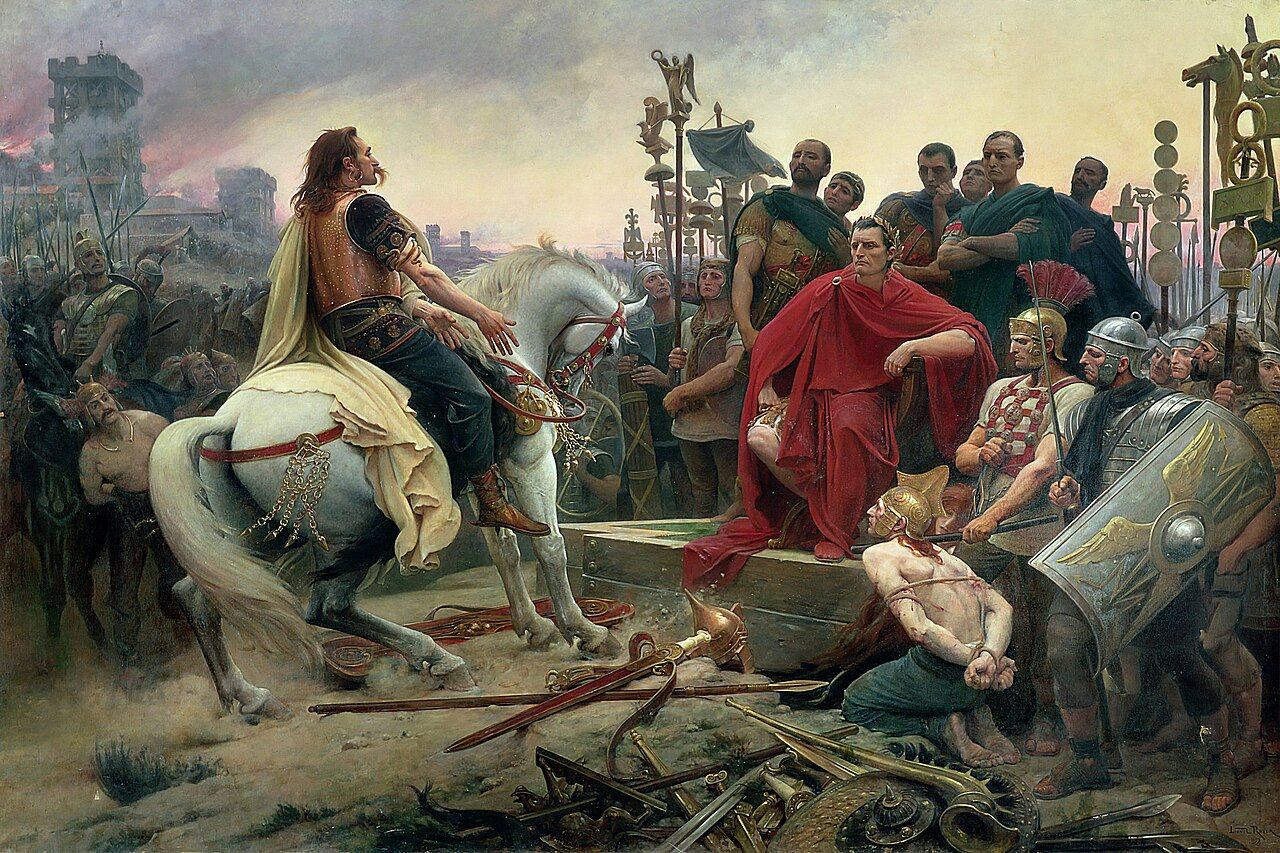
Land, slaves and the disappearance of the small farmer
The Republic’s crisis began in the countryside. Rome’s traditional soldier was a smallholder who owned enough property to equip himself and returned to his farm after a campaign. That model worked when wars were fought in the next valley in the summer. It broke when a legionary might spend six years in Spain. Farms went untended. Debt accumulated. And when the soldier came home, he found that his neighbor — a senator with capital and access to hundreds of war captives — had bought up the surrounding plots and merged them into a latifundium, a large estate worked by chained slave gangs producing wine, olive oil and livestock for market.
Slavery on this scale was new. The conquests dumped captives into Italy in numbers historians estimate in the hundreds of thousands; Epirus alone reportedly yielded 150,000 enslaved people in 167 BCE. Slave labor was cheaper than free labor and could not strike, migrate or vote. Dispossessed citizens drifted to Rome, where they swelled a poor, volatile urban population dependent on grain and on the patronage of politicians. Simultaneously, the property qualification for military service meant that as farmers fell below it, the recruitment pool shrank. Rome was, paradoxically, running out of soldiers because it had won too much.
The counter-pressure came from below too. Three large slave revolts erupted between 135 and 71 BCE, the last led by Spartacus, a Thracian gladiator whose following grew into an army of perhaps seventy thousand and beat several Roman forces before Crassus destroyed it. Six thousand survivors were crucified along the Appian Way. The revolts terrified the elite without changing anything structural. Slavery was not questioned; security was tightened.
The Gracchi and the breaking of the rules
Tiberius Gracchus, tribune in 133 BCE, proposed enforcing an old and ignored limit on how much public land any individual could occupy, redistributing the surplus to landless citizens in small allotments. The proposal was legal, moderate and arguably conservative — its goal was to rebuild the smallholder class that filled the legions. It was also an attack on the wealth of the men who ran the Senate.
What made Tiberius revolutionary was not the bill but the method. When a fellow tribune vetoed it, Tiberius had the assembly depose him, an act with no precedent. When the Senate starved the land commission of funds, he claimed the bequest of Pergamum to pay for it, seizing the Senate’s traditional control of finance. When he stood for a second consecutive tribunate to protect himself, a mob of senators led by the chief priest beat him to death with broken furniture on the Capitol and threw his body in the Tiber. His brother Gaius Gracchus, tribune in 123–122, went further — subsidized grain, colonies, courts taken from senators and given to the equestrian order — and died in 121 after the Senate passed its first senatus consultum ultimum, the emergency decree that effectively licensed killing citizens without trial.
The precedent set in 133 BCE was the one that mattered: political disputes at Rome could now be settled with blood. Every subsequent generation escalated. Historians conventionally date the Republic’s terminal crisis from this moment, and the labels optimates (those working through the Senate) and populares (those working through the assemblies and tribunate) come from this period — though it is a mistake to treat them as parties with platforms. They were methods, and ambitious men switched between them.
| Date | Event | Precedent it set |
|---|---|---|
| 133 BCE | Tiberius Gracchus killed by senators | Political murder inside Rome |
| 121 BCE | Death of Gaius Gracchus under emergency decree | Senate may suspend citizen rights |
| 107–100 BCE | Marius recruits the propertyless; repeated consulships | Armies loyal to a general, not the state |
| 88 BCE | Sulla marches his legions on Rome | The city itself is a military target |
| 82–79 BCE | Sulla’s dictatorship and proscriptions | State-sanctioned lists of citizens to be killed |
| 49 BCE | Caesar crosses the Rubicon | A provincial governor may invade Italy |
| 43 BCE | Second Triumvirate’s proscriptions; Cicero killed | Legalized elimination of the political class |
Marius, Sulla and the private army
Gaius Marius, a wealthy man from outside the old nobility, solved the recruitment crisis in the most dangerous way available. Facing war in North Africa and a Germanic invasion, he opened enlistment in 107 BCE to citizens with no property at all, equipping them at state expense. The cohort organization of the legion and the marching load that earned soldiers the nickname “Marius’s mules” are also credited to him, though recent scholarship treats the whole package of “Marian reforms” with caution: the property qualification had been falling for decades and the cohort was already in use, so Marius may have accelerated a trend rather than invented it. Militarily this was excellent; the reformed legions destroyed the Cimbri and Teutones in 102–101 BCE. Politically it was a bomb. A landless soldier had no farm to return to, so his retirement depended entirely on his general obtaining a land grant for him. The Senate was often unwilling. The general therefore became the veteran’s patron, and the army became the general’s clientele.
The bomb detonated in 88 BCE. When the assembly transferred a lucrative eastern command from Lucius Cornelius Sulla to Marius, Sulla marched his legions into Rome — something no Roman had done. The revealing detail is who went with him: the rank and file followed without hesitation, while all of his senior officers but one refused and left him. The soldiers now belonged to the general, not to the state. Sulla went east, and returned in 83 to fight a civil war, win it, and have himself made dictator with no time limit. He then published proscriptions: lists of citizens declared outlaws, whose killers were rewarded and whose property was auctioned, with the proceeds enriching his supporters. Ancient figures vary and are probably inflated, but they run to scores of senators and well over a thousand equestrians, with thousands of lesser victims besides. Sulla rewrote the constitution to strengthen the Senate and cripple the tribunate, then astonished everyone by resigning in 79 and dying in his bed. His constitution was dismantled within a decade. His example was not.
Julius Caesar inherited a system in which the rules were fictions. Allied with Pompey the Great and the immensely rich Crassus in the informal arrangement modern historians call the First Triumvirate, he took the consulship in 59, then a long command in Gaul, where between 58 and 50 BCE he conquered territory roughly equal to modern France and Belgium. Plutarch reports a million killed and a million enslaved — figures probably inflated but indicative of the scale. When the Senate, with Pompey’s backing, ordered him to disband his army and face prosecution, Caesar crossed the Rubicon river in January 49 BCE with a single legion. Civil war followed across Italy, Greece, Egypt and Spain. Caesar won, was made dictator for life in early 44, and was stabbed to death on the Ides of March at a meeting of the Senate in Pompey’s theatre complex, by a conspiracy of some sixty men who believed they were killing a tyrant and restoring the Republic.
They had misread the situation entirely. There was no republic left to restore — only competing armies. Caesar’s eighteen-year-old great-nephew and adopted heir Octavian allied with Mark Antony and Lepidus in the Second Triumvirate, which conducted its own proscriptions and killed Cicero, then destroyed the assassins at Philippi in 42 BCE. The alliance decayed into a final civil war fought as a propaganda contest — Octavian portraying Antony as a Roman unmanned by the Egyptian queen Cleopatra VII — and settled at the naval battle of Actium in 31 BCE. Antony and Cleopatra died by suicide the following year. Octavian, at thirty-two, held everything.
The most useful question about the Republic’s fall is not “who was to blame” but “what could a city-state constitution do with a Mediterranean empire?” Annual magistrates cannot run multi-year wars. Amateur governors with no salary and no audit will extort. Landless soldiers will follow whoever pays them. The Republic did not die of moral decline — it died of a mismatch between its institutions and its size.
Empire dissolved the Republic from within: conquest destroyed the smallholders who filled the legions, the fix created armies loyal to generals rather than the state, and once political murder became normal in 133 BCE, each generation escalated until only one man was left standing.
Section 4Augustus and the Roman Peace
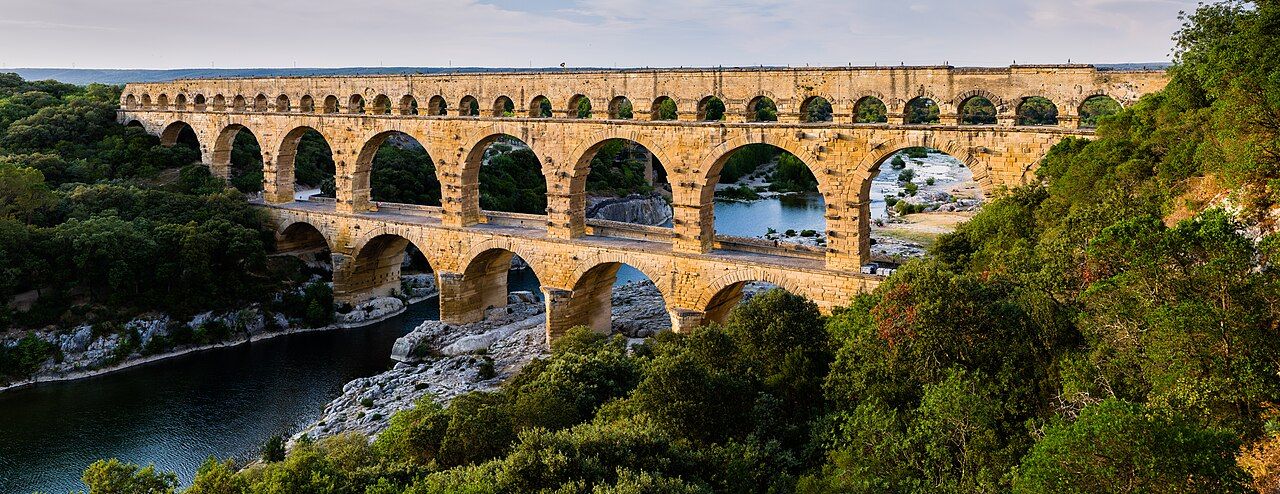
The constitutional magic trick
Octavian had watched his adoptive father get murdered for looking like a king. His solution was to hold monarchical power while scrupulously avoiding monarchical forms. In 27 BCE he theatrically returned his extraordinary powers to the Senate and people; the Senate, thoroughly managed, begged him to keep the essentials and voted him the honorific name Augustus, meaning something like “revered” — a religious word, not a political title. He called himself princeps, first citizen, from which historians take the term Principate for this phase of the empire.
What he actually held was an accumulation of ordinary republican powers, permanently. He kept a huge provincial command covering the frontier zones where the legions were, so the army was his. He held tribunicia potestas, tribunician power, giving him the veto and personal sacrosanctity without holding the office. He was pontifex maximus, chief priest, from 12 BCE. He controlled Egypt as personal property, and Egypt was the grain supply. Every element was traditional. The combination was unprecedented. The Senate still met, consuls were still elected, and the outward machinery ground on — which allowed the governing class to keep its dignity while surrendering its power. Tacitus, writing a century later, was scathing about the bargain and about the men who took it.
Augustus ruled for forty-four years after Actium, long enough that almost nobody alive at his death in 14 CE remembered the Republic functioning. He professionalized the army at twenty-eight legions with fixed sixteen- then twenty-year terms and a state pension fund, removing the veteran-settlement problem that had made generals into warlords. He created a permanent bureaucracy staffed partly by equestrians and freedmen loyal to him rather than to senatorial families. He rebuilt Rome physically — his boast that he found it brick and left it marble is roughly accurate — and legislated on marriage and adultery to encourage elite childbearing, with limited success. He also failed: three legions under Varus were annihilated in the Teutoburg Forest in 9 CE, ending expansion into Germany and fixing the frontier at the Rhine.
What the peace actually delivered
The two centuries from Augustus to Marcus Aurelius are conventionally called the Pax Romana. The phrase can be misleading — there was civil war in 68–69 CE, with 69 remembered as the Year of the Four Emperors, brutal frontier campaigns, and the crushing of Jewish revolts in 66–73 and 132–135 CE that destroyed the Second Temple in Jerusalem and depopulated Judaea. But for most of the interior, for most of that time, there was no war, and the effects were transformative.
Consider what an integrated Mediterranean made possible. Some 80,000 kilometers of paved roads eventually linked the provinces, primarily for military movement but usable by anyone. Piracy was suppressed, so grain from Egypt and North Africa fed a city of perhaps one million people. A common currency, and after the mid-second century a broadly common legal framework, made long-distance contracts enforceable. Cities were founded or refounded on a Roman template — forum, baths, amphitheater, aqueduct, grid streets — from Bath in Britain to Palmyra in Syria. Aqueducts delivered water at volumes that European cities would not match again until the nineteenth century. Rome had public latrines, sewers, and a fire brigade. It also had lead pipes, tenement collapses, and no germ theory.
The most consequential act of the period came in 212 CE, when the emperor Caracalla issued the Constitutio Antoniniana, granting Roman citizenship to virtually every free inhabitant of the empire. The motive was probably fiscal — citizens paid inheritance tax — and the practical effect was to make the old citizen/provincial distinction obsolete, replacing it with a distinction between honestiores (the respectable, who received lighter punishments) and humiliores (everyone else, who could be flogged, tortured or thrown to beasts). Legal equality arrived just as legal privilege shifted from citizenship to class.
| Emperor | Dates (CE) | Why they matter |
|---|---|---|
| Augustus | 27 BCE–14 CE | Invented the Principate; professionalized the army |
| Claudius | 41–54 | Conquered Britain; expanded the imperial bureaucracy |
| Nero | 54–68 | Great Fire of 64; first persecution of Christians; suicide ends the Julio-Claudians |
| Vespasian | 69–79 | Won the Year of the Four Emperors; began the Colosseum |
| Trajan | 98–117 | Empire at greatest territorial extent (Dacia, Mesopotamia) |
| Hadrian | 117–138 | Consolidated frontiers; the Wall in Britain; crushed the Bar Kokhba revolt |
| Marcus Aurelius | 161–180 | Stoic Meditations; Antonine Plague; endless Danube wars |
| Caracalla | 198–217 (sole from 211) | Universal citizenship in 212 |
Law, religion and daily life
Rome’s most durable export was law. Roman jurists developed the ius gentium, the “law of nations” — principles thought to be common to all peoples and therefore applicable to disputes between a Roman and a foreigner. Over time this merged with Stoic ideas of natural law and produced concepts still recognizable in modern legal systems: contracts requiring genuine consent, the notion that intent matters in assessing wrongdoing, that a person should not be condemned unheard, that the burden of proof lies with the accuser. Roman law was systematized under Justinian in the sixth century as the Corpus Juris Civilis, and through that text it became the foundation of the civil-law tradition of continental Europe and Latin America.
Roman religion was not a matter of belief in the modern sense but of correct performance. Rites had to be executed precisely; the gods, in exchange, sustained the state. This made Rome extraordinarily tolerant of new deities, which were simply added, and extraordinarily intolerant of refusal to participate, which looked like sabotage. Jews received a formal exemption in recognition of their ancient tradition. Christians, initially indistinguishable from Jews, lost that cover as they separated, and their refusal to sacrifice to the emperor’s genius made them suspects — though persecution before the third century was sporadic and local rather than systematic. Pliny the Younger’s letter to Trajan around 112 CE, asking how to handle Christians, and Trajan’s reply that they should not be sought out but must recant if accused, is our best window into official confusion on the subject.
For most people the empire meant work: farming, above all, since perhaps eighty to ninety percent of the population lived on the land. Roman society was steeply hierarchical and openly so, organized around patronage — the daily morning ritual in which clients called on a patron for favors, money or legal help and returned political support and public deference. Women could own property, run businesses and initiate divorce, and elite women exerted real informal influence, but they could not vote or hold office, and marriage was arranged around family strategy. Slavery was everywhere and legally total, though Roman manumission was unusually common and a freed slave became a citizen — a fluidity that startled Greek observers.
Do not mistake Roman religious tolerance for indifference or for pluralism as we mean it. Rome accepted any god you liked so long as you also honored the gods of Rome. The trouble with Christianity was not its content but its exclusivity — a refusal to participate in civic cult read to Roman officials as disloyalty, roughly the way refusing to acknowledge the state itself would read now.
Augustus made monarchy acceptable by dressing it in republican clothing, and the two centuries of relative peace that followed produced an integrated Mediterranean world — roads, cities, citizenship and law — whose legal and urban legacy long outlasted the state that built it.
Section 5Crisis, Reinvention and the End in the West
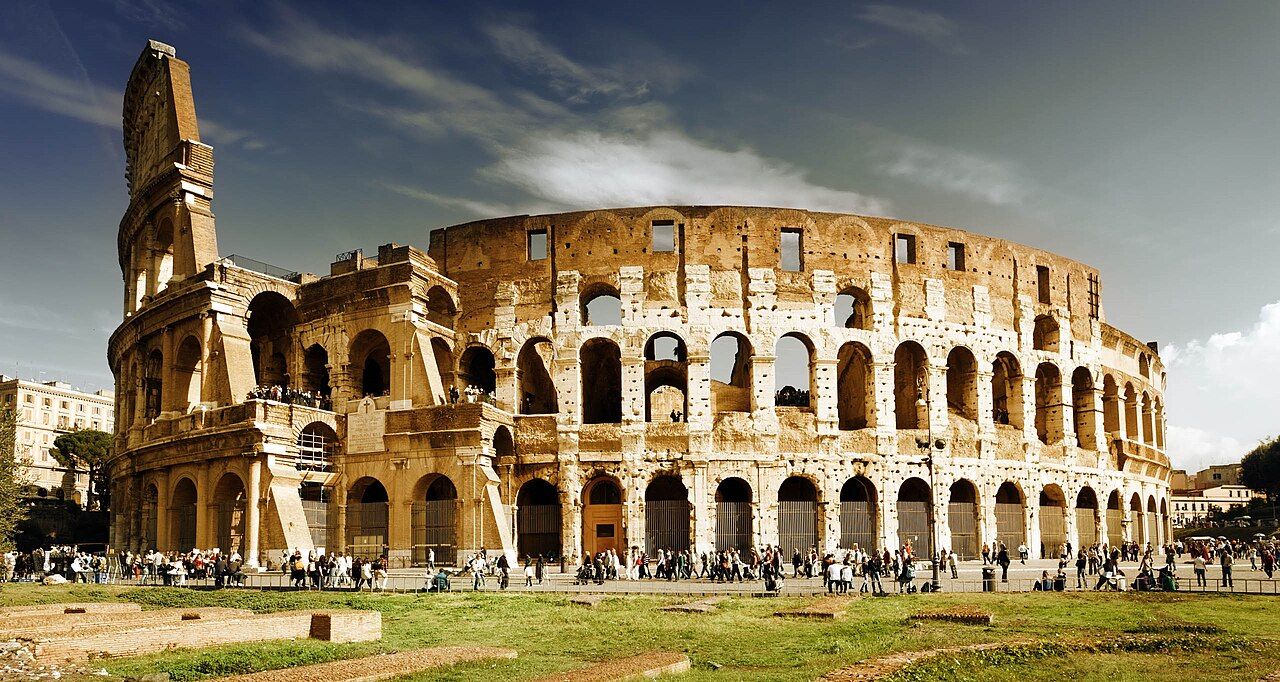
The third century nearly ends it
The system Augustus built had one structural flaw he never fixed: no rule of succession. As long as an emperor died with an adult heir the army accepted, things held. When Commodus — Marcus Aurelius’s son, and unfit for the job by every surviving account, all of them hostile — was strangled in 192, five men claimed the throne within a year. Septimius Severus won that contest and his dynasty patched over the gap for another four decades, largely by buying the army’s loyalty. After the murder of Severus Alexander by his own troops in 235, nothing held. Between 235 and 284 CE, the Crisis of the Third Century saw more than twenty men recognized as emperor and many more claimants, most of them elevated by their own troops and most of them murdered. The average reign was under three years.
The crisis was compound, and each element worsened the others. On the frontiers, a newly aggressive Sasanian Persia captured the emperor Valerian alive in 260 — an unprecedented humiliation — while Gothic and Alamannic groups raided deep into the Balkans, Greece and Gaul. To pay troops, emperors debased the silver coinage until the denarius contained almost no silver, and prices spiraled. Trade contracted as roads became unsafe. The Antonine Plague of the 160s and the Plague of Cyprian in the 250s killed populations already strained. The empire physically fragmented for over a decade into three pieces — a Gallic Empire in the west, a Palmyrene state in the east under Zenobia, and a rump center — before Aurelian reassembled it by force in the early 270s.
Diocletian, Constantine and the reinvented state
Diocletian (284–305) responded with radical restructuring. He split the empire administratively into eastern and western halves, each under an Augustus with a junior Caesar designated to succeed — the Tetrarchy, an attempt to engineer succession and put a ruler nearer each threatened frontier. He doubled the number of provinces to make governors less dangerous, separated military from civil commands, expanded the army and bureaucracy enormously, and abandoned the pretense of the Principate: the emperor became dominus, lord, approached with prostration in a court modeled on Persian ceremonial. His Edict on Maximum Prices in 301 tried to legislate inflation away and failed, as such edicts do. He also launched the empire’s most systematic persecution of Christians in 303.
The Tetrarchy survived Diocletian’s retirement to grow cabbages in Dalmatia by barely a year before the succession he had designed broke down into open competition. Constantine emerged from the resulting scramble, winning control of the west at the Milvian Bridge in 312 — a victory he attributed to the Christian God — and of the whole empire by 324. His two decisions of lasting consequence were to legalize and then favor Christianity, and to found a new capital at Byzantium, refounded in 330 as Constantinople, on a superbly defensible peninsula controlling the straits between Europe and Asia. He also summoned the Council of Nicaea in 325 to settle a doctrinal dispute, thereby establishing that the emperor would arbitrate the church — a precedent with a thousand-year afterlife, and the subject of the next chapter.
| Problem in the third century | Diocletian’s or Constantine’s answer | Result |
|---|---|---|
| No succession rule | Tetrarchy of four rulers with designated heirs | Broke down within two years of Diocletian’s retirement |
| Governors rebelling | Provinces doubled; civil and military commands split | Largely effective; usurpation rate fell |
| Debased coinage, inflation | New gold solidus; price edict | Solidus stable for centuries; price edict ignored |
| Tax evasion and labor flight | Occupations and tenancies made hereditary | Revenue secured; social mobility strangled |
| Rome too far from the frontiers | New capitals; Constantinople founded 330 | East strengthened, west relatively weakened |
Why the west fell and the east did not
After 395, when Theodosius I died and left the halves to his two sons, the empire was never again ruled by one man. The western half unraveled over the next eighty years. Pressure from the Huns pushed Gothic and other groups across the Danube; a Gothic force destroyed a Roman army and killed the emperor Valens at Adrianople in 378. Alaric’s Goths sacked Rome in 410, a shock felt across the Mediterranean even though the capital had moved to Ravenna. Vandals took North Africa — and with it the western grain and tax base — by 439. In 476 the general Odoacer deposed the boy emperor Romulus Augustulus and did not bother to replace him, sending the imperial regalia to Constantinople. That date is a convenient marker, not an event contemporaries thought momentous.
Explanations for the fall are genuinely contested. Edward Gibbon in the eighteenth century blamed Christianity for draining civic energy, an argument few historians accept today. Others have emphasized lead poisoning, plague, soil exhaustion, or the demographic effect of epidemics — each contributing but none sufficient. The serious modern debate runs between two poles. One tradition, associated with Peter Heather and Bryan Ward-Perkins, stresses external military pressure and sees a violent collapse with measurable material consequences: pottery quality, building in stone, coin circulation and literacy all drop sharply in the fifth-century west. Another, associated with Walter Goffart and much work on “Late Antiquity,” stresses gradual accommodation and transformation, with barbarian groups settled by treaty inside a Roman system that changed rather than ended.
The comparison with the east is the most useful analytical tool here. The eastern empire faced similar pressures and survived until 1453. Why? It was richer, with denser cities in Egypt, Syria and Anatolia and a larger tax base. Its capital was nearly impregnable behind the Theodosian Walls and could be supplied by sea. Its frontier was shorter and its main enemy, Persia, was a state that could be negotiated with rather than a set of migrating peoples. And it managed, sometimes by paying, to deflect invasions westward. The west, by contrast, lost Africa’s revenue early, could not pay its armies, and increasingly relied on the very Gothic and Frankish forces it needed to control. The empire did not so much die as get replaced piecemeal by successor kingdoms whose kings kept Roman titles, Roman taxes where they could collect them, and eventually Roman religion.
“Rome fell in 476” is a date historians use for convenience and then immediately qualify. Nobody at the time announced the end of the empire; Odoacer ruled Italy as a nominal subordinate of the emperor in Constantinople, the Senate kept meeting, and the eastern empire — which called itself Roman until 1453 — would reconquer much of Italy sixty years later under Justinian.
The third-century crisis nearly destroyed the empire and forced a reinvention — a bigger, more coercive, more Christian state with a new capital in the east — which saved the wealthier eastern half for a further millennium while the west fragmented into successor kingdoms that kept much of Rome inside them.
The chapter in one breath
Rome’s history is a single long argument between the size of its power and the design of its institutions. A city-state constitution built to prevent tyranny — annual, collegial magistrates, a dominant Senate, tribunes with a veto — proved unexpectedly good at absorbing neighbors, because Rome offered defeated Italians graded citizenship rather than subjection and thereby converted enemies into an inexhaustible supply of soldiers. That manpower beat Carthage, absorbed the Hellenistic east, and made Rome rich. It also flooded Italy with slaves and estates, destroyed the smallholding class that had filled the legions, and forced a fix — landless volunteers dependent on their generals — that put private armies in the hands of ambitious men. From the killing of Tiberius Gracchus in 133 BCE, Roman politics ran on violence until Octavian was the last man standing. Augustus solved the mismatch by building a monarchy that spoke republican, and bought two centuries of Mediterranean integration: roads, cities, law, and eventually universal citizenship. But he never solved succession. The third century nearly ended the experiment; Diocletian and Constantine rebuilt the state as something harder and more centralized, with its center of gravity in the wealthier east. The west, poorer and more exposed, dissolved into kingdoms that carried Roman law, language and religion forward under new management.
Words worth knowing
| Term | What it means |
|---|---|
| Res publica | “The public thing” — the Roman state as common property of the citizens, source of our word republic. |
| Consul | One of two annually elected chief magistrates holding executive and military command, each able to veto the other. |
| Senate | Life-tenured council of ex-magistrates; formally advisory, in practice the governing body of the Republic. |
| Tribune of the plebs | Sacrosanct plebeian officer who could veto any magistrate’s act; the plebeians’ institutional weapon. |
| Cursus honorum | The fixed ladder of public offices, with minimum ages and required sequence, that structured a Roman political career. |
| Patrician / plebeian | The closed hereditary aristocracy versus everyone else; the division behind the Struggle of the Orders. |
| Twelve Tables | Rome’s law code written down and publicly posted around 450 BCE, ending patrician monopoly on legal knowledge. |
| Mos maiorum | “The way of the ancestors” — unwritten custom that carried more moral force at Rome than statute. |
| Socii | Italian allies who kept their own laws and government but supplied troops and surrendered foreign policy to Rome. |
| Latifundium | A large slave-worked estate producing for market; its spread displaced Italy’s smallholding soldier-farmers. |
| Proscription | A published list of citizens declared outlaws, whose killers were rewarded and whose property was confiscated. |
| Optimates / populares | Not parties but methods — working through the Senate versus working through the assemblies and tribunate. |
| Princeps | “First citizen,” the modest title Augustus preferred; the root of the term Principate for the early empire. |
| Tribunicia potestas | Tribunician power held without the office, giving an emperor veto authority and personal sacrosanctity. |
| Pax Romana | The roughly two centuries of relative internal peace from Augustus to Marcus Aurelius, and the prosperity it enabled. |
| Constitutio Antoniniana | Caracalla’s edict of 212 CE granting citizenship to nearly all free inhabitants of the empire. |
| Ius gentium | “Law of nations” — principles held to apply to all peoples, a root of later natural-law and international-law thinking. |
| Tetrarchy | Diocletian’s rule of four — two senior and two junior emperors — intended to fix succession and frontier defense. |
| Patronage | The reciprocal patron–client relationship of favors for loyalty that structured Roman social and political life. |
| Late Antiquity | The period roughly 250–750 CE, studied as transformation rather than simple decline of the Roman world. |
Check yourself
Late Antiquity and the Rise of Christianity
Between roughly 200 and 600 CE the Roman world did not simply collapse—it was rebuilt, twice, and by the end it was unrecognizable. Soldiers made and unmade emperors at knifepoint. Diocletian answered the chaos with the largest bureaucratic reorganization the ancient world had seen. Constantine then attached the state to a persecuted minority religion, and within eighty years that religion was legally the only one. Meanwhile Gothic, Vandal and Frankish war-bands moved inside the frontier and turned into kingdoms, so that by 500 the western provinces answered to kings rather than emperors, and Roman taxation was giving way to land and personal service. This chapter asks two hard questions historians still argue about: why did Christianity win, and did Rome fall or change? The answers matter, because the institutions that carried Greek and Roman learning into the Middle Ages—bishoprics, monasteries, canon law, the Latin Bible—were all forged in these four centuries.
By the end of this chapter you can
- Explain the causes and consequences of the third-century crisis, including military anarchy, currency debasement and plague.
- Describe how Diocletian’s tetrarchy, provincial reorganization and tax reforms changed how the empire was governed.
- Evaluate the evidence for and significance of Constantine’s conversion and the legal turn from persecution to patronage.
- Trace how Christianity acquired a canon, a creed, a clergy and an enforcement apparatus, and identify the disputes settled at Nicaea (325) and Chalcedon (451).
- Analyze the origins and appeal of monasticism, from Egyptian hermits to the Rule of St. Benedict.
- Reconstruct the migrations and settlements of Goths, Vandals and Franks and explain why the western imperial office ended in 476.
- Compare competing scholarly models of the “fall”—catastrophe, transformation and Pirenne’s displacement thesis—and weigh the evidence for each.
- Assess the intellectual legacy of Augustine of Hippo and the ways late antique institutions transmitted classical learning.
- Situate the Roman world within its wider neighborhood, especially Sasanian Persia and the eastern Mediterranean that survived.
Section 1The Third-Century Crisis and the Remaking of the State
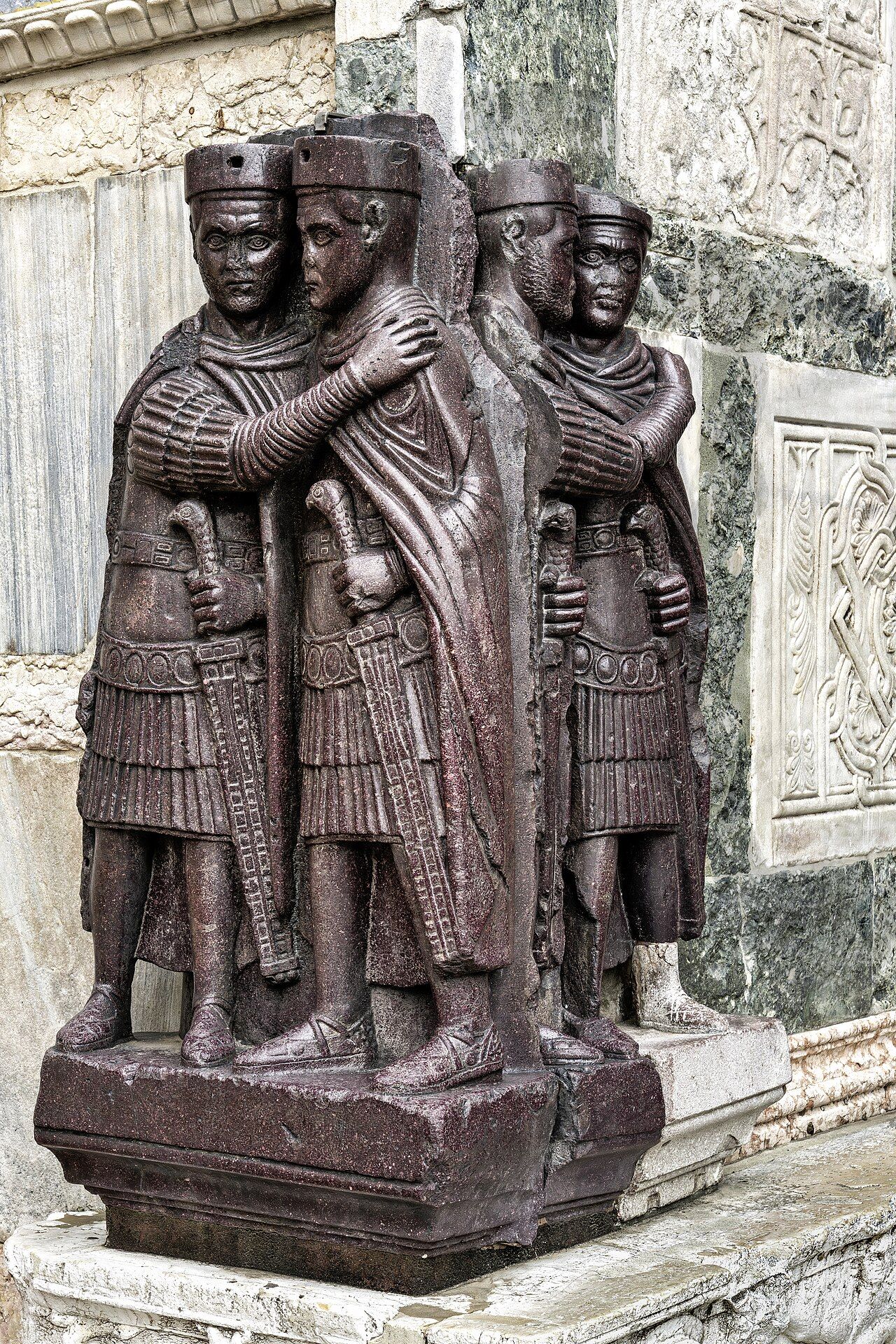
Fifty years of emergency
In 235 mutinous soldiers murdered the emperor Severus Alexander in his camp at Mainz on the Rhine, and for the next fifty years no ruler could count on dying in bed. Somewhere between twenty and thirty men were proclaimed emperor between 235 and 284; most reigned for months. Modern historians call this stretch the third-century crisis, and while the label flattens real regional variation—Britain and Africa had a quieter time than the Danube—the core problem is not in doubt. The Roman state had never developed a legal rule for succession. When the army discovered that it could sell the purple, the army kept selling it.
Three external pressures turned instability into emergency. In the east, the Parthian dynasty fell in 224 to the Sasanians, an aggressive Persian house with imperial ambitions of its own; in 260 Shapur I captured the emperor Valerian alive at Edessa and carved the humiliation into cliff faces at Naqsh-e Rustam. On the Rhine and Danube, loose confederations with new names—Alamanni, Franks, Goths—raided deep and repeatedly, reaching Athens in 267. And an epidemic remembered as the Plague of Cyprian tore through the empire from roughly 249 to 262, following the Antonine Plague of the previous century.
The fiscal consequences compounded everything. To pay troops, emperors debased the silver coinage: the antoninianus, notionally a double denarius, fell from roughly fifty percent silver when Caracalla introduced it in 215 to under five percent by the 260s, and prices in the surviving Egyptian papyri rise sharply. Debasement did not cause inflation single-handedly, but it destroyed confidence in coined money and pushed the state toward requisitioning goods and services directly. Cities stopped erecting inscriptions and public buildings, a habit that had defined Roman civic life for three centuries; the archaeological silence is one of the crisis’s clearest fingerprints.
Yet the empire did not break apart permanently, and that is the underappreciated half of the story. Regional commands did secede—a Gallic Empire under Postumus from 260, and Palmyra under Zenobia after 267—but Aurelian (r. 270–275) reconquered Palmyra in 272 and the Gallic provinces in 274, earning the title restitutor orbis, restorer of the world. He also walled the city of Rome, an admission that the capital was no longer beyond reach. The recovery was military and it was expensive, and it set the terms for what came next.
Diocletian: bureaucracy as the answer to civil war
Diocletian, a Dalmatian officer of humble birth, took power in 284 and held it for twenty-one years—then did something no Roman emperor had done: he retired, in 305, to a fortified palace at Split. His reign is the hinge of the period. His diagnosis was that the empire was too large for one man to defend and too tempting for any general to leave alone, so he multiplied the imperial office. In 286 he raised Maximian to Augustus in the west; in 293 each Augustus took a junior colleague and designated heir, a Caesar—Galerius in the east, Constantius in the west. This four-ruler college is the tetrarchy. Each ruler had a field army and a mobile capital: Nicomedia, Sirmium, Milan, Trier. Rome kept its Senate and its prestige and lost its centrality.
Underneath the tetrarchy Diocletian rebuilt administration from the ground up. He roughly doubled the number of provinces, from about fifty to close to one hundred, so that no single governor commanded enough territory to rebel; grouped them into twelve dioceses under vicars; and separated civil from military authority so that the man who collected taxes was not the man who commanded soldiers. He standardized taxation through a system usually called capitatio-iugatio, assessing land in notional units of productive capacity and heads of labor, then issuing a periodic budget (the indictio) that told each region what to deliver—often in kind rather than coin. The army grew substantially, though the true figure is disputed; estimates run from roughly 400,000 to 600,000 men, up from something near 350,000 in the second century.
Two policies failed conspicuously. The Edict on Maximum Prices of 301 fixed ceiling prices for over a thousand goods and services on pain of death; Lactantius says merchants withdrew goods from the market and the edict was quietly abandoned. And in 303 Diocletian launched the Great Persecution, the most systematic assault the Roman state ever mounted on Christianity—churches demolished, scriptures burned, clergy imprisoned, and eventually universal sacrifice demanded. It was pursued hardest in the east and half-heartedly in Constantius’s Gaul and Britain. Eight years later, dying of a horrible illness, Galerius issued an edict of toleration admitting the policy had not worked and asking Christians to pray for him.
| Problem in the 3rd century | Diocletian’s answer | Long-run effect |
|---|---|---|
| Usurpation by provincial commanders | Split civil and military commands; halve province size | Fewer regional revolts; a much larger officialdom |
| One emperor cannot defend three frontiers | Tetrarchy: two Augusti, two Caesars, four capitals | Effective defense; collapsed as a succession rule by 306 |
| Worthless silver coinage | New coin denominations; tax collected in kind | Reliable supply to the army; monetized trade weakened |
| Runaway prices | Edict on Maximum Prices (301) | Failure; goods vanished from open markets |
| Religious nonconformity read as disloyalty | Great Persecution (303–311) | Failure; produced martyrs, and the Donatist schism in Africa |
The third-century crisis nearly destroyed the empire through succession violence, invasion and monetary collapse, and the state that emerged under Diocletian was more centralized, more bureaucratic, more militarized and more coercive than the one it replaced.
Section 2Constantine and the Christian Turn
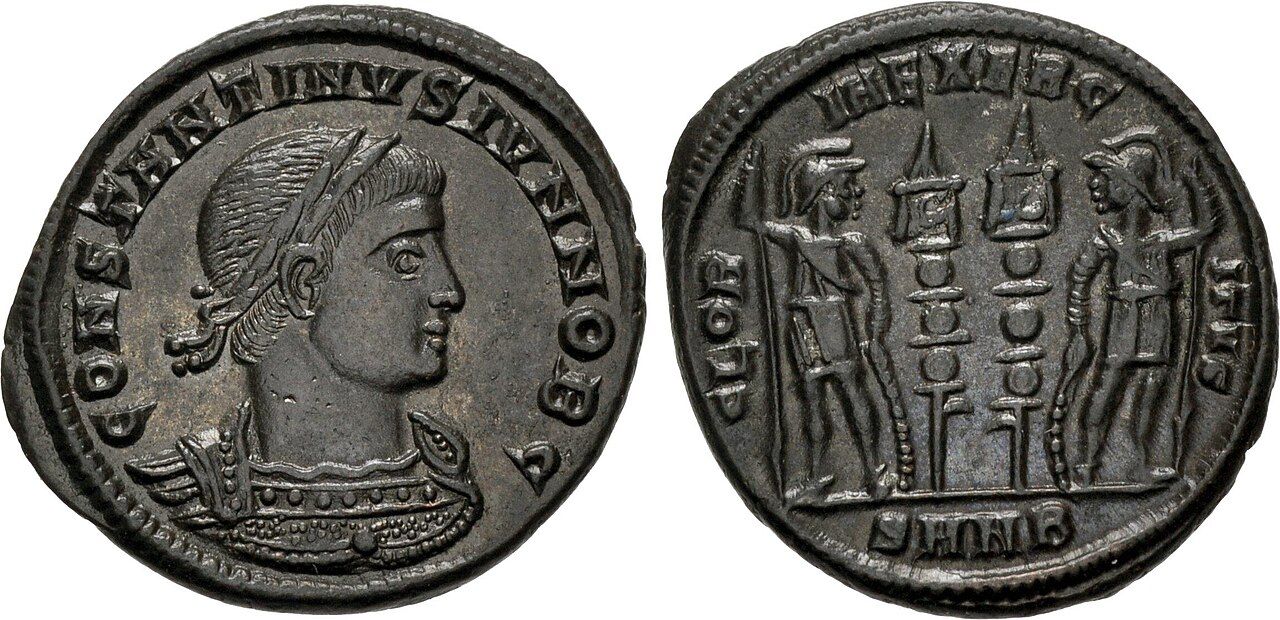
What happened at the Milvian Bridge
On 28 October 312, Constantine defeated his rival Maxentius at the Milvian Bridge north of Rome and became master of the western empire. Two contemporaries describe a religious experience before the battle, and they do not agree. Lactantius, writing within a few years, reports a dream instructing Constantine to mark his soldiers’ shields with a heavenly sign. Eusebius of Caesarea, writing a quarter century later in his Life of Constantine and claiming the emperor swore to it, describes a cross of light in the midday sky with the words “by this conquer,” followed by a dream. The discrepancy is exactly what you would expect from a story that grew. What is not in dispute is what Constantine did afterward: he began funding churches, favoring Christian clergy and using the Chi-Rho monogram on his standards.
In 313 Constantine and his eastern colleague Licinius met at Milan and agreed on a policy of full religious liberty, restoring confiscated Christian property. The so-called Edict of Milan was not technically an edict and probably not issued at Milan—we know it from a letter Licinius circulated in the east—but the substance is real: Christianity became a licit religion with legal standing to own property and receive bequests. That last point mattered enormously. A church that can inherit estates becomes, over generations, an institution with income, buildings and staff.
Constantine defeated Licinius in 324 and ruled alone until 337. He never made Christianity compulsory. Traditional sacrifice continued; he held the pagan office of pontifex maximus; the coinage carried Sol Invictus into the 320s. What he did was tilt every incentive. Clergy were exempted from the crushing municipal obligations that ruined the local gentry. Bishops received real judicial power to hear cases (the episcopalis audientia). A law of 321 made the “venerable day of the Sun” a day of rest for city dwellers—deliberately ambiguous between Christian and solar piety. He poured money into basilicas at Rome, and his building program in Palestine, publicized by his mother Helena’s pilgrimage there in the 320s, produced the Church of the Holy Sepulchre and a booming trade in relics of the True Cross.
He also built a city. Dedicated in 330 on the site of Greek Byzantium, Constantinople commanded the Bosporus, sat astride the land route to the Danube and the sea route to the east, and had a Senate of its own. It was planned as a Christian capital, though Constantine also stocked it with pagan statuary stripped from across the Greek world. Its foundation is arguably more consequential than the conversion: it gave the wealthier, more urbanized eastern half of the empire a permanent center of gravity, and when the west lost its emperors, the east had a capital that would hold for eleven centuries.
From toleration to establishment, 313–392
The road from tolerated minority to state church took eighty years and was not straight. Constantine’s sons legislated against sacrifice with more zeal than enforcement. Then in 361 his nephew Julian, raised Christian and privately converted to Neoplatonic paganism, became sole emperor and tried to reverse the whole project—restoring temple funding, organizing a pagan clergy modeled on Christian charity, and barring Christians from teaching classical literature on the ground that they did not believe the gods those texts honored. Julian died on campaign in Persia in 363 after twenty months. His failure is instructive: the pagan revival had no comparable organization, no scripture, no poor-relief network, and no successor.
The decisive legislation came from Theodosius I. His edict Cunctos populos of 380 commanded all peoples to hold the faith professed by the bishops of Rome and Alexandria—that is, Nicene Christianity—and branded dissenters heretics. Laws of 391 and 392 banned sacrifice outright, closed temples and criminalized even private household cult. Enforcement was uneven and local violence often outran the law: the Serapeum of Alexandria was destroyed by a Christian crowd in 391, and in 415 the philosopher Hypatia was murdered by a mob in the same city. In 384 the prefect Symmachus pleaded for the restoration of the Altar of Victory in the Senate house with the line that there cannot be only one road to so great a mystery; Bishop Ambrose of Milan answered, and Ambrose won. Six years later Ambrose forced Theodosius himself to do public penance for a massacre at Thessalonica—a bishop disciplining an emperor, and a precedent western churchmen would cite for a thousand years.
| Date | Ruler / event | Legal status of Christianity |
|---|---|---|
| 250 | Decius requires universal sacrifice with certificates | First empire-wide persecution; many lapse |
| 303–311 | Great Persecution under Diocletian and Galerius | Illegal; clergy jailed, scriptures burned |
| 311 | Edict of Galerius (Serdica) | Tolerated; persecution admitted a failure |
| 313 | Agreement of Constantine and Licinius (“Edict of Milan”) | Fully licit; property restored; may inherit |
| 325 | Council of Nicaea | Favored; emperor convenes and enforces doctrine |
| 361–363 | Julian | Tolerated but defunded and mocked |
| 380 | Theodosius I, Cunctos populos | Nicene Christianity the required faith of the empire |
| 391–392 | Theodosian laws on sacrifice | Traditional cult banned, publicly and privately |
Constantine converted the state’s incentives rather than its subjects, and the eighty years from the Edict of Milan to Theodosius’s bans show a minority faith becoming an established church through law, money and imperial patronage.
Section 3Building a Church: Canon, Creed, Clergy and the Desert

Why Christianity spread
Before Constantine, Christianity grew without armies, temples or state money, and explaining that growth is a genuine historical problem. We should be honest about the numbers: nobody counted Christians, and modern estimates for the year 300 range from a few percent of the empire’s roughly fifty to sixty million people to as much as ten percent, with wide regional variation—dense in Asia Minor, Syria and Egypt, thin in the Latin countryside. The sociologist Rodney Stark modeled a steady forty percent per decade growth rate; critics such as Ramsay MacMullen argue the curve was lumpier and more dependent on elite conversions.
What made it attractive is easier to reconstruct. Christianity offered exclusive membership in a world of casual religious pluralism—you joined, you were baptized, you belonged, and you were expected to leave the old gods. It offered organized charity: bishops ran distributions of food, buried the poor, ransomed captives and organized nursing that grew, in the fourth century, into the first public hospitals; in plague years Christians who tended the sick were noticed even by hostile observers. It offered women unusual scope—widows and virgins had recognized roles, deaconesses served in the east, and wealthy women such as Melania the Elder and Marcella funded whole movements. And it offered a portable, textual, translatable identity that worked equally in a Syriac village and a Roman townhouse.
Persecution helped more than it hurt, though it was real and terrifying. Because Roman religion was a civic obligation, refusal to sacrifice looked like treason, and prosecutions ran from Nero’s scapegoating in 64 through Decius’s universal sacrifice order in 250 to Diocletian’s campaign. But persecution was episodic and geographically patchy, and the accounts of martyrs—Perpetua and Felicity at Carthage in 203, Polycarp at Smyrna—circulated as literature that made conviction visible. The costlier problem was internal: what to do with the lapsi, those who had sacrificed under pressure. In North Africa that quarrel became the Donatist schism, a rival church that refused sacraments from clergy who had handed over scriptures, and which persisted for centuries despite imperial force.
Fixing what Christians believed
An emerging church had to answer three questions: which books count, who decides, and what exactly do we say about Jesus. The canon settled slowly and largely by usage rather than decree; the earliest surviving list of exactly our twenty-seven New Testament books is Athanasius’s Easter letter of 367, and disputes over Hebrews and Revelation lingered. Authority concentrated in the bishop, one per city, claiming succession from the apostles, with the bishops of Rome, Alexandria, Antioch and later Constantinople and Jerusalem enjoying special weight. Jerome’s Latin translation, the Vulgate, begun in 382, gave the west a single authoritative text for a millennium.
Doctrine was hammered out in councils, and the fights were ferocious because the stakes were understood as salvation itself. Around 318 an Alexandrian priest named Arius argued that if the Son was begotten, there was a time when he did not exist; the Son was therefore the highest creature, not co-eternal God. Constantine, alarmed at a dispute splitting his new eastern provinces, summoned some three hundred bishops to Nicaea in 325, and the council declared the Son homoousios—of the same substance—with the Father. That did not end it. Arian and semi-Arian parties dominated the eastern court for decades, Athanasius of Alexandria was exiled five times, and Gothic peoples evangelized in this period by the missionary Ulfilas adopted the non-Nicene form, which is why later Gothic and Vandal kings ruled Nicene subjects as fellow Christians of the wrong kind.
The next round asked how divinity and humanity coexisted in Christ. Ephesus (431) condemned Nestorius and affirmed Mary as Theotokos, God-bearer. Chalcedon (451) defined Christ as one person in two natures, unconfused and undivided. Chalcedon settled the Greek and Latin churches and permanently divided the Christian east: the Coptic, Syriac Orthodox, Armenian and Ethiopian churches rejected it and are properly called Miaphysite (the older label “Monophysite” is a polemical caricature of their position), while the Church of the East in Persia went its own way after Ephesus. Those divisions still exist. They also had political consequences: Egypt and Syria entered the seventh century estranged from Constantinople.
| Council | Year | Question at issue | Outcome and fallout |
|---|---|---|---|
| Nicaea I | 325 | Is the Son co-eternal with the Father? | Homoousios affirmed; Arianism condemned but thrives for 60 years |
| Constantinople I | 381 | Status of the Holy Spirit; Arianism | Nicene creed in its familiar form; Trinity settled for the empire |
| Ephesus | 431 | Is Mary Theotokos? Unity of Christ’s person | Nestorius deposed; Church of the East separates |
| Chalcedon | 451 | One person, how many natures? | Two natures in one person; Miaphysite churches separate permanently |
The desert and the Rule
Once Christianity became safe and fashionable, the most demanding Christians went looking for a harder version of it, and they found it in the Egyptian desert. Antony (c. 251–356) withdrew to the wilderness around 285; Athanasius’s Life of Antony, written about 360 and quickly translated into Latin, turned him into a bestseller and a template. Around 320 Pachomius did something organizationally new at Tabennisi: he gathered ascetics into a walled community with a written rule, shared meals, assigned work and an abbot. Hermit life is eremitic; community life is cenobitic, and it was the cenobitic form that would matter for European history.
The movement spread fast. Basil of Caesarea wrote rules in Greek that bound monasteries to service—hospitals, orphanages, poor relief. Macrina, Basil’s sister, ran an ascetic household that her brother Gregory of Nyssa memorialized; Melania the Younger liquidated one of the largest private fortunes in the empire to fund monasteries. John Cassian carried Egyptian practice to southern Gaul around 415. And around 530 a Roman-educated Italian named Benedict of Nursia wrote a short, moderate, remarkably practical rule for a monastery at Monte Cassino: stability of place, obedience to an elected abbot, a balanced day of prayer, reading and manual labor, and—crucially—no heroic extremes. The Rule of St. Benedict was one of several competing rules for two centuries before Carolingian rulers made it standard, but its moderation is exactly why it scaled. Monasteries became the west’s libraries, schools, agricultural improvers and copying houses. Nearly every classical Latin text you can read today survives because a monk copied it.
Christianity won not only converts but institutions—a canon, a creed defined at Nicaea and Chalcedon, a hierarchy of bishops and a monastic movement—and those institutions, not imperial favor alone, are what let it outlive the empire that adopted it.
Section 4Migration, Settlement and the End of the Western Empire
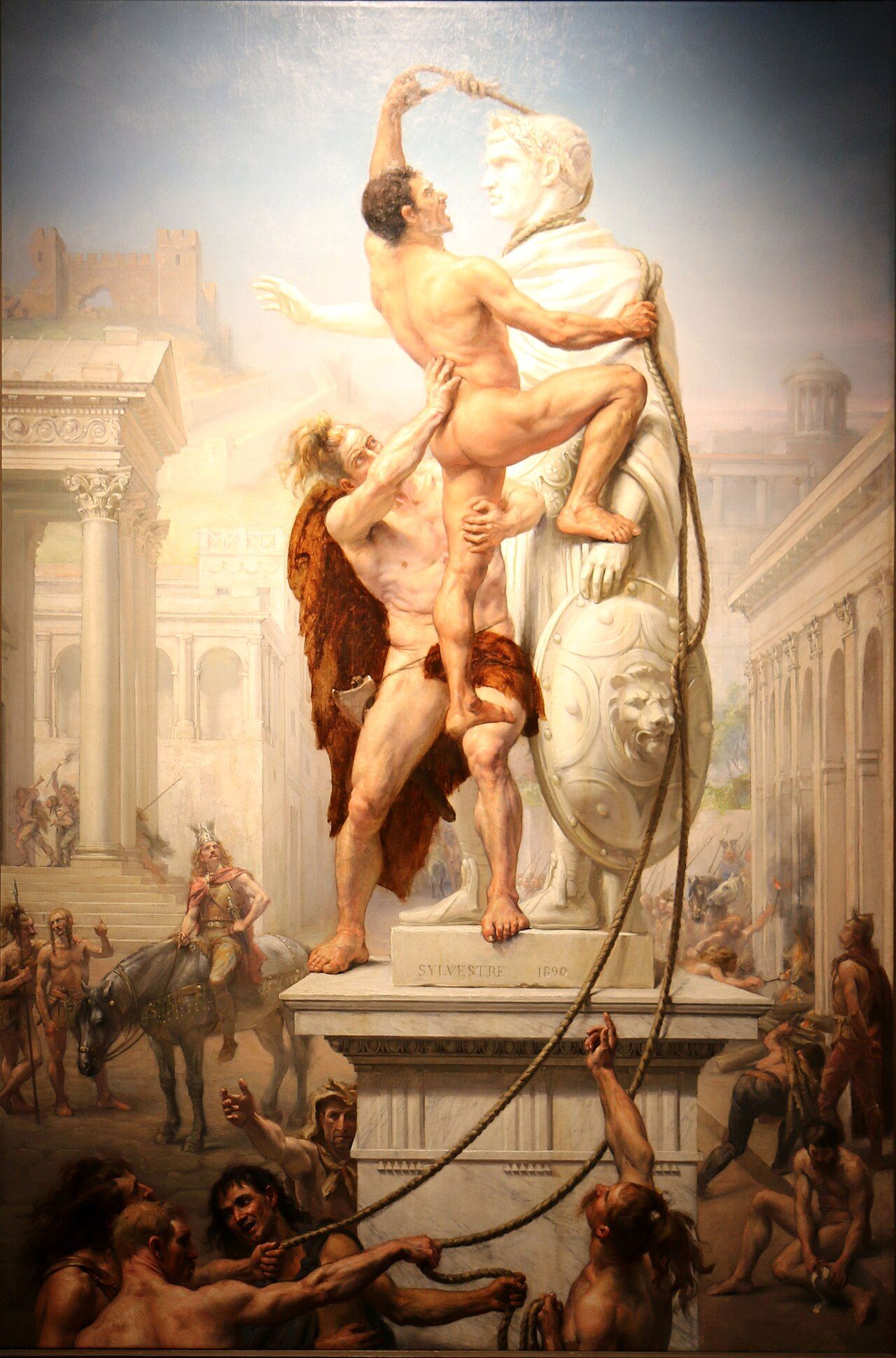
376 and after: a frontier that stopped holding
In 376 a large body of Goths under Fritigern appeared on the north bank of the Danube asking for asylum. They were fleeing the Huns, nomadic horse-archers pressing westward off the steppe, and the emperor Valens admitted them—partly from compassion, mostly because he wanted recruits. Roman officers then extorted and starved them so badly that, according to Ammianus Marcellinus, refugees sold children for dog meat. The Goths revolted. On 9 August 378 at Adrianople they destroyed the eastern field army and killed Valens. It was the worst Roman defeat since Cannae, and the empire never fully replaced those men.
What followed is better understood as accommodation than conquest. In 382 Theodosius settled the Goths inside the empire as foederati—allied troops under their own leaders, paid and supplied by Rome. This is the pattern for everything that comes next: barbarian groups did not batter down the frontier so much as move inside it and then bargain, serve, revolt and bargain again. Their identities were fluid; a “Goth” might be a Roman deserter, a Hun, or the son of a provincial. Recent scholarship (Walter Goffart, Guy Halsall) stresses that these peoples were partly created by the process of dealing with Rome; Peter Heather counters that the groups were real, large and genuinely destructive. Both sides agree the old picture of tidal waves of foreign nations is wrong.
The decisive breach came on the last night of 406, when Vandals, Alans and Suebi crossed a Rhine unguarded because troops had been pulled to Italy. They moved through Gaul into Spain by 409, and in 429 the Vandals under Geiseric crossed to Africa, taking Carthage in 439. That was the fatal blow. North Africa supplied Rome’s grain and the western treasury’s richest tax base; losing it meant the west could no longer pay armies to recover anything else. Meanwhile Alaric’s Visigoths, denied a settlement, sacked Rome for three days in August 410—militarily trivial, since the capital was Ravenna by then, psychologically enormous. Jerome in Bethlehem wrote that his voice failed him. Augustine began The City of God in response.
Attila united the Huns in the 440s, extracted enormous tribute from Constantinople, and invaded Gaul in 451, where a coalition under the Roman general Aetius and the Visigothic king Theodoric fought him to a standstill at the Catalaunian Plains. He ravaged Italy in 452 and died in 453; his empire fragmented within two years. Its main effect was to have pushed other peoples into Roman territory. Then the western court destroyed itself: Valentinian III murdered Aetius in 454 and was murdered in turn in 455, the Vandals sacked Rome that same year, and the last twenty-one years produced nine emperors, most of them creatures of their generals. On 4 September 476 the commander Odoacer deposed the boy emperor Romulus Augustulus and, rather than appoint a replacement, sent the imperial regalia to Constantinople and asked to govern Italy as the eastern emperor’s representative.
Did Rome fall?
Contemporaries did not experience 476 as the end of anything. There was still a Roman emperor; he was in Constantinople. Italy was still administered by a Roman Senate, Roman law and Roman tax officials, now under a Germanic king. When Theodoric the Ostrogoth killed Odoacer in 493 and ruled Italy until 526, he issued edicts in Latin, kept the consulship and employed Roman aristocrats such as Boethius and Cassiodorus. The successor kingdoms wrote down law codes that mixed Roman and customary rules. Clovis, king of the Franks, converted to Nicene rather than Arian Christianity around 496—a date scholars dispute, with some arguing for 508—and that choice aligned him with the Gallo-Roman bishops and made the Frankish kingdom the durable one.
So historians divide. Edward Gibbon in 1776 blamed Christianity and barbarism for a genuine catastrophe. Henri Pirenne argued in the 1930s that Mediterranean unity survived the Germanic kingdoms and was severed only by the Arab conquests of the seventh century—“without Muhammad, Charlemagne is inconceivable.” Peter Brown’s The World of Late Antiquity (1971) reframed the whole period as a creative transformation rather than a decline, and that view dominated for a generation. Bryan Ward-Perkins pushed back hard in 2005 with archaeology: standardized pottery, tile roofs, coin use, long-distance trade in bulk goods, literacy on ordinary objects and even cattle size all decline sharply in the fifth-century west, and in Britain to sub-Iron-Age levels. Kyle Harper has added disease and climate—the Plague of Cyprian, the Justinianic plague of 541, and cooling after the 530s—though the scale of those effects is actively debated. The defensible synthesis: the eastern empire transformed and survived; the western economy contracted severely and material living standards for most people fell; and cultural and religious life kept producing new things throughout.
| Successor kingdom | Where | Roughly | Fate |
|---|---|---|---|
| Visigoths | Aquitaine, then Spain | 418–711 | Pushed south by Franks at Vouillé (507); ends with Arab conquest |
| Vandals | North Africa, Sicily, Sardinia | 429–534 | Destroyed by Justinian’s general Belisarius |
| Ostrogoths | Italy | 493–553 | Annihilated in the Gothic War; Italy left in ruins |
| Franks | Northern Gaul, then most of Gaul | from c. 481 | Survives and expands; becomes the Carolingian empire |
| Anglo-Saxons | Lowland Britain | from c. 450 | Multiple kingdoms; re-Christianized from 597 |
| Burgundians | Rhone valley | c. 443–534 | Absorbed by the Franks |
The western empire ended through a long process of accommodation, fiscal starvation after the loss of Africa and internal political murder rather than a single conquest, and whether that counts as a fall or a transformation depends on whether you weigh political continuity or material decline.
Section 5What Late Antiquity Made
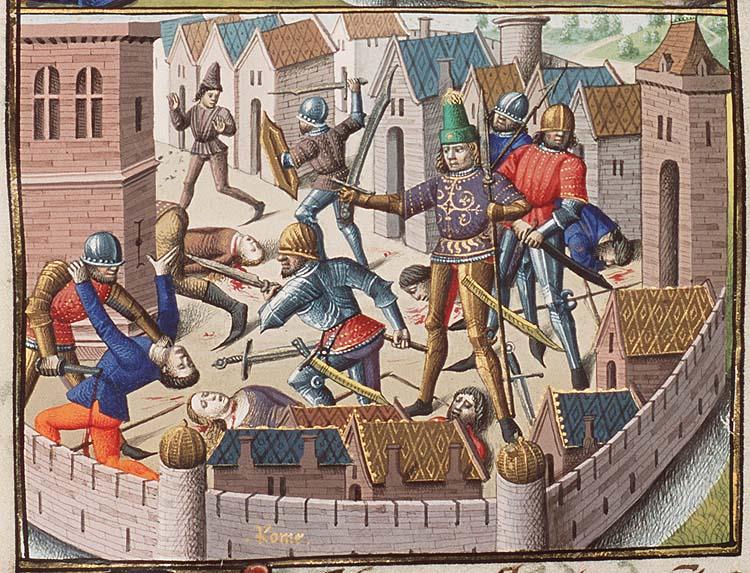
Augustine and the Latin mind
Augustine of Hippo (354–430) is the most influential Latin writer between Cicero and Aquinas, and the arc of his life is the period in miniature. Born in Roman North Africa to a pagan father and a Christian mother, trained as a rhetorician, he spent nine years as a Manichaean, taught in Rome and Milan, heard Ambrose preach, and converted in 386. He became bishop of Hippo in 395 and died in 430 while Vandals besieged the city. His Confessions (c. 397–400) is arguably the first sustained interior autobiography in western literature—a book about memory, desire and a mind arguing with itself.
Three of his positions shaped everything downstream. Against the Donatists he argued that the validity of a sacrament rests on Christ, not on the holiness of the priest, which is why the medieval church could survive corrupt clergy without dissolving. Against Pelagius, who held that God would not command what people are unable to do and that human nature retains a real capacity to choose righteousness, Augustine insisted on inherited sinfulness and the necessity of grace, setting the terms for debates that would explode again in the sixteenth century. And in The City of God, written between 413 and 426 to answer pagans who blamed the sack of Rome on the abandonment of the old gods, he separated the earthly city from the heavenly one. No empire is the kingdom of God; political order is necessary, provisional and not to be worshipped. That distinction between spiritual and temporal authority is a genuinely load-bearing idea in western political thought, and it is one reason medieval Europe never quite managed a fully sacred monarchy.
He did not work alone. Ambrose established that a bishop could face down an emperor. Jerome gave the west its Bible. Gregory the Great (pope 590–604) organized papal estates, wrote a manual of pastoral care that was still assigned centuries later, and sent Augustine of Canterbury to England, where he landed in 597. Boethius, awaiting execution around 524 on Theodoric’s orders, wrote The Consolation of Philosophy and translated enough Aristotelian logic to keep it alive in the Latin west; Cassiodorus founded the monastery of Vivarium and made manuscript copying a sacred duty. These were not men preserving a corpse. They were choosing what to carry.
The world that survived
It is easy to forget that the empire did not end. The eastern half, governed from Constantinople, kept its tax system, its cities, its army and its Greek high culture. Its emperors still called themselves Roman; so did their subjects, for another thousand years. Justinian (r. 527–565) had Roman law compiled into the Corpus Iuris Civilis between 529 and 534—the single most consequential legal act in European history, because its rediscovery in eleventh-century Bologna gave continental Europe its legal framework. He built Hagia Sophia in five years, reconquered Africa and Italy at appalling cost, and then watched the bubonic plague arrive in 541. Chapter 5 takes up that story.
Beyond the Roman frontier lay the other great power of the age, Sasanian Persia, which the textbooks slight. Sasanian shahs ruled from Ctesiphon over a Zoroastrian state with its own aristocracy, its own academy at Gundeshapur, and its own religious minorities—including a large Christian Church of the East that, cut off from Constantinople after Ephesus, evangelized as far as India and China. Rome and Persia fought intermittently for four centuries and exhausted each other in the great war of 602–628, which goes a long way toward explaining why the Arab armies of the 630s found both of them worn out and short of troops. Late antiquity also saw the Christianization of Armenia (traditionally 301, the first state to adopt the faith), Georgia and Ethiopia, and the vigorous continuation of Judaism, whose rabbis in Roman Palestine and Sasanian Babylonia compiled the two Talmuds in exactly these centuries.
What, then, did late antiquity leave the Middle Ages? A religion with a fixed creed, a professional clergy, a legal apparatus and a monastic engine. A Latin Bible and a Latin liturgy that made western Europe a single cultural zone despite political fragmentation. A theory of two authorities. A body of Roman law preserved in the east. A Mediterranean split three ways within another century, into Latin, Greek and Arabic worlds. And a lesson historians keep relearning: complex societies rarely die of one wound. They lose the ability to pay for themselves, and then everything else follows.
Late antiquity handed the Middle Ages its most durable institutions—the papacy and episcopate, the monastery, the Latin Bible, Augustinian theology and codified Roman law—which is why the period is better read as a foundation than as an ending.
The chapter in one breath
The Roman empire of 200 CE and the Christian Mediterranean of 600 CE are not the same civilization, and the four centuries between them explain the difference. Fifty years of military anarchy, plague and monetary collapse forced a rebuild; Diocletian supplied it with a tetrarchy, a doubled bureaucracy and taxation in kind, and paid for it with coercion, including the empire’s last and worst persecution of Christians. Constantine then reversed course, and by tilting law, money and status toward the church he set in motion an eighty-year process that ended with Theodosius outlawing traditional cult in 391. Christianity used that window to finish becoming an institution—canon, creed, councils at Nicaea and Chalcedon, bishops, and a monastic movement that would carry Latin learning through the next five centuries. Meanwhile Goths, Vandals and Franks moved inside the frontier, the loss of North Africa in 439 gutted western finances, and the western imperial office quietly lapsed in 476 without ending Roman law, language or landholding. The east endured. The west contracted materially and reorganized around bishops, monasteries and kings—the raw material of the Middle Ages.
Words worth knowing
| Term | What it means |
|---|---|
| Third-century crisis | The period c. 235–284 of rapid imperial turnover, invasion, plague and currency debasement. |
| Tetrarchy | Diocletian’s rule of four—two senior Augusti and two junior Caesars, each with a region and a capital. |
| Diocese | A grouping of provinces created by Diocletian; later borrowed as the name for a bishop’s territory. |
| Edict on Maximum Prices | Diocletian’s 301 attempt to cap prices empire-wide; unenforceable and abandoned. |
| Great Persecution | The systematic anti-Christian campaign of 303–311; the last and most severe. |
| Chi-Rho | Monogram of the first two Greek letters of “Christ,” adopted by Constantine as a military standard. |
| Edict of Milan | The 313 agreement of Constantine and Licinius granting religious freedom and restoring church property. |
| Constantinople | Constantine’s new eastern capital, dedicated 330 on the Bosporus; the Roman empire’s center for a millennium. |
| Arianism | The teaching of Arius that the Son is a created being subordinate to the Father; condemned at Nicaea in 325. |
| Homoousios | “Of the same substance”—the Nicene term for the Son’s relation to the Father. |
| Council of Chalcedon | The 451 council defining Christ as one person in two natures; rejected by the Miaphysite churches. |
| Miaphysite | The Christology of the Coptic, Syriac, Armenian and Ethiopian churches; one united nature of Christ. |
| Donatism | North African schism holding that sacraments from clergy who lapsed under persecution were invalid. |
| Cenobitic monasticism | Communal monastic life under a rule and an abbot, pioneered by Pachomius c. 320. |
| Rule of St. Benedict | Benedict’s moderate c. 530 monastic rule balancing prayer, study and labor; became the western standard. |
| Vulgate | Jerome’s Latin Bible, begun 382; the authoritative western text for over a thousand years. |
| Foederati | Barbarian groups settled inside the empire as allied troops under their own leaders. |
| Adrianople | The 378 battle where Goths destroyed the eastern field army and killed the emperor Valens. |
| The City of God | Augustine’s 413–426 work distinguishing the earthly from the heavenly city and desacralizing empire. |
| Pirenne thesis | The argument that Mediterranean unity survived the Germanic kingdoms and broke only with the Arab conquests. |
| Corpus Iuris Civilis | Justinian’s 529–534 codification of Roman law; the basis of later continental European legal systems. |
Check yourself
Byzantium, Islam and the Early Middle Ages
Between roughly 500 and 1000 the Mediterranean world stopped being one thing and became three. In the east, a Greek-speaking Roman Empire kept its capital, its law courts, its tax rolls and its emperor, and survived a century of catastrophe by shrinking and reorganizing. In Arabia, a new revelation gathered scattered tribes into a single community that within a hundred years governed from the Atlantic to the Indus and built cities where Greek philosophy, Persian administration and Indian mathematics met. In the Latin west, Roman government dissolved into successor kingdoms where bishops, abbots and warlords improvised order from the wreckage of an imperial system nobody could afford anymore. These three worlds argued, traded, raided and copied one another constantly. Understanding the early Middle Ages means understanding that separation — and refusing the old story in which one civilization “declined” while the others were merely background.
By the end of this chapter you can
- Explain what Justinian tried to do in the sixth century and why his reconquest of the west proved unsustainable, using the Corpus Juris Civilis, the Plague of Justinian and the Gothic War as evidence.
- Describe how the Byzantine Empire survived the seventh-century crisis, including the themes, Greek fire and the shift from Latin to Greek administration.
- Summarize the career of Muhammad, the meaning of the Hijra, and the core beliefs and practices of early Islam without reducing them to a list.
- Trace the Arab conquests from Yarmuk (636) to the failed siege of Constantinople (717–718) and identify the political and military reasons they succeeded so fast.
- Contrast the Umayyad and Abbasid caliphates in capital, personnel, religious politics and cultural output, and explain the origins of the Sunni–Shia division.
- Analyze how monasteries, bishops and the Rule of Saint Benedict preserved and reshaped learning in the post-Roman west.
- Evaluate the achievement of Charlemagne and the Carolingian Renaissance, including the coronation of 800 and the significance of Caroline minuscule.
- Explain how Viking, Magyar and Muslim raids after 840 reorganized power in western Europe, and state why historians now dispute the word feudalism.
- Compare the three post-Roman civilizations on a set of common measures — taxation, urbanism, literacy and law — and defend a judgment about what “decline” does and does not describe.
Section 1The Empire That Refused to End
Justinian’s gamble
When Justinian I came to the throne in 527 he ruled an empire that had lost its western half but kept the profitable one. Egypt and Syria still fed the treasury. Constantinople, with perhaps 400,000 people, was the largest city in the Mediterranean. Justinian was the nephew of a peasant soldier who had become emperor, he was tireless to the point of insomnia, and he believed something that most of his predecessors had quietly abandoned: that the loss of Italy, Africa and Spain was temporary and reversible.
He nearly lost everything in his fifth year. In January 532 the two great chariot-racing factions of the capital, the Blues and the Greens, briefly united against his tax collectors in what became the Nika riots. Half the city burned, the crowd acclaimed a rival emperor, and Justinian had ships loaded for flight. According to the historian Procopius, the empress Theodora stopped him with a line about purple making a fine burial shroud. Whether she said it or Procopius improved it, Justinian stayed, his generals trapped the crowd in the Hippodrome, and tens of thousands died. Out of the ashes he rebuilt the burned cathedral as Hagia Sophia, finished in under six years by the mathematicians Anthemius of Tralles and Isidore of Miletus — a dome on pendentives that engineers had not attempted at that scale before.
The reconquest followed. In 533 the general Belisarius landed in Africa and broke the Vandal kingdom in barely six months; its last king surrendered in the spring of 534. Italy was the disaster. The Gothic War that began in 535 was supposed to take two years; it took nineteen, and it wrecked the peninsula. Rome changed hands five times. The aqueducts were cut, the Senate never recovered as a working body, and the great senatorial estates that had survived Alaric and Odoacer did not survive Justinian’s liberation. In 554 the Pragmatic Sanction reorganized a province that no longer had much left to organize. Fourteen years later the Lombards walked into most of it.
Law, plague and overreach
Justinian’s most durable act had nothing to do with armies. In 528 he set a commission to reduce a thousand years of Roman legal opinion to something usable, and from 530 the work was directed by the jurist Tribonian. The result, later called the Corpus Juris Civilis, had four parts: the Codex of imperial legislation, the Digest of extracts from classical jurists, the Institutes as a student textbook, and the Novellae, the new laws Justinian kept issuing (mostly in Greek, which tells you where the empire was going). Rediscovered in Bologna in the late eleventh century, this compilation became the seedbed of the civil-law tradition that still governs most of continental Europe, Latin America, Quebec, Louisiana and Japan.
Then came the pandemic. In 541 a disease reached Pelusium in Egypt and spread along the grain routes; by spring 542 it was killing in Constantinople at a rate Procopius put, probably too high, at 10,000 a day. DNA recovered from sixth-century graves in Bavaria and elsewhere has confirmed the pathogen as Yersinia pestis — the same organism as the Black Death. The Plague of Justinian returned in waves for two centuries. Historians disagree sharply about how much it killed: older estimates of a third to a half of the Mediterranean population have been challenged by scholars who point to continuing building, stable coinage and thin archaeological evidence of collapse. What is not disputed is that the empire ended Justinian’s reign with more territory and less money than it began with, and that the bill came due under his successors.
Surviving the seventh century
Between 602 and 628 Rome and Persia fought the last and worst of their wars. The Sasanian king Khosrow II took Syria, Egypt and Jerusalem, carrying off the relic of the True Cross in 614. The emperor Heraclius (r. 610–641), in a campaign that reads like desperation dressed as strategy, melted down church plate, marched around the Persian flank through the Caucasus, and shattered Khosrow’s army near Nineveh in December 627. Both empires had spent everything. Within a decade Arab armies had taken Syria and Egypt from the exhausted victors, and within twenty years the Sasanian state had ceased to exist.
What remained of the empire — Anatolia, the Aegean coast, a strip of the Balkans, Sicily and a few Italian toeholds — reorganized around survival. Provincial armies were settled on the land in districts called themes (themata), where a single commander held both military and civil authority and soldiers held land in return for service. Older textbooks credit Heraclius with inventing the system in one stroke; most specialists now see it emerging piecemeal across the later seventh and eighth centuries as a response to permanent raiding. Latin gave way to Greek in government, and Heraclius replaced the old Latin titles with the Greek basileus in 629. Twice Arab fleets attacked Constantinople — a long blockade traditionally dated 674–678, which some scholars now redate to the 660s, and a full siege in 717–718 — and twice they failed, partly because of the triple Theodosian land walls and partly because of Greek fire, a petroleum-based incendiary sprayed from siphons that burned on water and whose exact recipe was such a close state secret that it is still not certainly known.
The strain produced a religious civil war of its own. From about 726 the emperor Leo III and, far more aggressively, his son Constantine V attacked the veneration of religious images as idolatry. Iconoclasm — literally image-breaking — was made official doctrine by a council in 754, overturned when the Second Council of Nicaea restored the veneration of icons in 787, imposed again from 815, and finally abandoned in 843, an event the Orthodox Church still commemorates as the Triumph of Orthodoxy. The quarrel mattered beyond art: it soured relations with the papacy, which sided firmly with the images, and pushed Rome toward a new protector in the north.
| Pressure | Byzantine response | Result by c. 750 |
|---|---|---|
| Loss of Egypt and Syria (636–642) | Free grain dole already ended in 618; tax Anatolia harder | Revenue down perhaps three-quarters; capital shrinks toward 40,000–70,000 |
| Annual Arab raids into Anatolia | Theme system; fortified hilltop kastra replace open cities | Countryside militarized; classical urban life largely ends in Anatolia |
| Naval assaults on the capital | Theodosian walls, Greek fire, dromon fleet | Two sieges broken (678, 718); Constantinople not taken until 1204 |
| Slavic settlement in the Balkans | Forced transfers of population; missions and baptism | Greece slowly recovered; Bulgaria becomes a rival Christian state after 864 |
| Internal religious division | Iconoclasm, then its reversal in 843 | Doctrinal settlement, but permanent friction with Rome |
By the ninth century the empire was smaller, poorer, more Greek and considerably tougher. Under the Macedonian dynasty founded by Basil I in 867 it went back on the offensive, and under Basil II (r. 976–1025) it annexed Bulgaria outright. Meanwhile its missionaries were doing quieter work: in 863 the brothers Cyril and Methodius went to Moravia and devised the Glagolitic alphabet for Slavic speech, out of which their disciples in Bulgaria developed the Cyrillic script that carries Cyril’s name; Bulgaria accepted baptism from Constantinople in 864, and the Rus’ of Kiev followed under Vladimir around 988. Eastern Christendom acquired a religious and cultural sphere that outlived the empire by a thousand years.
Byzantium survived not by restoring Rome but by abandoning most of it — trading the Mediterranean-wide, city-based empire Justinian tried to rebuild for a compact, militarized, Greek-speaking state that could actually be defended and paid for.
Section 2Revelation and Community: The Rise of Islam
Arabia before 610
Sixth-century Arabia was not empty and it was not isolated. Its northern tribes were clients of the Roman and Persian empires, paid to police desert frontiers. Yemen in the south had dams, irrigated agriculture and a long literate tradition. Between them ran caravan routes carrying incense, leather and slaves. Mecca, controlled by the Quraysh tribe, was a trading town and a pilgrimage site built around the Kaaba, a cube-shaped shrine housing the images of many deities. Jewish and Christian communities were established across the peninsula, and Arabic-speakers were entirely familiar with the idea of one God, scripture and prophecy.
Muhammad was born in Mecca around 570 into a respectable but not wealthy branch of the Quraysh. Orphaned early, he worked in the caravan trade and married his employer, a widow named Khadija. Around 610, according to the tradition, he began receiving revelations in a cave outside the city through the angel Gabriel. The message was uncompromising: there is one God, He will judge every person, wealth carries obligations toward the poor and the orphan, and the idols of the Kaaba are nothing. Recited aloud over twenty-two years and collected after his death, these revelations form the Quran — a text Muslims understand not as Muhammad’s words about God but as God’s own speech in Arabic.
The Hijra and the making of the umma
Mecca’s leadership heard a threat to the shrine economy and to the tribal order, and persecution followed. In 622 Muhammad and his followers accepted an invitation to arbitrate a feud in the oasis town of Yathrib, 340 kilometres north, which became Medina — “the city” of the Prophet. This migration, the Hijra, is the year 1 of the Islamic calendar, and the choice is revealing: the era begins not with the Prophet’s birth or first revelation but with the founding of a community that governed itself.
In Medina the movement became a polity. The document usually called the Constitution of Medina bound emigrants, local converts and several Jewish clans into a single mutual-defense compact. The umma, the community of believers, cut across the tribal blood ties that had organized Arabian life, which is precisely why it was revolutionary and why it was resisted. Eight years of intermittent war with Mecca followed — Badr in 624, Uhud in 625, the siege of Medina in 627 — ending when Muhammad entered Mecca essentially unopposed in 630 and cleared the Kaaba of its idols while keeping the shrine itself as the focus of pilgrimage. When he died in 632, most of the Arabian tribes had accepted his authority.
Succession and the first divisions
Muhammad left no son and, in Sunni understanding, no explicit successor. The community chose Abu Bakr, his close companion, as khalifa — caliph, deputy or successor. A minority held that leadership belonged to the Prophet’s cousin and son-in-law Ali ibn Abi Talib and his descendants. That disagreement, initially political, hardened over generations into the division between Sunni Muslims, who located authority in the consensus of the community and the recorded practice (sunna) of the Prophet, and Shia Muslims, the “party of Ali,” who located it in a designated line of imams.
The first four caliphs are known to Sunnis as the Rashidun, the Rightly Guided. Their record is not tranquil. Umar organized the conquests and was murdered by a Persian slave in 644. Uthman standardized the written text of the Quran — an act of lasting importance — and was killed by mutinous soldiers in 656. Ali’s caliphate was consumed by the first fitna or civil war: the Battle of the Camel against Aisha, the Prophet’s widow, in 656; the indecisive confrontation at Siffin with Muawiya, governor of Syria, in 657; the secession of the Kharijites, who held that a sinful ruler forfeited authority; and Ali’s assassination by a Kharijite in 661. In 680 Ali’s son Husayn and a small band were killed at Karbala in Iraq by Umayyad troops — a defeat that became the emotional centre of Shia devotion and is still commemorated annually.
| Caliph | Dates | What defined the reign |
|---|---|---|
| Abu Bakr | 632–634 | Ridda wars reassert authority over tribes that had seceded after the Prophet’s death |
| Umar ibn al-Khattab | 634–644 | Yarmuk (636) and Qadisiyya take Syria and Iraq; garrison cities founded at Kufa, Basra, Fustat |
| Uthman ibn Affan | 644–656 | Canonical text of the Quran fixed; charges of nepotism trigger revolt |
| Ali ibn Abi Talib | 656–661 | First civil war; capital moves to Kufa; Kharijite secession; assassination |
| Muawiya (first Umayyad) | 661–680 | Capital to Damascus; caliphate becomes hereditary in practice |
Why the conquests moved so fast
Within a decade of Muhammad’s death Arab armies had beaten a Roman force at the Yarmuk river in 636, taken the Sasanian capital of Ctesiphon, and occupied Egypt. Within a century the caliphate ran from Spain to the Indus. Explanations that rest on religious enthusiasm alone are inadequate; the enthusiasm was real but so were four structural advantages. First, both target empires had just exhausted themselves in the war of 602–628 and neither could field a reserve. Second, plague had thinned Mediterranean populations while sparing the interior of Arabia. Third, the conquerors used mobility and desert lines of retreat that heavy imperial armies could not match. Fourth, and most underrated, the terms were often attractive: the Arabs generally did not require conversion, left local administration and existing tax collectors in place for decades, and imposed a poll tax, the jizya, on non-Muslim dhimmi subjects that in Syria and Egypt was frequently lighter than Byzantine or Sasanian exactions, and lighter still for the Miaphysite Christians of Syria and Egypt — long labelled Monophysites by their opponents — whom Constantinople had been persecuting as heretics.
The result was a conquest that was fast militarily and slow religiously. Recent work using tax registers, papyri and the conversion curves reconstructed by Richard Bulliet suggests that Egypt, Syria and Iran did not become majority-Muslim until somewhere between the ninth and eleventh centuries. For a long while the ruling class was a small Arab garrison elite living in new cities, taxing a Christian, Zoroastrian and Jewish countryside.
Islam expanded so quickly because a genuinely new form of community coincided with two burned-out empires and a conquest policy that taxed subject populations rather than forcing their conversion.
Section 3Damascus, Baghdad, Cordoba: The Caliphates and Their Civilization
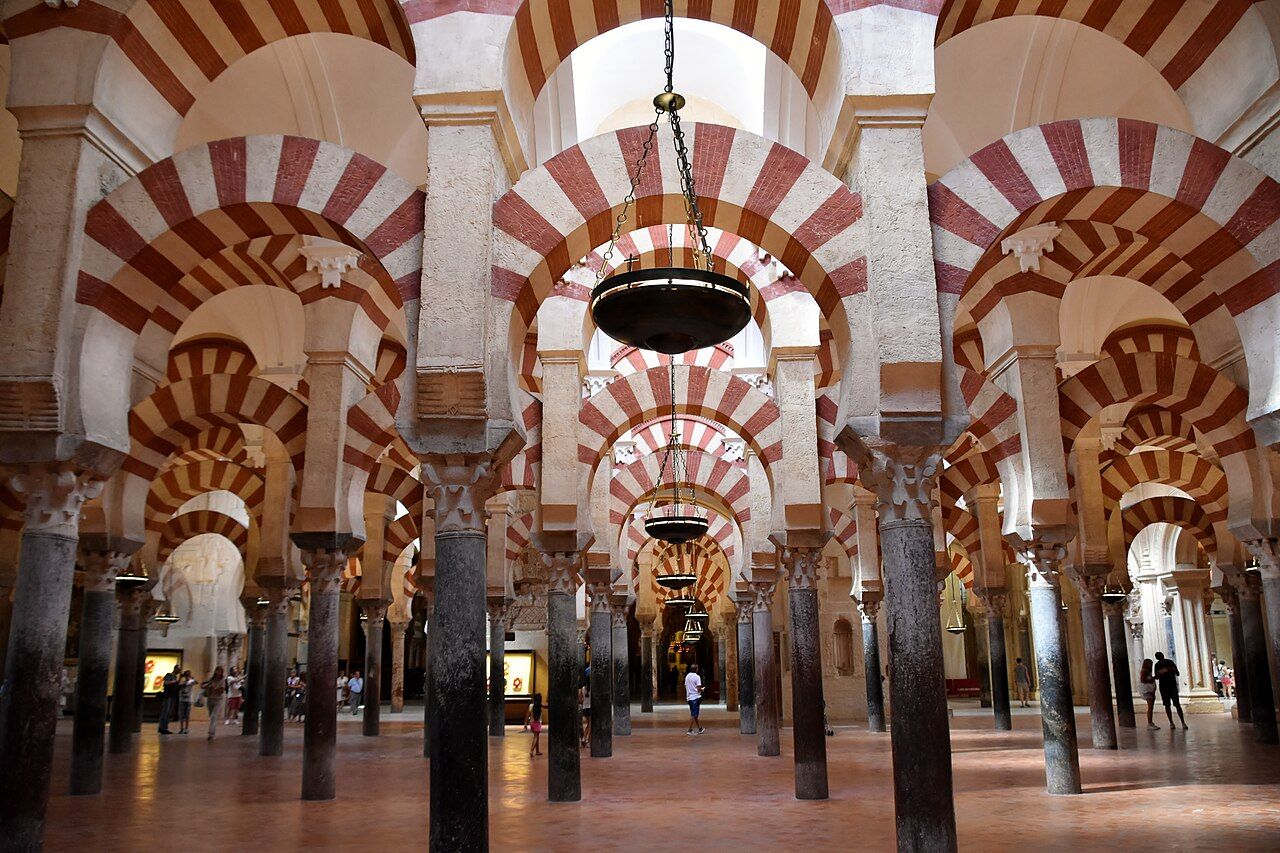
The Umayyads: an Arab kingdom
Muawiya made Damascus the capital in 661 — the seat of government had already left Medina for Ali’s Kufa — and named his son as heir, converting an elected office into a dynasty. The Umayyad caliphate (661–750) governed a Roman and Persian empire with Roman and Persian officials, and for a generation it looked like a continuation of the old order under new management: Greek-speaking clerks kept the accounts in Syria, Pahlavi clerks kept them in Iraq, and Byzantine-style coins circulated with the crosses filed off.
That changed under Abd al-Malik (r. 685–705). He made Arabic the language of administration, minted a purely epigraphic gold dinar with no ruler’s portrait, and in 691–692 built the Dome of the Rock in Jerusalem, whose interior inscriptions include Quranic verses addressed pointedly to Christians about the nature of Jesus. These were acts of statement as much as of governance: the caliphate was announcing that it was not a variant of Rome. Expansion continued to its natural limits — Spain from 711, Central Asia and Sind by 715, a raiding column stopped near Poitiers by Charles Martel in 732 — but the empire was straining. Non-Arab converts, the mawali, resented paying taxes that Arabs did not; Shia and Kharijite movements simmered; and in 750 a revolutionary coalition assembled in Khurasan destroyed the Umayyad army at the river Zab.
The Abbasid century
The Abbasids, who claimed descent from the Prophet’s uncle, hunted the Umayyad family almost to extinction and moved the centre of gravity east. In 762 the caliph al-Mansur founded Baghdad on the Tigris, a planned round city near the ruins of Ctesiphon, at the junction of the routes to Iran, India and the Mediterranean. Within fifty years it may have held several hundred thousand people; some estimates make it, with Chang’an, one of the two largest cities on earth. The Abbasid state was Persian in style: a vizier ran the bureaucracy, the caliph was screened from petitioners by court ritual, and Arab tribal aristocracy lost its monopoly on office to a cosmopolitan service class of Persians, Arabs, Christians and converts.
The famous cultural consequence was the translation movement. From the late eighth to the tenth century, and with lavish official patronage, nearly the whole surviving corpus of Greek science and philosophy was rendered into Arabic — Aristotle, Euclid, Ptolemy, Galen, Hippocrates, Archimedes — usually via Syriac, often by Christian scholars, of whom the greatest was Hunayn ibn Ishaq (d. 873), a Nestorian physician who translated Galen with a critical method that involved collating manuscripts. The Bayt al-Hikma or House of Wisdom in Baghdad is traditionally described as a great research academy; the historian Dimitri Gutas has argued persuasively that it was closer to a palace library and translation office, and that the real engine was broad elite demand for useful knowledge, not a single institution. Either way the transfer was decisive: Greek learning survived to reach medieval Europe largely because it had first been translated into Arabic.
What followed was not preservation but production. Al-Khwarizmi (d. c. 850) wrote a treatise on restoring and balancing equations whose title gave us the word algebra and whose Latinized name gave us algorithm; he also popularized the Indian decimal place-value numerals we still call Arabic. Al-Razi (Rhazes, d. 925) wrote the first clinical account distinguishing smallpox from measles and left case notes that read like modern rounds. Ibn Sina (Avicenna, d. 1037) compiled the Canon of Medicine, a systematization of Galenic medicine so thorough it was still assigned in European medical faculties in the seventeenth century. Ibn al-Haytham (Alhazen, d. c. 1040) demolished the theory that vision works by rays emitted from the eye and did it with controlled experiments in a darkened chamber, which is why he has a fair claim to be called the first experimental physicist. Paper, learned from Central Asia in the eighth century, made all of this cheap enough to circulate; the tradition that the technique was extracted from prisoners after the battle of Talas in 751 is a good story that specialists treat with caution.
Fragmentation, and Spain
Political unity did not last. A surviving Umayyad prince, Abd al-Rahman I, reached Spain in 755, took Cordoba the following year and founded an independent emirate there; his descendant Abd al-Rahman III declared himself caliph in 929. Tenth-century Cordoba had paved and lamplit streets, a library whose catalogue reportedly ran to forty-four volumes, and a population perhaps approaching 100,000 — larger than any Christian city west of Constantinople. Its scholars included the Jewish statesman Hasdai ibn Shaprut; the physician-philosopher Maimonides was born there in 1138, though the Almohad conquest drove his family out while he was still a boy. This convivencia, the coexistence of Muslims, Christians and Jews, was real but should not be romanticized: it was a legally unequal arrangement, punctuated by persecutions, that nonetheless permitted an intellectual exchange with few parallels in the period.
Elsewhere the caliphate hollowed out. The Shia Fatimids took Egypt in 969, founded Cairo, and endowed al-Azhar, which is still teaching a thousand years later. Turkish military slaves — mamluks — recruited to make the caliph independent of factions ended by dominating him, and after 945 the Abbasid caliph in Baghdad was a religious figurehead under the control of the Shia Buyid dynasty. The Islamic world of the year 1000 was a single civilization with a shared language of learning and three or more rival governments, which is roughly the condition Latin Christendom would reach some centuries later.
| Umayyad (661–750) | Abbasid (750–1258, real power to 945) | |
|---|---|---|
| Capital | Damascus — Mediterranean, Roman-facing | Baghdad — Mesopotamian, Persian-facing |
| Ruling elite | Arab tribal aristocracy; converts second-class | Cosmopolitan service class; convert status equalized |
| Style of rule | Accessible tribal chief with Byzantine machinery | Screened sacral monarch with vizier and Persian court ritual |
| Signature monument | Dome of the Rock; Great Mosque of Damascus | Round City of Baghdad; Samarra |
| Cultural output | Arabization of coinage and administration | Translation movement; algebra, optics, clinical medicine |
| Fatal weakness | Arab-versus-convert resentment; overextension | Provincial secession; dependence on Turkish slave soldiers |
The caliphates turned conquest into civilization by absorbing Greek, Persian and Indian learning into an Arabic-language culture that then surpassed its sources — even as the political unity that had made the exchange possible broke apart.
Section 4The Latin West: Kingdoms, Bishops and the Monastic Solution
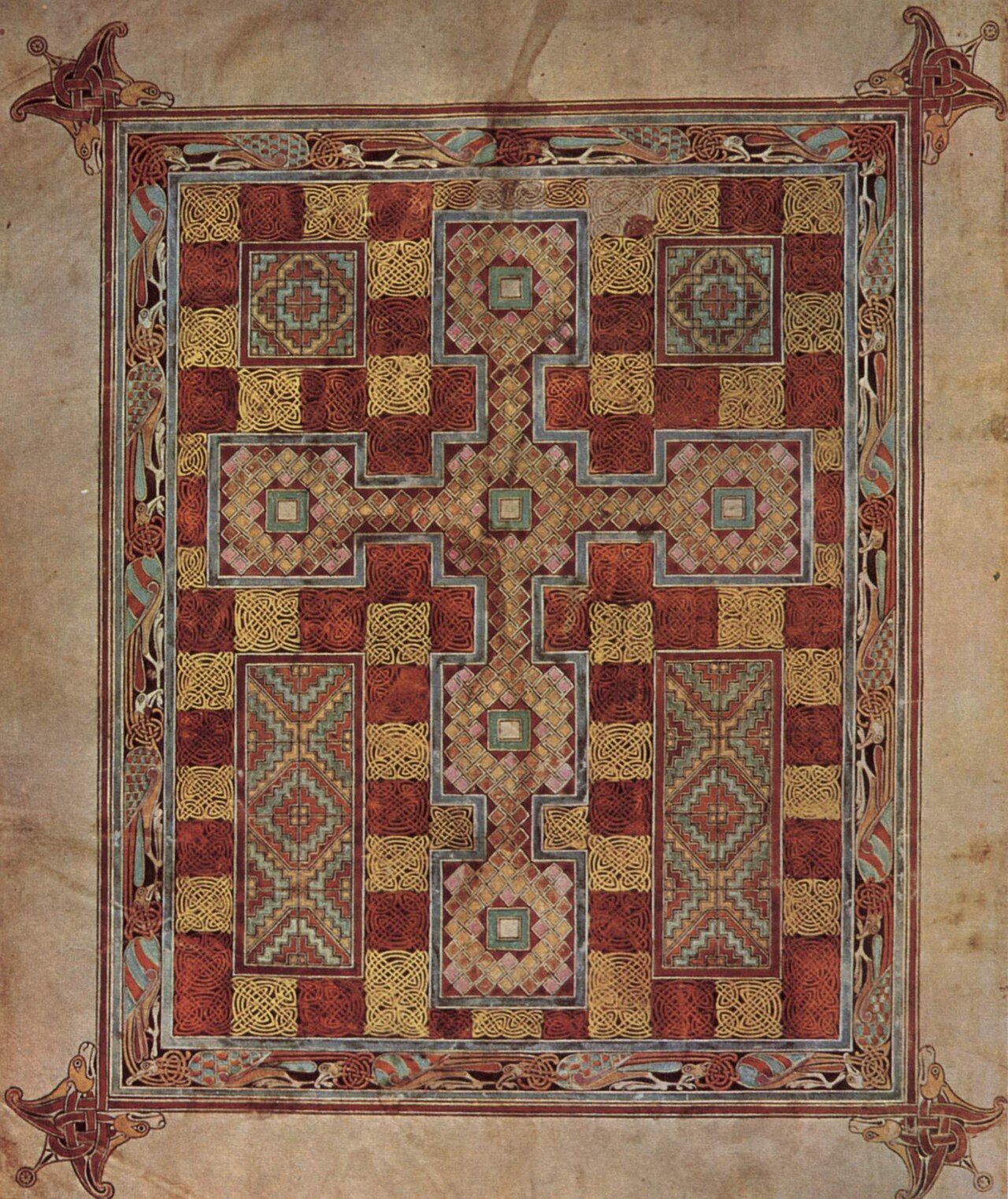
What actually ended in the west
The deposition of the last western emperor in 476 changed less at the time than the date suggests. What ended over the following century and a half was more consequential and less dramatic: the imperial tax system, the professional standing army it paid for, long-distance bulk trade in cheap goods, and the mass production of things like pottery and roof tiles. Archaeologists can watch it happen. Standardized African red-slip tableware, shipped to every Mediterranean province in 400, stops reaching most Italian sites by about 600; in Britain, always at the edge of that trade, wheel-thrown pottery of any kind essentially vanishes within a generation of 400. Coin finds thin out. Buildings switch from mortared stone to timber. Chris Wickham has argued that this simplification — a genuine fall in material complexity and in aggregate wealth — is the real content of the phrase “fall of Rome,” and it varied enormously by region: catastrophic in Britain, severe in Gaul, moderate in Italy and Spain, mild in Byzantine Egypt.
The successor kingdoms were not simply invaders squatting in the ruins. Their rulers wanted to be Roman. Theodoric the Ostrogoth (r. 493–526) governed Italy from Ravenna with the Senate intact, employed the Roman aristocrat Cassiodorus as his secretary, restored aqueducts and issued edicts in Latin. The problem was religion. Most of the Germanic peoples had been converted to Arian Christianity, which held that the Son was created by the Father and neither co-eternal nor equal with him, and their Catholic subjects regarded them as heretics. Theodoric’s later years soured accordingly; he executed the philosopher Boethius on suspicion of treason around 524, and Boethius wrote the Consolation of Philosophy in prison awaiting death — a book that would be among the most widely read in medieval Europe.
| Kingdom | Where and when | Outcome |
|---|---|---|
| Vandals | North Africa, 429–534 | Destroyed by Belisarius; Africa Byzantine until the Arab conquest |
| Ostrogoths | Italy, 493–553 | Annihilated in Justinian’s Gothic War; Lombards take the north from 568 |
| Visigoths | Spain and Aquitaine, c. 418–711 | Converted from Arianism at Toledo in 589; conquered by Arab and Berber armies in 711 |
| Burgundians | Rhone valley, c. 443–534 | Absorbed by the Franks |
| Anglo-Saxons | Britain, from the fifth century | Multiple kingdoms; Christianized from 597; Danish invasion from 865 |
| Franks | Gaul, from 481 | Pagan, then Catholic — never Arian; the one kingdom that lasts and expands |
Clovis and the Frankish exception
Clovis (r. 481–511) united the Frankish groups by conquest and murder — Gregory of Tours, our main source, is candid about both — and made one decision that separated his kingdom from all the others. He accepted baptism as a Catholic, not an Arian, probably around 496 or 508. That meant the Gallo-Roman bishops, who were the surviving administrative class, could work with him rather than against him. In 507 he destroyed the Visigothic king Alaric II at Vouillé and pushed Gothic power out of Gaul into Spain. His dynasty, the Merovingians, issued the Salic law code and ruled, with a fondness for partitioning the kingdom among sons that guaranteed recurring civil war, for two and a half centuries.
By the seventh century real power had drifted from Merovingian kings to their chief household officers, the mayors of the palace. The family that held that office in Austrasia produced Pippin II, then Charles Martel, who defeated an Umayyad raiding army between Tours and Poitiers in 732 — a battle whose importance Edward Gibbon inflated into the salvation of Christendom and which recent scholars treat more soberly as the checking of a raid, though it certainly consolidated Charles’s prestige. In 751 his son Pippin III asked Pope Zacharias whether it was right that the man with the power should not have the title. The pope’s answer was convenient for both. Pippin was made king, the last Merovingian was tonsured and sent to a monastery, and in 754 Pope Stephen II crossed the Alps to anoint him with holy oil in the manner of the kings of Israel. In return Pippin took central Italy from the Lombards and gave it to the papacy — the beginning of the Papal States, which endured until 1870.
The monastic engine
Roman schools required cities, endowments and a tax base. As those failed, education migrated to institutions that could feed themselves. Around the 530s or 540s a monk named Benedict of Nursia wrote a rule for his community at Monte Cassino that would organize western monastic life for a thousand years. The Rule of Saint Benedict is a short, moderate, practical document. It divides the day among prayer, manual labour and reading; it makes the abbot an elected authority who must consult the community; it requires stability, so monks stop wandering; and it insists on a level of humane compromise — adequate food, enough sleep, wine allowed — that made it workable for ordinary people rather than only for athletes of asceticism.
Its side effect was intellectual. Reading was mandatory, so books were needed; books had to be copied, so scriptoria appeared; copying required trained hands and correct Latin, so schools followed. Cassiodorus at Vivarium in Calabria explicitly turned manuscript copying into a spiritual discipline. The Irish, converted in the fifth century and never Roman, developed a monasticism of exile and scholarship: Columba founded Iona in 563, Columbanus carried the movement to Burgundy and northern Italy, and Irish monks maintained Latin learning, along with some Greek, at a level rare on the continent. In 597 Gregory the Great — the pope who fed Rome from papal estates when no imperial official could — sent Augustine to Kent, and the mission met the Irish stream head on. The Synod of Whitby in 664 settled the resulting disputes over the dating of Easter in Rome’s favour, aligning England with the continent. Out of that alignment came Bede (d. 735) at Jarrow, whose Ecclesiastical History of the English People is still the foundation of early English history and who did more than anyone to popularize dating years from the Incarnation — the AD convention.
In the Latin west the Roman state disappeared but the Roman church did not, and the monastery — self-supporting, disciplined and literate — became the institution that carried both learning and organized economic life through the poorest centuries.
Section 5Charlemagne, the Carolingian Order and the Second Wave
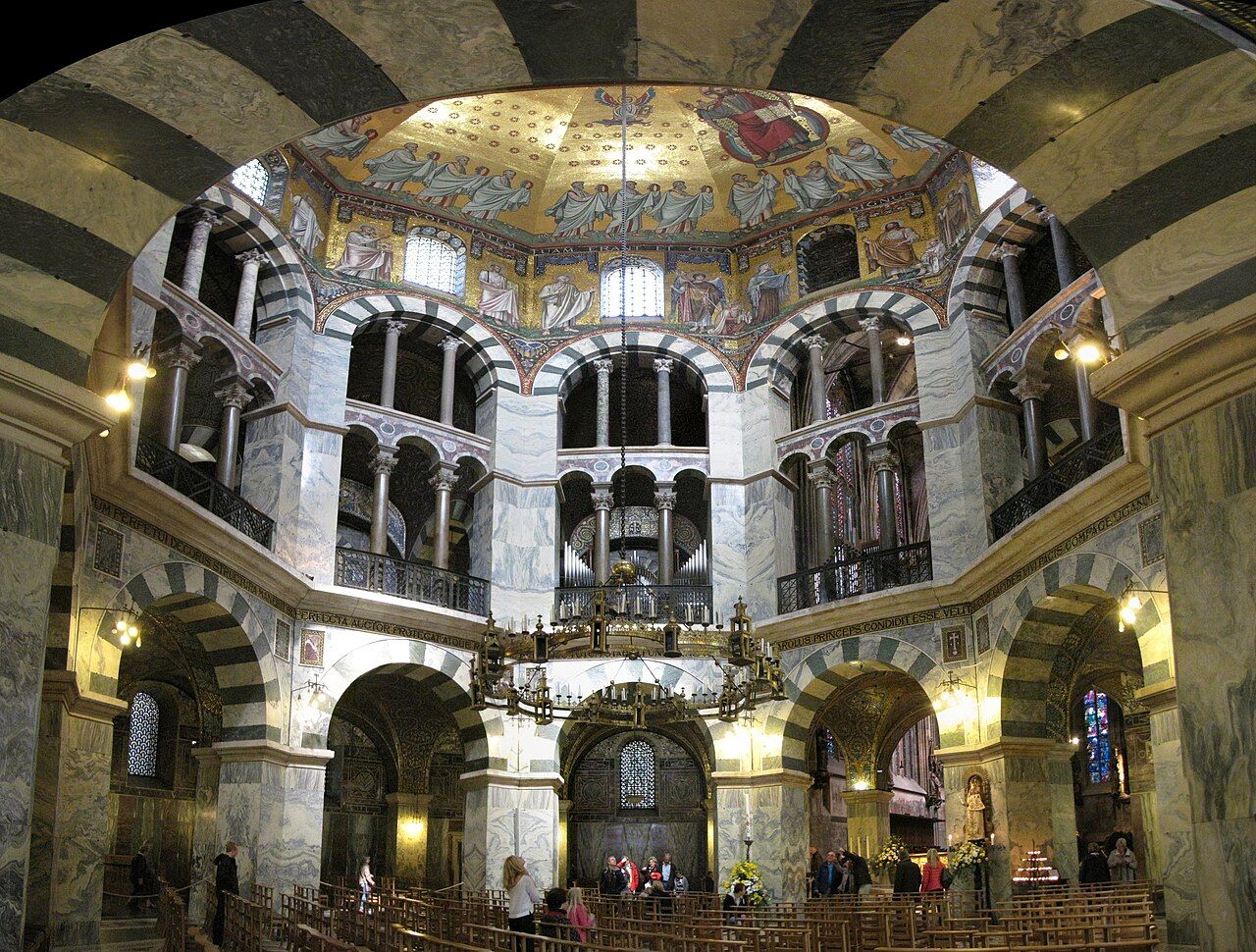
An empire assembled on horseback
Charlemagne (Charles the Great, r. 768–814) went on campaign in almost every year of his forty-six-year reign. He conquered the Lombard kingdom in 774 and added king of the Lombards to his own titles. He fought the pagan Saxons for thirty-two years in a war of forced conversion whose brutality his own biographer does not conceal; the annals record the execution of 4,500 Saxon captives at Verden in 782, a figure some historians suspect is a scribal corruption but which nobody can soften into gentleness. He destroyed the Avar khaganate in the Carpathian Basin, in what is now Hungary, in the 790s and hauled its treasury back to Francia, an injection of gold that funded a decade of building. He failed in Spain, where a rearguard ambush in the Pyrenees in 778 became, three centuries later, the Song of Roland.
On Christmas Day 800, in Saint Peter’s, Pope Leo III placed a crown on Charlemagne’s head and the congregation acclaimed him emperor. Einhard, his courtier-biographer, claims Charlemagne would not have entered the church had he known what was intended — a statement historians have argued about for two hundred years. It may be false modesty, or genuine irritation at having been crowned by a pope rather than acclaimed by his own people, or an attempt to avoid provoking Constantinople, where there was already a legitimate Roman emperor and where the throne was at that moment occupied by a woman, the empress Irene. What is clear is the consequence: western Europe now had an emperor of its own, crowned by the bishop of Rome, and the question of whether the crown made the emperor or the emperor made the pope would poison European politics for the next five hundred years.
Governing without a bureaucracy, and the Carolingian Renaissance
Charlemagne ruled 1.1 million square kilometres with no salaried civil service, no standing army and almost no cash economy. His instruments were counts who governed districts and held land at royal pleasure, missi dominici — travelling inspectors sent in pairs, one lay and one clerical, to audit the counts — and written instructions called capitularies. He also standardized the silver denarius on a reckoning of 240 pennies to the pound, a system that survived in Britain until 1971.
All of this required literacy, and literacy was in poor repair. Charlemagne imported scholars: Alcuin of York from Northumbria, Theodulf, a Goth from Spain and its Septimanian borderland, Paul the Deacon from Lombard Italy, Peter of Pisa. The Admonitio generalis of 789 ordered that every monastery and cathedral run a school. Scribes developed Caroline minuscule, a clear rounded script with word spaces, lower-case letters and punctuation, replacing a jumble of regional hands that were often barely decipherable. It worked so well that Renaissance humanists, finding classical texts in ninth-century copies, mistook the script for ancient Roman writing and revived it — which is why the letters you are reading now descend directly from a reform of Charlemagne’s court. Of the surviving manuscripts of Latin classical authors, the large majority of the oldest copies are Carolingian. Whether this deserves the name Carolingian Renaissance is debated: it was a narrow, clerical, correctness-driven programme aimed at fixing the liturgy and the Bible text, not a broad cultural flowering. It was also the single most important act of textual rescue in European history.
Division, invasion and the reorganization of power
The empire did not outlive its founder by a generation in working order. Louis the Pious (r. 814–840) faced rebellions by his own sons, and after his death the Treaty of Verdun in 843 divided the realm three ways: a west Frankish kingdom that became France, an east Frankish kingdom that became Germany, and a long unstable middle strip from the North Sea to Rome that Europe would fight over from Lorraine to Alsace for the next eleven centuries. Frankish inheritance custom treated a kingdom as property to be split among heirs, and no theory of an indivisible state existed to prevent it.
Into that division came the second wave of invasions. Scandinavian raiders sacked the monastery of Lindisfarne in 793 and were soon operating in fleets of hundreds of shallow-draught ships that could row up the Seine, the Loire, the Thames and the Volga. Paris was sacked in 845 and besieged in 885–886. In 865 a Danish “Great Heathen Army” came to England to settle rather than raid and destroyed three of the four English kingdoms; only Wessex under Alfred the Great (r. 871–899) survived, and Alfred bought his survival with fortified burhs, a reorganized levy, a fleet, and a programme of translating Latin works into English. In 911 the west Frankish king handed the lower Seine to a Viking leader named Rollo, whose descendants became the Normans. From the east came the Magyars, mounted archers who raided as far as Burgundy until Otto I destroyed them at the Lechfeld in 955, after which they settled and became Christian Hungary. From the south, Muslim fleets took Sicily between 827 and 902 and sacked the basilicas outside the walls of Rome in 846.
Against fast raiders arriving without warning, a king hundreds of kilometres away was useless. What worked was a local strongman with a fortified point and mounted retainers who could respond in hours. So power went local. Landholders commended themselves and their land to stronger neighbours in exchange for protection; free peasants accepted dependent status on manors in exchange for the same; and military service came to be owed in return for the use of land, the fief.
Textbooks have long called this bundle feudalism and drawn it as a neat pyramid of king, lords, knights and serfs. Be careful. Since Elizabeth Brown’s 1974 article and especially Susan Reynolds’s Fiefs and Vassals (1994), many medievalists have argued that the pyramid is a construct assembled by sixteenth-century lawyers and eighteenth-century philosophers from a legal literature written after the fact, and that actual arrangements were local, various, negotiated and frequently non-hierarchical. Some historians defend a modified version of the term as a useful shorthand. The honest summary is this: the decentralization was real and the manorial economy was real, but the tidy diagram is a modern invention, and you should treat the word as a label for a debate rather than a description of a system.
| Raiders | From where, when | Method | How it ended |
|---|---|---|---|
| Vikings | Scandinavia, 793–c. 1050 | Shallow-draught longships up navigable rivers; raid, then settle | Danelaw in England; Normandy granted 911; Scandinavia Christianized |
| Magyars | Steppe via the Danube basin, c. 899–955 | Mounted archery, extreme range, tribute extraction | Crushed at the Lechfeld, 955; kingdom of Hungary founded c. 1000 |
| Muslim fleets | North Africa and Spain, ninth–tenth centuries | Sea raiding; conquest of Sicily; coastal bases such as Garigliano | Bases cleared by 915; Sicily taken by the Normans after 1061 |
Charlemagne briefly recreated a western empire and permanently reformed western literacy, but his realm split among heirs and then fractured under raiders, leaving Europe with localized power, an imperial idea, and a corrected library.
The chapter in one breath
Justinian tried to put the Roman Mediterranean back together and instead spent the money that his successors needed for defence; plague, the ruinous Persian war of 602–628 and then the Arab conquests reduced the eastern empire to Anatolia and the Aegean, where it reinvented itself as a compact Greek-speaking military state defended by the theme system, the Theodosian walls and Greek fire, and exported its faith and alphabet to the Slavs. Meanwhile Muhammad’s revelations produced something the ancient world had not seen: a community organized by belief rather than blood, which after the Hijra of 622 became a state and after 632 an empire that stretched from Spain to the Indus within a century, taxing rather than converting its subjects and absorbing Greek, Persian and Indian learning into an Arabic civilization that surpassed its sources in optics, medicine and mathematics. In the Latin west the tax system, the army and the long-distance economy simply stopped, and order was rebuilt around bishops, Benedictine monasteries and Frankish warlords — culminating in Charlemagne, whose empire fell apart within two generations but whose script, schools and imperial title outlasted him by a millennium. Three civilizations, one inheritance, three answers.
Words worth knowing
| Term | What it means |
|---|---|
| Corpus Juris Civilis | Justinian’s codification of Roman law (529–534); rediscovered in eleventh-century Bologna and the root of the modern civil-law tradition. |
| Theme (thema) | Byzantine military-administrative district where soldiers held land in return for service; the backbone of survival after the Arab conquests. |
| Greek fire | Petroleum-based incendiary sprayed from ship-mounted siphons that burned on water; a Byzantine state secret whose formula is still uncertain. |
| Iconoclasm | The eighth- and ninth-century Byzantine campaign against religious images, reversed in 843; a major irritant in relations with Rome. |
| Hijra | Muhammad’s migration from Mecca to Medina in 622, and year 1 of the Islamic calendar. |
| Umma | The community of believers, defined by faith rather than by tribal descent. |
| Quran | The recited revelations received by Muhammad, understood by Muslims as God’s own speech; textually standardized under Uthman. |
| Caliph | Successor or deputy; the political leader of the Muslim community after the Prophet’s death. |
| Rashidun | The first four caliphs (632–661), called “rightly guided” in Sunni tradition. |
| Sunni and Shia | The two main branches of Islam, divided originally over whether authority lay with the community’s consensus or with Ali’s designated line. |
| Dhimmi / jizya | Protected non-Muslim subjects of an Islamic state, and the poll tax they paid in lieu of military service. |
| Translation movement | The Abbasid-sponsored rendering of Greek science and philosophy into Arabic, largely eighth to tenth centuries. |
| Arianism | The doctrine that the Son was created by the Father and is not co-eternal with him; held by most Germanic kingdoms and a source of friction with Catholic subjects. |
| Rule of Saint Benedict | Sixth-century monastic constitution balancing prayer, labour and reading; the organizing document of western monasticism. |
| Missi dominici | Paired lay and clerical inspectors sent by Charlemagne to audit his counts. |
| Caroline minuscule | Clear, spaced, lower-case script developed under Charlemagne; the ancestor of modern Roman type. |
| Treaty of Verdun | The 843 partition of the Carolingian Empire into west, east and middle kingdoms. |
| Manor | The agricultural estate combining a lord’s demesne with dependent peasant holdings; the basic economic unit of the early medieval countryside. |
| Feudalism | Contested modern label for early medieval arrangements of land held for military service; useful shorthand, but not a system contemporaries would recognize. |
Check yourself
The High Middle Ages
Between roughly 1000 and 1300 western Europe stopped being a poor, thinly settled periphery and became a crowded, aggressive, inventive society. The population may have doubled. Forests fell, marshes drained, mills turned, towns filled with people who had walked away from the fields. Out of that surplus came institutions we still live with: chartered cities, jury trials, universities, parliaments, banks, corporate law, and a papacy that claimed authority over kings. It also produced the crusades, the persecution of Jews and heretics, and a legal machinery for defining who belonged and who did not. This chapter follows the material engine first — climate, ploughs, calories, coins — because everything else rests on it, and then traces how surplus turned into power, and power into argument. The High Middle Ages is where Europe acquired both its confidence and its cruelty, and the two grew from the same root.
By the end of this chapter you can
- Explain how the Medieval Warm Period, the heavy plough, the three-field system and animal power raised European agricultural output after 1000.
- Describe manorialism and serfdom as economic and legal arrangements, and distinguish them from slavery.
- Evaluate the scholarly debate over whether feudalism is a useful description of medieval society.
- Trace the commercial revolution through the Champagne fairs, guilds, communes and credit instruments such as the bill of exchange.
- Analyse the Investiture Controversy and explain why the Concordat of Worms settled a procedure but not a principle.
- Compare state-building in England, France and the Empire, using Domesday Book, common law, Magna Carta and the Capetian consolidation as evidence.
- Assess the causes, course and consequences of the crusades, including the Reconquista and the Albigensian Crusade.
- Explain how the university, scholasticism and the recovery of Aristotle changed European intellectual life.
- Identify the structural and symbolic features of Gothic architecture and connect them to urban wealth and civic pride.
Section 1The Great Expansion: Land, Climate and Labour
A warmer world and a wider frontier
From roughly 950 to 1250 much of the North Atlantic region ran warmer than the centuries on either side — a period climate historians call the Medieval Warm Period or, more carefully, the Medieval Climate Anomaly. In Europe the growing season lengthened by perhaps two to three weeks, the tree line and the vine line crept north, and harvests failed less often. Norse farmers settled Greenland around 985 and reached Newfoundland shortly after. English monasteries kept vineyards. None of this made anyone rich by itself, but a run of decent harvests is the difference between a society that buries its children and one that raises them.
Add to the climate a simpler fact: the raiding stopped. The Viking, Magyar and Saracen incursions that had shredded ninth- and tenth-century Europe subsided as raiders were converted, defeated, or absorbed — the Normans settled in Normandy in 911, Hungary accepted Christian kingship under Stephen I in 1000. Peace is an agricultural input. A farmer who expects to keep the crop plants more of it and invests in land that takes years to pay off: drainage ditches, fruit trees, terraces, a mill.
The result was the largest land clearance in European history before the modern era. Between about 1050 and 1250 peasants and lords together attacked forest, fen and heath. Cistercian monks specialised in marginal land. Dutch and Flemish colonists diked and drained coastal marshes and then exported the technique east. German settlers moved into Slavic-speaking lands beyond the Elbe under charters that offered lighter dues to anyone willing to break new ground. Historians call this the Ostsiedlung. It was colonisation, sometimes violent, sometimes contractual, and it permanently redrew the ethnic map of central Europe.
The tools that moved the soil
Mediterranean agriculture had used a scratch plough, or ard, which cuts a shallow furrow and works well in light dry soils. It is nearly useless on the wet, heavy clays of the northern European plain — which happen to be extraordinarily fertile once you can turn them. The heavy plough, with an iron coulter to cut vertically, a share to cut horizontally, and a mouldboard to flip the sod over, solved that problem. It also demanded a team of six or eight oxen, far more than one household owned, which pushed villagers toward cooperative ploughing and the long open strip fields that shaped the northern landscape for eight centuries.
Traction improved too. The rigid horse collar, spreading in Europe from the tenth century, transferred pull to a horse’s shoulders rather than choking its windpipe; tandem harnessing let animals be lined up in series; iron horseshoes protected hooves in wet ground. A horse eats more than an ox and costs more, but it works faster and longer, and by the twelfth century horse ploughing was common in the grain belts of northern France and England. Where horses replaced oxen, a family could work more land in the narrow window between thaw and sowing.
The third change was rotation. Under the older two-field system half the arable lay fallow each year. The three-field system divided land into a winter grain (wheat or rye), a spring crop (oats, barley, or — crucially — legumes such as peas and beans), and a fallow. The share of arable actually in crop therefore rose from a half to two-thirds — about a third more sown land every year — and the legumes fixed nitrogen while adding protein to a starch-heavy diet. Meanwhile watermills multiplied: Domesday Book, the survey Norman England compiled in 1086, records something in the order of 6,000 mills for a population of perhaps 1.5 to 2 million. Windmills appear in the sources by the 1180s. Grinding, fulling cloth, sawing wood, driving forge hammers — medieval Europe mechanised a surprising amount of drudgery.
| Innovation | Spreading widely | What it actually changed |
|---|---|---|
| Heavy mouldboard plough | 9th–12th c. | Opened wet clay soils of the north; encouraged shared ox teams and strip fields |
| Rigid horse collar and tandem harness | 10th–12th c. | Let a horse pull hard without choking (the old “fourfold power” figure is disputed); faster ploughing and carting |
| Three-field rotation | 9th–13th c. | Cut fallow from one-half to one-third; legumes added nitrogen and protein |
| Watermill and (later) windmill | 10th–13th c. | Mechanised milling, fulling, sawing; became a lucrative lordly monopoly |
| Iron in quantity (shares, horseshoes, nails) | 11th–13th c. | Durable tools; supported clearance, building and the arms trade |
| Drainage, diking, forest clearance | 1050–1250 | Expanded arable land itself — the single largest source of extra output |
More people, more mouths, more markets
Estimates of medieval population are educated reconstructions from tax rolls, manorial surveys and archaeology, and they vary. The consensus range has Europe rising from roughly 35 to 40 million people around the year 1000 to somewhere between 70 and 80 million by 1300. Italy, France and the Low Countries grew densest. England went from about 1.5 million at Domesday to somewhere between 4 and 6 million before the fourteenth-century crisis, a range historians still argue over.
Growth of that scale changes everything downstream. A farm family that produces a surplus can sell it; a village that sells needs a market; a market needs a road, a mint, a measure, and someone to enforce a contract. Lords who wanted cash rather than eggs began commuting labour dues into money rents. Younger sons with no land walked to the towns. And by about 1270 the frontier had closed: the good land was taken, marginal plots were being ploughed that should never have been, holdings were subdividing, and real wages were falling. The expansion carried its own limit inside it, and the fourteenth century would collect the debt.
A favourable climate, the end of the raids, and a package of ordinary technologies — plough, collar, rotation, mill — produced the food surplus that made every other achievement of the High Middle Ages possible.
Section 2Lords, Peasants and the Return of the Town
What we mean — and do not mean — by feudalism
Textbooks used to present a tidy pyramid: king grants land to great lords, lords to lesser lords, lesser lords to knights, knights ride out to fight, peasants at the bottom feed everyone. The core relationship in that picture is vassalage: a free man does homage to a lord, swears fealty, and receives a fief — usually land, sometimes an office or a revenue — in return for military service and counsel.
Those words are real and appear in medieval documents. The tidy system is not. Elizabeth A. R. Brown, in a 1974 article memorably titled “The Tyranny of a Construct,” and Susan Reynolds, in Fiefs and Vassals (1994), argued that historians had built “feudalism” largely out of sixteenth- and seventeenth-century lawyers reading a twelfth-century Italian legal compilation, the Libri Feudorum, and generalising it across five centuries and a continent. Reynolds showed that in many regions most land was held as heritable property, not conditional fief, and that the vocabulary of homage varied wildly from Normandy to Catalonia to Saxony. Not everyone accepts the full demolition; medievalists still argue about how much of the old model survives. But the honest position is that “feudalism” is a useful shorthand for a world of personal, negotiated, overlapping obligations, and a bad description of a system, because there was no system.
What did exist everywhere was the castle and the mounted warrior. Between about 950 and 1050, as royal power fragmented in France, local strongmen built earthwork-and-timber castles and used the men inside them to extract dues from everyone within riding distance. Historians call this the “castellan revolution” or, more contentiously, the “feudal revolution” — a genuine scholarly quarrel about whether the change around the year 1000 was a sharp rupture or a slow drift. Either way, the practical unit of medieval power was a fortified point with armed men in it and peasants around it.
Life on the manor
The manor was an estate, not a village, though the two often overlapped. Its arable was split between the lord’s demesne, farmed for him, and tenant holdings farmed by peasant families. Tenants paid in labour (so many days a week ploughing, more at harvest), in kind (hens at Christmas, eggs at Easter), and increasingly in cash. Beyond that lay the banalités: monopolies obliging tenants to grind grain at the lord’s mill, bake at his oven and press at his winepress, each for a cut. The mill was often the single most profitable asset on the manor, which is why unauthorised handmills were confiscated and smashed.
Custom governed all of it. The manorial court, whose rolls survive in the tens of thousands and are one of the best sources we have for ordinary medieval life, recorded transfers of holdings, fines for stray pigs, disputes over boundaries and the occasional scandal. Custom protected the peasant as well as bound him: a lord who demanded more than “the custom of the manor” risked flight, foot-dragging and, occasionally, litigation. Peasants were not passive. They bargained, sued, absconded to towns, and in 1358 and 1381 they revolted.
Peasant life was also brutally physical and short. Bad years came — the Great Famine of 1315 to 1317 killed perhaps a tenth of northern Europe. Housing was one or two rooms with animals often sharing the space. Bread supplied most calories; meat was occasional; ale was the safe drink. Yet by the thirteenth century the peasantry of England and France was better fed and more numerous than in 900, and a growing minority held their land by rent alone, legally free.
Towns, guilds and the commercial revolution
Roman urban life had never entirely vanished in Italy, but north of the Alps towns were small and often shrivelled by 900. From the eleventh century they exploded. Merchants clustered outside monastery or castle walls in settlements called faubourgs or portus; the settlement outgrew the fortress; the merchants bought or bullied a charter from lord or king guaranteeing personal freedom, the right to hold a market, their own court and their own taxes. The German proverb Stadtluft macht frei — town air makes you free — referred to a real legal rule in many places: a serf who lived a year and a day in a chartered town without being reclaimed became free.
Inside the walls, work was organised by guilds: associations of merchants or craftsmen that fixed prices and quality standards, restricted entry through apprenticeship, buried their dead, endowed chantries and quarrelled endlessly with each other for civic office. Guilds were monopolies with a religious face, and they were also the first mass institutions of urban self-government. In northern Italy and Flanders the towns went further and became communes — sworn associations of citizens that in practice governed themselves, so that Milan, Florence, Genoa and Pisa were functioning republics while nominally imperial. The Lombard cities in particular, Milan, Cremona, Brescia, Bergamo and Verona among them, formed the Lombard League, defeated the emperor Frederick I Barbarossa at Legnano in 1176, and extracted the Peace of Constance in 1183 confirming their self-rule.
Long-distance trade knitted the regions together. Northern Italian ships carried eastern spices, silk and alum; Flanders and Brabant made the finest woollen cloth in Europe from English wool; the Hanseatic League, a confederation of north German towns crystallising in the thirteenth century, controlled Baltic grain, timber, wax, furs and above all fish. Between north and south lay the Champagne fairs, six great fairs a year rotating among Troyes, Provins, Lagny and Bar-sur-Aube under the protection of the counts of Champagne, where an Italian could buy Flemish cloth, settle accounts by paper rather than coin, and go home. When the fairs declined around 1300 — partly because the French crown absorbed Champagne, partly because Genoese galleys began sailing directly to Bruges — the credit techniques survived them.
| Instrument or institution | What it did | Why it mattered |
|---|---|---|
| Bill of exchange | Written order to pay a sum in another city and currency | Moved value without moving coin; dodged bandits and, legally, the usury ban |
| Commenda partnership | Investor funds a voyage, travelling partner runs it, profits split | Pooled capital and shared risk; the ancestor of the joint-stock company |
| Double-entry bookkeeping | Every transaction recorded twice, debit and credit | Emerges in Italian ledgers around 1300; made large firms auditable |
| Merchant and craft guilds | Regulated entry, quality, price; provided welfare | Trained labour and enforced contracts where the state could not |
| Town charter / commune | Legal freedom, own court, own taxes | Created a self-governing corporate body inside a lordly world |
| Gold coinage revived | Florin (Florence, 1252), genovino, ducat (Venice, 1284) | Gave Europe a high-value currency for international settlement again |
Rural surplus fed a commercial revolution that produced a genuinely new social actor — the self-governing, credit-using, legally free townsman — whose institutions did not fit the older world of lords and peasants at all.
Section 3Popes, Kings and the Invention of the State
Reform and the Investiture Controversy
The reform movement began in the monasteries. The abbey of Cluny, founded about 910 and answerable directly to the pope rather than to any local lord, became the centre of a network of hundreds of houses committed to strict observance and freedom from lay interference. The idea spread: if a monastery should be free of the local count, why should a bishopric be the private gift of a king?
By the mid-eleventh century a party of reformers around the papacy had a programme. They attacked simony (buying church office), nicolaitism (clerical marriage and concubinage), and above all lay investiture — the practice by which a secular ruler handed a new bishop the ring and staff of his office. In 1059 a papal decree moved papal elections into the hands of the cardinals, cutting out the Roman nobility and the emperor. In 1075 twenty-seven blunt propositions known as the Dictatus Papae were entered in the register of Pope Gregory VII: that the pope alone may depose emperors, that he may be judged by no one, that all princes should kiss his feet.
The emperor Henry IV, whose government in Germany and Italy depended on bishops he appointed and could trust, refused. Gregory excommunicated and deposed him in 1076. German nobles, delighted, announced they would elect another king if Henry were not absolved within a year. In January 1077 Henry crossed the Alps in winter and stood in the snow outside the castle of Canossa for three days as a penitent until Gregory, who as a priest could hardly refuse absolution to a penitent, readmitted him. The fighting resumed almost immediately; Henry later drove Gregory from Rome, and Gregory died in exile at Salerno in 1085. The formal settlement came only in 1122 at the Concordat of Worms: the emperor renounced investiture with ring and staff and allowed free canonical election; the pope conceded that elections in Germany could take place in the emperor’s presence and that the bishop would receive his secular lands and rights from the ruler.
England: conquest, common law and Magna Carta
In 1066 Duke William of Normandy defeated Harold Godwinson at Hastings and took England by force. What followed was one of the most thorough elite replacements in European history: within twenty years virtually the entire English landholding aristocracy had been dispossessed in favour of perhaps 200 Norman and French families, castles were planted in every shire, and the language of government became Latin and French. In 1085–86 William ordered a survey of who held what, worth how much, then and in King Edward’s day. Domesday Book is the most detailed administrative document produced anywhere in eleventh-century Europe and it exists because a conquering king wanted to tax precisely.
The decisive legal turn came under Henry II (1154–89). Faced with a kingdom exhausted by civil war, he sent royal justices on regular circuits, offered standardised written writs that let a free man move a land dispute out of a lord’s court into the king’s, and used sworn panels of neighbours — the ancestor of the jury — to answer questions of fact. Royal justice was faster, more predictable and less bloody than trial by battle or ordeal, so litigants chose it, and choosing it made it customary. That accumulated custom is the common law: judge-made, precedent-driven, and today the legal foundation of England, Ireland, the United States, Canada, Australia, India and much else. Henry’s attempt to extend the same jurisdiction over criminous clerks brought him into collision with Archbishop Thomas Becket, murdered in Canterbury Cathedral in December 1170 by four knights who took the king’s rage literally.
Strong government invites resistance. Henry’s son John lost Normandy to Philip II of France in 1204, taxed savagely to try to get it back, and then watched the allied army meant to recover it destroyed at Bouvines in 1214. In June 1215 rebel barons forced him to seal Magna Carta at Runnymede. Most of its sixty-three clauses concern baronial grievances about wardship, forests and fish weirs. But clauses 39 and 40 — that no free man shall be seized, imprisoned or dispossessed except by the lawful judgement of his equals or by the law of the land, and that justice shall not be sold, denied or delayed — established in writing that the king was under the law. The charter was annulled by the pope within ten weeks and reissued repeatedly thereafter. Its long career as a constitutional icon owes as much to seventeenth-century lawyers as to 1215, but the principle was genuinely there.
France, the Empire and the papal monarchy
The Capetians, elected in 987 in the person of Hugh Capet, began as kings whose effective authority barely reached beyond the Île-de-France. They had two advantages: an unbroken run of male heirs for over three centuries, and the habit of crowning the son during the father’s lifetime. Slowly they turned dynastic luck into administration. Philip II Augustus (1180–1223) multiplied royal revenue several times over, installed salaried officials called baillis and sénéchaux to govern in the king’s name instead of hereditary counts, confiscated Normandy, Anjou and Maine from King John in 1204, and confirmed it all at Bouvines. His grandson Louis IX (1226–70) added moral prestige: he heard petitions personally, led two crusades, died at Tunis in 1270 and was canonised in 1297. His grandson Philip IV, by contrast, showed what a bureaucratic monarchy could do when it stopped being pious, summoning the Estates General in 1302, humiliating Pope Boniface VIII at Anagni in 1303, and destroying the Knights Templar to seize their assets.
The Holy Roman Empire moved the other way. Its kings were elected, its magnates entrenched, and its Italian ambitions ruinous. Frederick I Barbarossa (1152–90) fought six Italian campaigns and lost the decisive one at Legnano. His grandson Frederick II (1194–1250) — raised in Palermo, fluent in Arabic, an obsessive falconer, called by contemporaries stupor mundi, the wonder of the world — built a genuinely modern administration in his Sicilian kingdom with the Constitutions of Melfi in 1231, while conceding away royal rights in Germany to buy princely support. He spent his life at war with the papacy and was excommunicated four times. After his death the Empire never regained a strong central monarchy; real power settled with princes, bishops and free cities, and German political fragmentation lasted until unification in 1871.
The papacy meanwhile became a monarchy in its own right. Innocent III (1198–1216) claimed to stand “below God but above man,” arbitrated a disputed imperial election, laid England under interdict until John accepted his candidate for Canterbury and held the kingdom as a papal fief, and launched both the Fourth and the Albigensian crusades. The Fourth Lateran Council of 1215, which he convened, is the most consequential church council of the Middle Ages: it defined transubstantiation, required every Christian to confess and receive communion at least annually, forbade clergy to participate in trials by ordeal (effectively killing the ordeal and accelerating the turn to juries and inquisitorial procedure), and ordered Jews and Muslims to wear distinguishing dress.
| England | France | Holy Roman Empire | |
|---|---|---|---|
| Succession | Hereditary, often disputed | Hereditary; direct male line 987–1328 | Elective; princes choose the king |
| Key instrument | Royal writs, itinerant justices, juries | Salaried baillis; territorial confiscation | Bishops and ministerials; Italian revenues |
| Landmark | Domesday 1086; Magna Carta 1215 | Bouvines 1214; Louis IX’s courts | Concordat of Worms 1122; Melfi 1231 |
| Relations with papacy | Becket crisis 1170; John submits 1213 | Cooperative, then hostile under Philip IV | Continuous conflict, four Frederick II bans |
| Outcome by 1300 | Centralised law, taxation by consent | Strongest monarchy in Europe | Fragmented into princely territories |
The struggle between popes and rulers permanently divided authority in the West — no medieval European ruler ever fully controlled the Church, and that unresolved split left room for law, corporate rights and eventually constitutional government.
Section 4Frontiers and Crusades: Europe Turns Outward
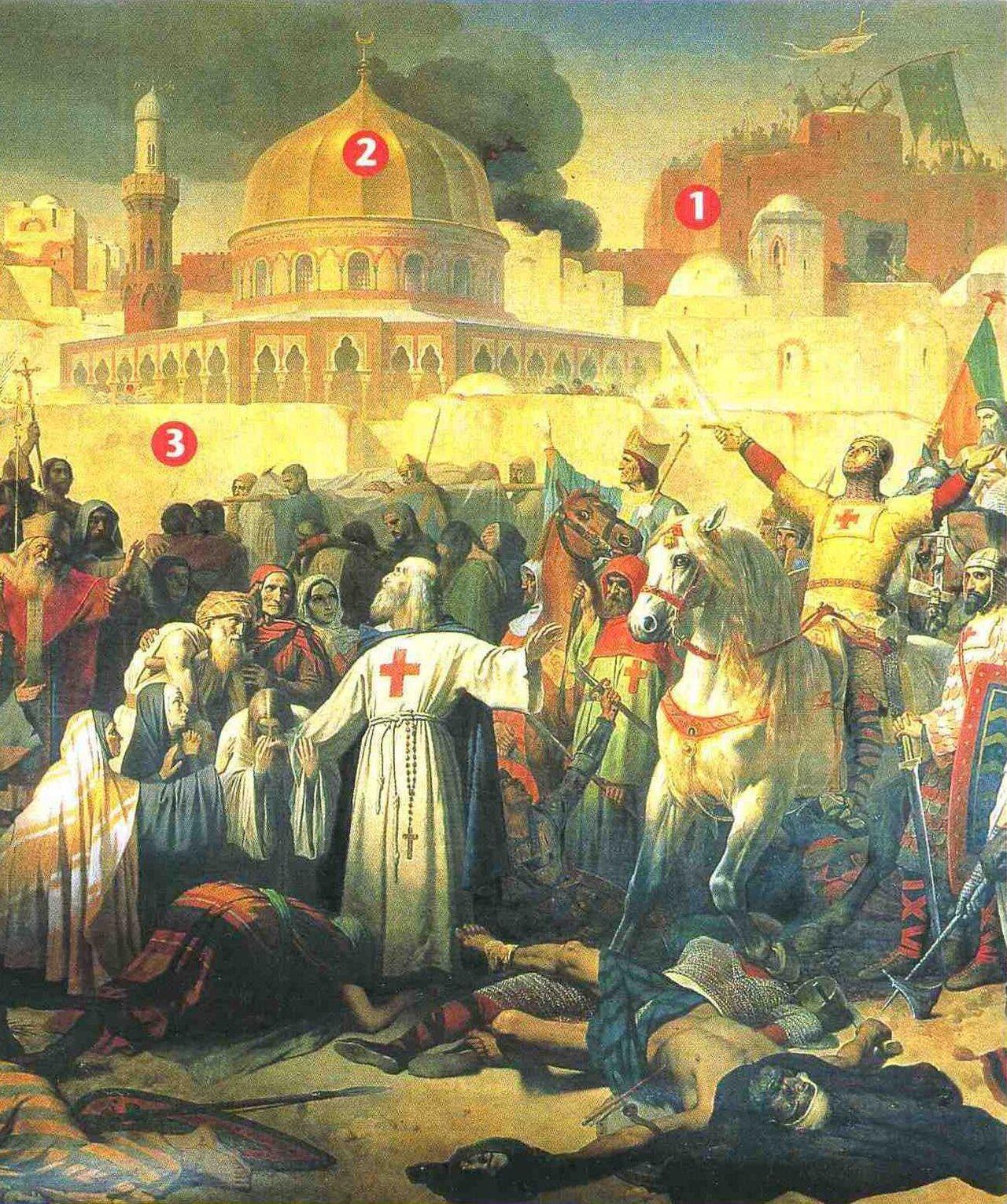
Clermont and the First Crusade
In 1071 the Seljuk Turks destroyed a Byzantine army at Manzikert and overran most of Anatolia. Twenty-four years later the emperor Alexios I Komnenos asked the West for mercenaries. What he got instead was something new. At the Council of Clermont in November 1095, Pope Urban II preached an armed pilgrimage to recover Jerusalem and offered participants an unprecedented spiritual reward: remission of the penance due for confessed sins. No text of the sermon survives; five later accounts disagree about what he said, which is a useful reminder of how much of this history is reconstruction.
The response was enormous and largely unplanned. A popular movement led by the preacher Peter the Hermit set out early, and in the spring of 1096 bands from the same wave, above all the followers of Count Emicho of Flonheim, massacred the Jewish communities of the Rhineland — Speyer, Worms, Mainz, Cologne — in the first large-scale pogroms in western European history, often over the objections of local bishops who tried to shelter them. The princely armies that followed took Nicaea in 1097, endured a horrific siege at Antioch, and on 15 July 1099 stormed Jerusalem and slaughtered much of its Muslim and Jewish population. Latin chroniclers described the massacre with satisfaction; it is not a modern invention. Four crusader states resulted: the County of Edessa, the Principality of Antioch, the County of Tripoli and the Kingdom of Jerusalem.
Why did people go? Motives were mixed and provable case by case from charters: genuine terror of damnation and hope of remission, loyalty to a lord who had taken the cross, family tradition, the prestige of the journey, and yes, land and plunder for some. But the majority of crusaders mortgaged or sold property to finance a ruinously expensive trip, and most who survived came home. Crusading was, for most participants, a devotional act with a catastrophic cost–benefit ratio.
Saladin, Constantinople and the crusading habit
The crusader states survived because their Muslim neighbours were divided. When the Zengid and then Ayyubid rulers unified Egypt and Syria, the arithmetic changed. Edessa fell in 1144, prompting the Second Crusade (1147–49), preached by Bernard of Clairvaux and a total failure. In 1187 Saladin destroyed the army of the Kingdom of Jerusalem at the Horns of Hattin and retook Jerusalem in October, permitting most inhabitants to ransom themselves — a contrast with 1099 that impressed even his enemies.
The Third Crusade (1189–92) drew the three greatest rulers of Europe. Frederick Barbarossa drowned crossing a river in Anatolia and his army dissolved. Philip II went home early. Richard I of England took Acre and Jaffa, twice came within sight of Jerusalem without attacking it, and negotiated a truce guaranteeing Christian pilgrims access to the city. The Fourth Crusade (1202–04) is the darkest chapter: unable to pay the Venetians for transport, the army first sacked the Christian city of Zara for them, then intervened in a Byzantine succession dispute, and in April 1204 stormed and pillaged Constantinople itself, carrying off relics and bronze horses and installing a Latin emperor. Innocent III had forbidden it and then accepted the result. The wound to relations between Latin and Greek Christianity never healed; the Byzantine Empire, restored in 1261, never recovered its strength. Acre, the last mainland crusader stronghold, fell in 1291.
Consequences are easy to overstate. Europe did not learn algebra or acquire spices because of the crusades — Italian merchants were already trading with Egypt and Syria, and the great intellectual transmission ran through Spain and Sicily, not Palestine. What the crusades did produce was durable: the military orders (Templars, Hospitallers, Teutonic Knights) which became international banking and landholding corporations; a papal machinery for taxing the clergy and issuing indulgences that would eventually help detonate the Reformation; and an ideological template in which holy war against an external enemy could be turned inward against anyone defined as an enemy of Christendom.
| Crusade | Dates | Trigger | Result |
|---|---|---|---|
| First | 1096–99 | Byzantine appeal; Urban II at Clermont | Jerusalem taken and its people massacred; four Latin states founded |
| Second | 1147–49 | Fall of Edessa, 1144 | Failed before Damascus; damaged crusading prestige |
| Third | 1189–92 | Saladin’s victory at Hattin, 1187 | Coastal strip recovered; Jerusalem stayed Muslim; pilgrim access secured |
| Fourth | 1202–04 | Innocent III; Venetian debt | Sack of Constantinople; Latin Empire; permanent Greek–Latin rupture |
| Albigensian | 1209–29 | Cathar heresy in Languedoc | Heresy suppressed; the south annexed to the French crown |
| Baltic / Northern | 1147–15th c. | Conversion of pagan Slavs, Prussians, Balts | Teutonic Order state in Prussia and Livonia |
Iberia, the Baltic and the enemy within
The Iberian Reconquista was longer, closer to home and more consequential for Europe than anything in Syria. Toledo fell to Alfonso VI of Castile in 1085, bringing with it a mass of Arabic manuscripts and a mixed population of Arabic-speaking Christians, Muslims and Jews. The decisive battle came at Las Navas de Tolosa in 1212, where a combined Christian army broke the Almohads. Córdoba fell in 1236, Valencia in 1238, Seville in 1248. Only the emirate of Granada survived, paying tribute, until 1492. Iberian society for two centuries after each conquest was one of pragmatic and unequal coexistence — the arrangement historians call convivencia, a term now used with caution because it can romanticise what was legally subordinate status for religious minorities, punctuated by real violence.
In the north-east the crusading idea was applied to pagan Slavs, Prussians and Balts. The Teutonic Knights, redeployed from the Holy Land, conquered Prussia between 1230 and 1283 and built a monastic state with brick castles and chartered German towns. Conversion, colonisation and conquest were, in practice, the same operation.
Most disturbing is the turn inward. After his legate was murdered in Languedoc, Innocent III proclaimed in 1208 a crusade against the Cathars, dualists who rejected the material world, the sacraments and the Church’s authority; the army marched the next year. Twenty years of war — the sack of Béziers in 1209, the sieges of Carcassonne and Toulouse — broke the movement, wrecked the culture of the troubadours and delivered the south to the French crown by the Treaty of Paris in 1229. Montségur, the last Cathar stronghold, held out until 1244. To finish the job the papacy from the early 1230s appointed standing inquisitors, mostly Dominicans, using written records, systematic interrogation and (after 1252) torture. Jews meanwhile went from a protected if precarious minority to a targeted one: badge requirements after 1215, the ritual-murder libel first recorded at Norwich in 1144, the massacre at York in 1190, expulsion from England in 1290 and from royal France in 1306. R. I. Moore called the pattern a “persecuting society” — the argument that the same administrative sophistication that produced universities and common law also produced the capacity to define, register and eliminate deviance. The claim is debated, but the chronology is not.
Crusading expressed a confident, expanding Europe, and the same expansion that pushed outward into Syria, Iberia and the Baltic turned inward to define and persecute heretics and Jews at home.
Section 5Schools, Cathedrals and the Life of the Mind
From cathedral school to university
Learning in the early Middle Ages lived in monasteries, and its purpose was prayer and preservation. In the eleventh century the centre of gravity shifted to cathedral schools in the growing towns — Chartres, Laon, Reims, Paris — where masters taught the seven liberal arts to clerics who intended careers in administration. Demand outran supply. Where students and masters gathered in numbers they did what everyone else in a twelfth-century town did: they formed a guild. The Latin for such a corporation was universitas, and that is all the word originally meant — not a campus, a corporation of persons.
The two prototypes differed instructively. At Bologna, where students were often adult professionals studying Roman and canon law, the students formed the guild and hired, fined and disciplined the professors, docking pay for skipping difficult passages. At Paris, where the arts and theology dominated and students were younger, the masters formed the guild; Philip II granted privileges in 1200 after a lethal town-and-gown riot, and papal statutes of 1215 and 1231 confirmed its autonomy from the local bishop. Oxford grew from an English migration out of Paris, Cambridge from a migration out of Oxford after a hanging in 1209. Salerno and later Montpellier led in medicine.
The structure the universities invented is still recognisable: a fixed curriculum, examinations, a licence to teach (licentia docendi), which at the greatest schools carried the right to teach anywhere in Christendom, the degrees of bachelor, master and doctor, faculties of arts, law, medicine and theology, academic dress, and a jealously guarded legal immunity from the local courts. It is one of the very few institutions to survive from the twelfth century to the present without a break in function.
| Studium | Emerges | Specialty | Governing guild |
|---|---|---|---|
| Bologna | c. 1088–1150 | Roman and canon law | Students hire and fine the masters |
| Paris | c. 1150–1200 | Arts and theology | Masters; chartered 1200, statutes 1215 |
| Oxford | c. 1167–1200 | Arts, theology, natural philosophy | Masters, under a chancellor |
| Salerno | 11th c. | Medicine (Arabic and Greek texts) | Loose association of practitioners |
| Montpellier | c. 1180–1220 | Medicine and law | Masters, with papal privileges |
Aristotle returns: scholasticism and its limits
For centuries the Latin West knew Aristotle only through two logical works. Between about 1120 and 1250 nearly the entire corpus arrived — physics, metaphysics, ethics, biology, meteorology — along with Euclid, Ptolemy’s Almagest, Galen, and the commentaries of the Persian Ibn Sina (Avicenna) and the Andalusian Ibn Rushd (Averroes). The route ran through Toledo, where Gerard of Cremona (died 1187) alone translated some seventy works from Arabic, and through Sicily and Constantinople for translations straight from the Greek. Europe received its own classical inheritance back, enlarged, from Muslim and Jewish scholars who had preserved and extended it.
The method that digested it is scholasticism. Its engine is the disputed question: state the problem, marshal the authorities that say yes, marshal those that say no, then resolve the contradiction by distinction. Peter Abelard’s Sic et Non (around 1120) lined up 158 theological questions with conflicting patristic quotations on each side and left the reconciling to the reader — deliberately, to train students in analysis. Gratian did the same for church law in his Decretum (about 1140), creating the discipline of canon law; Peter Lombard’s Sentences (about 1150) became the standard theology textbook for four hundred years.
The synthesis belongs to Thomas Aquinas (about 1225–1274), a Dominican who taught at Paris and Naples and whose unfinished Summa Theologiae argues that reason and revelation cannot ultimately conflict because both come from God, that philosophy is therefore legitimate on its own terms, and that grace perfects nature rather than replacing it. Not everyone agreed. In 1277 the bishop of Paris, Étienne Tempier, condemned 219 propositions circulating in the arts faculty, several of them close to Aquinas’s own positions. Some historians, following Pierre Duhem, argued that this condemnation freed natural philosophy from Aristotle’s authority and helped make later science possible; others think the claim is far too neat. What is not in doubt is that the medieval university institutionalised the practice of arguing systematically about first principles.
Reform, friars and lay devotion
Monastic life kept reinventing itself. The Cistercians, founded at Cîteaux in 1098 and driven by the ferocious energy of Bernard of Clairvaux from 1115, rejected Cluniac wealth for austerity, manual labour, plain unadorned churches and remote sites — and, through the labour of lay brothers, became the most efficient agricultural operation in Europe, which made them rich and started the cycle again. Their standardised architecture and their wool business ran from Yorkshire to Poland.
The thirteenth century’s innovation was to bring religious life into the streets. Francis of Assisi (about 1181–1226), a cloth merchant’s son, renounced his inheritance, embraced absolute poverty and preached to anyone who would listen; Innocent III gave his brotherhood verbal approval in 1209–10 and a written rule followed in 1223. Dominic de Guzmán, confronting the Cathars in Languedoc, concluded that preachers could not credibly denounce wealth while travelling in it, and founded an order of trained preachers approved in 1216. The friars were mobile, urban and highly educated — Aquinas was a Dominican, Bonaventure a Franciscan — and they staffed the universities and, less happily, the inquisition. Lay movements multiplied too: the beguines of the Low Countries, women who lived communally in poverty and service without taking permanent vows, were admired, then suspected, then in 1310 saw one of their number, Marguerite Porete, burned in Paris for a book of mystical theology. Earlier, Hildegard of Bingen (1098–1179) had written on visions, medicine and music and corresponded with popes and emperors.
Stone, light and the vernacular voice
Eleventh-century Romanesque churches were solid: round arches, barrel vaults, thick walls, small windows, dim interiors, and sculpture concentrated on the doorway. The Gothic alternative is usually dated to the rebuilt choir of the abbey of Saint-Denis outside Paris, consecrated in 1144 under Abbot Suger, who wrote that material light lifted the mind toward immaterial truth. Three devices made it work together: the pointed arch, which directs thrust downward and allows vaults of different spans to meet at the same height; the ribbed vault, which channels weight to points rather than along a whole wall; and the flying buttress, which braces those points from outside. Take the load off the wall and the wall can become glass.
The results were competitive and sometimes reckless. Notre-Dame de Paris was begun in 1163; Chartres was rebuilt after a fire in 1194 with the finest surviving programme of twelfth- and thirteenth-century stained glass; Amiens raised its vault to about 42 metres; Beauvais tried 48 and the choir vault collapsed in 1284. These were civic projects as much as religious ones, funded by bishops, guilds, kings and pilgrims, employing hundreds over generations, and they announced a town’s wealth as loudly as its piety.
Language changed with the buildings. Latin remained the tongue of law, liturgy and learning, but from about 1100 literature in the spoken languages of Europe found an audience: the Song of Roland in Old French, the troubadour lyrics of Occitania that invented the conventions of romantic love, Chrétien de Troyes’s Arthurian romances with Lancelot and the Grail, the German Nibelungenlied and the poems of Walther von der Vogelweide. The line runs directly to Dante Alighieri (1265–1321), who argued in De vulgari eloquentia that the vernacular could carry the highest matter and then proved it in the Commedia. A literate lay public, with money and leisure, now wanted to read in its own language — and that public is the precondition for everything Chapter 7 describes.
Urban wealth and a recovered classical inheritance produced two lasting institutions — the university and the Gothic cathedral — that together made systematic argument and monumental civic ambition normal features of European life.
The chapter in one breath
Three centuries of good weather, better ploughs and the end of the raids let Europe grow more food and more people than it had since Rome. That surplus paid for towns, and towns bought charters, formed guilds, invented credit and produced a class of free people who owed nothing to any lord. Rulers taxed the new wealth and used it to build administrations — Domesday and the common law in England, salaried officials and confiscated provinces in France, a reformed and increasingly monarchical papacy in Rome. When pope and emperor collided over who appointed bishops, neither won outright, and the permanent division of authority they left behind became one of the West’s most distinctive political inheritances. The same confident society sent armies to Jerusalem, Iberia and the Baltic, and then turned the machinery of holy war on Cathars and Jews at home. Its schools became universities; its recovered Aristotle became scholasticism; its money and pride became cathedrals of glass. By 1300 the good land was gone, the population was pressing its limits, and the whole structure was one bad decade away from catastrophe.
Words worth knowing
| Term | What it means |
|---|---|
| Medieval Warm Period | A regionally warmer interval roughly 950–1250 that lengthened growing seasons in the North Atlantic world. |
| Three-field system | Rotation of winter grain, spring crop and fallow, reducing idle land from one-half to one-third. |
| Manorialism | The economic organisation of an estate into lord’s demesne and tenant holdings, with labour, kind and cash dues. |
| Serf | An unfree tenant bound to the land and owing services, but holding property and protected by manorial custom. |
| Fief | Land, office or revenue granted in return for service, usually military; the core of what later writers called feudalism. |
| Banalités | Lordly monopolies compelling tenants to use the lord’s mill, oven or winepress for a fee. |
| Commune | A sworn association of townspeople governing their own city, especially in Italy and Flanders. |
| Guild | A licensed association of merchants or craftsmen regulating entry, quality, price and mutual welfare. |
| Bill of exchange | A written order to pay a sum in another city and currency; the foundation of medieval international finance. |
| Simony | The buying or selling of church office, a central target of eleventh-century reformers. |
| Lay investiture | A secular ruler conferring the symbols of episcopal office, the flashpoint of the Gregorian conflict. |
| Concordat of Worms | The 1122 compromise separating a bishop’s spiritual office from his secular lands and rights. |
| Domesday Book | The 1086 English survey of landholding and value, made so that a conquering king could tax accurately. |
| Common law | Judge-made English law built from royal writs, itinerant justices and juries under Henry II. |
| Magna Carta | The 1215 charter forced on King John, asserting that the king is bound by the law of the land. |
| Crusade | A papally authorised armed pilgrimage carrying a spiritual reward, directed at Muslims, pagans, heretics or political enemies. |
| Reconquista | The centuries-long Christian conquest of Muslim Iberia, decisively advanced after Las Navas de Tolosa in 1212. |
| Scholasticism | The university method of resolving contradictions between authorities through logical distinction and disputed questions. |
| Universitas | Originally a guild or corporation of persons; applied to associations of masters or students, hence “university.” |
| Gothic | The architectural style using pointed arch, ribbed vault and flying buttress to replace load-bearing wall with glass. |
Check yourself
THE RENAISSANCE
Between roughly 1350 and 1550, a cluster of crowded, quarrelsome Italian cities produced a body of art, scholarship and political writing that Europe has been arguing about ever since. The people involved thought they were doing something specific: recovering the language, literature and civic ideals of ancient Rome after what they called a dark middle age. They were wrong about the darkness and right about the recovery. This chapter follows the money that paid for it, the classical texts that fed it, the optical and chemical techniques that made painting look new, the wars that ended Italian independence, and the printing press that carried the whole package north. It also asks the harder questions: who was actually included in this rebirth, whose labor and whose captivity underwrote it, and whether “Renaissance” is a period or a piece of very effective public relations.
By the end of this chapter you can
- Explain how plague, banking and city-state rivalry created the material conditions for Italian patronage, using Florence, Venice and the Medici bank as cases.
- Define humanism and the studia humanitatis, and distinguish them from modern secular humanism.
- Trace how Petrarch, Leonardo Bruni and Lorenzo Valla turned textual scholarship into a tool with political and religious consequences, including philology and the Donation of Constantine.
- Describe the technical breakthroughs—linear perspective, oil paint, contrapposto, chiaroscuro—and explain why patrons paid for them.
- Analyze Machiavelli’s political thought in the context of the Italian Wars and the fall of the Florentine republic.
- Evaluate the impact of movable-type printing on cost, circulation and standardization of knowledge.
- Compare Italian and Northern Renaissance priorities, including Christian humanism and Erasmus.
- Assess competing interpretations of the period, from Jacob Burckhardt to Joan Kelly, and state which evidence supports which view.
Section 1Plague, Money and the Italian City-States
A demographic catastrophe with paradoxical results
The Renaissance begins in a graveyard. The plague that reached Sicily in October 1347 and swept the peninsula through 1348 and 1349 killed somewhere between a third and half of the population in most Italian cities. Florence may have fallen from perhaps 90,000–120,000 people before 1340 to roughly 40,000 a century later—the tax census of 1427 counted about 37,000—and recurring outbreaks in 1363, 1374 and 1400 kept it down. Giovanni Boccaccio, who lived through it, opens the Decameron with a description of bodies in the streets and neighbors abandoning neighbors that historians still quote because no one wrote a better one.
The paradox is that this catastrophe left the survivors richer per head. Land, houses, tools, ships and coin passed to fewer hands. Wages for skilled labor rose because labor was scarce; the price of grain fell because there were fewer mouths. Inheritance concentrated capital in merchant families who had not previously commanded so much liquid wealth. None of this “caused” the Renaissance in any simple sense—Petrarch was already working before the plague arrived—but it does help explain why a small, war-torn, epidemic-ridden region could afford so many chapels, tombs, altarpieces and libraries in the century that followed. A great deal of Renaissance art is, quite literally, funeral spending: money laid out by anxious men to shorten their time in purgatory and to keep their family name visible in a parish church.
The shape of Italian power
Italy in 1450 was not a country. It was a checkerboard of roughly a dozen significant states and dozens of minor ones, and its politics were shaped by two absences: no strong emperor and no strong king. The Holy Roman Emperor claimed northern Italy but rarely enforced the claim; the papacy had spent 1309 to 1377 at Avignon and then wrecked its own authority in the Great Schism (1378–1417). Into that vacuum stepped the commune—the self-governing city—and then, in most places, the signoria, one-family rule dressed in republican clothing.
| State | Official form | Who actually ruled | Economic base |
|---|---|---|---|
| Republic of Florence | Republic; offices filled by lot from guild rolls | The Medici, informally, from 1434 (Cosimo) to 1494 and again after 1512 | Wool and silk finishing, international banking |
| Republic of Venice | Republic; Great Council closed to new families in 1297 | A hereditary patriciate; the doge was elected for life but constrained | Levant trade, shipping, the state-run Arsenal, mainland estates |
| Duchy of Milan | Duchy under imperial title | Visconti to 1447; Francesco Sforza, a mercenary captain, from 1450 | Armor and arms manufacture, irrigated Lombard agriculture |
| Kingdom of Naples | Monarchy | Aragonese kings after Alfonso V took the city in 1442 | Grain, wool exports, a landed baronage |
| Papal States | Elective monarchy of the pope | The pope, weakly, over semi-independent lords in Romagna and Umbria | Church revenues from all Europe, alum mines at Tolfa, pilgrimage |
Milan and Venice signed the Peace of Lodi in April 1454, Florence joined at once, and in 1455 all five powers bound themselves into the Italian League, producing forty years of comparative stability, a genuine balance-of-power system, and resident ambassadors—an Italian invention that later became standard European diplomacy. Warfare in this period was largely subcontracted to condottieri, professional captains under contract. Machiavelli would later blame mercenaries for Italy’s collapse; modern military historians are gentler, noting that condottieri fought hard when paid and that the real problem in 1494 was scale, not cowardice.
Banks, bookkeeping and the Medici
Florentine wealth rested on finishing and dyeing English and Spanish wool, on silk, and above all on international finance. The Florentine florin, struck in gold at a stable weight since 1252, and the Venetian ducat were the dollars of late medieval Europe. Merchants developed instruments that still exist in recognizable form: the bill of exchange, marine insurance, partnership contracts with limited terms, and double-entry bookkeeping, which the friar Luca Pacioli codified for print in his Summa de arithmetica of 1494 after Italian merchants had used it for well over a century.
The Medici bank, founded by Giovanni di Bicci de’ Medici in 1397, ran branches in Rome, Venice, Geneva, Bruges, London and elsewhere. Its most profitable business was not lending at interest, which canon law condemned as usury, but handling papal revenue and executing currency exchanges in which the profit was concealed inside the exchange rate. Cosimo de’ Medici (1389–1464), exiled in 1433 and recalled in triumph in 1434, spent enormous sums on the convent of San Marco, the Medici palace and the church of San Lorenzo. His grandson Lorenzo the Magnificent (1449–1492) was a better poet and politician than banker; branches failed under bad managers, and the bank was liquidated in 1494 when the family was expelled.
Plague-concentrated capital, gold-based commerce and the absence of a dominant monarchy gave Italian cities both the money and the political motive to compete through spectacular cultural display.
Section 2Humanism: Reading the Ancients Again
What humanism actually was
The word confuses students because it means something different now. Renaissance humanism was a curriculum and a professional identity, not a philosophy of life and certainly not atheism. Its practitioners taught and practiced the studia humanitatis: grammar, rhetoric, poetry, history and moral philosophy, studied in the original Latin and, increasingly, Greek. The Italian word umanista was student slang for the teacher of these subjects, on the model of legista for a law professor.
Humanists defined themselves against the scholastics of the universities, who worked in a technical Latin on logic, metaphysics and theology and who dominated Paris, Oxford and Padua. The humanist charge was that scholastic Latin was barbarous and that its questions were sterile. The scholastic reply—that elegance is not truth—was not unreasonable. What the humanists offered instead was eloquence in the service of active life: the conviction, drawn from Cicero and Quintilian, that persuasive speech is what makes citizens out of individuals. Nearly all of them were Christians, many were clergy, and several were popes.
Petrarch and the invention of the Middle Ages
Francesco Petrarca (1304–1374), known in English as Petrarch, is the hinge. Trained in law at Bologna, he abandoned it for letters, hunted manuscripts across Europe, and in 1345 found in the cathedral library at Verona a lost collection of Cicero’s private letters to Atticus—a discovery that shocked him, because the Cicero of the letters was vain, indecisive and frightened, not the marble statesman of the speeches. Petrarch wrote letters back to Cicero, and to Livy and Homer, in a tone of intimate reproach. That gesture is the whole movement in miniature: the ancients treated as absent friends rather than as authorities.
Petrarch also invented the periodization we are still using. He described the centuries between the fall of Rome and his own day as a dark age of tenebrae, and imagined a coming return of light. This was a rhetorical weapon, not a historical finding, and it was unfair: the twelfth century had recovered Aristotle, built Chartres and founded universities. But the label stuck for six hundred years, which tells you something about the power of a well-turned phrase.
Civic humanism, Greek and the weaponizing of grammar
In Florence around 1400, humanism acquired a political edge. Coluccio Salutati, chancellor of the republic from 1375 to 1406, and his protégé Leonardo Bruni (c. 1370–1444), chancellor himself from 1427, argued that the highest human life was not monastic withdrawal but service to a free city. Bruni’s Panegyric to the City of Florence, written about 1403–1404 just after Florence had survived encirclement by Milan, cast Florence as the heir of the Roman republic and Milan as a new tyranny. Historians since Hans Baron in the 1950s have called this civic humanism; Baron’s tight causal link between the Milanese threat and the ideology has been substantially criticized since, and the dating of key texts remains contested, but the phenomenon itself is real enough.
Greek returned to the Latin West as a living classroom subject when the Byzantine diplomat Manuel Chrysoloras taught in Florence from 1397 to 1400. The Council of Ferrara–Florence in 1438–1439, called to reunite the Greek and Latin churches, brought further scholars, including the Platonist Gemistos Plethon, whose lectures helped inspire Cosimo de’ Medici to fund a translation program. Marsilio Ficino (1433–1499) produced the first complete Latin Plato, printed in 1484, and an influential fusion of Platonic and Christian thought. His younger associate Giovanni Pico della Mirandola (1463–1494) drafted 900 theses in 1486 and prefaced them with the speech we call the Oration on the Dignity of Man, arguing that human beings alone have no fixed nature and must choose what they become. The papacy condemned thirteen of the theses; the Oration went unpublished until after his death.
The sharpest tool humanists developed was philology: the study of how language changes over time. Lorenzo Valla (1407–1457) used it in 1440 to demolish the Donation of Constantine, the document by which the papacy claimed that Constantine had granted the popes temporal rule over the western empire. Valla showed that its Latin contained words and usages that did not exist in the fourth century—that it was, on internal evidence alone, a forgery of several centuries later. He also annotated the Latin Vulgate against Greek manuscripts of the New Testament, quietly establishing that the Church’s official Bible contained translation errors. Erasmus found Valla’s notes in 1504 and printed them in 1505. Within a generation those two moves—a forged charter and a flawed translation—were live ammunition in the Reformation.
| Date | Work or event | Figure | Why it mattered |
|---|---|---|---|
| 1345 | Discovery of Cicero’s Letters to Atticus at Verona | Petrarch | Antiquity becomes personal, contradictory, human |
| 1397–1400 | Greek taught publicly in Florence | Manuel Chrysoloras | Direct access to Plato, Homer, the Greek New Testament |
| c. 1403–04 | Panegyric to the City of Florence | Leonardo Bruni | Republican liberty framed as the ancient inheritance |
| 1440 | On the Falsely Believed Donation of Constantine | Lorenzo Valla | Philology disproves a papal legal claim |
| c. 1463–1484 | Complete Plato translated into Latin | Marsilio Ficino | Platonism enters European thought as a rival to Aristotle |
| 1486 | 900 Theses and the Oration on the Dignity of Man | Pico della Mirandola | Boldest statement of human self-fashioning; condemned in part |
Humanism was a literary and educational program whose most explosive product was a method—dating a text by its own language—that could unmake documents on which institutions rested.
Section 3Making the World Visible: Art and Technique
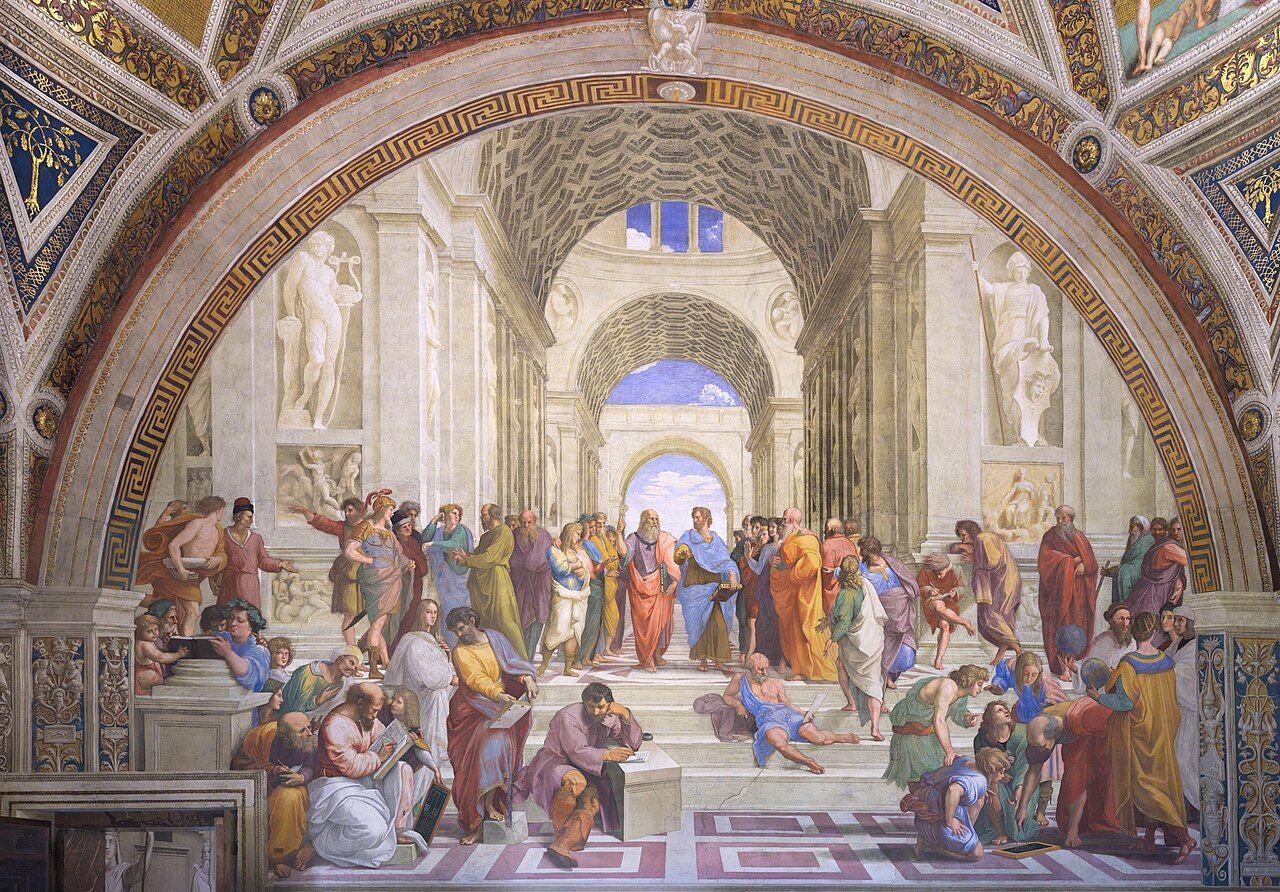
The engineering of appearance
Something changed in Italian painting between about 1400 and 1430 that is visible to anyone, expert or not: figures acquire weight, floors recede, light falls from a single direction, and the picture stops being a gold surface and becomes a window. That change was technical before it was philosophical.
The pivot was linear perspective. Filippo Brunelleschi (1377–1446), a goldsmith turned architect, demonstrated the principle sometime around 1413 with a painted panel of the Florence Baptistery, a small hole drilled through it and a mirror: viewers looked through the back of the panel at the reflection and could not distinguish painting from building. Leon Battista Alberti turned the trick into a teachable geometry in De pictura (1435, Italian version 1436), instructing painters to treat the picture as a cross-section of a visual pyramid and to run orthogonals to a single vanishing point at eye level. Masaccio (1401–1428) put it to devastating use in the Holy Trinity in Santa Maria Novella, painted about 1427, whose barrel-vaulted chapel appears to be cut into the actual wall.
Two other technical shifts matter as much. First, sculpture recovered contrapposto, the ancient device of shifting weight onto one leg so that hips and shoulders counter-rotate; Donatello’s bronze David, usually dated to the 1440s though the evidence allows anywhere from the 1420s to the 1460s, is generally called the first free-standing nude male statue since antiquity. Second, painters north and south adopted oil paint, worked out to a high standard in the Netherlands by Jan van Eyck and his contemporaries in the 1420s and 1430s. Oil dries slowly, allowing blending and correction, and it can be layered in translucent glazes that produce depth of color impossible in fast-drying egg tempera. Venetian painters, working on canvas in a damp lagoon city where fresco decayed, made oil the basis of a whole tradition of color that runs from Giovanni Bellini through Titian.
| Innovation | Decisive early use | What it changed |
|---|---|---|
| Linear perspective | Brunelleschi’s panel, c. 1413; Masaccio, Holy Trinity, c. 1427 | Pictorial space becomes measurable and unified; the viewer gets a fixed position |
| Oil glazing | Jan van Eyck, Arnolfini Portrait, 1434 | Deep saturated color, minute texture, slow correction of the surface |
| Contrapposto in free-standing bronze | Donatello, David, c. 1440s | Sculpture returns to the round; the body reads as alive and weighted |
| Chiaroscuro and sfumato | Leonardo, Virgin of the Rocks and Mona Lisa, c. 1483–1519 | Modelling by light and smoky transition rather than by outline |
| Ribbed double-shell dome without centering | Brunelleschi, Florence cathedral, 1420–1436 | Proves that ancient engineering could be equalled and surpassed |
Who paid, and what they bought
Almost no Renaissance artwork was made speculatively. Contracts survive in quantity and they are startling to modern eyes: they specify the pigments (ultramarine, ground from lapis lazuli imported through Venice, was priced by the ounce and named in the contract), the number of figures, the deadline, the penalty for lateness, and how much of the work the master must do with his own hand rather than delegating to the workshop. Confraternities, guilds, monastic houses, city governments, popes and private families all commissioned. The wool guild funded the cathedral dome. The Arte di Calimala paid for Ghiberti’s bronze baptistery doors, awarded by public competition in 1401 and finished, in the second set, in 1452.
The status of the artist rose across the period, but unevenly and by argument. Painters and sculptors began as guild craftsmen: painters in Florence were enrolled with the doctors and apothecaries because they bought pigments. Alberti, Leonardo and Vasari campaigned to redefine painting as a liberal art grounded in mathematics and invention, and by the sixteenth century the campaign had partly succeeded. Michelangelo (1475–1564) was addressed as il divino, negotiated with popes, and had two biographies published in his lifetime. That is a different social world from the one Giotto worked in.
Rome, Venice and the High Renaissance
By 1500 the center of gravity had shifted to Rome, where the papacy was rebuilding a city whose population had sunk to perhaps 20,000 during the Avignon years and had only begun to recover. Julius II (r. 1503–1513) began new St Peter’s in 1506, hired Michelangelo for the Sistine Chapel ceiling (1508–1512) and Raphael for the papal apartments (from 1509). Leo X, a Medici, continued the spending; the sale of indulgences that helped fund St Peter’s is one of the direct threads connecting Renaissance patronage to Luther’s protest in 1517, which Chapter 8 takes up.
Venice went another way. Its painters cared less about drawn contour and more about color, atmosphere and the female nude in landscape, and its patrons commissioned for private palaces and civic halls as well as churches. Titian (c. 1488–1576) built an international clientele that included Emperor Charles V and Philip II of Spain, and he did it largely with oil on canvas—portable, rollable, shippable. It is worth noticing that the medium that let art travel is the medium that let artists work for foreign kings.
Renaissance art looks new because artists solved concrete technical problems—perspective, oil, casting, dome construction—for patrons who were paying for prestige, salvation and civic advertisement.
Section 4Courts, Wars and the Politics of Reality
1494 and the end of Italian independence
The forty-year Italian equilibrium broke in September 1494, when Charles VIII of France marched an army of perhaps 25,000 men with a modern siege train of bronze cannon into Italy to claim the throne of Naples. Fortresses that had held out for months fell in days. Charles walked the length of the peninsula, and the Medici were expelled from Florence for letting him. What followed was sixty-five years of the Italian Wars, in which France, Spain and the Holy Roman Empire fought each other on Italian ground, with Italian states switching sides as survival required.
| Year | Event | Consequence |
|---|---|---|
| 1494 | Charles VIII invades; Medici expelled from Florence | Savonarola’s republic; the balance-of-power system collapses |
| 1498 | Savonarola tried, hanged and burned in Florence, 23 May | Republic survives without him; Machiavelli enters the chancery |
| 1509 | Venice crushed at Agnadello by the League of Cambrai | Venice nearly loses its mainland empire; recovers most of it by 1517 |
| 1512 | Spanish troops restore the Medici | Machiavelli dismissed, imprisoned, tortured; writes The Prince in 1513 |
| 1525 | Battle of Pavia: Francis I of France captured | Spanish and imperial dominance in Italy confirmed |
| 1527 | Sack of Rome by unpaid imperial troops | Roman artistic community scattered across Europe; deep cultural shock |
| 1559 | Peace of Cateau-Cambrésis | Spanish hegemony in Italy for over 140 years |
Between 1494 and 1498 Florence was governed under the moral influence of Girolamo Savonarola, a Dominican friar from Ferrara whose sermons predicted divine punishment and whose followers held the famous “bonfire of the vanities” in 1497, burning wigs, mirrors, playing cards, cosmetics and some books and paintings. Savonarola is a useful corrective to lazy pictures of the age: the same city that commissioned Botticelli produced mass public repentance, and Botticelli himself is reported to have been among the friar’s sympathizers. Excommunicated and abandoned, Savonarola was hanged and his body burned in the Piazza della Signoria on 23 May 1498.
Machiavelli and the separation of politics from moralizing
Niccolò Machiavelli (1469–1527) served the Florentine republic as second chancellor and diplomatic secretary from 1498 to 1512, watched Cesare Borgia at close range, and organized a citizen militia because he distrusted mercenaries. When the Medici returned in 1512 he was dismissed, implicated in a conspiracy, tortured with the strappado, and released into rural exile. In 1513 he wrote The Prince, a short handbook he hoped would get him a job. It did not. It was published in 1532, five years after his death, and placed on the papal Index in 1559.
The Prince is disturbing because of a single methodological move. Earlier “mirrors for princes” described the virtues a ruler ought to have. Machiavelli says he will describe instead the verità effettuale, the effective truth of the matter, and that a ruler who insists on being good among so many who are not will come to ruin. Hence the notorious conclusions: it is safer to be feared than loved if you cannot be both; a prudent ruler cannot and should not keep his word when keeping it would harm him; cruelty applied once and decisively is less cruel than cruelty spread out. He introduces virtù—not Christian virtue but skill, force and timing—set against fortuna, the tide of circumstance, which he says governs about half of what we do.
The last chapter is a passionate appeal to expel the “barbarians” from Italy, which is the key to reading the whole book: Machiavelli wrote as a patriot watching foreign armies march through his country at will. And his longer, more considered work, the Discourses on Livy, is a defense of republican government in which he argues that a free state needs the friction of class conflict, that citizen armies beat mercenaries, and that liberty depends on institutions rather than on good men. Scholars still disagree about how to reconcile the two books—whether The Prince is emergency advice, cynical job application, or covert republican satire—and you should be suspicious of anyone who tells you the question is settled.
Courts, manners and the question of women
Where Florence produced civic humanism, the smaller princely courts—Urbino, Mantua, Ferrara, Milan—produced a culture of refinement. Baldassare Castiglione’s Book of the Courtier, set in Urbino in 1507 and published in 1528, was translated across Europe and taught generations how to behave at court. Its central idea is sprezzatura: a studied nonchalance that conceals the effort behind every accomplishment, so that skill appears to be nature. It is the Renaissance ancestor of the modern instruction to make hard work look effortless, and it is a shrewd observation about how elites signal status.
Did women share in this rebirth? A minority did, and the record is real: Isabella d’Este (1474–1539), marchioness of Mantua, was a formidable collector, patron and political manager; Laura Cereta and Cassandra Fedele circulated Latin letters and delivered public orations in the 1480s and 1490s; Vittoria Colonna was a poet of high reputation and Michelangelo’s close friend; Sofonisba Anguissola (c. 1532–1625) spent more than a decade at the court of Philip II of Spain as painter and lady-in-waiting to the queen. But in 1977 the historian Joan Kelly asked “Did Women Have a Renaissance?” and answered no, at least for noblewomen: compared with their twelfth-century predecessors they lost economic independence, political function and sexual agency, while courtly ideals redefined them as chaste ornaments of male honor. Kelly’s argument has been qualified in the decades since—evidence on working women, widows, nuns and convent writers complicates it—but her core point stands as a permanent warning: a period is not “progressive” in general, only for particular people in particular ways.
The French invasion of 1494 destroyed Italian political independence and, in doing so, produced the period’s most unsentimental political thinking—Machiavelli’s attempt to describe power as it works rather than as it should.
Section 5Print, the North, and the Limits of Rebirth
What Gutenberg actually invented
Printing with carved blocks existed in East Asia centuries earlier, and Korean printers cast movable metal type before Europe did. Johannes Gutenberg’s achievement at Mainz, culminating in the 42-line Bible of about 1455, was a manufacturing system: an adjustable hand mould that let a workshop cast thousands of identical letters quickly, a lead-tin-antimony alloy that cast crisply and wore slowly, an oil-based ink that adhered to metal, and an adapted screw press. In an alphabet of a few dozen characters, this combination was transformative in a way it had not been for scripts with thousands of characters.
The scale-up was extraordinarily fast. Presses reached Italy at Subiaco in 1465, Rome by 1467, Venice by 1469, Paris by 1470 and London by 1476, and by 1500 more than 250 European towns had one. Surviving records list roughly 28,000 to 30,000 distinct editions printed before 1501—the incunabula—and total copies are usually estimated in the millions, though the figures depend heavily on assumptions about print runs and should be treated as orders of magnitude, not measurements. Venice became the industry capital; Aldus Manutius introduced italic type in 1501 and small, affordable octavo editions of the classics that a reader could carry.
| Aspect | Manuscript world, c. 1440 | Print world, c. 1500 |
|---|---|---|
| Production time | Months of copying per volume by hand | Hundreds of copies from one setting of type |
| Cost to a reader | A Bible could equal a year of a laborer’s wages | Falls roughly by a factor of ten or more for common texts |
| Errors | Each copy introduces new ones; texts drift apart | Errors are duplicated exactly—but so are corrections, and errata sheets appear |
| Who reads | Clergy, lawyers, notaries, wealthy laity | Adds artisans, merchants, schoolboys, some women of means |
| Political effect | Ideas travel at the speed of a copyist | A pamphlet can reach several countries in weeks |
Christian humanism north of the Alps
When humanist method crossed the Alps, it hit a different religious temperature and turned toward Scripture and reform. The northern movement is usually called Christian humanism, and its emblem is Desiderius Erasmus of Rotterdam (c. 1466–1536), the illegitimate son of a priest, an Augustinian canon who obtained release from the cloister and became the most widely read author in Europe. His Adages (1500, repeatedly expanded) made classical proverbs common property. His Praise of Folly (1511) satirized monks, theologians and popes with a wit sharp enough to be dangerous and elegant enough to be forgiven. His most consequential book was the 1516 Novum Instrumentum, the first Greek New Testament to be published, printed alongside a fresh Latin translation that showed readers where the Vulgate had gone astray. Erasmus called his program the philosophia Christi: a simple ethical Christianity grounded in the Gospels rather than in scholastic technicality.
Others worked the same seam. Thomas More published Utopia in 1516, a Latin fiction about an island commonwealth without private property whose exact ironies scholars still argue over. Cardinal Cisneros in Spain organized the Complutensian Polyglot Bible in parallel Hebrew, Greek and Latin columns; its New Testament volume was printed in 1514 and the set completed in 1517, but papal permission to circulate it came only in 1520, which is why Erasmus reached readers first. Jacques Lefèvre d’Étaples produced reforming biblical commentary in France. Albrecht Dürer (1471–1528) traveled to Venice, absorbed Italian proportion theory, and made his living from a northern medium he raised to the status of major art—the printed image, engraved and woodcut, sold in editions across Europe.
When Luther posted his objections in 1517, all of this was already in the air, and the printers were already in place. Erasmus, who wanted reform without schism, spent his last years attacked by both sides; he left Basel for Catholic Freiburg in 1529 when the city turned Protestant, returned in 1535, and died there the following year. The old jibe that Erasmus laid the egg that Luther hatched is unfair but not baseless.
How much of a rebirth was it?
Jacob Burckhardt’s Civilization of the Renaissance in Italy (1860) argued that the period saw the birth of the individual, of the state as a work of art, and of the modern secular outlook—that the medieval veil of faith and illusion melted away. It is a magnificent book and much of it has been dismantled. Charles Homer Haskins showed in 1927 that a genuine renaissance of law, philosophy and Latin letters had occurred in the twelfth century. Medievalists point out that individual self-awareness is visible in Abelard and Dante. Economic historians note that Italy’s commercial peak was before 1348, not after. Religious historians note that the age of Ficino and Pico was also an age of relic cults, astrology, witchcraft prosecutions and Savonarola.
What survives of the claim is more modest and more defensible. Between about 1350 and 1550 a durable change occurred in the European educational curriculum, in the visual conventions of representation, in the technology of textual reproduction, and in the willingness to date and criticize sources. Those four things persisted and compounded. Meanwhile the same decades saw Europeans enter the Atlantic slave trade, expel Jews from Spain in 1492, and begin the conquests treated in Chapter 9. The Renaissance was not a moral improvement in the human condition. It was a change in tools—of language, of vision, of reproduction—and tools serve whoever picks them up.
Printing turned a regional Italian scholarly movement into a European one, and the northern version aimed its philology at Scripture—setting up the religious rupture of the next chapter.
The chapter in one breath
The Renaissance was made possible by a disaster. Plague concentrated wealth in the hands of Italian merchants who lived in fiercely competitive city-states with no king to overshadow them, and those merchants, guilds, confraternities and popes spent extravagantly on chapels, palaces and libraries. Scholars beginning with Petrarch recovered classical Latin and then Greek, built a curriculum around rhetoric and history, and developed philology—a method sharp enough for Valla to prove the Donation of Constantine a forgery and to catch errors in the Church’s own Bible. Artists solved technical problems in sequence: perspective, oil glazing, bronze casting, dome construction, chiaroscuro, and in doing so changed what a picture is. Then, in 1494, French artillery ended Italian independence and produced Machiavelli’s cold analysis of power. Printing, meanwhile, carried the whole apparatus north, where Erasmus and his circle turned humanist method on Scripture. What resulted was not a moral rebirth—slavery, expulsions and witch trials belong to these same decades—but a durable transformation in Europe’s tools for seeing, arguing and reproducing knowledge.
Words worth knowing
| Term | What it means |
|---|---|
| Humanism | A Renaissance educational and literary program centered on classical languages, rhetoric, history and moral philosophy; not the same as modern secular humanism |
| Studia humanitatis | The five-subject humanist curriculum: grammar, rhetoric, poetry, history, moral philosophy |
| Philology | The study of language change used to date, authenticate and correct texts |
| Donation of Constantine | A forged charter granting papal temporal rule, exposed by Lorenzo Valla in 1440 on linguistic grounds |
| Civic humanism | The claim, associated with Bruni and Florence, that the classical ideal is active service to a free republic |
| Commune | A self-governing medieval Italian city with elected councils and guild participation |
| Signoria | Rule by one dominant lord or family, often preserving republican forms as a facade |
| Condottiere | A mercenary captain who supplied troops to Italian states under written contract |
| Usury | Lending at interest, condemned by canon law and evaded through exchange contracts and partnerships |
| Double-entry bookkeeping | Recording every transaction as both debit and credit; codified in print by Luca Pacioli in 1494 |
| Linear perspective | A geometric system projecting three-dimensional space onto a plane using orthogonals and a vanishing point |
| Contrapposto | A stance in which weight rests on one leg so hips and shoulders counter-rotate, giving figures life |
| Chiaroscuro | Modelling form through strong contrasts of light and shadow rather than outline |
| Sfumato | Leonardo’s technique of smoky, imperceptible transitions between tones |
| Sprezzatura | Castiglione’s studied nonchalance that hides the effort behind courtly accomplishment |
| Virtù and fortuna | In Machiavelli, effective skill and daring set against the roughly half of events governed by chance |
| Incunabula | Books printed in Europe before 1501, numbering roughly 28,000 to 30,000 known editions |
| Christian humanism | The northern movement applying humanist scholarship to Scripture and church reform |
| Philosophia Christi | Erasmus’s program of a simple, ethical Christianity drawn from the Gospels |
| Italian Wars | The conflicts of 1494–1559 in which France, Spain and the Empire fought over Italy, ending Italian independence |
Check yourself
Reformation and the Wars of Religion
In October 1517 an obscure professor of Bible in a small Saxon university town circulated a set of Latin debating points about indulgences. Within four years he had been excommunicated and outlawed; within a decade the Latin West had permanently split; within a century and a half the Holy Roman Empire had lost something close to a fifth of its people to the wars that followed. None of that was contained in the original document, and the work of this chapter is to explain how one led to the other without pretending the connection was simple or inevitable. We will look at what people actually believed and feared, at the printing shops and the credit markets, at princes who found theology useful and peasants who found it liberating, at the Catholic renewal that was not merely a reaction, and at the long, grinding wars that ended less in tolerance than in exhaustion. The Reformation is where religion, money, print and the modern state all collide.
By the end of this chapter you can
- Describe the condition of the late-medieval Church, distinguishing genuine grievances—simony, pluralism, absenteeism—from the assumption that popular piety was in decline.
- Explain the theology of purgatory and the treasury of merit, and show how the Albrecht of Mainz indulgence campaign turned doctrine into a financial instrument.
- State Luther’s core claims—justification by faith alone, sola scriptura, the priesthood of all believers—and trace his path from the Ninety-Five Theses (1517) to the Diet of Worms (1521).
- Assess the role of the printing press and vernacular Bibles in making this schism different from earlier ones.
- Compare the Lutheran, Reformed and Anabaptist movements on the Eucharist, church government and the use of force, using Zwingli, Calvin, Münster and the German Peasants’ War.
- Analyze the English Reformation as a sequence of state actions under Henry VIII, Edward VI, Mary I and Elizabeth I, including the Act of Supremacy and the Elizabethan Settlement.
- Evaluate the Catholic Reformation, the Council of Trent (1545–63) and the Society of Jesus, and explain why historians dispute the label “Counter-Reformation.”
- Explain the causes and settlements of the French Wars of Religion, the Dutch Revolt and the Thirty Years’ War, including the Edict of Nantes (1598) and the Peace of Westphalia (1648).
- Weigh the confessionalization thesis and the evidence on witch hunts, literacy and state power when judging what the Reformation actually changed.
Section 1A Church Under Strain, Not a Church in Decay
The vitality problem
Textbooks used to open this story with a corrupt, exhausted Church that a healthy reform movement swept away. Much of the evidence cuts against the first half. Around 1500 Europeans were building parish churches at a furious rate, endowing chantries, joining confraternities by the hundred thousand, walking to Compostela and Walsingham, and paying for more Masses than the clergy could physically say. Eamon Duffy’s The Stripping of the Altars (1992) argued from English parish records that traditional religion was flourishing right up to the moment the state dismantled it, and the book reset the field. It did not settle it. Critics answer that Duffy generalizes from unusually well-documented parishes, that endowments and bequests can record convention as easily as fervor, and that the anticlerical feeling evangelical pamphlets tapped so easily in the 1520s had to come from somewhere. Take the revisionist case as a strong challenge rather than a verdict. What both sides grant is the point that matters here: a dead institution collapsing explains nothing, and intense piety and intense anticlericalism are not opposites.
Structural grievances were concrete and long documented. Simony meant buying and selling church offices. Pluralism meant one man holding several benefices at once, and absenteeism meant he could not reside in all of them, so he hired an underpaid vicar to do the work. Clerical concubinage was widespread. Bishoprics in the Holy Roman Empire were dominated by noble families who treated them as property. German diets had been submitting formal complaints, the gravamina of the German nation, since the 1450s, and their central theme was money flowing across the Alps.
Purgatory, merit and the indulgence machine
To understand 1517 you must understand the doctrine it attacked, which was neither absurd nor a scam. Medieval theology distinguished the guilt of sin, forgiven through confession and absolution, from the temporal punishment still owed for it. Purgatory was where that debt was discharged after death. An indulgence remitted that punishment out of the treasury of merit—the superabundant merits of Christ and the saints, dispensed by papal authority. Given its public form in the Jubilee of 1300 and its doctrinal charter by Clement VI in 1343, the system had by 1500 travelled a long way from its origins: indulgences could be obtained without pilgrimage or hardship, applied to souls already in purgatory (an extension papally authorized in 1476), and printed by the thousand.
The campaign Luther attacked shows how theology and finance had fused. Albrecht of Brandenburg, aged twenty-three, already held two sees when the archbishopric of Mainz—the richest in Germany, carrying an electoral vote—fell vacant in 1514. The dispensation to hold three cost roughly 24,000 ducats, which he borrowed from the Fugger bank. Leo X, needing cash for St Peter’s, then licensed an eight-year indulgence campaign in Albrecht’s lands, proceeds split half to Rome and half to repay the Fuggers, a Fugger agent traveling along to guard the chest. The Dominican Johann Tetzel worked this circuit.
Reformers before the Reformation
Luther was not the first to say most of this aloud. The Oxford theologian John Wycliffe (c. 1328–84) attacked papal authority, questioned transubstantiation and promoted vernacular scripture; his followers, the Lollards, survived underground in England for a century. In Bohemia Jan Hus preached similar ideas, was granted an imperial safe-conduct to the Council of Constance, and was burned there in 1415 anyway—producing fifteen years of Hussite wars the empire could not win. That precedent mattered enormously in 1521, when Luther was offered a safe-conduct to Worms and everyone knew what had happened to the last man who took one. The Church, meanwhile, had spent the Great Schism (1378–1417) fighting itself, and fifteenth-century popes so thoroughly dismantled the conciliar movement that they left themselves no internal mechanism for reform.
Finally, the scholars. Lorenzo Valla proved in 1440 on linguistic grounds that the Donation of Constantine was a forgery. Erasmus of Rotterdam, the most famous intellectual in Europe, published the Novum Instrumentum in 1516: the Greek New Testament with a fresh Latin translation and notes, demonstrating that the Vulgate mistranslated key passages. Where the Vulgate had poenitentiam agite, “do penance,” the Greek said metanoeite, “change your mind,” or repent inwardly. That single philological point, which Valla had already raised and Erasmus buried in a scholarly annotation, quietly knocked away the main biblical proof-text for the sacramental system of penance. Luther’s first thesis in 1517 begins from it.
| Grievance | What it meant in practice | Who was harmed | Why it persisted |
|---|---|---|---|
| Simony | Offices bought and sold; entry fees (annates) paid to Rome on appointment | Able clergy without money or family; laity who got the buyer | Fees funded the papal court and princely dynasties alike |
| Pluralism and absenteeism | One man holding several benefices, resident in none, paying a substitute a fraction of the income | Parishes left with poorly trained vicars | Benefices were treated as property and family patrimony |
| Clerical ignorance | Many parish priests could recite the Mass but not explain it; few had university training | Laity seeking instruction and confession | No general system for training parish clergy existed until Trent ordered diocesan seminaries in 1563 |
| Indulgence sales | Commissioned preaching campaigns tied to building projects and bank debt | The poor, who paid on a sliding scale for the dead | Reliable revenue for popes, bishops and their creditors |
| Curial jurisdiction | Cases and appeals drawn to Rome, with fees at every stage | Local litigants; princes who wanted their own courts supreme | Canon law genuinely was a Europe-wide legal system |
Whatever else was wrong in 1517, the Church was not simply a corpse: late-medieval religion was demanding, expensive and, on the revisionist reading now dominant, intensely popular. What had failed was less belief than the institution’s capacity to reform itself.
Section 2Luther: From Debating Points to Schism
An anxious monk and a specific problem
Martin Luther was born in Eisleben in 1483, son of a copper-mining entrepreneur who wanted him to be a lawyer. He was studying law at Erfurt in July 1505 when a thunderstorm at Stotternheim knocked him down and he vowed to St Anne to become a monk. He entered the Augustinian friary two weeks later, was ordained in 1507, and by 1512 held a doctorate and the chair of biblical studies at Wittenberg, a provincial university founded by Frederick the Wise of Saxony in 1502.
What tormented him was not the corruption of Rome. It was the word righteousness. Luther had been trained in the via moderna, the late-medieval school associated with Gabriel Biel, which held that God accepts those who “do what is in them”—that a person who does his moral best will be granted grace. For a scrupulous man this was not comfort but terror, because there is no way to know whether you have done your best. Luther called these episodes Anfechtungen: assaults, spiritual panic attacks. He confessed for hours at a stretch; his superior Johann von Staupitz eventually told him to go and find a real sin to confess.
The resolution came out of lecturing on Psalms, Romans and Galatians between 1513 and 1518. Reading Romans 1:17—“the righteousness of God is revealed from faith to faith; the just shall live by faith”—Luther concluded that the phrase does not describe the standard by which God judges but the status God gives. Righteousness is not earned and then rewarded; it is imputed, received as a gift, and good works follow from it as fruit rather than producing it. This is justification by faith alone. He described the moment, decades later, as feeling that the gates of paradise had opened.
Historians argue about when this “tower experience” occurred and whether Luther’s retrospective account tidied a gradual development into a single flash. Heiko Oberman argued that Luther remained far more a late-medieval man—apocalyptic, devil-haunted, formed by nominalist categories—than the modern hero of private conscience that later admirers wanted him to be. That reading is now widely held but not universal, and it matters: on Oberman’s account the Reformation is the last great medieval reform movement rather than the first modern one.
1517 to 1521: how a faculty dispute became an outlawry
The Ninety-Five Theses, dated 31 October 1517, were Latin propositions for academics. They do not deny purgatory, reject the papacy outright, or mention justification by faith. They argue that indulgences breed false security, that the pope would empty purgatory out of love if he could, and that giving to the poor is better than buying a letter. Thesis 1 takes up Erasmus’s point that metanoeite means a whole life of repentance. Whether Luther nailed them to the Castle Church door is genuinely disputed. Erwin Iserloh argued in 1961 that the posting is a legend: no contemporary source mentions it, Luther never claimed it, and Melanchthon’s account was written after Luther was dead, by a man who had not yet arrived in Wittenberg in October 1517. Defenders reply that the door was simply the university notice board, that posting theses for a disputation was routine, and that a marginal note in the hand of Luther’s secretary Georg Rörer, found in 2006 in Rörer’s copy of the New Testament, supports it. What is certain is that on 31 October he sent the theses to Albrecht of Mainz and to his own bishop. What was also not routine was the speed—translated and reprinted in Nuremberg, Leipzig and Basel, they were read across the empire within two months.
Rome escalated in stages, and each stage radicalized him. Cardinal Cajetan interrogated him at Augsburg in October 1518 and demanded a bare recantation; Luther asked to be shown his error from scripture. At the Leipzig Disputation in the summer of 1519 the formidable Johann Eck maneuvered him into admitting that some of Hus’s condemned propositions were “most Christian and evangelical,” and therefore that a general council could err. That was the hinge. If popes can err and councils can err, then scripture alone stands as final authority—sola scriptura.
In 1520 Luther wrote three treatises that turned a quarrel about indulgences into a program. The bull Exsurge Domine that June condemned forty-one propositions and gave him sixty days to submit; on 10 December he burned it, along with volumes of canon law, outside Wittenberg’s Elster Gate. Excommunication followed in January 1521.
| Treatise (1520) | Audience and language | Central claim | Consequence |
|---|---|---|---|
| To the Christian Nobility of the German Nation | German princes, in German | The “three walls” Rome hides behind are false; all the baptized are priests, so laymen may summon a reforming council | Invited secular rulers to take charge of church reform |
| On the Babylonian Captivity of the Church | Theologians, in Latin | Of the seven sacraments only baptism and the Lord’s Supper survive the test of scripture, with penance folded back into baptism; the Mass is not a sacrifice offered by a priest | Dismantled the sacramental basis of clerical power; Erasmus said the breach was now irreparable |
| On the Freedom of a Christian | General readers, both languages | A Christian is a perfectly free lord, subject to none, and a perfectly dutiful servant, subject to all | Gave the movement its devotional heart—and a slogan peasants would soon read politically |
The Diet of Worms in April 1521 brought Luther before Charles V, a twenty-one-year-old ruling Spain, the Netherlands, Naples, the Austrian lands and the American conquests. Asked to recant, Luther took a day, then answered that unless convinced by scripture or plain reason he could not, since acting against conscience is neither safe nor honest. “Here I stand” appears in the printed version but not the earliest transcripts. The Edict of Worms made him an outlaw anyone might kill—but Charles left Germany within months for a decade of war with France and the Ottomans, and an emperor with no standing army and no bureaucracy inside the territories had no way to enforce the edict against a prince who declined to cooperate. Frederick the Wise staged a fake kidnapping and hid him in the Wartburg, where as “Junker Jörg” he turned Erasmus’s Greek New Testament into German in eleven weeks.
Print, vernacular scripture, and why this schism stuck
Wycliffe and Hus said comparable things and were contained. Luther was not, and the difference is the press. Movable type had been in Europe some sixty-five years by 1517, and the industry had spare capacity, distribution and an appetite for fast-selling titles. The Flugschrift—a quarto pamphlet of eight to thirty-two pages, printable in days, sold for about the price of a chicken—was the perfect vehicle. Treat figures as orders of magnitude, but German pamphlet output rose from a few hundred editions a year before 1517 into the thousands by the early 1520s, and Luther may have written a fifth of everything printed in German in that window.
Two further features mattered. Cranach’s woodcuts carried the argument to people who could not read, most brutally in the Passional Christi und Antichristi of 1521, which paired Christ washing feet with the pope having his kissed. And language: Luther’s German Bible—the September Testament of 1522, the complete Bible of 1534—was shaped, as he put it, by how the mother in the house and the common man in the marketplace actually spoke. It sold enormously and did more than any other book to standardize written German. Tyndale’s English New Testament followed in 1526, Olivetan’s French Bible in 1535, the Swedish Gustav Vasa Bible in 1541.
It is easy to overstate this. Print did not cause the Reformation; Catholic authors printed too, and simply chose Latin and scholarly formats for too long. Literacy across the empire was perhaps five to ten percent. But pamphlets were read aloud in workshops and marketplaces, so the audience always exceeded the readership. What print supplied was speed and irreversibility: by the time censorship responded, the ideas had entered a medium no bonfire could catch.
Luther’s breakthrough was personal and academic, but it survived where earlier reform movements were crushed because German princely politics shielded him and the printing press outran the Church’s capacity to suppress him.
Section 3The Reformation Multiplies: Peasants, Swiss, Radicals, Calvin
1525: the year the movement chose sides
Luther had said that a Christian is a perfectly free lord subject to no one. He meant it spiritually. Rural Germany, where serfdom was tightening, common woods and streams were being enclosed by lords, and new death duties were being invented, read it differently. Beginning in the summer of 1524 in the Black Forest and spreading across Swabia, Franconia, Thuringia and the Tyrol, the German Peasants’ War became the largest popular uprising in Europe before 1789, involving perhaps 300,000 people.
Its charter document, the Twelve Articles drafted at Memmingen in March 1525, is remarkable. It demands that each community elect and dismiss its own pastor, that the great tithe support that pastor and the poor while the small tithe be abolished, that serfdom end because Christ redeemed everyone, and that hunting, fishing and woodcutting rights be restored. Each demand is argued from cited scripture, and the document closes with an offer: show any of these articles to be contrary to the word of God and it will be withdrawn. Printed in some twenty-five editions within two months, it is among the first documents in European history to justify concrete social demands from the vernacular Bible.
Luther’s response destroyed his standing with the rural poor. An Admonition to Peace blamed the princes for provoking the revolt but denied that any Christian may take up the sword against authority. Then, as risings turned violent under the apocalyptic preacher Thomas Müntzer, he published Against the Robbing and Murdering Hordes of Peasants, urging rulers to stab, smite and slay. At Frankenhausen on 15 May 1525 Müntzer’s force of perhaps 8,000 was annihilated by professional cavalry and artillery in about an hour, at the cost of a handful of casualties on the princes’ side; he was tortured, then beheaded twelve days later. Estimates of the dead run from 70,000 to 100,000.
The consequences shaped everything after. The Reformation in the empire became magisterial—carried out by magistrates, princes and city councils, dependent on their protection, defined by their territorial borders. Luther’s two kingdoms doctrine, distinguishing the spiritual realm ruled by the gospel from the temporal realm ruled by the sword, hardened into a theology of obedience to constituted authority. How far that inheritance shaped later German politics is a genuinely open question; the once-popular straight line from Luther to twentieth-century authoritarianism is now rejected by most specialists as far too neat. And the socially radical strand of reform was driven underground, where it became something else entirely.
Zürich, Marburg, and the fracture over bread
The Swiss Reformation began independently. Huldrych Zwingli, people’s priest at the Grossmünster in Zürich from 1519, reached his positions through Erasmian humanism and preaching straight through the New Testament. Zürich was a republic, so reform proceeded by council vote: the “affair of the sausages” in Lent 1522, the Sixty-Seven Articles of 1523, images gone in 1524, the Mass in 1525, the organ silenced. Where Luther retained whatever the Bible did not forbid, the Reformed removed whatever it did not command—which is why a Saxon church still looks Catholic and a Genevan one is a whitewashed room with a pulpit.
The split became formal over the Eucharist. Luther, reading “this is my body” literally, held that Christ is truly and bodily present in, with and under the bread and wine—not transubstantiation, but real bodily presence. Zwingli read “is” as “signifies” and treated the Supper as a memorial. Philip of Hesse, wanting a united Protestant alliance, brought them together at the Marburg Colloquy in October 1529. They agreed on fourteen of fifteen articles and deadlocked on the fifteenth; Luther is said to have chalked hoc est corpus meum on the table and refused to move. Protestantism has had no single body since. Zwingli died two years later at Kappel, and the Catholic cantons quartered and burned his corpse.
The radicals: rebaptism, Münster, and the pacifist turn
In Zürich, some of Zwingli’s own students concluded he had stopped too soon. If the church consists of true believers, infant baptism is meaningless, because an infant cannot believe. On 21 January 1525 Conrad Grebel baptized Georg Blaurock in a private house, and the others followed. Opponents called them Anabaptists—rebaptizers—a name they rejected, since in their view the infant ceremony had never been a baptism. Rebaptism was capital under a Roman law of 529 still on the books, and Protestant and Catholic authorities alike used it: Felix Manz was drowned in the Limmat in 1527, an execution the magistrates found grimly witty.
The mainstream of the movement, defined by the Schleitheim Articles of February 1527, was radically separatist and non-violent: believers’ baptism, a gathered church disciplined by the ban, refusal of the oath, refusal of the magistracy, and complete withdrawal from the sword. Michael Sattler, who drafted them, had his tongue cut out and was burned three months later.
Then came Münster, which is why everyone remembers Anabaptists as fanatics. In 1534 apocalyptic preachers seized that Westphalian city, expelled or rebaptized the population and declared it the New Jerusalem. The tailor Jan van Leiden proclaimed himself king, abolished private property and imposed polygamy, taking sixteen wives and beheading one who objected. The prince-bishop retook the city in June 1535; in January 1536 the surviving leaders were publicly tortured to death and their bodies hung in iron cages from St Lambert’s tower, where the cages still hang. Afterward Menno Simons gathered survivors around a strictly pacifist discipline, giving us the Mennonites.
Calvin and Geneva
The second generation belongs to John Calvin, born at Noyon in Picardy in 1509, trained in law at Orléans and Bourges and in classics in Paris. After a “sudden conversion” he never described in detail, and after the Affair of the Placards in October 1534 made France unsafe for evangelicals, he fled to Basel and in March 1536 published the first edition of the Institutes of the Christian Religion—six chapters, pocket-sized, meant as a primer. He revised it for the rest of his life; the definitive Latin edition of 1559 runs to four books and eighty chapters. It is the most systematically organized theology of the Reformation, which is the main reason Calvinism traveled so well: it could be taught.
Detoured through Geneva in 1536, Calvin was browbeaten into staying by Guillaume Farel, expelled in 1538, and returned in 1541 on his own terms after three formative years in Strasbourg with Martin Bucer. The Ecclesiastical Ordinances established four offices—pastors, doctors, elders, deacons—and the Consistory, which summoned citizens for drunkenness, fornication, dancing and absence from sermons and could bar them from communion but not imprison them. Geneva was no theocracy in the strict sense; Calvin was a salaried employee, not a citizen until 1559. John Knox called it the most perfect school of Christ since the apostles. The hardest case is the anti-Trinitarian physician Michael Servetus, tried and burned in October 1553. The sentence was passed by Geneva’s Small Council, a body in which Calvin held no office and no vote; he supplied the evidence, argued the case against him, and asked without success that the man be beheaded rather than burned. Whether that makes Calvin the executioner, an accomplice or an expert witness in a trial he did not control is still argued, and the argument has been carried on for four centuries by people with a stake in the answer. What is not argued is the reception: Catholic and Protestant Europe alike approved, and the one loud dissent, Sebastian Castellio’s, observed that to kill a man is not to defend a doctrine but simply to kill a man.
Predestination is what Calvin is remembered for, though it is not where the Institutes begins. Since salvation is entirely God’s free gift, his choice must precede and cause faith rather than answer it; if some are chosen, the rest are passed over. Calvin called this a dreadful decree. What it did to the people who believed it is disputed. Max Weber argued in 1904–05 that it produced not fatalism but driving conscientiousness, as believers looked for evidence of election in disciplined, productive lives, and that this “Protestant ethic” helped make modern capitalism. The thesis has never stopped being contested: Catholic Antwerp, Augsburg and northern Italy had sophisticated capitalism first, pastors’ casebooks record as much anxiety as assurance, and economists have argued that the later Protestant economic advantage tracks Bible-driven literacy rather than any distinctive attitude to work.
| Position | Lord’s Supper | Church and state | Who governs the church | Baptism |
|---|---|---|---|---|
| Catholic | Transubstantiation; Mass is a sacrifice | Two swords; clergy exempt from lay courts | Pope and bishops | Infants; necessary for salvation |
| Lutheran | Real bodily presence in, with and under the elements | Two kingdoms; prince as emergency bishop | Prince and territorial superintendents | Infants |
| Reformed (Zwingli, Calvin) | Memorial (Zwingli) or spiritual feeding by the Spirit (Calvin) | Distinct spheres, mutually accountable; church disciplines its own | Pastors and lay elders in consistory and synod | Infants, as covenant sign |
| Anabaptist | Memorial meal of a gathered community | Total separation; refusal of oath, office and sword | The congregation | Believing adults only |
Meanwhile the empire settled its quarrel by force and then treaty. The Lutheran princes formed the Schmalkaldic League in 1531; Charles V crushed them at Mühlberg in 1547 and still could not impose uniformity, because the victory frightened the German princes of both confessions into seeing him as a threat to their own liberties: in 1552 Maurice of Saxony, the Lutheran ally whose defection had won him the war, switched sides again with subsidies from Catholic France and nearly captured him at Innsbruck. The Peace of Augsburg of 1555, summarized by later jurists as cuius regio, eius religio—a phrase that appears nowhere in the treaty itself—let each prince choose Lutheranism or Catholicism, dissenters free to emigrate. It made no provision for Calvinists, about to become the empire’s most dynamic confession. Augsburg did not end the German religious question; it postponed it for sixty-three years.
Once scripture alone was the authority, no one could control who read it: the movement split within a decade into princely Lutheranism, disciplined Reformed churches and persecuted radical congregations, and the 1555 compromise that froze the German split left out the group most likely to break it.
Section 4England’s Statutory Reformation and the Catholic Renewal
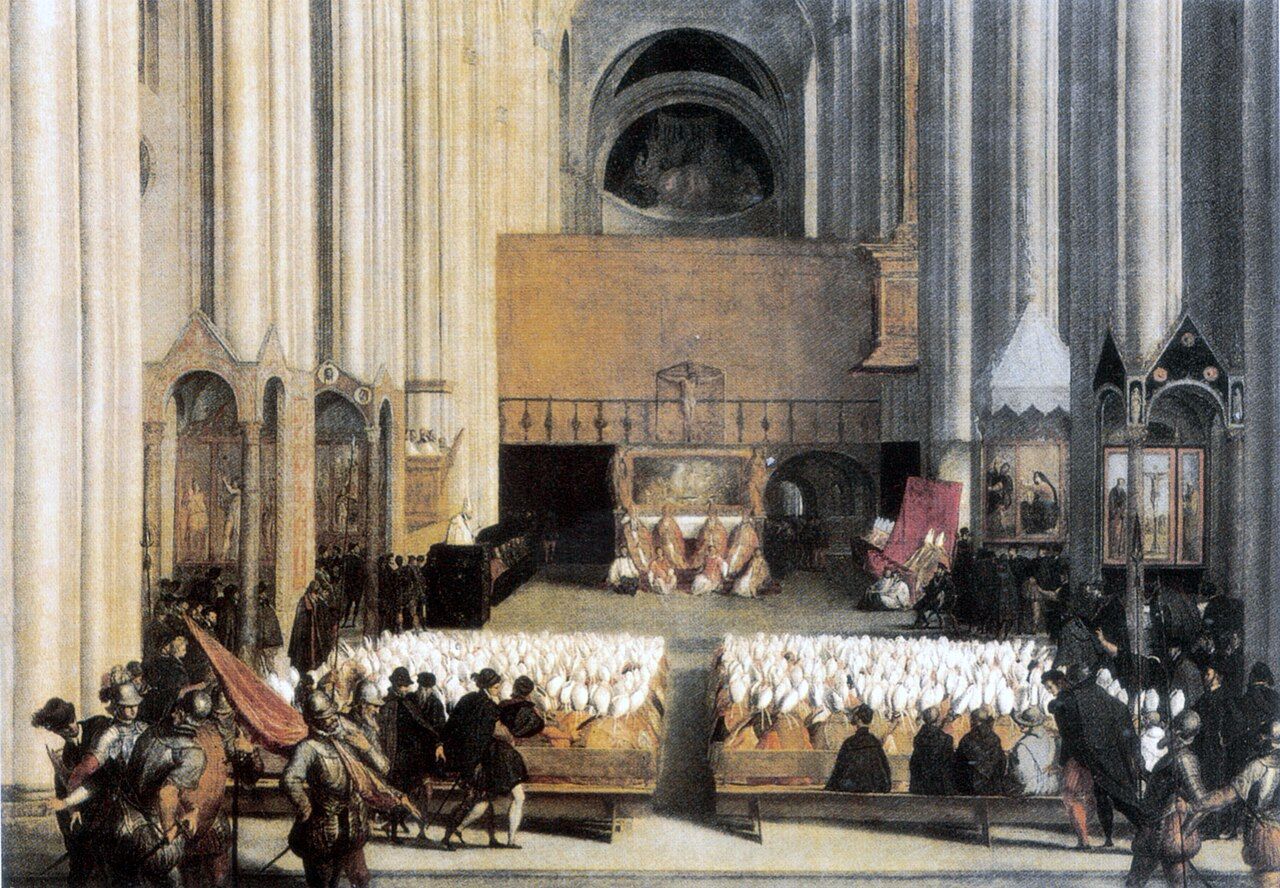
Henry VIII: a schism without a theology
The English Reformation began as a jurisdictional dispute, not a doctrinal one. Henry VIII had written—or at least signed—a defense of the seven sacraments against Luther in 1521, for which Leo X named him Defender of the Faith. His problem was dynastic. Catherine of Aragon had given him a surviving daughter, Mary, and no son; England’s only previous experiment with a female ruler had produced civil war. Henry wanted his marriage annulled on the grounds that Leviticus forbids marrying a brother’s widow, and that the dispensation Julius II had granted in 1503 was therefore invalid.
In ordinary times a king might have got this. But in 1527 imperial troops sacked Rome, leaving Clement VII in the power of Charles V—Catherine’s nephew. Wolsey fell in 1529 for failing to deliver. Thomas Cromwell then supplied a bolder solution: if Rome would not grant it, England would remove Rome by statute. The Act in Restraint of Appeals of 1533 declared that “this realm of England is an empire,” subject to no foreign jurisdiction, so Archbishop Thomas Cranmer could rule on the marriage himself. The Act of Supremacy of 1534 made the king Supreme Head of the Church of England; More and Fisher were beheaded in 1535.
The Dissolution of the Monasteries between 1536 and 1540 was the reign’s most consequential act, and its motives were substantially fiscal. Roughly 800 houses were closed and their lands—perhaps a sixth of England’s landed wealth—taken by the crown, which sold most within a decade to gentry and merchants, creating a propertied class with a direct stake in never restoring Catholicism. It also swept away in a single decade much of England’s hospital provision, schooling, library holdings and organized charity, though how much the monasteries had actually still been providing by the 1530s is one of the sharper disputes in the field. The Pilgrimage of Grace of 1536 put 30,000 northerners in the field; Henry negotiated, promised a parliament, then hanged the leaders. He died in 1547 head of a church Catholic in belief and papal-free in law.
Edward, Mary, Elizabeth: three settlements in eleven years
Under the boy king Edward VI (1547–53), Cranmer moved fast. Chantries were dissolved, images removed, clerical marriage permitted, and—his enduring achievement—the Book of Common Prayer appeared in English in 1549, revised in a markedly more Protestant direction in 1552. Its cadences shaped the language for four centuries. Its imposition also provoked the Western Rebellion of 1549 in Devon and Cornwall, where protesters complained the new service was “like a Christmas game” and where many spoke Cornish and found English no more intelligible than Latin.
Mary I (1553–58) reversed everything, restored papal obedience, and burned close to 285 Protestants, including Cranmer, Latimer and Ridley. By the standards of continental persecution the numbers are modest; the political effect was catastrophic for her cause, because John Foxe’s Acts and Monuments of 1563—the “Book of Martyrs,” chained in parish churches beside the Bible—fixed the identification of Catholicism with foreign cruelty in the English mind for centuries. Her marriage to Philip II of Spain and the loss of Calais compounded the damage.
Elizabeth I (1558–1603) built the settlement that lasted. The Acts of Supremacy and Uniformity of 1559 made her Supreme Governor rather than Head, restored a revised Prayer Book, and required parish attendance under a modest fine; the Thirty-Nine Articles of 1563 defined doctrine in broadly Reformed but carefully ambiguous terms. She is often credited with a deliberate via media, a phrase popularized by nineteenth-century Anglicans hunting a usable ancestry. Her settlement was less a principled middle way than a workable one—Protestant doctrine in a traditional shell, enforcing outward conformity while declining to make windows into men’s souls.
That tolerance was conditional, and politics ended it. Pius V’s bull Regnans in Excelsis of 1570 excommunicated Elizabeth and released her subjects from allegiance, turning every English Catholic into a potential traitor; after seminary priests arrived in 1574 and Jesuits in 1580, recusancy fines rose steeply and some 180 Catholics were executed. Puritans pressed from the other flank. Historians once called the English Reformation rapid and popular—A. G. Dickens in 1964—but revisionists led by Christopher Haigh and Eamon Duffy argue from wills and parish accounts that it was slow, resisted and imposed over generations. The debate is unsettled.
Catholic renewal: not simply a reaction
Calling everything Rome did after 1517 the “Counter-Reformation” makes it sound purely reactive. Much of it was not. The Spanish church had been overhauled by Cardinal Cisneros from the 1490s, with a reformed episcopate, a new university at Alcalá and the Complutensian Polyglot Bible. The Oratory of Divine Love, the Theatines of 1524, the Capuchin reform of 1528 and Angela Merici’s Ursulines of 1535—the first order of women dedicated to teaching girls—all grew from Catholic roots. Hubert Jedin proposed using both terms: Catholic Reformation for internal renewal, Counter-Reformation for the deliberate campaign against Protestantism. Most historians now use his double formula, and some prefer “early modern Catholicism” to escape the argument altogether.
The most consequential new order was the Society of Jesus. Íñigo López de Loyola was a Basque soldier whose leg was shattered at Pamplona in 1521; convalescing with nothing to read but a life of Christ and a book of saints, he resolved to compete with the saints as he had once competed with courtiers. A year at Manresa produced the Spiritual Exercises, a structured four-week retreat of guided imaginative meditation. He then spent eleven years acquiring an education, gathered six companions at Paris who took vows at Montmartre in 1534, and saw Paul III approve the Society in 1540.
The Jesuits were built differently from monastic orders: no choir office, no distinctive habit, mobility instead of enclosure, a fourth vow of obedience to the pope regarding missions, and a long, selective formation. They became Europe’s teachers, running roughly 200 colleges by 1600 under the standardized Ratio Studiorum of 1599 and educating Catholic elites largely free of charge. Francis Xavier reached Goa in 1542 and Japan in 1549; Matteo Ricci entered China in 1583 and mastered Confucian scholarship to argue Christianity in its own terms. Their record is genuinely mixed—brilliant intercultural adaptation alongside deep entanglement with colonial power—and Chapter 9 takes that up.
The Council of Trent
The Council of Trent met in three periods—1545–47, 1551–52 and 1562–63—delayed repeatedly by war, plague and the conflicting interests of pope, emperor and French king. It was small by conciliar standards; fewer than forty bishops attended some early sessions, and Italians dominated throughout. It did two distinct things.
Doctrinally, it closed every door Protestants had opened. Session 4 declared that revelation comes through scripture and unwritten apostolic tradition, and made the Vulgate the authentic text. Session 6, on justification, was the most carefully drafted: it affirmed that grace initiates salvation and that no one merits the first grace, but insisted that justification actually transforms the person rather than merely covering them, and that faith formed by love, cooperating freely, genuinely merits an increase of grace. Later sessions reaffirmed all seven sacraments, transubstantiation, the Mass as a true sacrifice, purgatory, indulgences and the veneration of saints and images—though Session 21 in 1562 abolished the office of the licensed indulgence-seller, the closing session of 1563 condemned all money-gains attached to indulgences, and Pius V in 1567 revoked every indulgence attached to a fee.
Disciplinarily, and arguably more importantly, it forced bishops to reside in their dioceses, ordered every diocese to found a seminary to train priests, required parish registers, mandated preaching and catechesis, and—through the Tametsi decree—required marriages to be contracted publicly before a parish priest and two witnesses, ending centuries of disputed clandestine marriages. Combined with the Roman Inquisition (1542), the Index of Prohibited Books (1559 and 1564), the Roman Catechism, and a revised Missal and Breviary, this produced a far more uniform, better-instructed and more tightly supervised church than the one Luther had attacked.
| Issue | Protestant position (broadly) | Trent’s definition |
|---|---|---|
| Authority | Scripture alone | Scripture and unwritten apostolic tradition, received with equal reverence |
| Justification | By faith alone; righteousness imputed | By grace, received in baptism, genuinely transforming; faith working through love truly merits increase |
| Sacraments | Two (baptism, Lord’s Supper) | Seven, instituted by Christ, conferring grace by the act performed |
| Eucharist | Memorial or spiritual or real presence, but not a sacrifice | Transubstantiation; the Mass is a true propitiatory sacrifice |
| Bible text and language | Original Hebrew and Greek; vernacular translation essential | Vulgate authentic; vernacular liturgy rejected, vernacular Bibles restricted |
| Clergy | Married, trained, the priesthood of all believers | Celibate, seminary-trained, resident, sacramentally distinct |
England broke with Rome by act of parliament for dynastic reasons and only gradually acquired a Protestant theology, while Rome answered the schism with a renewal that was partly older than Luther and that hardened Catholic identity as much as it reformed Catholic practice.
Section 5The Wars of Religion and the Peace of Exhaustion
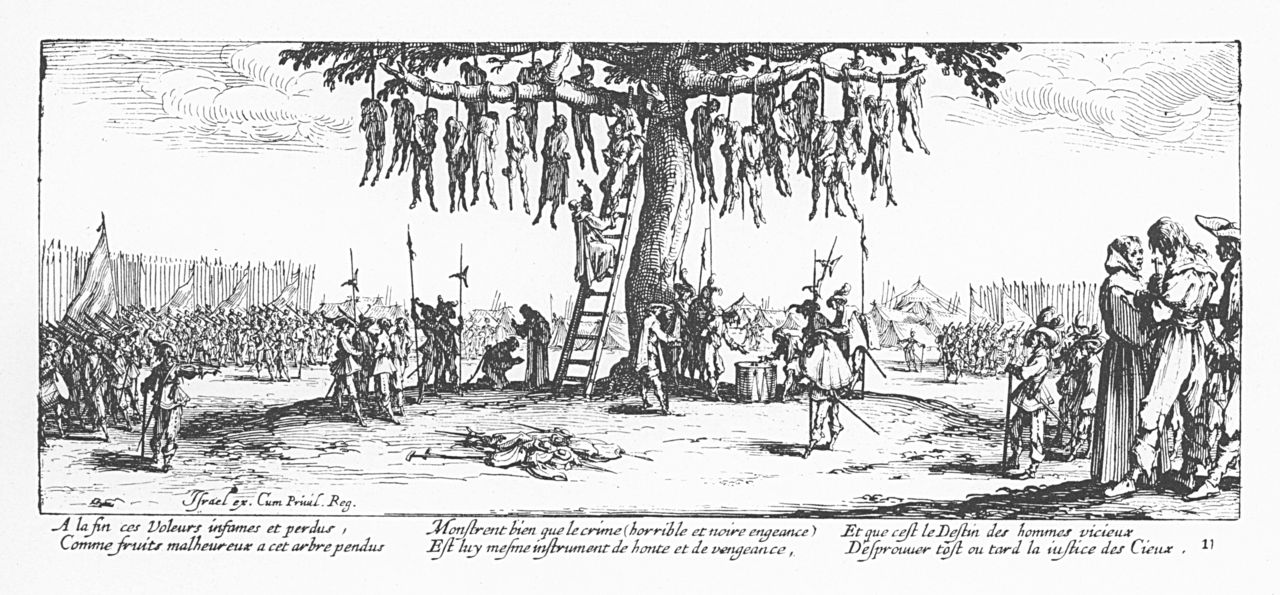
France: eight wars, one massacre, one edict
France had perhaps two million Huguenots—French Calvinists—by 1562, under a tenth of the population but concentrated in southern and western towns and, decisively, among the nobility, where the proportion may have reached a third. Noble converts brought armed clienteles, so a religious minority became a military one. The crown, weakened by Henry II’s accidental death in a tournament in 1559 and a run of young kings, could not control three great houses—the Catholic Guise, the Protestant Bourbon, the wavering Montmorency—maneuvering around the queen mother Catherine de’ Medici.
The wars began in March 1562 when the duke of Guise’s men killed Huguenot worshippers in a barn at Vassy, and ran in eight rounds until 1598. The defining atrocity was the St Bartholomew’s Day massacre. In August 1572 Paris was full of Huguenot nobility for the wedding of Henry of Navarre to the king’s sister. After a botched attempt on Admiral Coligny, the court authorized a strike on the Huguenot leadership on the night of 23–24 August; a targeted killing became general slaughter as militia and crowds took over. Perhaps 2,000 to 3,000 died in the capital and thousands more as it spread to provincial cities.
The massacre changed Huguenot political thought. Writers called monarchomachs—Hotman, Beza, the anonymous Vindiciae contra tyrannos of 1579—argued that kings hold power under contract, that lesser magistrates may lawfully resist a tyrant, and that a ruler who breaks covenant may be deposed. These resistance theories reappear in the Dutch Act of Abjuration, the English Civil War and eventually 1776—an irony worth noting, since their authors wanted a godly kingdom, not a liberal one.
The same decades produced the politiques: Catholics such as the chancellor Michel de L’Hôpital and the jurist Jean Bodin who concluded that the survival of the state must take priority over religious uniformity. Bodin’s Six Books of the Commonwealth (1576) defined sovereignty as a single, indivisible, perpetual power to make law—the theoretical foundation of the absolutism of Chapter 10, and a direct product of civil war.
The knot was cut by heredity. When the last Valois king was assassinated in 1589 the heir was Henry of Navarre, a Protestant who could win battles but not take Paris. In July 1593 he converted—“Paris is worth a Mass” is almost certainly not his—and in April 1598 issued the Edict of Nantes. It is no declaration of religious freedom: Catholicism remained the state religion, while Huguenots got conscience everywhere, public worship only in named places, civil rights, mixed court chambers and, by the secret articles, roughly a hundred fortified places of safety, the most important of them garrisoned at royal expense. It was a treaty with an armed minority. Ravaillac stabbed Henry to death in 1610; Louis XIV revoked the edict in 1685.
The Dutch Revolt
The Netherlands were seventeen wealthy, urbanized, jealously privileged provinces that Charles V had inherited from his Burgundian ancestors and rounded out by conquest, and that Philip II then ruled through regents from Spain. Philip raised taxes, reorganized the bishoprics to tighten control, and enforced heresy laws against a growing Calvinist minority. In August 1566 the Beeldenstorm swept the country as crowds smashed images in hundreds of churches. Philip sent the duke of Alba with 10,000 troops and a tribunal, the Council of Troubles, which condemned over a thousand people; the counts of Egmont and Hoorn, both Catholic noblemen, were beheaded in 1568 for insufficient zeal, persuading many that this was an attack on Netherlandish liberties as such.
Revolt became viable when the Sea Beggars seized Brielle in April 1572 and Holland and Zeeland declared for William of Orange. Spain won most battles and lost the war to water, walls and money: the Dutch flooded polders to break sieges, and unpaid Spanish troops mutinied and sacked Antwerp in 1576. The revolt split along a military line—the Union of Arras reconciling the south, the Union of Utrecht binding the north, both 1579—and the Act of Abjuration of 1581 deposed Philip on the grounds that a prince who treats subjects as slaves forfeits his office. The republic survived William’s assassination in 1584, won a truce in 1609 and recognition in 1648.
The Thirty Years’ War
The Peace of Augsburg finally failed in Bohemia. In May 1618 Protestant nobles threw two royal governors and a secretary out of a window of Prague Castle—the Defenestration of Prague—after the guarantees of worship granted in Rudolf II’s Letter of Majesty of 1609 were withdrawn; they survived the fall, on a dung heap or by angelic intervention depending on the pamphlet. The nobles deposed the Habsburg Ferdinand as king of Bohemia and elected the Calvinist Elector Palatine, Frederick V. Since Bohemia carried an imperial electoral vote, this threatened a Protestant majority in the college that chose the emperor. Ferdinand crushed Frederick at the White Mountain in November 1620, executed twenty-seven leaders in the Old Town Square, confiscated half the land in Bohemia and re-Catholicized the kingdom by force.
It should have ended there. Instead it widened phase by phase, as each defeated Protestant party was replaced by a larger foreign power afraid of Habsburg dominance. Two features made it uniquely destructive. Armies grew far beyond what any state could pay—Wallenstein raised 100,000 men and financed them by systematic “contributions” extracted from occupied territory, institutionalizing plunder. And unpaid troops living off the land spread famine and typhus far more efficiently than they fought battles. The sack of Magdeburg in May 1631 killed some 20,000 of 25,000 inhabitants and became the century’s byword for atrocity.
| Phase | Dates | Main challenger | Turning point | Outcome |
|---|---|---|---|---|
| Bohemian | 1618–25 | Bohemian estates, Frederick V | White Mountain, 1620 | Habsburg victory; Bohemia forcibly re-Catholicized |
| Danish | 1625–29 | Christian IV of Denmark | Wallenstein’s victories; Edict of Restitution, 1629 | Habsburg high-water mark; Catholic princes alarmed by imperial power |
| Swedish | 1630–35 | Gustavus Adolphus, subsidized by France | Breitenfeld 1631; Gustavus killed at Lützen 1632 | Protestant north saved; Sweden checked at Nördlingen 1634 |
| French | 1635–48 | France under Richelieu, then Mazarin | Rocroi, 1643 | Habsburg hegemony broken; negotiated settlement |
The French phase exposes what the war had become. Cardinal Richelieu, a prince of the Roman Church and first minister of the most populous Catholic kingdom in Europe, subsidized Lutheran Sweden from 1631 and declared war on Catholic Spain in 1635, because containing Habsburg power mattered more than confessional solidarity. That is raison d’état, and its open practice is one reason historians treat 1648 as a turning point.
The Peace of Westphalia was negotiated simultaneously at Catholic Münster and Protestant Osnabrück and signed in October 1648. It extended Augsburg to include Calvinists, set 1 January 1624 as the “normative year” fixing each territory’s legal confession, granted minorities private worship and rights of emigration, recognized Dutch and Swiss independence from the Empire, and let the imperial estates make their own alliances. The demographic cost was staggering, though smaller than the figure textbooks long repeated. Older accounts, following seventeenth-century chroniclers, said Germany lost a third or even half its people. Modern regional work in tax lists and parish registers has revised that down: the Empire’s population fell from roughly twenty million to about sixteen or seventeen, a loss near a fifth, distributed with brutal unevenness—Württemberg, Pomerania and Mecklenburg lost half or more, while parts of the northwest were barely touched.
Witches, literacy, and what the century actually produced
The great European witch hunts peaked between roughly 1560 and 1630, exactly overlapping the confessional wars. Careful modern estimates, built from surviving court records rather than from rhetoric, put the total at roughly 90,000 to 110,000 prosecutions and 40,000 to 60,000 executions across three centuries, perhaps half in the fragmented Holy Roman Empire, with 75 to 80 percent of victims women. The often-repeated figure of nine million traces back to Gottfried Christian Voigt, who in 1784 extrapolated from the records of one town to the whole of Europe; it has no evidentiary basis and was recycled first by nineteenth-century anticlericals and later by writers who found it useful.
Two corrections matter. This was not a medieval phenomenon: the Middle Ages generally treated belief in night-flying witches as superstition, and the great hunts belong to the early modern period, contemporary with the Scientific Revolution. Nor was it simply Catholic: Lutheran, Calvinist and Catholic jurisdictions all hunted, while the Roman and Spanish Inquisitions, with trained judges and strict evidentiary rules, were markedly more skeptical than local secular courts. The worst panics came where central judicial supervision was weakest and torture unregulated, in small prince-bishoprics such as Trier, Würzburg and Bamberg. Salem in 1692, with twenty executions, was tiny by these standards.
On the other side of the ledger, confessional competition drove a real educational revolution. Every church that told believers to read the Bible had to teach them to read, and every church that catechized had to print catechisms. Lutheran Sweden ran household reading examinations that produced near-universal reading literacy by about 1700; Scotland’s reformers called for a school in every parish in 1560; Jesuit colleges did the same work on the Catholic side. Poor relief was reorganized on a civic basis as monastic charity vanished, and parish registers gave states unprecedented information about their populations.
That last observation is the core of the confessionalization thesis of Heinz Schilling and Wolfgang Reinhard: that Lutheran, Reformed and Catholic states did structurally parallel things—imposed creeds, standardized liturgy, policed morals, took over education and welfare, kept records—and that this built the disciplinary apparatus of the early modern state. It is powerful and it has real critics, who argue that it mistakes official prescription for social reality, understates how far ordinary people ignored or blended confessions, and fits Germany better than France, Poland or the Dutch Republic. The honest position is that confessionalization describes what governments attempted, and that success varied enormously.
Finally, toleration. It is tempting to end with the Reformation giving birth to religious freedom. It did not, or not directly. Nantes, Augsburg and Westphalia were armistices between armed confessions, and each treated a person’s religion as their ruler’s business. But armistices harden into habits. Once several confessions had survived a century of maximum violence without any being eliminated, the claim that uniformity was achievable lost its evidence and the claim that coercion was worth its cost lost its constituency. The principled case—Castellio in 1554, Dutch practice, Locke in 1689—grew in ground cleared by exhaustion.
A century of confessional warfare ended not with anyone’s victory but with settlements that accepted permanent religious division, and the lasting products were stronger states, wider literacy, and a grudging, pragmatic toleration that principle would only later justify.
The chapter in one breath
A vigorous, expensive and badly governed Church met a scrupulous professor who concluded that salvation is a gift rather than a wage, and a printing industry that could put that conclusion in front of Europe in a matter of weeks. Luther’s protest against indulgences in 1517 became a rejection of papal authority by 1520 and an outlawry at Worms in 1521, and it survived because German princes found an independent church politically useful. Once scripture alone was the standard, the movement fractured immediately: peasants read liberation into it and were massacred, Zwingli and Luther could not agree what bread is, Anabaptists concluded that the church must be voluntary and were drowned for it, and Calvin built in Geneva the disciplined, exportable model that carried Reformed Christianity to France, Scotland and the Netherlands. Rome answered with a renewal partly older than the crisis, defining doctrine at Trent and rebuilding practice through seminaries and the Jesuits. Then Europe fought about it for ninety years—in France, in the Netherlands, and in the Empire until 1648—and stopped only when victory proved impossible. The wreckage left stronger states, more literate populations, permanently divided churches, and a toleration born of fatigue.
Words worth knowing
| Term | What it means |
|---|---|
| Indulgence | Remission of the temporal punishment due for sins already forgiven, drawn from the Church’s treasury of merit; by 1500 routinely obtained by a payment. |
| Purgatory | The state after death in which the remaining debt of temporal punishment is discharged; the doctrine that gave indulgences their market. |
| Simony | Buying and selling church offices or spiritual goods, named for Simon Magus in Acts 8. |
| Pluralism and absenteeism | Holding several benefices at once and residing in none, delegating the work to poorly paid substitutes. |
| Justification by faith alone | Luther’s claim that God declares sinners righteous as a free gift received by faith, so good works follow salvation rather than earning it. |
| Sola scriptura | The principle that scripture is the sole final authority in faith, above popes, councils and tradition. |
| Priesthood of all believers | The doctrine that all the baptized share equal spiritual standing, so clergy differ in function rather than sacred status. |
| Ninety-Five Theses | Luther’s Latin propositions of 31 October 1517 challenging indulgence preaching, translated and printed across Germany within weeks. |
| Diet of Worms | The 1521 imperial assembly where Luther refused to recant before Charles V and was declared an outlaw. |
| Two kingdoms | Luther’s distinction between the spiritual realm ruled by the gospel and the temporal realm ruled by the sword, used to require obedience to rulers. |
| Anabaptists | Radical reformers who baptized only believing adults and mostly refused oath, office and sword; persecuted by Catholics and Protestants alike. |
| Predestination | The doctrine, systematized by Calvin, that God eternally elects the saved, so salvation rests on divine choice rather than human merit. |
| Consistory | The Genevan board of pastors and lay elders that supervised belief and morals and could bar offenders from communion. |
| Cuius regio, eius religio | “Whose realm, his religion”—a lawyers’ shorthand coined a generation after 1555 and not found in the treaty text, summarizing the Peace of Augsburg’s rule that each German prince set his territory’s confession, Lutheran or Catholic only. |
| Act of Supremacy | The 1534 statute making the English monarch Supreme Head of the Church of England, turning a marriage dispute into a permanent break with Rome. |
| Council of Trent | The Catholic council of 1545–63 that defined doctrine against Protestant claims and ordered seminaries, resident bishops and parish registers. |
| Society of Jesus | The order founded by Ignatius Loyola and approved in 1540, marked by mobility, papal obedience, the Spiritual Exercises, colleges and global missions. |
| Edict of Nantes | Henry IV’s 1598 grant of conscience, limited worship, civil rights and fortified towns to the Huguenots; revoked in 1685. |
| Peace of Westphalia | The 1648 treaties ending the Thirty Years’ War, recognizing Calvinism, fixing 1624 as the normative year, and confirming Dutch and Swiss independence. |
| Confessionalization | The thesis that Lutheran, Reformed and Catholic states alike built discipline, education and record-keeping around an enforced creed, strengthening the state. |
Check yourself
Exploration, Encounter and Empire
Between 1400 and 1700 the Atlantic Ocean stopped being an edge and became a highway. Portuguese captains crept down the African coast looking for gold and a way around the Muslim-controlled spice routes; Spanish crowns gambled on a westward shortcut and stumbled into two continents whose existence Europe had not imagined. What followed was not a tidy story of discovery. It was an entanglement: microbes, silver, sugar, enslaved people, printed maps, horses, potatoes and smallpox all moving in currents that no monarch controlled. Within a century the population of the Americas collapsed by perhaps eighty percent, West African societies were reorganized around a slave trade that would put roughly 12.5 million people on ships bound west, and Chinese demand for silver was pulling Bolivian ore across the Pacific. This chapter asks how a poor, fragmented, plague-scarred western peninsula of Eurasia ended up at the center of the first genuinely global economy — and at what cost, to whom.
By the end of this chapter you can
- Explain the technological, financial and religious preconditions — the caravel, the astrolabe, Ptolemaic cartography and the Reconquista — that made Iberian voyaging possible.
- Trace Portuguese expansion from Ceuta (1415) to Vasco da Gama’s arrival at Calicut (1498) and describe the trading-post empire model.
- Analyze why the conquests of the Aztec and Inca states succeeded, weighing epidemic disease, indigenous alliances and technology against the myth of European invincibility.
- Describe the Columbian Exchange and evaluate its demographic, ecological and nutritional consequences on four continents.
- Explain the labor systems of the Spanish Americas — encomienda, repartimiento, the mita — and the plantation chattel slavery of the Atlantic system.
- Assess the volume, organization and human cost of the transatlantic slave trade and the Middle Passage.
- Compare Spanish, Portuguese, Dutch, French and English imperial strategies, including the role of the joint-stock company.
- Evaluate competing explanations for the price revolution and the rise of mercantilism.
- Weigh the moral arguments raised at the time — by Bartolomé de las Casas, Juan Ginés de Sepúlveda and Michel de Montaigne — about conquest, slavery and human difference.
Section 1Why Europe Went to Sea
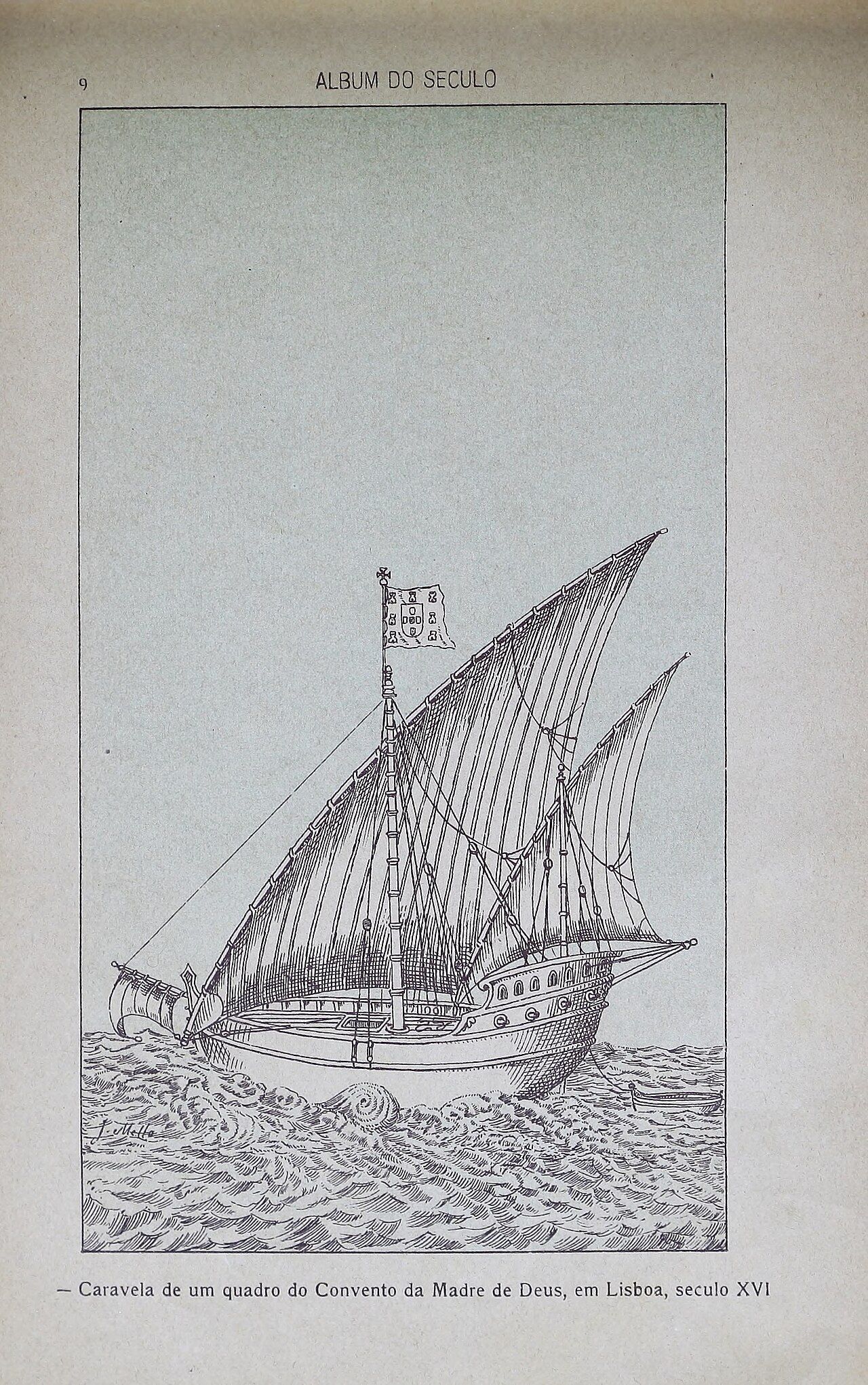
A poor continent with an expensive habit
It is worth starting with a correction. In 1400 Europe was not the wealthiest, largest or most technologically advanced region on earth. Ming China had a population roughly twice that of all Latin Christendom, a bureaucracy of examined officials, printing centuries older than Gutenberg’s, and between 1405 and 1433 sent Zheng He’s treasure fleets — ships far larger than anything Columbus commanded — as far as the Swahili coast. The Ottoman Empire was expanding, not contracting. The sultanates of India were wealthy, and within a century the Mughal and Safavid empires would be wealthier still. Europe was a peninsula recovering from the Black Death, fractured into hundreds of jurisdictions, and chronically short of what it wanted most: spices, silk, sugar and gold, all of which arrived through intermediaries.
That poverty was itself a motive. European buyers paid Venetian merchants, who paid Mamluk officials in Alexandria, who paid Indian Ocean traders. Every hand took a cut. Pepper that cost a few grams of silver in Calicut sold for many times that in Antwerp. The Ottoman capture of Constantinople in 1453 did not simply close the eastern routes — historians now emphasize that trade continued and the Ottomans were happy to profit from it — but it did sharpen the sense in Lisbon and Seville that the terms of trade were set by someone else. A sea route to the source would cut out every middleman at once.
Religion was tangled up with profit rather than separate from it. The Iberian kingdoms had spent nearly eight centuries in the intermittent campaigns later called the Reconquista, ending with the fall of Granada in January 1492. That long war produced a warrior nobility with no more Iberian frontier to conquer, a crusading vocabulary that framed expansion as holy work, and institutions — military orders, royal grants of conquered land, the Inquisition established in Castile in 1478 — that were exported almost intact to the Atlantic. The persistent legend of Prester John, a Christian king somewhere beyond the Muslim world who might be recruited as an ally, gave the search a strategic gloss.
The tools: caravel, compass, quadrant, chart
Almost none of the enabling technologies originated in Europe, and that matters. The magnetic compass came from China by way of the Indian Ocean; the astrolabe was a Greek instrument perfected by Islamic astronomers; the triangular lateen sail had been standard in Mediterranean and Indian Ocean shipping for centuries. What the Portuguese did was integrate them. The caravel, developed through the fifteenth century, was small (often 50 to 70 tons), shallow-drafted enough to nose into river mouths, and rigged with lateen sails that let it sail closer to the wind than square-rigged vessels. The larger carrack (Portuguese nau) carried cargo and guns for the long ocean crossings.
The decisive navigational discovery was not a device but a pattern. Sailing south along Africa, ships rode favorable winds and currents; returning north against them was nearly impossible. Portuguese pilots learned to swing far out into the Atlantic on the way home, catching westerlies in a great arc — the volta do mar, the turn of the sea. This counterintuitive move, sailing away from your destination to reach it, is what converted African exploration from suicide into commerce. Columbus later used the same logic across the Atlantic: out on the northeast trades, home on the westerlies.
Cartography was catching up unevenly. The recovery of Ptolemy’s Geography in Latin translation around 1406 gave Europeans a coordinate grid and the concept of latitude and longitude, but it also embedded errors — notably an underestimate of the earth’s circumference and an overestimate of Asia’s eastward extent. Educated Europeans knew perfectly well the earth was a sphere; that had been standard since antiquity. What they argued about was its size. Columbus’s critics at the Castilian court were not flat-earthers. They were right, and he was wrong, and he sailed anyway.
Money, monarchy and the profit motive
Voyages were expensive and risky, so they required a financing structure. Portugal’s early efforts were driven by the crown and by Prince Henry (called “the Navigator” only by nineteenth-century writers — he never sailed on the voyages he funded and was as interested in crusading revenue as in geography). Henry drew income from the Order of Christ, a successor to the Templars, and plowed it into expeditions from his base in the Algarve. Italian capital and expertise mattered enormously: Genoese and Florentine bankers, cut out of the eastern Mediterranean by Venetian dominance and Ottoman expansion, moved money and men west. Columbus himself was Genoese; Amerigo Vespucci, Florentine.
Centralizing monarchies could do what feudal fragmentation could not: guarantee a monopoly, enforce a contract at a distance, and grant a share of future revenue. The Capitulations of Santa Fe (April 1492) made Columbus Admiral of the Ocean Sea and promised him a tenth of the proceeds of whatever he found. That is a business agreement, and it tells you how the enterprise was understood at the time.
| Enabling factor | Where it came from | What it made possible |
|---|---|---|
| Lateen sail / caravel | Mediterranean & Arab shipping, adapted in Portugal | Sailing against the wind; coastal exploration with return |
| Magnetic compass | China, via Indian Ocean trade | Heading in cloud or open ocean |
| Astrolabe / quadrant / cross-staff | Islamic astronomy, simplified for sea use | Latitude from the sun or Polaris |
| Volta do mar | Portuguese trial and error, 1430s–1480s | Reliable return voyages from the South Atlantic |
| Ptolemy’s Geography (Latin, c.1406) | Hellenistic Egypt via Byzantine manuscripts | Coordinate mapping — and a fatally small earth |
| Naval gunnery on sailing ships | European casting, 15th–16th c. | Coercion at sea against non-gunned shipping |
| Genoese/Florentine credit | Italian banking displaced eastward | Financing high-risk, long-payback voyages |
Europe went to sea not because it was strong but because it was peripheral, hungry for Asian goods, and had just assembled — largely from borrowed technologies — the ability to make an ocean voyage a round trip.
Section 2Portugal, Spain and the First Voyages
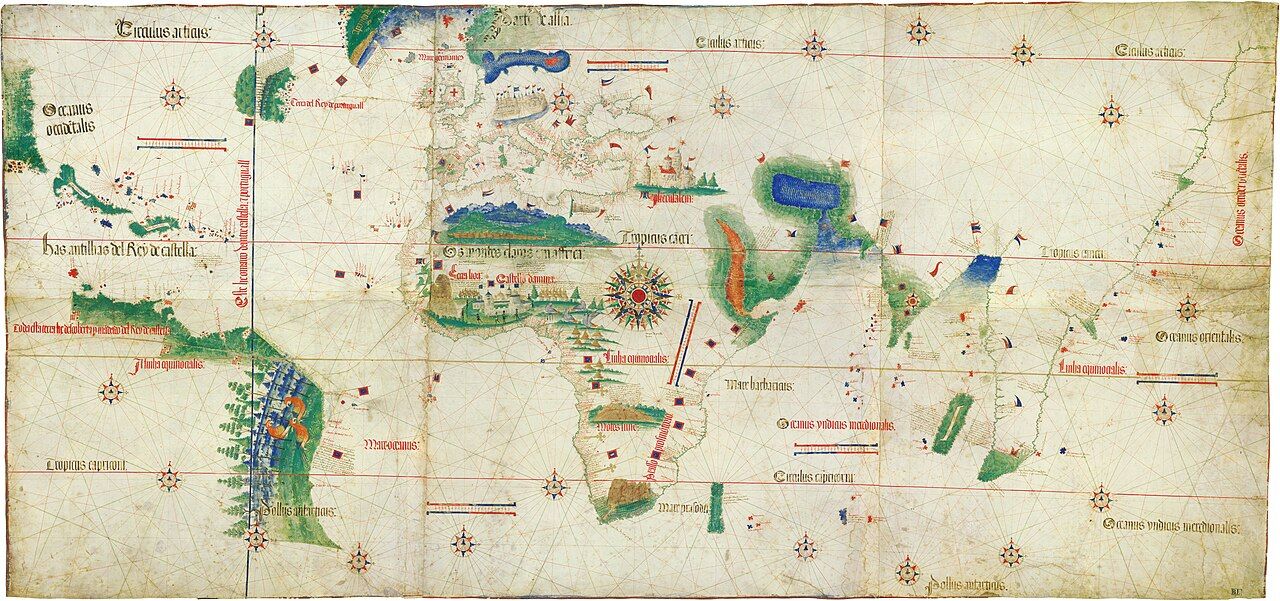
Down the African coast, 1415–1498
Portuguese expansion began with a raid. In 1415 a Portuguese force took Ceuta, a Muslim port on the Moroccan side of the Strait of Gibraltar. It proved less lucrative than hoped — the caravan trade simply rerouted — but it established the pattern of seizing a coastal strongpoint rather than conquering an interior. Over the next seventy years captains crept south in increments: Cape Bojador rounded in 1434, the Senegal and Gambia rivers reached by the 1440s, São Jorge da Mina (Elmina, in present-day Ghana) fortified in 1482 as a gold-trading castle, the Congo estuary in 1483. Bartolomeu Dias rounded the southern tip of Africa in 1488, blown past it before he realized it; his crew forced him to turn back.
The commercial logic changed along the way. West African gold was the first prize — Elmina’s name means “the mine” — and the Portuguese inserted themselves into an existing trans-Saharan gold economy from the seaward side. But they also bought and seized enslaved people almost immediately: the first large cargo was auctioned at Lagos, in the Algarve, in 1444. At first these captives worked in Iberia and the Atlantic islands. That last detail is the hinge of the whole chapter, because on Portuguese Madeira and above all São Tomé — and on the Canaries, which Castile was conquering over the same decades — Europeans built the sugar plantation worked by enslaved Africans. The Atlantic plantation complex was invented in the eastern Atlantic before Columbus sailed, and then shipped west.
In July 1497 Vasco da Gama left Lisbon with four ships, swung deep into the South Atlantic, rounded the Cape, worked up the East African coast to Malindi, and with a local pilot crossed to Calicut on the Malabar coast in May 1498. His trade goods — cloth, hats, coral, washbasins — were laughed at by merchants who dealt in far finer things. He returned with a cargo of pepper and cinnamon that nevertheless repaid the voyage many times over, having lost roughly two-thirds of his men, largely to scurvy. The route was open.
Columbus and the accidental hemisphere
Christopher Columbus had been shopping his proposal for years. Portuguese experts rejected it because they were right about the distance; Ferdinand and Isabella accepted it in 1492, in the flush of Granada’s fall, because the downside was three small ships and the upside was Asia. He made landfall on 12 October 1492 on an island in the Bahamas that the Taino called Guanahani and that he renamed San Salvador, then coasted Cuba and Hispaniola. He went to his death in 1506 insisting he had reached the outskirts of Asia. Four voyages and considerable evidence did not shake him.
The naming injustice is instructive. It was Amerigo Vespucci, in letters describing voyages along the South American coast around 1499–1502, who argued that this was a mundus novus, a new world, not Asia’s fringe. The German cartographer Martin Waldseemüller put “America” on a map in 1507 in Vespucci’s honor, and the label stuck before anyone could reconsider. Whether Vespucci’s letters were partly fabricated or embellished by publishers remains genuinely disputed among scholars.
Spain and Portugal now had overlapping claims, and they resolved them the way Christian monarchs did: by papal arbitration and then by negotiation. The Treaty of Tordesillas (1494) drew a line 370 leagues west of the Cape Verde Islands; everything east was Portuguese, everything west Spanish. The line was fixed without knowing what lay on either side, which is why Brazil — reached by Pedro Álvares Cabral in 1500 while swinging wide into the Atlantic to catch the winds, though whether by accident or design is still argued — fell to Portugal and speaks Portuguese today. No other European power, and certainly no non-European one, ever accepted the treaty’s authority. Francis I of France reportedly asked to see the clause in Adam’s will that divided the world between two kings.
The trading-post empire and its limits
What Portugal built in the Indian Ocean was not a territorial empire but a trading-post empire, the Estado da Índia: a chain of fortified ports and a claim to control the sea lanes between them. Under Afonso de Albuquerque, governor from 1509, the Portuguese took Goa (1510), Malacca (1511) and Hormuz (1515), and tried to take Aden. The strategy was to hold the choke points — the Red Sea mouth, the Persian Gulf mouth, the Strait of Malacca — and force Asian shipping to buy a Portuguese pass, the cartaz, or be treated as a prize.
The one real European advantage was shipboard artillery. Indian Ocean trade had been largely peaceful and unarmed for centuries; Portuguese ships arrived carrying cannon and a willingness to use them, as at Diu in 1509 against a combined Gujarati–Mamluk fleet. But we should be careful not to overstate it. On land the Portuguese were weak, dependent on local allies, and repeatedly defeated — catastrophically at Alcazarquivir in Morocco in 1578, where King Sebastian died and the dynasty effectively ended. They never controlled more than a fraction of Asian trade; most pepper still moved through the Red Sea by the mid-sixteenth century. Portugal skimmed a rich margin off an enormous system it could not command.
Portugal sought a route to existing Asian wealth and built a seaborne network of forts and tolls; Spain, aiming at the same target, blundered into two continents and improvised a very different kind of empire.
Section 3Conquest, Collapse and the Columbian Exchange
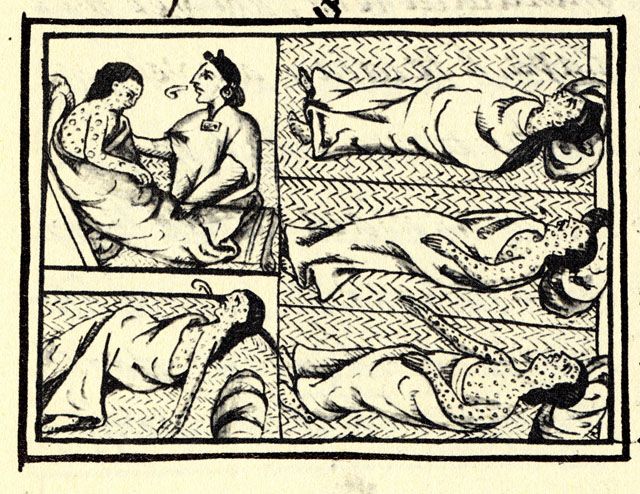
Two conquests
In 1519 Hernán Cortés landed on the Gulf coast of Mexico with roughly 500 men, sixteen horses and a few small cannon. Two years later the Mexica (Aztec) capital of Tenochtitlan — a lake city of perhaps 200,000 people, larger than any city in Spain — had fallen. In 1532 Francisco Pizarro, with about 168 men, seized the Inca emperor Atahualpa at Cajamarca, collected a room filled with gold and silver as ransom, and executed him anyway. By 1533 the Spanish held Cuzco.
These numbers invite a bad explanation: that European technology and courage simply overwhelmed. The evidence points elsewhere. First, alliances. The Mexica ran a tribute empire resented by its subjects; Cortés arrived with a translator, the Nahua woman Malintzin (doña Marina, often called La Malinche), and rapidly recruited tens of thousands of Tlaxcalan warriors who had their own reasons to want Tenochtitlan destroyed. The final siege was overwhelmingly an indigenous army with a Spanish command element. In Peru, Pizarro walked into a civil war: Atahualpa had just defeated his half-brother Huáscar, and the losing faction was willing to deal.
Second, disease. Smallpox reached Tenochtitlan in 1520 and killed a large share of the population, including the emperor Cuitláhuac, during the months the Spanish were regrouping after being driven from the city on the Noche Triste. In the Andes, an epidemic — probably smallpox — had already killed the emperor Huayna Capac around 1524–27, which is what triggered the succession war Pizarro exploited. Third, technology mattered at the margin. Steel blades, crossbows and especially horses gave shock advantages in open field battle; firearms of the period were slow and unreliable. None of this is a story of inevitability. It is a story of contingency stacked on catastrophe.
The demographic catastrophe
The population of the Americas in 1492 is genuinely contested. Estimates run from about 40 million to more than 100 million, with many current specialists clustering around 50–60 million. What is not seriously contested is the direction and scale of the collapse: by 1600–1650 the indigenous population had fallen by something in the range of 80 to 95 percent in the hardest-hit regions. Hispaniola’s Taino population, plausibly several hundred thousand in 1492, was functionally extinguished within fifty years. Central Mexico fell from perhaps 15–25 million to around one million by 1620.
The primary cause was epidemiological, not military. The Americas had been isolated from Afro-Eurasian disease pools for millennia and had few domesticated herd animals, the source of many crowd diseases. Smallpox, measles, typhus, influenza and later malaria and yellow fever arrived in waves against populations with no acquired immunity and no cultural experience of such epidemics. Because everyone fell ill at once, no one could nurse, farm or harvest — so famine followed infection. In Mexico the catastrophic cocoliztli epidemics of 1545 and 1576 killed millions; recent genetic work on burial sites has recovered Salmonella enterica Paratyphi C, suggesting enteric fever as at least one agent, though the identification remains debated.
To say disease did most of the killing is not to acquit conquest. Forced labor, war, dispossession, forced resettlement and the deliberate destruction of food systems all raised mortality and prevented recovery, and colonial regimes concentrated survivors in exactly the conditions that spread epidemics. Historians increasingly frame this as a compound catastrophe rather than a purely biological accident. The demographic hole was so deep that some climate scientists argue reforestation of abandoned American farmland drew down enough atmospheric carbon dioxide to contribute to the cooling of the “Little Ice Age” around 1610 — a striking, and still argued, claim.
The exchange in both directions
The historian Alfred Crosby named the whole biological transfer the Columbian Exchange in 1972, and the term stuck because it captures something the old vocabulary of “discovery” missed: the traffic ran both ways and much of it was invisible.
Eastward went crops that reshaped Old World diets and populations. The potato, an Andean domesticate, produced more calories per acre than grain on poor northern soils and underwrote population growth in Ireland, northern Europe and Russia — and, when a single clonal crop met Phytophthora infestans in the 1840s, catastrophic famine. Maize became a staple in southern Europe, west Africa and China; cassava, also American, became an African famine crop. Tomatoes, chilies, cacao, vanilla, peanuts, squash and tobacco all crossed east. Chilies reached India and Sichuan within decades and are now inseparable from those cuisines.
Westward went wheat, rice, sugarcane, bananas, coffee and citrus — and animals. Cattle, pigs, sheep and goats bred explosively in grasslands with no comparable grazers, transforming ecosystems and sometimes destroying indigenous fields. The horse, extinct in the Americas for millennia, reached the Great Plains through Spanish New Mexico and by the eighteenth century had remade Comanche, Lakota and Blackfeet societies into mounted powers that checked European expansion for two hundred years. And westward went the pathogens. The one plausible major transfer east is a virulent form of syphilis, which appeared in Naples in 1495 and swept Europe; the “Columbian hypothesis” for its origin has substantial skeletal evidence behind it but is not settled.
| Moving west (to the Americas) | Moving east (to Afro-Eurasia) | Consequence |
|---|---|---|
| Smallpox, measles, typhus, influenza | — | Population collapse of 80–95% in many regions |
| Wheat, sugarcane, rice, coffee, bananas | Maize, potato, cassava, sweet potato | Plantation economies west; population growth east |
| Horses, cattle, pigs, sheep, goats | Turkeys, guinea pigs (minor) | Ecological transformation; mounted Plains societies |
| — | Tomato, chili, cacao, vanilla, peanut, tobacco | Remade cuisines from Italy to Sichuan; global tobacco habit |
| — | Possibly virulent syphilis (disputed) | European epidemic from 1495 |
| Enslaved Africans (forced migration) | American silver | Atlantic slave system; global monetization via China |
The conquests turned on indigenous alliances, civil war and above all epidemic collapse — and the biological exchange that followed reorganized diet, ecology and population on every continent it touched.
Section 4Silver, Sugar and Slavery: the Atlantic System
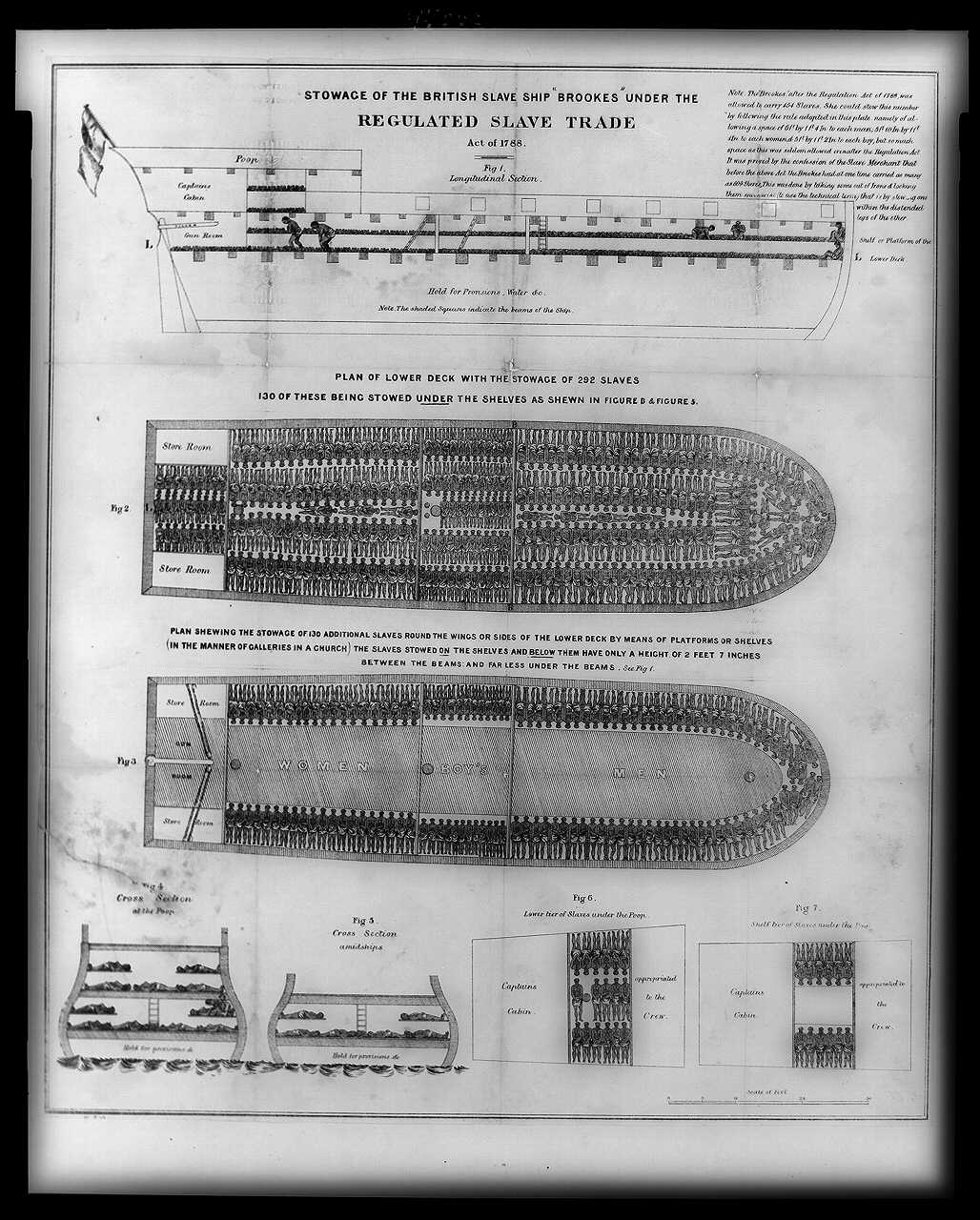
The mountain of silver
In 1545 Spanish prospectors, following indigenous knowledge, opened the Cerro Rico at Potosí in the Andes at 4,000 meters altitude. It became the largest silver deposit the world had known. A second great strike at Zacatecas in Mexico followed in 1546. By 1600 Potosí was a city of perhaps 160,000 people — comparable to London — sitting in thin air on a barren mountain, fed entirely by imported food and coerced labor. Between roughly 1500 and 1800 the Americas produced on the order of 150,000 tons of silver, something like 80 percent of world output.
The technology that made it possible was the patio process, refined at Pachuca in the 1550s, which used mercury amalgamation to extract silver from low-grade ore. Mercury came from Huancavelica in Peru and Almadén in Spain, and it poisoned the men who handled it. Labor came from the mita, a rotational draft the Spanish adapted from an Inca institution and turned into something far harsher: villages across a vast catchment were required to send a proportion of their adult men to Potosí each year. Mortality was severe enough that communities hid people, fled, or paid substitutes.
Where did the silver go? Not mainly to Spain, in the end. Ming China had shifted its tax system toward silver payment (the “single whip” reform), creating enormous demand and a silver price roughly double Europe’s. Silver therefore flowed east: across the Atlantic to Seville and onward to Amsterdam, Genoa and Asia, and directly across the Pacific on the Manila galleon from Acapulco, running from 1565 to 1815. This is the first genuinely global trade circuit, and it is worth noticing that its engine was Chinese fiscal policy, not European demand. Some historians argue that when Ming silver demand slackened in the 1630s–40s the shock rippled back to Spanish America; others think the link has been overdrawn.
Labor systems: encomienda, repartimiento, chattel slavery
Spain never intended a settler-labor colony; it intended to extract wealth from existing populations. The encomienda granted a Spanish conquistador the right to demand tribute and labor from a specified group of indigenous people, in theory in exchange for protection and Christian instruction. In practice it was close to enslavement. The New Laws of 1542, pushed through by the Dominican friar Bartolomé de las Casas, banned indigenous slavery and ordered encomiendas to lapse on the holder’s death; colonists revolted, a viceroy was killed in Peru, and enforcement was partial. The system slowly gave way to the repartimiento (wage-labor drafts) and to debt peonage on haciendas.
Where indigenous populations collapsed and the crop was sugar, planters turned to Africa. Sugar is the crucial variable. It is brutally labor-intensive: cane must be cut and crushed within hours, boiling houses run day and night through harvest, and the work killed people at rates that required constant replacement. Brazil, under Portugal, became the first great sugar colony from the 1550s; the English Caribbean followed after Barbados converted to sugar in the 1640s, and Saint-Domingue (Haiti) became the most profitable colony on earth in the eighteenth century.
What developed was chattel slavery: hereditary, lifelong, racially defined, and legally classifying human beings as movable property. This form was historically distinctive. Slavery existed in Africa, in the Islamic world, in ancient Rome and in medieval Europe, and Europeans did not invent it. But the Atlantic system’s combination of scale, heritability through the mother, near-total legal disability, and an ideology of racial difference constructed to justify it produced something new. Racial categories hardened as the system expanded; they were a product of it as much as a cause.
The Middle Passage and its arithmetic
The Trans-Atlantic Slave Trade Database, built from surviving voyage records, is the best evidence we have. It indicates roughly 12.5 million Africans were embarked on slave ships between 1501 and 1866, and about 10.7 million survived to disembark — meaning some 1.8 million died at sea, an average mortality of roughly 15 percent that was far higher on some routes and in some decades. Millions more died in the marches to the coast and in coastal barracoons before ever boarding.
The destinations surprise students. Under 4 percent of those who landed alive — roughly 390,000 people — disembarked in British North America and later the United States. Brazil received nearly half; the Caribbean took most of the rest, with the British islands alone absorbing about a fifth of the whole trade. The reason the United States nonetheless had a large enslaved population by 1860 is that its enslaved population grew by natural increase, while Caribbean and Brazilian sugar regimes consumed lives faster than they reproduced.
The trade was not something Europeans simply imposed on a passive Africa. European traders rarely marched inland; they bought captives at coastal factories from African merchants and states. Kingdoms such as Dahomey, Asante and Oyo were transformed by the trade, some enriched and militarized by it, others devastated. Guns flowed in, people flowed out. Historians debate the trade’s demographic effect on Africa — the economist Nathan Nunn has shown a statistical association between the intensity of slave exports from a region and its later economic underdevelopment, and Joseph Inikori and Walter Rodney argued the case earlier in different terms — but the direction of harm is not seriously disputed. African complicity in supply does not distribute moral responsibility evenly; the demand, the capital, the ships and the plantations were European.
| Region of disembarkation | Approx. share of arrivals | Dominant economy |
|---|---|---|
| Brazil | ~45–46% | Sugar, later gold and coffee |
| British Caribbean | ~22% | Sugar (Barbados, Jamaica) |
| French Caribbean | ~11% | Sugar, coffee (Saint-Domingue) |
| Spanish Americas | ~11–12% | Mining, ranching, later Cuban sugar |
| Dutch/Danish Caribbean | ~5% | Sugar, transshipment |
| British North America / USA | under 4% | Tobacco, rice, later cotton |
American silver monetized a global economy and American sugar consumed human lives, and the two together produced an Atlantic system whose profits depended on coerced labor at a scale without precedent.
Section 5Rivals, Companies and the Argument Over Empire
Latecomers with better institutions
Spain and Portugal had a century’s head start and lost it. Part of the reason was structural. Spanish American wealth flowed to a crown that spent it on European wars — against the Ottomans, the Dutch rebels, the French, the English — and defaulted on its debts repeatedly (1557, 1560, 1575, 1596, and on into the seventeenth century). Silver passed through Seville and out to German and Genoese bankers. The economist’s phrase is the resource curse; the contemporary Spanish phrase, from Martín González de Cellorigo in 1600, was that Spain had become a nation of “the bewitched, living outside the natural order.”
The Dutch did something different. After revolting against Spanish rule, the northern Netherlands built financial institutions of remarkable sophistication: the Amsterdam Exchange Bank (1609), a bourse, marine insurance, low interest rates, and above all the joint-stock company. The Dutch East India Company (VOC, founded 1602) pooled capital from many investors in permanent, tradable shares, spreading risk across voyages instead of betting on one. It was granted sovereign powers — to make war, sign treaties, coin money, hang people. The English East India Company (1600) worked on similar lines, though it financed itself voyage by voyage until it adopted permanent capital in 1657; the Dutch West India Company followed in 1621. This is the birth of the corporation as an instrument of empire, and it let private capital do what strained royal treasuries could not.
The VOC displaced the Portuguese systematically: Amboina in 1605, Batavia founded in 1619, Malacca taken in 1641, Ceylon by 1658, and a monopoly on nutmeg enforced on the Banda Islands with a 1621 massacre and deportation under Jan Pieterszoon Coen that killed or removed most of the population of roughly 15,000. Monopoly here was not a metaphor. It was enforced by extermination.
Different empires, different logics
By 1700 the European presence overseas had sorted into recognizable types. The Spanish built a territorial empire of viceroyalties, cities, cathedrals and universities (Mexico City and Lima, both 1551), governed through the Council of the Indies, with a large mixed population and a formal caste hierarchy — the sistema de castas — that classified people by ancestry. The Portuguese ran coastal trading factories plus a genuinely territorial plantation colony in Brazil. The French in Canada were few, dispersed and heavily invested in the fur trade, which made alliance with Huron and Algonquian nations essential and produced deep diplomatic entanglement rather than displacement. The English came to farm — indentured servants, mostly young and male, in the Chesapeake; whole families in New England — and so took land rather than labor, having less use for indigenous workers and therefore less use for indigenous people — a settler-colonial logic with its own grim consequences.
Everywhere, the crown’s theory of empire was some version of mercantilism: the belief that global wealth is roughly fixed, that a nation grows rich by exporting more than it imports and accumulating bullion, and that colonies exist to supply raw materials and buy finished goods from the mother country alone. England’s Navigation Acts (from 1651) required colonial trade to move in English ships; Spain funneled everything through a single licensed fleet system, the flota, at Seville and later Cádiz. Mercantilist rules were routinely evaded — smuggling was the real economy of the Caribbean — and Adam Smith would demolish the theory in 1776. But it shaped policy, and it made colonies a reason for war.
Inflation, and the argument that would not go away
Between about 1500 and 1650 prices in western Europe rose roughly sixfold — modest by modern standards, roughly one to two percent a year, but unprecedented in a society used to stable prices. The classic explanation, from Earl Hamilton in the 1930s, was monetary: American silver expanded the money supply, so prices rose. That explanation is now considered partial. Population recovery after the plague years increased demand for food faster than agricultural output could grow, which is why grain prices rose far more than manufactured goods; currency debasement by cash-strapped governments added more. Most historians today treat the price revolution as demographic and monetary together, with the balance still argued.
Whatever its cause, the distributional effect was sharp. Landlords who could raise rents and farmers selling surplus did well. Wage laborers, whose pay lagged badly, saw real income fall by perhaps half over the period. Nobles on fixed feudal dues were squeezed. The winners were commercial farmers, merchants and the state’s creditors — a reshuffling that fed into the social conflicts of the seventeenth century.
And from the beginning there was moral argument, which is worth taking seriously rather than treating as a modern afterthought. In 1511 the Dominican Antonio de Montesinos preached on Hispaniola asking his congregation by what right they held the Indians in servitude. Bartolomé de las Casas, once an encomendero himself, spent fifty years documenting atrocities in works such as the Brevísima relación (1552) and lobbying the crown. At Valladolid in 1550–51 he debated Juan Ginés de Sepúlveda, who argued from Aristotle that some peoples are natural slaves and that conquest was therefore lawful. Neither side was declared a clear winner. The theologian Francisco de Vitoria at Salamanca had already argued that indigenous peoples held genuine dominion over their lands, laying groundwork for international law. In France, Montaigne’s essay “Of Cannibals” (1580) turned the mirror around, suggesting the Europeans were the barbarians. Las Casas’s own record is not clean — he early on proposed importing African slaves to spare the Indians, and later repented of it in writing. That contradiction is instructive: the moral categories were being built in real time, unevenly, by people who were also implicated.
| Power | Model | Main assets by 1700 | Chief instrument |
|---|---|---|---|
| Portugal | Trading posts + plantation Brazil | Goa, Macau, Angola, Brazil | Royal monopoly, cartaz system |
| Spain | Territorial, extractive | Mexico, Peru, Philippines, Caribbean | Viceroyalties, flota, encomienda/mita |
| Netherlands | Commercial monopoly | Batavia, Ceylon, Cape, Surinam | VOC / WIC joint-stock companies |
| England | Settler colonies + company trade | Mainland colonies, Barbados, Jamaica, Bengal foothold | EIC, Navigation Acts, chartered colonies |
| France | Fur trade + sugar islands | New France, Saint-Domingue, Louisiana | Alliances, royal companies, Colbert’s policy |
Northern European latecomers overtook Iberia by inventing financial institutions rather than finding new coasts, while the moral legitimacy of the whole enterprise was contested from the first decades by Europeans themselves.
The chapter in one breath
A poor, divided Europe wanted Asian goods it could not afford at second hand, and by borrowing the compass, the lateen sail and the astrolabe and adding gunnery, ocean-going hulls and Italian credit, it found ways around the middlemen. Portugal built a chain of fortified tollbooths from Elmina to Malacca. Spain, aiming at Asia, hit two continents whose peoples had no immunity to Eurasian disease, and within a century their populations fell by 80 to 95 percent — a catastrophe that made conquest possible and then created a labor vacuum the conquerors filled with drafted indigenous workers at Potosí and, on the sugar coasts, with enslaved Africans — 12.5 million of whom were shipped west between 1501 and 1866, of whom 10.7 million survived the crossing. The exchange ran both ways: potatoes and maize fed Europe, Asia and Africa; horses remade the Great Plains; American silver, pulled by Chinese fiscal demand, closed the first global trade circuit. Northern Europeans then overtook Iberia not by sailing better but by inventing the joint-stock company and the financial machinery to sustain distant, decade-long ventures. From Montesinos in 1511 to Valladolid in 1550 to Montaigne in 1580, Europeans argued about whether any of it was just. The argument did not stop the ships.
Words worth knowing
| Term | What it means |
|---|---|
| Caravel | Small, shallow-draft Portuguese sailing ship with lateen sails, able to sail closer to the wind than square-rigged vessels. |
| Volta do mar | “Turn of the sea” — sailing far out into the Atlantic to catch favorable winds home, the technique that made return voyages possible. |
| Reconquista | The long, intermittent Christian campaigns to take Iberia from Muslim rule, completed with the fall of Granada in 1492. |
| Treaty of Tordesillas (1494) | Spanish–Portuguese agreement dividing non-Christian lands along a line 370 leagues west of the Cape Verde Islands; gave Brazil to Portugal. |
| Trading-post empire | Portuguese model of fortified coastal ports controlling sea lanes and tolls rather than governing territory. |
| Cartaz | A pass Portuguese authorities required of Asian shipping in the Indian Ocean; ships without one could be seized. |
| Columbian Exchange | Alfred Crosby’s term for the transfer of plants, animals, people and pathogens between the Americas and Afro-Eurasia after 1492. |
| Encomienda | Spanish grant of the right to demand tribute and labor from a group of indigenous people, nominally in exchange for protection and instruction. |
| Mita | Rotational labor draft adapted from Inca practice; under Spain it supplied coerced workers to the Potosí silver mines. |
| Repartimiento | Later Spanish labor draft assigning paid but compulsory indigenous work, replacing the encomienda in principle. |
| Chattel slavery | Hereditary, lifelong slavery in which people are legally movable property; in the Atlantic system defined by race. |
| Middle Passage | The Atlantic crossing of slave ships, with average mortality of roughly 15 percent of those embarked. |
| Manila galleon | Annual Spanish voyage from Acapulco to Manila (1565–1815) trading American silver for Asian goods. |
| Patio process | Mercury-amalgamation refining method that made low-grade American silver ore profitable from the 1550s. |
| Joint-stock company | Business owned through tradable shares held by many investors; the VOC (1602) was the first with permanent capital. |
| Mercantilism | Policy doctrine that national wealth is fixed and grows by trade surplus and bullion; colonies exist to serve the mother country. |
| Navigation Acts | English laws from 1651 requiring colonial trade to travel in English ships, enforcing a closed imperial market. |
| Price revolution | The roughly sixfold rise in European prices, c.1500–1650, attributed to some mix of silver inflow, population growth and debasement. |
| Sistema de castas | Spanish American classification of people by ancestry, tying legal and social standing to descent. |
| Valladolid debate (1550–51) | Formal dispute between Las Casas and Sepúlveda over whether conquest and forced labor of indigenous Americans were lawful. |
Check yourself
Absolutism, the Scientific Revolution and the Enlightenment
Between roughly 1600 and 1789 Europeans rebuilt two things at once: the machinery of the state and the machinery of knowing. Kings who had once bargained with nobles, towns and provincial estates now taxed harder, drilled larger armies and claimed to answer to God alone — while in England and the Dutch Republic a different settlement gave law-making power to assemblies and made public credit, not royal glory, the sinew of power. In the same decades a small, quarrelsome network of astronomers, physicians and instrument-makers replaced Aristotle’s cosmos with a mathematical one, and then argued that the same methods could be turned on law, religion, punishment and trade. The result was the Enlightenment: not a single doctrine but an argument conducted in salons, coffeehouses and smuggled books. This chapter traces how power was concentrated, how it was checked, how nature was re-described, and what happened when reformers tried to govern by reason.
By the end of this chapter you can
- Define absolutism and explain what it actually achieved — and what it never controlled — using Louis XIV’s France as the test case.
- Compare the fiscal-military states of France, Brandenburg-Prussia, Russia and the Austrian Habsburg lands.
- Trace the English road from the Petition of Right to the Glorious Revolution and the Bill of Rights, and say why a constitutional monarchy borrowed money more cheaply than an absolute one.
- Explain the heliocentric argument from Copernicus through Kepler, Galileo and Newton, and identify what each actually contributed.
- Distinguish empiricism from rationalism and describe how new institutions such as the Royal Society made knowledge public and repeatable.
- Analyze the core Enlightenment texts — Montesquieu, Voltaire, Diderot’s Encyclopédie, Rousseau, Beccaria, Smith, Kant — and the public sphere that carried them.
- Evaluate enlightened absolutism under Frederick II, Catherine II and Joseph II, separating rhetoric from measurable reform.
- Assess the Enlightenment’s contradictions on slavery, race and women’s status, and its concrete gains in medicine and public health, including variolation and vaccination.
Section 1The Sinews of Power: Absolutism and Its Limits
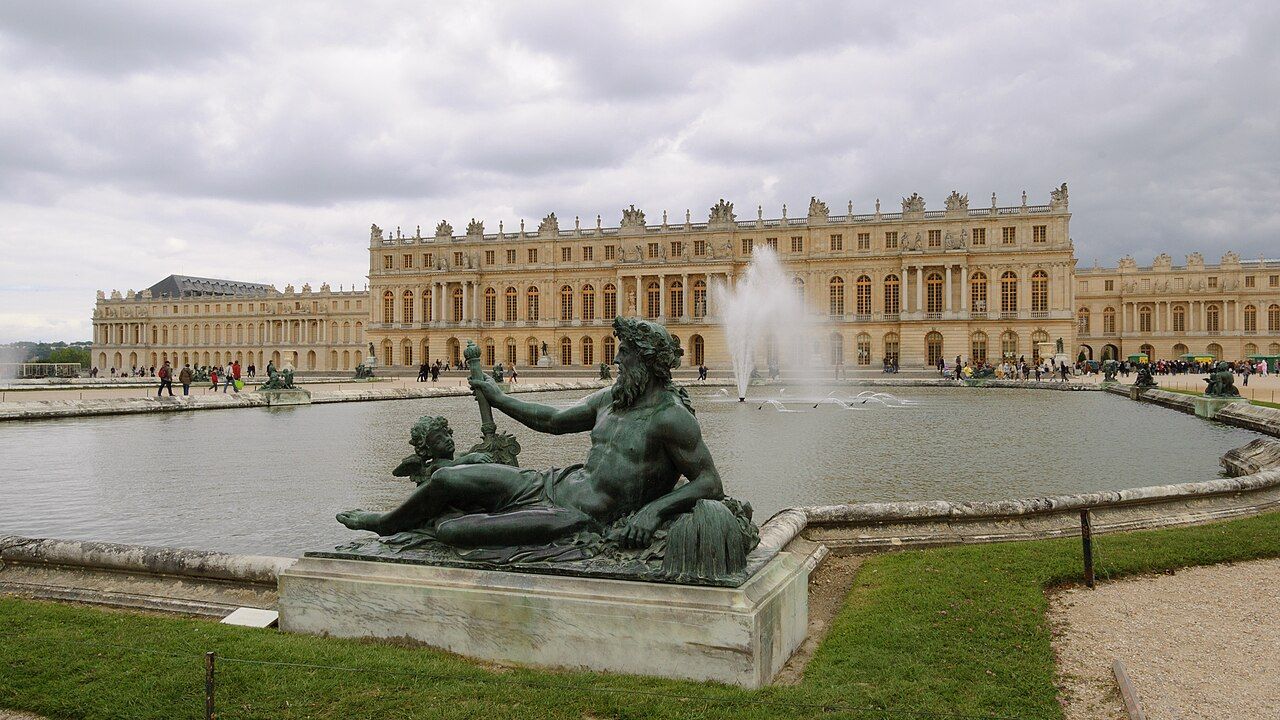
What absolutism claimed
Absolutism is the doctrine that sovereignty is indivisible and rests wholly in the monarch, who is accountable to God rather than to any assembly, court or corporate body. Its clearest statement came from Jacques-Bénigne Bossuet, tutor to Louis XIV’s son, in Politics Drawn from the Very Words of Holy Scripture: the king’s person is sacred, his authority paternal, absolute and subject to reason. Behind Bossuet stood Jean Bodin, who in 1576 had defined sovereignty as the power to make law without consent, and Thomas Hobbes, who in Leviathan (1651) reached a similar conclusion from an entirely secular premise: without an undivided sovereign, life is a war of all against all.
The claim was a response to trauma. France had endured four decades of religious civil war, then the Fronde of 1648–1653, a tangled revolt of law courts and great nobles during which the boy king Louis XIV was hustled out of Paris in the night. He never forgot it. When Cardinal Mazarin died in 1661, the twenty-two-year-old announced that he would govern without a chief minister — and, remarkably for a man of his era, actually did the paperwork, meeting his councils several hours a day for fifty-four years.
The famous line L’état, c’est moi is almost certainly a later invention; what Louis is reliably reported to have said on his deathbed is closer to the opposite: Je m’en vais, mais l’État demeurera toujours — I depart, but the State will remain. That distinction matters. Absolutism was less a cult of personality than a theory of the state, and its practical content was administrative.
Building the fiscal-military state
What made the seventeenth-century monarchy formidable was money and men. Jean-Baptiste Colbert, controller-general of finances from 1665 until his death in 1683, attacked tax farming, audited accounts, chartered manufactures, subsidized the Gobelins tapestry works and the navy, and pursued mercantilism — the assumption that world trade was a fixed pot and that a state grew rich by exporting more than it imported. He also extended the intendants, royal commissioners posted to each généralité who reported directly to the royal council and could override local officials. The intendant, not Versailles’ mirrors, was the real innovation.
Meanwhile the army swelled from perhaps 70,000 men in the 1660s to over 340,000 on paper by the 1690s, with uniforms, standardized muskets, magazines and Vauban’s ring of frontier fortresses. Historians call this the fiscal-military state: a government whose primary business is extracting revenue to pay for war, and whose bureaucracy grows because war debts do. Louis fought in four major conflicts. The last, the War of the Spanish Succession (1701–1714), ended at Utrecht and Rastatt with his grandson on the Spanish throne but barred from ever inheriting France, and France itself exhausted, its people taxed through the taille, the gabelle salt monopoly and the new capitation head tax, and the famines of 1693–94 and 1709 killing well over a million people between them.
Versailles itself, occupied by the court from 1682, was a political instrument. By requiring the high nobility to attend the king’s rising and retiring, to compete for the right to hand him his shirt, Louis converted a warrior aristocracy into courtiers whose careers depended on visibility rather than on provincial armies. It worked, at a price: the nobles kept their fiscal exemptions, and the crown kept borrowing.
Variants: Prussia, Russia, Austria, Spain
The French model was copied unevenly. In Brandenburg-Prussia, Frederick William the Great Elector (1640–1688) struck a bargain that would define the state: the Junker nobility surrendered political resistance and paid little tax, and in exchange received unchallenged authority over their serfs plus, in time, a near-monopoly on officer commissions. His grandson Frederick William I (1713–1740) drilled an army of 80,000 out of a population of some 2.2 million, ran the treasury like a miser and created the General Directory. Prussia was, in a phrase usually credited to Mirabeau though its origin is disputed, not a state with an army but an army with a state.
In Russia, Peter the Great (r. 1682–1725) forced a top-down transformation: a new capital, St Petersburg, begun in 1703 on conquered marshland at enormous human cost; the beard tax and Western dress imposed on the service nobility; the Table of Ranks (1722) tying status to state service rather than birth; the patriarchate replaced by a Holy Synod under a lay procurator. Victory over Sweden at Poltava (1709) and the peace of Nystad (1721) made Russia a European great power. It also deepened serfdom exactly as western Europe was shedding it — the great east-west divergence of early modern Europe.
The Austrian Habsburgs ruled a composite monarchy of Austrian, Bohemian and Hungarian lands, each with its own laws and diets; after breaking the Ottoman siege of Vienna in 1683 and winning Hungary at Karlowitz (1699), they expanded outward but never centralized as thoroughly. Spain moved the other way. Burdened by American silver that fuelled inflation rather than industry, by the expulsion of the Moriscos and by chronic war, it lost Portugal in 1640, revolted in Catalonia, and by 1700 was a prize to be fought over rather than a power.
| State | Key ruler | Instrument of control | Structural weakness |
|---|---|---|---|
| France | Louis XIV, 1643–1715 | Intendants, standing army, court ritual at Versailles | Tax exemptions for clergy and nobility; venal offices; war debt |
| Brandenburg-Prussia | Frederick William I, 1713–1740 | Junker–crown bargain; canton recruitment; General Directory | Small population; scattered, indefensible territories |
| Russia | Peter I, 1682–1725 | Table of Ranks; Holy Synod; conscription from serf villages | Reform reached only the elite; serfdom hardened |
| Austria | Leopold I, 1658–1705 | Dynastic marriage; Catholic renewal; army against the Ottomans | Composite monarchy of separate diets and legal systems |
| Spain | Charles II, 1665–1700 | Councils and viceroys inherited from the sixteenth century | Debt, depopulation, revolt in Catalonia and Portugal |
Absolutism was a theory of undivided sovereignty whose real achievement was a tax-raising, army-feeding bureaucracy — built, everywhere, by leaving noble privilege intact.
Section 2The Other Path: England, the Dutch and the Politics of Consent
Civil war, regicide and the failure of republican rule
England’s crown was chronically poor. Without a standing army or a professional bureaucracy, Stuart kings needed Parliament to vote taxes, and Parliament used the moment to press grievances. Charles I accepted the Petition of Right in 1628 — no taxation without parliamentary consent, no arbitrary imprisonment, no billeting of troops — then ruled without Parliament for eleven years, raising money through revived medieval devices such as ship money. The system held until he tried to impose an Anglican prayer book on Presbyterian Scotland in 1637. The Scots invaded; Charles needed money; the Long Parliament met in 1640 and never let go.
Civil war broke out in 1642. It was fought over religion as much as taxation, and it radicalized fast: at Putney in 1647 the New Model Army’s council, chaired by Oliver Cromwell, heard Colonel Thomas Rainsborough insist that “the poorest he that is in England hath a life to live as the greatest he.” In January 1649 a purged Parliament tried the king for treason against his own people and beheaded him — an act that horrified Europe precisely because it made the monarch a defendant. The republic that followed, and then Cromwell’s Protectorate (1653–1658), never solved the problem of legitimacy without a king. In 1660 Charles II was invited back.
The Restoration settlement papered over the real dispute: whether a Catholic could inherit. The Exclusion Crisis of 1679–1681 produced the labels Whig and Tory. When James II succeeded in 1685, suspended penal laws by royal prerogative, packed the army with Catholic officers and then fathered a Catholic heir in June 1688, seven leading men invited his Protestant son-in-law William of Orange to intervene.
1688 and its settlement
The Glorious Revolution was neither bloodless nor purely English — William landed with roughly 15,000 troops, and the accompanying wars in Ireland and Scotland were savage. But in England the outcome was constitutional. The Declaration and then the Bill of Rights (1689) barred the crown from suspending laws, keeping a standing army in peacetime or levying taxes without parliamentary consent, guaranteed free elections and free speech in Parliament, and excluded Catholics from the throne. The Toleration Act of the same year gave Protestant dissenters freedom of worship, though not full civil rights. The Act of Settlement (1701) secured judges’ tenure and the Hanoverian succession; the Union with Scotland followed in 1707.
John Locke’s Two Treatises of Government, published in 1689, was long read as the revolution’s official apology. Since Peter Laslett’s work most scholars date its composition a decade earlier, during the Exclusion Crisis, making it a justification for resistance rather than a rationalization of a fait accompli. Its argument is still the load-bearing one in liberal political thought: individuals possess natural rights to life, liberty and property; government is a trust created by consent to protect them; when a ruler breaks that trust, the people may replace him.
The practical payoff was financial. A monarch who could not repudiate debts unilaterally, whose budgets Parliament audited, was a better credit risk. The Bank of England (1694) and a funded national debt let Britain borrow at rates France could not match, which is how a smaller country outspent a larger one through a century of war. This is the great irony of the period: the constitutional state proved more powerful than the absolutist one, because consent was cheaper than coercion.
| Year | Event | What it settled |
|---|---|---|
| 1628 | Petition of Right | No taxation or imprisonment without due parliamentary or legal process |
| 1642–1651 | Civil wars | Military defeat of the royalist claim to rule without Parliament |
| 1649 | Trial and execution of Charles I | A king could, in fact, be judged by his subjects |
| 1660 | Restoration of Charles II | Monarchy restored, but the fiscal question left unresolved |
| 1679 | Habeas Corpus Act | Enforceable remedy against detention without charge |
| 1688–89 | Glorious Revolution; Bill of Rights | Parliamentary consent for taxes and armies; Protestant succession |
| 1694 | Bank of England | Public credit backed by Parliament, not by the king’s promise |
Republics that were not democracies
The Dutch Republic offered a third model: seven sovereign provinces, a States General that voted by province, no monarch, and a stadholder from the House of Orange who commanded the armed forces. Amsterdam merchants ran the richest economy in Europe on the back of the Baltic grain trade, the herring fishery, the Bank of Amsterdam (1609) and the Dutch East India Company (1602). Religious pluralism was pragmatic rather than principled — Catholics worshipped in “hidden churches,” Sephardic Jews found refuge, and Amsterdam’s presses printed what French censors banned, which is why so much of the century’s scientific and philosophical writing carries a Dutch imprint.
It is worth being blunt about the limits. The Dutch Republic was governed by a closed oligarchy of regent families; England’s post-1689 electorate was perhaps four or five percent of the population, and constituencies were wildly unequal. Neither was democratic in any modern sense. What they had was accountable government: rulers who could be checked, budgets that could be scrutinized, and a press that could not be silenced.
The counterexample is instructive. The Polish-Lithuanian Commonwealth had an elective monarchy and a Sejm in which any single deputy could annul an entire session by invoking the liberum veto, used destructively from 1652 onward. Liberty without an effective executive proved fatal: between 1772 and 1795 Russia, Prussia and Austria partitioned the Commonwealth out of existence. Consent had to be paired with capacity.
England and the Dutch Republic showed that dividing sovereignty could increase a state’s power, because governments answerable to taxpayers could borrow far more cheaply than governments answerable to no one.
Section 3A New Way of Knowing: The Scientific Revolution
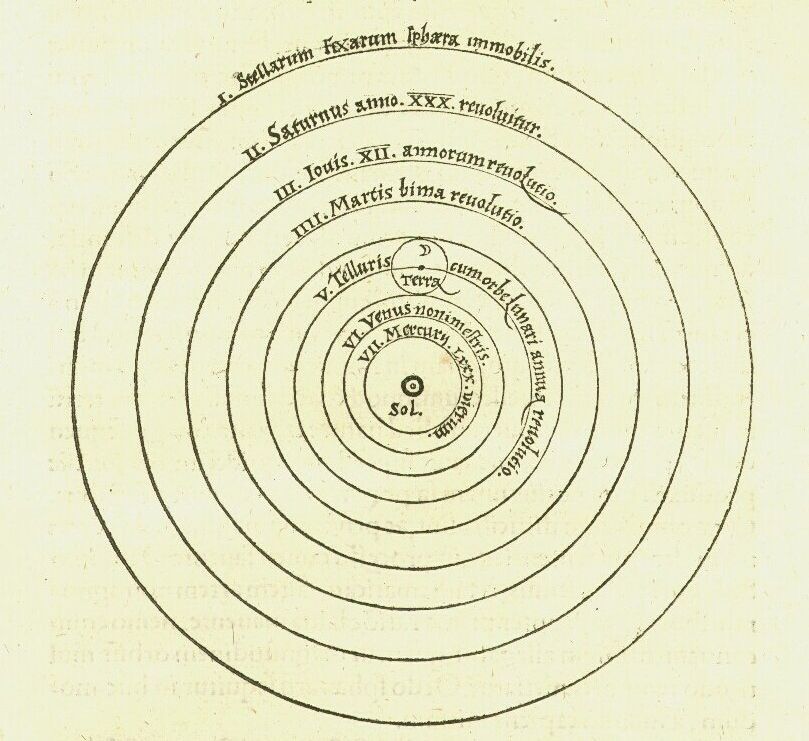
Breaking the closed cosmos
The inherited picture of the universe was Aristotle’s, refined by Ptolemy: a motionless Earth at the center, surrounded by nested crystalline spheres carrying the moon, sun, planets and fixed stars in perfect circles. Below the moon, things were made of earth, water, air and fire and were subject to change; above it, an unchanging fifth element. It was elegant, matched everyday experience and had been fused with Christian theology since the thirteenth century.
Nicolaus Copernicus, a Polish canon and physician, published On the Revolutions of the Heavenly Spheres in 1543, the year of his death. Putting the sun at the center explained the retrograde loops of the planets far more simply. But it created problems he could not answer: if the Earth moves, why is there no perceptible stellar parallax, and why are we not thrown off? Copernicus kept circles and epicycles, and his book was read for decades mainly as a calculating device.
Evidence accumulated from unexpected directions. Tycho Brahe, from his observatory Uraniborg, produced the most accurate naked-eye measurements ever made, and his observations of the new star of 1572 and the comet of 1577 showed changes above the moon and a path that should have shattered crystalline spheres. Johannes Kepler, using Tycho’s Mars data, abandoned circles altogether: planets travel in ellipses with the sun at one focus, sweep equal areas in equal times (1609), and their orbital periods relate to their distances by a fixed mathematical ratio (1619). Galileo Galilei turned a telescope on the sky from 1609 and found mountains on the moon, four satellites of Jupiter, sunspots and, late in 1610, the full cycle of phases of Venus — the last a direct refutation of the Ptolemaic arrangement, though not of Tycho’s compromise scheme.
Method, mathematics and the body
Two rival accounts of how to know emerged. Francis Bacon, in the Novum Organum (1620), argued for empiricism: systematic observation and controlled experiment, working upward from particulars, with the mind purged of its “idols” — the biases of language, tradition and self. René Descartes, in the Discourse on Method (1637), argued for rationalism: doubt everything doubtable until you reach an indubitable starting point, then deduce. His analytic geometry made curves algebraic, and his mechanical philosophy pictured the universe — and animal bodies — as matter in motion, obeying laws. Cartesian dualism, mind separate from an extended machine-like body, shaped medical thinking for centuries and still colors how clinicians talk about the “mind–body problem.”
Medicine supplied one of the era’s cleanest demonstrations. William Harvey, in De motu cordis (1628), used dissection, vivisection, ligature experiments on the arm and simple arithmetic — multiply stroke volume by heart rate and the blood pumped in an hour vastly exceeds body weight — to show that blood must circulate rather than being continuously manufactured and consumed as Galen had taught. He could not see the capillaries; Marcello Malpighi found them with a microscope in 1661. Robert Hooke’s Micrographia (1665) coined “cell,” and Antoni van Leeuwenhoek’s single-lens instruments revealed bacteria and protozoa in the 1670s. Robert Boyle, meanwhile, insisted chemistry describe matter as corpuscles rather than Aristotelian elements, and published the pressure–volume relation in 1662.
Isaac Newton’s Philosophiæ Naturalis Principia Mathematica (1687) closed the circle. Three laws of motion plus a single law of universal gravitation — every mass attracts every other in proportion to the product of the masses and inversely as the square of the distance — derived Kepler’s ellipses, the tides, the precession of the equinoxes and the path of comets from one principle. The same physics governed a falling apple and the moon. Newton candidly refused to explain what gravity is: hypotheses non fingo, I frame no hypotheses — a line he added to the second edition of 1713. Mathematical description that predicts, without a mechanical story, became the standard for science.
| Year | Work and author | Why it mattered |
|---|---|---|
| 1543 | Copernicus, On the Revolutions | Sun-centered model simplifies planetary motion |
| 1609, 1619 | Kepler, Astronomia Nova; Harmonices Mundi | Elliptical orbits; three quantitative laws replace circles |
| 1610 | Galileo, Sidereus Nuncius | Telescopic evidence against an unchanging heavens |
| 1628 | Harvey, De motu cordis | Circulation of the blood, proved by measurement |
| 1637 | Descartes, Discourse on Method | Systematic doubt; analytic geometry; mechanical philosophy |
| 1665 | Hooke, Micrographia | Microscopy as a discipline; the word “cell” |
| 1687 | Newton, Principia | Universal gravitation unifies terrestrial and celestial motion |
Who was allowed in the room
Discovery became durable because it became institutional. The Royal Society of London, founded in 1660 and chartered in 1662, adopted the motto Nullius in verba — take nobody’s word for it. Its secretary Henry Oldenburg launched the Philosophical Transactions in 1665, initially as his own venture, and it created something new: dated, credited, citable, criticizable publication. The Académie Royale des Sciences in Paris (1666) took the opposite approach, salaried and state-directed, aimed at maps, ballistics and engineering. Between them they established peer scrutiny, replication and priority disputes as the ordinary business of science.
Access was sharply bounded by sex and status. Margaret Cavendish, Duchess of Newcastle, published natural philosophy and visited the Royal Society in 1667 — as a spectacle, and no woman was elected to full fellowship until 1945. Maria Winkelmann-Kirch discovered a comet in 1702 while working in her husband’s Berlin observatory; after his death the Academy refused her the post on the grounds that it would set a precedent. Émilie du Châtelet translated the Principia into French with a commentary that remains the standard version; Laura Bassi held a chair at Bologna from 1732. Artisans, instrument-makers and apothecaries did essential work and are largely anonymous in the record.
Historians also disagree about the phrase itself. Herbert Butterfield popularized “the Scientific Revolution” in 1949; Steven Shapin opened a well-known 1996 book by denying there was any such thing — and then explaining why we talk about it anyway. The point of the debate is real: alchemy, theology and biblical chronology occupied Newton at least as much as optics did, and change was slower and messier than the word revolution suggests. Something decisive nevertheless happened by 1700, namely the settled expectation that claims about nature must be tested publicly and expressed mathematically where possible.
The Scientific Revolution replaced argument from authority with public, repeatable, preferably mathematical evidence — and built the journals and academies that kept it that way.
Section 4The Enlightenment: Reason Goes Public
From Newton’s method to society’s laws
The core Enlightenment wager was an analogy: if a few simple laws explain the heavens, then reasoned inquiry can find the laws of politics, economics, education and morality. Locke supplied the psychological half. His Essay Concerning Human Understanding (1690) denied innate ideas and described the mind at birth as blank paper written on by experience. If character comes from environment, then schools, laws, prisons and religions make people what they are — and can be redesigned. Reform became thinkable in a way it had not been when human nature was fixed by original sin.
Immanuel Kant gave the movement its slogan in 1784: enlightenment is humanity’s emergence from self-imposed immaturity, and its motto is sapere aude — dare to know. Note “self-imposed.” Kant blamed laziness and cowardice as much as tyranny, and he distinguished the private use of reason, where an official must do his job, from the public use, where a scholar addressing the reading world must be entirely free.
Skepticism cut both ways. Pierre Bayle’s Historical and Critical Dictionary (1697) modeled the corrosive footnote, showing that atheists might be virtuous and that most persecution rested on bad history. David Hume pushed further, arguing that causation is a habit of expectation rather than something we observe, and that no report of a miracle can outweigh uniform experience. A movement that began by trusting reason ended by interrogating reason’s own limits — which is precisely why Kant felt obliged to write the Critique of Pure Reason (1781).
The great texts and what they argued
Montesquieu, a Bordeaux magistrate, published The Spirit of the Laws in 1748 after two decades of comparative research. Laws, he argued, are not arbitrary; they arise from climate, religion, commerce and custom, and each form of government has an animating principle — virtue in a republic, honor in a monarchy, fear in a despotism. His prescription, drawn from an idealized reading of England, was the separation of legislative, executive and judicial powers so that, in his phrase, power checks power. American constitution-writers cited him more often than any other modern author.
Voltaire was the movement’s publicist and its conscience. After exile in England he praised its religious pluralism and its Newtonianism in the Letters on the English (1733), lampooned facile optimism in Candide (1759) after the Lisbon earthquake, and in 1762 took up the case of Jean Calas, a Toulouse Protestant broken on the wheel for a murder he did not commit. Three years of pamphleteering got the verdict annulled. That campaign, more than any treatise, showed what a writer with a public could do to a judicial system.
The Encyclopédie edited by Denis Diderot and Jean le Rond d’Alembert (28 volumes, 1751–1772) was the movement’s engine. It described stocking-frames and glassworks in exact detail, dignifying craft knowledge, and buried heterodoxy in cross-references — the article on cannibals sent readers to “Eucharist,” “Communion” and “Altar,” leaving them to draw the conclusion. Suppressed twice, it still sold thousands of sets. Rousseau, the movement’s great dissenter, denied that arts and sciences improved morals, argued in the Discourse on Inequality (1755) that property founded oppression, and in The Social Contract (1762) grounded legitimacy in the general will — a formula that has been read as democratic and as authoritarian ever since. Cesare Beccaria’s On Crimes and Punishments (1764) argued that certainty of punishment deters better than severity, and demanded the end of torture and the death penalty; Adam Smith’s Wealth of Nations (1776) explained how self-interested exchange, division of labour and open markets generate general prosperity — while warning that merchants seldom meet without conspiring against the public.
| Text | Author, year | Central claim | Downstream effect |
|---|---|---|---|
| The Spirit of the Laws | Montesquieu, 1748 | Separate and balance the powers of government | US Constitution; French constitutional debates |
| Encyclopédie | Diderot & d’Alembert, 1751–72 | All useful knowledge, including craft, belongs to the public | Model for reference publishing; diffusion of critique |
| The Social Contract | Rousseau, 1762 | Sovereignty lies in the general will of the people | Jacobin politics; modern democratic theory |
| On Crimes and Punishments | Beccaria, 1764 | Proportionate, certain punishment; no torture | Penal codes in Tuscany, Austria, later France; quoted but not enacted in Catherine II’s Nakaz |
| The Wealth of Nations | Smith, 1776 | Specialization and exchange, not hoarded bullion, create wealth | Free-trade policy; the discipline of economics |
| What Is Enlightenment? | Kant, 1784 | Dare to think for yourself; free public use of reason | The movement’s self-definition |
Salons, coffeehouses and the book trade
Ideas needed carriers. The public sphere — Jürgen Habermas’s term for a space between household and state where private people reason together about common affairs — took physical form in London coffeehouses (roughly 550 by 1740, each a penny university), in Masonic lodges, in provincial academies and reading clubs, and above all in the Parisian salon. Madame Geoffrin fed the encyclopedists on Mondays and Wednesdays; Julie de Lespinasse and Suzanne Necker managed conversation with a firm hand. Shut out of universities and public office almost everywhere, women nonetheless controlled introductions as salonnières, enforced the rules of civil argument and effectively curated who was heard.
Censorship shaped the trade rather than stopping it. French books carried false imprints reading Amsterdam or London; publishers in Neuchâtel and the Dutch Republic supplied the market; smugglers carried bales over the Jura. Robert Darnton’s research on those networks shows that the best sellers of the illegal trade were often not the polished treatises but scandal sheets, pornographic satires of the court and cheap philosophical pamphlets — which may have done more to corrode royal prestige than Montesquieu ever did.
Historians now stress the plural. There was a moderate Enlightenment that sought reform within monarchy and Christianity, and, in Jonathan Israel’s influential account, a radical Enlightenment descending from Spinoza that was materialist, democratic and hostile to revealed religion. There were distinct national flavours: a Scottish Enlightenment of Hume, Smith and Adam Ferguson centred on universities; a German Aufklärung respectful of the state and of Lutheran piety; a Jewish Haskalah around Moses Mendelssohn; a Catholic Enlightenment in Naples and Milan. Most philosophes were deists or heterodox believers, not atheists — and the same century produced Methodism, Pietism and Hasidism, revivals of feeling that were not simply reason’s enemies but its contemporaries.
The Enlightenment applied the prestige of Newtonian method to human affairs, and its decisive novelty was the public sphere — a reading, arguing audience before which every institution had to defend itself.
Section 5Reason in Power: Reform, Empire and Contradiction
Enlightened absolutism, tested
Enlightened absolutism describes rulers who adopted the philosophes’ vocabulary — utility, tolerance, codified law, rational administration — without surrendering an ounce of sovereignty. Frederick II of Prussia (r. 1740–1786) called himself the first servant of the state, restricted judicial torture on his accession in 1740 and abolished it outright in 1754, allowed wide religious latitude, hosted Voltaire until they quarrelled bitterly, and ordered the legal codification that became the Prussian General Code of 1794. He also seized Silesia in 1740 in a naked war of aggression, tightened the Junkers’ grip on serfs and pressed hardest for the first partition of Poland in 1772, taking the smallest share by area but the one that mattered — the land bridge joining Brandenburg to East Prussia.
Catherine II of Russia (r. 1762–1796) corresponded with Voltaire and Diderot, bought Diderot’s library and left him its keeper with a salary, and in 1767 convened a Legislative Commission for which she wrote a Nakaz or Instruction lifted substantially from Montesquieu and Beccaria. The commission produced no code. After Pugachev’s massive Cossack and peasant revolt of 1773–1775 she reversed course, reorganized provincial government to strengthen noble control, and issued the Charter to the Nobility (1785) confirming their privileges. Serfdom expanded into newly conquered Ukraine. Rhetoric and reality had parted company.
Joseph II of Austria (sole ruler 1780–1790) was the genuine radical, and his failure is the most instructive. His Patent of Toleration (1781) granted Lutherans, Calvinists and Orthodox private worship and civil rights; the Edict of Tolerance for Jews (1782) opened trades and schools while pressing assimilation; he abolished personal serfdom in 1781 and, in his criminal code of 1787, the death penalty for almost all civil offences — judicial torture had already gone in 1776, under his mother Maria Theresa. He dissolved hundreds of contemplative monasteries and redirected their wealth to parishes and hospitals, including the great Vienna General Hospital. He also imposed German on Hungary, alienated the Church, the nobles and many peasants at once, and on his deathbed most of it was being repealed. Reform by decree, without consent, was brittle.
| Ruler | Real reform | Limit or reversal |
|---|---|---|
| Frederick II, Prussia | Torture curbed 1740 and abolished 1754; religious latitude; legal codification begun | Serfdom entrenched; aggressive wars; Poland partitioned |
| Catherine II, Russia | Nakaz of 1767; provincial reform; education and inoculation promoted | No code enacted; noble power confirmed 1785; serfdom extended |
| Joseph II, Austria | Toleration 1781–82; personal serfdom abolished; hospitals funded | Forced Germanization; near-total repeal after 1790 |
| Charles III, Spain | Jesuits expelled 1767; free internal trade; Madrid public works | Colonial reforms provoked revolt in Peru and New Granada |
| Gustav III, Sweden | Torture abolished 1772; fewer capital crimes; free grain trade 1775 | Seized power by coup 1772; later curbed the press; assassinated by nobles 1792 |
Evidence at the bedside
The century’s most defensible achievements were medical and demographic. John Graunt’s Natural and Political Observations on the London Bills of Mortality (1662) had already invented population statistics by treating death registers as data. James Lind ran what is usually called the first controlled clinical trial aboard HMS Salisbury in 1747, dividing twelve scurvy patients into six pairs and giving each pair a different remedy; the two men on oranges and lemons recovered, and his Treatise on the Scurvy (1753) followed — though the Royal Navy took four decades to act, and Lind himself hedged about the cause.
Smallpox drove the biggest change. Variolation — deliberately infecting a person with material from a mild case — was long practised in Africa, Anatolia, India and China. Lady Mary Wortley Montagu observed it in Istanbul, had her son inoculated in 1718 and her daughter in London in 1721, and pushed it into elite English practice. In Boston, where the enslaved African Onesimus had years earlier described the West African practice to Cotton Mather, the epidemic of 1721 prompted the physician Zabdiel Boylston to inoculate some 240 people; comparative death rates — roughly two percent among the inoculated against fourteen percent among the naturally infected — were among the first published epidemiological statistics in America. In 1796 Edward Jenner tested the folk observation that dairymaids who caught cowpox did not take smallpox, inoculating eight-year-old James Phipps with cowpox and then challenging him with smallpox. Vaccination was safer than variolation, and it spread across Europe within a decade.
These were Enlightenment achievements in method, not only in outcome: count the cases, compare the groups, publish the numbers, let strangers check them. That habit — not any particular remedy — is what modern clinical practice inherited from the eighteenth century.
The contradiction at the center
The same decades that produced declarations of natural rights saw the Atlantic slave trade reach its peak, with more Africans forcibly transported in the eighteenth century than in the sixteenth and seventeenth combined. Enlightenment writers built the intellectual case against it: Montesquieu’s savage irony in The Spirit of the Laws, the Abbé Raynal and Diderot’s History of the Two Indies (1770 onward), Condorcet’s Reflections on Negro Slavery (1781), Adam Smith’s argument that slave labour was economically inefficient. Organized abolition followed — Quaker-led petitioning, the Somerset ruling of 1772 that no master could forcibly remove a slave from England, the London Society for Effecting the Abolition of the Slave Trade (1787), the Société des Amis des Noirs (1788), and above all the testimony of formerly enslaved authors such as Olaudah Equiano, whose 1789 narrative went through nine editions in his lifetime.
But the same intellectual toolkit produced racial classification. Linnaeus sorted humans into varieties with temperamental traits attached; Blumenbach’s craniology, begun in 1775, coined “Caucasian” in its 1795 edition; Hume appended a footnote asserting the inferiority of Africans, and Kant lectured on race in terms no reader can defend today. A philosophy that grounded rights in a universal human nature also supplied the pseudo-scientific machinery for denying that some humans possessed it. Historians such as Sankar Muthu emphasize a genuine anti-imperial strand in Diderot, Kant and Herder; others stress how thin it was against the century’s racial thinking. The honest reading holds both.
Women’s position is the parallel case. Rousseau’s Emile prescribed for Sophie an education entirely oriented to pleasing men — from the author of a book on liberty. Yet the reading public he helped create included women in growing numbers, and the reply came quickly: Olympe de Gouges’s Declaration of the Rights of Woman (1791) and Mary Wollstonecraft’s Vindication of the Rights of Woman (1792), which argued that women appear frivolous because they are educated to be so, and demanded rational schooling as a matter of justice and of public utility. That argument, and the revolutions it collided with, carry directly into the next chapter.
Reason in power produced real gains — tolerance edicts, penal reform, vaccination, statistics — and real hypocrisies, and the same universal language that justified slavery’s abolition had to be pried out of the hands of those who denied it applied to everyone.
The chapter in one breath
Two revolutions ran in parallel. Politically, the wreckage of the religious wars pushed rulers toward undivided sovereignty: Louis XIV’s intendants, standing army and choreographed court became the model, copied by Peter the Great and the Hohenzollerns, while Spain declined and the Habsburgs governed a patchwork. England and the Dutch Republic went the other way, dividing power between crown and assembly, and discovered that accountable government could borrow more cheaply and therefore fight longer — a lesson Poland-Lithuania, paralysed by the liberum veto and partitioned out of existence, learned in reverse. Intellectually, Copernicus, Kepler, Galileo, Harvey, Boyle and Newton replaced Aristotle’s closed cosmos with a mathematical universe and, more importantly, established that claims must be tested publicly and published for criticism. Enlightenment writers turned that method on society itself, arguing over the separation of powers, tolerance, punishment, markets and the general will before a new reading public of salons, coffeehouses and smuggled books. Monarchs borrowed the vocabulary; Joseph II meant it and failed; vaccination and statistics delivered where decrees did not. The unfinished business — slavery, race, the rights of women — became the agenda of the revolutions to come.
Words worth knowing
| Term | What it means |
|---|---|
| Absolutism | Doctrine that sovereignty is indivisible and lodged in a monarch answerable to God alone, not to assemblies or courts. |
| Divine right of kings | Claim, argued by Bossuet, that royal authority is conferred by God and so cannot lawfully be resisted. |
| Fronde | French revolts of 1648–1653 by law courts and nobles whose humiliation of the boy Louis XIV shaped his later politics. |
| Intendant | Royal commissioner sent to a French district with authority over taxation, justice and policing, reporting straight to the crown. |
| Mercantilism | Policy assuming a fixed volume of world trade, favouring exports, bullion accumulation, colonies and protected home manufactures. |
| Fiscal-military state | A government organized primarily to extract revenue and credit for war, expanding its bureaucracy as its debts grow. |
| Serfdom | Legal bondage of peasants to land and lord; abolished in much of western Europe but intensified east of the Elbe after 1600. |
| Constitutional monarchy | Rule by a monarch whose powers are limited by law and by a legislature controlling taxation. |
| Bill of Rights (1689) | English statute barring suspension of laws, peacetime standing armies and taxation without parliamentary consent. |
| Liberum veto | Right of any single deputy in the Polish-Lithuanian Sejm to void an entire session, crippling the Commonwealth’s government. |
| Heliocentrism | Model placing the sun rather than the Earth at the centre of planetary motion. |
| Empiricism | View, associated with Bacon and Locke, that knowledge derives from observation and experiment rather than innate ideas. |
| Rationalism | View, associated with Descartes, that certain knowledge is reached by deduction from indubitable first principles. |
| Scientific method | The public cycle of hypothesis, controlled test, mathematical description, publication and replication by strangers. |
| Philosophe | An eighteenth-century public intellectual who wrote for a general audience about reform rather than for the academy. |
| Public sphere | Arena of salons, coffeehouses, journals and clubs where private people debated public affairs and formed opinion. |
| Deism | Belief in a creator known through nature and reason, without revelation, miracles or a priesthood. |
| Enlightened absolutism | Rule by monarchs who adopted reformist, utilitarian language while retaining undivided sovereign power. |
| Variolation | Deliberate inoculation with smallpox matter to induce a milder infection and lasting immunity. |
| Vaccination | Jenner’s safer method of inducing smallpox immunity using cowpox material, published in 1798. |
Check yourself
An Age of Revolutions: American, French and Industrial
Between the 1760s and the 1840s the Atlantic world tore up its own operating instructions. Colonists in North America decided that a Parliament three thousand miles away could not tax them; within a generation the French decided that a king anointed by God could be tried by ordinary men and beheaded in a public square. While those political earthquakes ran their course, a quieter revolution in Lancashire cotton mills and Shropshire ironworks was multiplying what a single pair of hands could produce, pulling families off the land and into towns that grew faster than anyone could sewer them. These three revolutions were not separate stories. They shared debts, ideas, personnel and consequences. This chapter traces how they connected, why they produced such different outcomes, and how by 1848 Europeans had inherited a new political vocabulary—citizen, nation, class, rights—that Europe is still arguing about.
By the end of this chapter you can
- Explain how the Seven Years’ War and imperial debt set off the crisis between Britain and its North American colonies.
- Trace the American argument from no taxation without representation to full independence, and identify what the United States Constitution did and did not settle.
- Analyze the fiscal, social and intellectual causes of the French Revolution of 1789, including the Estates-General and the Declaration of the Rights of Man and of the Citizen.
- Distinguish the phases of the French Revolution—constitutional monarchy, republic, the Terror, the Directory and Napoleon—and explain what drove each transition.
- Assess the Haitian Revolution as a test of revolutionary universalism, and explain why it succeeded where other slave uprisings failed.
- Describe the technological, agricultural and institutional preconditions of the Industrial Revolution in Britain.
- Evaluate the social consequences of industrialization for wages, health, child labor and the working class, distinguishing evidence from rhetoric.
- Compare the ideologies born of this era—liberalism, conservatism, nationalism and early socialism—and explain the outcome of the revolutions of 1848.
- Weigh competing historical interpretations of why these revolutions happened when and where they did.
Section 1The Atlantic Crisis and the American Revolution
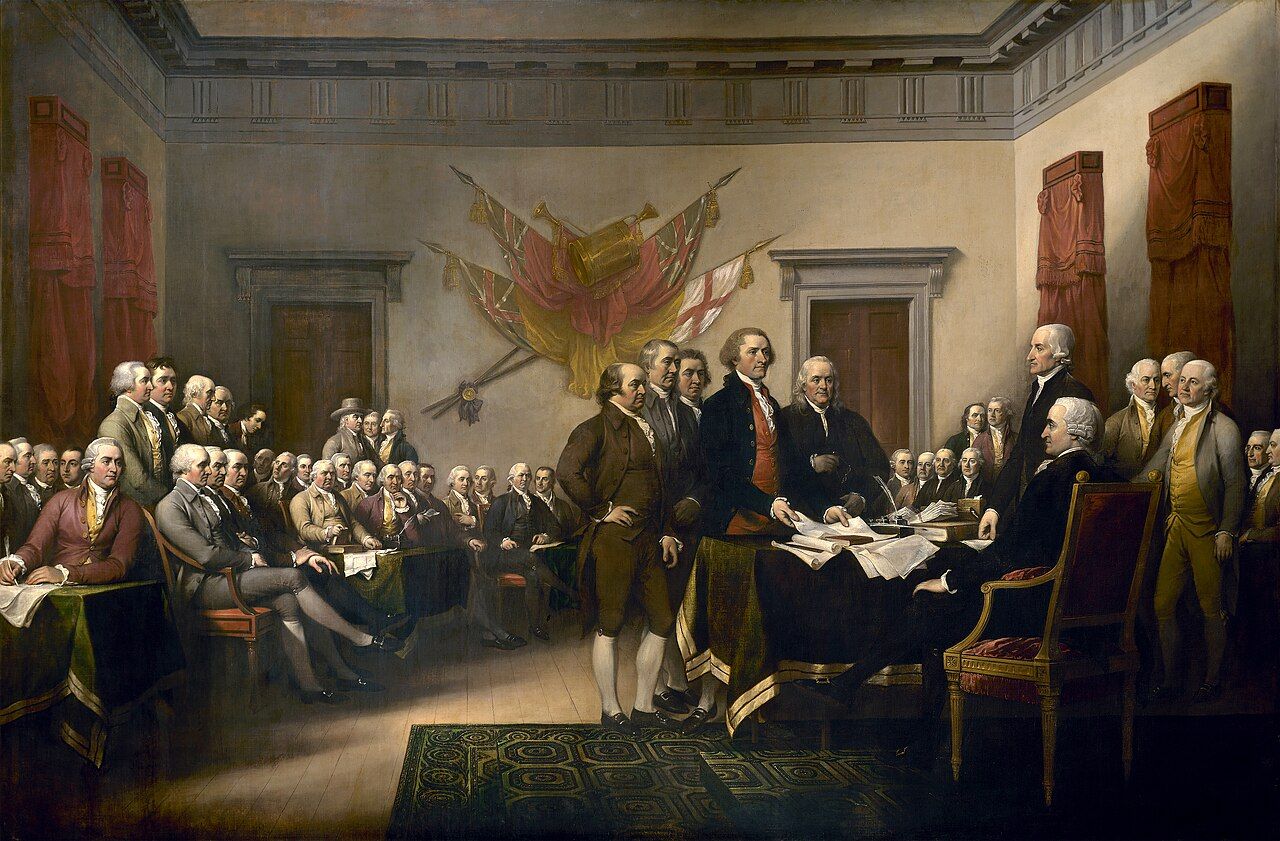
War, debt and a change of policy
The American Revolution began as an accounting problem. Britain emerged from the Seven Years’ War (1756–1763) as the dominant power in North America and India, having stripped France of Canada and its Ohio Valley claims. Victory cost money. The national debt roughly doubled, from about £75 million to some £133 million, and servicing it consumed more than half of ordinary peacetime revenue. Ministers in London looked west, saw thirteen prosperous colonies that had been defended by British regulars, and concluded reasonably enough that the colonists should contribute to the cost of their own protection.
The instruments were modest by European standards. The Sugar Act (1764) actually lowered the duty on molasses while promising, for the first time, to collect it. The Stamp Act (1765) taxed paper—newspapers, legal documents, playing cards—a tax already familiar in Britain. The Townshend duties (1767) taxed glass, lead, paint, paper and tea. What made these measures explosive was not their weight but their principle. Colonial assemblies had voted their own internal taxes for over a century. A tax laid by Parliament, in which no colonist sat, looked to Americans like the thin end of a wedge that ended in arbitrary rule.
British officials answered with the doctrine of virtual representation: members of Parliament represented the whole empire, not merely the freeholders who elected them, exactly as they represented the unenfranchised residents of Manchester or Birmingham. Americans found the argument insulting rather than persuasive. If Manchester was badly represented, that was an argument for reforming Manchester, not for extending the defect across an ocean. By the time the Stamp Act Congress met in October 1765 and the Act was repealed the following March, the colonists had discovered two things that mattered more than the tax itself: that coordinated non-importation could hurt British merchants, and that the colonies could act together.
From resistance to independence
Escalation followed a grimly familiar pattern of provocation and overreaction. Troops quartered in Boston fired into a jeering crowd in March 1770, killing five, an incident patriot propagandists promptly christened the “Boston Massacre.” The Tea Act of 1773, which actually made tea cheaper by giving the East India Company a direct sales monopoly, was read as a bribe to swallow the principle of parliamentary taxation; on 16 December 1773 men in Mohawk disguise dumped 342 chests into Boston harbor. Parliament replied with the Coercive Acts, closing the port and rewriting the Massachusetts charter. The First Continental Congress convened in September 1774. Shots at Lexington and Concord came in April 1775.
Even then, independence was not the goal. Congress sent the Olive Branch Petition to George III in July 1775. What changed opinion was partly the king’s refusal to receive it, partly the hiring of German auxiliaries, and enormously Thomas Paine’s Common Sense, published in January 1776. Paine wrote in the plain idiom of a corset-maker turned journalist, and he attacked not a ministry but monarchy itself—“a French bastard landing with an armed banditti,” he called the Norman Conquest. Perhaps 150,000 copies circulated in a population of 2.5 million. Six months later Congress adopted Jefferson’s Declaration, whose opening claims were less original than they were compressed: Locke on natural rights, the Scottish Enlightenment on moral sense, English common-law grievance-listing, all fused into a paragraph a farmer could memorize.
The war itself was won by endurance, foreign help and geography. Washington’s central achievement was keeping the Continental Army in existence. Saratoga (October 1777) persuaded France to intervene openly in 1778, turning a colonial rebellion into a global war that stretched British resources to the Caribbean, Gibraltar and India. At Yorktown in October 1781, Cornwallis surrendered to a Franco-American force whose blocking element was the French fleet under de Grasse. The Treaty of Paris in 1783 recognized independence and handed the new republic territory to the Mississippi.
Constitution and unfinished business
Winning was easier than governing. The Articles of Confederation gave Congress no power to tax or regulate trade, and the near-collapse of public finance, plus Shays’s Rebellion of indebted Massachusetts farmers in 1786–87, convinced nationalists that the frame needed replacing. The Philadelphia Convention of 1787 produced a document of remarkable engineering: separated powers, a bicameral legislature reconciling large and small states, an independent judiciary, and an amendment process. The Bill of Rights followed in 1791.
It also produced compromises with slavery that would take a civil war to undo. The three-fifths clause counted enslaved people for representation while denying them any voice; the international slave trade was protected until 1808; a fugitive-slave clause obliged free states to return the escaped. The word “slavery” never appears, which tells you the framers knew what they were doing. Meanwhile the promise that “all men are created equal” was already being taken literally by people the framers had not consulted—by Elizabeth Freeman, who sued for and won her freedom in Massachusetts in 1781, and by the free Black petitioners of Boston and Philadelphia. The American Revolution launched a standard that outran its authors.
The American Revolution began as a constitutional dispute over who could tax whom and ended by producing a durable federal republic whose founding compromises with slavery embedded a contradiction at the heart of its own principles.
Section 21789: The French Revolution and the Republic
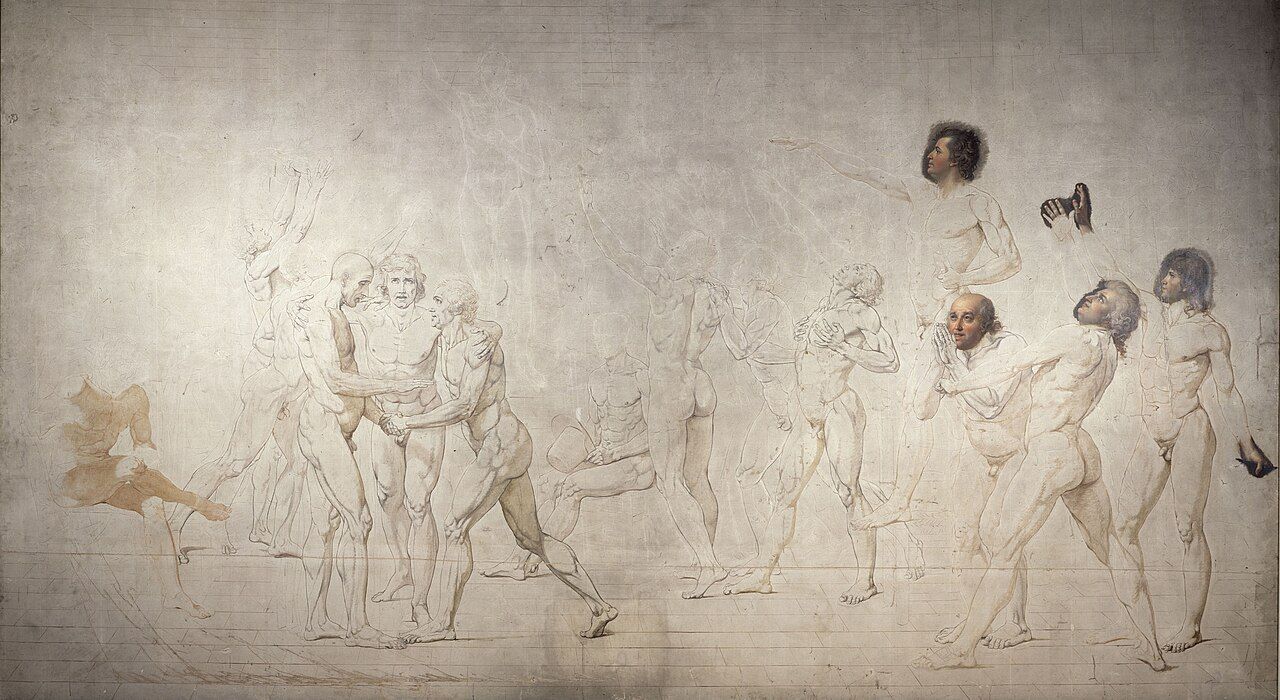
Why France broke
France in 1788 had the largest economy and the largest population in western Europe, and it was insolvent. Helping the Americans had cost roughly a billion livres, all of it borrowed, and by the late 1780s about half of state revenue went to debt service. Unlike Britain, France had no central bank and no funded national debt, so it borrowed at punishing rates through a patchwork of venal offices and short-term expedients. The tax system compounded the problem: the taille fell chiefly on peasants, the nobility and clergy enjoyed extensive exemptions, and tax farming siphoned off collections before they reached the treasury.
Society was legally divided into three estates—clergy, nobility, and everyone else. The Third Estate was around 97 percent of some 28 million people, and it included not only peasants but a growing, educated, prosperous bourgeoisie of lawyers, merchants and officials who paid for the state and were largely shut out of its highest honors. Historians disagree sharply about how far this was a class conflict. Marxist accounts once described a rising bourgeoisie overthrowing a feudal nobility; revisionists since Alfred Cobban and François Furet have pointed out that many nobles were commercially active and many revolutionary leaders were officeholders, not manufacturers. What is not in dispute is that the language of privilege had become intolerable to people who thought of themselves as citizens.
Then came weather. The volcanic eruption of Laki in Iceland (1783) and a catastrophic hailstorm in July 1788 wrecked harvests; bread prices in Paris climbed all through the following spring and peaked in July 1789 at a level that could consume 80 to 88 percent of a laborer’s daily wage. Hunger did not make the Revolution, but it filled the streets at the decisive moments.
From Estates-General to Republic
Louis XVI summoned the Estates-General for May 1789, the first meeting since 1614. The immediate quarrel was procedural and therefore fundamental: would the estates vote by order (giving clergy and nobility two votes to one) or by head? The Third Estate, doubled in numbers but not in power, waited six weeks and then on 17 June declared itself the National Assembly, representing the nation. Locked out of its hall three days later, its deputies swore the Tennis Court Oath not to disperse until France had a constitution. Sovereignty had changed hands on paper.
It changed hands on the street on 14 July, when Parisians seized the Bastille—a fortress holding seven prisoners but a great deal of gunpowder. In the countryside the Great Fear of late July sent peasants against seigneurial archives. On the night of 4 August the Assembly abolished feudal dues, tithes, venal office and provincial privilege in a few hours of competitive renunciation. The Declaration of the Rights of Man and of the Citizen (26 August) asserted that men are born free and equal in rights, that sovereignty resides in the nation, and that law is the expression of the general will. In October, market women marched to Versailles and brought the royal family back to Paris.
The constitutional monarchy of 1791 might have held. Two things killed it. The Civil Constitution of the Clergy (1790) reorganized the Church as a branch of the state and required an oath; roughly half the parish clergy refused, and the papal condemnation in 1791 split Catholic France permanently. And in June 1791 the king fled toward the eastern frontier, was recognized at Varennes and brought back under guard. A monarch who runs from his own constitution cannot easily be trusted to defend it. France declared war on Austria in April 1792 and Prussia joined against her within weeks; the monarchy fell on 10 August; the Republic was proclaimed on 22 September; Louis XVI was guillotined on 21 January 1793.
Terror and Thermidor
In 1793 the Republic faced foreign invasion, civil war in the Vendée, federalist revolts in Lyon and Marseille, and food riots. The Convention’s answer was emergency government: the Committee of Public Safety, the levy in mass (levée en masse) that put some 750,000 men under arms, the Law of the Maximum fixing prices, and the Revolutionary Tribunal. Roughly 17,000 people were executed by sentence, with tens of thousands more dead in prison or in the pacification of the Vendée, where the death toll may have exceeded 150,000.
Historians still argue whether the Terror flowed logically from the Revolution’s ideology—Furet’s view, that a politics of the indivisible general will has no room for legitimate opposition—or whether it was a contingent response to genuine emergency, as Georges Lefebvre and others held. Both readings explain something. Robespierre’s claim that virtue without terror is powerless was an ideological statement; the fact that the Terror wound down as the armies won was a circumstantial one. He fell on 9 Thermidor Year II (27 July 1794) and was executed the next day. The Directory that followed was corrupt, coup-prone and dependent on the army—which is how a Corsican artillery officer became the obvious solution.
| Phase | Dates | Regime | Defining act |
|---|---|---|---|
| Constitutional monarchy | 1789–1792 | National / Legislative Assembly | Declaration of the Rights of Man; Constitution of 1791 |
| Republic and Terror | 1792–1794 | National Convention | Execution of Louis XVI; Committee of Public Safety |
| Thermidorian reaction | 1794–1795 | Convention (post-Robespierre) | Dismantling of the Maximum and the Tribunal |
| Directory | 1795–1799 | Five Directors, two councils | Rule by coup; reliance on the army |
| Consulate and Empire | 1799–1815 | Napoleon Bonaparte | Civil Code (1804); coronation as Emperor |
France’s revolution began as a fiscal crisis that a privileged society could not resolve without redefining sovereignty, and once sovereignty moved to “the nation” each successive crisis pushed the definition of who spoke for the nation further and more violently.
Section 3Napoleon, Haiti and the Revolution Exported
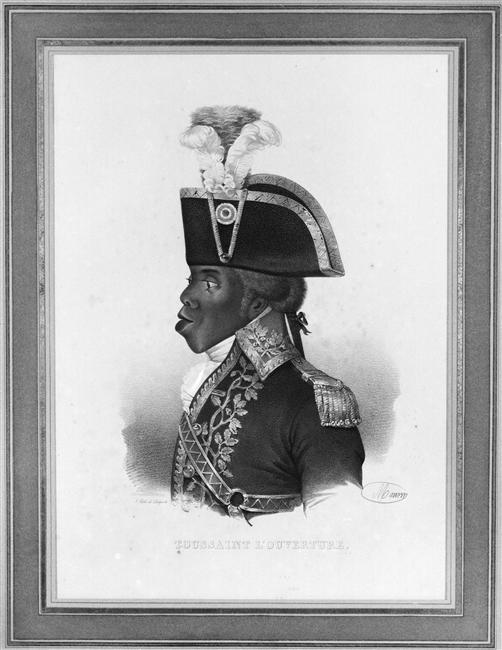
The Napoleonic settlement
Napoleon Bonaparte seized power in the coup of 18 Brumaire (9 November 1799) and governed France until 1814, with a brief return in 1815. He is impossible to sort into hero or tyrant, because he was consistently both. He ended the Revolution’s political instability and preserved its social core. The Napoleonic Code of 1804 confirmed equality before the law, secure property, religious toleration and civil marriage—while restoring the legal subordination of wives to husbands. The colonies were excluded from the Code and governed by special laws; there, by a separate decree of 20 May 1802, Napoleon had already reimposed slavery. Political liberty he simply removed: the sixty-odd Paris newspapers were cut to thirteen in 1800 and to four by 1811, elections became plebiscites on decisions already taken, and Fouché’s police watched everyone else. The Concordat of 1801 made peace with the papacy without returning Church lands. The Bank of France, the lycée system, the prefects and a rationalized tax bureaucracy gave France an administrative machine that survived every later regime change.
Abroad he was a conqueror who carried the Revolution in his baggage train. He broke the Austro-Russian coalition at Austerlitz (1805), the Prussians at Jena-Auerstedt (1806) and the Russians at Friedland (1807). Wherever French armies went, they abolished serfdom and guild monopolies, imposed legal equality, dissolved the Holy Roman Empire (1806) and reorganized the German states. They also requisitioned food, conscripted men and looted art. The Spanish rising after 1808 taught Europe the word guerrilla and taught Napoleon that nationalism could be turned against him. The invasion of Russia in 1812 took roughly 600,000 men east; perhaps one in six came back. The Congress of Vienna (1814–15), guided by Metternich, redrew the map to contain France, restored legitimate dynasties and left behind a Concert of Europe, a standing habit of great-power consultation aimed at smothering revolution before it spread. But no congress could restore the belief that dynasties governed by right alone.
Saint-Domingue: the revolution nobody planned
The French colony of Saint-Domingue was the most profitable piece of real estate on earth—in the 1780s it produced about 40 percent of the world’s sugar and over half its coffee, worked by roughly 500,000 enslaved people under some 30,000 whites and a similar number of free people of color. Mortality was so high that the population was sustained only by continuous importation from Africa. When Paris declared that men are born free and equal, the colonists insisted the words did not travel.
In August 1791 a mass uprising began in the northern plain, and the colony descended into a war of everyone against everyone, complicated by Spanish and British invasions. Toussaint Louverture, freed before the revolt and a skilled military organizer, emerged as the dominant figure, switching from Spanish to French service in 1794 after the Convention abolished slavery in the colonies. By 1801 he governed the whole island and issued a constitution naming himself governor for life. Napoleon sent his brother-in-law Leclerc with an expedition to restore slavery; Toussaint was seized under a flag of truce and died in a French prison in 1803. But yellow fever destroyed the French army, and Jean-Jacques Dessalines finished the war. On 1 January 1804 Haiti declared independence—the second independent state in the Americas and the only nation founded by a successful revolt of the enslaved.
The consequences ran in every direction. France, having lost its most valuable colony, sold Louisiana to the United States in 1803 for fifteen million dollars. Slaveholding societies from Virginia to Brazil tightened controls and told each other Haitian horror stories for decades. And in 1825 France extracted from Haiti an indemnity of 150 million francs—compensation to former slaveholders for their lost human property—a debt Haiti serviced into the twentieth century. Historians such as Michel-Rolph Trouillot have argued that Haiti was long “silenced” in European accounts precisely because it was unthinkable within them.
| American | French | Haitian | |
|---|---|---|---|
| Dates | 1765–1789 | 1789–1799 | 1791–1804 |
| Core grievance | Taxation without consent | Privilege and fiscal collapse | Slavery itself |
| Social violence | Limited; ~60,000 loyalists exiled | High; ~17,000 executed, Vendée war | Extreme; a decade of total war |
| Slavery outcome | Preserved in the South | Abolished 1794, restored 1802 | Abolished permanently |
| Final regime | Federal republic, durable | Empire, then restored monarchy | Independent state, crippled by indemnity |
Napoleon spread the Revolution’s legal and administrative reforms across Europe by force while betraying its political liberty, and Haiti showed that the Revolution’s universal claims could be seized by those it never intended to include.
Section 4The Industrial Revolution
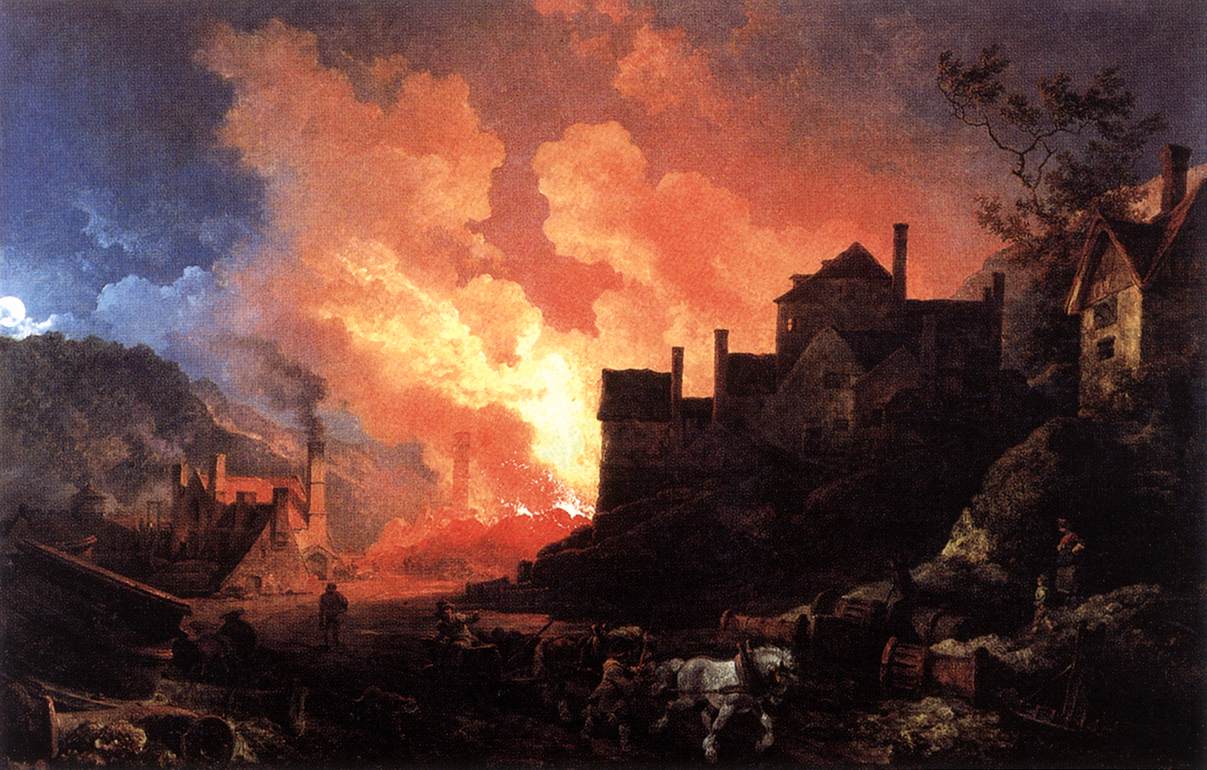
Why Britain, why then
No single cause explains industrialization, and honest historians disagree about the weighting. What is agreed is a cluster of preconditions that happened to coincide in Britain after about 1760. Agriculture came first: enclosure of open fields, the Norfolk turnip-and-clover rotation publicized by Viscount “Turnip” Townshend, Robert Bakewell’s selective livestock breeding and better drainage raised yields enough that a shrinking share of the population could feed a growing one. By 1800 perhaps a third of English workers were still in agriculture, an extraordinarily low figure for the time. Enclosure also displaced smallholders and cottagers, supplying labor to towns—a process contemporaries experienced as dispossession, whatever its aggregate efficiency.
Second, coal. Britain had large, accessible coal seams near navigable water, and had been burning coal domestically since the sixteenth century because its forests were depleted. Coal is what made steam worth pursuing: Thomas Newcomen’s atmospheric engine (1712) was hopelessly inefficient but perfectly viable at a pit-head where fuel was almost free. James Watt’s separate condenser (patented 1769) and rotary motion (1781), commercialized with Matthew Boulton, cut fuel use by roughly three-quarters and freed the engine from the coalfield.
Third, institutions and markets. Britain had secure property rights, a funded national debt and a Bank of England that borrowed cheaply, patent law, no internal tariffs, dense canal and coastal shipping, and an Atlantic empire that supplied raw cotton—grown by enslaved labor in the American South and the Caribbean—and bought finished cloth. Robert Allen has argued that the decisive factor was a peculiar British price structure: high wages and cheap coal made labor-saving, fuel-burning machinery profitable in Britain and not in France or China. Joel Mokyr emphasizes instead a culture of “useful knowledge” linking tinkering artisans to natural philosophers. The debate is live.
Cotton, iron, steam and rails
Cotton was the pacesetter because it was a new industry with no guild restrictions and an elastic global market. John Kay’s flying shuttle (1733) sped weaving and created a yarn shortage; James Hargreaves’s spinning jenny (c.1764), Richard Arkwright’s water frame (1769) and Samuel Crompton’s mule (1779) answered it. Arkwright’s real innovation was arguably organizational: the Cromford mill of 1771 gathered workers under one roof, on a clock, under supervision. British raw cotton consumption rose from around 2.5 million pounds in 1760 to over 100 million by 1815 and roughly 600 million by 1850. Prices collapsed, and cheap washable clothing spread across the world.
Iron followed. Abraham Darby had smelted with coke at Coalbrookdale in 1709; Henry Cort’s puddling and rolling process (1783–84) made wrought iron in bulk. Transport then compounded everything. The Bridgewater Canal (1761) halved Manchester coal prices; George Stephenson’s Rocket won the Rainhill Trials in 1829, and the Liverpool and Manchester Railway opened in 1830. By 1850 Britain had over 6,000 miles of track. Railways were not just faster carts—they created national markets, standardized time, consumed enormous quantities of iron and coal, and mobilized capital through joint-stock companies on a new scale.
| Innovation | Approx. date | Associated with | Why it mattered |
|---|---|---|---|
| Coke smelting of iron | 1709 | Abraham Darby | Freed ironmaking from charcoal and forests |
| Flying shuttle | 1733 | John Kay | Faster weaving; created demand for yarn |
| Spinning jenny | c.1764 | James Hargreaves | Multiplied spindles per worker |
| Water frame and factory | 1769–71 | Richard Arkwright | Strong yarn plus the factory discipline model |
| Separate-condenser steam engine | 1769–81 | Watt and Boulton | Efficient rotary power anywhere |
| Puddling and rolling | 1783–84 | Henry Cort | Cheap wrought iron for machines and rails |
| Steam locomotive railway | 1825–30 | George Stephenson | National markets; huge demand for iron and coal |
Living through it
The human record is mixed and the argument over it is old. Real wages for most workers probably stagnated from the 1780s to the 1820s and then rose clearly after about 1840—the “pessimist” and “optimist” camps mostly differ over which decades to weight. What is not ambiguous is what happened to towns. Manchester grew from roughly 25,000 people in 1772 to over 300,000 by 1851. Housing went up back-to-back with no through ventilation; privies served dozens of families; water came from contaminated wells. Life expectancy at birth in 1840s Manchester and Liverpool ran around twenty-five years, far below the figure for healthy rural districts. Cholera arrived in Britain in 1831–32 and returned in 1848; Edwin Chadwick’s Report on the Sanitary Condition of the Labouring Population (1842) and the resulting Public Health Act of 1848 were the first systematic responses.
Work itself changed character. Time became the employer’s property, marked by a bell and enforced by fines—a shift E.P. Thompson analyzed in his classic essay on time and work-discipline. Children as young as five worked in mills and mines; the 1842 Royal Commission report on mines, with its engravings of children dragging corves through low galleries, shocked Parliament into banning underground work for women and boys under ten. The Factory Act of 1833 limited children’s hours and, crucially, created paid inspectors—the first labor law with teeth. The Ten Hours Act came in 1847. Workers organized too: Luddite machine-breaking (1811–13), the Peterloo massacre at Manchester in 1819 when cavalry charged a reform meeting, killing at least fifteen and injuring hundreds, the legalization of unions in 1824–25, and the Chartist movement, whose 1839, 1842 and 1848 petitions demanded universal male suffrage and the secret ballot. Chartism failed in its moment; five of its six points became law within a lifetime.
Industrialization broke the ancient link between population growth and falling living standards, but it did so through a decades-long transition whose first generation paid in shortened lives and lengthened working days.
Section 5New Ideologies and the Revolutions of 1848
The isms are born
Almost every political word we still argue with was coined or reshaped between 1789 and 1848. Liberalism meant constitutional government, careers open to talent, freedom of speech, press and religion, secure property and free trade—and, for most of its nineteenth-century adherents, a property qualification for voting. It was the creed of the professional and commercial middle classes. John Stuart Mill’s On Liberty (1859) gave it its most searching statement; Adam Smith’s Wealth of Nations (1776) and David Ricardo supplied its economics.
Conservatism was formulated in direct reaction. Edmund Burke’s Reflections on the Revolution in France (1790) argued that society is an inherited partnership between the living, the dead and the unborn, that abstract rights are a poor guide to practical government, and that reform should be gradual and grafted onto existing institutions. Joseph de Maistre pushed further toward throne and altar. Metternich turned conservatism into an international system at Vienna, using the Carlsbad Decrees (1819) to censor German universities.
Nationalism was in 1848 usually a liberal cause, not yet a militarist one. Johann Gottfried Herder had argued that each people has a distinctive language, folklore and spirit; Giuseppe Mazzini’s Young Italy fused national unity with republican democracy. And early socialism ranged widely: Robert Owen built a model community at New Lanark and an experiment at New Harmony, Charles Fourier designed cooperative phalanstèries, Louis Blanc argued for a guaranteed right to work through state-funded “social workshops” owned by their members. Marx and Engels, in the Communist Manifesto published in February 1848, dismissed all of them as “utopian” and offered instead a theory of history driven by class conflict, in which industrial capitalism would create the proletariat that would overthrow it. The pamphlet had almost no effect that year and enormous effect later.
| Ideology | Core claim | Key voice | Main constituency |
|---|---|---|---|
| Liberalism | Constitutional rule, individual liberty, property, free markets | Mill; Smith | Professional and commercial middle class |
| Conservatism | Continuity, prescription, gradual reform, established religion | Burke; Metternich | Landed aristocracy, church, monarchy |
| Nationalism | Political borders should follow national communities | Herder; Mazzini | Intellectuals, students, subject peoples |
| Socialism | Production should serve the community, not private profit | Owen; Fourier; Marx | Artisans and, later, factory workers |
Reform, repression and 1848
Britain reformed just enough to avoid rupture. The Great Reform Act of 1832 abolished the worst rotten boroughs and enfranchised much of the urban middle class, raising the electorate from roughly 500,000 to 800,000—about one adult man in five. Catholic Emancipation came in 1829, slavery was abolished in the British Empire in 1833–34 (with compensation paid to owners, not the enslaved), and the Corn Laws were repealed in 1846. On the Continent, the July Revolution of 1830 replaced Charles X with the “bourgeois king” Louis-Philippe, Belgium won independence, and a Polish rising was crushed.
Then came 1848. A potato blight and grain failure in 1845–47 caused the last great subsistence crisis in western Europe—and, in Ireland, a famine that killed about a million people and drove a million more overseas. A financial downturn threw urban workers out of jobs. In February a banquet campaign in Paris turned into a rising; Louis-Philippe abdicated and a Second Republic was declared. Within weeks Vienna, Berlin, Milan, Venice, Budapest, Prague and dozens of German states were in revolt. Metternich fled to England. The Frankfurt Parliament assembled to write a constitution for a united Germany.
By mid-1849 nearly all of it had been reversed. The reasons are instructive. The revolutionaries split—liberals wanted constitutions and property qualifications, workers wanted bread and the right to work, and when the new Constituent Assembly closed the national workshops in June, the army killed some 1,500 Parisian workers in four days and deported thousands more to Algeria. Nationalists split too: Hungarians, Czechs, Croats and Germans all invoked national self-determination against one another, and the Habsburgs exploited it, using Croatian troops against Hungarians and Russian troops to finish the job in 1849. The Frankfurt Parliament offered the German crown to Frederick William IV of Prussia, who refused a “crown from the gutter.” In France, voters elected Louis-Napoleon Bonaparte president by a landslide; he made himself emperor in 1852.
Historians once called 1848 “the turning point at which modern history failed to turn,” a line usually traced to G.M. Trevelyan. The judgment is too neat. Serfdom was abolished in the Habsburg lands and never restored. Piedmont kept its constitution and became the engine of Italian unification. And the lesson conservative statesmen drew—that nationalism was too strong to fight and might be harnessed instead—runs straight to Cavour and Bismarck in the following chapter.
The revolutionary era generated the ideological menu—liberal, conservative, national, socialist—that Europe would use for the next century, and 1848 showed that these commitments could not be combined into a single winning coalition.
The chapter in one breath
Three revolutions, one long convulsion. Britain won an expensive war and tried to bill its colonies; the colonists answered that consent, not conquest, is the ground of taxation, and by 1789 they had a federal constitution that worked and a compromise with slavery that did not. France, bankrupted partly by helping them, called an Estates-General it had not used since 1614, and the meeting turned into a claim that sovereignty belongs to the nation—a claim that ran through the Declaration of the Rights of Man, the guillotining of a king, the Terror, and finally a general who kept the Revolution’s civil code while discarding its liberty. In Saint-Domingue, half a million enslaved people took the Declaration at its word and won the only successful slave revolution in history, then paid for it with an indemnity that lasted a century. Meanwhile in Lancashire and Shropshire, coal, cotton, credit and clock-discipline broke the old ceiling on human productivity, at the cost of a generation’s health. Out of all this came liberalism, conservatism, nationalism and socialism—and in 1848 they tore each other apart, leaving the old order standing but permanently on notice.
Words worth knowing
| Term | What it means |
|---|---|
| Virtual representation | British claim that MPs represented the whole empire, including those who could not vote for them; rejected by the colonists. |
| Articles of Confederation | The first U.S. framework (1781–89); a league of states with no federal taxing power, replaced by the Constitution. |
| Three-fifths clause | Constitutional rule counting three of every five enslaved people toward a state’s representation, boosting Southern power in Congress. |
| Estates-General | France’s medieval representative body of clergy, nobility and commons, summoned in 1789 for the first time since 1614. |
| Third Estate | Everyone outside the clergy and nobility—about 97 percent of French people, from peasants to wealthy lawyers. |
| Tennis Court Oath | Vow of 20 June 1789 by Third Estate deputies not to disperse until France had a constitution. |
| Great Fear | Rural panic and anti-seigneurial risings of summer 1789 that pushed the Assembly to abolish feudal dues on 4 August. |
| Declaration of the Rights of Man and of the Citizen | August 1789 statement that men are born free and equal in rights and that sovereignty resides in the nation. |
| Civil Constitution of the Clergy | 1790 law reorganizing the Church under state control; the required oath split French Catholics. |
| Committee of Public Safety | Twelve-man emergency executive of 1793–94, dominated by Robespierre, that directed the Terror and the war effort. |
| Levée en masse | The 1793 mass conscription decree that mobilized the whole population for war and created Europe’s first citizen army of scale. |
| Thermidor | The coup of July 1794 that overthrew Robespierre; by extension, the cooling phase after a revolution’s radical peak. |
| Napoleonic Code | 1804 civil code fixing legal equality, property and secularism—and the legal subordination of married women. |
| Enclosure | Conversion of open fields and commons into private, fenced holdings; raised yields and displaced smallholders. |
| Factory system | Concentration of powered machinery and supervised, clock-timed labor under one roof, pioneered by Arkwright at Cromford. |
| Luddites | Textile workers who destroyed machinery in 1811–13, protesting not technology as such but the collapse of skilled wages. |
| Peterloo | The 1819 cavalry charge on a reform meeting in Manchester that killed at least fifteen and became a symbol of repression. |
| Chartism | British working-class movement (1838–48) demanding universal male suffrage, secret ballot and paid MPs. |
| Liberalism | Belief in constitutional government, individual liberty, secure property and free markets; initially favored limited suffrage. |
| Concert of Europe | The post-1815 system of great-power consultation, shaped by Metternich, aimed at containing France and suppressing revolution. |
Check yourself
Nationalism, Imperialism and the Nineteenth Century
Between the fall of Napoleon in 1815 and the guns of August 1914, Europeans rebuilt the political map twice — once inside their own continent and once across most of the planet. Two new engines drove the century. The first was nationalism, the conviction that humanity divides naturally into peoples, and that each people deserves a state of its own. The second was industrial power, which gave a handful of governments steel, steam, telegraph cables, quinine and machine guns, and with them the ability to project force farther and faster than any empire in history. This chapter follows both engines: how a romantic idea about language and folk poetry hardened into the ruthless statecraft of Cavour and Bismarck; how factories and sewers and mass electorates rewrote domestic politics; how Europe took roughly ninety percent of Africa in thirty years; and why the same nationalism that built states also cracked them open by 1914.
By the end of this chapter you can
- Explain the aims of the Congress of Vienna and why the Concert of Europe could contain revolution for a generation but not defeat it.
- Trace how Romantic nationalism — Herder’s Volk, philology, folklore collecting — became a political program, and evaluate the scholarly debate over whether nations are ancient or modern inventions.
- Account for the causes and near-total failure of the Revolutions of 1848, including the collapse of the Frankfurt Parliament.
- Compare the unifications of Italy and Germany, and define Realpolitik with evidence from Cavour, Garibaldi and Bismarck.
- Describe the Second Industrial Revolution and connect steel, chemicals, electricity and the sanitary movement to urban mortality, public health nursing and mass politics.
- Distinguish liberalism, conservatism, Marxist socialism, revisionism, anarchism and social Catholicism as competing answers to the “social question.”
- Explain the New Imperialism — its technologies, ideologies and the Berlin Conference — and assess the Hobson–Lenin economic thesis against alternative explanations.
- Analyze how nationalism destabilized the Habsburg, Ottoman and Russian empires and fed the alliance system that broke in 1914.
- Evaluate anti-colonial and minority responses, from Adwa and the Indian National Congress to the Dreyfus affair and political Zionism.
Section 1The Nation Imagined: Restoration, Romanticism and 1848
The Vienna settlement and its enemies
Napoleon’s defeat left the victors with a problem they had never faced: how to unbuild a revolution. From September 1814 to June 1815 the Congress of Vienna assembled under the Austrian foreign minister Klemens von Metternich, with Britain’s Castlereagh, Russia’s Alexander I, Prussia’s Hardenberg and, remarkably, the defeated French represented by Talleyrand. Their instincts were conservative but not stupid. They did not crush France; they restored the Bourbons, kept France inside the great-power club, and built a ring of stronger buffer states around her — an enlarged Netherlands, a Prussian foothold on the Rhine, Piedmont-Sardinia strengthened with Genoa. The guiding ideas were legitimacy (restore rightful dynasties), compensation and a rough balance of power in which no single state could dominate.
What Vienna deliberately refused to honor was national feeling. Italy was left as a patchwork of eight states with Austria controlling Lombardy and Venetia directly. The three-hundred-odd German states of the old Holy Roman Empire were consolidated into a loose German Confederation of thirty-nine, presided over by Austria. Poland was partitioned again, most of it as a Russian-ruled kingdom. Belgians were handed to a Dutch king. The settlement worked, in its own terms, better than anyone expected: no general European war occurred for ninety-nine years, and none between the Congress powers themselves until the Crimean War of 1853–56. But the price was permanent low-grade rebellion.
Metternich policed that rebellion through the Concert of Europe, a habit of great-power consultation, and through censorship at home. After a nationalist student murdered the playwright August von Kotzebue in 1819, the Carlsbad Decrees dissolved student societies, put university lecturers under surveillance and imposed press censorship across the Confederation. Secret societies flourished anyway — the Italian Carbonari, the Greek Philiki Hetairia. The system also had a fatal inconsistency: Britain, France and Russia backed Greek independence from the Ottoman Empire (a nationalist revolt) because it suited their interests, sinking the Ottoman-Egyptian fleet at Navarino in 1827 and securing Greek statehood by 1832. Legitimacy, it turned out, was negotiable.
Where nations come from: Herder, philology and folklore
Before nationalism was a political movement it was a theory of culture. Johann Gottfried Herder (1744–1803) argued that humanity is not one undifferentiated mass improvable by universal reason but a garden of distinct peoples, each with a Volksgeist — a spirit expressed in its language, songs, proverbs and law. Language, for Herder, was not a tool but the soul of a people made audible. This was a claim about authenticity, and it was initially anti-imperial in flavor: it defended small cultures against French cultural dominance.
Napoleon militarized it. After Prussia’s humiliation at Jena, Johann Gottlieb Fichte delivered his Addresses to the German Nation in occupied Berlin in the winter of 1807–08, telling Germans they were an Urvolk with an original language and therefore a destiny. Scholars supplied the raw material. Jacob and Wilhelm Grimm published their collected household tales in 1812 and began a monumental German dictionary in 1838; parallel work produced Serbian folk-song collections (Vuk Karadžić), Finnish epic (the Kalevala, 1835), and standardized Czech, Hungarian and Norwegian literary languages. A grammar could be a political act. Where a printed standard language existed, a nation could be argued into existence around it.
The political translation came from Giuseppe Mazzini, who founded Young Italy in 1831 and preached that each nation had a God-given mission and that a Europe of free nations would be a Europe at peace. Mazzini was a democrat and an internationalist; the later career of nationalism — exclusionary, biological, militarized — would have appalled him. That distinction between civic nationalism (the nation as a community of citizens who consent) and ethnic nationalism (the nation as descent and blood) is imperfect but genuinely useful, and the nineteenth century drifted steadily from the first toward the second.
Pearl. Nations feel timeless from the inside, which is exactly what makes them modern. Benedict Anderson called the nation an “imagined community” — imagined because you will never meet most of your compatriots, yet feel kinship with them — and the essays Eric Hobsbawm and Terence Ranger collected in The Invention of Tradition (1983) showed how many “ancient” national traditions were manufactured in the nineteenth century — Hugh Trevor-Roper on kilts and clan tartans, David Cannadine on royal ceremonial. Not everyone agrees: Anthony Smith argued that modern nations grew from real, older ethnic cores (ethnies) rather than out of nothing. The honest position is that nationalism used genuine older materials to build something genuinely new.
1848: the springtime that failed
Palermo had already risen in January 1848. In February a banquet campaign for suffrage reform in Paris turned into a street rising; Louis-Philippe abdicated and a republic was declared. Within weeks the shock traveled the telegraph and the railway to Vienna, where Metternich fled in March, and on to Berlin, Milan, Venice, Budapest and Prague. The causes stacked: the “hungry forties” potato blight and grain failure of 1845–47, a credit and industrial slump, artisan displacement, censorship, and the refusal of monarchs to concede constitutions. In a matter of months more than fifty states saw uprisings.
Within eighteen months nearly all of it was reversed. The German liberals elected a Frankfurt Parliament in May 1848 — 585 delegates, heavily professorial, arguing for a year over borders and rights. Their central question, “Grossdeutsch or Kleindeutsch” (a Germany including Austria’s German lands, or a smaller Germany under Prussia), had no answer that Austria would accept. When they finally offered the imperial crown to Frederick William IV of Prussia in April 1849, he refused it: a crown from the gutter, offered by professors rather than princes, carried no legitimacy he recognized. In Hungary, Lajos Kossuth’s revolutionary government was crushed in August 1849 by Habsburg forces with a Russian army of some 200,000 in support. In Italy, Piedmont’s Charles Albert lost at Custoza (1848) and Novara (1849); Mazzini’s Roman Republic fell in July 1849 — to a French army sent by a republic, protecting the Pope. In Paris, the June Days pitted General Cavaignac’s regular army and the newly raised Mobile Guard, backed by bourgeois National Guard units, against unemployed workers, and killed several thousand; by December 1852 Louis-Napoleon had made himself Emperor Napoleon III.
Why did the revolutions fail so completely? Three reasons matter more than the rest. Liberals wanted constitutions and property rights; workers wanted bread and jobs; once the workers moved, the middle classes chose order. Nationalism divided the revolutionaries against each other — Germans in Frankfurt voted to keep Polish Posen, Hungarians denied Croat and Romanian claims, and the Habsburgs survived partly by playing subject nationalities off one another. And the armies mostly stayed loyal to their monarchs. The lasting lesson, absorbed above all by Cavour and Bismarck, was that liberals and nationalists could not deliver unity by moral argument; a state with an army would have to do it for them.
| 1848 — where | What was demanded | Outcome by 1852 |
|---|---|---|
| France | Suffrage, republic, right to work | Second Republic, then Napoleon III’s Second Empire |
| Habsburg Austria | Constitution, end of censorship | Metternich gone, absolutism restored under Franz Joseph; serfdom abolished (the one lasting gain) |
| Hungary | Independence under Kossuth | Crushed 1849 with Russian military help |
| German states | Unification, liberal constitution | Frankfurt Parliament dissolved; Prussian crown refused |
| Italian states | Expel Austria, unify, republic in Rome | Austrian and French restoration; Piedmont keeps its constitution |
Vienna built a durable peace by ignoring nationality, and 1848 proved that ignoring nationality was not the same as defeating it — but also that idealism without an army changed nothing.
Section 2Made by War: The Unifications of Italy and Germany
Cavour’s calculation and Garibaldi’s gamble
Italian unification — the Risorgimento — succeeded when it stopped being Mazzini’s and became Piedmont’s. Camillo Benso di Cavour, prime minister of Piedmont-Sardinia from 1852, was a modernizing liberal aristocrat, not a romantic: he built railways, cut tariffs, reformed banking, and understood that Piedmont alone could never beat Austria. So he bought an ally. He sent 18,000 Piedmontese troops to the Crimean War in 1855 for no Italian interest whatsoever, purely to earn a seat at the peace table. At the secret meeting at Plombières in July 1858 he and Napoleon III agreed that France would fight Austria if Austria could be maneuvered into appearing the aggressor. Cavour duly provoked; Austria duly issued an ultimatum; war came in 1859.
The French and Piedmontese won bloody victories at Magenta and Solferino — Solferino’s carnage so appalled the Swiss businessman Henry Dunant that he founded what became the Red Cross in 1863 — and then Napoleon III abruptly made a separate peace at Villafranca, frightened by Prussian mobilization and by revolutions in central Italy he had not authorized. Piedmont got Lombardy, not Venetia. But the central Italian duchies held plebiscites and joined anyway; Cavour paid France with Nice and Savoy in 1860.
Then came the improvisation. In May 1860 Giuseppe Garibaldi sailed from Genoa with roughly a thousand red-shirted volunteers, landed in Sicily, and by September had taken Naples — toppling a Kingdom of the Two Sicilies of some nine million people, helped by Sicilian peasant revolt and Bourbon incompetence. Cavour was horrified: a republican hero marching on Rome could bring French intervention. He sent the Piedmontese army south to intercept, and at Teano in October 1860 Garibaldi handed his conquests to King Victor Emmanuel II and retired to his farm. The Kingdom of Italy was proclaimed in March 1861. Venetia followed in 1866 as Prussia’s payoff for the Austro-Prussian War; Rome only in 1870, when French troops left to fight Prussia and Italian forces walked in through a breach at Porta Pia.
Pearl. “We have made Italy; now we must make Italians” is usually quoted as Massimo d’Azeglio’s, and the attribution is shaky — the surviving phrasing in his memoirs is close but not identical. The underlying fact is not shaky at all. At unification perhaps only 2.5 percent of the population habitually spoke standard Italian rather than a regional language, illiteracy in the south exceeded 80 percent, and the new state fought a counterinsurgency in the south (the brigantaggio, 1861–65) that killed more Italians than all the wars of unification combined. Building a nation-state is not the same as having a nation.
Bismarck, Realpolitik and three wars
Otto von Bismarck became minister-president of Prussia in September 1862 in the middle of a constitutional crisis: the liberal-majority parliament refused to fund army expansion, so Bismarck simply collected the taxes without a budget. Days into the job he told a budget committee that the great questions of the day would be settled not by speeches and majority votes — that was the error of 1848 — but by iron and blood. The phrase defined Realpolitik: policy set by calculation of power and interest rather than by ideology, sentiment or legitimist principle.
Three short wars in seven years did the work. In 1864 Prussia and Austria jointly seized Schleswig and Holstein from Denmark — and the deliberately messy joint administration of the duchies gave Bismarck his pretext against Austria. In 1866 the Austro-Prussian War lasted seven weeks; Prussia’s railways, breech-loading needle guns and Moltke’s general staff destroyed the Austrian army at Königgrätz on 3 July. Bismarck then insisted on lenient terms — no territory taken from Austria proper, no triumphal entry into Vienna — because he wanted Austria neutral later, not vengeful. Austria was excluded from Germany; the North German Confederation formed in 1867 under Prussia. Finally, in 1870, Bismarck edited a telegram from his king at Ems to make a routine diplomatic exchange read as a mutual insult, published it, and France declared war. The Franco-Prussian War was catastrophic for France: Napoleon III captured at Sedan on 2 September 1870, Paris besieged and starved through the winter, an indemnity of five billion francs, and the annexation of Alsace and most of Lorraine over the explicit protest of their inhabitants. The German Empire was proclaimed at Versailles on 18 January 1871.
Was Bismarck a master planner? Older accounts made him a chess player executing a design from 1862. Most historians now read him as a superb opportunist — a man who created options, waited, and improvised brilliantly, and who himself said statesmanship consisted of listening for God’s footsteps and grabbing the coat-tail. What is certain is the shape of what he built: a federal empire with universal male suffrage for the Reichstag but a chancellor responsible to the Kaiser alone, an army outside parliamentary control, and Prussia dominant within it. He then spent twenty years defending it — the Kulturkampf against Catholic institutional independence (largely abandoned by the early 1880s as a failure), the Anti-Socialist Laws of 1878–1890, and, most consequentially, the world’s first national social insurance system: sickness insurance in 1883, accident insurance in 1884, old-age and disability pensions in 1889. That was not benevolence. It was an attempt to detach workers from socialism by making the state, not the party, the source of security.
| Year | Italy | Germany |
|---|---|---|
| 1834 | Mazzini’s Young Italy conspiracies fail | Zollverein customs union creates a Prussian-led economic Germany |
| 1848–49 | Charles Albert defeated; Roman Republic crushed | Frankfurt Parliament collapses; crown refused |
| 1859–64 | War with Austria; Lombardy gained; Garibaldi takes the south (1860) | Bismarck takes office (1862); Danish War (1864) |
| 1866 | Venetia acquired as a byproduct of Prussia’s war | Königgrätz; Austria excluded from Germany |
| 1870–71 | Rome taken when French garrison withdraws; capital moved 1871 | Sedan; Empire proclaimed at Versailles; Alsace-Lorraine annexed |
| Method | Diplomacy plus foreign alliance plus popular insurgency, then absorbed by a monarchy | State-directed war by a professional army; liberals co-opted after the fact |
What unification cost
Both new states were smaller than their nationalist rhetoric. Italy left Italian-speakers in Austrian Trieste and Trentino (the irredenta, the “unredeemed”), and its seizure of Rome put it in open conflict with the papacy for nearly sixty years; Pius IX declared himself a prisoner of the Vatican and forbade Catholics to vote in national elections. Germany excluded millions of German-speaking Austrians and included resentful Poles, Danes and Alsatians. Both states responded with programs of forcible assimilation — language laws in Prussian Poland, conscription and schooling as Italianizing machines.
The international consequences were larger still. France now had a permanent grievance and a lost province. Austria, shut out of Germany, turned toward the Balkans, where it collided with Russia. And a united Germany, with the largest army and soon the largest industrial economy in Europe, sat in the middle of the continent as a structural problem that no balance of power had been designed to hold. Bismarck spent the rest of his career building alliances to keep France isolated; his successors dismantled them within two years of his dismissal in 1890.
Italy and Germany were unified not by the liberals and romantics who imagined them but by conservative statesmen using armies, alliances and manipulated crises — and the manner of their making shaped, and destabilized, European politics for the next forty years.
Section 3Steel, Cities and the Politics of the Masses
The Second Industrial Revolution
The first industrial revolution ran on coal, iron, cotton and the steam engine, and it was largely British. The Second Industrial Revolution, roughly 1870–1914, ran on steel, chemicals, electricity and the internal combustion engine, and its leaders were Germany and the United States. The difference was not just scale but method: this was the first industrialization driven by organized science. Henry Bessemer’s converter (1856) and the Siemens–Martin open-hearth furnace made cheap steel possible; the Gilchrist–Thomas process (1878) allowed the use of phosphoric ores, which happened to be exactly what Lorraine and Luxembourg had. German steel output, well behind Britain’s in 1870, was roughly double it by 1913.
Chemistry became an industry with a laboratory attached. William Perkin’s accidental synthesis of mauve dye in 1856 launched synthetic dyes; by 1900 German firms — BASF, Bayer, Hoechst — controlled the overwhelming majority of world dye production and, with them, the beginnings of the pharmaceutical industry (Bayer marketed aspirin in 1899). Electricity moved from curiosity to infrastructure: practical incandescent lighting by 1879–1880, alternating-current transmission in the 1890s, electric trams reshaping where working people could afford to live. Transport and communication collapsed distance: a working transatlantic telegraph cable in 1866, the Suez Canal in 1869, compound marine engines, and refrigerated shipping from the 1880s that let Argentine beef and New Zealand mutton feed British cities.
Two consequences ran straight into politics. First, the price deflation and profit squeeze of 1873–1896 — contemporaries called it the Great Depression — ended the free-trade consensus; Germany returned to protective tariffs in 1879, France and others followed, and Britain became the lonely exception. Second, production concentrated. Cartels, trusts and investment banks replaced the family firm; by 1900 a German steel or chemical works employed thousands and coordinated prices with its rivals. Big capital summoned big labor, and big labor summoned mass parties.
| Innovation | Date | Why it changed the century |
|---|---|---|
| Bessemer converter | 1856 | Cheap steel — rails, ships, girders, artillery, skyscrapers |
| Transatlantic telegraph | 1866 | News and orders cross the Atlantic in minutes; global markets and imperial command |
| Suez Canal | 1869 | Cuts London–Bombay by roughly 40 percent; makes Egypt strategically irresistible |
| Germ theory and antisepsis | 1860s–1880s | Pasteur, Lister, Koch — surgery survivable, disease causation identified, nursing professionalized |
| Maxim machine gun | 1884 | Self-powered automatic fire; decisive asymmetry in colonial warfare |
| Electric power and traction | 1880s–1900s | Factories freed from waterwheels and shafting; suburbs, night work, mass lighting |
| Synthetic chemicals | 1856–1913 | Dyes, drugs, fertilizer and explosives — and German industrial leadership |
The city and the sanitary state
Europe’s population roughly doubled in the century, and the increase piled into cities. London grew from about one million in 1800 to some 6.5 million by 1900; Berlin from about 170,000 to nearly two million. The early results were lethal. In the worst districts of Manchester and Liverpool in the 1840s, average age at death for laborers’ families fell into the teens, dragged down by infant mortality; cholera epidemics swept Europe in 1832, 1848–49, 1854 and 1866.
The response created the modern public-health state — and it is worth noticing that it largely preceded the germ theory that eventually justified it. Edwin Chadwick’s 1842 Report on the Sanitary Condition of the Labouring Population argued from a mistaken theory (miasma, bad air) to correct policy: drainage, clean water, refuse removal. Britain’s first Public Health Act followed in 1848. In 1854 John Snow mapped cholera deaths around the Broad Street pump in Soho and made the case for waterborne transmission by spatial evidence rather than microscopy. After the “Great Stink” of 1858, Joseph Bazalgette built London’s 82 miles of intercepting sewers. Then the biology arrived: Louis Pasteur’s work on fermentation and microbial disease in the 1860s, Joseph Lister’s carbolic antisepsis in 1867, and Robert Koch’s identification of the tubercle bacillus in 1882 and the cholera vibrio in 1883.
Nursing became a profession in the same decades and by a similar logic. Florence Nightingale arrived at the British barrack hospital at Scutari in 1854, where mortality was driven far less by battle wounds than by typhus, typhoid, cholera and dysentery in an overcrowded building sitting on defective sewers. Her most durable contribution was not the lamp but the arithmetic: she compiled mortality statistics, popularized the polar-area diagram to display seasonal causes of death, and used them to force sanitary reform on the army. Her Notes on Nursing (1859) and the Nightingale Training School at St Thomas’ (1860) established nursing as trained, salaried, evidence-using work. Between roughly 1880 and 1914 European urban death rates fell sharply — a change attributable more to water, sewers, milk regulation and housing than to any drug, since effective antibacterials were still decades away.
Pearl. A common misconception is that nineteenth-century mortality fell because doctors learned to cure disease. Overwhelmingly it fell because engineers and inspectors stopped disease from spreading — clean water, sewage separation, pasteurized and inspected milk, less crowding, better nutrition. Nightingale herself resisted germ theory for years and still saved enormous numbers of lives, because her sanitary interventions were correct regardless of why they worked. Good practice can outrun correct theory; that is an argument for measuring outcomes, not for ignoring mechanisms.
Ideologies for a mass electorate
Politics had to change because the electorate did. Britain’s Reform Acts of 1832, 1867 and 1884 expanded the franchise from roughly one adult male in ten before 1832 to about one in five after it, one in three after 1867 and about three in five after 1884, with the secret ballot from 1872. The German Empire had universal male suffrage for the Reichstag from 1871; France had had it since 1848, retained under the Second Empire and inherited by the Third Republic in 1870. Mass literacy, cheap newspapers and mass parties followed. So did the “social question”: what does the state owe people who own nothing but their labor?
Karl Marx and Friedrich Engels had given one answer in the Communist Manifesto of 1848 and in Capital (volume one, 1867): history is driven by class struggle, capitalism concentrates wealth while immiserating workers, and it will be overthrown. The organized movement that followed him was more cautious than his rhetoric. The German Social Democratic Party, illegal in effect from 1878 to 1890, became the largest party in the Reichstag by 1912 with about 35 percent of the vote — and did so by winning elections, running newspapers, libraries, choirs and cycling clubs. In 1899 Eduard Bernstein published the argument that made this explicit: wages were rising, the middle class was not disappearing, and socialism should therefore be pursued by reform through parliament. Karl Kautsky and others attacked this revisionism as a betrayal, and the split between reformist social democracy and revolutionary Marxism, opened here, would define the twentieth-century left.
Other answers competed. Liberals shifted from pure laissez-faire toward the “new liberalism” of state-provided minimums (Britain’s old-age pensions in 1908, national insurance in 1911). Conservatives discovered that nationalism and welfare could bind workers to the existing order — Bismarck’s insurance laws, Disraeli’s social legislation. Anarchists rejected the state itself and, in the “propaganda of the deed” wave between 1894 and 1901, assassinated a French president, a Spanish prime minister, an Austrian empress, an Italian king and an American president. And the Catholic Church entered the field with Leo XIII’s encyclical Rerum Novarum (1891), which condemned both socialism and unrestrained capitalism and defended a living wage and the right to organize.
| Position | Diagnosis of the problem | Preferred remedy |
|---|---|---|
| Classical liberalism | State interference and privilege | Free markets, free trade, constitutional government, limited franchise |
| New liberalism | Poverty blocks real freedom | Pensions, insurance, factory regulation within capitalism |
| Conservatism | Disorder and rootlessness | Monarchy, church, army, nation — plus state welfare to buy loyalty |
| Marxist socialism | Private ownership of the means of production | Class organization and eventual revolutionary transfer of ownership |
| Revisionism | Marx’s predictions were empirically failing | Trade unions, ballots, incremental reform |
| Anarchism | The state itself is coercion | Abolition of the state; some factions embraced assassination |
| Social Catholicism | Both greed and class hatred violate human dignity | Living wage, unions, family, private property with obligations |
Women, work and the vote
Industrial capitalism sorted women’s lives by class. Working-class women had always worked; now they worked in textile mills, matchworks, domestic service and, by 1900, in the new white-collar jobs created by the typewriter and the telephone exchange. Middle-class ideology, meanwhile, elevated the “separate spheres” doctrine that a respectable woman’s domain was the home — a norm that described a minority and disciplined everyone.
Legal change came first in property and family law. Britain’s Married Women’s Property Acts of 1870 and 1882 ended the rule that a wife’s earnings and possessions belonged to her husband. Access to education and the professions opened slowly and unevenly: Elizabeth Garrett Anderson qualified in medicine in Britain in 1865 by exploiting a loophole the Society of Apothecaries then closed; Marie Curie, a Polish woman working in France, shared the Nobel Prize in Physics in 1903 and took the Chemistry prize alone in 1911. Nursing and teaching, both coded feminine and both underpaid, became the mass professional entries.
Suffrage came last and hardest. Millicent Fawcett’s National Union of Women’s Suffrage Societies (1897) campaigned constitutionally; Emmeline Pankhurst’s Women’s Social and Political Union (1903) turned to window-breaking, arson and hunger strikes met by force-feeding. New Zealand granted national women’s suffrage in 1893, Australia in 1902, Finland in 1906 (with the right to stand for election); most of Europe and the United States conceded only during or after the First World War. Historians still argue whether militancy accelerated British suffrage or delayed it — the evidence genuinely cuts both ways.
Steel, sewers and suffrage belong in the same story: industrial concentration created the urban working masses, sanitary reform kept them alive, and mass electorates forced every political tradition — liberal, conservative, socialist and Catholic — to answer for their conditions.
Section 4The New Imperialism
Why so fast, and why then
Europeans had traded on African coasts for four centuries without conquering the interior. Between about 1880 and 1900 they took almost all of it. Three enabling changes explain the timing. Medically, the prophylactic use of quinine from the 1850s cut European mortality in West Africa from catastrophic to merely bad. Militarily, breech-loading rifles, then repeaters, then the Maxim gun of 1884 produced a lethality gap so wide that at Omdurman in 1898 a Mahdist army lost on the order of 11,000 dead against 48 British and Egyptian fatalities. Logistically, steamships, railways, the Suez Canal and the telegraph made distant administration possible and made distant crises look urgent in European capitals within hours.
The motives were mixed and genuinely contested. Economic arguments — raw materials (rubber, cotton, tin, copper, palm oil), markets, and outlets for investment — mattered, but the colonies that were seized fastest were often the least profitable. Strategic logic mattered enormously: Britain occupied Egypt in 1882 after the Urabi nationalist revolt largely to secure the canal route to India, then found itself pushed up the Nile to protect Egypt, then into Sudan to protect the Nile. Prestige mattered: for Italy, Germany and Belgium, colonies were credentials of great-power status. And ideology supplied the permission structure — a “civilizing mission,” missionary enthusiasm, and the pseudo-science that misapplied Darwin to human societies. Herbert Spencer’s phrase “survival of the fittest” was recruited to argue that conquest was nature’s verdict; Kipling’s “White Man’s Burden” (1899) dressed domination as duty.
The Scramble, Berlin and the Congo
The Berlin Conference of November 1884 to February 1885, convened by Bismarck, brought fourteen states together to regulate the partition of Africa. No African was present. It did not itself draw the borders, but it set the rules — free navigation on the Congo and Niger, notification of claims, and the principle that coastal claims required “effective occupation” — which converted the race into a legal obligation to march inland. A large share of the resulting borders are straight lines drawn without reference to who lived there, cutting through language groups, kingdoms and grazing routes; the consequences persist.
The conference also recognized Leopold II of Belgium’s claim to what he named the Congo Free State — not a Belgian colony but the personal possession of a European king, presented to the world as a humanitarian and anti-slavery project. It became a forced-labor rubber operation. Villages were assigned quotas; hostages were taken; the Force Publique was required to account for cartridges by producing severed hands. The missionary and diplomatic evidence assembled by Edmund Dene Morel, and the official British consular report by Roger Casement in 1904, forced Belgium to annex the territory from its own king in 1908. Estimates of the death toll vary widely — Adam Hochschild’s widely cited figure of about ten million represents a population decline from killings, starvation, exhaustion and epidemic disease over roughly two decades, and demographers dispute both the baseline and the attribution. That there was mass atrocity on a colossal scale is not disputed. Nor was the Congo unique: German forces under Lothar von Trotha issued an explicit extermination order against the Herero in 1904 and drove Herero and Nama populations into the Omaheke desert, an episode now widely classified as the twentieth century’s first genocide.
Pearl. Empire is often defended as having been, on balance, an economic project that paid. For the imperial powers as a whole, it usually did not. Britain’s largest returns on foreign investment came from the United States, Argentina and the self-governing dominions, not from tropical Africa, while the costs of garrisons, railways and administration were carried by all taxpayers. The gains were real but concentrated — in shipping firms, chartered companies, settler landholders, arms makers and army careers. That is precisely J. A. Hobson’s 1902 argument: empire socialized the costs and privatized the profits.
Asia: India, China, Japan
Asia showed three different outcomes. India was the model of direct rule. After the rebellion of 1857 — sparked among sepoys by rifle cartridges greased with animal fat, but fed by annexations, land settlements and religious anxiety — the East India Company was abolished and the Crown took over in 1858; Victoria was proclaimed Empress of India in 1877. British India got railways (about 25,000 miles by 1900, over 30,000 by 1910), a telegraph network, codified law, English-language universities and an Indian Civil Service that Indians could enter only in tiny numbers. It also got deindustrialization of its textile handloom sector, revenue systems that offered no cushion, and famines — 1876–78 and 1896–1902 — in which millions died while grain was exported and officials cited market principles. Historians disagree sharply over the net economic effect of British rule; they no longer seriously disagree that famine policy was a moral catastrophe.
China was not colonized but was pried open. Britain fought the First Opium War (1839–42) to compel China to accept a drug trade it had banned; the Treaty of Nanjing took Hong Kong, opened five treaty ports and imposed an indemnity. A second war (1856–60) ended with the sacking of the Summer Palace. Layered on top came the unequal treaties — extraterritoriality, fixed tariffs, most-favored-nation clauses — and internal catastrophe in the Taiping Rebellion (1850–64), which killed perhaps twenty million. After defeat by Japan in 1895, the powers carved out spheres of influence; the anti-foreign Boxer Uprising of 1899–1901 was crushed by an eight-nation expedition and punished with a crushing indemnity.
Japan drew the opposite lesson and acted on it. Commodore Perry’s squadron forced Japanese ports open in 1853–54; within fifteen years the Meiji Restoration (1868) had abolished the shogunate and the samurai class privileges, imported European legal codes, built state industries then sold them to private combines, instituted universal conscription and compulsory schooling, and adopted a constitution in 1889. Japan then joined the imperialists: it defeated China in 1894–95, annexed Taiwan, and in 1904–05 destroyed Russian forces at Mukden and annihilated the Baltic Fleet at Tsushima. Ethiopia had already humbled Italy at Adwa in 1896, but this was the first time in the modern era that an Asian power had beaten a European great power in a full-scale war, and the news electrified nationalists from Cairo to Calcutta.
| Case | Form of control | Consequence to remember |
|---|---|---|
| Egypt (Britain, 1882) | Occupation with nominal Ottoman-Khedival sovereignty | Strategic protection of Suez pulled Britain up the Nile into Sudan |
| Congo (Leopold II, 1885–1908) | Personal fief, then Belgian colony | Rubber quotas, mutilation and mass death; first global human-rights campaign |
| India (Britain, 1858–1947) | Direct Crown rule plus princely states | Railways and law codes alongside famine and exclusion; birth of Congress nationalism |
| China (multiple, 1842–1901) | Treaty ports, extraterritoriality, spheres of influence | Sovereignty hollowed out without formal colonization |
| Japan | Escaped, then imperialized | Meiji reform, victory over Russia 1905, model for Asian nationalists |
| Ethiopia | Successful resistance | Menelik II destroys an Italian army at Adwa, 1 March 1896 |
Explaining empire, and resisting it
Three families of explanation compete. Hobson (1902) and then Lenin (1916) made empire a function of capitalism: surplus capital at home, seeking higher returns, drove annexation, and Lenin called imperialism the highest stage of capitalism. Critics point out that capital exports mostly went elsewhere and that annexation frequently preceded investment. A second school, associated with Ronald Robinson and John Gallagher, argued that Europeans generally preferred informal influence and were dragged into formal rule by crises on the periphery — local collaborators failing, nationalist revolts, frontier instability. A third emphasizes European domestic politics: prestige, popular jingoism in a newspaper age, and diplomatic rivalry, with Africa as a low-cost arena for competition that could not safely be conducted in Europe. Most historians today use some blend, and weight it differently case by case.
Resistance was constant and is often written out. Ethiopia’s Menelik II, having modernized his artillery and played the powers against each other, destroyed an invading Italian army at Adwa in 1896 and kept his independence. The Mahdist state ruled Sudan for over a decade. Samori Touré fought the French in West Africa for sixteen years. The Indian National Congress, founded in 1885 by moderate professionals petitioning for a share in government, radicalized after the 1905 partition of Bengal into the Swadeshi boycott movement. Egyptian, Vietnamese, Filipino and Korean nationalists drew on European nationalist vocabulary and turned it back on its authors. Nationalism, exported as a European doctrine, became the most effective anti-European weapon of the following century.
The New Imperialism was made possible by industrial technology and medicine, driven by a mixture of strategy, prestige and profit rather than any single cause, justified by racial pseudo-science, and answered almost immediately by the same nationalist logic that had built Europe’s own nation-states.
Section 5Empires Under Strain, 1890–1914
Multinational empires in a national age
Three empires straddling eastern and southeastern Europe were structurally incompatible with nationalism. The Habsburg monarchy, defeated by Prussia in 1866, bought Hungarian loyalty with the Ausgleich of 1867, creating the dual monarchy of Austria-Hungary: two parliaments, two governments, one emperor-king, shared army and foreign policy. It stabilized the Hungarians and enraged everyone else — Czechs, Poles, Slovaks, Croats, Serbs, Romanians, Slovenes, Italians. Language became the battlefield: the Badeni decrees of 1897, requiring officials in Bohemia to know Czech as well as German, brought parliamentary obstruction, street violence and the fall of the government. Austria introduced universal male suffrage in 1907, which converted national conflict into electoral conflict without resolving it.
The Ottoman Empire had been reforming since the Tanzimat decrees of 1839, which promised legal equality regardless of religion — a direct challenge to the older millet system of confessional self-government. A constitution in 1876 was suspended in 1878 by Abdülhamid II. Territory drained steadily: Greece broke away by 1832, and after the Russo-Turkish war of 1877–78 and the Congress of Berlin, Serbia, Romania and Montenegro won full independence and Bulgaria autonomy. The Young Turk revolution of 1908 restored the constitution and then, under the pressure of further defeats, turned toward Turkish nationalism — a trajectory that would end in the Armenian genocide of 1915.
Russia had abolished serfdom in 1861 and industrialized rapidly under Witte in the 1890s, but its politics did not follow. Defeat by Japan triggered the revolution of 1905: Bloody Sunday in January, when troops fired on a peaceful petition march to the Winter Palace; a general strike; the first workers’ soviets; and the October Manifesto conceding a parliament, the Duma, whose powers Nicholas II promptly narrowed. Stolypin’s land reforms tried to create a conservative peasant proprietor class and were cut short by his assassination in 1911.
Race, religion and the politics of exclusion
Nationalism produced not only demands for statehood but also definitions of who did not belong. Older religious anti-Judaism was recast in the 1870s and 1880s as racial antisemitism — the term itself was popularized by the German agitator Wilhelm Marr in 1879 — and mass politics gave it electoral traction, most visibly in Karl Lueger’s Vienna. In the Russian Empire, the assassination of Alexander II in 1881 was followed by waves of pogroms and the May Laws of 1882, which tightened residence and occupation restrictions; the Kishinev pogrom of 1903 killed dozens and drew international protest. Roughly two million Jews emigrated from the Russian Empire between 1881 and 1914, most to the United States.
In France, the Dreyfus affair exposed how deep the fracture ran even in a republic. Captain Alfred Dreyfus, an Alsatian Jewish artillery officer, was convicted of treason in 1894 on forged and flimsy evidence and sent to Devil’s Island. When the army learned the real culprit’s identity, it covered up rather than admit error. Émile Zola’s open letter J’accuse in January 1898 split France into Dreyfusards (republic, individual rights, civilian courts) and anti-Dreyfusards (army, church, nation). Dreyfus was finally exonerated in 1906. The affair pushed the Third Republic toward the formal separation of church and state in 1905, and it hardened the conviction of the Viennese journalist Theodor Herzl, who covered the case, that assimilation would not protect Jews. His Der Judenstaat (1896) and the first Zionist Congress at Basel in 1897 launched political Zionism as an organized movement.
Pearl. It is tempting to read 1900 as a straight road to 1933. Resist that. Antisemitic parties actually lost ground in Germany in the elections just before 1914, and Imperial Germany was in many ways a more comfortable place for Jews than the Russian Empire. What the period did establish was a vocabulary — nation as biology, minority as contamination, science as the authority for both — that later movements found lying ready to hand. The danger was the availability of the ideas, not their inevitability.
Alliances, arms and the Balkan fuse
Bismarck’s post-1871 system was designed to keep France isolated and Austria and Russia from fighting: the Dual Alliance with Austria-Hungary (1879), the Triple Alliance adding Italy (1882), and the Reinsurance Treaty with Russia (1887). His successors let the Reinsurance Treaty lapse in 1890, and the logic reversed. Republican France and autocratic Russia — ideological opposites — allied in 1894. Germany’s decision under Tirpitz to build a battle fleet from 1898 turned Britain from a benevolent bystander into an opponent; the launch of HMS Dreadnought in 1906 restarted the naval race from zero and Britain won it. Britain settled colonial quarrels with France in the Entente Cordiale of 1904 and with Russia in 1907. By 1907 Europe had two armed blocs, and Germany had persuaded itself it was encircled.
Two Moroccan crises (1905, 1911) in which Germany tried to break the Entente only tightened it. The real fuse was in the Balkans, where Ottoman retreat left a vacuum that Austria-Hungary and Russia both wanted, and where Serbia had become a magnet for South Slav nationalism. Austria annexed Bosnia-Herzegovina outright in 1908, humiliating Serbia and Russia. The Balkan Wars of 1912–13 expelled the Ottomans from nearly all of Europe and doubled Serbia’s size. Vienna concluded that Serbia was an existential threat that must be dealt with by force. On 28 June 1914, Gavrilo Princip, a Bosnian Serb linked to a Serbian officers’ secret society, shot Archduke Franz Ferdinand in Sarajevo. Within five weeks the alliance system, mobilization timetables that treated speed as survival, and the German general staff’s plan to knock out France before Russia could deploy turned a regional quarrel into a continental war.
| Pressure | Mechanism | Why it mattered in 1914 |
|---|---|---|
| Alliance blocs | Triple Alliance vs. Franco-Russian alliance and the Ententes | Turned any two-power quarrel into a five-power war |
| Mobilization planning | Railway timetables, plans that could not be paused | Compressed the time available for diplomacy to days |
| Naval and arms race | Tirpitz’s fleet; conscript army expansion | Made Britain a committed opponent; fed “better now than later” thinking |
| Balkan nationalism | Serbian expansion; South Slav irredentism inside Austria-Hungary | Gave Vienna a motive to destroy Serbia and Russia a motive to protect it |
| Domestic politics | Mass nationalist press, elites fearing socialism | Raised the cost of visible retreat for every government |
Pearl. Historians have never settled the blame question, and you should know the shape of the argument rather than a verdict. Fritz Fischer (1961) placed primary responsibility on German bids for world power; A. J. P. Taylor emphasized mobilization timetables; Christopher Clark’s The Sleepwalkers (2012) spreads responsibility across all the capitals, Belgrade and Vienna included; others stress Austrian recklessness or Russian mobilization. What almost everyone now rejects is the idea that the war was an accident nobody chose. Real people made deliberate decisions with the information they had.
The same principle that created Italy and Germany — that a people deserves a state — corroded the Habsburg, Ottoman and Russian empires from inside, and when it fused with the alliance system and rigid war plans in the Balkans, it detonated.
The chapter in one breath
The nineteenth century took an idea about culture and turned it into the organizing principle of world politics. Herder’s claim that peoples are defined by language became Mazzini’s claim that peoples deserve states, and when the amateur revolutionaries of 1848 failed to deliver, professionals with armies did it instead: Cavour by alliance and manipulation, Bismarck by three calculated wars. Both new nation-states were smaller and messier than their myths, and both left grievances that would matter in 1914. Meanwhile the Second Industrial Revolution — steel, chemicals, electricity, telegraphy — concentrated Europeans in cities that first killed them and then, through sanitary engineering, professional nursing and germ theory, kept them alive in unprecedented numbers. Mass survival produced mass electorates, and every ideology from Marxism to social Catholicism scrambled to answer them. The same industrial power, aimed outward, let Europe seize nearly all of Africa in a generation and hollow out Chinese sovereignty, justified by a racial pseudo-science that dressed conquest as duty. But nationalism travels. It armed Japanese, Indian, Egyptian and Ethiopian resistance abroad, and inside Europe it pulled the Habsburg, Ottoman and Russian empires apart. The century that invented the nation-state ended by handing it a world war.
Words worth knowing
| Term | What it means |
|---|---|
| Congress of Vienna | The 1814–15 settlement that redrew Europe after Napoleon on principles of legitimacy, compensation and balance of power, deliberately ignoring nationality. |
| Concert of Europe | The habit of great-power consultation after 1815 to manage crises and suppress revolution; it kept general war away for decades. |
| Volksgeist | Herder’s idea of the distinctive “spirit” of a people, expressed above all in its language and folklore. |
| Civic vs. ethnic nationalism | The nation as a community of consenting citizens, versus the nation as shared descent, language and blood. |
| Frankfurt Parliament | The 1848–49 elected German assembly whose offer of an imperial crown was refused by Prussia’s king, ending liberal unification. |
| Risorgimento | The nineteenth-century movement and process of Italian unification, completed between 1859 and 1870. |
| Realpolitik | Politics conducted by calculation of power and interest rather than by ideology or moral principle; Bismarck’s signature method. |
| Zollverein | The Prussian-led German customs union from 1834 that built economic unity ahead of political unity. |
| Kulturkampf | Bismarck’s 1870s campaign against the political and institutional independence of the Catholic Church in Germany; largely abandoned as a failure. |
| Second Industrial Revolution | The 1870–1914 wave of steel, chemicals, electricity and internal combustion, driven by organized science and led by Germany and the United States. |
| Sanitary movement | The nineteenth-century public-health campaign for drainage, clean water and refuse removal, which cut urban mortality before germ theory explained why. |
| Revisionism | Bernstein’s 1899 argument that socialism should be achieved by parliamentary reform because Marx’s predictions were not coming true. |
| Rerum Novarum | Leo XIII’s 1891 encyclical rejecting both socialism and unrestrained capitalism and defending a living wage and workers’ associations. |
| New Imperialism | The rapid formal partition of Africa and much of Asia, roughly 1870–1914, enabled by industrial technology and quinine. |
| Berlin Conference | The 1884–85 meeting of fourteen states that set rules for the partition of Africa, including “effective occupation,” with no African participation. |
| Unequal treaties | Agreements imposed on China (and others) granting extraterritoriality, fixed tariffs and treaty ports, stripping sovereignty without formal colonization. |
| Meiji Restoration | Japan’s 1868 political revolution and program of state-led industrialization, conscription and legal reform that made it a great power. |
| Ausgleich | The 1867 compromise creating dual-monarchy Austria-Hungary, which satisfied Hungarians and inflamed every other nationality. |
| Pogrom | An organized mob attack on a Jewish community, most notoriously in the Russian Empire after 1881. |
| Irredentism | The claim that territory inhabited by co-nationals under foreign rule must be “redeemed” and joined to the nation-state. |
Check yourself
The World Wars and Totalitarianism
Between 1914 and 1945 Europe tried to destroy itself twice, and very nearly succeeded. Barely thirty-one years separate the assassination in Sarajevo from the ashes of Berlin, and inside that span the continent that had confidently exported its factories, its science and its empires to the rest of the world produced industrial trench slaughter, three revolutions, a global depression, purpose-built death camps and the first use of nuclear weapons. This chapter asks the hard question underneath the chronology: how did societies that were literate, urban, scientifically advanced and formally law-governed generate the most systematic mass killing in recorded history? The answer is not that Europeans went mad. It lies in specific choices made by identifiable people under identifiable pressures — alliance commitments, economic collapse, revolutionary ideology, bureaucratic ambition and ordinary careerism — and in the terrible new capacity of the modern state to organize everything, including murder.
By the end of this chapter you can
- Explain the long-term and immediate causes of the First World War, and evaluate competing historical arguments about responsibility, including the Fischer thesis.
- Describe how total war transformed economies, gender roles, empires and the reach of the state between 1914 and 1918.
- Trace the Russian Revolution of 1917 from the fall of the Romanovs through the Bolshevik seizure of power and the civil war.
- Assess the Treaty of Versailles and the wider Paris settlement as both a peace and a source of future instability.
- Compare fascism, Nazism and Stalinism as regimes, and explain what the contested term totalitarianism does and does not capture.
- Analyze how the Great Depression and the failure of appeasement converted a fragile peace into a second world war.
- Explain the course and the global scale of the Second World War, including the war on the Eastern Front and the war in the Pacific.
- Describe the Holocaust as a process — from exclusion to mass shooting to the extermination camps — and identify the debates over how the decision to murder European Jewry was made.
- Evaluate the postwar reckoning at Nuremberg and the birth of the modern language of genocide and human rights.
Section 1The Great War, 1914–1918
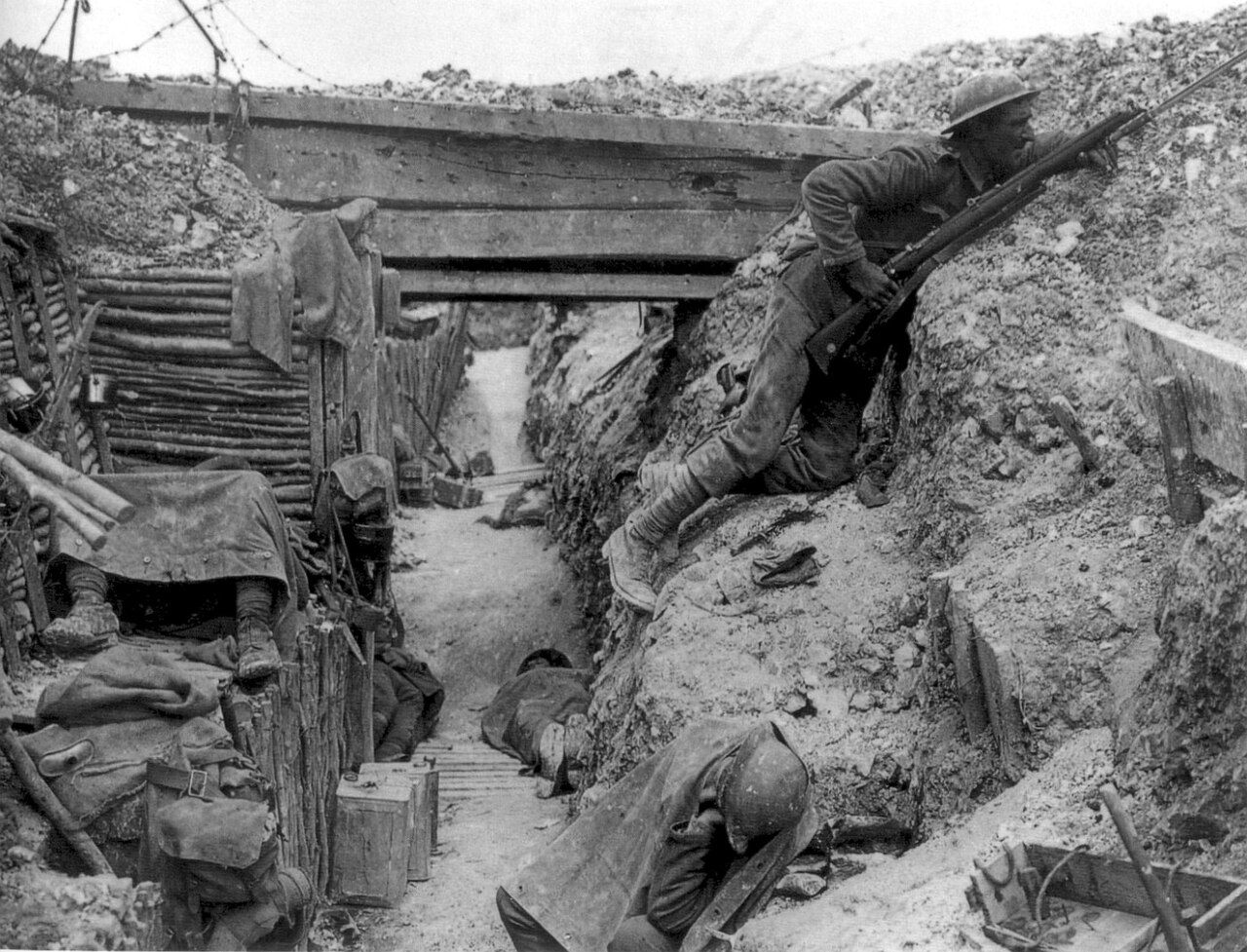
Sarajevo and the July Crisis
On 28 June 1914 Archduke Franz Ferdinand, heir to the Habsburg throne, was shot dead in Sarajevo along with his wife Sophie by Gavrilo Princip, a nineteen-year-old Bosnian Serb armed and trained by officers connected to the Serbian secret society commonly called the Black Hand. Assassinations of royalty were not rare in this era. What made this one catastrophic was the machinery it triggered.
Vienna wanted a war with Serbia and used the murder as its occasion, but it would not move without Berlin. On 5–6 July, Kaiser Wilhelm II and Chancellor Bethmann Hollweg gave Austria-Hungary what became known as the blank cheque — unconditional German backing. On 23 July, Austria delivered an ultimatum deliberately written to be rejected; Serbia accepted nearly all of it anyway, and Austria declared war on 28 July regardless. Russia, patron of Serbia and unwilling to be humiliated again after the Bosnian annexation crisis of 1908, ordered general mobilization on 30 July. Because Germany’s war plan required defeating France before Russia could concentrate, German mobilization was inseparable from invasion. Germany declared war on Russia on 1 August, on France on 3 August, and invaded neutral Belgium on 4 August, which brought Britain in that same night.
Under it all lay pressures built up over decades: a rigid alliance system, an Anglo-German naval race, mass conscript armies whose timetables punished hesitation, imperial rivalry, a press that traded in national humiliation, and a Habsburg monarchy convinced that Balkan nationalism was an existential threat. None of that made war inevitable. Men in a handful of capitals chose it in about five weeks.
Stalemate and industrial killing
The German advance through Belgium into France was halted at the First Battle of the Marne in September 1914. Both sides then tried to outflank each other northward until they ran out of ground at the sea. By November the Western Front was a continuous line of trenches roughly 440 miles long, and it barely moved for more than three years.
The reason was technological asymmetry. Defensive firepower — magazine rifles, machine guns, barbed wire and above all quick-firing artillery — had outrun the ability of infantry to cross open ground, while radio was too primitive to coordinate an attack once it left the start line. Roughly 60 per cent of battlefield casualties came from shellfire. Generals were not uniformly stupid; they were solving a problem for which no solution yet existed, and they solved it eventually with combined-arms tactics, creeping barrages, tanks and aircraft. The learning curve cost millions of lives.
The numbers still shock. At Verdun, from February to December 1916, French and German casualties together approached three-quarters of a million. On the first day of the Somme, 1 July 1916, the British Army suffered 57,470 casualties, of whom 19,240 were killed — the worst single day in its history. Lethal chemical weapons arrived on a large scale at Ypres in April 1915, when German troops released chlorine gas; by 1918 both sides used gas routinely. Nor was the war confined to France: Tannenberg destroyed a Russian army in August 1914, the Gallipoli landings of 1915 failed bloodily, Italy and Austria fought twelve battles along the Isonzo, and the Ottoman government used wartime emergency to carry out the Armenian Genocide of 1915–1916, in which roughly a million or more Armenians died.
Total war and the state
What distinguished this conflict from earlier European wars was the mobilization of entire societies. Governments took powers they had never held in peacetime: conscription, rationing, censorship, direction of labour, nationalization of railways, control of prices and raw materials. Britain’s Defence of the Realm Act, Germany’s Hindenburg Programme, and the French wartime ministries all pointed the same way — the state as economic manager. Enemy civilians became legitimate economic targets: the British naval blockade of Germany caused severe malnutrition, most visibly in the “turnip winter” of 1916–1917, and German submarines answered by sinking merchant shipping. That precedent did not disappear in 1918. It became the template for the planned economies and command states of the following decades.
Millions of women entered munitions factories, transport and clerical work. The consequences were uneven: many were pushed back out after 1918, but the franchise followed in Britain (1918, for women over thirty with property qualifications; equal suffrage in 1928), Germany, Austria and elsewhere. Empires were mobilized too. Around 1.3 million Indian troops served, along with Senegalese, Algerian, Canadian, Australian, New Zealand and South African forces; their service fed postwar demands for self-government that European governments were unwilling to meet.
The war ended not in a clean military conquest but in exhaustion and internal collapse. Unrestricted submarine warfare and the Zimmermann Telegram brought the United States in on 6 April 1917. Russia left the war after two revolutions. Germany’s spring offensives of 1918 came close and then broke; the Allied counteroffensive from August rolled the German army back, the Habsburg and Ottoman fronts disintegrated, sailors mutinied at Kiel, and the Kaiser abdicated. The armistice took effect at 11 a.m. on 11 November 1918. About nine to ten million soldiers were dead, with comparable civilian losses, and the influenza pandemic of 1918–1919 would kill tens of millions more worldwide.
| Country | Military dead (approx.) | Share of mobilized men killed | Political outcome by 1923 |
|---|---|---|---|
| Germany | 2.0 million | about 15% | Monarchy fell; Weimar Republic |
| Russia | 1.8 million | about 14% | Two revolutions; civil war |
| France | 1.4 million | about 16% | Victor; northern departments devastated |
| Austria-Hungary | 1.1 million | about 14% | Empire dissolved into successor states |
| Britain and Empire | 0.9 million | about 11% | Victor; imperial strains, Irish war |
| Ottoman Empire | 0.8 million | about 27% | Occupied 1918; partition imposed 1920; Turkish republic 1923 |
| Italy | 0.6 million | about 11% | Victor; “mutilated victory” grievance |
| United States | 117,000 | about 3% | Creditor power; rejects League |
The First World War began as a Balkan crisis that alliance obligations and mobilization timetables turned continental, and it ended by handing modern states both the habit and the tools of organizing whole societies for destruction.
Section 2Revolution, Versailles and the Fragile Peace
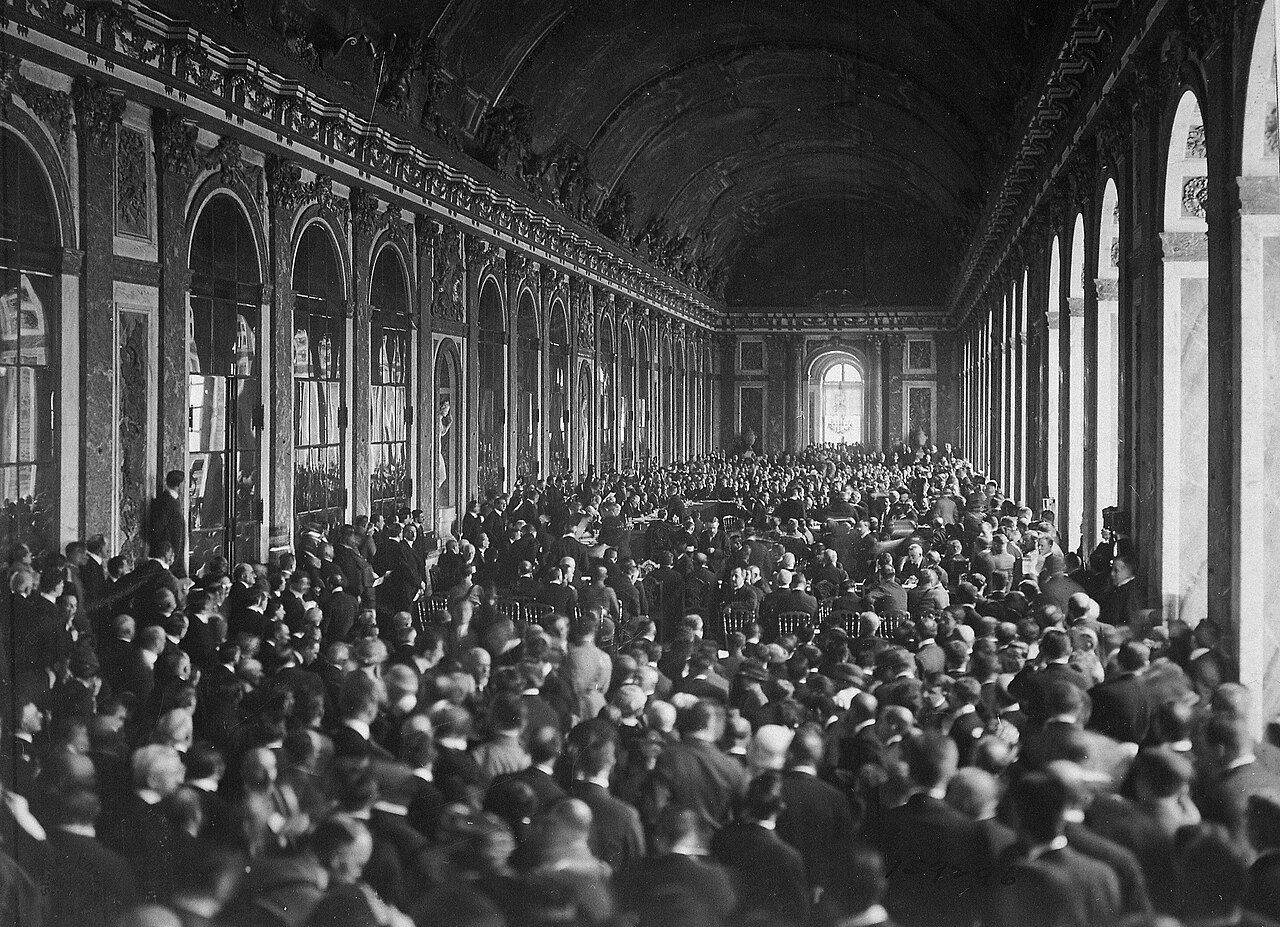
1917: the Romanovs fall, the Bolsheviks rise
Russia entered the war with the largest army in Europe and the weakest administration. By early 1917 the cities were short of bread and fuel, the transport network was breaking down, and Nicholas II had made the fatal error of taking personal command at the front, so that every defeat was his. In late February by the Russian calendar — early March by ours — bread queues and a women’s demonstration in Petrograd turned into a general strike; the garrison refused to fire and joined the crowds. On 15 March the Tsar abdicated. Three hundred years of Romanov rule ended in about a week, with no organized revolutionary party directing it.
What followed was dual power: a Provisional Government of liberal and moderate socialist politicians, and alongside it the Petrograd Soviet of Workers’ and Soldiers’ Deputies, which actually controlled the garrison and the railways. The Provisional Government made a decision that destroyed it — to stay in the war — and postponed the land question to a future Constituent Assembly while peasants were already seizing estates without waiting for legislation. Vladimir Lenin, returned from Swiss exile in April with German assistance, offered the opposite in three words: peace, land, bread. Through the summer, as the Kerensky offensive failed and General Kornilov’s attempted coup discredited the right, Bolshevik support in the soviets grew from a fringe to a majority in Petrograd and Moscow.
On the night of 25 October (7 November), Bolshevik-led forces under the Military Revolutionary Committee seized bridges, telegraph offices and finally the Winter Palace. It was less a mass insurrection than a well-timed coup by a disciplined party inside a collapsing state. When elections to the Constituent Assembly gave the Bolsheviks only about a quarter of the vote, Lenin dissolved it after one day in January 1918. The Treaty of Brest-Litovsk in March 1918 bought peace with Germany at the price of Poland, the Baltic provinces, Finland and Ukraine — roughly a third of the empire’s population.
The Russian Civil War that followed, from 1918 to 1921, killed far more people than the revolution: perhaps seven to ten million, mostly from famine and typhus. Under War Communism the Bolsheviks requisitioned grain and nationalized industry, while the Cheka — the political police founded in December 1917, months before War Communism began — ran a Red Terror that set the pattern for what came later. They won because they held the centre, the railways and the arms factories, and because their opponents were a geographically scattered coalition with no common political programme. In 1921, with peasant revolts spreading and the Kronstadt sailors in open mutiny, Lenin retreated to the New Economic Policy, allowing small-scale private trade. He died in January 1924, leaving a party that had won a war it had not expected and had built a dictatorship in the process.
Making the peace
The Paris Peace Conference opened in January 1919 with delegations from thirty-two states and decisions made by four men: Woodrow Wilson, David Lloyd George, Georges Clemenceau and, marginally, Vittorio Orlando. Wilson had arrived with the Fourteen Points and the principle of national self-determination; Clemenceau wanted French security against a Germany with sixty million people to France’s forty; Lloyd George wanted a Germany weak enough to be safe and strong enough to buy British exports.
The Treaty of Versailles, signed on 28 June 1919, returned Alsace-Lorraine to France, gave Poland access to the sea through a corridor that split East Prussia from the rest of Germany, placed the Saar under League administration, demilitarized the Rhineland, stripped Germany of its colonies, capped the army at 100,000 men with no tanks, submarines or air force, and required reparations whose total was fixed in 1921 at 132 billion gold marks — though the bond structure meant the realistically collectable sum was closer to fifty billion. Article 231, the so-called war guilt clause, was drafted as a legal basis for liability. Germans read it as a moral verdict, and it became the single most effective propaganda gift ever handed to the German right.
Four further treaties dismantled the rest. Saint-Germain reduced Austria to a small German-speaking rump forbidden to unite with Germany; Trianon cost Hungary about two-thirds of its prewar territory and left roughly three million ethnic Hungarians outside the new borders, a grievance still audible in Hungarian politics; Neuilly punished Bulgaria; Sèvres partitioned the Ottoman Empire so harshly that Turkish nationalists under Mustafa Kemal fought and overturned it, producing the Treaty of Lausanne in 1923. Ottoman Arab lands became mandates under British and French administration — empire with a League of Nations label. Self-determination, in practice, was applied to Europeans and denied to nearly everyone else.
The golden years, 1924–1929
The early 1920s were violent and unstable. France and Belgium occupied the Ruhr in January 1923 to extract reparations in kind; German passive resistance and money-printing produced hyperinflation so extreme that by November 1923 a dollar cost more than four trillion marks, wiping out savings and pensions and permanently discrediting the Weimar Republic among the middle class. That same month Adolf Hitler attempted a putsch in a Munich beer hall and went to prison, where he wrote Mein Kampf.
Then came a genuine recovery. The American-brokered Dawes Plan of 1924 rescheduled reparations and opened a flow of US loans into German industry. Gustav Stresemann, as foreign minister, negotiated the Locarno treaties of 1925, in which Germany voluntarily accepted its western borders; Germany joined the League in 1926; and the Kellogg-Briand Pact of 1928, eventually signed by more than sixty states, renounced war as an instrument of national policy. Weimar Germany in these years produced the Bauhaus, Fritz Lang, Bertolt Brecht and a scientific establishment second to none. It was, however, a prosperity built on short-term foreign credit, and the eastern borders were never guaranteed at all.
The revolutions of 1917 and the settlements of 1919–1923 replaced four empires with unstable successor states and a peace that depended on American money and Allied unity — both of which vanished after 1929.
Section 3Depression and the Totalitarian Turn
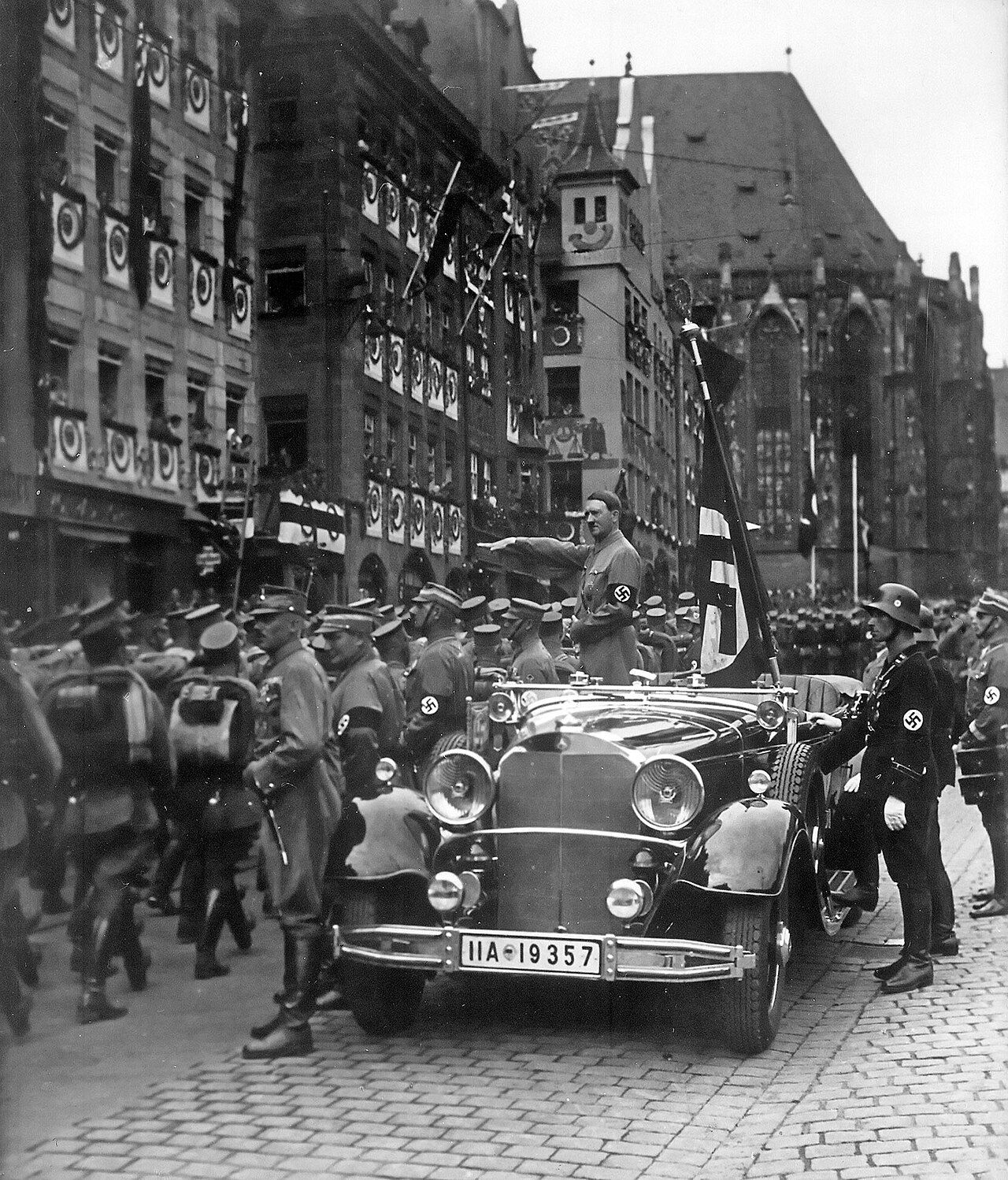
The crash and its politics
The Wall Street collapse of October 1929 mattered to Europe because American short-term loans were the hinge of the whole postwar financial system. When they were called in, Central Europe went first: the Austrian Creditanstalt failed in May 1931, taking German banks with it; Britain abandoned the gold standard in September 1931; world trade fell by roughly two-thirds in value between 1929 and 1932. In Germany, industrial production halved and registered unemployment passed six million — close to a third of the workforce, with many more on short time. Chancellor Heinrich Brüning, unable to command a Reichstag majority and governing after July 1930 by presidential emergency decree under Article 48, responded with deflation, cutting wages and benefits to defend the currency and, not incidentally, to prove reparations unpayable. The policy worked politically for his enemies. Every quarter of misery pushed voters toward the extremes.
Look at the German election results and the mechanism is unmistakable. In May 1928 the Nazis took 2.6 per cent of the vote and twelve Reichstag seats. In September 1930, after a year of depression, they took 18.3 per cent. In July 1932 they took 37.3 per cent and became the largest party in the Reichstag. They never won a free majority — their vote actually fell to 33.1 per cent in November 1932 — and Hitler became chancellor on 30 January 1933 because a circle of conservative politicians around President Hindenburg, led by Franz von Papen, believed they could use him and contain him. Within six months there were no other legal parties left in Germany.
Italy: fascism invents itself
Italy got there first. Benito Mussolini, a former revolutionary socialist and newspaper editor, founded the Fasci Italiani di Combattimento in Milan in March 1919, drawing on demobilized soldiers, futurist intellectuals and a widespread sense that Italy had been cheated at Paris of the territory promised in 1915 — the “mutilated victory.” His squads offered landowners and industrialists something the state seemed unable to provide during the strike wave of 1919–1920: organized violence against socialists. In October 1922, after the theatrical March on Rome, King Victor Emmanuel III appointed him prime minister rather than declare martial law.
The dictatorship was assembled piece by piece: the Acerbo Law of 1923 rigged the electoral system; the murder of the socialist deputy Giacomo Matteotti in 1924 provoked a crisis that Mussolini survived by claiming full responsibility and doubling down; by 1926 opposition parties were banned and a secret police established. Fascism as an ideology celebrated the nation as an organism, the state as absolute, violence as regenerative, and the leader as the will of the people made flesh. Mussolini also made peace with the Catholic Church in the Lateran Accords of 1929, creating Vatican City and buying enormous domestic legitimacy. His regime was brutal but, by the standards of what came next, far less lethal at home — a distinction worth keeping, because fascism and Nazism are related, not identical.
Germany: from chancellor to Führer in eighteen months
Hitler’s consolidation of power is a case study in how a legal order can be dismantled using its own instruments. On 27 February 1933 the Reichstag burned; a Dutch communist, Marinus van der Lubbe, was caught at the scene. The next day Hindenburg signed the Reichstag Fire Decree suspending civil liberties — freedom of speech, press, assembly, privacy of correspondence, protection from arbitrary arrest — and it was never lifted. Thousands of communists were arrested; the first permanent concentration camp opened at Dachau in March. On 23 March, with communist deputies imprisoned or in flight and SA men lining the hall, the Reichstag passed the Enabling Act by 441 votes to 84, granting the cabinet the power to make law without parliament. Only the Social Democrats voted no.
What followed was Gleichschaltung, the “coordination” of German life: trade unions abolished in May, all other parties banned by July, the civil service purged of Jews and opponents, universities and professional associations brought into line. On 30 June 1934, the Night of the Long Knives, Hitler had the SA leadership murdered along with assorted conservative enemies, which reassured the army; when Hindenburg died on 2 August, Hitler merged the presidency with the chancellorship and the armed forces swore a personal oath to him. The Nuremberg Laws of September 1935 stripped German Jews of citizenship and criminalized marriage and sexual relations between Jews and other Germans. On the night of 9–10 November 1938, Kristallnacht destroyed hundreds of synagogues and thousands of Jewish businesses, killed at least ninety-one people, sent 30,000 Jewish men to concentration camps, and then fined the Jewish community a billion marks for the damage.
The Soviet Union: revolution from above
Joseph Stalin won the succession struggle after Lenin’s death not through charisma but through the general secretaryship, which let him place clients throughout the party apparatus. Having defeated Trotsky, Zinoviev and Kamenev on the left, he then adopted their economic programme and destroyed Bukharin on the right. The first Five-Year Plan, launched in 1928, drove breakneck industrialization — Magnitogorsk, the Dnieper dam, tractor factories — paid for by extracting grain from the countryside.
Collectivization was the instrument. Peasants were forced onto collective farms, and the more prosperous, labelled kulaks, were deported or shot; roughly two million were exiled to special settlements. Peasants slaughtered livestock rather than surrender it, and grain procurement quotas were maintained through catastrophic harvests. The result was the famine of 1932–1933, in which perhaps five to seven million people died across the USSR — concentrated in Ukraine, Kazakhstan, the Volga and the North Caucasus, and proportionally worst among Kazakh herders, of whom something like 1.5 million died. Some 3.5 to 5 million of the dead were in Ukraine — the Holodomor, which many states and a substantial body of scholarship now classify as genocide, while other historians argue it was a lethal consequence of policy applied brutally across several grain regions rather than a plan to destroy Ukrainians as such. The disagreement is real and turns on evidence of intent.
The Great Terror of 1937–1938 turned the machinery inward. Public show trials in Moscow in 1936, 1937 and 1938 saw the old Bolshevik leadership confess to fantastical conspiracies before execution. Far larger was the secret operation: NKVD Order 00447 set arrest and execution quotas by region for “anti-Soviet elements,” and national operations targeted Poles, Germans, Koreans and others. Approximately 1.5 million were arrested and around 680,000 to 750,000 shot in those two years alone; millions more passed through the Gulag camp system. Stalin also destroyed his own officer corps, executing three of five marshals and a large share of senior commanders — a decision Germany would exploit in 1941.
| Fascist Italy | Nazi Germany | Stalin’s USSR | |
|---|---|---|---|
| Core claim | The nation-state as supreme organism | Race and living space (Lebensraum) | Class struggle and building socialism |
| Route to power | Street violence plus royal appointment, 1922 | Mass electoral surge plus elite bargain, 1933 | Coup 1917, then apparatus control by 1929 |
| Property | Private, under corporatist direction | Private, subordinated to rearmament | Abolished; state ownership and planning |
| Terror organ | OVRA | Gestapo, SS, SD | Cheka–OGPU–NKVD |
| Principal victims | Socialists, Slovenes, Libyans, Ethiopians | Jews, Roma, Slavs, disabled, political and sexual minorities | Peasants, national minorities, party cadres, “class enemies” |
| Scale of killing | Thousands at home; tens to hundreds of thousands in the colonies (Libya, Ethiopia) | Millions (mostly outside Germany, in wartime) | Millions (mostly in peacetime, 1930–1938) |
The Depression did not create fascism or communism, but it destroyed the credibility of liberal democracy in states with shallow democratic roots, and let movements promising order, work and national rebirth convert protest into power.
Section 4The Second World War, 1939–1945
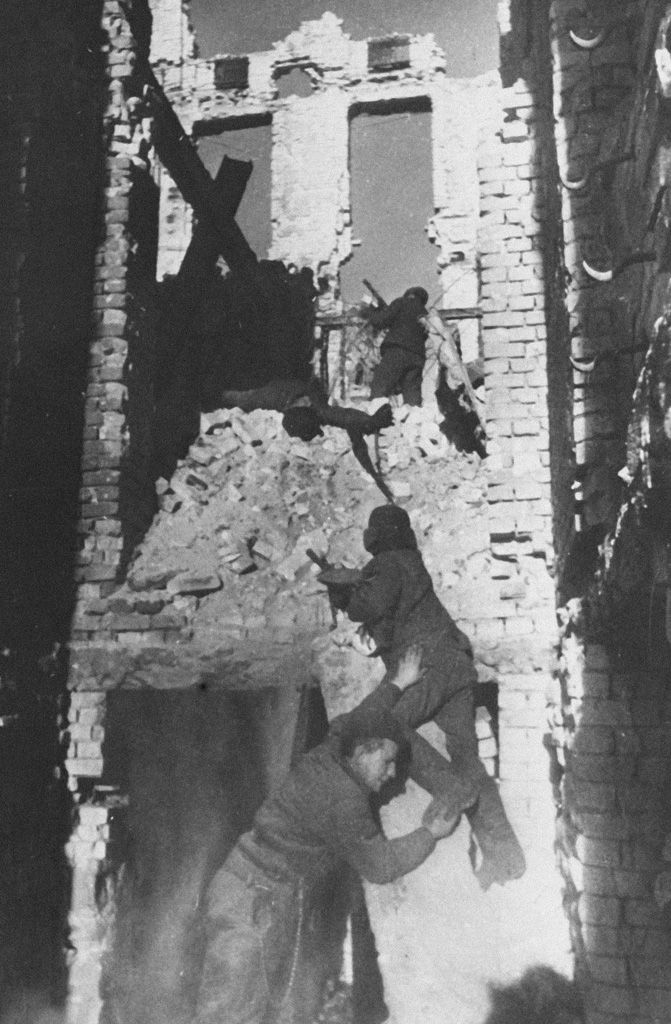
The road from Munich
Hitler dismantled the Versailles order in stages, each time gambling that his opponents would not fight. He left the League and the disarmament conference in 1933; announced conscription and an air force in 1935; remilitarized the Rhineland in March 1936 with orders to his outnumbered troops to withdraw if the French moved, which they did not. Mussolini invaded Ethiopia in 1935 and the League’s sanctions failed conspicuously. From 1936 to 1939 both dictators intervened in the Spanish Civil War on Franco’s side while Britain and France declared non-intervention; the bombing of Guernica by the German Condor Legion in April 1937 previewed what aircraft would do to cities.
Then came 1938. In March, German troops entered Austria to general acclaim — the Anschluss. In September, at the Munich Conference, Neville Chamberlain and Édouard Daladier handed Hitler the Czechoslovak Sudetenland without Czechoslovak participation, and Chamberlain came home to describe it as peace for our time. In March 1939 Germany occupied the rest of the Czech lands, which had no German-population justification at all and finally destroyed the argument that Hitler wanted only to unite Germans. Britain and France guaranteed Poland.
Appeasement deserves a fair hearing. Britain was rearming but not ready, its public remembered 1916, its Dominions were reluctant, its planners feared bombing would kill hundreds of thousands in the first weeks, and the Soviet Union looked no more trustworthy than Germany. That said, the guarantee to Poland was unenforceable, and the decisive blow came on 23 August 1939, when Ribbentrop and Molotov signed a non-aggression pact whose secret protocol divided Poland, the Baltic states, Finland and Bessarabia into spheres of interest. With his eastern flank secured, Hitler invaded Poland on 1 September. Britain and France declared war on 3 September. The Soviet Union invaded Poland from the east on 17 September.
Axis triumph, 1939–1942
Poland fell in five weeks. After a quiet winter, Germany took Denmark and Norway in April 1940 and then, on 10 May, attacked in the west. The decisive stroke was an armoured thrust through the Ardennes, judged impassable by French planners, which cut the Allied armies in two. The British evacuated some 338,000 men from Dunkirk between 26 May and 4 June, abandoning their equipment. France signed an armistice on 22 June; the north was occupied and a collaborationist French state under Marshal Pétain governed from Vichy. The Nazi advantage was not superior numbers of tanks — the French had comparable numbers and often better armour — but concentration, radio coordination, air support and operational nerve, the package popularly called blitzkrieg.
Britain fought on under Winston Churchill. In the Battle of Britain from July to October 1940, RAF Fighter Command, aided by radar and an integrated control system, denied the Luftwaffe air superiority and made invasion impossible; the Blitz that followed killed some 43,000 British civilians without breaking morale or war production. Then, on 22 June 1941, Hitler launched Operation Barbarossa against the Soviet Union with more than three million Axis troops along a front of 1,800 miles. This was the war he had always intended: a war of conquest and annihilation for Lebensraum, fought under explicit orders, such as the Commissar Order, that suspended the laws of war. Soviet losses in 1941 were staggering — whole army groups encircled at Minsk, Smolensk and Kiev — but the Germans failed to take Moscow before winter, and a Soviet counteroffensive in December ended any hope of a quick decision.
On 7 December 1941 Japan attacked Pearl Harbor, and on 11 December Hitler declared war on the United States — a decision he was not obliged to make and which ensured that the world’s largest economy would be fully committed against him. The war was now genuinely global, joining a European conflict to a Pacific and Asian war that Japan had been fighting in China since 1937.
The turn and the reckoning
Three battles in a twelve-month span reversed the direction of the war. At Midway in June 1942, American carriers, aided by broken Japanese codes, sank four Japanese fleet carriers and ended Japanese naval initiative. At El Alamein in October and November 1942, Montgomery’s Eighth Army broke Rommel in North Africa. And at Stalingrad, Soviet forces encircled the German Sixth Army in November 1942; about 91,000 men surrendered on 2 February 1943, of whom roughly 5,000 ever came home. In July 1943 the Germans failed at Kursk, the largest armoured battle in history, and thereafter never mounted a strategic offensive in the east again.
Production decided the rest. The United States built more than 300,000 aircraft and around 2,700 Liberty ships during the war; Soviet factories evacuated beyond the Urals turned out T-34s faster than Germany could destroy them; Lend-Lease supplied the Red Army with trucks, radios and food that made its offensives mobile. Allied strategic bombing devastated German cities — Hamburg in July 1943, Dresden in February 1945 — at a cost of some 400,000 to 500,000 German civilian lives and about 55,000 British bomber crew; historians continue to debate both its military effectiveness and its morality.
The Anglo-American armies landed in Sicily in July 1943, which brought down Mussolini, and in Normandy on D-Day, 6 June 1944. On 22 June the Soviets launched Operation Bagration, destroying German Army Group Centre and advancing to the Vistula. Paris was liberated in August. A last German gamble in the Ardennes in December 1944 failed. Soviet troops entered Berlin in April 1945; Hitler killed himself in his bunker on 30 April; Germany surrendered unconditionally on 8 May. In the Pacific, island campaigns of extraordinary savagery brought American bombers within range of Japan; atomic bombs destroyed Hiroshima on 6 August and Nagasaki on 9 August, killing well over 100,000 people immediately and many more from injury and radiation, and the Soviet Union declared war on 8 August. Japan announced surrender on 15 August and signed on 2 September 1945.
| Country | Total deaths (approx.) | Share of prewar population | Note |
|---|---|---|---|
| Soviet Union | 26–27 million | about 14% | Roughly two-thirds civilian |
| China | 15–20 million | about 3–4% | War from 1937; famine and occupation |
| Poland | 5.6–6 million | about 17% | Includes about 3 million Polish Jews |
| Germany | 6.6–8.8 million | about 8–10% | Includes about 0.5 million from bombing |
| Japan | 2.5–3.1 million | about 4% | Includes about 0.8 million civilians |
| Yugoslavia | 1.0–1.7 million | about 7–10% | Occupation plus internal civil war |
| France | 0.6 million | about 1.4% | Occupation, deportation, bombing |
| Britain | 0.45 million | about 1% | Mostly military and merchant marine |
| United States | 0.42 million | about 0.3% | Almost entirely military |
Hitler won spectacular early victories with operational skill against unprepared opponents, then lost decisively once the war became a contest of industrial output and manpower against the Soviet Union, the United States and the British Empire together.
Section 5The Holocaust and the Reckoning
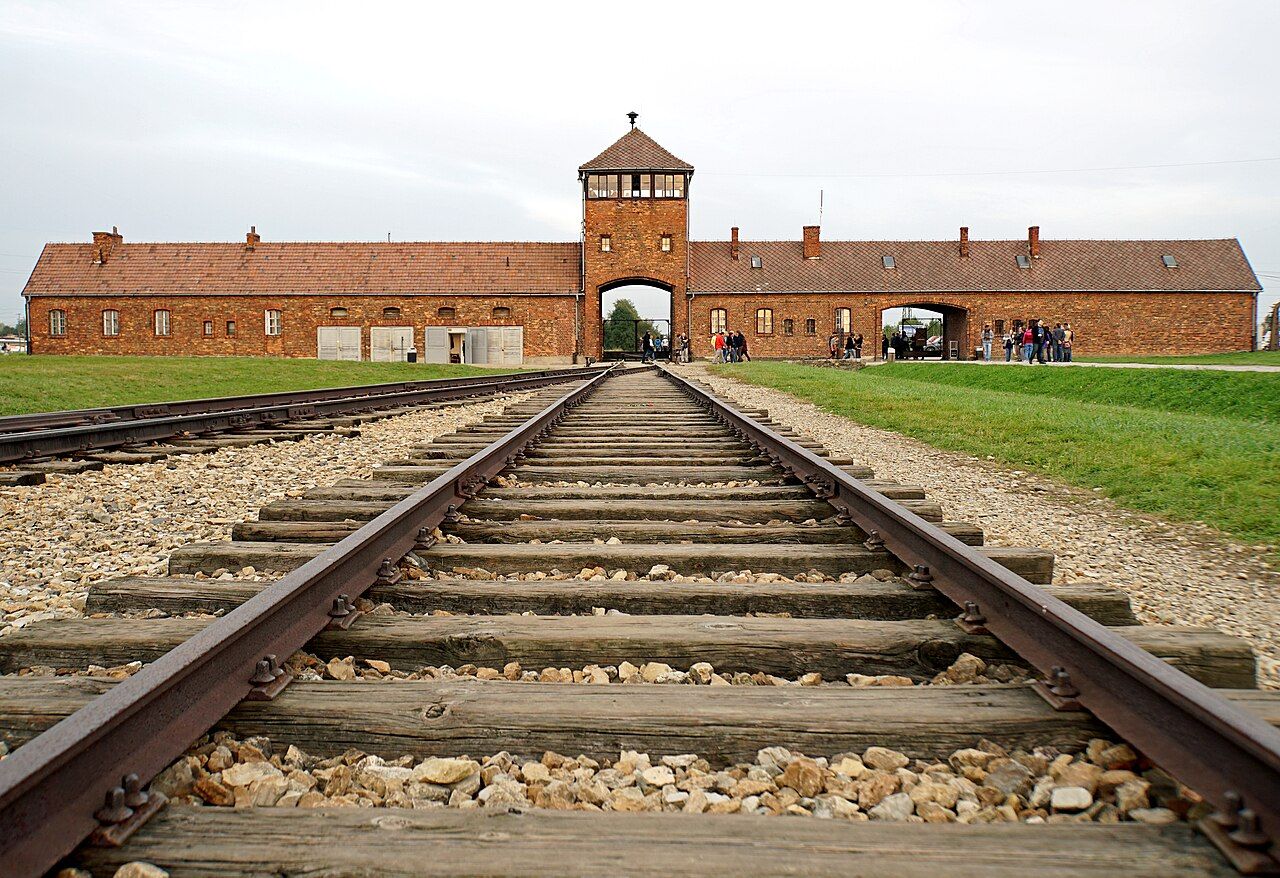
From exclusion to extermination
The Holocaust was not a single decision but a process that escalated over roughly a decade, and understanding the escalation is the point. The years 1933 to 1939 were years of legal exclusion: dismissal from the civil service and the professions, the boycott of April 1933, the Nuremberg Laws of 1935, forced “Aryanization” of businesses, the violence of Kristallnacht. The intent then was emigration by pressure, and roughly half of Germany’s 525,000 Jews had left by 1939 — a figure that would have been higher had other countries, including the United States and Britain, opened their doors. The Evian Conference of July 1938 produced sympathy and almost no visas.
War changed the arithmetic. The conquest of Poland in 1939 brought nearly two million Jews under German control; they were concentrated into sealed ghettos, of which Warsaw held some 400,000 people in about 1.3 square miles, where tens of thousands died of starvation and disease. The invasion of the Soviet Union in June 1941 opened the next phase. Four Einsatzgruppen, mobile killing units of the SS and police, followed the army and shot Jewish men, then women and children too: at Babi Yar outside Kiev on 29–30 September 1941, 33,771 Jews were murdered in two days. By the end of 1941 mass shooting had killed roughly half a million people, and the perpetrators themselves complained of its psychological cost and inefficiency.
The Wannsee Conference of 20 January 1942 did not decide on genocide — killing was already under way — but it coordinated the bureaucracy for the “final solution of the Jewish question in Europe,” a plan whose own minutes counted eleven million potential victims. In 1942 the killing became industrial. Under Operation Reinhard, camps at Belzec, Sobibor and Treblinka existed for nothing but murder: transports arrived, and within hours nearly everyone aboard was dead in carbon-monoxide gas chambers. Treblinka alone killed roughly 800,000 people. At Auschwitz-Birkenau, which combined a slave-labour complex with extermination facilities using Zyklon B, about 1.1 million died, including 430,000 Hungarian Jews deported in a period of eight weeks in 1944, when the war was already lost.
Approximately six million Jews were murdered, about two-thirds of European Jewry and roughly nine of every ten Jews in Poland and the Baltic states. The Nazi regime also murdered between 250,000 and 500,000 Roma and Sinti; killed some 70,000 disabled Germans in the Aktion T4 gassing programme and tens of thousands more afterward by starvation and injection; worked and starved to death approximately 3.3 million Soviet prisoners of war; and imprisoned or killed Jehovah’s Witnesses, homosexual men, Polish elites and political opponents. All of it required accountants, railway schedulers, chemists, physicians, clerks and local collaborators — ordinary professionals doing their jobs.
Resistance, rescue and complicity
Resistance existed and was punished with collective reprisal. The Warsaw Ghetto Uprising of April and May 1943 pitted a few hundred poorly armed fighters against SS troops for nearly a month. There were revolts at Treblinka and Sobibor, and a Sonderkommando rising at Auschwitz in October 1944. Partisan movements in Yugoslavia, the Soviet Union, Greece, Poland, France and Italy tied down Axis divisions; the French Resistance mattered militarily around D-Day and mattered morally far more. In Germany itself, the Kreisau Circle, the students of the White Rose — Hans and Sophie Scholl, executed in 1943 — and the army officers who tried to kill Hitler on 20 July 1944 all failed and paid for it.
Rescue was rare and consequential. Denmark ferried roughly 7,200 Jews to neutral Sweden in October 1943. Bulgaria, under pressure from its own parliament and church, refused to deport the roughly 48,000 Jews of Bulgaria proper — though it handed over more than 11,000 from the Greek and Yugoslav territories it occupied. Diplomats including Raoul Wallenberg in Budapest and Chiune Sugihara in Kaunas issued papers that saved thousands. Set against this were the auxiliary police, militias and administrations across occupied Europe without whose participation the killing could not have proceeded at the speed it did — a subject that remains politically explosive in several countries today. Allied governments knew a great deal by 1942 and declared it publicly in December of that year, but rescue never became a strategic priority.
Judgment and the new vocabulary
In 1944 the Polish-Jewish jurist Raphael Lemkin coined the word genocide because existing law had no name for the destruction of a people. Within a year the language of law was tested at the Nuremberg Trials, where an International Military Tribunal of American, British, French and Soviet judges tried twenty-two major German defendants between November 1945 and October 1946 on charges including crimes against humanity — a category that had barely existed in enforceable form. Twelve were sentenced to death, three acquitted. Twelve subsequent American trials at Nuremberg prosecuted doctors, judges, industrialists and Einsatzgruppen commanders; the Doctors’ Trial produced the Nuremberg Code on informed consent in human experimentation, which underlies research ethics in medicine and nursing to this day. A parallel tribunal sat in Tokyo.
The criticisms were serious and were made at the time: victors’ justice, retroactive law, and the presence on the bench of a Soviet state that had itself invaded Poland and massacred Polish officers at Katyn. Yet the alternative on the table — summary execution, which Churchill initially favoured — would have left no evidentiary record. Nuremberg established that following orders is not a defence, that heads of state are not immune, and that the documents would be preserved.
The institutional aftermath was rapid. The United Nations Charter was signed in June 1945; the Genocide Convention and the Universal Declaration of Human Rights were both adopted in December 1948. Europe itself was transformed: perhaps eleven million displaced persons, twelve to fourteen million ethnic Germans expelled from eastern Europe, cities in ruins, and a continent divided along the line where the armies had stopped. That division is the subject of the next chapter.
The Holocaust escalated from legal exclusion to mass shooting to purpose-built extermination camps through the initiative of a modern bureaucracy at war, and the postwar trials created the legal vocabulary — genocide, crimes against humanity, informed consent — that we still use to name such crimes.
The chapter in one breath
A pistol shot in Sarajevo in June 1914 caught the European great powers in a web of alliances and mobilization schedules, and produced four years of industrial siege warfare that killed roughly ten million soldiers and taught governments how to command entire societies. That lesson outlived the war. Russia’s collapse gave Lenin a state to remake; the revolutions of 1917–1918 and the Paris settlement together replaced four empires with unstable successor states, humiliated Germany without disabling it, and depended on American money that vanished in 1929. The Depression then destroyed liberal government wherever its roots were shallow, opening the way for Mussolini’s Italy, Hitler’s Germany and Stalin’s revolution from above, each claiming the whole of life for the party and each answering opposition with terror. Appeasement bought time and lost credibility; the Nazi-Soviet Pact of August 1939 removed the last obstacle. The war that followed killed sixty million or more, was decided chiefly on the Eastern Front and in the factories of the United States and the Urals, and included within it the deliberate murder of six million Jews by a literate, technically accomplished state. Out of the wreckage came a new legal vocabulary — genocide, crimes against humanity, human rights — and a divided continent.
Words worth knowing
| Term | What it means |
|---|---|
| Total war | Conflict in which the state mobilizes the whole economy and population, and civilians become both producers and targets. |
| Blank cheque | Germany’s unconditional promise of support to Austria-Hungary in July 1914, which emboldened Vienna to attack Serbia. |
| Fischer thesis | Fritz Fischer’s 1961 argument that Germany deliberately sought a continental war for world-power status; still debated. |
| Dual power | The 1917 arrangement in which Russia’s Provisional Government and the soviets each held part of real authority. |
| Bolsheviks | Lenin’s faction of Russian Marxists, committed to a disciplined vanguard party; seized power in October 1917. |
| War Communism | Bolshevik civil-war policy of grain requisitioning, nationalization and terror, replaced by the New Economic Policy in 1921. |
| Article 231 | The Versailles clause assigning Germany and its allies responsibility for war damage; read in Germany as a guilt verdict. |
| Mandate | League of Nations arrangement placing former Ottoman and German territories under Allied administration — empire renamed. |
| Hyperinflation | Germany’s 1923 currency collapse, which wiped out middle-class savings and permanently damaged faith in the republic. |
| Fascism | Mussolini’s movement and its imitators: ultranationalist, anti-liberal, anti-Marxist, glorifying violence, the state and the leader. |
| Enabling Act | The law of 23 March 1933 allowing Hitler’s cabinet to legislate without the Reichstag; the legal end of German democracy. |
| Gleichschaltung | The Nazi “coordination” of unions, parties, professions and associations under party control during 1933–1934. |
| Lebensraum | “Living space” — the Nazi aim of conquering and colonizing eastern Europe at the expense of its Slavic and Jewish populations. |
| Collectivization | Stalin’s forced consolidation of peasant farms from 1929, which produced mass deportation and the famine of 1932–1933. |
| Holodomor | The Ukrainian famine of 1932–1933; recognized by many states and scholars as genocide, a classification some historians contest. |
| Gulag | The Soviet forced-labour camp administration, through which many millions of prisoners passed under Stalin. |
| Appeasement | The British and French policy of conceding Hitler’s demands to avoid war, discredited after the occupation of Prague in March 1939. |
| Blitzkrieg | Popular label for German operations combining concentrated armour, radio coordination and air support to break through and encircle. |
| Einsatzgruppen | SS and police mobile killing units that shot roughly 1.5 million Jews and others behind the Eastern Front from 1941. |
| Crimes against humanity | The Nuremberg charge covering large-scale atrocities against civilians, including a state’s own, regardless of domestic legality. |
Check yourself
The Cold War and the Contemporary World
In 1945 Europe lay in ruins and two powers on its edges — neither of them fully European in self-image — picked up the pieces. For the next forty-four years the world was organized around their rivalry: two military alliances, two economic systems, two accounts of what freedom meant, and — at the peak of the arsenals in the mid-1980s — some seventy thousand nuclear warheads to settle the argument if words failed. That rivalry never produced the direct war everyone feared, but it shaped nearly everything else — the collapse of Europe’s overseas empires, the building of welfare states, the invention of the European Union, the wars in Korea, Vietnam and Afghanistan, and the political vocabulary we still use. The story runs from Yalta to the fall of the Berlin Wall and then past it, because 1989 was not an ending. It was a hinge, and we are still swinging on it.
By the end of this chapter you can
- Explain how wartime cooperation between the Allies broke down between 1945 and 1949, and evaluate competing explanations for the origins of the Cold War.
- Describe the strategy of containment and trace how it was expressed through the Truman Doctrine, the Marshall Plan, NATO and NSC-68.
- Analyze how nuclear deterrence and the doctrine of mutually assured destruction both stabilized and endangered the superpower relationship, using the Cuban Missile Crisis as a case study.
- Account for the speed and the violence of decolonization in Asia, Africa and the Middle East, and explain the appeal of non-alignment.
- Compare the postwar social settlement in Western Europe — the welfare state, the trente glorieuses, European integration — with conditions behind the Iron Curtain.
- Evaluate why the Soviet bloc collapsed between 1985 and 1991, weighing the roles of perestroika, glasnost, economic stagnation and civil-society movements such as Solidarity.
- Assess the consequences of 1989 — globalization, the wars of Yugoslav succession, EU enlargement, and the return of great-power confrontation.
- Distinguish between what Cold War actors said publicly and what actually drove them, and say honestly where historians still disagree.
Section 1From Grand Alliance to Iron Curtain, 1945–1950
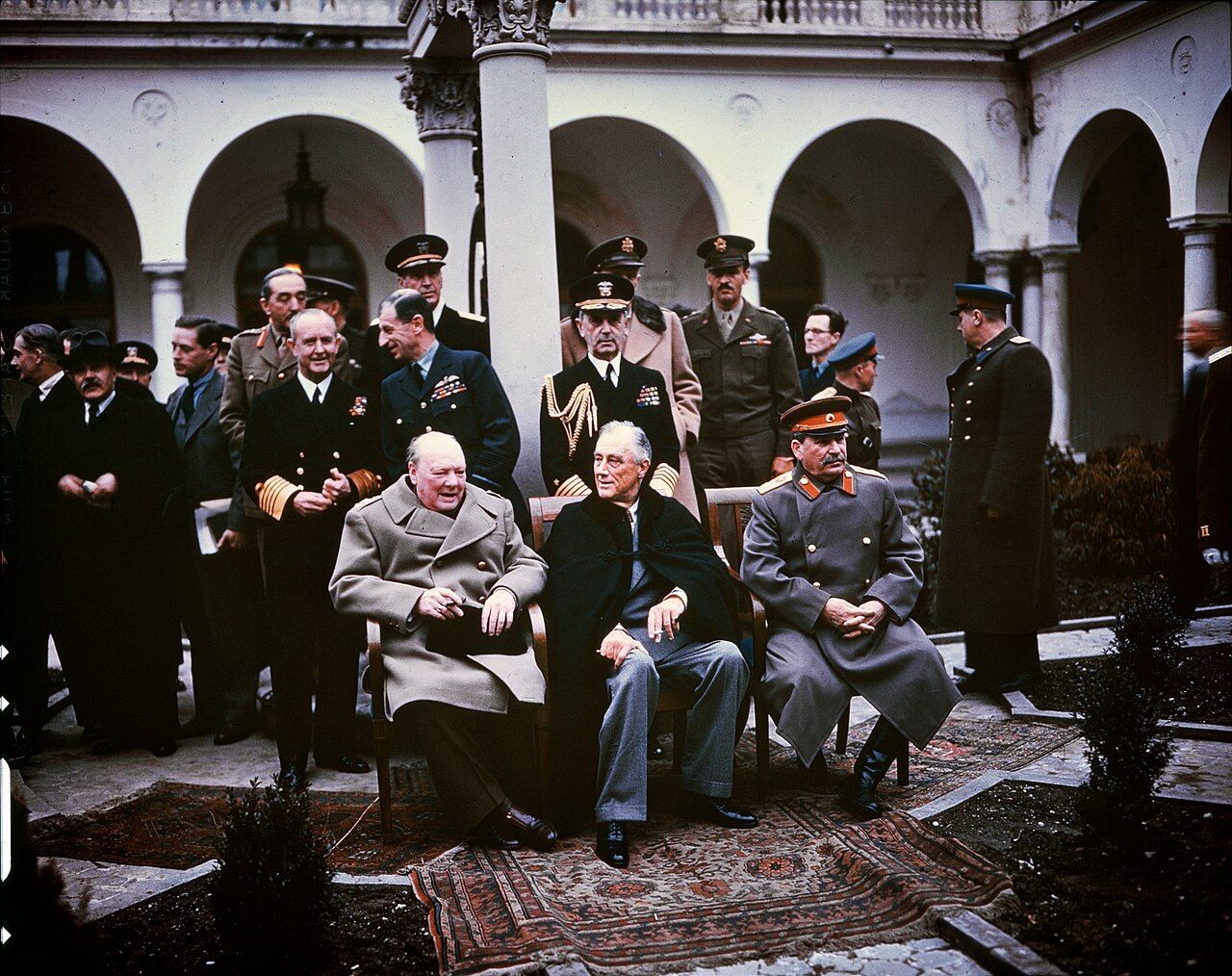
An alliance held together by a common enemy
The Grand Alliance of the United States, Britain and the Soviet Union was a marriage of necessity. Franklin Roosevelt, Winston Churchill and Joseph Stalin shared exactly one durable objective: the destruction of Nazi Germany. Beyond that they disagreed about almost everything, and they had good historical reasons to distrust one another. Western troops had intervened against the Bolsheviks in the Russian Civil War. Stalin had signed a pact with Hitler in August 1939 and taken half of Poland. Stalin, for his part, believed the Western Allies had deliberately delayed the second front until the Wehrmacht and the Red Army had bled each other white — and the casualty figures did nothing to dispel the suspicion. The Soviet Union lost roughly twenty-seven million people; the United States lost about four hundred thousand.
At Yalta in February 1945 the three men agreed to divide Germany into occupation zones, to bring the Soviet Union into the war against Japan, and to hold “free and unfettered elections” in liberated Europe. That last phrase was the problem. To Roosevelt and Churchill it meant genuinely competitive politics. To Stalin it meant governments that would never again let an invading army cross Poland into Russia — which in practice meant governments he controlled. By the Potsdam Conference in July and August 1945 Roosevelt was dead, Churchill was voted out mid-conference, and Harry Truman had in hand the report of a successful atomic test carried out in New Mexico on 16 July, the day before the talks opened. The personnel had changed and so had the balance of power.
What followed was less a decision than a slide. Between 1945 and 1948 Communist-dominated governments were installed across Eastern Europe by a repeatable method: join a coalition, take the interior ministry, control the police, then eliminate rivals. Poland, Romania, Bulgaria and Hungary went this way. The Czechoslovak coup of February 1948 was the shock that crystallized Western opinion, partly because Czechoslovakia was a genuine interwar democracy and partly because the foreign minister Jan Masaryk died in a fall from a window two weeks later. Churchill had already named the emerging line in a speech at Fulton, Missouri, on 5 March 1946: an Iron Curtain had descended from Stettin in the Baltic to Trieste in the Adriatic.
Containment: the doctrine that organized forty years
The intellectual architecture came from a mid-level American diplomat in Moscow. George Kennan’s Long Telegram of February 1946, expanded into an anonymous 1947 article in Foreign Affairs, argued that Soviet hostility flowed from internal insecurity rather than from any specific Western provocation, that it could not be charmed away, but that it need not be fought either. Soviet power should be met with “long-term, patient but firm and vigilant containment.” Kennan meant something political and economic, concentrated on the handful of industrial centers that actually shifted the balance of power; he spent the rest of his life complaining that policymakers turned containment into an open-ended global military commitment. He had a point, and the distinction matters when you assess Vietnam.
Containment acquired institutions with astonishing speed. In March 1947 Truman asked Congress for four hundred million dollars for Greece and Turkey, framing it as a worldwide choice between two ways of life — the Truman Doctrine. In June, Secretary of State George Marshall proposed a European Recovery Program; roughly thirteen billion dollars flowed to sixteen participating countries between 1948 and 1952. The Marshall Plan was generous and it was self-interested: a prosperous Western Europe would resist communism and buy American exports. Stalin forbade the Eastern bloc to participate, which had the effect of making the economic division of Europe permanent.
Germany was the flashpoint. When the Western powers merged their zones and introduced a new currency, the Deutsche Mark, Stalin cut the land routes into West Berlin on 24 June 1948. Rather than force the blockade or abandon the city, the Western allies flew in food and coal — some 2.3 million tons over the fifteen months the airlift operated, at its peak a landing every few minutes. The Berlin Blockade ended on 12 May 1949, and its political consequences were exactly the reverse of what Stalin intended: West Germans came to see the occupiers as protectors, two German states were founded in 1949, and twelve nations signed the North Atlantic Treaty on 4 April 1949, committing themselves in Article 5 to treat an attack on one as an attack on all. The Soviet bloc answered with the Warsaw Pact in May 1955, prompted by West German rearmament and NATO membership.
1949–1950: the year the stakes changed
Two events in 1949 transformed a European standoff into a global one. On 29 August the Soviet Union tested an atomic bomb, years earlier than most American estimates predicted, aided by espionage from the Manhattan Project. On 1 October Mao Zedong proclaimed the People’s Republic of China after the Communist victory in the civil war. In Washington these were read together as evidence of a coordinated communist advance — a reading we now know overstated Sino-Soviet unity considerably, since Mao and Stalin distrusted each other and the alliance would rupture within a decade.
The policy response was NSC-68, a National Security Council paper of April 1950 that called for a massive, permanent, peacetime military buildup. It was expensive and initially unpopular. Then on 25 June 1950 North Korean forces crossed the 38th parallel, and the argument was over. The Korean War drew in a United Nations coalition under American command, Chinese “volunteers” in their hundreds of thousands, and roughly three million deaths before the armistice of 27 July 1953 restored a line close to where it started. No peace treaty was ever signed. American defense spending more than tripled between 1950 and 1953 and never returned to its prewar level.
| Date | Event | Why it mattered |
|---|---|---|
| Feb 1945 | Yalta Conference | Agreed occupation zones and “free elections” — a phrase each side defined differently |
| Mar 1946 | Churchill’s Fulton speech | Named the “iron curtain” and made division public language |
| Mar 1947 | Truman Doctrine | Committed the U.S. to supporting free peoples resisting subjugation — open-ended by design |
| Jun 1947 | Marshall Plan announced | Tied European recovery to the Western bloc; Soviet refusal locked in the split |
| Feb 1948 | Czechoslovak coup | Convinced Western publics that coexistence was failing |
| Jun 1948–May 1949 | Berlin Blockade and Airlift | First direct confrontation; produced two German states |
| Apr 1949 | North Atlantic Treaty | Permanent U.S. military commitment to Europe in peacetime |
| Aug–Oct 1949 | Soviet atomic test; PRC founded | Ended the American nuclear monopoly and globalized the conflict |
| Jun 1950 | Korean War begins | Militarized containment; more than tripled U.S. defense spending |
Where historians disagree
Blame for the Cold War has been assigned three different ways, and the debate is worth knowing because it is a good model of how historical interpretation moves. The orthodox view of the 1950s held that Soviet expansionism forced a reluctant America to respond. Revisionist historians of the 1960s, writing under the shadow of Vietnam, argued that American economic ambitions and atomic diplomacy provoked a defensive Soviet Union. Post-revisionists from the 1970s onward, and especially historians working in Soviet archives opened after 1991, tend toward a middle position: Stalin was opportunistic rather than following a master plan, he wanted a buffer more than a world revolution, but his methods in Eastern Europe were brutal enough to make Western alarm reasonable. Most specialists today emphasize misperception on both sides without treating the two systems as morally equivalent.
The Cold War emerged not from a single decision but from a chain of defensive moves between 1945 and 1950 that hardened a temporary occupation line into two permanent, armed, ideologically opposed blocs.
Section 2Living with the Bomb: Crises, Deterrence and the Frozen Order
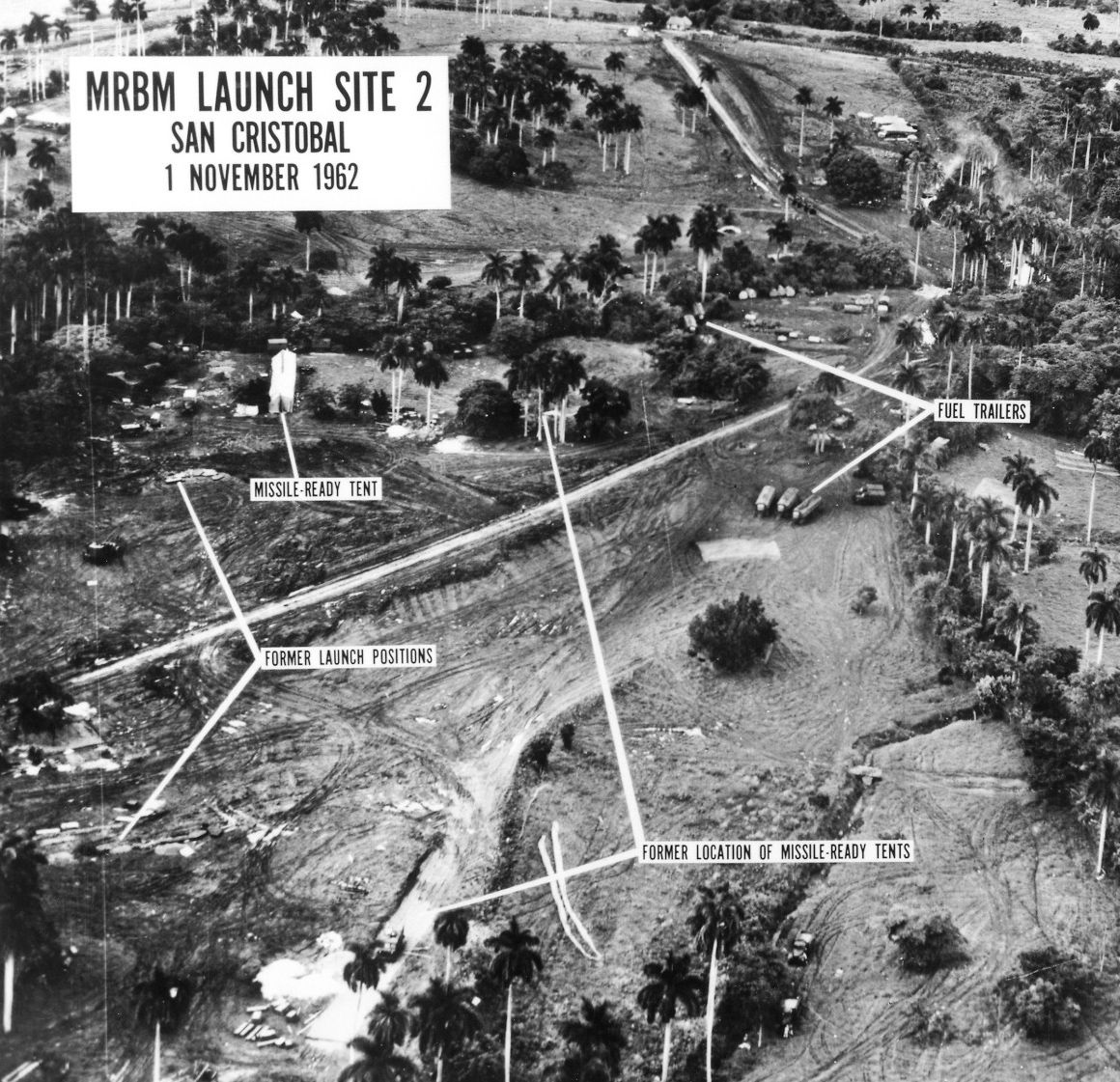
Thaw, secret speech, and the limits of reform
Stalin died on 5 March 1953. What followed was not liberalization exactly, but a loosening. Millions were released from the Gulag. At the Twentieth Party Congress on 25 February 1956, Nikita Khrushchev delivered a four-hour closed-session speech denouncing Stalin’s “cult of personality,” his purges of loyal Communists, and his catastrophic unpreparedness in 1941. The Secret Speech did not stay secret. Read aloud in party meetings and leaked to the West, it detonated across the bloc.
In Poland, protests in Poznań produced a negotiated change of leadership. In Hungary the result was a revolution. Beginning on 23 October 1956, students, workers and eventually army units took Budapest; the reform Communist Imre Nagy announced a multiparty system and Hungarian withdrawal from the Warsaw Pact. That last step crossed the line. Soviet armor returned on 4 November, killing some twenty-five hundred Hungarians; roughly two hundred thousand fled west; Nagy was executed in 1958. The West, loudly sympathetic and simultaneously distracted by the Suez Crisis, did nothing military. The lesson learned in Eastern Europe was bitter and lasting: reform was possible only inside limits Moscow set, and the West would not come.
The nuclear balance
The 1950s and 1960s were the years in which humanity acquired the capacity to end itself and then built the political machinery to live with that fact. The United States tested a thermonuclear device in November 1952; the Soviet Union answered with a hydrogen bomb in August 1953 and a true two-stage weapon in 1955. The Soviet launch of Sputnik on 4 October 1957 demonstrated a rocket that could carry a warhead to North America and triggered an American panic about a “missile gap” that turned out not to exist — the gap ran the other way. Both sides built triads of bombers, land-based missiles and submarines, and by the end of the 1960s each could absorb a first strike and still annihilate the other. This condition, mutually assured destruction, was grotesque and, most strategists concluded, stabilizing: it made deliberate war between the superpowers close to unthinkable and pushed their competition into proxies, propaganda, sport and space.
Berlin remained the pressure point. Between 1949 and 1961 roughly 2.7 million people left East Germany, most of them simply walking out through the open border in Berlin, and they were disproportionately young, trained and mobile — a hemorrhage the East German state could not survive. On the night of 13 August 1961 barbed wire went up, then concrete. The Berlin Wall was an admission of failure dressed as an anti-fascist protective barrier, and it stabilized the German question for twenty-eight years by making it insoluble.
Thirteen days in October
The closest the world came to nuclear war began with photographs. In October 1962 American U-2 flights confirmed that the Soviet Union was installing medium-range nuclear missiles in Cuba, ninety miles from Florida. Khrushchev’s motives were mixed: deterring another American invasion attempt after the Bay of Pigs fiasco of 1961, and offsetting American Jupiter missiles already deployed in Turkey and Italy. John F. Kennedy rejected the initial advice to bomb the sites and chose a naval “quarantine” instead, buying time.
For thirteen days — 16 to 28 October — both leaders looked for an exit that would not humiliate either. The settlement was public and private: the Soviets withdrew the missiles, the Americans publicly pledged not to invade Cuba, and secretly agreed to remove the Jupiters from Turkey within months. Later revelations made the episode look worse, not better. Soviet forces in Cuba already had tactical nuclear weapons; a Soviet submarine officer, Vasili Arkhipov, refused to consent to launching a nuclear torpedo while under depth-charge harassment. The Cuban Missile Crisis frightened both governments into arms control: a Moscow–Washington hotline in 1963, the Limited Test Ban Treaty the same year, and the Nuclear Non-Proliferation Treaty opened for signature in 1968.
| Crisis | Date | Trigger | Outcome |
|---|---|---|---|
| Berlin Blockade | 1948–49 | Western currency reform in Germany | Airlift succeeded; two German states; NATO founded |
| Hungarian Revolution | Oct–Nov 1956 | De-Stalinization; withdrawal from Warsaw Pact | Soviet invasion; ~2,500 killed; no Western intervention |
| Suez Crisis | Oct–Nov 1956 | Nasser nationalized the Suez Canal | U.S. pressure forced British and French withdrawal; end of their great-power pretensions |
| Berlin Wall | Aug 1961 | Mass emigration through West Berlin | Border sealed; German question frozen until 1989 |
| Cuban Missile Crisis | Oct 1962 | Soviet missiles in Cuba | Missiles withdrawn; secret Jupiter deal; hotline and test-ban treaty |
| Prague Spring | 1968 | Dubček’s “socialism with a human face” | Warsaw Pact invasion; Brezhnev Doctrine proclaimed |
1968 and the closing of the reform road
In January 1968 Alexander Dubček became Czechoslovak party leader and began dismantling censorship, promising “socialism with a human face.” The Prague Spring was an attempt to reform communism from inside, not to leave the bloc. It was still intolerable: on the night of 20–21 August, Warsaw Pact forces — a quarter of a million at the outset, building toward half a million — occupied the country. Leonid Brezhnev then articulated what the West called the Brezhnev Doctrine: the socialist community had the right and duty to intervene where socialism was threatened. Many Western European Communists broke with Moscow permanently after 1968, and inside the bloc a generation concluded that the system was not reformable — a conclusion that would matter enormously in 1989.
Nuclear weapons made direct superpower war effectively unthinkable, which froze Europe’s dividing line in place and pushed the real fighting, and the real reform struggles, into proxies and satellites.
Section 3The End of Empire and the Making of a Third World
Why the empires went, and went fast
In 1945 European states governed roughly a third of the world’s population. By 1975 nearly all of it was gone. The speed demands explanation, and the explanation is layered. First, the war itself had shattered the prestige of empire: the fall of Singapore in 1942 and the German occupation of France showed colonized peoples that European power was neither natural nor invincible. Second, the metropoles were broke. Britain finished the war owing more than three billion pounds in sterling balances, much of it to India. Third, colonial subjects had fought — over two million Indians served in the British Indian Army; hundreds of thousands of Africans served in French and British forces — and returned with claims that were hard to refuse. Fourth, both superpowers were formally anti-colonial, which meant that Europe’s empires now embarrassed their own protectors.
Fifth, and most important, colonized peoples organized. The Indian National Congress, the Vietnamese Viet Minh, Ghana’s Convention People’s Party, the Algerian FLN and the Kenyan movements built mass politics that made governing without consent expensive. Where the imperial power judged the cost tolerable, it fought; where it did not, it left.
Partition, war, and the varieties of independence
India and Pakistan became independent on 14–15 August 1947, an event that fused triumph with catastrophe. The Partition line drawn by Cyril Radcliffe, who had never been to India, cut through Punjab and Bengal. Between ten and fifteen million people moved; estimates of the dead in the accompanying communal violence range from several hundred thousand to a million. Mohandas Gandhi, who had opposed partition, was assassinated by a Hindu nationalist in January 1948. Kashmir remains disputed and both states are now nuclear-armed.
Elsewhere, transitions ranged from negotiated to savage. Ghana became Britain’s first sub-Saharan African colony to win independence, on 6 March 1957, under Kwame Nkrumah. In 1960 alone seventeen African states became independent — the “Year of Africa.” But France fought eight years in Indochina, losing decisively at Dien Bien Phu in May 1954, and then seven and a half years in Algeria (1954–1962), a war involving systematic torture, roughly a million European settlers displaced, and Algerian death estimates ranging from three hundred thousand to over a million depending on the source. The Algerian war destroyed the French Fourth Republic and brought Charles de Gaulle back to power in 1958; it was de Gaulle who eventually negotiated the Evian Accords of March 1962 and let Algeria go. Portugal held on longest, until its own dictatorship fell in the Carnation Revolution of 1974.
| Territory | Imperial power | Independence | Path |
|---|---|---|---|
| India / Pakistan | Britain | 1947 | Negotiated, but partition killed hundreds of thousands |
| Indonesia | Netherlands | 1949 | Four years of armed struggle plus U.S. pressure on the Dutch |
| Vietnam (north) | France | 1954 | Military defeat of France; country divided at the 17th parallel |
| Ghana | Britain | 1957 | Mass party politics and negotiated transfer |
| Congo | Belgium | 1960 | Abrupt withdrawal; secession, Lumumba’s murder, Mobutu’s dictatorship |
| Algeria | France | 1962 | War from 1954 to 1962; settler exodus; collapse of the Fourth Republic |
| Angola / Mozambique | Portugal | 1975 | Guerrilla wars ended by revolution in Lisbon; then Cold War civil wars |
Non-alignment and the cost of taking sides
New states faced an unwelcome choice: line up with Washington, with Moscow, or try to avoid both. At Bandung in Indonesia in April 1955, twenty-nine Asian and African states met to assert a third path; the Non-Aligned Movement was formally founded at Belgrade in 1961 under Yugoslavia’s Tito, Egypt’s Nasser, India’s Nehru, Indonesia’s Sukarno and Ghana’s Nkrumah. Non-alignment was never neutrality in practice — most members took aid from someone — but it gave smaller states leverage and a voice in the United Nations, whose membership grew from sixty at the start of 1955 to one hundred and twenty-seven by 1970.
The superpowers competed for these states with weapons, dams, scholarships and coups. The results were often disastrous for local populations. In the Congo, independent on 30 June 1960, the elected prime minister Patrice Lumumba was deposed and murdered in January 1961 with Belgian complicity and American approval of his removal; Mobutu Sese Seko then ruled for thirty-two years. In Iran, a British- and American-backed coup in August 1953 removed the elected prime minister Mohammad Mosaddegh, who had nationalized Anglo-Iranian Oil, and restored the Shah — a decision whose bill came due in the Iranian Revolution of 1979. Vietnam became the extreme case: American forces peaked above half a million in 1969, the Tet Offensive of January 1968 destroyed official claims that the war was being won and with them much of the domestic support for it, and Saigon fell on 30 April 1975. Somewhere between two and three million Vietnamese died, along with about fifty-eight thousand Americans.
Decolonization dismantled Europe’s overseas empires within thirty years, but because it happened inside a superpower rivalry, independence frequently arrived attached to proxy wars, arbitrary borders and client dictatorships.
Section 4The Western Settlement: Affluence, Welfare, Integration and Revolt
Thirty glorious years
Between roughly 1948 and 1973 Western Europe experienced the fastest sustained economic growth in its history — the French called it les trente glorieuses, the Germans the Wirtschaftswunder. West German output grew at about eight percent a year through the 1950s; Italy averaged near six. The causes were unglamorous: rebuilding from a low base, American aid and open American markets, cheap oil, rapid movement of labor from farms into factories, and a currency system fixed at Bretton Woods that made trade predictable. Real wages roughly doubled in a generation. Car ownership, refrigerators, paid holidays and television moved from luxury to normal.
The politics that accompanied prosperity were consciously anti-1930s. Everyone remembered that mass unemployment had produced fascism. So Western European states built welfare states: Britain’s National Health Service opened in 1948 on the model of the 1942 Beveridge Report, which named “five giants” — want, disease, ignorance, squalor and idleness — to be defeated. France, Italy and West Germany expanded pensions, family allowances and health insurance. Christian Democratic and Social Democratic parties, historic enemies, converged on a mixed economy with strong unions, high taxes and a broad safety net. This settlement is often called the postwar consensus, and it held until the oil shock of 1973 and the inflation that followed cracked its economic assumptions.
Building Europe out of coal and steel
The most original institutional invention of the era began with a technical proposal. On 9 May 1950 Robert Schuman, prompted by Jean Monnet, proposed pooling French and German coal and steel production under a common authority — making war between them, in his phrase, materially impossible. The European Coal and Steel Community (1951) linked France, West Germany, Italy, Belgium, the Netherlands and Luxembourg. The Treaty of Rome, signed 25 March 1957, created the European Economic Community with a customs union and common agricultural policy. Britain stayed out, applied late, and was vetoed twice by de Gaulle before joining in 1973.
The method was deliberate: integrate the boring things first — tariffs, standards, agricultural prices — and let political union follow the economics. It worked for four decades and generated real prosperity, but it also created a body of European law and administration with weak democratic accountability, a “democratic deficit” that critics have raised ever since and that surfaced with force in the Brexit referendum.
| Step | Year | What it did |
|---|---|---|
| Schuman Declaration | 1950 | Proposed pooling Franco-German coal and steel |
| European Coal and Steel Community | 1951 | First supranational authority; six members |
| Treaty of Rome (EEC) | 1957 | Customs union, common market, common agricultural policy |
| First enlargement | 1973 | Britain, Ireland and Denmark join after de Gaulle’s vetoes lapse |
| Single European Act | 1986 | Committed to a single market by 1992; expanded majority voting |
| Maastricht Treaty | 1992 | Created the European Union, EU citizenship and the path to the euro |
| Eastern enlargement | 2004–2007 | Twelve mostly post-communist states join; the continent formally reunites |
Who the prosperity was for — and 1968
Growth needed workers, and Western Europe imported them. West Germany signed labor recruitment agreements with Italy (1955), Turkey (1961) and others; the Gastarbeiter, or guest workers, were expected to leave and largely did not. Britain drew migrants from the Caribbean and South Asia, a movement symbolized by the arrival of the Empire Windrush in 1948; France drew from the Maghreb. By the 1970s Western Europe contained large settled minority populations whose legal status, housing and citizenship rights lagged far behind their economic contribution — the origin of debates that still dominate European politics.
The postwar order also produced children who did not share their parents’ gratitude for stability. University enrollments exploded — France had about two hundred thousand students in 1960 and over five hundred thousand by 1968 — into institutions and cities that had not expanded to hold them. In May 1968 student protests in Paris escalated into a general strike of roughly nine million workers that briefly paralyzed France. De Gaulle survived, and his party won the June elections handily; the immediate political result was conservative. The cultural result was not. The 1968 movements — in Berkeley, Berlin, Prague, Mexico City, Rome and Warsaw — helped legitimize a shift in authority relations inside families, universities, churches and workplaces.
Two parallel movements changed more lives than the barricades did. Second-wave feminism, drawing on Simone de Beauvoir’s The Second Sex (1949) and Betty Friedan’s The Feminine Mystique (1963), won equal-pay legislation, access to contraception and divorce reform across Western Europe — Italy legalized divorce in 1970 and upheld it by referendum in 1974. And the American civil rights movement, culminating in the Civil Rights Act of 1964 and Voting Rights Act of 1965, dismantled legal segregation while exposing how much of racial inequality was economic rather than statutory. Meanwhile the Roman Catholic Church remade its own relationship to modernity at the Second Vatican Council (1962–1965), permitting vernacular liturgy and repudiating the charge of collective Jewish guilt for the death of Jesus.
Western Europe answered the catastrophe of 1914–1945 with a deliberate package — welfare states, mixed economies and supranational integration — that delivered a generation of unprecedented prosperity while deferring hard questions about migration, empire and democratic accountability.
Section 5Collapse and Aftermath: 1975 to the Present
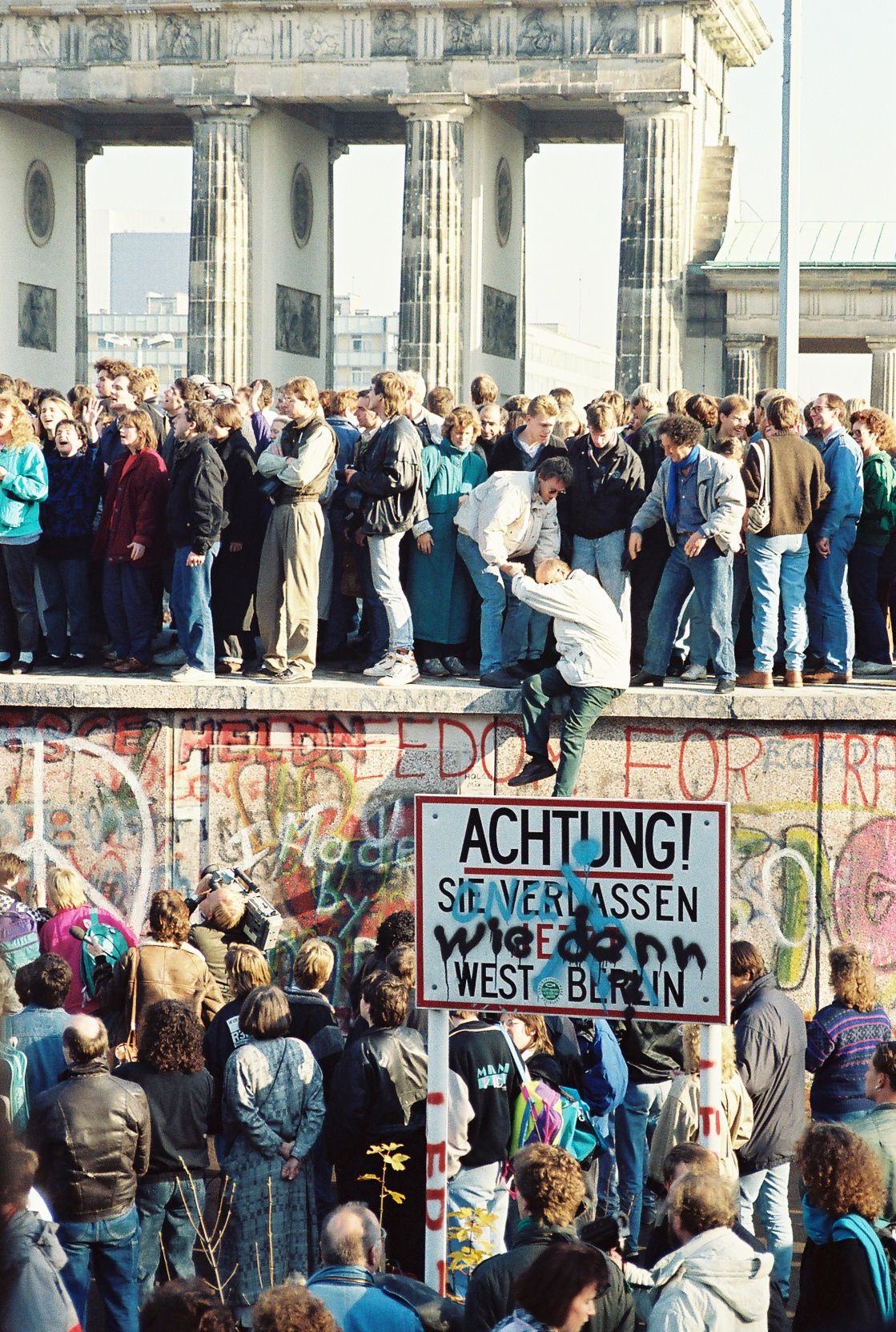
Stagnation, détente, and the human rights loophole
By the mid-1970s the Soviet economy was visibly failing at the thing it had once done well: producing more. Growth rates fell through the Brezhnev years, agriculture required grain imports from the United States, and consumer goods were scarce enough that queuing became a way of life. Military spending consumed a share of output usually estimated at fifteen to twenty-five percent — the uncertainty itself tells you how opaque the system was. Meanwhile détente produced real agreements: SALT I in 1972 capped missile launchers, and the Helsinki Final Act of August 1975 recognized existing European borders, which Moscow wanted.
Helsinki also contained “Basket Three,” a set of human rights commitments the Soviets regarded as decorative. They were not. Dissidents from Moscow to Prague began citing them, forming monitoring groups — Charter 77 in Czechoslovakia, the Moscow Helsinki Group — and holding governments to promises made in their own signatures. In Poland the combination was explosive: a Polish pope, John Paul II, elected in 1978 and greeted by millions on his 1979 visit; then in August 1980 the Gdańsk shipyard strike that produced Solidarity, an independent trade union that within a year had close to ten million members. General Jaruzelski imposed martial law in December 1981 and drove it underground, but did not kill it. Détente itself collapsed after the Soviet invasion of Afghanistan in December 1979 and the deployment of new intermediate-range missiles on both sides.
Gorbachev and the unintended revolution
Mikhail Gorbachev became general secretary in March 1985 believing the Soviet system could be saved by reform. Perestroika (restructuring) tried to introduce limited market mechanisms; glasnost (openness) allowed criticism in the press, initially to expose bureaucratic obstruction. The Chernobyl reactor explosion of 26 April 1986, and the days of official silence that followed it, convinced Gorbachev that secrecy was itself lethal. He also concluded that the arms race was unaffordable, signing the INF Treaty in December 1987 — the first agreement to eliminate an entire class of nuclear weapons — and, decisively, abandoning the Brezhnev Doctrine. Eastern European regimes were told they would not be rescued by Soviet tanks.
Nineteen eighty-nine followed with a speed no intelligence agency predicted. Poland held partly free elections on 4 June; Solidarity won essentially every seat it was allowed to contest. Hungary opened its border with Austria, and East Germans began escaping through it by the thousands. Mass demonstrations in Leipzig grew weekly. On the evening of 9 November a garbled East German press announcement about travel rules brought crowds to the checkpoints, and overwhelmed guards opened the gates. Czechoslovakia’s Velvet Revolution installed the playwright Václav Havel as president within seven weeks. Romania was the exception: Nicolae Ceaușescu and his wife were shot on 25 December after a violent uprising. Germany reunified on 3 October 1990. The Soviet Union itself dissolved on 26 December 1991, after a failed hard-line coup in August had discredited the center and empowered Boris Yeltsin and the republics.
| Country | 1989 turning point | Character of the change |
|---|---|---|
| Poland | Round Table talks; June elections | Negotiated; Solidarity sweeps contested seats |
| Hungary | Border with Austria opened; party dissolves itself | Reform from within the ruling party |
| East Germany | Leipzig marches; Wall opens 9 November | Mass pressure; regime loses will to shoot |
| Czechoslovakia | Velvet Revolution, November–December | Rapid, nonviolent, led by Charter 77 dissidents |
| Bulgaria | Zhivkov removed by his own politburo | Palace coup followed by gradual opening |
| Romania | Timișoara and Bucharest uprisings | Violent; Ceaușescu executed 25 December |
What the 1990s promised and what arrived
The mood of 1991 was triumphal. Francis Fukuyama’s 1989 essay “The End of History?” argued that liberal democracy had won the argument about how to organize a society; it was widely misread as a prediction that nothing more would happen. What actually happened was uneven. Poland, the Czech Republic and the Baltic states built functioning democracies and joined NATO and then the EU, which took in ten new members in 2004 alone. Russia’s “shock therapy” produced hyperinflation, a collapse in male life expectancy and an oligarchy, conditions that made an authoritarian restoration under Vladimir Putin, in power from 2000, broadly popular at home.
And Yugoslavia disintegrated in war. Slovenia and Croatia declared independence in 1991 and Bosnia in 1992; the fighting in Croatia and Bosnia was waged largely through ethnic cleansing, the forced removal of populations to make territory ethnically uniform. The massacre of roughly eight thousand Bosniak men and boys at Srebrenica in July 1995, in a United Nations “safe area,” was later ruled a genocide by international tribunals. NATO airstrikes and the Dayton Accords ended the Bosnian war in 1995. NATO intervened again in 1999 to stop the expulsion of Kosovo’s Albanians, this time without Security Council authorization, opening a debate about humanitarian intervention that has never been settled; Kosovo remained under United Nations administration until it declared independence in 2008.
The world we are actually in
Three forces have defined the decades since. Globalization — container shipping, the internet, China’s entry into the World Trade Organization in 2001 — lifted roughly a billion people out of extreme poverty while hollowing out industrial employment in Western democracies, a distributional fact that later showed up in their politics. Terrorism and its aftermath: the attacks of 11 September 2001 killed nearly three thousand people and led to wars in Afghanistan and Iraq, the latter launched in 2003 on claims about weapons of mass destruction that proved false, with lasting damage to Western credibility. And the return of hard power: Russia’s annexation of Crimea in 2014 and full-scale invasion of Ukraine on 24 February 2022 ended the assumption that borders in Europe would no longer be changed by force, and brought Finland and Sweden into NATO in 2023 and 2024.
Layered on top are stresses the Cold War framework never addressed: the financial crisis of 2008 and the eurozone crisis that followed; migration pressures from Syria and the Sahel; the COVID-19 pandemic beginning in 2020; the rise of populist and nationalist parties across Europe and North America, including the British vote to leave the European Union on 23 June 2016; and climate change, the first genuinely planetary problem, addressed by the Paris Agreement of 2015 with commitments that most assessments judge insufficient. Historians are properly cautious about the recent past — we lack archives, distance and outcomes — but the pattern is legible: the institutions built between 1945 and 1957 are under strain from problems they were never designed to solve.
The Soviet bloc fell because economic stagnation, civil-society movements and Gorbachev’s refusal to shoot converged in a single year — and the liberal order that inherited the victory has since been tested by globalization, war in Europe and problems no Cold War institution was built to handle.
The chapter in one breath
Out of the wreckage of 1945 came a divided world. The United States and the Soviet Union, allies only against Hitler, hardened an occupation line into two blocs by 1949 through a chain of moves — Truman Doctrine, Marshall Plan, Berlin airlift, NATO — that each side experienced as defensive. Nuclear weapons then froze that line: because direct war would be suicidal, the conflict was fought in Korea, Vietnam, the Congo and Afghanistan, and at moments like October 1962 the whole species came closer to extinction than most people knew. Under the nuclear umbrella, Europe’s overseas empires dissolved in thirty years, sometimes by negotiation and often by war, leaving new states to navigate a rivalry not of their making. Western Europe meanwhile built something new out of the memory of the 1930s: welfare states, mixed economies, and a coal-and-steel community that grew into the European Union, financed by a quarter-century boom that ended with the oil shocks. In the East the same period produced stagnation, and by 1989 a system whose own leaders no longer believed in it. Its collapse was fast, mostly peaceful and almost entirely unforeseen. What replaced it — a globalized, unequal, warming and once again contested world — is the one we live in.
Words worth knowing
| Term | What it means |
|---|---|
| Cold War | The armed political rivalry between the U.S.-led and Soviet-led blocs, roughly 1947–1991, waged everywhere except in direct war between the two. |
| Iron Curtain | The phrase Churchill made famous at Fulton in 1946 for the closed boundary separating Soviet-controlled Eastern Europe from the West. |
| Containment | Kennan’s strategy of patiently blocking Soviet expansion rather than rolling it back or accommodating it. |
| Truman Doctrine | The 1947 pledge of U.S. support to peoples resisting subjugation; the open-ended justification for later interventions. |
| Marshall Plan | The European Recovery Program, about 13 billion dollars of U.S. aid to sixteen countries, 1948–1952. |
| NATO / Warsaw Pact | The Western alliance of 1949 with its mutual-defense Article 5, and the Soviet counter-alliance of 1955. |
| NSC-68 | The 1950 U.S. planning document calling for permanent large-scale peacetime rearmament. |
| Mutually assured destruction | The condition in which each side can survive a first strike and still destroy the other, making deliberate attack irrational. |
| Secret Speech | Khrushchev’s February 1956 denunciation of Stalin, which loosened the bloc and triggered unrest in Poland and Hungary. |
| Brezhnev Doctrine | The claim, stated after the 1968 invasion of Czechoslovakia, of a right to intervene where socialism was threatened. |
| Decolonization | The dissolution of European overseas empires, roughly 1945–1975, by negotiation, revolt or both. |
| Non-Aligned Movement | A bloc of states, founded at Belgrade in 1961 after Bandung, refusing formal alignment with either superpower. |
| Trente glorieuses | The roughly 1948–1973 boom that doubled Western European living standards. |
| Welfare state | The postwar package of health care, pensions and social insurance funded by taxation and designed to prevent a return to the 1930s. |
| European integration | The stepwise pooling of sovereignty from the Coal and Steel Community (1951) through the Treaty of Rome (1957) to the EU (1992). |
| Détente | The 1969–1979 relaxation of superpower tension, producing SALT I and the Helsinki Final Act. |
| Helsinki Final Act | The 1975 agreement recognizing European borders while committing signatories to human rights that dissidents then invoked. |
| Solidarity | The independent Polish trade union born at Gdańsk in 1980, suppressed under martial law and victorious in 1989. |
| Perestroika and glasnost | Gorbachev’s economic restructuring and political openness, intended to save the Soviet system and instead fatal to it. |
| Ethnic cleansing | The forced removal of a population from a territory on ethnic grounds; central to the Yugoslav wars of 1991–1999. |