Psychology
What Is Psychology?
Almost everyone has a theory about people. Why did a friend snap? Why did an ad work? Why do we keep a New Year's goal, or drop it? Psychology is what happens when those hunches are put to a fair test. It is the scientific study of mind and behavior. It is not a pile of opinions about people. It is a set of methods for finding out which claims about people really hold up. This chapter defines that science. It tells the short story of how it broke away from philosophy. It lays out the main lenses psychologists use to explain the same behavior in different ways. It shows what psychologists really do for a living. And it shows why a little of their doubt is worth carrying into everyday life.
By the end of this chapter you can
- Define psychology and explain what makes it a science and not just opinion.
- State psychology's four goals, describe, explain, predict, change, and give an example of each.
- Tell real science from pop-psychology and from plain “common sense.”
- Trace where the field came from: Wundt and structuralism, James and functionalism, and the shift toward a science of behavior and mind.
- Compare the seven major perspectives. Say what each one looks at first.
- Describe the main subfields. Contrast clinical, research, and applied work, and a psychologist with a psychiatrist.
- Use critical thinking to judge a claim. That includes telling correlation from cause, and a story from real evidence.
Section 1Psychology as a science
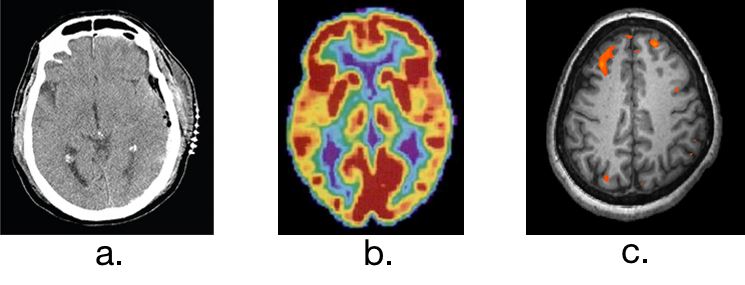
A definition worth taking apart
Psychology is the scientific study of mind and behavior. Each word in that phrase has a job. Behavior is anything a living thing does that others can see or record. A frown counts. So does a reaction time, an answer on a survey, or a rat pressing a lever. Mind means the inner events we cannot watch directly. Thoughts, memories, feelings, and motives are all part of the mind. We figure them out from behavior. The word scientific is what sets psychology apart from every kitchen-table theory about people. Psychologists do not just say what people are like. They gather empirical evidence, which means facts collected by careful, planned observation. Then they let that evidence decide.
Being empirical is what makes psychology a science, even though so much of what it studies is hidden. You cannot see a memory. But you can count how many words a person recalls. You cannot see worry. But you can time how long someone stays away from a feared object, and you can record their heart rate. Psychologists turn hidden processes into things they can measure. That lets them use the scientific method on old questions. The method is a cycle: observe, form a guess called a hypothesis, test it, and revise. For centuries, philosophers could only argue about these questions. Psychology tests them.
The four goals
Psychological science has four goals. Each one asks a little more than the one before. To describe is to say what happens, carefully and without bending the facts. To explain is to say why it happens, which means finding the causes. To predict is to say when it will happen again, and under what conditions. To change is to use that knowledge to make things better. This goal is sometimes called control or influence. It might mean easing a phobia, raising a test score, or designing a safer cockpit. A description with no explanation is only a list. An explanation that cannot predict is only a story. A good prediction proves its worth when it helps us change outcomes for the better.
| Goal | Question it answers | Everyday example |
|---|---|---|
| Describe | What is happening? | Teens who sleep less report more low mood |
| Explain | Why is it happening? | Lost sleep upsets the brain circuits that steady our emotions |
| Predict | When will it happen again? | Students at early-start schools will report more mood problems |
| Change | How can we make it better? | Later school start times cut reported mood problems |
Why “common sense” is not enough
People often say psychology just proves the obvious. The trouble is that “the obvious” often points both ways. Common sense says birds of a feather flock together. It also says opposites attract. It says absence makes the heart grow fonder, and also out of sight, out of mind. Folk wisdom has a saying for every outcome. So it predicts nothing ahead of time. It only sounds wise after we know the answer. That trap is called hindsight bias, the feeling that we “knew it all along.”
Worse, a lot of popular pop-psychology is simply false. You may have heard that we use only ten percent of our brains. You may have heard that opposites make the best couples, or that venting anger drains it away. Many people believe that each learner has a fixed “learning style,” and that teaching must match it. Each of these claims has been tested. Each one failed. The point of a science of the mind is not to agree with our hunches. It is to check them.
- Psychology is the scientific study of mind and behavior. Behavior is what we can see. The mind is what goes on inside, which we figure out from behavior.
- It is a science because it rests on empirical evidence and the scientific method. Opinion and gut feeling do not count as proof.
- Its four goals are to describe, explain, predict, and change behavior.
- “Common sense” can explain any outcome after the fact (hindsight bias). So it cannot replace testing claims ahead of time.
Section 2A short history
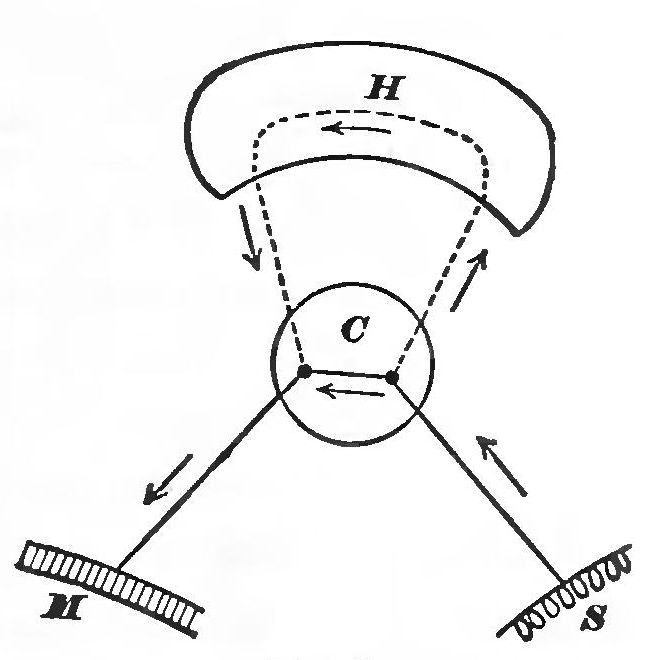
1879: psychology leaves philosophy
Questions about the mind are very old. Aristotle, Descartes, and Locke all had answers. But for most of history, those questions belonged to philosophy. People settled them by argument, not by experiment. Psychology as its own science has a birthday: 1879. That year, Wilhelm Wundt opened the first laboratory built to study the mind by experiment. It was in Leipzig, Germany. Wundt's method was introspection, which means looking inward. He trained people to report their own conscious experience under tightly controlled conditions. For example, they might describe the exact feelings a ticking metronome produced. Introspection seems rough today. The bold step was the setting. It was a laboratory, with set stimuli, measurements, and repeated trials. Wundt is remembered as the father of experimental psychology.
Two founding schools: structuralism and functionalism
Wundt's student Edward Titchener carried these ideas to the United States. He built them into structuralism, the first school of thought in psychology. Wundt supplied the lab methods. Titchener gave the school its name and its narrow aim. Structuralists wanted to break conscious experience into its basic parts: sensations, images, and feelings. It was like a chemist breaking water into hydrogen and oxygen. The plan rested entirely on introspection, and it stalled. Trained observers looking inward at the same stimulus often reported different things. There was no way to settle who was right.
A rival grew up in America around William James. His 1890 book, The Principles of Psychology, shaped the field for a generation. James was strongly shaped by Darwin. He did not ask what the mind is made of. He asked what it is for. That approach is called functionalism. Why do we have memory, emotion, and habit? Because they serve a function. They help a living thing adapt to its world and survive. Functionalism did not last as a formal school either. But its central question still runs through modern psychology: what is this mental process good for? That question leads straight into the evolutionary perspective.
| School | Key figure(s) | Core question | Method / what happened |
|---|---|---|---|
| Structuralism | Titchener, building on Wundt's lab methods | What are the parts of conscious experience? | Introspection; fell apart as unreliable |
| Functionalism | William James | What is the mind for? | Folded into later psychology |
| Behaviorism | Watson, Pavlov, Skinner | What can we learn from behavior we can see? | Led the field from the 1920s to the 1950s |
The turn to behavior, and back to the mind
By the 1910s, many psychologists were tired of how unreliable introspection was. John B. Watson argued that a real science should study only what can be seen and measured. That meant behavior. His school was called behaviorism. It drew on Ivan Pavlov's discovery of classical conditioning in dogs. It reached full strength with B. F. Skinner. Skinner showed how rewards and punishments shape what animals and people do. Behaviorism led psychology for decades. It left powerful tools that therapy and teaching still use. But it treated the mind as a “black box” that was not worth opening. By the 1950s and 1960s, that felt like a real loss.
Then came the cognitive revolution. The computer, a new machine that processed information, gave researchers a fresh model for the mind. Memory, attention, language, and thought moved back to the center of the science. This time they were studied with careful experiments, not introspection.
- Wundt opened the first psychology lab in 1879. He used introspection, or looking inward, in a tightly run setting.
- Structuralism (Titchener) looked for the parts of conscious experience. Functionalism (James) asked what mental processes are for.
- Behaviorism (Watson, Pavlov, Skinner) studied only behavior we can see. It led the field for decades.
- The cognitive revolution brought the mind back. It kept the strict demand for proof.
Section 3The major perspectives
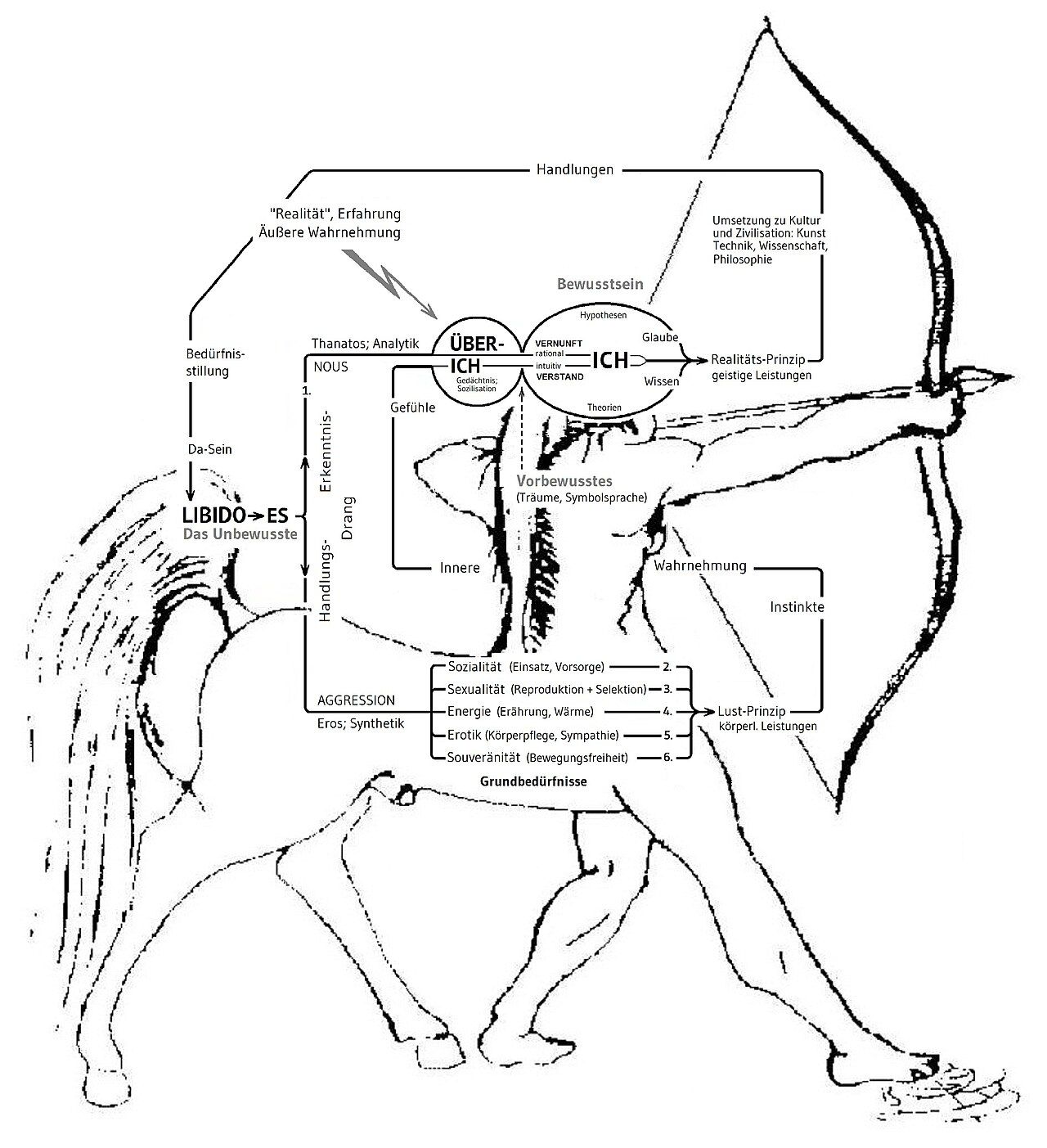
One behavior, several lenses
Modern psychology is not built around one grand theory. Instead it uses a set of perspectives. Each one is a different angle on the same behavior. Ask why a student freezes before an exam. Each perspective gives a different answer, and each is partly true. It might be a hidden fear of failure. It might be a history of being punished for mistakes. It might be a chain of worst-case thoughts. It might be a blocked need to feel capable. It might be a surge of stress hormones. It might be an ancient threat response. Or it might be the pressure of a culture that prizes grades. No single answer is the whole story. Together they are far more complete. This is why psychologists talk about the biopsychosocial model. It says behavior comes from biological, psychological, and social causes all at once.
The seven you should know
The psychodynamic perspective was founded by Sigmund Freud. Followers such as Carl Jung, Alfred Adler, and Erik Erikson revised it. It traces behavior to hidden, unconscious conflicts and to early life experience. The behavioral perspective comes from Pavlov, Watson, and Skinner. Albert Bandura extended it with his work on learning by watching others. It explains behavior through conditioning and reward. The cognitive perspective studies the mental steps in between. It asks how we notice, remember, reason, and solve problems. Jean Piaget's account of how children's thinking grows is a landmark here. The humanistic perspective is linked with Carl Rogers and Abraham Maslow. It stresses free will, personal growth, and the drive to reach our full potential, called self-actualization.
Three more complete the set. The biological perspective is also called the neuroscience perspective. It looks for the roots of behavior in the brain, in chemical messengers called neurotransmitters, in hormones, and in genes. Hans Selye's work on how the body responds to stress is a classic example. The evolutionary perspective comes from Darwin. It asks how a trait or behavior might have helped our ancestors survive and have children. The sociocultural perspective looks at how other people and the surrounding culture shape us. It is the tradition behind Solomon Asch's studies of conformity and Stanley Milgram's studies of obedience.
| Perspective | Core idea | Key figures | Sample question |
|---|---|---|---|
| Psychodynamic | Hidden conflicts and early experience drive behavior | Freud, Jung, Adler, Erikson | What childhood conflict feeds this fear? |
| Behavioral | Behavior is learned through conditioning and reward | Pavlov, Watson, Skinner, Bandura | What rewards or punishments shaped this? |
| Cognitive | The way we process information shapes behavior | Piaget, Neisser | How is this person thinking about the threat? |
| Humanistic | People have free will and strive to grow | Rogers, Maslow | What unmet need is blocking growth here? |
| Biological | Brain, genes, and hormones underlie behavior | Selye | What is happening in the nervous system? |
| Evolutionary | Traits last because they helped survival | Darwin (the root idea) | How might this response have helped our ancestors? |
| Sociocultural | Culture and other people shape behavior | Asch, Milgram | How do others and culture influence this? |
Under all of them runs psychology's oldest debate, the nature-nurture question. How much of who we are comes from the biology we inherit? How much comes from experience and our surroundings? Today's answer is not “which one.” It is “how do they work together?” Genes and experience keep shaping each other, all through life. The biological and sociocultural perspectives study that give-and-take from opposite ends.
- Psychology does not use one master theory. It uses several perspectives that work together.
- There are seven core lenses. They are psychodynamic, behavioral, cognitive, humanistic, biological, evolutionary, and sociocultural.
- Each lens has its big names. Freud is psychodynamic. Skinner and Bandura are behavioral. Piaget is cognitive. Rogers and Maslow are humanistic. Selye is biological. Darwin is evolutionary. Asch and Milgram are sociocultural.
- Today the nature-nurture debate is not a contest. Genes and experience work together.
Section 4Subfields & careers
Three broad kinds of work
“Psychologist” is an umbrella word. It covers a wide range of jobs. Those jobs sort roughly into three families. Clinical and counseling psychologists assess and treat mental health conditions and emotional distress. This is the popular picture of the field, but it is only one part. Research psychologists run studies and teach. They are also called experimental or academic psychologists. They build the base of knowledge itself. Applied psychologists take that knowledge out into the world. They work in offices, schools, courts, hospitals, sports teams, and product design, solving real problems. One person may do more than one of these. A professor might study memory, teach classes, and advise a company on how to train its staff.
A tour of the subfields
The research side alone holds a dozen specialties. Developmental psychologists study how we change as we grow up and grow old. Piaget studied how children reason. Mary Ainsworth studied how babies bond with caregivers, called attachment. Erikson described stages of identity. Cognitive psychologists study memory, attention, and language. Biological psychologists and neuroscientists study the brain behind them. Social psychologists study how people affect one another, as Asch and Milgram did. Personality psychologists study the ways each of us stays the same over time, and how we differ from others.
On the applied side, industrial-organizational (I/O) psychologists improve workplaces and hiring. School and educational psychologists support learning. Health psychologists study how habits and stress affect illness. They build on Selye's work. Forensic psychologists work where psychology meets the law. Sports psychologists help athletes perform. Human-factors psychologists make tools, screens, and machines easier and safer to use.
| Family | Example subfields | What they do |
|---|---|---|
| Clinical / counseling | Clinical, counseling, health psychology | Assess and treat mental health conditions; support coping and well-being |
| Research / academic | Developmental, cognitive, social, biological, personality | Run studies, teach, and build new knowledge |
| Applied | Industrial-organizational, school, forensic, sports, human factors | Use findings at work, in learning, in law, and in design |
Psychologist versus psychiatrist
People mix these two up all the time, and the difference matters. A clinical psychologist usually holds a doctoral degree, either a Ph.D. or a Psy.D. Clinical psychologists treat mental health conditions mainly through testing and psychotherapy, which is talk-based, behavioral, and thinking-based treatment. A psychiatrist is a medical doctor, with an M.D. or a D.O. A psychiatrist finished medical school and then extra training in psychiatry, called a residency. As a physician, a psychiatrist focuses on the biological side and can prescribe medicine. In most U.S. states, psychologists cannot prescribe. A few states let psychologists with extra training in medicines prescribe some of them. In most settings, the two work as a team. The psychiatrist manages medicine while the psychologist provides therapy. Counseling psychologists, clinical social workers, and licensed counselors complete the mental health team. Each has a different level and kind of training.
- Psychology jobs fall into three families: clinical/counseling, research, and applied. Clinical care is only one part.
- Some subfields mostly do research. Think of developmental, cognitive, social, biological, and personality. Others mostly put ideas to use. Think of I/O, school, health, forensic, and sports.
- A psychologist usually holds a Ph.D. or Psy.D. and treats mainly with therapy. A psychiatrist is a medical doctor (M.D. or D.O.) who can prescribe medicine.
- Big names span the subfields: Piaget and Ainsworth in development, Asch and Milgram in social, Selye in health.
Section 5Why psychology matters
A toolkit for thinking clearly
Many people never take another psychology class. Even so, the field gives them something valuable: a habit of mind. That habit is critical thinking. It means carefully checking claims and evidence before you accept them. Psychology has to teach this, because the mind is the one tool that keeps fooling its owner. We remember some things and forget others. We notice facts that fit what we already believe, and we skip the rest. That habit is called confirmation bias. We also see patterns in random noise. And we rewrite the past to fit the present. Knowing all this does not make us immune. But it makes us careful in the right places. Doubting our own certainty is the start of wisdom.
Reading claims with healthy doubt
Claims about the mind are everywhere. They show up in ads, headlines, self-help books, and social media feeds. Most have never been tested. A few questions knock down most of the bad ones.
First, is this one story, or real data? A vivid anecdote is a single personal story, such as “it worked for my cousin.” It is not evidence. A controlled study of many people is. Second, and most important, does a correlation prove a cause? A correlation means two things rise and fall together. That does not mean one causes the other. Ice-cream sales and drownings both climb in summer. Neither causes the other. Hot weather drives both. Third, has the finding been replicated? That means other researchers repeated the study and got the same result. One flashy result is not enough. Fourth, does the claim only look like science? Pseudoscience borrows the look of science but none of its substance. Astrology, “detox” cures, and personality typing that can never be shown wrong are examples.
| When you hear… | Ask… | Why it matters |
|---|---|---|
| “It worked for me!” | Is this one story or real data? | One case cannot rule out luck or the placebo effect |
| “X is linked to Y” | Correlation or cause? | A third factor may cause both |
| “A new study shows…” | Has it been repeated? | A single result is often a fluke |
| “Science-backed!” | Could the claim be proven wrong? | Claims that can never be tested are pseudoscience |
Better everyday decisions
The payoff is practical. Knowing how rewards work helps you build good habits and drop bad ones. Knowing how stress works, Selye's ground, helps you protect your health. Knowing how memory works tells you why cramming fails and spaced practice works. Knowing about conformity and obedience, from Asch and Milgram, helps you spot social pressure while you can still resist it. Psychology will not hand you a formula for life. But it will make you a sharper reader of the endless claims about how people think, feel, and act. That includes the claims you make about yourself.
Confirmation bias is easier to read about than to escape. In 1960 the psychologist Peter Wason gave people a short number puzzle. Most of them tested only guesses they expected to be right, and so they never found the real rule. Try the same puzzle below. Watch which kind of test you reach for first.
- The skill you can take anywhere is critical thinking. It means you check a claim and its proof before you believe it.
- Human thinking is prone to confirmation bias, hindsight bias, and seeing patterns that are not there. That is exactly why careful methods are needed.
- Test a claim by asking: one story or data? correlation or cause? repeated? able to be proven wrong (not pseudoscience)?
- Used wisely, the science improves real choices about health, habits, learning, and standing up to social pressure.
The chapter in one breath
- Psychology is the scientific study of mind and behavior. What makes it a science is empirical testing, not opinion.
- Its four goals are to describe, explain, predict, and change behavior. It is needed because “common sense” explains everything only in hindsight.
- The field became a science with Wundt's 1879 lab. Structuralism and functionalism gave way to behaviorism, and then to the cognitive revolution.
- Modern psychology uses seven perspectives. They work as a team. Each one looks at the same act from a new side.
- The old nature-nurture debate is now seen as genes and experience shaping each other.
- Psychologists work in clinical/counseling, research, and applied jobs. A psychologist is not the same as a psychiatrist. A psychiatrist is a medical doctor who can prescribe.
- Psychology's best gift is critical thinking. Above all, it teaches that correlation is not causation.
ReferenceWords worth knowing
A quick guide to the terms in this chapter. Skim it now, or come back whenever a word trips you up.
- Applied psychology
- Using what psychology knows to solve real problems in places such as workplaces, schools, courts, and product design.
- Behaviorism
- The school led by Watson and Skinner that limits psychology to behavior we can observe, and to how that behavior is conditioned.
- Biological perspective
- The lens that explains behavior through the brain, neurotransmitters, hormones, and genes. It is also called biopsychology or neuroscience.
- Clinical psychology
- The subfield that assesses and treats mental health conditions, usually through therapy. It requires a doctoral degree.
- Cognitive perspective
- The lens that studies mental processes, such as noticing, remembering, reasoning, and language, as causes of behavior.
- Correlation
- A link in which two things change together. A correlation does not, by itself, prove that one causes the other.
- Critical thinking
- Carefully checking claims and evidence before accepting them.
- Empiricism
- The idea that knowledge should rest on evidence gathered by careful observation and experiment.
- Evolutionary perspective
- The lens, which comes from Darwin, that asks how a behavior might have helped survival and having children.
- Functionalism
- William James's school, which asked what mental processes are for: how they help a living thing adapt.
- Humanistic perspective
- The lens linked with Rogers and Maslow. It stresses free will, personal growth, and self-actualization.
- Introspection
- Wundt's method of having trained observers report what they were consciously experiencing.
- Nature-nurture question
- The old question of how much behavior comes from inherited biology and how much from experience. Today it is seen as the two working together.
- Pseudoscience
- Claims that borrow the look of science but cannot be tested or shown to be wrong. Astrology is one example.
- Psychiatry
- The medical specialty, practiced by physicians (M.D. or D.O.), that treats mental health conditions and can prescribe medicine.
- Psychodynamic perspective
- The lens founded by Freud. It traces behavior to hidden, unconscious conflict and early experience.
- Psychology
- The scientific study of mind and behavior.
- Scientific method
- The cycle of observing, forming a testable hypothesis, gathering data, and revising based on the results.
- Sociocultural perspective
- The lens that looks at how other people and the surrounding culture shape behavior.
- Structuralism
- The first school of thought (Titchener, building on Wundt). It used introspection to break conscious experience into basic parts.
- Theory
- An organized explanation of many observations that leads to predictions we can test.
Check yourself
Psychological Research
How do we know what we think we know about the mind? Not from gut feeling. Not from tradition. Not from the loudest, most confident person in the room. Those sources have a poor track record. Psychology earns the word science because it tests its ideas against evidence. It gathers that evidence with methods built to catch our own mistakes. This chapter shows how psychologists ask questions that can be answered. It shows how they describe behavior and how they measure links between things. It shows how they run experiments that can truly reveal a cause. It also explains the rules that protect the people, and the animals, who make that knowledge possible.
By the end of this chapter you can
- Explain why psychology relies on the scientific method, and describe the scientific attitude.
- Tell a theory from a hypothesis, and explain why claims must be falsifiable.
- Define an operational definition, and explain why replication matters.
- Compare the three descriptive methods: case study, naturalistic observation, and survey. Give a strength and a limit of each.
- Read a correlation coefficient and a scatterplot. Explain why correlation does not prove causation.
- Pick out the independent and dependent variables, the control and experimental groups, random assignment, and the job of a placebo.
- Sum up the ethics rules for research: informed consent, the IRB, deception and debriefing, and humane animal care.
Section 1The scientific method
Why psychology needs a method
Everyone is an amateur psychologist. We explain why a friend snapped. We guess how a crowd will act. We feel sure we understand ourselves. The trouble is that this everyday confidence is wrong often enough to be risky.
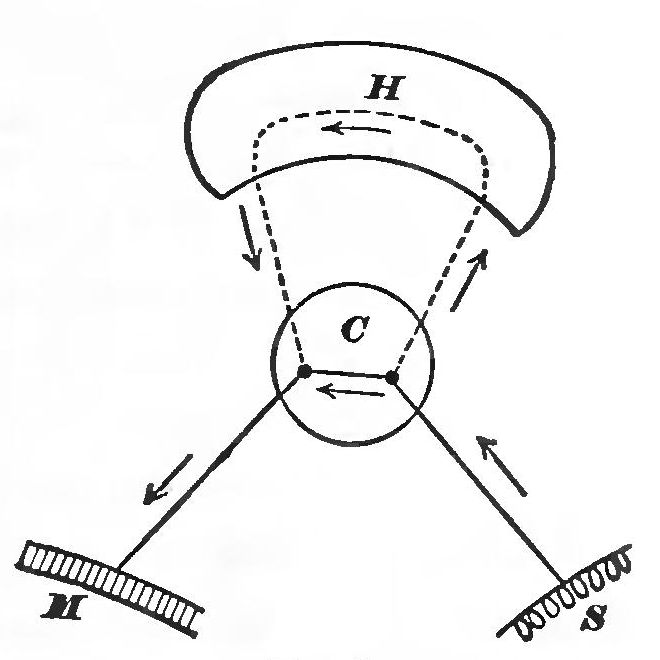
Take hindsight bias, the “I knew it all along” feeling. It makes any outcome seem obvious after it happens. So common sense can “explain” a result and its opposite equally well. We also notice evidence that fits our beliefs and miss the rest. Human judgment makes these mistakes in steady, predictable ways. That is exactly why the scientific method exists. It is a set of habits for asking questions so that the world, not our wishes, decides the answer.
At the heart of the method is the scientific attitude. It blends three things. The first is curiosity, a real wish to find out. The second is skepticism, which means not accepting a claim until the evidence is in. The third is humility, a willingness to be shown wrong. Psychology became its own science in 1879. That year Wilhelm Wundt opened the first psychology laboratory, in Leipzig. He began measuring mental processes instead of just guessing about them. That shift, from armchair opinion to controlled observation, is what this whole chapter is about.
Theory versus hypothesis
People swap these two words in everyday talk. In science they mean very different things. A theory is an explanation that ties many observations together and predicts new ones. It is a big idea that is well supported by evidence. A hypothesis is a specific prediction that can be tested. A theory, or even a hunch, can produce one. It is a single claim you can go out and check.
Here is an example. A theory of stress might lead to this hypothesis: “Students who sleep fewer than six hours before an exam will score lower than students who sleep eight.” The hypothesis is what you test. The theory is what the pile of results supports or weakens over time.
A scientific claim must be falsifiable. That means it is stated clearly enough that some possible result could prove it wrong. Think about this claim: “People act the way they do because of hidden forces we can never observe.” It explains everything, so it predicts nothing. No result could ever count against it. So it is not scientific. A good hypothesis takes a risk. It says ahead of time what result would count as failure.
| Theory | Hypothesis | |
|---|---|---|
| What it is | A broad explanation that ties many findings together | One specific prediction that can be tested |
| Scope | Wide: covers many situations | Narrow: one situation, one prediction |
| Example | Sleep helps lock in memories | Students who sleep 8 hours recall more word pairs than students who sleep 4 hours |
| Tested by | The weight of many studies over time | One well-designed study |
Operational definitions and replication
Say you want to test “sleep improves memory.” First you must say exactly what you mean by sleep and by memory. An operational definition states a variable in terms of the exact steps used to measure it or change it. A variable is anything that can vary, or change, from person to person. Here, “sleep” might become “hours of sleep written in a sleep diary.” “Memory” might become “the number of word pairs recalled correctly after 24 hours.”
Operational definitions do two jobs at once. They force you to be concrete. And they let anyone else run your exact study. That is the point of replication, which means repeating a study to see if the finding holds. The best replications use new people and new settings. A result that shows up once may be a fluke. A result that shows up again and again is one you can start to trust.
In the 2010s, large teams tried to repeat many well-known psychology studies. Many of the findings did not hold up, or turned out much weaker than first reported. This became known as the “replication crisis.” The field answered by tightening its methods. Many researchers now publish their plans before they collect data, use larger samples, and share their data. That is the scientific attitude at work, correcting its own mistakes.
- The scientific method exists because gut feeling is unreliable. Hindsight bias is one reason why.
- The scientific attitude is curiosity plus skepticism plus humility.
- A theory is a broad explanation. A hypothesis is one testable prediction. Both must be falsifiable.
- Operational definitions make each variable measurable and repeatable. That makes replication possible.
Section 2Descriptive research
When you want to describe, not explain
Sometimes the goal is not to find a cause. The goal is just to describe what people are like or what they do. Descriptive research paints an accurate picture of behavior. It comes in three main forms: the case study, naturalistic observation, and the survey. None of them can tell you why a behavior happens. But each one captures something that neater methods miss.
Case studies and naturalistic observation
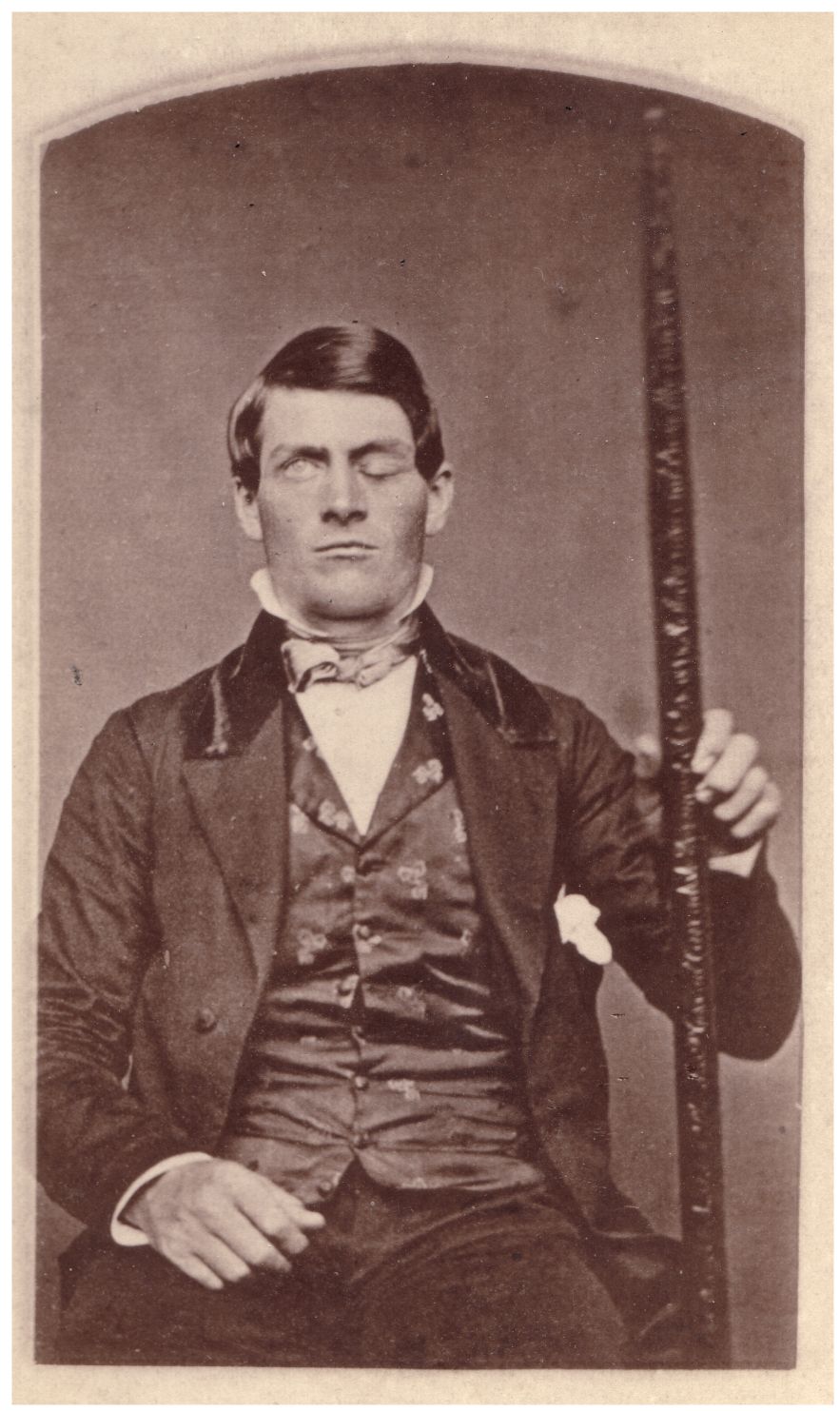
A case study looks at one person, or a small group, in great depth. The classic example is Phineas Gage. He was a railroad foreman. In 1848, a three-foot iron rod blasted through his frontal lobe, the front part of his brain. He survived. Afterward, people who knew him said he became rude and reckless. His case gave an early, vivid clue that the frontal lobes help control judgment and self-control. Later historians found that many retold versions of his story were exaggerated. In fact, Gage recovered enough to work for years as a stagecoach driver in Chile. That twist itself teaches a lesson about case studies.
Case studies are very valuable for rare conditions. They are also good for sparking new hypotheses. But they carry a built-in danger. One person may be unusual. What is true of them may not generalize, or apply, to anyone else.
Naturalistic observation means watching behavior as it happens in its real setting, without stepping in. A researcher might watch children on a playground, drivers at a crossing, or shoppers in a store. Its strength is realism. You see what people really do, not what they say they would do. Its limit is that you cannot control anything. Two separate problems can also bend what you find.
The first problem is reactivity, also called the observer effect. People who know they are being watched act differently. That is why researchers try to stay out of sight. You may hear this called the Hawthorne effect. The name comes from old studies at the Hawthorne factory, where workers were said to work harder just because they were being studied. Later re-checks of the original lighting data found little support for that story. Those studies also changed working conditions and attention, not just watching. The second problem is observer bias. Here the researcher's own expectations shape what gets noticed and written down. To guard against it, researchers define the behaviors ahead of time. They also have the scoring done by coders who do not know the hypothesis.
Surveys and sampling
A survey asks many people the same questions. It gathers a lot of data quickly and cheaply. It is the only practical way to study attitudes, habits, or opinions across a large group. But a survey is only as good as its sample.
The whole group you care about is the population. The smaller group you actually question is the sample. For the sample to speak for the population, you need a random sample. In a random sample, every member of the population has an equal chance of being picked. Skip that step and you get bias. A poll of only your friends will mislead you. So will a poll of only the people who chose to answer.
Surveys have other weak spots. The wording of a question can change the answers. And people may shade their answers to look good. That is called social desirability bias.
| Method | What it does | Strength | Main limit |
|---|---|---|---|
| Case study | Studies one person or group in depth | Rich detail; great for rare cases and new hypotheses | May not generalize; one unusual case |
| Naturalistic observation | Watches behavior in its real setting | Very realistic; behavior is genuine | No control; being watched can change behavior |
| Survey | Asks many people the same questions | Large samples, fast and cheap | Sampling and wording bias; people may shade answers |
Why does a random sample matter so much? Draw samples yourself below. Compare a random sample with a convenience sample, and watch how far each guess lands from the truth.
- Descriptive research describes behavior. It cannot show a cause.
- A case study gives depth on one person, such as Phineas Gage, but may not generalize.
- Naturalistic observation is realistic but has no control. Watch for reactivity, when people change because they are watched. Watch for observer bias, when the researcher's hopes bend the scoring.
- A survey needs a random sample of the population to avoid bias.
Section 3Correlation
The correlation coefficient
Often we cannot control the thing we want to study. We cannot randomly make people rich, or lonely, or left-handed. But we can still measure whether two things move together. Correlation measures how strong and in what direction two variables are linked. It is summed up by one number, the correlation coefficient. It is written r, and it runs from −1.0 to +1.0.
The sign tells you the direction. A positive correlation means the two rise and fall together. More study hours go with higher grades. A negative correlation means one rises as the other falls. More absences go with lower grades. The size of the number tells you the strength. That means how close it is to 1, in either direction. An r of +0.85 is a strong link. An r near 0 means the two are basically unrelated. Here is the key point: −0.70 is a stronger link than +0.30. Strength is the distance from zero, not the sign.
Reading a scatterplot
A scatterplot shows the raw link as a cloud of dots. Each dot is one person. One variable goes on each axis. If the dots slope upward from left to right, the correlation is positive. If they slope downward, it is negative. The more tightly the dots hug a straight line, the stronger the correlation. Then r is close to ±1. A shapeless blob of dots means no link at all.
Always look at the scatterplot before you trust the number. Here is why. The value of r only measures straight-line links. A strong curved pattern, such as an upside-down U, can give an r near zero.
Why correlation is not causation
Here is the most important idea in this chapter: a correlation, no matter how strong, cannot prove that one variable causes the other. When two things travel together, three explanations stay open. First, A might cause B. Second, B might cause A. That is the directionality problem. Third, and most often missed, a hidden third variable might cause both. A third variable that muddies a result is also called a confound.
Ice-cream sales and drowning deaths are strongly correlated. But ice cream does not drown anyone. Hot summer weather raises both, each on its own. Self-esteem goes with success. But which causes which? Or does a supportive home life boost both? Whenever a headline dresses up a correlation as a cause, ask two questions. Could it run the other way? Could a third variable be pulling the strings?
| Coefficient | Direction | Meaning | Everyday example |
|---|---|---|---|
| r = +0.90 | Positive, strong | Rise together, tightly | Height and arm span |
| r = +0.30 | Positive, weak | Loosely rise together | Study time and final grade |
| r = 0.00 | None | No straight-line link | Shoe size and IQ |
| r = −0.80 | Negative, strong | One goes up, the other goes down | Class absences and grade |
- The correlation coefficient (r) runs from −1 to +1. The sign gives the direction. The distance from 0 gives the strength.
- A scatterplot shows the link as dots. Tighter dots mean a stronger correlation.
- Correlation does not prove causation. Watch for a reversed direction and for a third variable (a confound).
- Only an experiment can show a cause.
Section 4The experiment
Independent and dependent variables
The experiment is the only method that can reveal cause and effect. Here is why. The researcher actively changes one thing and holds everything else steady. Then the researcher watches what changes as a result.
The factor the researcher changes on purpose is the independent variable (IV). It is the possible cause. The behavior that is then measured is the dependent variable (DV). It is the possible effect. It gets its name because it may depend on the IV. Say you want to test whether caffeine speeds up reaction time. The caffeine dose is the IV. You set it. Reaction time is the DV. You record it. Here is a quick way to keep them straight: you change the independent variable, and you measure the dependent variable.
Control and experimental groups, random assignment
An experiment needs a comparison. The experimental group gets the treatment, such as the caffeine. The control group is treated the same in every way, except that it does not get the treatment. Then any difference in the DV between the groups can be traced to the IV. But that only works if the two groups were alike to begin with.
That is the job of random assignment. It means sorting people into groups purely by chance, such as by a coin flip or a list of random numbers. Then differences between people, such as age, drive, or how well they slept, spread out evenly across both groups. They do not pile up in one group. Random assignment is what sets a true experiment apart from every descriptive or correlational method. It is exactly why an experiment can support a claim about cause and a correlation cannot.
Do not mix this up with random sampling, from the survey section. Sampling is about who gets into the study. Assignment is about which group they land in.
Placebos, blinding, and confounds
People often feel better just because they believe they are being treated. This is the placebo effect. To separate a drug's real action from that belief, the control group gets a placebo. A placebo is a fake look-alike with no active ingredient, such as a sugar pill. If the experimental group improves more than the placebo group, that extra improvement is the treatment's true effect.
Expectations can also leak in from the researcher. So the strongest designs are double-blind. In a double-blind study, neither the participant nor the person collecting the data knows who got the real treatment. They find out only when the study ends. All of these steps guard against confounding variables. A confounding variable is any factor besides the IV that differs between the groups. It offers another possible explanation for the results.
| Part | What it is | Caffeine example |
|---|---|---|
| Independent variable | The factor the researcher changes (cause) | Caffeine or no caffeine |
| Dependent variable | The behavior measured (effect) | Reaction time in milliseconds |
| Experimental group | Gets the treatment | Drinks coffee with caffeine |
| Control group | Gets no treatment, or a placebo | Drinks decaf that looks the same |
| Random assignment | Chance sorts people into groups | A coin flip decides each person's group |
- An experiment changes the independent variable and measures the dependent variable. It is the only way to show a cause.
- The experimental group gets the treatment. The control group does not, or it gets a placebo.
- Random assignment makes the groups alike at the start. That rules out differences that were there before.
- Placebo controls and double-blind designs guard against expectations and confounds.
Section 5Research ethics
Protecting human participants
Research studies people, so it can harm them. History holds ugly proof. Nazi doctors ran cruel experiments on prisoners, and the trials that followed produced the Nuremberg Code. In the United States, the Public Health Service ran the Tuskegee study from 1932 to 1972. It deceived Black men who had syphilis and kept treatment from them for decades, even after penicillin became the standard cure.
Out of that history came a firm set of ethics rules. In the U.S., they rest on the Belmont Report (1979). It names three principles: respect for persons, beneficence, and justice. Beneficence means doing good and avoiding harm. Justice means sharing the risks and benefits of research fairly.
The cornerstone is informed consent. Before taking part, people must learn enough about the study's steps and risks to make a free, informed choice. They may quit at any time with no penalty. Some people cannot legally consent, such as children. Then a parent or guardian gives permission, and the child also agrees in a way that fits their age. That agreement is called assent. Whatever is learned, each person's data must be kept confidential, or private.
The IRB, deception, and debriefing
No researcher gets to be the only judge of their own study's ethics. Before a study can start, an Institutional Review Board (IRB) must approve it. An IRB is a committee that reviews the plan. It weighs the risks against the likely benefits. It can require changes, or it can refuse outright.
Some studies need mild deception. Telling people the true purpose would spoil the very behavior being measured. Solomon Asch could not have studied conformity if everyone knew his “other participants” were actors. Deception is allowed only under three conditions. The knowledge gained must justify it. No less deceptive method would work. And it must cause no lasting harm.
Whenever deception is used, people get a debriefing at the end. Ideally, they get one after any study. A debriefing explains the study's real purpose and the reason for any deception. It also gives a chance to ask questions. The Milgram obedience experiments, which people still debate today, are a big reason the field takes debriefing so seriously.
The care of animal subjects
Some questions cannot be studied in people without causing harm. About seven percent of psychological research uses animals. That work gave us basic knowledge about learning, the brain, and stress. Animal research comes with its own strict duties. A study must be justified. It must use the fewest animals needed. And it must keep pain and distress as low as possible. These duties are often called the “three Rs”: replace, reduce, refine.
In the United States, a separate committee reviews and oversees animal studies. It is called the Institutional Animal Care and Use Committee (IACUC). Federal law also sets standards for housing and humane treatment. The bottom line is the same for all research, human or animal. The knowledge sought must be weighed honestly against the cost to those who are studied.
| Safeguard | What it requires | Why it exists |
|---|---|---|
| Informed consent | People freely agree after learning the risks and steps | Respect for persons; freedom to choose |
| IRB review | An outside board approves the study first | Weighs risk against benefit; no one polices only themselves |
| Deception limits | Used only when needed and harmless | Some behaviors change if the purpose is known |
| Debriefing | A full explanation is given afterward | Corrects any deception; restores understanding |
| Confidentiality | Personal data is kept private | Protects people from exposure |
| Animal care (IACUC, 3 Rs) | Justify the study, use fewer animals, reduce suffering | Humane treatment of animal subjects |
- Informed consent lets people agree freely after they learn the risks. They can quit at any time.
- An IRB must approve research with people before it starts. It weighs risks against benefits.
- Deception is allowed only when needed and harmless. It must always be followed by a debriefing.
- Animal research follows humane standards: the three Rs and IACUC oversight.
The chapter in one breath
- Psychology uses the scientific method because gut feeling is unreliable. Hindsight bias bends it. The scientific attitude is curiosity, skepticism, and humility.
- A theory is a broad explanation. A hypothesis is a specific, falsifiable prediction. It is written in operational definitions so it can be replicated.
- Descriptive research includes the case study, naturalistic observation, and the survey. It describes behavior but cannot show a cause. Surveys need a random sample.
- Correlation (r, from −1 to +1) shows how two variables move together on a scatterplot. But correlation does not prove causation.
- The experiment changes an independent variable and measures a dependent variable. It compares an experimental group with a control group.
- Random assignment, a placebo control, and double-blind designs make the experiment the only method that can reveal a cause.
- Ethical research needs informed consent, IRB approval, limited deception with debriefing, privacy, and humane animal care.
ReferenceWords worth knowing
A quick guide to the terms in this chapter. Skim it now, or come back whenever a word trips you up.
- Case study
- A deep look at one person or a small group. It is rich in detail but hard to generalize.
- Confounding variable
- A factor other than the independent variable that differs between groups. It offers another possible explanation for the results.
- Control group
- The people in an experiment who do not get the treatment, or who get a placebo. They serve as the comparison.
- Correlation
- A measure of how strongly, and in what direction, two variables are linked.
- Correlation coefficient (r)
- A number from −1.0 to +1.0 that sums up a correlation. The sign gives the direction. The distance from zero gives the strength.
- Debriefing
- The explanation given to people after a study. It tells them the true purpose and the reason for any deception.
- Dependent variable
- The behavior measured in an experiment. It is the possible effect.
- Experiment
- A method that changes an independent variable and controls other factors to show cause and effect.
- Falsifiable
- Stated clearly enough that some possible result could prove it wrong. Scientific claims must be falsifiable.
- Hypothesis
- A specific prediction that can be tested. It often comes from a theory.
- Independent variable
- The factor the researcher changes on purpose. It is the possible cause.
- Informed consent
- A person's free agreement to take part after learning the study's steps and risks.
- Institutional Review Board (IRB)
- A committee that reviews research with people. It must approve a study before it starts.
- Naturalistic observation
- Watching and recording behavior in its natural setting without stepping in.
- Observer bias
- Errors in what a researcher notices or records, caused by the researcher's own expectations.
- Operational definition
- A statement of a variable in terms of the exact steps used to measure it or change it.
- Placebo
- A fake treatment with no active ingredient, given to a control group. It separates real effects from expectation.
- Random assignment
- Sorting people into experimental and control groups by chance, so the groups start out alike.
- Random sample
- A sample in which every member of the population has an equal chance of being picked.
- Reactivity (observer effect)
- A change in people's behavior caused by knowing they are being watched.
- Replication
- Repeating a study to see if its findings hold, ideally with new people and new settings.
- Scientific method
- The self-correcting process of testing ideas against evidence, to cut down the errors of gut feeling.
- Survey
- A descriptive method that gathers data by asking many people the same questions.
- Theory
- A broad explanation that ties many observations together and produces hypotheses we can test.
Check yourself
Biopsychology
Every thought you have ever had is a physical event. So is every feeling, every memory, and every choice. Each one is a pattern of electricity and chemistry moving through living cells. Biopsychology is the part of psychology that takes this idea seriously. It asks how the nervous system, and the glands that tune it, give rise to mind and behavior. This chapter starts with one working unit, the neuron. Then it follows the signal outward. You will see how one cell fires and how it passes a message to the next cell across a synapse. You will see how those cells are wired into the main lines of the nervous system and how the brain groups them into regions with jobs. Last, you will meet a slower chemical message service, the endocrine system, which sets the body's background mood. Once you know these pieces, the rest of psychology stops feeling like magic. It starts to feel like biology.
By the end of this chapter you can
- Label the main parts of a neuron and say what each part does.
- Describe the resting potential and walk through the steps of the action potential.
- Explain how a signal crosses the synapse. Name the main neurotransmitters and their jobs.
- Tell drugs that act as agonists apart from drugs that act as antagonists.
- Map the parts of the nervous system: central vs peripheral, somatic vs autonomic, and sympathetic vs parasympathetic.
- Find the hindbrain, midbrain, and forebrain, and give the jobs of the four cortical lobes.
- Explain how the endocrine system sends signals with hormones, and how that differs from nerve signals.
- Link real cases and researchers to the brain and body systems they helped explain. These include Phineas Gage, Broca, Wernicke, Sperry, and Selye.
Section 1The neuron
The parts of a neuron
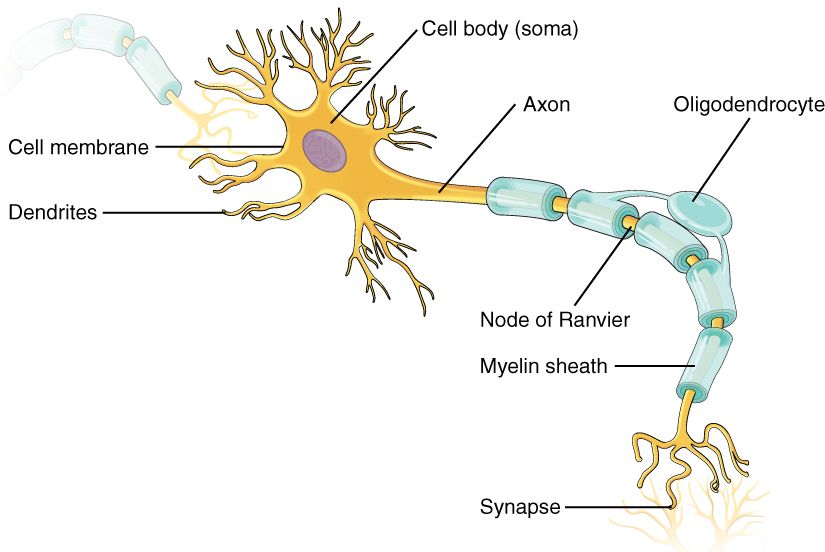
The neuron is the basic cell of the nervous system that handles information. All of psychology runs on neurons. That includes seeing, remembering, feeling, and moving. Your brain has about 86 billion of them, all wired together. A neuron does three jobs in order. It receives a signal. It decides whether to pass the signal on. Then it sends it.
The receiving end is a spray of branches called dendrites. They carry incoming signals toward the cell body, also called the soma. The cell body holds the nucleus. It also adds up everything that arrives. If the total is big enough, the signal leaves along one long fiber, the axon. The axon ends in small swollen tips called terminal buttons. There, the signal is handed off to the next cell.
Many axons are wrapped in a fatty white coating called the myelin sheath. It works like the plastic coating on a wire. Support cells lay it down. Myelin is not one smooth tube. It comes in segments with bare gaps between them. These gaps are the nodes of Ranvier, and they are the secret to how fast a myelinated axon can be.
Neurons do not work alone. They have a crew of helpers called glial cells, or glia. The brain has roughly 85 billion glia. That is about one glial cell for every neuron in the brain as a whole. In the cerebral cortex, though, glia outnumber neurons several times over. Glia build myelin, feed neurons, clean up waste, and hold everything in place. For a long time, people treated glia as simple packing material. An old textbook claim said there were ten glia for every neuron, and you may still hear it. Careful cell counts have retired both ideas. We now know glia help shape how signals travel.
| Part | Job |
|---|---|
| Dendrites | Take in signals from other neurons and carry them toward the cell body |
| Cell body (soma) | Holds the nucleus; integrates (adds up) all incoming signals to decide whether to fire |
| Axon | One long fiber that carries the outgoing signal away from the cell body |
| Myelin sheath | Fatty coating that speeds the signal; its gaps are the nodes of Ranvier |
| Terminal buttons | Axon tips that release neurotransmitter onto the next cell |
| Glial cells | Helper cells that make myelin, feed neurons, and protect them |
How a neuron fires: the action potential
At rest, a neuron is like a tiny charged battery. It keeps pumping charged particles, called ions, across its outer membrane. A pump called the sodium-potassium pump does much of this work. The result is that the inside of the cell sits at about −70 millivolts compared with the outside. This state is the resting potential. The cell is polarized, which means the inside and outside carry different charges. It is primed and waiting.
Signals from other neurons nudge that voltage up or down. Some push the cell toward firing. Others push it away. If enough push-toward signals add up, the voltage climbs to a tipping point near −55 mV. That tipping point is the threshold. Once the cell crosses it, the neuron fires.
Firing is the action potential. It is a quick electrical spike that races down the axon. It always runs in the same order. First, gates in the membrane fly open. Positively charged sodium (Na+) ions rush in. For a moment the inside turns positive. This step is depolarization. A split second later, the sodium gates shut and potassium (K+) ions flow out. That drags the voltage back down. This step is repolarization. The voltage often dips a little below rest before it settles.
During the spike and just after it, there is a short refractory period. In this window the cell cannot fire again, or it needs an extra strong push to do so. This keeps the signal moving one way down the axon. Then the cell settles back to rest, and the pump keeps the ion balance steady over time. The neuron is ready to go again.
One rule is key. The action potential is all-or-none. A neuron fires a full spike, or it does not fire at all. Think of a gun trigger. You cannot fire half a shot. So how does the brain know a strong touch from a light one? It does not use bigger spikes. Instead, a stronger stimulus makes neurons fire faster, and it makes more neurons fire.
In a myelinated axon, the spike does not crawl along the fiber. It leaps from one node of Ranvier to the next. This shortcut is called saltatory conduction. The name comes from the Latin word saltare, which means "to jump." This is why myelin matters so much. It can make a signal many times faster. It lets a signal travel from your spinal cord to your toe in a small part of a second.
- A neuron takes in signals at its dendrites, adds them up in the cell body, and sends the result down its axon to the terminals.
- The resting potential (about −70 mV) is a primed, polarized state. Crossing threshold (about −55 mV) makes the neuron fire.
- The action potential is an all-or-none spike. Na+ flows in (depolarize), then K+ flows out (repolarize).
- Myelin allows fast saltatory conduction. When myelin is damaged, signals and behavior suffer.
Section 2Neurotransmitters
Crossing the synapse
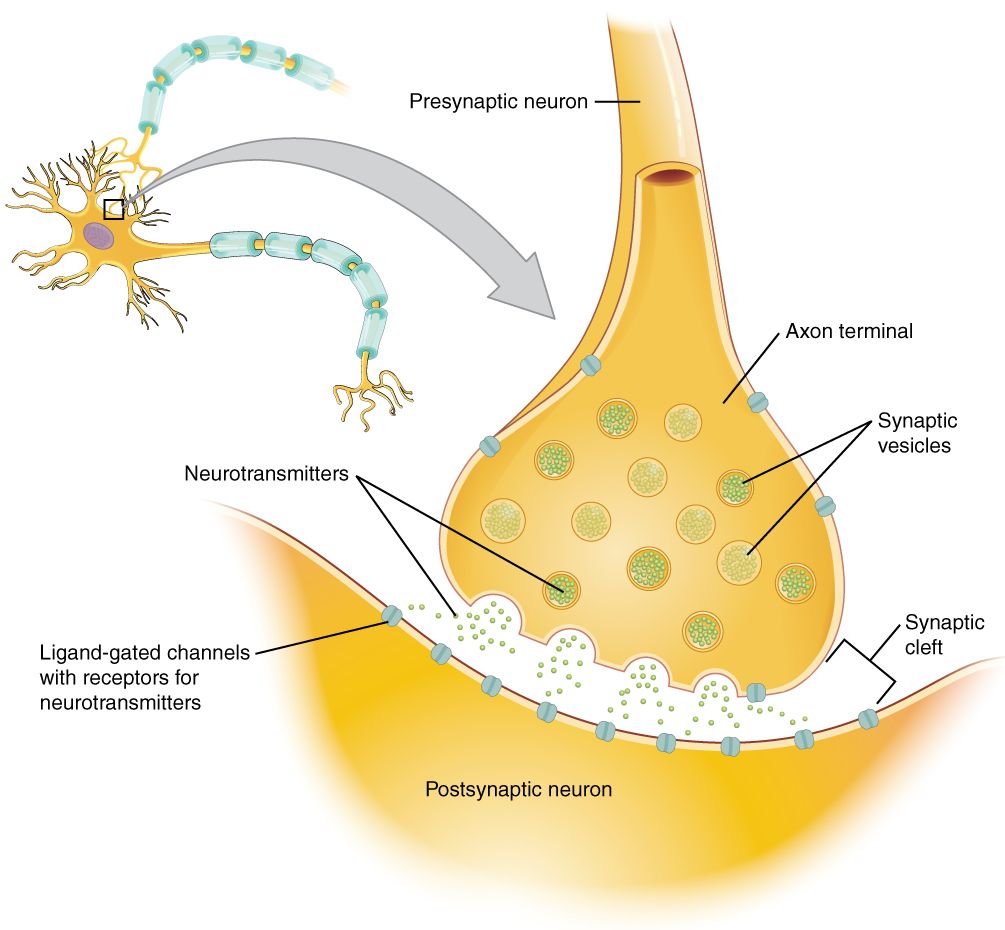
At most junctions, neurons do not touch. A very small gap sits between the end of one neuron and the dendrite of the next. This gap is the synaptic cleft. The whole junction is called the synapse. (A few synapses in the body are electrical and pass current straight through. Most, and the ones this chapter is about, are chemical.)
The electrical spike cannot jump the gap. So the message is turned into a chemical one. When the spike reaches the terminal buttons, tiny sacs called vesicles empty their contents into the cleft. What spills out are molecules of neurotransmitter. These chemical messengers drift across the gap. They lock onto receptors on the receiving neuron. Each receptor is shaped to fit a certain neurotransmitter, the way a lock fits one key.
The effect can be excitatory, which nudges the next neuron toward firing. Or it can be inhibitory, which nudges it away. Either way, the signal has to be shut off fast. If not, the receptor would keep going. The body turns off the signal in two ways. Enzymes in the cleft break the neurotransmitter apart. Or the sending neuron sucks the leftover molecules back up to use again. This second way is called reuptake. Reuptake will matter a lot in a moment, because many drugs for mental health conditions act on exactly this step.
The major neurotransmitters
Scientists have found dozens of neurotransmitters. A handful do most of the work that matters for psychology. Each is loosely tied to certain jobs. Each is also tied to certain disorders when its system runs too high or too low.
| Neurotransmitter | Linked with | When it is out of balance |
|---|---|---|
| Acetylcholine (ACh) | Muscle movement, learning, memory | Loss is linked to Alzheimer's disease |
| Dopamine | Reward, motivation, movement, pleasure | Loss of dopamine cells causes Parkinson's; too much activity in some pathways is linked to schizophrenia |
| Serotonin | Mood, sleep, appetite | Linked to depression, though not as a simple shortage |
| Norepinephrine | Alertness, arousal, the stress response | Tied to anxiety and mood |
| GABA | The brain's main inhibitory messenger; calming | Low activity linked to anxiety and seizures |
| Glutamate | The brain's main excitatory messenger; learning | Too much can overexcite and damage neurons |
| Endorphins | Pain relief and pleasure (the body's own opioids) | Copied by morphine and heroin |
A word of care about serotonin. You may hear that depression is "low serotonin." Research does not back that simple story. Large reviews have not found a clear serotonin shortage in most people with depression. Serotonin is part of the picture. So are stress, sleep, other brain chemicals, life events, and how brain networks change over time.
How drugs act: agonists and antagonists
Almost every drug that changes the mind does it by meddling with this chemical hand-off. The effects fall into two camps. An agonist is anything that increases a neurotransmitter's action. It might copy the neurotransmitter and bind its receptor directly. It might cause more of it to be released. Or it might block reuptake, so the neurotransmitter stays in the cleft longer. An antagonist does the opposite. It blocks or reduces a neurotransmitter's action. Often it plugs the receptor, so the real neurotransmitter cannot dock.
This split is the heart of psychopharmacology, the study of drugs that affect the mind. SSRIs are the most common antidepressants. They are agonists that block the reuptake of serotonin, which leaves more of it in the synapse. Many antipsychotic drugs are dopamine antagonists. They calm an overactive dopamine system. Caffeine, nicotine, opioids, and antihistamines all get their effects by pulling one of these levers.
- Signals cross the synapse as chemicals. Vesicles release neurotransmitter, which binds to receptors on the next neuron.
- The signal is cleared by enzymatic breakdown (enzymes break it apart) or by reuptake back into the sending neuron.
- Key neurotransmitters include dopamine, serotonin, acetylcholine, GABA, glutamate, and endorphins. Each is tied to certain jobs and disorders.
- Agonists increase a neurotransmitter's action. Antagonists block it. Most psychiatric drugs work one of these two ways.
Section 3The nervous system
Central and peripheral
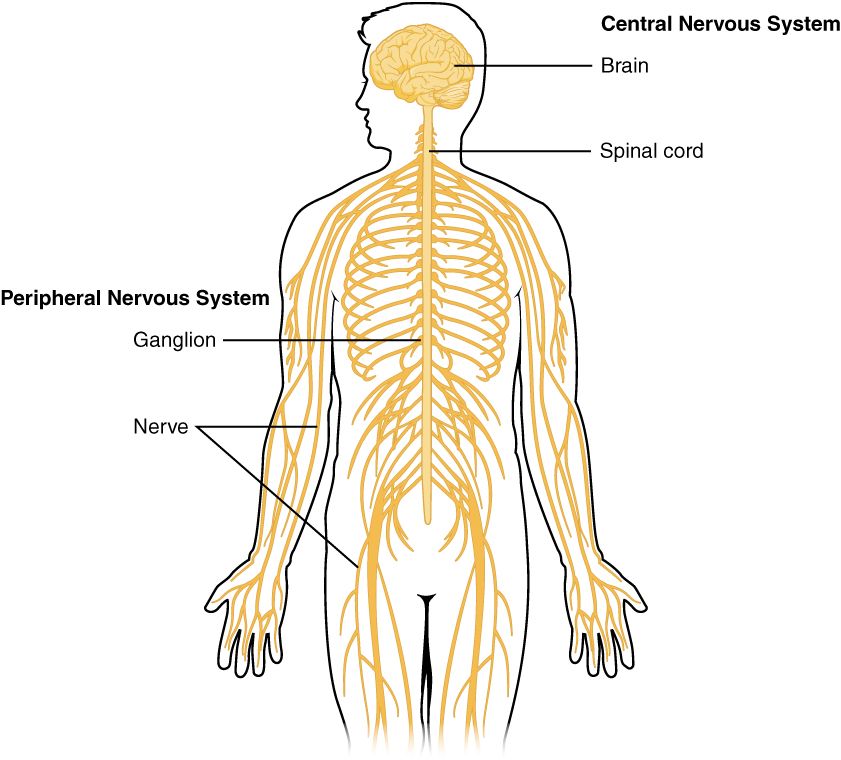
All those neurons are organized into two main parts. The central nervous system (CNS) is the brain and the spinal cord. It is the command center, where information is combined and decisions are made. Everything else is the peripheral nervous system (PNS). This is the huge web of nerves that runs out to the muscles, skin, and organs. Its job is to carry messages back and forth between the CNS and the rest of the body.
Sensory neurons carry messages in toward the CNS. Motor neurons carry messages out to muscles and glands. The spinal cord is not just a cable, either. It can run simple reflexes on its own. That is why your hand jerks off a hot stove before your brain even notices the pain.
Somatic and autonomic
The peripheral system splits again. This time the split is about whether you control the action. The somatic nervous system handles what you do on purpose. It carries sense information in. It also sends commands out to the skeletal muscles you control, as when you lift a cup, type, or walk. The autonomic nervous system runs the background jobs you never think about. These include heartbeat, digestion, breathing rate, pupil size, and sweating. The words "autonomic" and "automatic" sound alike for a reason. This system runs the body on autopilot.
Sympathetic and parasympathetic
The autonomic system has two branches that work against each other, like a gas pedal and a brake. The sympathetic nervous system is the gas pedal. It gets the body ready for action. This is the famous fight-or-flight response. When you face a threat, it speeds up your heart and widens your pupils. It sends sugar into your blood and shifts resources to your muscles, all in an instant.
The parasympathetic nervous system is the brake. It is sometimes called rest-and-digest. Once the danger passes, it slows the heart and restarts digestion. It brings the body back to a calm baseline. Both branches are almost always working at some level. Health depends on the balance between them. Trouble starts when the sympathetic gas pedal is held down too long, as happens in long-term stress.
| Organ | Sympathetic (“fight-or-flight”) | Parasympathetic (“rest-and-digest”) |
|---|---|---|
| Heart | Speeds up | Slows down |
| Pupils | Dilate (widen) | Constrict (narrow) |
| Digestion | Slowed | Stimulated |
| Lungs | Airways widen | Airways narrow |
| Adrenal glands | Release stress hormones | No direct role |
| Overall effect | Spend energy for action | Save energy, restore calm |
- The CNS (brain plus spinal cord) combines information. The PNS carries signals to and from the body.
- The somatic system controls the skeletal muscles you move on purpose. The autonomic system runs organs automatically.
- The sympathetic branch powers fight-or-flight. The parasympathetic branch brings back rest-and-digest.
- Health is the balance between the two. Keeping the sympathetic branch switched on for weeks is the biology of chronic stress.
Section 4The brain
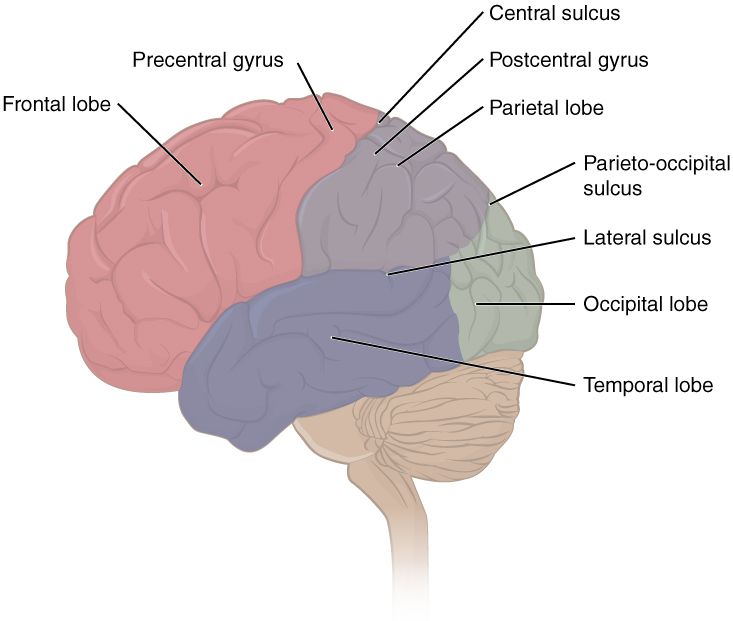
Hindbrain, midbrain, forebrain
One useful way to read the brain is from the bottom up, with the oldest parts first. The hindbrain sits where the spinal cord enters the skull. It runs the machinery of staying alive. It includes three parts. The medulla controls heartbeat and breathing. The pons is a relay station that helps with sleep and arousal. The cerebellum, which means "little brain," coordinates balance, posture, and smooth, practiced movement.
The small midbrain sits just above the hindbrain. It helps you turn toward sudden sights and sounds. It also helps control movement and alertness. Together, the midbrain, pons, and medulla make up the brainstem, the brain's survival core. The cerebellum is part of the hindbrain but is not part of the brainstem. It attaches behind it.
The forebrain is the newest and largest region. It is where most of psychology lives. Deep inside it are several parts we will meet again and again. The thalamus is a relay station for the senses. It routes incoming signals to the right places. The hypothalamus controls hunger, thirst, body temperature, and the endocrine system. The limbic system includes the amygdala, which handles emotion, especially fear. It also includes the hippocampus, which helps form new memories. Draped over all of this is the wrinkled outer layer that makes us most human: the cerebral cortex.
The four cortical lobes
The cerebral cortex is the thin, folded sheet of neurons that covers the brain. It is split into two halves, called hemispheres. Each half is divided into four lobes, and each lobe has typical jobs.
- The frontal lobe sits at the front. It handles planning, judgment, personality, and voluntary movement. Its back strip is the motor cortex, which sends out movement commands. It also holds Broca's area, which is needed to produce speech.
- The parietal lobe sits just behind it. It handles touch, temperature, and body position. It does this along a strip called the somatosensory cortex.
- The temporal lobe sits at the side, near your ears. It handles hearing and understanding language. It is home to Wernicke's area, and it helps with memory.
- The occipital lobe sits at the very back. It is almost all about vision.
| Lobe | Location | Main jobs |
|---|---|---|
| Frontal | Front | Planning, judgment, personality, voluntary movement (motor cortex), speech production (Broca's area) |
| Parietal | Top, toward the back | Touch, temperature, pain, body position (somatosensory cortex) |
| Temporal | Sides | Hearing, understanding language (Wernicke's area), memory |
| Occipital | Back | Vision |
Two hemispheres, one brain
The cortex shows lateralization. That means the two hemispheres are not exact copies. For most people, language is centered in the left hemisphere. The right side leans toward spatial tasks, like reading a map or judging a face. Each hemisphere also controls the opposite side of the body. The left motor cortex moves your right hand.
A thick bundle of fibers called the corpus callosum links the two halves. In the 1960s, some people with severe seizures had this bundle cut to stop the seizures from spreading. Roger Sperry and Michael Gazzaniga studied these split-brain patients. If a picture was flashed only to the left hemisphere, the person could name it. If it was flashed only to the right hemisphere, the person often could not say what it was. But the left hand, which the right hemisphere controls, could still pick it out by touch. Sperry shared a Nobel Prize in 1981 for this work.
These findings are real. But a popular myth grew out of them. It says people are "left-brained" (logical) or "right-brained" (creative). Brain scans do not support this. A large study of over a thousand people found no sign that some people use one side more than the other overall. In a healthy brain, the two halves work as a team on almost every task.
None of this wiring is fully fixed, either. The brain shows great plasticity. That means it can rewire itself. After an injury, or with practice, healthy regions can take over lost jobs. This is strongest in young people, but it lasts across life.
- The hindbrain (medulla, pons, cerebellum) and the midbrain form the brain's survival core. The brainstem is that core minus the cerebellum.
- The forebrain holds the thalamus, hypothalamus, limbic system (amygdala, hippocampus), and cortex.
- The four lobes are frontal (planning, movement, speech), parietal (touch), temporal (hearing, language), and occipital (vision).
- Broca's area, Wernicke's area, split-brain studies, and Phineas Gage each tie a job to certain brain tissue. "Left-brained" and "right-brained" personalities are a myth, and the brain stays plastic.
Section 5The endocrine system
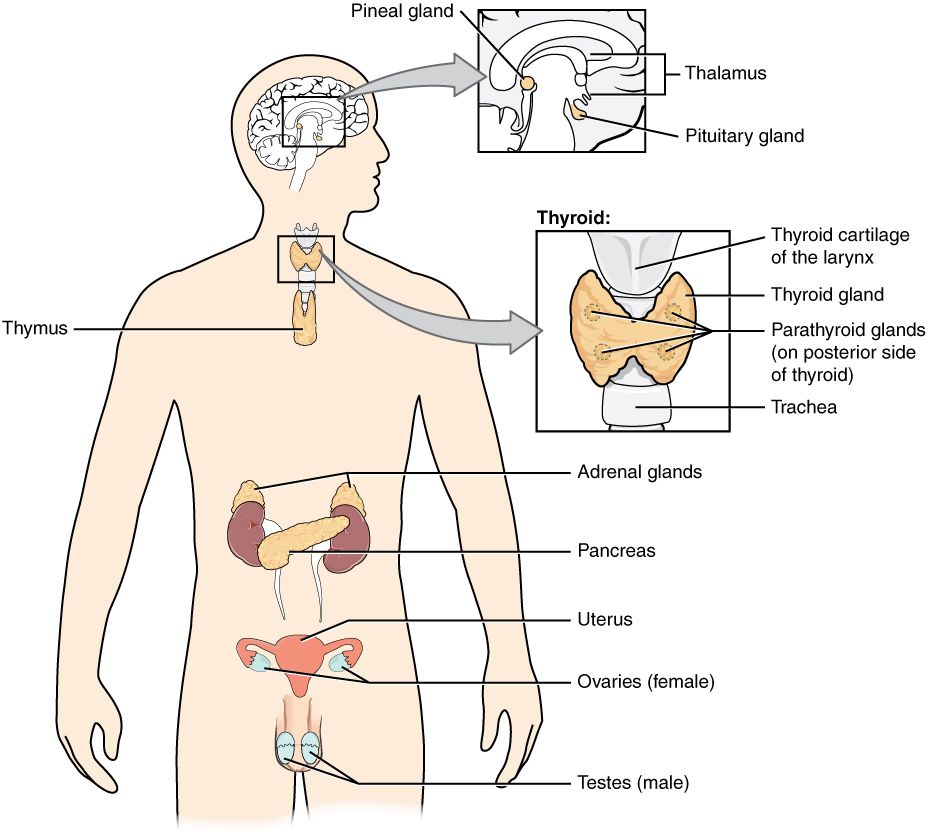
Glands and hormones
The nervous system is not the body's only message service. The endocrine system is a network of glands. These glands release chemical messengers called hormones straight into the bloodstream. The blood then carries them to organs far away. A neuron speaks privately to the one cell across its synapse. A gland broadcasts to the whole body at once. Any cell with the right receptor will answer.
The "master gland" is the pituitary. It is tucked under the brain, and it takes orders from the hypothalamus. This is the place where the nervous system and the endocrine system shake hands. The pituitary, in turn, directs the other glands.
| Gland | Key hormone(s) | Main effect |
|---|---|---|
| Pituitary | Growth hormone; hormones that signal other glands | The “master gland” directs other glands and controls growth |
| Thyroid | Thyroxine | Sets the body's energy use (metabolic rate) |
| Adrenal glands | Epinephrine (adrenaline), cortisol | Drive the stress response; arousal and energy |
| Pancreas | Insulin, glucagon | Keep blood sugar in balance |
| Gonads (ovaries and testes) | Estrogen, testosterone | Reproduction and sex characteristics |
| Pineal | Melatonin | Helps time sleep and the daily body clock |
Hormones versus nerve signals
Both systems use chemical messengers. Sometimes they even use close cousins. Epinephrine (adrenaline) travels in the blood as a hormone. Its close relative, norepinephrine, works as a neurotransmitter in the brain. But the two systems run on very different time scales, and that difference is the point.
Nerve signals are fast, precise, and brief. An action potential fires in about a thousandth of a second. It aims at one cell, and it is over almost as soon as it starts. Hormone signals are slow, spread out, and long-lasting. A hormone may take seconds to minutes to reach its target. It washes over the whole body, and its effects can last for hours. Think of how long it takes to calm down after a fright, long after the danger is gone. That lingering quality is why hormones shape mood and long-running states, rather than split-second reactions.
| Feature | Nerve signals | Hormone signals |
|---|---|---|
| Messenger | Neurotransmitter | Hormone |
| Route | Across a synapse to one cell | Through the bloodstream to the whole body |
| Speed | Milliseconds | Seconds to minutes |
| How long it lasts | Brief | Long-lasting |
| Precision | Targeted, private | Broadcast, spread out |
- The endocrine system is a network of glands that release hormones into the bloodstream.
- The hypothalamus and the pituitary gland link the nervous and endocrine systems and direct the other glands.
- Compared with nerve signals, hormones are slower, more spread out, and longer-lasting. They are the chemistry of mood and stress.
- Selye's work ties chronic stress and cortisol to real harm to health.
The chapter in one breath
- The neuron takes in signals at its dendrites, adds them up in its cell body, and sends them down its axon. Myelin speeds the signal.
- Crossing threshold sets off an all-or-none action potential. Na+ flows in to depolarize, and K+ flows out to repolarize.
- Signals cross the synapse as neurotransmitters. They bind to receptors and are then cleared by reuptake or by enzymes.
- Drugs act as agonists (boost a neurotransmitter) or antagonists (block it). SSRIs and antipsychotics work this way.
- The nervous system splits into central vs peripheral, somatic vs autonomic, and sympathetic (fight-or-flight) vs parasympathetic (rest-and-digest).
- The brain runs from the hindbrain and midbrain survival core up to the forebrain. Its cortex has four lobes: frontal, parietal, temporal, and occipital. The two hemispheres differ in some jobs but work as a team.
- The endocrine system signals with hormones through the blood. Hormones are slower, more spread out, and longer-lasting than nerve signals, and they drive the stress response.
ReferenceWords worth knowing
Here is a quick guide to the terms in this chapter. Skim it now, or come back any time a word trips you up.
- Action potential
- The quick, all-or-none electrical spike a neuron fires and sends down its axon.
- Agonist
- A drug or substance that increases a neurotransmitter's action. It may copy it, boost its release, or block its reuptake.
- Antagonist
- A drug or substance that blocks or reduces a neurotransmitter's action, often by sitting in its receptor.
- Autonomic nervous system
- The part of the peripheral system that runs automatic jobs like heartbeat and digestion. It has a sympathetic branch and a parasympathetic branch.
- Axon
- The one long fiber that carries a neuron's outgoing signal away from the cell body.
- Central nervous system (CNS)
- The brain and spinal cord, where information is combined and decisions are made.
- Cerebral cortex
- The wrinkled outer layer of the brain. It has two hemispheres and four lobes and handles higher mental jobs.
- Corpus callosum
- The thick bundle of fibers that connects the left and right hemispheres.
- Dendrite
- A branching fiber that takes in signals and carries them toward the cell body.
- Endocrine system
- The network of glands that release hormones into the bloodstream to signal organs far away.
- Glial cell
- A helper cell of the nervous system that makes myelin, feeds neurons, and protects them.
- Hormone
- A chemical messenger that a gland releases into the bloodstream.
- Lateralization
- The way some jobs lean more on one hemisphere than the other, such as language on the left for most people.
- Myelin sheath
- The fatty coating around many axons that speeds the signal. Its gaps are the nodes of Ranvier.
- Neuron
- The basic cell of the nervous system that handles information.
- Neurotransmitter
- A chemical released across a synapse to carry a signal to the next neuron.
- Parasympathetic nervous system
- The autonomic branch that calms the body and restores it: “rest-and-digest.”
- Peripheral nervous system (PNS)
- All the nerves outside the brain and spinal cord. They connect the CNS to the body.
- Plasticity
- The brain's ability to rewire itself after injury or with practice.
- Resting potential
- The neuron's charged, polarized resting state, about −70 mV inside compared with outside.
- Reuptake
- The sending neuron taking leftover neurotransmitter back in.
- Somatic nervous system
- The part of the peripheral system that carries sense information and controls the skeletal muscles you move on purpose.
- Sympathetic nervous system
- The autonomic branch that gets the body ready for action: “fight-or-flight.”
- Synapse
- The junction between two neurons, including the tiny gap (synaptic cleft) the signal crosses.
- Threshold
- The level of charge (about −55 mV) a neuron must reach to fire an action potential.
Check yourself
States of Consciousness
Right now you are aware. You are aware of these words and of the chair under you. You may now notice a background hum that you had tuned out until this sentence pointed to it. That awareness is consciousness. It is not one fixed thing. It shifts every day, from alert waking, to drowsiness, to sleep, to dreams. People also change it on purpose, with everything from coffee to anesthesia. This chapter follows consciousness across the twenty-four-hour day. You will meet the inner clock that drives it, the structure of a night's sleep, the strange world of dreams, the disorders that disrupt sleep, and the drugs that take over awareness. All of this matters because you spend about a third of your life asleep. What happens there shapes the memory, mood, and health of the two-thirds you spend awake.
By the end of this chapter you can
- Define consciousness and describe how awareness varies along a continuum.
- Explain what a biological rhythm is, and name the circadian rhythm as the body's daily clock.
- Describe how the suprachiasmatic nucleus, light, and melatonin control the sleep-wake cycle.
- Sum up the main theories of why we sleep.
- Tell the stages of NREM sleep from REM sleep by their brain waves, and describe how sleep cycles across a night.
- Compare theories of dreaming, including Freud's theory and the activation-synthesis hypothesis.
- Recognize the main sleep disorders: insomnia, sleep apnea, narcolepsy, and the parasomnias.
- Sort psychoactive drugs into depressants, stimulants, opioids, and hallucinogens, and explain tolerance and dependence.
Section 1What consciousness is
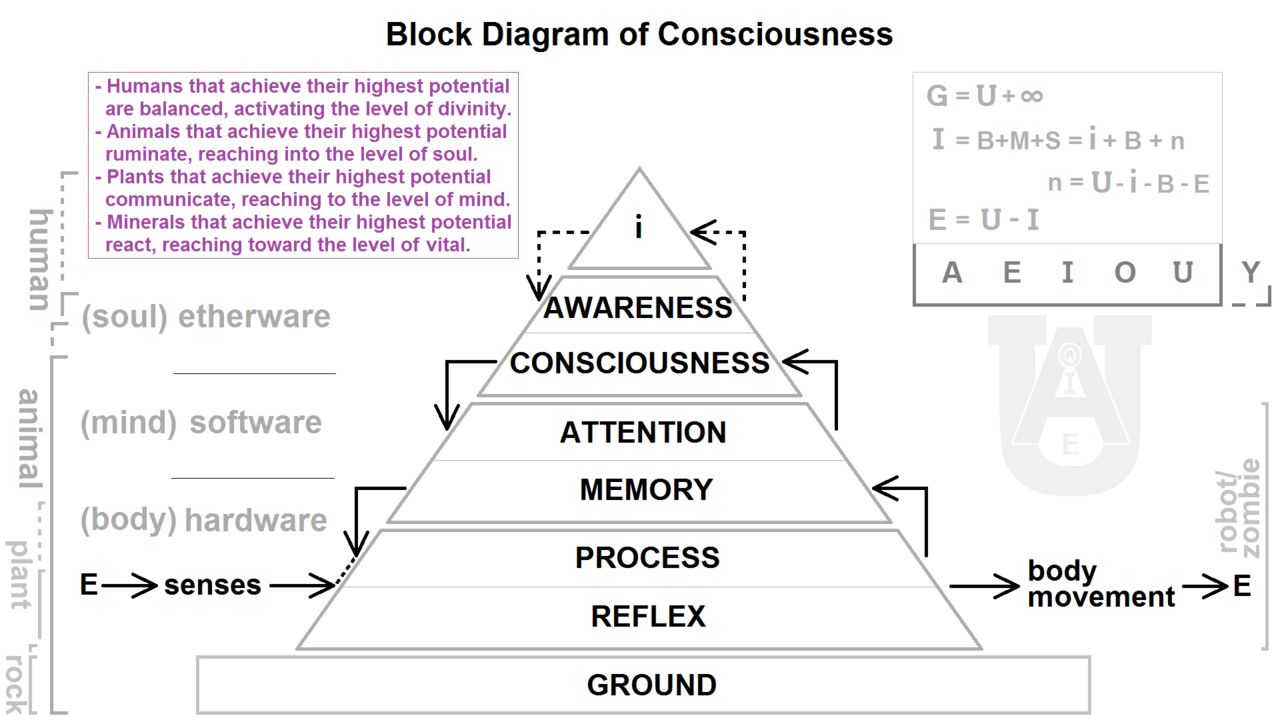
Awareness: the feature that defines consciousness
Psychologists define consciousness as your awareness of internal states and the external environment. The internal part includes your thoughts, your feelings, and body signals like hunger or pain. The external part includes everything your senses pick up from the world.
Consciousness is hard to study because it is private. No one else can directly see your experience. Yet it is the very thing psychology most wants to explain. In the early and middle 1900s, behaviorists set it aside because they could not test it. Today, tools like the EEG and brain scans let researchers link states of awareness to patterns of brain activity they can measure.
Consciousness is a continuum, not a switch
It is tempting to think you are simply "awake" or "unconscious." But awareness comes in shades. At one end is sharp, effortful attention. This is the controlled processing you use to learn a new skill. At the other end is automatic processing, a low-awareness autopilot. It lets an experienced driver get home while deep in talk, with almost no memory of the drive.
Sleep lowers awareness further, but it does not switch it off. Anesthesia or a coma lowers it further still. Even selective attention shows the limits of awareness. This is the "cocktail party" skill of following one voice in a noisy room. It shows that consciousness is a narrow spotlight, not a floodlight that takes in everything at once.
Biological rhythms: the body runs on clocks
Much of the daily rise and fall of awareness comes from biological rhythms. These are repeating cycles of body activity that are built into us. They are sorted by how long one cycle lasts.
- A circadian rhythm repeats about every twenty-four hours. It runs the sleep-wake cycle, body temperature, and the release of some hormones.
- An ultradian rhythm repeats more than once a day. The ninety-minute cycle inside a night's sleep is the classic example.
- An infradian rhythm lasts longer than a day. Examples are the menstrual cycle, which runs about twenty-eight days, and seasonal shifts in mood.
These clocks run whether or not you pay attention to them. That is why you get sleepy at about the same hour, even on a day with no plans.
| Rhythm | Cycle length | Examples in the body |
|---|---|---|
| Circadian | About 24 hours | Sleep-wake cycle, body temperature, cortisol and melatonin release, daily alertness |
| Ultradian | Shorter than 24 hours | The roughly 90-minute sleep cycle; cycles of hunger and focus across the day |
| Infradian | Longer than 24 hours | The menstrual cycle (about 28 days); seasonal patterns of mood and behavior |
- Consciousness is awareness of internal states and the external environment.
- Awareness is a continuum. It runs from controlled attention, through automatic processing and sleep, to anesthesia. It is not an on/off switch.
- Biological rhythms are built-in cycles: circadian (about 24 h), ultradian (less than 24 h), and infradian (more than 24 h).
- The circadian rhythm is the body's daily clock and the engine of the sleep-wake cycle.
Section 2Sleep and the circadian rhythm
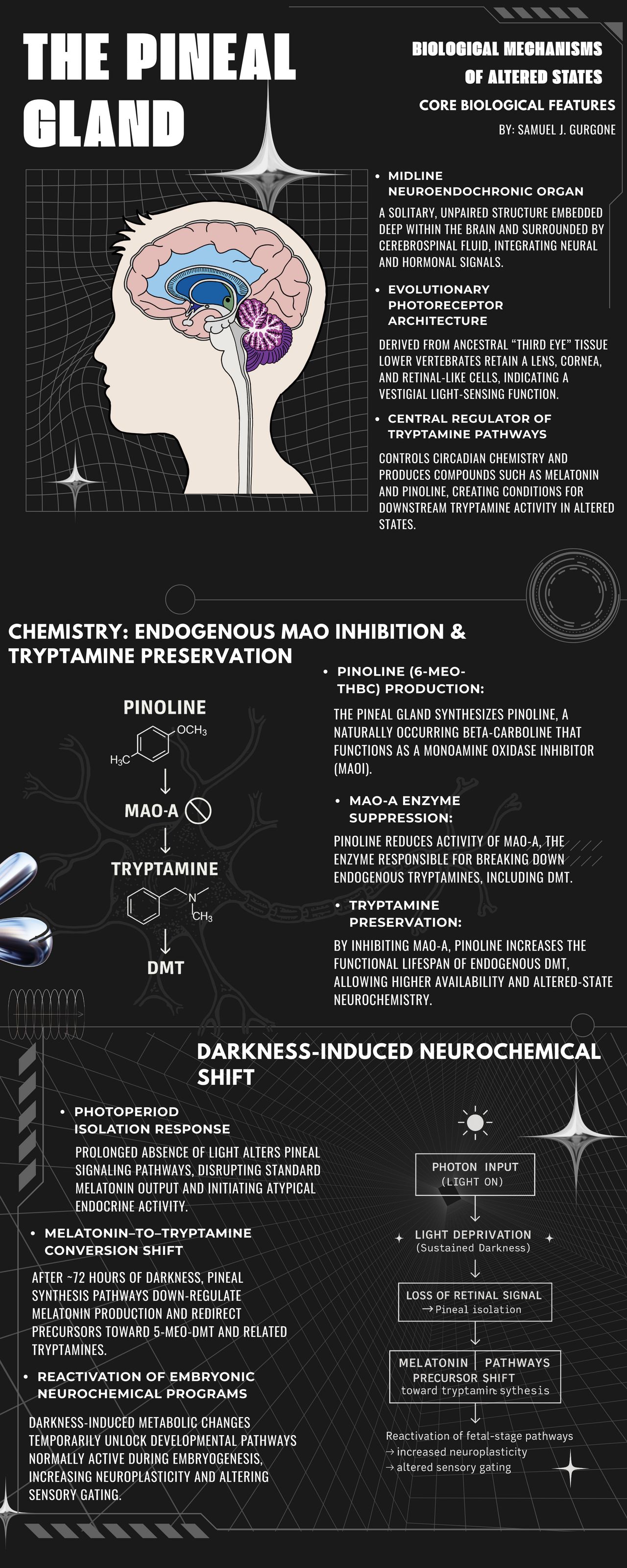
The sleep-wake cycle and the master clock
The body's twenty-four-hour clock is a real place in the brain. It is a small cluster of neurons called the suprachiasmatic nucleus (SCN). It sits in the hypothalamus, just above the spot where the two optic nerves cross. The SCN keeps its own beat of close to 24 hours, even in total darkness. But light keeps it in step with the outside world. Special cells in the retina report how bright it is straight to the SCN. The SCN then times the daily rise and fall of alertness, body temperature, and hormones.
Cues that reset this clock are called zeitgebers, which is German for "time-givers." Light is the main one. Meal times and activity help too. When you fly across time zones, your SCN is out of step with the local light for a while. The grogginess and broken sleep of jet lag is the clock catching up.
Melatonin: the darkness hormone
The SCN does much of its work through a small gland called the pineal gland. This gland releases the hormone melatonin. Melatonin is the body's chemical signal for "night." Its level climbs in the evening as light fades. It peaks in the small hours of the night and falls toward morning. It nudges you toward sleep and helps keep you there.
Light holds melatonin back. So the timing of light is powerful. Bright morning light moves the clock earlier and sharpens daytime alertness. Bright light late at night pushes the clock later and delays sleep. This is the reason behind one of the most common modern sleep complaints. It also explains why people use melatonin from the drugstore for jet lag and shift work.
Why do we sleep?
Sleep leaves an animal helpless for hours each day. If it were not doing something vital, evolution would likely have dropped it. Three theories explain the push to sleep. They fit together rather than compete.
- The restorative theory says sleep repairs the body and brain. Growth hormone is released and tissues rebuild. A cleaning system called the glymphatic pathway may also flush waste out of the brain, including proteins linked to brain disease. This cleaning idea comes from animal studies and is still being tested.
- The adaptive (evolutionary) theory says sleep evolved to save energy. It also keeps animals safely still during the hours when moving around would be dangerous.
- The memory-consolidation theory says sleep sorts, strengthens, and stores what you learned that day. That is why pulling an all-nighter before an exam so often backfires.
| Theory | Core idea | Supporting evidence |
|---|---|---|
| Restorative | Sleep repairs body and brain and may clear waste | Growth-hormone release and tissue repair peak in deep sleep; animal studies point to a glymphatic "wash-out" of waste |
| Adaptive / evolutionary | Sleep saves energy and keeps animals safe when activity is risky | The timing of a species' sleep tracks its way of life: predators, prey, and feeding schedules |
| Memory consolidation | Sleep sorts, strengthens, and stores the day's learning | People who sleep after studying remember more; both slow-wave and REM sleep help memory |
Sleep pressure: the second process
The clock is only half the story. The longer you stay awake, the more your brain builds up a chemical called adenosine. Adenosine creates sleep pressure, a growing need to sleep. Sleep clears it away again. Alexander Borbély described this as the two-process model of sleep (1982). Process S is sleep pressure. It climbs all day. Process C is the circadian clock. It sends a wake signal that is strongest in the evening. You fall asleep most easily when sleep pressure is high and the clock's wake signal fades.
This model also explains caffeine. Caffeine is an adenosine antagonist. It blocks adenosine receptors, so you do not feel the pressure for a while. The adenosine is still there, though. When the caffeine wears off, the pressure comes back.
- The suprachiasmatic nucleus (SCN) in the hypothalamus is the master circadian clock. Light resets it every day.
- The pineal gland releases melatonin in darkness to promote sleep. Light holds it back.
- Jet lag, shift work, and late-night screens put sleep out of step with the day.
- We sleep for restoration, adaptive safety and energy saving, and memory consolidation. Sleep timing comes from sleep pressure (adenosine) plus the circadian clock.
Section 3The stages of sleep
Reading sleep with the EEG
From the outside, sleep looks like nothing is happening. But an electroencephalogram (EEG) tells a different story. The EEG uses small sensors on the scalp to record the combined electrical activity of the cortex. It shows a night full of big, orderly changes.
When you are awake and alert, the EEG shows fast, small, jagged beta waves. When you close your eyes and relax, these turn into slower, more even alpha waves. From there the brain moves down through clear stages. Each stage has its own wave pattern. A turning point came in 1953. Eugene Aserinsky and Nathaniel Kleitman noticed times when a sleeper's eyes darted quickly under closed lids. This was the discovery of REM sleep. It overturned the old idea that sleep is one single, even state.
The four stages: N1, N2, N3, and REM
Sleep is divided into non-REM (NREM) stages and REM.
- N1 is light, drifting sleep. It is the doorway into sleep, marked by theta waves. Here you may feel like you are falling, or your body may give a sudden twitch called a hypnic jerk. If someone wakes you, you might insist you were not asleep.
- N2 is true sleep. It takes up about half the night. Its EEG shows quick bursts called sleep spindles and sharp, single waves called K-complexes. These are thought to help protect sleep and store memories.
- N3 is deep slow-wave sleep. Large, slow delta waves fill it. It is the hardest stage to wake from. It is also the stage most tied to repairing the body.
- REM is a puzzle. The brain waves look almost awake. The eyes move quickly, and vivid dreams unfold. Yet the body's major muscles are paralyzed. This safety state is called atonia. Because the mind is active while the body is switched off, REM is often called paradoxical sleep.
How sleep cycles across the night
You do not climb through these stages once and stop. A full cycle goes roughly N1, then N2, then N3, then back up through N2, and then into REM. One cycle takes about ninety minutes. You repeat it four to six times a night.
The mix changes as the night goes on. The early cycles are rich in deep N3 slow-wave sleep. That is why the first hours feel so restoring. The later cycles trade deep sleep for longer and longer REM periods. So most of your slow-wave sleep comes in the first one or two cycles after you fall asleep. What counts is the time since you fell asleep, not the time on the clock. Most of your dreaming happens in the hours before you wake. That is why a night cut short takes away mostly REM.
| Stage | Main EEG waves | What is happening |
|---|---|---|
| Awake, alert | Beta | Eyes open, active thinking and attention |
| Drowsy, relaxed | Alpha | Eyes closed, calm, on the edge of sleep |
| N1 (NREM) | Theta | Light sleep; hypnic jerks and drifting images; easy to wake |
| N2 (NREM) | Theta with sleep spindles and K-complexes | True sleep; heart rate and temperature fall; about half the night |
| N3 (NREM) | Delta (slow waves) | Deep slow-wave sleep; hardest to wake; body repair |
| REM | Small, fast, wake-like | Vivid dreams, darting eyes, muscle atonia; "paradoxical" sleep |
- The EEG defines sleep by the shape of brain waves: beta (awake), alpha (drowsy), theta (N1), spindles and K-complexes (N2), and delta (N3).
- Aserinsky and Kleitman discovered REM sleep in 1953. It showed that sleep is not one even state.
- REM is "paradoxical." The brain looks awake and dreams are vivid, but the body is paralyzed (atonia).
- A cycle lasts about 90 minutes. The early night favors deep N3. The later night favors longer REM.
Section 4Dreams and sleep disorders

Theories of dreaming
Everyone dreams several times a night, whether or not they remember it. Yet why the brain makes dreams is still debated.
Sigmund Freud offered the first major theory in The Interpretation of Dreams (1900). He said dreams are hidden wish fulfillment. He split a dream into two layers. The manifest content is the storyline you remember. The latent content is the hidden wish he believed the story stood for. Research has found little support for Freud's details. Still, his framework shaped a century of thinking.
A modern rival puts biology first. It is the activation-synthesis hypothesis of J. Allan Hobson and Robert McCarley (1977). During REM, the brainstem fires signals more or less at random. The cortex is always trying to make sense of things, so it weaves those signals into a story. In this view, dreams are the mind's way of explaining its own noise.
A third view is the information-processing view, also called the continuity view. It treats dreaming as part of memory consolidation. Dreams replay and sort the worries and events of waking life.
Insomnia, apnea, and narcolepsy
Sleep goes wrong for tens of millions of people. The disorders work in very different ways. The DSM-5-TR is the manual clinicians use to name these conditions, and its names appear below.
Insomnia is the most common complaint. It means ongoing trouble falling asleep or staying asleep, even with a full chance to sleep. The DSM-5-TR calls it insomnia disorder when it lasts at least three nights a week for three months. The first treatment to try is not a pill. It is cognitive behavioral therapy for insomnia (CBT-I), along with better sleep habits.
Sleep apnea is a breathing disorder. In the common obstructive form, the airway keeps collapsing during sleep. The sleeper stops breathing for seconds at a time. Then they jolt partway awake to gasp. They never reach restful deep sleep. The signs are loud snoring and crushing daytime tiredness. It is often treated with a CPAP machine, which gently blows air to hold the airway open.
Narcolepsy is rarer. It brings sudden, overpowering sleep attacks in the middle of the day. Many people with it also have cataplexy. This is a sudden loss of muscle tone set off by strong emotion, such as laughing. In the type with cataplexy, called narcolepsy type 1, the cause is the loss of brain cells that make a wake-promoting chemical called hypocretin (also called orexin).
Parasomnias: acting out of sleep
The parasomnias are unusual behaviors that break into sleep. Sleepwalking (somnambulism) and night terrors come from deep N3 slow-wave sleep, not from dreams. The DSM-5-TR groups them as NREM sleep arousal disorders. They cluster in the first third of the night. They are far more common in children, who get more N3.
In REM sleep behavior disorder, the normal REM paralysis fails. The sleeper acts out dreams with their body, sometimes forcefully. Sleep paralysis is the mirror image. The mind wakes up while REM atonia lingers. For a short time the person cannot move, and they may see or sense frightening things. Ordinary nightmares are different again. They are simply upsetting dreams that happen during REM.
| Disorder | Main feature | Notes |
|---|---|---|
| Insomnia | Ongoing trouble falling or staying asleep | The most common complaint; treated with better sleep habits and CBT-I |
| Sleep apnea | Repeated pauses in breathing during sleep | Loud snoring, gasping, daytime tiredness; obstructive form treated with CPAP |
| Narcolepsy | Sudden, uncontrollable sleep attacks | Often with cataplexy; type 1 is linked to loss of hypocretin (orexin) cells |
| Parasomnias | Unusual events during sleep | Sleepwalking and night terrors come from N3; REM sleep behavior disorder means acting out dreams |
- Freud saw dreams as wish fulfillment (manifest vs latent content). The activation-synthesis hypothesis (Hobson and McCarley) sees them as the cortex explaining random REM signals.
- Insomnia is trouble sleeping. The first care to try is CBT-I, not medication.
- Sleep apnea means breathing pauses (treated with CPAP). Narcolepsy means sleep attacks, often with cataplexy (type 1 involves hypocretin loss).
- Parasomnias such as sleepwalking and night terrors happen in deep N3, not in REM.
Section 5Psychoactive drugs
How drugs reach the mind
A psychoactive drug is any chemical that changes perception, mood, thinking, or behavior. It does this by changing activity at the synapse. It may copy a neurotransmitter or block its receptor. It may also change how much of it is released or taken back up. You met these moves in Chapter 3 as agonists and antagonists.
Many misused drugs hit one target: the brain's reward pathway. This is a dopamine circuit that runs from the ventral tegmental area to the nucleus accumbens. Normally it rewards survival behaviors like eating. Drugs flood this circuit with dopamine. That teaches the brain to want the drug again. This is the brain basis of craving. Psychoactive drugs fall into four broad families, based on what they do to the central nervous system.
The four families: depressants, stimulants, opioids, hallucinogens
- Depressants slow the central nervous system. They do this largely by boosting GABA, the brain's main calming messenger. Alcohol, barbiturates, and benzodiazepines belong here. In small doses they relax people and ease anxiety. But they harm coordination and judgment. In overdose, they can slow breathing until it stops.
- Stimulants do the opposite. They speed up the nervous system and raise dopamine and norepinephrine. Caffeine, nicotine, cocaine, amphetamines, and MDMA belong here. They bring alertness and a rush of good feeling, along with a racing heart and often a hard crash. (Caffeine works a little differently: it blocks adenosine, as you saw above.)
- Opioids include morphine, codeine, heroin, oxycodone, and the very strong drug fentanyl. They bind to the same receptors as the body's own endorphins. They give powerful pain relief and good feelings. They also slow breathing in a dangerous way.
- Hallucinogens include LSD, psilocybin, and mescaline. They change perception and the senses. Sometimes they bring vivid images or a feeling that reality has shifted. LSD works mainly by acting on serotonin receptors.
Some drugs do not fit neatly in one family. Cannabis, for example, mixes mild changes in perception with relaxation. Its main chemical, THC, acts on the brain's own cannabinoid receptors.
Tolerance, dependence, and addiction
Using a drug again and again changes the brain. Tolerance means the same dose has less effect over time. The nervous system adapts, so a person needs more to get the first effect. This slide can push people toward dangerous amounts.
Dependence comes in two forms. Physical dependence means the body has adjusted to the drug. When the drug stops, a withdrawal syndrome appears, and it can be severe. Withdrawal often feels like the opposite of the drug's effect. Psychological dependence is the emotional pull. It is the craving and the drive to seek the drug, and it can last long after the body is clear.
When drug use becomes compulsive and goes on despite clear harm, clinicians call it a substance use disorder. This is the DSM-5-TR term for what people often call addiction. Today it is understood as a long-lasting brain condition that can be treated, not a simple lack of willpower. Tolerance and withdrawal alone do not mean a person has this disorder. Someone taking a pain medicine exactly as prescribed may have both and still not have a substance use disorder.
| Family | Examples | Effect on the nervous system |
|---|---|---|
| Depressants | Alcohol, barbiturates, benzodiazepines | Slow the CNS (boost GABA); relaxation, sleepiness, poor coordination; overdose can stop breathing |
| Stimulants | Caffeine, nicotine, cocaine, amphetamines, MDMA | Speed the CNS (raise dopamine and norepinephrine); alertness, euphoria, faster heart rate, crash |
| Opioids | Morphine, codeine, heroin, oxycodone, fentanyl | Bind endorphin receptors; strong pain relief and euphoria; dangerous slowing of breathing |
| Hallucinogens | LSD, psilocybin, mescaline, PCP | Change perception and the senses; LSD acts on serotonin receptors |
- A psychoactive drug changes mood, perception, or awareness by changing activity at the synapse. Many take over the dopamine reward pathway.
- The four families are depressants (slow the CNS), stimulants (speed the CNS), opioids (act on endorphin receptors), and hallucinogens (change perception).
- Tolerance means needing more for the same effect. Dependence means physical withdrawal plus psychological craving.
- Mixing depressants (such as opioids and alcohol) adds up the slowing of breathing. Naloxone reverses opioid overdose.
The chapter in one breath
- Consciousness is awareness of what is inside you and around you. It runs along a continuum from focused attention, to automatic processing, to sleep.
- Biological rhythms (circadian, about 24 h; ultradian; infradian) drive the daily rise and fall of alertness and sleep.
- The SCN in the hypothalamus is the master clock, reset by light. It drives melatonin release from the pineal gland to time sleep. Sleep pressure from adenosine builds while you are awake.
- We sleep for restoration, evolutionary safety, and memory consolidation.
- Sleep moves through NREM stages N1 to N3 and REM, each defined by EEG waves. Cycles last about 90 minutes, with deep sleep early and REM late.
- Dreams are explained by Freud's wish fulfillment and by the activation-synthesis hypothesis. Sleep disorders include insomnia, apnea, narcolepsy, and the parasomnias.
- Psychoactive drugs (depressants, stimulants, opioids, hallucinogens) change the brain and can lead to tolerance and dependence.
ReferenceWords worth knowing
Here is a quick guide to the terms in this chapter. Skim it now, or come back any time a word trips you up.
- Activation-synthesis hypothesis
- The theory that dreams are the cortex trying to make sense of random signals fired by the brainstem during REM sleep.
- Adenosine
- A chemical that builds up in the brain while you are awake and creates sleep pressure. Caffeine blocks its receptors.
- Cataplexy
- A sudden loss of muscle tone, often set off by strong emotion. It is a key sign of narcolepsy type 1.
- Circadian rhythm
- A body cycle of about 24 hours, such as the sleep-wake cycle, run by the body's inner clock.
- Consciousness
- Awareness of internal states and of the external environment.
- Dependence
- A state in which the body or mind has adapted to a drug. Stopping it brings withdrawal (physical) or craving (psychological).
- Depressant
- A drug that slows the central nervous system, such as alcohol or a benzodiazepine.
- Hallucinogen
- A drug that changes perception and the senses, such as LSD or psilocybin.
- Insomnia
- Ongoing trouble falling asleep or staying asleep, even with a full chance to sleep.
- Latent content
- In Freud's theory, the hidden meaning beneath a dream's storyline.
- Manifest content
- In Freud's theory, the storyline of a dream as you remember it.
- Melatonin
- A hormone the pineal gland releases in darkness that makes you sleepy.
- Narcolepsy
- A disorder of sudden, uncontrollable sleep attacks, often with cataplexy.
- NREM sleep
- Non-rapid-eye-movement sleep. It includes stages N1, N2, and N3.
- Opioid
- A drug that binds the body's endorphin receptors to relieve pain and cause euphoria, such as morphine or heroin.
- Parasomnia
- An unusual behavior or event during sleep, such as sleepwalking or night terrors.
- Psychoactive drug
- A chemical that changes perception, mood, or awareness by changing brain chemistry.
- REM sleep
- Rapid-eye-movement sleep. It has wake-like brain waves, vivid dreams, and muscle paralysis (atonia).
- Sleep apnea
- A disorder in which breathing stops and starts again and again during sleep.
- Stimulant
- A drug that speeds up the central nervous system, such as caffeine or cocaine.
- Suprachiasmatic nucleus (SCN)
- A small part of the hypothalamus that serves as the body's master circadian clock.
- Tolerance
- A smaller response to a drug over time, so a larger dose is needed for the same effect.
- Two-process model
- Borbély's model of sleep timing: sleep pressure (Process S) and the circadian clock (Process C) work together.
- Withdrawal
- Unpleasant physical and mental symptoms that appear when a dependent person stops using a drug.
Check yourself
Sensation & Perception
Right now, light is bouncing off this page and into your eyes. Air is pushing in tiny waves against your eardrums. Your clothes are pressing on your skin. Yet you do not feel a storm of raw data. You feel a calm, smooth world. This chapter is about the gap between those two things. Sensation is how your senses pick up the world and turn it into nerve signals. Perception is how your brain sorts those signals and gives them meaning. It turns them into objects, faces, songs, and ideas. We will start with the rules that every sense follows. Then we will look at vision and hearing. Next come taste, smell, touch, pain, and balance. We will end with the clever ways your brain puts it all together, and the ways it can be fooled.
By the end of this chapter you can
- Tell sensation from perception, and bottom-up from top-down processing.
- Explain transduction and say where it happens in each sense.
- Define the absolute threshold and the difference threshold, and state Weber's law.
- Sum up signal detection theory and what it adds to the idea of a fixed threshold.
- Follow light through the eye, and compare the trichromatic and opponent-process theories of color.
- Describe how the ear turns sound into signals, and how we hear pitch and loudness.
- Explain taste, smell, touch, pain (gate-control theory), and the senses of body position.
- State the Gestalt principles, and explain depth perception and perceptual constancy.
Section 1Sensation versus perception
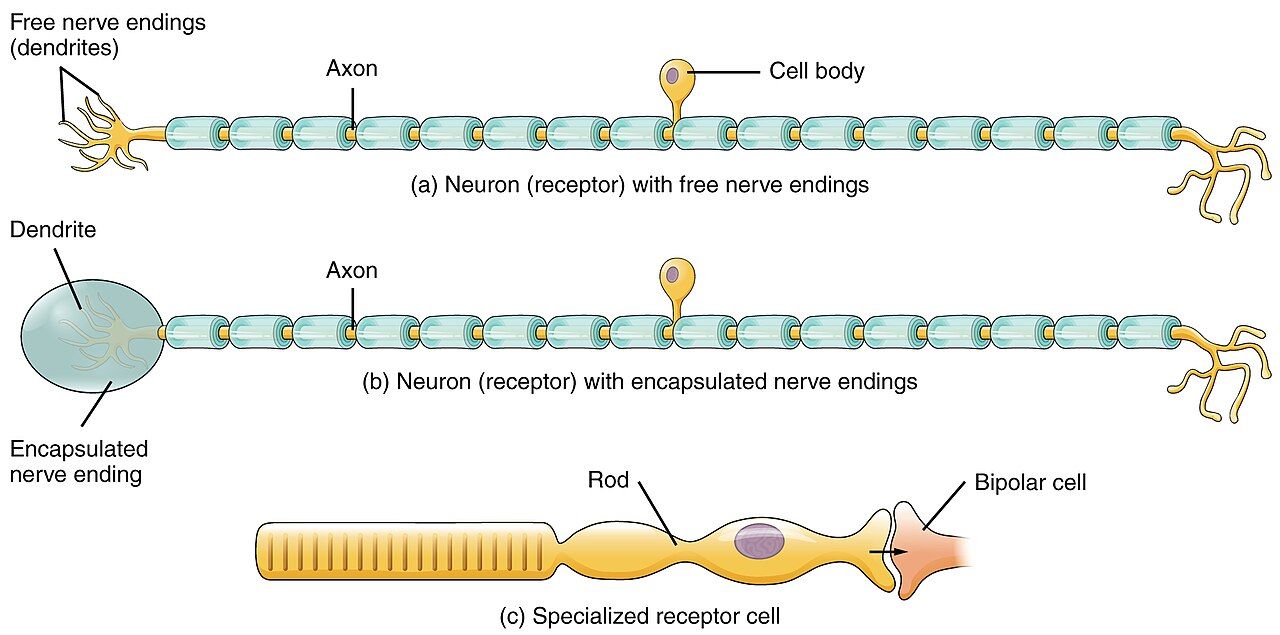
Two steps, one smooth experience
Psychologists split each moment of experience into two steps, even though the two steps feel like one. Sensation is the first step. Your sense organs pick up energy from the world around you, such as light waves, sound waves, molecules, pressure, or heat, and turn it into nerve signals. Perception is the next step. The brain picks out, sorts, and makes sense of those signals. A scatter of signals becomes your grandmother's face, or the first notes of a song you love. Two people can sense the very same thing in the same way, yet perceive it very differently. That is why it helps to keep sensation and perception apart.
The two steps match two ways that information can flow. Bottom-up processing starts with the raw signal at the sense receptors. It builds up from small pieces to a whole picture, which is how you make sense of something brand new. Top-down processing runs the other way. Your hopes, past knowledge, and the setting around you shape what you perceive. It lets you read messy handwriting and hear a mumbled word in a loud room. Almost all perception mixes the two. So your brain is not like a camera that records the world. It is more like a scientist who makes fast, smart guesses about what is out there.
Transduction: turning energy into signals
Every sense faces the same problem: the brain only understands electrical and chemical signals. But the world arrives as light, shaking air, and chemicals. The answer is transduction. Transduction means changing one kind of energy into nerve signals the body can use. Special cells called sensory receptors do this job. For example, photoreceptors in the eye turn light into signals. Hair cells in the ear turn shaking, or vibration, into signals. Receptors in the skin turn pressure and temperature into signals. Transduction is the border crossing between the physical world and the mind, and it is the first step in every chain of events that ends in something you notice.
The limits of the senses: thresholds and signal detection
Our senses are very keen, but they have limits. Psychophysics is the study of how physical energy relates to what we sense. Its founder, Gustav Fechner, gave us the words for those limits. The absolute threshold is the weakest level of a stimulus you can detect half the time. A stimulus is anything your senses can pick up. A classic example of the threshold is a single candle flame about thirty miles away on a clear, dark night. The difference threshold is the smallest change between two stimuli you can detect half the time. It is also called the just noticeable difference (JND). Ernst Weber found that this change is not a set amount. It is a set fraction of the starting stimulus. This rule is Weber's law. Add one pound to a two-pound bag, and you notice it right away, but add the same pound to a hundred-pound load, and you cannot tell.
| Idea | What it measures | Everyday example |
|---|---|---|
| Absolute threshold | The weakest stimulus you can detect 50% of the time | A candle flame about 30 miles away on a dark night |
| Difference threshold (JND) | The smallest change you can detect between two stimuli | Noticing a screen just got brighter |
| Weber's law | The JND is a set fraction of the stimulus | Add 1 lb: easy to feel on 2 lb, lost on 100 lb |
| Subliminal stimulus | A stimulus below the absolute threshold | A word flashed too fast to see on purpose |
| Sensory adaptation | A sense fades when a stimulus stays the same | Not feeling your clothes after a few minutes |
A stimulus below the absolute threshold is called subliminal. Lab studies show that subliminal words or pictures can nudge us a little, for a short time. But the effects are small. There is no good proof that hidden messages in ads can make people buy things they did not already want. Sensory adaptation is a different idea. When a stimulus stays the same, your senses slowly stop reacting to it. That is why you stop feeling your watch on your wrist.
The word "threshold" sounds like a sharp on and off line. But real detection is rarely that clean. Signal detection theory gives a more real picture. Picture a weak signal buried in background noise. Whether you catch it depends on two things. One is how keen your senses are. The other is your decision criterion. That is how ready you are to say, "Yes, I noticed it." Your criterion shifts with what you expect, what you want, how tired you are, and what a mistake would cost. The theory sorts every choice into four outcomes. A hit means the signal was there and you said yes. A miss means it was there and you said no. A false alarm means it was not there and you said yes. A correct rejection means it was not there and you said no. This explains why a worried new parent may hear a baby cry that never happened. It also explains why a skilled radiologist and a beginner can look at the same scan and reach different answers.
- Sensation picks up and codes stimuli. Perception sorts them and gives them meaning.
- Bottom-up processing builds from the raw signal. Top-down processing uses what you expect and the setting.
- Transduction changes physical energy into nerve signals at the sensory receptors.
- Absolute and difference thresholds, Weber's law, and signal detection theory describe the limits and biases of noticing things.
Section 2Vision
The eye: a camera made of living tissue
Vision begins with light. Light is one small slice of a wide band of energy called the electromagnetic spectrum. The wavelength of light, or the distance between its waves, sets the color, or hue, we see. Its intensity, or strength, sets how bright it looks. Light first hits the cornea, the clear front surface of the eye, which does most of the focusing. Next, light passes through the pupil, an opening that can get bigger or smaller. The colored muscle around it, the iris, controls its size. Behind the pupil sits the lens, which fine-tunes the focus by changing its shape. This is called accommodation. The lens casts a small, upside-down image onto the retina, a thin layer that lines the back of the eye.
The retina is where biology takes over from optics. Its photoreceptors catch the light and pass their signals to a layer of bipolar cells, which pass them on to ganglion cells. The long fibers of the ganglion cells bundle together into the optic nerve. The optic nerve carries the signals out of the eye to the brain. The spot where this nerve leaves has no receptors at all, and it is called the blind spot. Yet you never notice the hole, because your brain quietly fills it in. Your sharpest vision comes from the fovea. This is a small pit in the center of the retina, packed with receptors that pick up fine detail.
How light becomes a signal
Two kinds of photoreceptor handle transduction in the eye. They are named for their shapes. Rods number about 120 million, and they are spread around the edges of the retina. Rods are very sensitive, so they let you see in dim light, but only in shades of gray. Cones number about six million, and most of them are packed into the fovea. Cones need brighter light, but in return they give you sharp detail and color. Both kinds hold light-sensitive chemicals called photopigments. When light strikes them, these chemicals change shape. That change is the spark that starts the nerve signal. This split in jobs explains a night-sky trick. A faint star is easier to see if you look a little to one side of it. That puts its light on the rod-rich edges of your retina.
| Feature | Rods | Cones |
|---|---|---|
| Number | About 120 million | About 6 million |
| Location | Edges of the retina | Packed in the fovea |
| Light needed | Very little: work in dim light | Bright light |
| Color? | No: grays only | Yes: full color |
| Best for | Night vision and side vision | Daylight, color, fine detail |
Color vision: two theories, both true
How can three kinds of cone give us millions of colors? The trichromatic theory gives part of the answer. Thomas Young proposed it, and Hermann von Helmholtz improved it. It says the retina has three types of cone. One type responds most to short wavelengths (blue). One responds most to medium wavelengths (green). One responds most to long wavelengths (red). The brain reads the balance of activity across the three as a certain color. This explains most color mixing. It also explains red-green color blindness, which happens when one cone type is missing or does not work well. But the theory cannot explain one odd fact. Stare at a green square, then look at a white wall. You will see a red afterimage.
Ewald Hering's opponent-process theory fills in the missing piece. It says that, farther along the path to the brain, color is handled in opposing pairs. The pairs are red versus green, blue versus yellow, and black versus white. A cell that fires for green is held back by red. That is why you can never see a "reddish green." When the green side gets tired, its red partner bounces back. That bounce is the afterimage. Today, scientists agree both theories are right. They just work at different stages. The trichromatic theory describes the cones. The opponent-process theory describes the cells after them.
- The cornea and lens focus light onto the retina. Signals leave through the optic nerve, which makes a blind spot.
- Rods handle dim light and side vision. Cones handle color and fine detail, and cluster in the fovea.
- Trichromatic theory explains color at the cones. Opponent-process theory explains afterimages farther along the path.
Section 3Hearing
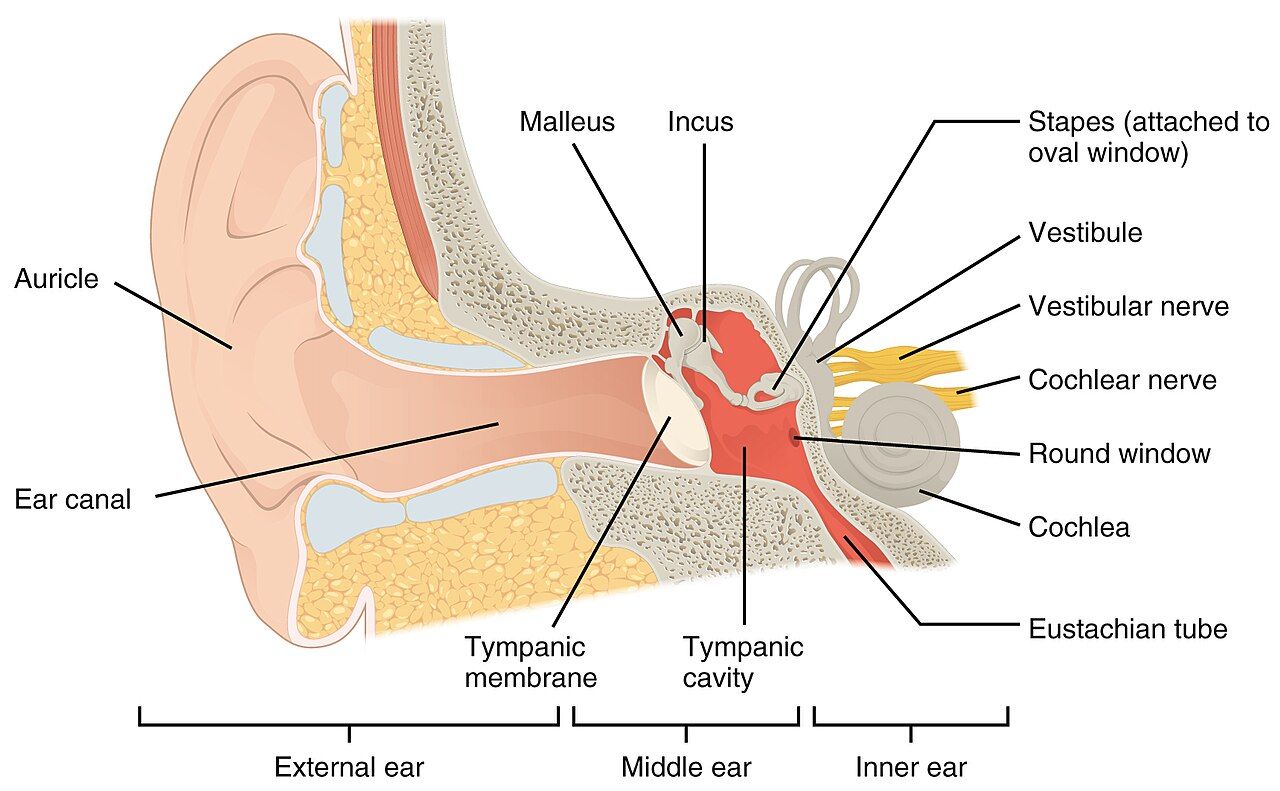
From pressure waves to vibration
Sound is just waves of pressure moving through the air. Two features of those waves become two parts of what we hear. The first is frequency. That is how many waves pass each second. It is measured in hertz (Hz), and we hear it as pitch. The second is amplitude. That is the height of the waves. It is measured in decibels (dB), and we hear it as loudness. Young human ears can pick up sounds from about 20 to 20,000 Hz. The ear's job is to catch these faint waves and turn them into nerve signals. It does this in a neat chain of steps.
First comes the outer ear. The flap you can see, called the pinna, funnels sound down the ear canal to the eardrum. The eardrum shakes, or vibrates. Next comes the middle ear, which is filled with air and holds three tiny bones. They are the hammer, anvil, and stirrup, also called the malleus, incus, and stapes. They work like levers that make the vibration stronger and pass it to the inner ear, which is filled with fluid. There, a coiled tube called the cochlea carries the vibration as a wave. The wave rolls along the basilar membrane, which is lined with hair cells. When the membrane ripples, the hair cells bend, and that bending is the moment of transduction, when motion becomes a nerve signal. The signal travels along the auditory nerve to the brain.
How we hear pitch and loudness
Loudness is fairly easy to explain. Louder sounds bend more hair cells and make them fire faster. The brain reads more nerve activity as more volume. Pitch took two rival theories to explain. In the end, the two worked as partners. Place theory came from Helmholtz. It says the brain reads pitch from where the basilar membrane shakes the most. High sounds shake it most near the base, close to the oval window. Low sounds shake it most near the far tip, called the apex. Place theory explains high pitches very well, but it struggles with low ones. For low sounds, the shaking spreads too wide to pin down one spot.
Frequency theory, also called temporal theory, fills that gap. It says the auditory nerve fires at the same rate as the sound wave. So a 100 Hz tone makes the nerve fire 100 times per second. This works well for low pitches, but it fails for high ones. A single neuron cannot fire much faster than about 1,000 times per second. Ernest Wever described the volley principle to solve this. Teams of neurons take turns firing, one after another, so their combined "volley" can match sounds far faster than any one cell could. So the brain uses place for high pitches and frequency for low pitches. In the middle range, it uses both.
| Theory | How pitch is coded | Best explains |
|---|---|---|
| Place theory | Where the basilar membrane shakes the most | High-frequency (high-pitched) sounds |
| Frequency theory | Nerve firing rate matches the sound's frequency | Low-frequency (low-pitched) sounds |
| Volley principle | Groups of neurons take turns firing in fast volleys | Middle frequencies, above one neuron's limit |
- We hear frequency as pitch and amplitude as loudness.
- The outer ear gathers sound, the middle-ear bones make it stronger, and hair cells in the cochlea turn it into signals.
- Place theory explains high pitches, frequency theory explains low pitches, and the volley principle covers the middle.
Section 4The other senses
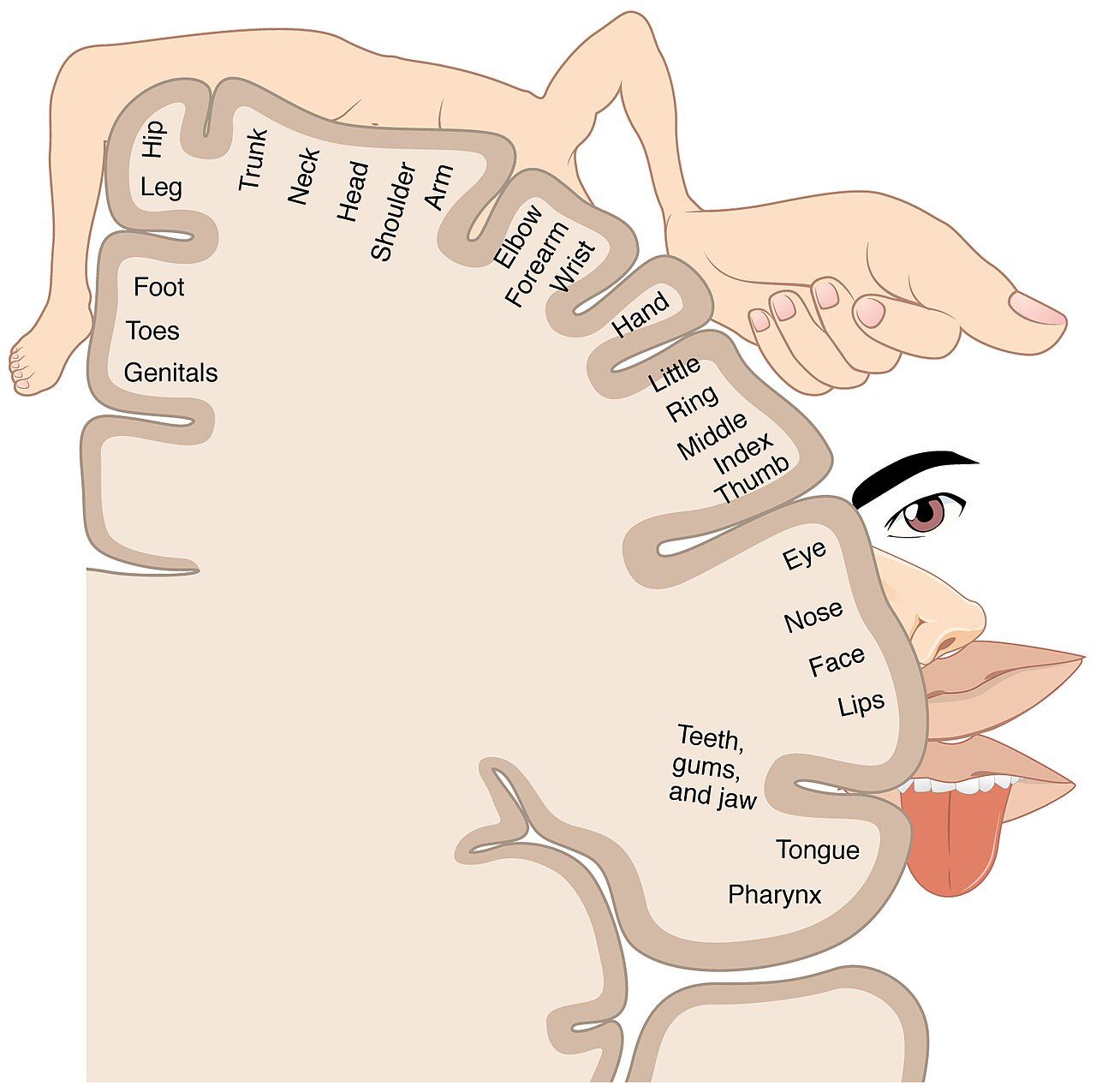
The chemical senses: taste and smell
Taste is also called gustation. It begins when chemicals dissolved in saliva reach the taste buds. Taste buds sit in the small bumps on your tongue and in your mouth. There are five basic tastes: sweet, sour, salty, bitter, and a savory taste called umami. Taste bud cells replace themselves about every ten days. Smell, also called olfaction, works on molecules floating in the air. These molecules reach receptor neurons high up inside the nose. Humans have about 400 types of smell receptor. Different mixes of these receptors let us tell apart a huge range of odors. Smell has a special route in the brain. Its signals go to the olfactory bulb. From there, they go on to the limbic system, the brain's center for emotion and memory. They do this without first stopping at the thalamus, the relay station that other senses pass through. That is why one scent can bring back a childhood memory so strongly. What we call "flavor" is mostly taste and smell working together. Anyone who has eaten dinner with a head cold knows this.
The skin senses and pain
The skin reports four basic feelings: pressure, warmth, cold, and pain. Its receptors are spread unevenly across the body, which is why your fingertips and lips are far more sensitive than your back. Pain needs a closer look, because it is not a simple measure of injury. Ronald Melzack and Patrick Wall proposed the gate-control theory of pain. It says the spinal cord has a kind of nerve "gate." The gate can block pain signals or let them through to the brain. Signals from large nerve fibers carry harmless touch, like the rubbing you give a bumped shin. These signals switch on cells in the spinal cord that help close the gate. Messages from the brain matter too. Attention, worry, and what you expect can swing the gate open or shut. That is why a soldier may not notice a wound during battle. It is also why the same injury can hurt more at 3 a.m. than at noon.
Knowing where your body is
Two senses you rarely think about keep you upright and steady. Kinesthesia is also called proprioception. It uses receptors in your muscles, tendons, and joints. These track where your body parts are and how they move. It is how you can touch your nose with your eyes closed. The vestibular sense tracks balance and the position of your head. It uses the fluid-filled semicircular canals and the otolith organs of the inner ear. When you spin and stop, that fluid keeps sloshing, and you feel dizzy. On a rocking boat, your inner ear and your eyes disagree, and you can feel motion sick.
| Sense | Also called | Where it lives | Stimulus |
|---|---|---|---|
| Taste | Gustation | Taste buds on the tongue and in the mouth | Dissolved chemicals |
| Smell | Olfaction | Receptor neurons high in the nose | Molecules in the air |
| Touch | Somatosensation | Receptors throughout the skin | Pressure, warmth, cold |
| Pain | Nociception | Nociceptors (pain receptors) across the body | Things that can damage tissue |
| Body position | Kinesthesia and vestibular sense | Muscles and joints; inner-ear canals | Movement, position, gravity |
- Taste (five basic tastes) and smell are chemical senses. Smell goes straight to the limbic system, which ties odors to memory.
- The skin senses pressure, warmth, cold, and pain. Gate-control theory explains why pain can be blocked or made worse.
- Kinesthesia tracks where your limbs are. The vestibular sense (semicircular canals) controls balance.
Section 5Perceptual organization
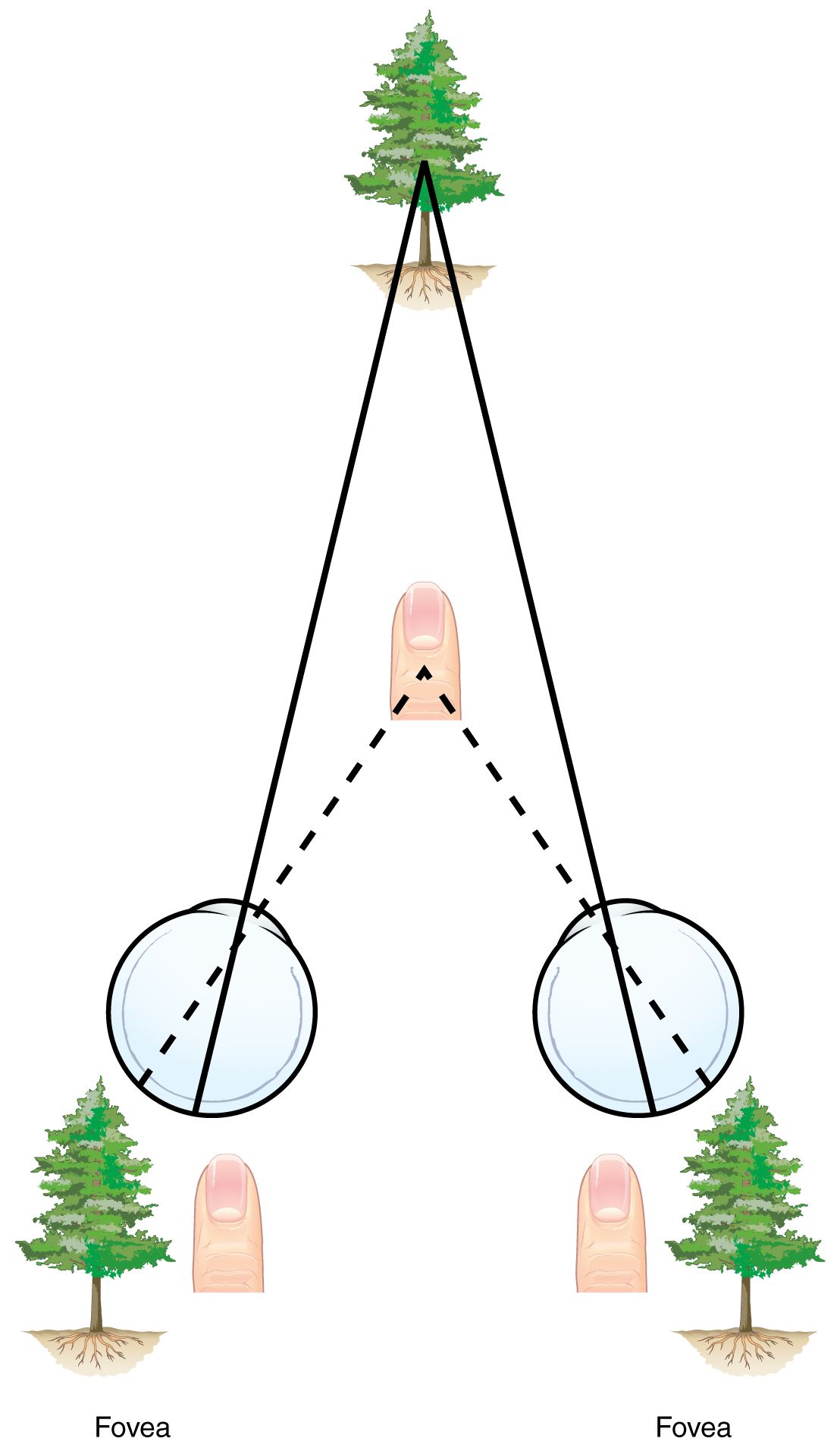
Gestalt principles: the whole and its parts
In the early 1900s, a group of German psychologists made a bold claim. They were Max Wertheimer, Kurt Koffka, and Wolfgang Köhler. They said we do not see the world as a pile of separate bits, but as organized wholes. Their school took its name from the German word Gestalt. It means form, shape, or organized whole. Christian von Ehrenfels brought the term into psychology in 1890. Wertheimer carried it into the Berlin group with his 1912 work on apparent motion. That is the way two lights flashing one after the other look like one light moving. Koffka later summed up their main idea in a slogan: "the whole is different from the sum of its parts." In other words, the brain does not add the organization later. Organization is part of perception from the start. The Gestalt group listed the rules the brain uses to group bits into objects. The most basic rule is figure-ground. We automatically split an object (the figure) from what is behind it (the ground). Black words jumping off a white page are an example. Other rules explain how we group things. We group by nearness, by likeness, and by smooth lines. We also tend to finish shapes that have gaps.
| Principle | We tend to… | Everyday example |
|---|---|---|
| Figure-ground | Split an object from its background | Words standing out from the page |
| Proximity | Group things that are near each other | Seeing three clusters of dots, not many dots |
| Similarity | Group things that look alike | Sorting players by jersey color |
| Continuity | See smooth, unbroken lines | Two crossing lines, not four short pieces |
| Closure | Fill in gaps to see a whole object | Reading a logo with pieces missing |
| Common fate | Group things that move together | A flock of birds seen as one unit |
Depth perception: seeing a 3-D world
Each eye gets only a flat, two-dimensional image. Yet you see a world with depth and distance. Eleanor Gibson and Richard Walk tested this with their famous visual cliff. It was a sheet of glass laid over a sudden drop, and babies who could crawl would not crawl out over the "edge," even when a parent called. This showed that crawling babies already perceive depth. Because these babies had already been moving around, the study cannot tell us whether depth perception is fully inborn. Later work suggests that experience with crawling helps build the fear of heights. The brain builds depth from two families of clues, called cues. Binocular cues need both eyes. In retinal (binocular) disparity, the two eyes see slightly different views. The bigger the difference, the closer the object. In convergence, the eyes turn inward to look at something near. Monocular cues need only one eye. They let a flat painting look deep. They include relative size, interposition (near things block far things), linear perspective (parallel lines seem to meet in the distance), texture gradient, relative height, and motion parallax (near things seem to rush past faster than far things).
Perceptual constancy and the set of the mind
The image an object casts on your retina keeps changing. A door swinging open makes a shifting, slanted shape, and a friend walking away gets smaller and smaller. Yet you see these things as stable. This is perceptual constancy. We see objects as keeping the same size, shape, color, and lightness, even when the raw input changes. Size constancy tells you your friend is not really shrinking. Shape constancy keeps the door a rectangle in your mind. Perception is also guided from the top down by a perceptual set. A perceptual set is a readiness to see one thing instead of another, based on the setting and what you expect. Visual illusions, like the Müller-Lyer and Ponzo figures, are useful for this reason. They make these hidden rules easy to see. They trick a system that is usually right into being confidently wrong.
- Gestalt principles describe how we group parts into wholes: figure-ground, proximity, similarity, continuity, closure, and common fate.
- Depth perception uses binocular cues (retinal disparity, convergence) and monocular cues (relative size, interposition, linear perspective, motion parallax).
- Perceptual constancy keeps objects stable when the input changes. A perceptual set lets what we expect shape what we perceive.
The chapter in one breath
- Sensation picks up and codes stimuli through transduction. Perception sorts them and gives them meaning, mixing bottom-up and top-down processing.
- The absolute and difference thresholds, Weber's law, and signal detection theory describe how well, and how reliably, we notice faint stimuli.
- In vision, the cornea and lens focus light onto the retina. There, rods and cones turn it into signals. Color comes from trichromatic coding at the cones and opponent-process coding after them.
- In hearing, the middle-ear bones make vibration stronger, and hair cells in the cochlea turn it into signals. Place and frequency theories, plus the volley principle, explain pitch.
- The chemical senses (taste, smell) and the skin senses feed perception too. Gate-control theory shows that pain is adjusted, not just measured.
- Kinesthesia and the vestibular sense track body position and balance.
- Gestalt principles, binocular and monocular depth cues, and perceptual constancy show that perception is built by the brain. That is exactly why illusions work.
ReferenceWords worth knowing
Here are the key terms from this chapter. Skim them now, or come back whenever a word trips you up.
- Absolute threshold
- The weakest stimulus you can detect 50% of the time.
- Binocular disparity
- The small difference between the images the two eyes get. The brain uses it as a two-eye cue to work out depth.
- Bottom-up processing
- Perception that starts with raw sense input and builds up to a whole picture.
- Cochlea
- The coiled, fluid-filled tube of the inner ear. Its hair cells turn sound into nerve signals.
- Cones
- Photoreceptors packed in the fovea. They detect color and fine detail in bright light.
- Difference threshold
- The smallest difference between two stimuli you can detect 50% of the time. Also called the just noticeable difference (JND).
- Gate-control theory
- The idea (Melzack and Wall) that the spinal cord has a nerve "gate" that blocks pain signals or lets them reach the brain.
- Gestalt psychology
- A school named for the German word Gestalt (form, shape, organized whole). It holds that we perceive organized wholes, not separate parts. Its slogan: "the whole is different from the sum of its parts."
- Kinesthesia
- The sense of where your body parts are and how they move. Also called proprioception.
- Olfaction
- The sense of smell. Molecules in the air trigger receptors whose signals go straight to the limbic system.
- Opponent-process theory
- The theory (Hering) that color is handled in opposing pairs: red-green, blue-yellow, and black-white. It explains afterimages.
- Perception
- The process of sorting and making sense of sense information, so it becomes meaningful objects and events.
- Perceptual constancy
- Seeing objects as keeping the same size, shape, color, and lightness, even when the image on the retina changes.
- Place theory
- The theory that pitch is coded by where the basilar membrane shakes the most. It best explains high pitches.
- Rods
- Photoreceptors around the edges of the retina. They work in dim light but see only shades of gray.
- Sensation
- The process in which sense receptors pick up stimuli and code them as nerve signals.
- Sensory adaptation
- Becoming less sensitive to a stimulus that stays the same over time.
- Signal detection theory
- A model of noticing. Whether you catch a faint signal depends on both how keen your senses are and your decision criterion, or how ready you are to say yes.
- Transduction
- Changing one form of energy into nerve signals the nervous system can use.
- Trichromatic theory
- The theory (Young-Helmholtz) that color vision comes from three cone types, tuned to short (blue), medium (green), and long (red) wavelengths.
- Vestibular sense
- The sense of balance and head position. It is based in the semicircular canals and otolith organs of the inner ear.
- Weber's law
- The rule that the difference threshold is a set fraction of the starting stimulus, not a set amount.
Check yourself
Learning
Think about the language you speak, the fear you feel at the sound of a dentist's drill, and the pull of a phone buzzing in your pocket. All of these were learned. Learning is the process by which experience makes a lasting change in what a living thing knows or does. Psychologists have spent more than a hundred years mapping how it works. This chapter tells that story. It moves from Pavlov's drooling dogs, to Skinner's levers, to Bandura's blow-up clown doll. Along the way, you will learn the words you need to spot conditioning in classrooms, casinos, and your own habits. Once you know these few ideas, a great deal of human and animal behavior stops looking like a mystery.
By the end of this chapter you can
- Define learning and tell it apart from reflex, instinct, maturation, and fatigue.
- Compare associative learning with non-associative kinds, such as habituation and sensitization.
- Map out classical conditioning using the US, UR, CS, and CR. Describe acquisition, extinction, spontaneous recovery, generalization, and discrimination.
- Explain Thorndike's law of effect and how Skinner built it into operant conditioning.
- Tell reinforcement from punishment, and positive from negative. Explain why negative reinforcement is not punishment.
- Describe shaping by successive approximations.
- Compare the four schedules of reinforcement and the pattern of behavior each one produces.
- Sum up Bandura's Bobo doll study and the four steps of observational learning.
Section 1What learning is
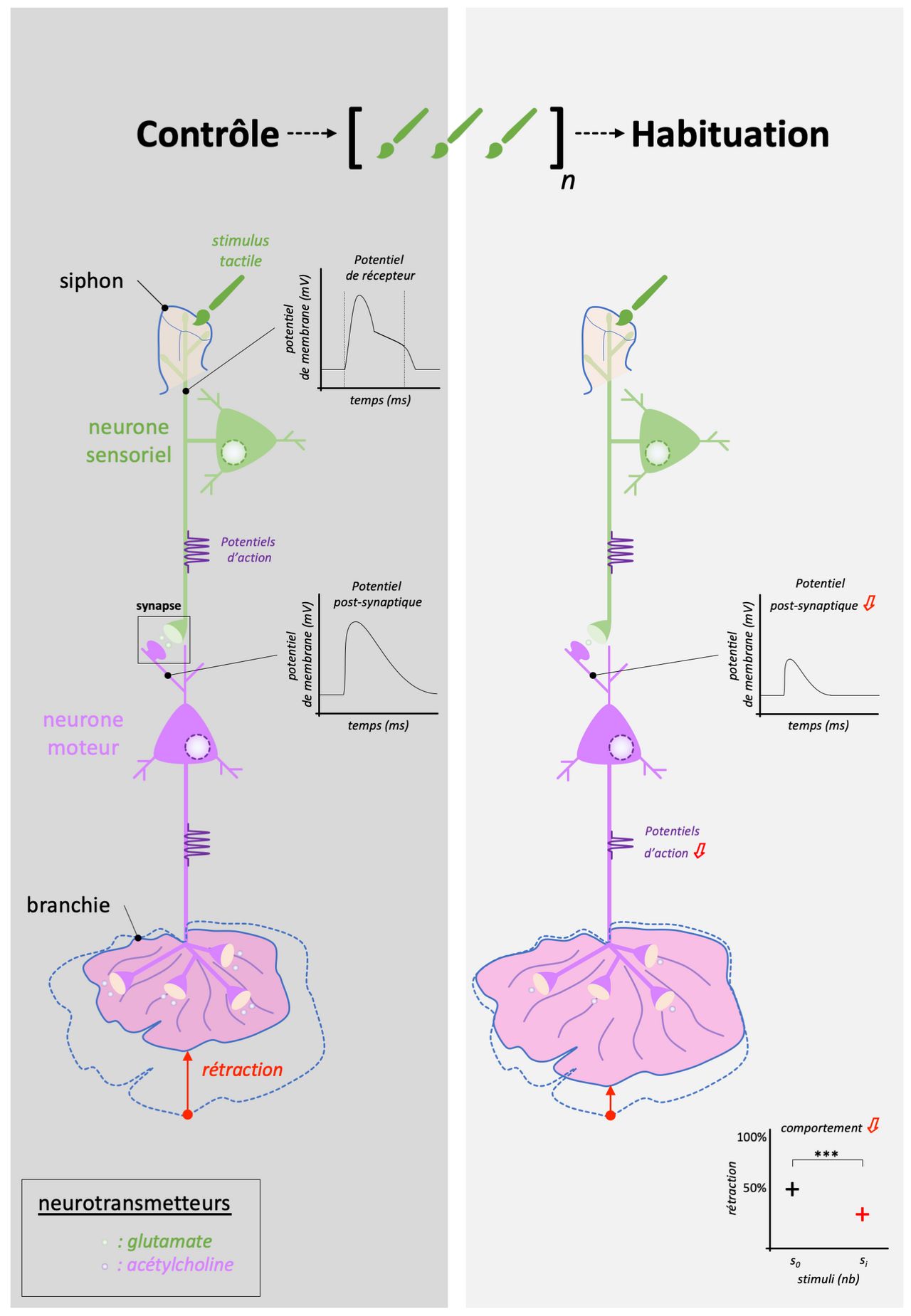
A working definition
Psychologists define learning as a fairly lasting change in behavior or knowledge that comes from experience. Each part of that sentence matters. First, the change must last. A change that is gone in a moment does not count. Second, it must come from experience. That rules out three look-alikes. One is maturation, or growing up. A baby walks mostly because its nervous system has matured, not because it practiced. Another is reflexes and instincts. You were born able to blink, so blinking is not learned. The last is a passing state, like fatigue or the effect of a drug. Learning is what is left once you take away growing up, being born knowing, and being tired.
Associative learning
The main engine in this chapter is associative learning. This means forming a link in the mind between two events, so one comes to signal or cause the other. It comes in two big forms. In classical conditioning, a living thing links two stimuli. A stimulus is any event it can sense. One stimulus becomes a signal that another is coming. In operant conditioning, a living thing links a behavior to its consequence, or what happens after it. Rewards and penalties then reshape what it does. Almost all the training people do with animals, children, and themselves runs on one of these two tracks.
The other kinds
Not all learning is associative. The simplest kind is non-associative learning. It involves just one stimulus that repeats. In habituation, a response gets smaller as the stimulus repeats. A few minutes after you walk into the kitchen, you stop hearing the hum of the refrigerator. In sensitization, a response gets bigger. After a sudden clap of thunder, small noises make you jump. There are also richer kinds of learning. They include observational learning (Section 5). They also include latent learning, which is learning that stays hidden until there is a reason to show it. Early behaviorists gave this kind of learning too little credit. The behaviorist John B. Watson wanted psychology to study only what could be seen. Later, the field brought the mind back in. But the visible processes in this chapter are still its base.
| Kind of learning | What is linked or changed | Everyday example |
|---|---|---|
| Habituation | Response to one repeated stimulus decreases | You stop noticing a ticking clock |
| Sensitization | Response to one repeated stimulus increases | Jumpier at every creak after a scare |
| Classical conditioning | Two stimuli become linked | Mouth waters at a pizza shop's jingle |
| Operant conditioning | A behavior is linked to its consequence | Studying hard because it earns good grades |
| Observational learning | Behavior copied from a model | A toddler copies a parent's phone habits |
- Learning is a lasting change in behavior or knowledge that comes from experience, not maturation, reflex, or fatigue.
- Associative learning links events: classical conditioning (two stimuli) and operant conditioning (a behavior and its consequence).
- Non-associative learning involves one repeated stimulus: habituation (the response falls) and sensitization (the response rises).
- Observational and cognitive learning show that learning is more than simple stimulus and response.
Section 2Classical conditioning
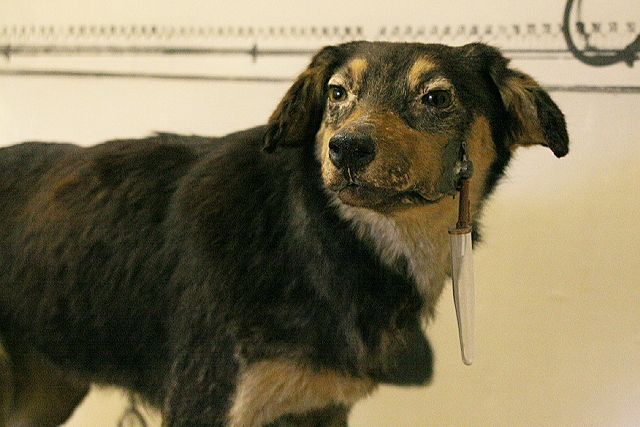
Pavlov's lucky accident
Ivan Pavlov was a Russian physiologist, a scientist who studies how the body works. He studied digestion. That work won him a Nobel Prize in 1904. Then his dogs changed his plans. They began to drool not just at food, but at the sight of the lab helper who fed them. They even drooled at the sound of footsteps coming, before any food showed up. Pavlov did not brush this off. He built the rest of his career on it. He paired a signal that meant nothing, like a metronome, buzzer, or tone, with meat powder. Then he measured, drop by drop, how the dogs learned to expect the meal.
The four parts: US, UR, CS, CR
The logic is simple once you name the four parts. Food in the mouth makes a dog drool on its own. The food is the unconditioned stimulus (US). The drooling it causes is the unconditioned response (UR). Neither one is learned. "Unconditioned" means no training needed. At first, a metronome means nothing to the dog. It is a neutral stimulus. But sound the metronome just before the food, again and again. Soon the dog drools at the metronome alone. Now the metronome is a conditioned stimulus (CS). The drooling it now causes is the conditioned response (CR). This response was learned through the pairing.
Acquisition, extinction, and generalization
Acquisition is the stage when the link between the CS and the US is built. It works best when the CS comes just before the US, every time. Now stop the pairing. Sound the metronome again and again with no food. The CR gets weaker and then stops. This is extinction. Yet the learning is not erased. After a rest, the metronome can bring back a burst of drooling. This comeback is called spontaneous recovery. Two more processes complete the picture. In stimulus generalization, stimuli that are like the CS also cause the CR. A dog trained to a 1000-Hz tone will also drool to a 1200-Hz tone. In discrimination, the animal learns to respond only to the exact CS.
The best-known human example is the "Little Albert" study by John B. Watson and Rosalie Rayner in 1920. A baby was conditioned to fear a white rat. Each time he reached for the rat, the researchers struck a steel bar to make a loud, scary clang. Soon the rat alone made him cry. His fear then spread, or generalized, to a rabbit, a dog, a fur coat, and a Santa Claus mask with a beard. The study is famous, but it has serious problems. It tested only one child. It was loosely controlled, and no one has repeated it. The researchers also never removed the fear they had created. Today, ethics rules would not allow a study like it.
| Term | What it is | Pavlov's dog | Everyday example |
|---|---|---|---|
| Unconditioned stimulus (US) | Causes a response on its own, no learning needed | Meat powder | Smell of baking bread |
| Unconditioned response (UR) | Automatic reaction to the US | Drooling at food | Mouth watering at the smell |
| Conditioned stimulus (CS) | Once neutral; now predicts the US | Metronome | The bakery's doorbell |
| Conditioned response (CR) | Learned reaction to the CS | Drooling at the metronome | Mouth watering at the doorbell |
- Pavlov found that a neutral signal paired with a US comes to cause a learned response.
- The US→UR pair is not learned. The CS→CR pair is learned through pairing.
- Acquisition builds the link, extinction fades it, and spontaneous recovery brings it back for a time.
- Generalization spreads the CR to similar stimuli. Discrimination narrows it to the exact CS.
Section 3Operant conditioning
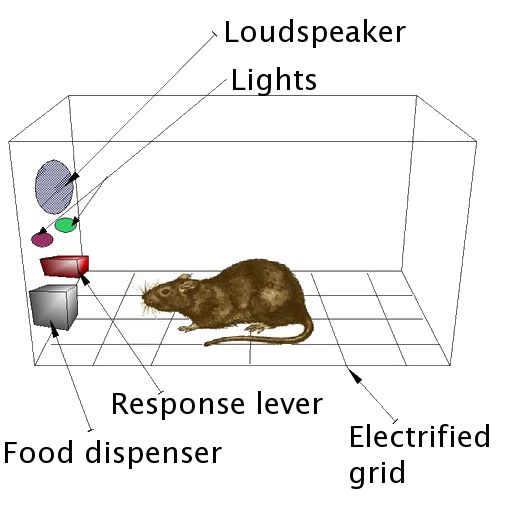
Thorndike's law of effect
Classical conditioning is about signals. Operant conditioning is about consequences. Its roots go back to Edward Thorndike. He put hungry cats in "puzzle boxes." A cat could get out only by working a latch. On the first try, a cat clawed and wriggled at random. Over many tries, it got out faster and faster. It zeroed in on the action that worked. Thorndike summed this up in the law of effect. Behaviors followed by pleasing results get stronger and happen more often. Behaviors followed by unpleasant results get weaker. Consequences pick which behaviors survive, the way a gardener picks which plants to keep.
Skinner and the operant chamber
B. F. Skinner turned that idea into a careful science. He came up with the word operant, because the behavior "operates" on the world to produce results. He built the operant chamber, often called the "Skinner box." Inside, a rat presses a lever or a pigeon pecks a lit-up key. A machine then gives food and records every response. Compare this with Pavlov. Classical conditioning works on automatic, reflex responses, like drooling, blinking, or fear. Operant conditioning works on voluntary behaviors, ones the animal chooses to do to earn rewards or avoid trouble.
Reinforcement, punishment, positive, negative
Every consequence has two features. The first is its effect. Reinforcement makes a behavior more likely. Punishment makes it less likely. The second is whether something is added or taken away. Positive means a stimulus is added. Negative means a stimulus is removed. Here, the words do not mean "good" or "bad." Cross the two features, and you get four cases, shown in the table below. Reinforcers also come in two kinds. Primary reinforcers meet a body need directly, like food, water, or warmth. Secondary reinforcers, also called conditioned reinforcers, include money, grades, praise, and the click of a training clicker. They gain their power only by being linked with primary reinforcers.
| Consequence | Positive: add a stimulus | Negative: remove a stimulus |
|---|---|---|
| Reinforcement (behavior increases) | Positive reinforcement: give a treat for sitting | Negative reinforcement: the seatbelt buzzer stops when you buckle |
| Punishment (behavior decreases) | Positive punishment: a scolding for texting in class | Negative punishment: losing phone time after breaking a rule |
Punishment can stop a behavior for a while. But it has known drawbacks. It shows what not to do, but not what to do instead. Harsh physical punishment is linked with more fear, anxiety, and aggression in children. That is why most experts suggest pairing any punishment with reinforcement of a better behavior.
- Thorndike's law of effect: pleasing results strengthen a behavior, and unpleasant results weaken it.
- Skinner studied this as operant conditioning of voluntary behavior in the operant chamber.
- Reinforcement increases behavior. Punishment decreases it. Positive adds a stimulus. Negative removes one.
- Primary reinforcers meet body needs. Secondary reinforcers (money, praise) work by being linked to them.
Section 4Shaping and schedules of reinforcement
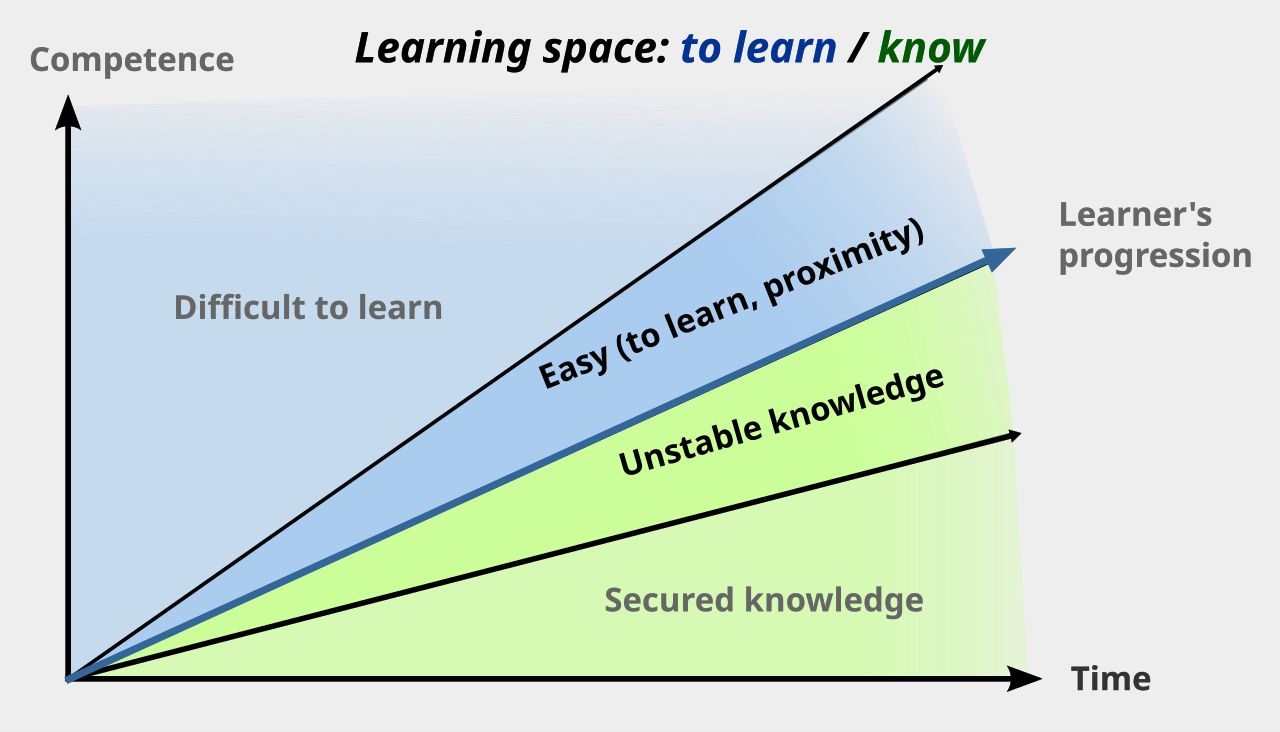
Shaping a new behavior
A rat will not walk over and press a lever on its own. So how do you reward a behavior that has never happened? The answer is shaping. In shaping, you reward successive approximations. These are small steps that move closer and closer to the goal. First, reward the rat just for turning toward the lever. Then reward it only for walking up to the lever. Then only for touching it. At last, reward it only for a full press. Each step builds on the one before. The same method teaches a dolphin to leap through a hoop. It helps a child learn to write letters. It helps a person recovering from a stroke learn to walk again. Complex behavior is built one rewarded step at a time.
How often to reinforce
Once a behavior exists, how often you reward it changes everything. In continuous reinforcement, every correct response earns a reward. This gives the fastest learning. But it also gives the fastest extinction once the rewards stop. People give up on a vending machine that always worked the first time it fails. In partial, or intermittent, reinforcement, only some responses earn a reward. This builds behavior that is very hard to extinguish. The effect is so reliable that it has its own name: the partial reinforcement effect. It is why a slot machine, which pays off only now and then, keeps a person playing long after they would have left a broken vending machine.
The four schedules
Partial reinforcement comes in four types. Two questions define them. First, is the reward tied to the number of responses? That is a ratio schedule. Or is it tied to the passing of time? That is an interval schedule. Second, is the rule fixed, meaning it stays the same? Or is it variable, meaning it changes in a way you cannot predict? Each of the four mixes gives its own pattern of responding. Variable-ratio schedules give the highest, steadiest rates. They are also the hardest to extinguish. Fixed-interval schedules give a telltale "scallop." Responding drops right after a reward and speeds up as the next reward time gets close.
| Schedule | Reward given | Response pattern | Real-world example |
|---|---|---|---|
| Fixed ratio (FR) | After a set number of responses | High rate; short pause after each reward | Pay per piece made; buy ten, get one free |
| Variable ratio (VR) | After an unpredictable number of responses | Highest, steadiest; very hard to extinguish | Slot machines; lottery tickets |
| Fixed interval (FI) | First response after a set time | "Scalloped": slow, then faster near the deadline | Cramming before a scheduled exam |
| Variable interval (VI) | First response after an unpredictable time | Slow and steady | Checking for a text; pop quizzes |
- Shaping builds a new behavior by rewarding successive approximations toward a goal.
- Continuous reinforcement is learned fastest but extinguished fastest. Partial reinforcement resists extinction.
- Schedules are ratio (based on responses) or interval (based on time), and fixed or variable.
- Variable-ratio gives the highest, most stubborn responding. It is the psychology behind gambling.
Section 5Observational learning
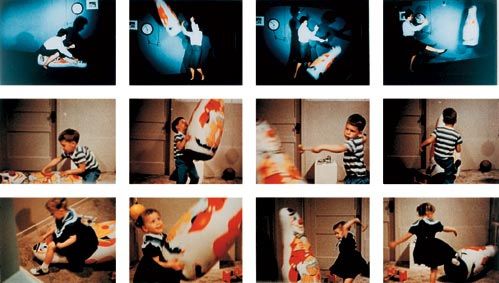
Learning without doing
In conditioning, the learner has to act and feel the result. But people learn a great deal just by watching. Albert Bandura called this observational learning, or modeling. He made it the center of his social-cognitive theory. The key point is that the watcher does not need any reward at all. It is enough to see a model, or another person, do the behavior. We also take in results that happen to someone else. Seeing a model rewarded can make us more likely to copy them. This is called vicarious reinforcement. Seeing a model punished makes us less likely to copy them. This is called vicarious punishment. In Bandura's own data, the second effect was the stronger and more reliable one.
The Bobo doll experiment
Bandura's classic study in 1961 made the point hard to forget. Preschool children watched an adult with a blow-up doll named Bobo. Some children saw the adult attack the doll. The adult punched it, kicked it, hit it with a mallet, and shouted, "Sock him!" Other children saw the adult play calmly. Later, each child was left alone with the doll. Children who had watched the aggressive model copied the very same attacks, often using the same words. Some even made up new attacks. Children who had seen the calm model mostly did not.
Later versions of the study added results for the model, and the effect was lopsided. Children who saw the model punished copied much less. Children who saw the model rewarded copied about as much as children who saw no result at all. Then Bandura showed something even more important. He offered every child a reward for showing what they had seen. Now all the groups did the acts equally well. All of them had learned the behavior by watching. The results for the model only changed how willing they were to perform it. This went against strict behaviorism. Learning had happened with no reward to the child at all. Later researchers have pointed out a limit. Hitting a toy built to be hit is not the same as hurting a person. So the study shows copying clearly, but it says less about real-world violence.
The four steps of modeling
Bandura said that turning watching into doing takes four steps. First, you must pay attention to the model. Second, you must retain, or remember, what was done. Third, you must be physically able to reproduce it. Fourth, you need the motivation to do it, often from the reward you expect. Miss any one step, and the behavior will not appear. Modeling helps explain how children pick up language, manners, kindness, prejudice, and aggression. It is why role models, teachers, and people in the media carry so much weight. We are built to copy the people we watch.
| Step | What must happen | Example: learning to cook from a chef |
|---|---|---|
| Attention | Notice and focus on the model | Watch how the chef holds the knife |
| Retention | Store a memory of the behavior | Picture the method later at home |
| Reproduction | Be able to copy it | Have the hand control to chop safely |
| Motivation | Have a reason to do it | Want the praise a good meal earns |
- Bandura showed that people learn by watching models, without being rewarded themselves.
- In the Bobo doll study, children copied an adult's aggression. Seeing the model punished cut down copying. Seeing the model rewarded added little over seeing no result.
- When every child was later offered a reward, the differences went away. This shows the difference between learning and performance.
- Vicarious reinforcement and punishment shape whether we copy what we see.
- Modeling needs attention, retention, reproduction, and motivation.
The chapter in one breath
- Learning is a lasting change in behavior or knowledge that comes from experience. It is not reflex, instinct, maturation, or fatigue.
- Associative learning links events. Non-associative learning (habituation, sensitization) involves one repeated stimulus.
- In classical conditioning (Pavlov), a neutral stimulus paired with a US becomes a CS that causes a CR. Key processes are acquisition, extinction, spontaneous recovery, generalization, and discrimination.
- Operant conditioning (Thorndike's law of effect, Skinner) shapes voluntary behavior through its consequences.
- Reinforcement increases behavior, and punishment decreases it. Positive adds a stimulus, and negative removes one. Negative reinforcement is not punishment.
- Shaping rewards successive approximations. The four schedules (FR, VR, FI, VI) give different response patterns, and variable-ratio is the most stubborn.
- Observational learning (Bandura's Bobo doll) shows we learn by watching models, through attention, retention, reproduction, and motivation.
ReferenceWords worth knowing
Here are the key terms from this chapter. Skim them now, or come back whenever a word trips you up.
- Acquisition
- The first stage of conditioning, when the link is being built between a conditioned stimulus and an unconditioned stimulus (or between a behavior and its consequence).
- Associative learning
- Learning that links two events: two stimuli in classical conditioning, or a behavior and its consequence in operant conditioning.
- Classical conditioning
- Learning in which a neutral stimulus, paired with an unconditioned stimulus, comes to cause a conditioned response. Pavlov studied it first.
- Conditioned response (CR)
- The learned reaction to a stimulus that used to be neutral and is now conditioned.
- Conditioned stimulus (CS)
- A stimulus that was once neutral. After being paired with an unconditioned stimulus, it comes to cause a conditioned response.
- Extinction
- The weakening and fading of a conditioned response when the CS is no longer paired with the US (or a behavior is no longer reinforced).
- Fixed-interval schedule
- Rewarding the first response after a set amount of time has passed. It gives a scalloped response pattern.
- Fixed-ratio schedule
- Rewarding after a set number of responses. It gives a high rate with a short pause after each reward.
- Generalization
- When stimuli that are like the conditioned stimulus also cause the conditioned response.
- Habituation
- A non-associative drop in response to a stimulus that repeats and is harmless.
- Law of effect
- Thorndike's rule that behaviors followed by pleasing results get stronger, and those followed by unpleasant results get weaker.
- Learning
- A fairly lasting change in behavior or knowledge that comes from experience.
- Negative reinforcement
- Strengthening a behavior by removing something unpleasant. Do not confuse it with punishment.
- Observational learning
- Learning by watching and copying a model, without being rewarded directly. It is central to Bandura's theory.
- Operant conditioning
- Learning in which the results of a voluntary behavior make it more or less likely to happen again.
- Positive reinforcement
- Strengthening a behavior by adding something pleasant after it happens.
- Punishment
- Any consequence that makes a behavior less likely to happen again.
- Reinforcement
- Any consequence that makes a behavior more likely to happen again.
- Shaping
- Building a new behavior by rewarding successive approximations, or closer and closer steps, toward the target behavior.
- Spontaneous recovery
- When an extinguished conditioned response comes back after a rest period.
- Unconditioned stimulus (US)
- A stimulus that causes a response naturally and automatically, with no learning.
- Variable-ratio schedule
- Rewarding after an unpredictable number of responses. It gives the highest rate of responding and the hardest to extinguish.
Check yourself
Memory
Right now you are reading these words. A moment from now you will remember reading them, or you won't. Memory is the set of steps that lets an experience leave a trace. It takes information in. It holds on to it. It pulls it back out when you need it. Memory feels like a video camera that records the past just as it happened. It is nothing like that. Memory is built, rebuilt, edited, and now and then made up. That is why it is one of the most useful things your mind does, and also one of the easiest to fool. This chapter follows a memory all the way from your eyes and ears to a courtroom.
By the end of this chapter you can
- Name the three basic memory processes, encoding, storage, and retrieval, and the three stores of the multi-store model.
- Compare sensory memory, short-term memory, and long-term memory by how long they last and how much they hold.
- Explain working memory and why it is more than a box that just holds things.
- Tell automatic processing from effortful processing, and use the levels-of-processing effect.
- Tell explicit (declarative) memory from implicit (nondeclarative) memory, and say where the brain handles each one.
- Compare recall and recognition, describe how retrieval cues work, and read Ebbinghaus's forgetting curve.
- Explain the misinformation effect and why eyewitness memory is less reliable than it feels.
Section 1How memory works
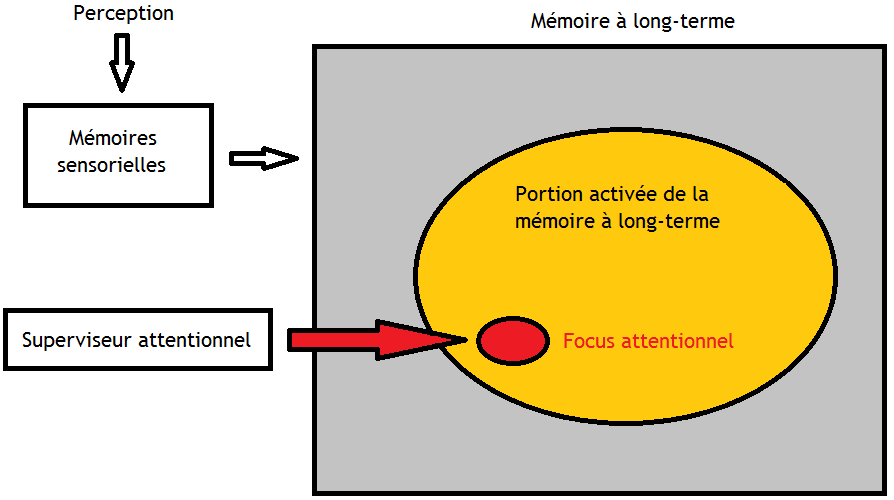
Three jobs: encoding, storage, retrieval
Before we ask where memories are kept, let's look at what the mind is doing. Every memory goes through three steps. Encoding means getting information in. The brain turns a sight, a sound, or an idea into a form it can hold. Storage means keeping it over time. That might be for a split second or for a whole life. Retrieval means getting it back out. A failure at any of the three steps feels the same from the inside: "I can't remember." But the cause is different each time, and so is the fix. Much of this chapter is about telling them apart.
The three-stage model
The best-known map of memory is the multi-store model. Richard Atkinson and Richard Shiffrin proposed it in 1968. In this model, information flows through three stores. The stores differ a great deal in how much they hold and for how long. New input lands first in sensory memory. This is a huge but very brief holding area. It keeps a near-exact copy of what your senses just picked up. The visual form is called iconic memory. It lasts about a quarter of a second. The sound form is called echoic memory. It lasts three to four seconds. That is long enough to "replay" the end of a sentence you were only half listening to. In 1960, George Sperling showed that we hold far more for a brief moment than we can report before the trace fades.
Whatever you pay attention to moves on to short-term memory (STM). This is the small workspace of the moment. If you do nothing with it, it holds information for only about fifteen to thirty seconds. Its space is famously small. In 1956, George Miller put it at "the magical number seven, plus or minus two" items. Later researchers, such as Nelson Cowan, lowered that to about four chunks. Chunking means grouping items into meaningful units. A phone number becomes three groups instead of ten digits. That is how we stretch our tiny short-term space. If you rehearse material, or encode it deeply, it moves into long-term memory (LTM). This is the store that lasts a long time. No one has found a limit to how much it can hold.
| Store | How long it lasts | How much it holds | Example |
|---|---|---|---|
| Sensory memory | Iconic about 0.25 s; echoic 3 to 4 s | Very large (a full copy of the input) | The glowing "trail" a sparkler leaves |
| Short-term / working | About 15 to 30 s without rehearsal | Small: about 4 chunks (classic estimate 7 ± 2) | Holding a phone number long enough to dial it |
| Long-term memory | Minutes to a lifetime | No known limit | Your name, your childhood home |
From short-term to working memory
The name "short-term memory" makes the middle store sound like a shelf. Items sit there and slowly slide off. In 1974, Alan Baddeley and Graham Hitch argued that it is really an active working memory. Think of a workbench in your mind. You don't just hold information there. You also work on it. In their model, a central executive acts as the boss. It directs attention and runs two helpers. The phonological loop handles sounds and words. It is the voice that repeats a number in your head. The visuospatial sketchpad handles pictures and places. You use working memory to do math in your head, to follow directions, or to hold a sentence in mind while you decide how to end it.
- Memory uses three processes: encoding (in), storage (keep), and retrieval (out).
- The multi-store model (Atkinson and Shiffrin) moves information through sensory, short-term, and long-term memory.
- Sensory memory is huge but lasts under a second (iconic) to a few seconds (echoic). STM holds about 4 chunks for 15 to 30 seconds. LTM has no known limit.
- Working memory (Baddeley and Hitch) is an active workspace, not a shelf.
Section 2Encoding: getting memories in
Automatic versus effortful processing
Some information slips into long-term memory with no work at all. Automatic processing stores details like place, time, and how often something happens. It also handles material you know very well. None of this needs conscious attention. You can usually say about where on a page a fact appeared. You know what you did yesterday. You know what a familiar word means. You never "tried" to remember any of it. But most of what school and work ask of you needs effortful processing. That takes focused attention, practice, and a plan. A definition, a formula, or a new name will not stick just because it passed in front of your eyes. You have to work on it.
The simplest effortful strategy is rehearsal. It comes in two kinds, and they are not equally useful. Maintenance rehearsal is plain repetition, like saying a number over and over. It keeps material alive in working memory. It does little to help you remember it later. Elaborative rehearsal links new material to what you already know. It is far more powerful. That difference leads straight to the next idea.
Levels of processing
In 1972, Fergus Craik and Robert Lockhart made a proposal. They said memory strength depends less on how long you hold something and more on how deeply you process it. This is the levels-of-processing effect. Shallow (structural) processing notices only the surface, such as whether a word is in capital letters. Intermediate (phonemic) processing pays attention to sound, such as whether it rhymes with another word. Deep (semantic) processing works with meaning. What does the word mean? How does it fit a sentence? How does it connect to you? The deeper the level, the better you remember it later, even when study time is the same.
| Level | What you focus on | Sample question about the word BRAIN | Later memory |
|---|---|---|---|
| Shallow (structural) | How it looks | Is it in capital letters? | Poor |
| Intermediate (phonemic) | How it sounds | Does it rhyme with train? | Fair |
| Deep (semantic) | What it means | Would it fit in "The surgeon examined the ___"? | Best |
Several study methods have strong research behind them. They all work by making you encode more deeply and in a more organized way. Mnemonics give a structure to material that has none. Examples are acronyms, peg words, and the method of loci. In the method of loci, you picture each item in a place you know well. The self-reference effect shows that tying facts to yourself builds some of the strongest memories of all. Ask, "Has this ever happened to me?" The spacing effect is also called distributed practice. It means study spread over several days beats the same hours crammed into one. The testing effect shows that quizzing yourself locks facts in. Pulling a fact out of memory works better than reading it again.
- Automatic processing stores place, time, frequency, and well-learned material without effort. Most learning needs effortful processing.
- Elaborative rehearsal (linking to what you know) works far better than maintenance rehearsal (plain repetition).
- The levels-of-processing effect: deep semantic encoding beats shallow structural or phonemic encoding.
- Spacing, the self-reference effect, mnemonics, and the testing effect all make encoding stronger.
Section 3Long-term memory: kinds and places
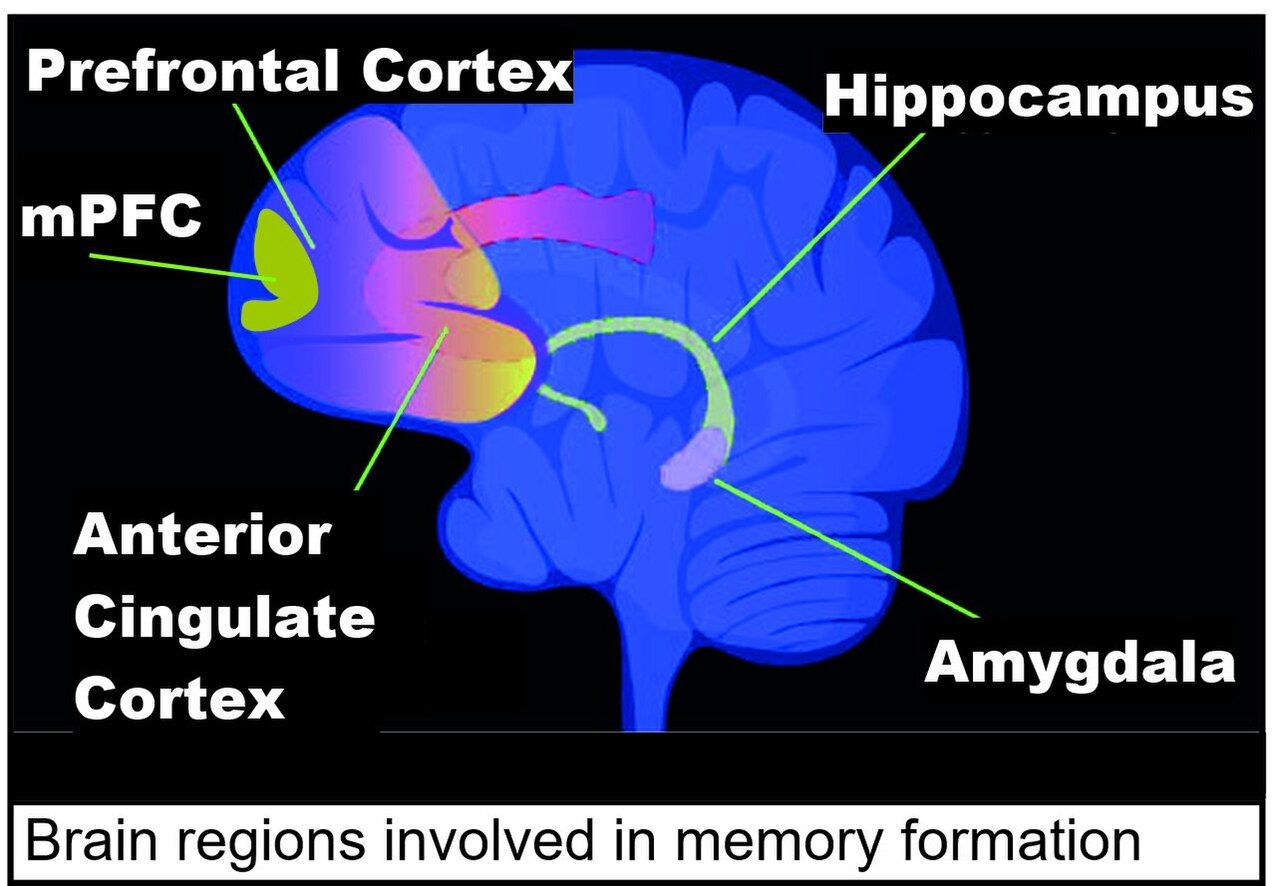
Explicit and implicit memory
Long-term memory is not one thing. Its biggest split is between two kinds. Some memories you can bring to mind on purpose. Others shape what you do without you knowing it. Explicit (declarative) memory holds facts and experiences you can recall on purpose and "declare," or say out loud. Endel Tulving split it into two parts. Semantic memory is general knowledge, like the capital of France or the meaning of a word. Episodic memory is your record of events you lived through, like your last birthday. Implicit (nondeclarative) memory works outside of awareness. It includes procedural memory for skills, like riding a bike or typing. It includes the effects of classical conditioning. It also includes priming. In priming, seeing something recently helps you recognize it faster later, without your knowing why.
| Type | Aware of it? | Subtypes | Example |
|---|---|---|---|
| Explicit (declarative) | Yes: you can say it | Semantic; episodic | "Paris is the capital of France"; "my first day of school" |
| Implicit (nondeclarative) | No: it shows in behavior | Procedural; conditioning; priming | Riding a bike; flinching at a sound; finishing a familiar phrase |
Where memories live
Different memory systems depend on different brain parts. That is why brain damage can wipe out one kind of memory and spare another. The hippocampus sits deep in the temporal lobe. It is needed to form new explicit memories. It also helps move them out to the cortex for long-term keeping. This steadying process is called consolidation. The amygdala sits right next to it. It tags memories with emotion. That is why scary or thrilling events are often remembered so clearly. Implicit memories rely on other structures. The cerebellum stores classically conditioned reflexes, like a learned eye blink. The basal ganglia support skills and habits. Long-term explicit memories are not filed in one spot. They are spread across the cerebral cortex. When you remember, the brain puts the pieces back together.
The most famous proof of this split is a patient known as H.M. (Henry Molaison). In 1953, surgeons removed much of his hippocampus and nearby medial temporal lobe on both sides. The goal was to treat his severe epilepsy. Afterward he could form almost no new explicit memories. He met the same people as strangers day after day. This is called anterograde amnesia. Yet he could still learn new motor skills. Each day he got better at a mirror-tracing task, while saying he had never done it before. His explicit memory for new events was gone. His implicit memory still worked. At the level of brain cells, storage is thought to involve long-term potentiation (LTP). LTP is a lasting strengthening of the links between neurons that fire together. Eric Kandel studied how learning strengthens synapses in a sea slug called Aplysia. That work earned him a share of the 2000 Nobel Prize.
- Explicit (declarative) memory is conscious. It splits into semantic (facts) and episodic (events). Implicit memory (procedural, conditioning, priming) works without awareness.
- The hippocampus forms new explicit memories and drives consolidation. The amygdala adds emotion.
- The cerebellum and basal ganglia support implicit and procedural memory. Long-term explicit memories are spread across the cortex.
- H.M. lost the ability to form new explicit memories but kept implicit learning. LTP is thought to be the synapse-level basis of storage.
Section 4Retrieval and forgetting
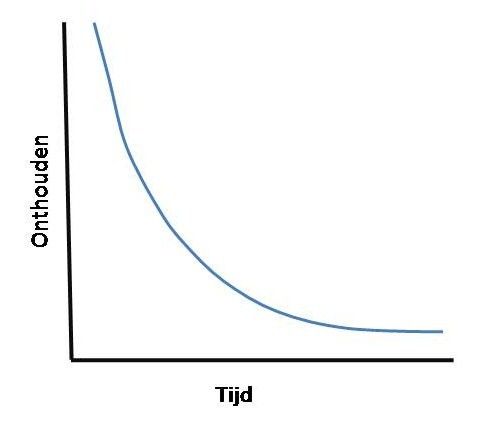
Recall, recognition, and cues
Getting information back out comes in different forms, and some are harder than others. Recall means producing information with no help. A fill-in-the-blank or essay question asks for recall. Recognition means picking out the right answer from choices, as on a multiple-choice question. It is much easier, because the answer is right in front of you. A third measure is relearning. Material you learned once and seem to have forgotten comes back faster the second time. The time you save is called savings. It shows memory that recall and recognition can miss.
Retrieval usually needs a retrieval cue. A cue is a reminder that leads back to stored information. Cues work best when they match the conditions you were in while learning. This rule is called encoding specificity. In context-dependent memory, being in the same place helps you remember. In 1975, Godden and Baddeley had scuba divers learn word lists. Lists learned underwater were recalled best underwater. Lists learned on land were recalled best on land. (A large 2021 repeat of this study found a much smaller effect, so the size of it is still debated.) In state-dependent and mood-congruent memory, your inner state works the same way. Being sober or intoxicated, happy or sad, can act as a cue. One more retrieval pattern is worth knowing. It is the serial position effect. From a list, you tend to remember the first items and the last items better than the middle. Remembering the first items is the primacy effect. They got extra rehearsal into LTM. Remembering the last items is the recency effect. They are still in working memory.
Why we forget
In the 1880s, Hermann Ebbinghaus tested himself on nonsense syllables. He plotted the first forgetting curve. Memory drops fast in the first hours and days after learning. Then it levels off. What survives the first week tends to last. Forgetting is not one problem but several. Encoding failure means the information never got into long-term memory at all. You can't lose what you never stored. That is why you can't draw a coin you have handled thousands of times. Storage decay is the fading of an unused memory over time. Retrieval failure means the information is stored but you can't reach it right now. The annoying tip-of-the-tongue feeling is one example. Interference happens when memories compete. In proactive interference, old learning gets in the way of new learning. Last year's locker combination keeps popping up when you want this year's. In retroactive interference, new learning gets in the way of old learning.
| Reason for forgetting | What went wrong | Everyday example |
|---|---|---|
| Encoding failure | Never stored (usually no attention) | Can't recall the exact design of a coin |
| Storage decay | The trace faded from lack of use | A language you haven't spoken in years |
| Retrieval failure | Stored but out of reach for now | A name on the tip of your tongue |
| Interference | Other memories compete | A new phone number blocks the old one |
- Recall (produce it) is harder than recognition (pick it out). Relearning shows hidden savings.
- Retrieval cues work best when they match encoding (encoding specificity). Place, inner state, and mood can all act as cues.
- The serial position effect favors the first (primacy) and last (recency) items of a list.
- We forget through encoding failure, storage decay, retrieval failure, and interference. The forgetting curve drops fast, then levels off. Spaced review flattens it.
Section 5Memory errors and eyewitnesses
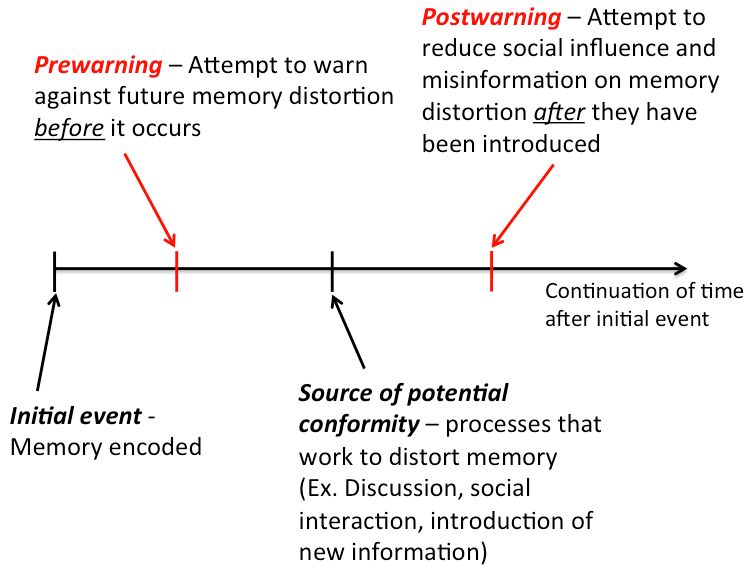
Memory is rebuilt, not replayed
Here is the most important fact about memory: it does not work like a video. In the 1930s, Frederic Bartlett showed that people remember stories by fitting them to their schemas. A schema is a mental framework of what you expect. People dropped details that seemed strange. They added details that "should" have been there. Retrieval is an act of reconstruction. Each time you remember, the brain rebuilds the memory from pieces. It fills the gaps with good guesses. Most of the time this works well enough. But it means each act of remembering is also a chance to change the memory. And the changes feel just as real as the truth.
The clearest proof is the misinformation effect, studied by Elizabeth Loftus. Information you get after an event can quietly change your memory of it. In a classic 1974 study, Loftus and Palmer showed people a film of a car crash. Then they asked how fast the cars were going when they "hit" each other. Other groups heard "smashed into" instead. That one changed word pushed speed guesses higher. A week later, people who heard "smashed" were more likely to falsely remember broken glass. There was no broken glass in the film. Related errors include source amnesia, which means forgetting where a memory came from. They also include full false memories. In Loftus's "lost in the mall" studies, suggestion alone led about a quarter of the people to remember a childhood event that never happened.
Eyewitnesses and the courtroom
These findings matter outside the lab. A jury finds eyewitness testimony very convincing. Yet it is far less reliable than a witness's confidence suggests. Several things make it less accurate. Leading questions do. So does weapon focus: attention narrows onto a weapon and away from the face. Stress hurts accuracy. So does the cross-race effect: people identify faces of their own race more accurately than faces of other races. Unfair lineup methods hurt it too. Confidence needs care, because it depends on when it was measured. Once a memory has been changed by feedback, by suggestion, or by a second look at the same suspect, a witness's confidence is a poor guide to accuracy. Even an officer saying "Good, that's the one" can raise it. But confidence taken at the moment of a first, fair identification is a much better sign. A witness who says "That's him, I'm sure" in a fair, double-blind first lineup is usually right. It is confidence in the courtroom, months and many retellings later, that has drifted away from accuracy. The stakes are real. The Innocence Project found that mistaken eyewitness identification played a part in about 70% of U.S. convictions later overturned by DNA evidence.
| Factor | Effect on eyewitness accuracy |
|---|---|
| Leading questions / suggestion | Can add details that were never there |
| Weapon focus | Attention on the weapon lowers memory for the face |
| Cross-race identification | Own-race faces are identified more accurately |
| Feedback after the lineup | Raises confidence without raising accuracy |
| High stress / a brief look | Weakens encoding of details |
These errors are built into how memory works. So the fixes are about procedure. Researchers have pushed for double-blind lineups, where the person running the lineup does not know who the suspect is. They push for fair instructions that say the culprit may not be in the lineup. They ask that the witness's confidence be written down at the moment of the first identification. They also support the cognitive interview. This is a way of questioning that avoids leading questions and lets the witness remember freely. These changes do not turn memory into a recording. Nothing can. But they keep the rebuilding honest.
- Memory is reconstructive. Retrieval rebuilds the memory and fills gaps using schemas, which can add errors.
- The misinformation effect (Loftus) shows that information heard after an event changes memory. Suggestion can even plant full false memories.
- Eyewitness accuracy drops with leading questions, weapon focus, the cross-race effect, and feedback after the lineup. Confidence tracks accuracy only at the first, untouched identification. After feedback or repeat viewings, it no longer does.
- Mistaken identification is a leading cause of wrongful convictions. Changes like double-blind lineups and the cognitive interview lower the risk.
The chapter in one breath
- Memory runs on three processes: encoding, storage, and retrieval. The multi-store model moves information through sensory, short-term, and long-term memory.
- Sensory memory is huge but lasts under a second (iconic) to a few seconds (echoic). Short-term/working memory holds about four chunks for a short time and actively works on them. LTM has no known limit.
- Encoding ranges from automatic to effortful. By the levels-of-processing effect, deep, meaningful encoding beats shallow repetition. Spacing, self-reference, and self-testing all help.
- Long-term memory splits into explicit (semantic and episodic) and implicit (procedural, conditioning, priming). The hippocampus, amygdala, cerebellum, and cortex handle different parts. H.M. showed these systems are separate.
- Recall is harder than recognition. Retrieval cues and the serial position effect shape what we get back. The forgetting curve drops fast, then levels off, and spaced review flattens it.
- Memory is reconstructive. So the misinformation effect and rebuilding errors make eyewitness testimony less reliable than courtroom confidence suggests. This causes wrongful convictions. It is also the reason for reforms, such as writing down confidence at the very first identification.
ReferenceWords worth knowing
A quick list of the terms in this chapter. Skim it now, or come back any time a word trips you up.
- Amnesia
- Memory loss. Anterograde amnesia blocks new memories from forming. Retrograde amnesia wipes out memories from before the injury.
- Automatic processing
- Storing things like place, time, frequency, and well-learned material with little or no conscious effort.
- Chunking
- Grouping items into meaningful units so short-term memory can hold more.
- Effortful processing
- Encoding that takes attention and conscious work, such as rehearsal or study.
- Encoding
- Getting information into memory by turning it into a form the brain can use.
- Episodic memory
- Explicit memory of events you lived through, tied to a time and place.
- Explicit (declarative) memory
- Memory of facts and experiences that you can bring to mind on purpose and put into words.
- Forgetting curve
- Ebbinghaus's finding that memory drops fast soon after learning, then levels off.
- Hippocampus
- A structure in the temporal lobe that is needed to form new explicit memories and to consolidate them.
- Implicit (nondeclarative) memory
- Memory that shows in behavior without conscious awareness. It includes skills, conditioning, and priming.
- Interference
- Forgetting caused by memories competing. Proactive: old gets in the way of new. Retroactive: new gets in the way of old.
- Levels of processing
- The idea that deeper, meaning-based (semantic) encoding makes stronger memories than shallow encoding.
- Long-term memory (LTM)
- The lasting memory store, with no known limit on how much it holds.
- Long-term potentiation (LTP)
- A lasting strengthening of the links between neurons. It is thought to be the brain-cell basis of learning and memory.
- Misinformation effect
- When misleading information heard after an event changes the memory of that event.
- Recall
- Getting information back out with no cues, as on a fill-in-the-blank question.
- Recognition
- Picking out learned information from choices, as on a multiple-choice question.
- Retrieval
- Getting stored information back out of memory.
- Semantic memory
- Explicit memory for general knowledge and facts, apart from when you learned them.
- Sensory memory
- The very brief, very large store that holds a near-exact copy of what the senses take in (iconic and echoic).
- Serial position effect
- The pattern of remembering the first (primacy) and last (recency) items of a list best.
- Working memory
- The active workspace (Baddeley and Hitch) that holds and works on information, run by a central executive.
Check yourself
Thinking, Language & Intelligence
Every waking moment, your mind is busy. It sorts the world into groups. It hunts for answers. It wraps ideas in words. It sizes up how smart the person across from you seems. This chapter opens up the machinery of higher thought. You will see how we build the concepts that let us think at all. You will see the shortcuts and traps that shape our judgments. You will meet language, an amazing system that a toddler learns without a single lesson. And you will follow a hundred-year effort to define and measure intelligence. Along the way you will meet Rosch, Tversky and Kahneman, Chomsky, Spearman, Gardner, Binet, and Wechsler. They turned these everyday wonders into science you can test. The goal is not to memorize a long list. It is to see how thinking works and where it breaks. It is also to see why measuring a mind is much harder than it looks.
By the end of this chapter you can
- Define a concept and explain how prototypes and schemas organize what you know.
- Tell algorithms from heuristics, and spot roadblocks to problem solving such as mental set and functional fixedness.
- Explain the availability and representativeness heuristics, confirmation bias, and the framing effect, with real examples.
- Describe the building blocks of language: phonemes, morphemes, grammar, and the steps of language development.
- Compare Skinner's and Chomsky's views of how children learn language.
- Compare theories of intelligence: Spearman's g, Gardner's multiple intelligences, Sternberg's triarchic theory, and emotional intelligence.
- Explain how IQ is defined and why a good test must be both reliable and valid.
- Sum up what twin and adoption studies show about the nature-nurture roots of intelligence.
Section 1Concepts & Problem Solving
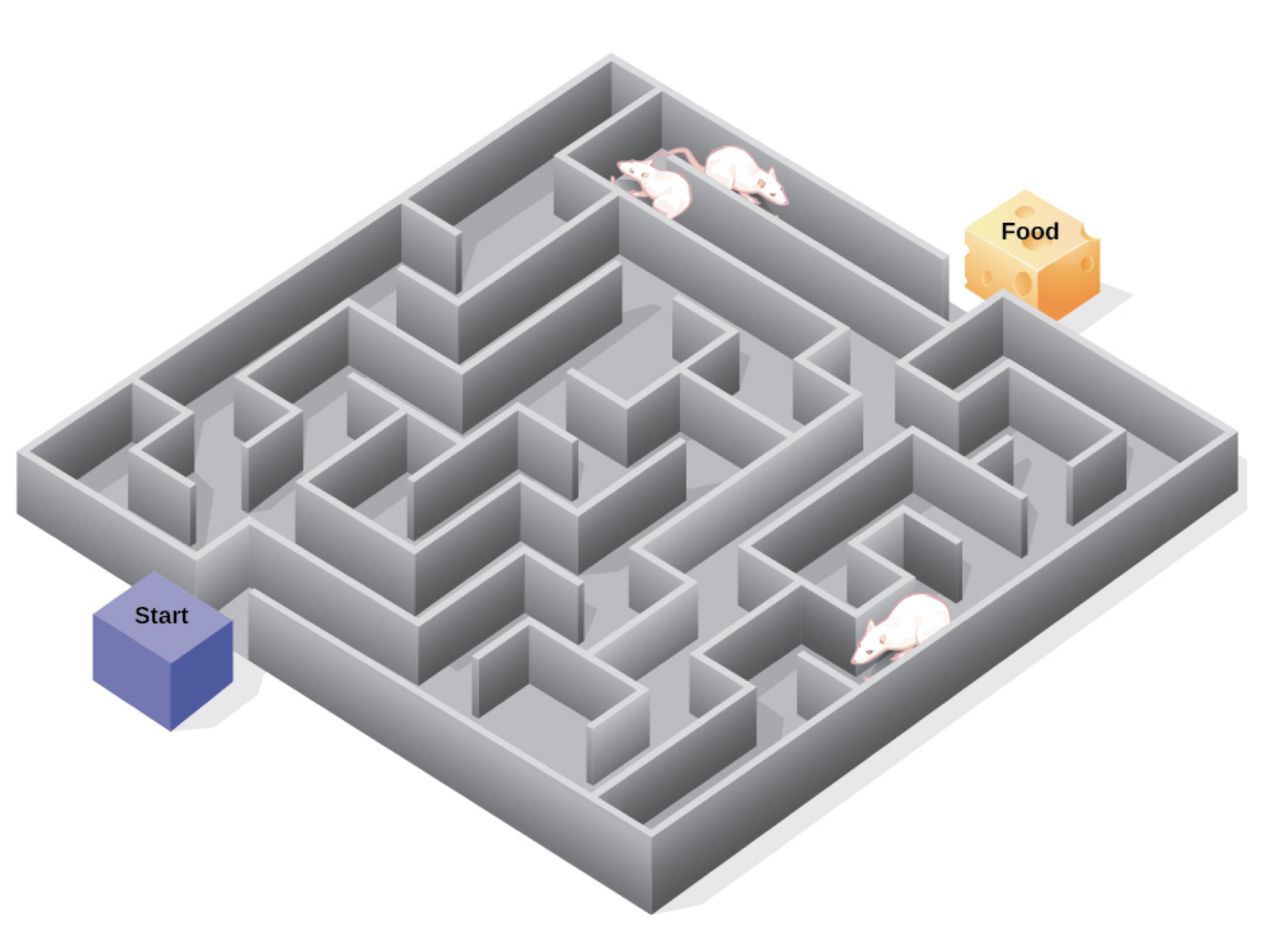
Concepts: the mind's filing system
Imagine if you had to treat every object, event, and idea as something brand new. Thinking would be impossible. Instead, the mind sorts things into concepts. A concept is a mental group of objects, events, or ideas that share features. The concept dog lets you see that a Chihuahua and a Great Dane are the same kind of thing. You can guess that both will bark and need food. You do all this without trying. Concepts come in two rough kinds. Natural concepts come from everyday life. Their edges are fuzzy. Think of fruit or game. Artificial (formal) concepts are set by a fixed list of features. A triangle is any closed shape with three straight sides. There are no exceptions.
We rarely store a concept as a list of rules. Eleanor Rosch offered prototype theory. In it, each group has a prototype at its center. A prototype is the best, most typical example. For most North Americans, a robin is a very typical bird. A penguin or an ostrich sits out at the edge of the group. The closer an item is to the prototype, the faster we see that it belongs. Concepts also link together into schemas. A schema is a bigger framework that organizes information and what we expect. A role schema tells you how a librarian is likely to act. An event schema, also called a script, tells you the usual order of events at a restaurant: get seated, order, eat, pay. Schemas make life easier. But they also plant the seeds of stereotypes and false expectations. Later sections show how those can mislead us.
Solving problems: algorithms and heuristics
A problem exists any time there is a gap between where you are and where you want to be. Psychologists sort the ways across that gap into two broad plans. An algorithm is a step-by-step method. If you follow it correctly, it is guaranteed to give the right answer. Examples are a long-division rule, a recipe, or trying every possible code on a lock. Algorithms are reliable but often slow. For big problems they can take far too long. A heuristic is a mental shortcut, or rule of thumb. It usually gets you there faster, but it comes with no promise. "Start with the corners and edges" is a heuristic for a jigsaw puzzle. Two other heuristics solve many everyday problems. One is working backward from the goal. The other is means-ends analysis, where you keep taking the step that most shrinks the distance to the goal. The trade is clear. Algorithms buy certainty with effort. Heuristics buy speed with a risk of error.
| Strategy | What it is | Guaranteed? | Everyday example |
|---|---|---|---|
| Algorithm | A complete, step-by-step rule | Yes, if followed correctly | Trying every 4-digit PIN in order |
| Heuristic | A shortcut or rule of thumb | No: it usually works | Guessing the PIN is a birth year |
| Trial and error | Try options until one works | No | Jiggling keys to find the right one |
| Insight | A sudden new view (the "aha!") | No | Suddenly seeing how a riddle works |
Good solutions also get blocked by roadblocks we can predict. A mental set is the habit of using a method that worked in the past, even when a simpler way exists. In Abraham Luchins's 1942 water jar studies, people who learned a long formula kept using it on later problems that had a two-step answer. Functional fixedness is a special kind of mental set. It means seeing an object only in its usual role. You may miss that a coin can work as a screwdriver, or that a book can prop open a window. Spotting these traps is the first step to escaping them. That is just what the next section is about.
- A concept is a mental group. Prototypes are its most typical members. Schemas link concepts into expectations.
- Algorithms guarantee a correct answer but are slow. Heuristics are fast shortcuts with no guarantee.
- Mental set and functional fixedness are habits of thought that block fresh solutions.
- Heuristics really are efficient. That same speed is what produces predictable errors.
Section 2Judgment & Bias
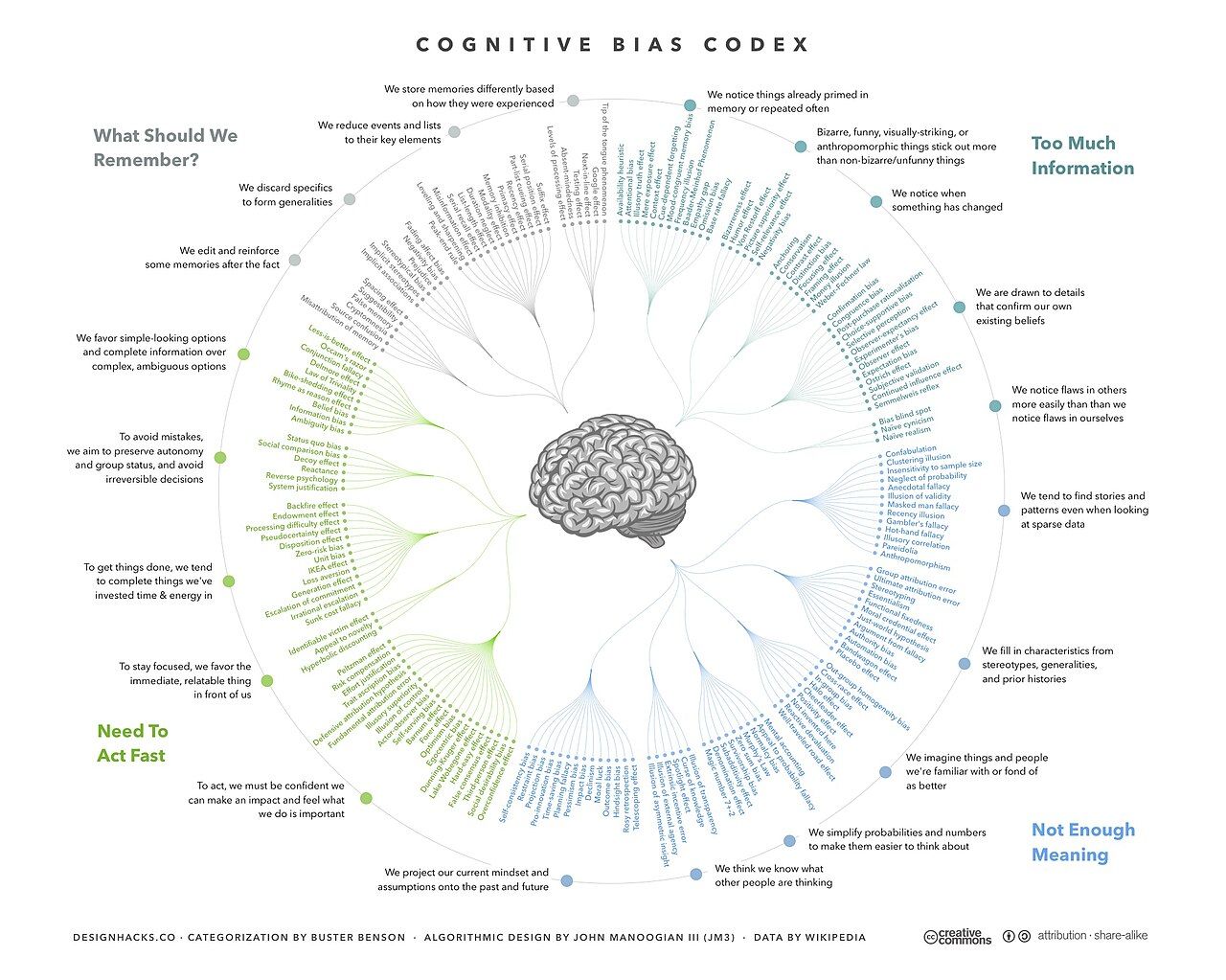
Two heuristics that bend our judgment
Starting in the 1970s, Amos Tversky and Daniel Kahneman showed something important. The shortcuts from the last section don't cause random mistakes. They cause predictable ones. The availability heuristic judges how likely or common something is by how easily examples come to mind. Events that are vivid, recent, or all over the news feel more likely than they are. People fear plane crashes more than car crashes. They fear shark attacks more than the backyard swimming pool, which is far more deadly. The dramatic cases are so easy to bring to mind, or available. Yet the everyday risks kill far more people. The representativeness heuristic judges how likely something is by how well it matches a prototype. Suppose you hear, "Steve is shy, tidy, and pays close attention to detail." Most people guess he is more likely a librarian than a farmer. They ignore the base rate: there are far more farmers than librarians. The same heuristic causes the famous conjunction fallacy. People rate "Linda is a bank teller and a feminist" as more likely than "Linda is a bank teller." That can never be true. Two things together can't be more likely than one of them alone. People choose it because the fuller description fits their prototype better.
| Bias | The shortcut | Where it goes wrong |
|---|---|---|
| Availability heuristic | Judge how common something is by how easily cases come to mind | Overrating vivid, well-reported risks (plane crashes, lottery wins) |
| Representativeness heuristic | Judge how likely something is by how much it looks like a prototype | Ignoring base rates; the conjunction fallacy |
| Confirmation bias | Look for and favor evidence that fits what you believe | Never testing a belief that could be wrong |
| Framing effect | Let the wording (gain or loss) drive the choice | Different choices for the same facts |
Confirmation bias and framing
Confirmation bias is the habit of looking for, favoring, and remembering information that supports what we already believe. At the same time, we brush off evidence that goes against it. Peter Wason ran classic studies with cards and number rules. People tested their hunches almost only by looking for cases that fit. They rarely tried the test that could have shown their idea was wrong. This bias quietly drives many things, from stubborn political arguments to a doctor sticking with a first diagnosis. Last comes the framing effect. It shows that the wording of a choice, not just the facts, moves decisions. Tversky and Kahneman used the "Asian disease" problem, about an imagined disease outbreak. People chose between programs described as lives saved or lives lost. When the choice was framed as a gain, people played it safe. When the same odds were framed as a loss, people took the risk. Meat labeled "90% lean" sells better than the same meat labeled "10% fat." The facts stay the same. Only the frame changes, and so does the answer.
- The availability heuristic mistakes ease of recall for how common something truly is. The representativeness heuristic mistakes looking alike for being likely, and ignores base rates.
- Confirmation bias means looking for evidence that fits a belief and avoiding tests that could disprove it.
- The framing effect means the same facts, worded as a gain or a loss, lead to different choices.
- These errors are predictable. That is what makes them a science and not just a list of mistakes.
Section 3Language
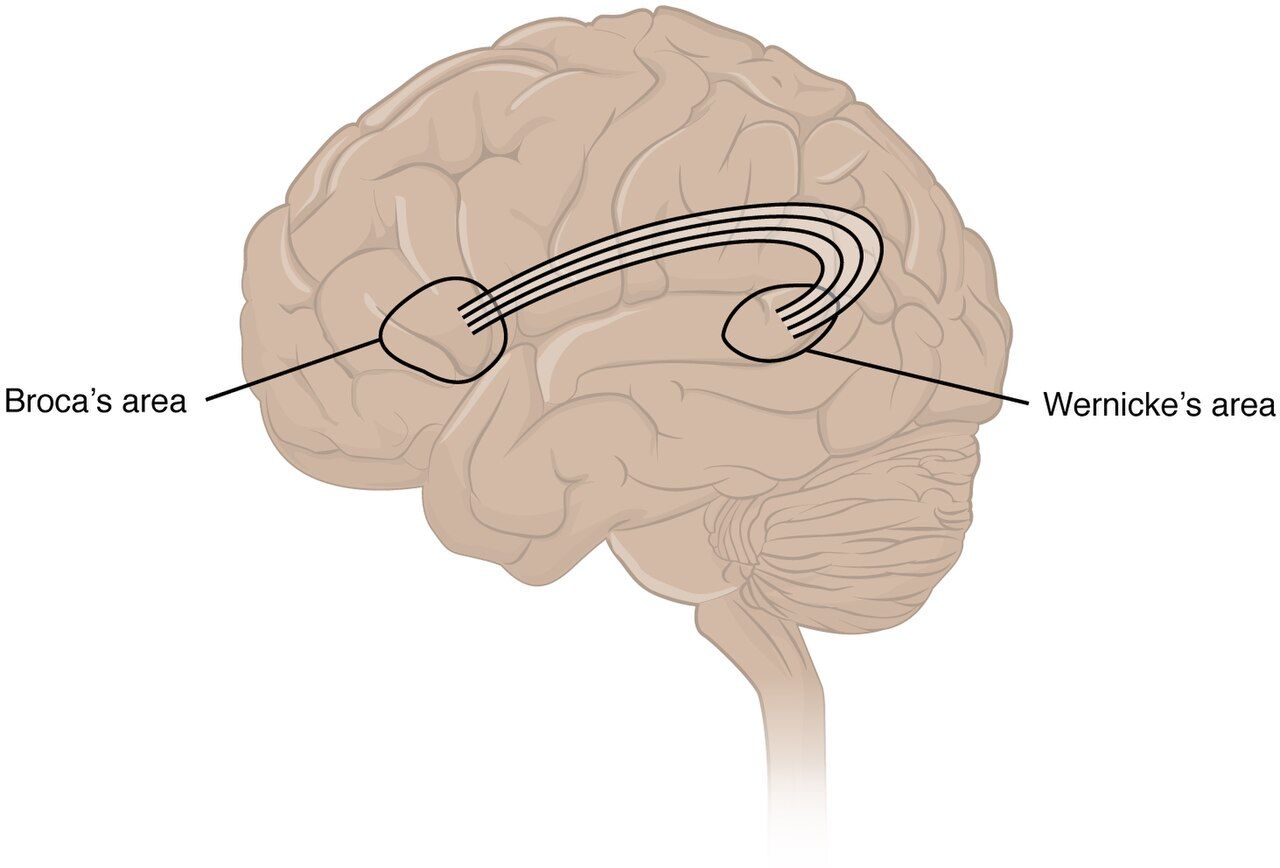
The building blocks of language
Language is a system of symbols joined by rules. It lets us share an endless range of meanings. The symbols are arbitrary. The word "dog" does not look or sound like a dog. Language gets its power from being built in layers. The smallest units of sound are phonemes. English uses about forty-four of them. A phoneme is the difference between the b and the p that separates bat from pat. Phonemes combine into morphemes. A morpheme is the smallest unit that carries meaning. The word cats holds two morphemes: cat (an animal) and -s (more than one). Morphemes build words. The study of what words mean is called semantics. Words are arranged by the rules of grammar. Grammar includes syntax, the rules for word order. This layered design gives language its most remarkable feature, called generativity. From a limited set of sounds and rules, we can make and understand sentences no one has ever said before, including this one.
| About what age | Stage | What it sounds like |
|---|---|---|
| 2 to 4 months | Cooing | Long vowel sounds ("ooo," "aaa") |
| About 6 months | Babbling | Strings of consonant and vowel sounds ("bababa"), at first including sounds the home language doesn't use |
| About 12 months | One-word (holophrastic) | Single words that stand for whole ideas ("milk!") |
| 18 to 24 months | Telegraphic speech | Two-word basics, with small words dropped ("want cookie") |
| 2 to 3 years | Fast grammar growth | Overregularization ("goed," "foots") |
How children learn language
Children learn this system amazingly fast. Through the toddler years they pick up roughly a new word every two waking hours. They also move through the stages in an order that is strikingly similar around the world (see the table). One telling clue is overregularization. A child who once said "went" starts saying "goed." This shows she has figured out the past-tense rule, add "-ed." She is not just copying what she heard. That fact sits at the heart of a famous debate. B. F. Skinner was a behaviorist. He argued that language is learned like any other behavior: through copying, reinforcement, and shaping. Parents reward correct speech and fix wrong speech. Noam Chomsky pushed back. He said reinforcement can't explain how fast and how creatively children make sentences no one taught them. It also can't explain errors like "goed," which no adult says. Chomsky proposed that humans are born with a language acquisition device. This is an inborn readiness for a universal grammar that underlies all languages. It just needs exposure to language to switch on. Today's view blends both sides. Biology supplies the equipment and a sensitive critical period for learning. A rich language setting supplies the input. A related question is whether the language you speak shapes the thoughts you can think. This is the linguistic relativity (Sapir-Whorf) hypothesis. Today it is seen as real but modest. Language nudges what we notice and remember. It does not lock thought in a cage.
- Language is built in layers: phonemes (sounds) → morphemes (units of meaning) → words → grammar/syntax.
- Development follows the same order around the world: cooing → babbling → one word → telegraphic speech.
- Skinner stressed learning and reinforcement. Chomsky proposed an inborn language acquisition device and universal grammar.
- Overregularization ("goed") shows children pull out rules rather than just copy.
Section 4Theories of Intelligence
One intelligence, or many?
Broadly, intelligence is the ability to learn from experience, solve problems, and adapt to new situations. But psychologists have argued for a century about whether it is one thing or many. Charles Spearman used a new math tool called factor analysis. It finds the hidden factors behind a set of scores. He noticed that people who score well on one kind of mental test tend to score well on others. He concluded there must be one underlying general intelligence, which he called g. In his view, g sits beneath all the specific abilities. Later thinkers refined this single factor. Raymond Cattell split it in two. Fluid intelligence is the raw ability to reason and solve new problems. It peaks in early adulthood. Crystallized intelligence is the knowledge and skills you build up. It grows with age. L. L. Thurstone rejected the single number entirely. He argued that intelligence is a cluster of seven "primary mental abilities," not one master factor.
| Theory | Theorist | Core idea |
|---|---|---|
| General intelligence (g) | Spearman | One underlying factor drives all mental abilities |
| Fluid vs. crystallized | Cattell | Reasoning power (fluid) vs. built-up knowledge (crystallized) |
| Multiple intelligences | Gardner | Eight separate intelligences (linguistic, musical, spatial…) |
| Triarchic theory | Sternberg | Analytical, creative, and practical intelligence |
| Emotional intelligence | Salovey & Mayer | Noticing, understanding, and managing emotions |
Widening the definition
The strongest challenge to a single g came from Howard Gardner. His theory of multiple intelligences proposes at least eight fairly separate kinds. They are linguistic, logical-mathematical, musical, bodily-kinesthetic, spatial, interpersonal, intrapersonal, and naturalist. Gardner points to two kinds of evidence. One is savants, people with one striking ability. The other is brain injuries that knock out one ability and spare the rest. Many researchers are not convinced. Scores on the eight abilities still tend to rise and fall together. There is little direct test support for the theory. Some say the eight are better called talents. Also, the eight are not "learning styles." Many people believe you learn best when a lesson matches your style, such as "visual" or "auditory." Careful studies have not backed that up. It is a myth.
Robert Sternberg's triarchic theory offers a neater set of three. Analytical intelligence is the school-style problem solving that tests measure well. Creative intelligence is inventing and imagining. Practical intelligence is the "street smarts" of getting things done. A related idea spread far beyond the lab: emotional intelligence. Peter Salovey and John Mayer first described it, and Daniel Goleman made it popular. It is the ability to notice, understand, use, and manage emotions in yourself and in others. It predicts some parts of success at work and in love and friendship that an IQ score misses. But critics warn that it is hard to measure fairly. It can also turn into a label for every good trait.
- Spearman's g holds that one general factor underlies all mental abilities.
- Cattell split fluid (reasoning with new problems) from crystallized (built-up knowledge) intelligence.
- Gardner's multiple intelligences and Sternberg's triarchic theory argue that intelligence is plural, not one number. Multiple intelligences has weak test support and is not the same as "learning styles," which are a myth.
- Emotional intelligence (Salovey and Mayer; Goleman) covers skills of noticing and managing emotions that IQ tests miss.
Section 5Measuring Intelligence
From mental age to IQ
The modern intelligence test began with a practical request. In 1905, the French government asked Alfred Binet and Théodore Simon to find schoolchildren who needed extra help. Their scale introduced the idea of mental age. Mental age is the age level of the problems a child can solve. Lewis Terman of Stanford adapted the test into the Stanford-Binet. He also borrowed a formula for the intelligence quotient (IQ): mental age divided by real age, times 100. An eight-year-old who performed like a ten-year-old scored an IQ of 125. Modern tests dropped that formula. The main ones are David Wechsler's scales: the WAIS for adults and the WISC for children. They use a deviation IQ instead. It compares your score with people your own age on a normal distribution. This is the bell curve. Its average is 100, and about two-thirds of people score between 85 and 115. Wechsler's earlier tests also gave separate Verbal and Performance IQs. Today's versions dropped that split. They report a Full Scale IQ plus a set of index scores. The indexes are verbal comprehension, visual-spatial (perceptual) reasoning, fluid reasoning, working memory, and processing speed. This fits the many-part view of ability from the last section even better.
What makes a test trustworthy
A number is only as good as the test that made it. Two qualities decide whether an intelligence score means anything. Reliability means consistency. A reliable test gives nearly the same result if you take it twice. This is called test-retest reliability. It also gives matching results when you compare its two halves, called split-half reliability. Validity means accuracy. Does the test really measure what it claims to? A test has predictive (criterion) validity if scores predict a related outcome, such as school grades. It has construct validity if it truly taps the trait of intelligence and not something else, such as reading speed. Here is the key point. A test can be reliable without being valid. Picture a bathroom scale that always reads five pounds heavy. It is perfectly consistent and perfectly wrong. Both qualities depend on standardization. That means giving and scoring the test the same way every time. It also means comparing scores against the norms, or typical scores, of a large sample that represents the population.
| Quality | Question it answers | How it is checked |
|---|---|---|
| Reliability | Is the score consistent? | Test-retest; split-half agreement |
| Validity | Does it measure the right thing? | Predicts outcomes (grades, job success); construct evidence |
| Standardization | Is it given and scored the same way? | Fixed steps; norms from a sample that represents the population |
Last comes the oldest question: where does intelligence come from? Twin and adoption studies give a clear answer that is easy to misread. Identical twins raised apart still have much closer IQs than adopted siblings raised together. So heritability estimates for intelligence are large. Heritability is about the differences between people in a group. It is the share of those differences that comes from differences in genes. The share changes with age. Estimates run near 0.4 to 0.5 in childhood. They rise to about 0.6 to 0.8 by adulthood. This pattern is called the Wilson effect. But heritability describes a group, not a person. It also says nothing about why groups differ. Environment matters a great deal. Enrichment, nutrition, and schooling raise scores. Average scores climbed steadily across the twentieth century. This rise is the Flynn effect. In some countries the rise has recently slowed or reversed, which also points to environmental causes. Claude Steele's work on stereotype threat found that reminding people of a negative stereotype about their group can lower their test scores. Later, larger studies suggest the effect is real but smaller and less consistent than first reported. Intelligence is neither fixed at birth nor endlessly changeable. It grows out of genes and environment working together all the time.
- Binet and Simon made the first practical test. Terman gave us the Stanford-Binet and the IQ formula. Wechsler introduced deviation IQ and the WAIS and WISC.
- IQ scores fall on a normal distribution centered at 100.
- A good test must be both reliable (consistent) and valid (measures what it claims). A test can be reliable without being valid.
- Twin studies put the heritability of intelligence near 0.4 to 0.5 in childhood, rising to about 0.6 to 0.8 in adulthood. But environment, the Flynn effect, and stereotype threat show that nurture matters greatly.
The chapter in one breath
- Concepts are the mind's groups. Prototypes are their best examples, and schemas organize what we expect.
- Algorithms guarantee correct answers slowly. Heuristics are fast shortcuts that also cause predictable errors. Mental set and functional fixedness block fresh solutions.
- The availability and representativeness heuristics, confirmation bias, and the framing effect, mapped by Tversky and Kahneman, bend judgment in predictable ways.
- Language is built in layers from phonemes to morphemes to grammar. Children learn it in the same order around the world, which fueled the Skinner and Chomsky debate.
- Theories of intelligence range from Spearman's g to Gardner's multiple intelligences, Sternberg's triarchic theory, and emotional intelligence.
- IQ testing runs from Binet to Terman to Wechsler. Scores fall on a normal distribution and mean something only if a test is both reliable and valid.
- Twin studies put the heritability of intelligence at about 0.4 to 0.5 in childhood and nearer 0.6 to 0.8 in adulthood. But the Flynn effect and stereotype threat show that environment is powerful too.
ReferenceWords worth knowing
A quick list of the terms in this chapter. Skim it now, or come back any time a word trips you up.
- Algorithm
- A step-by-step method that, if followed correctly, guarantees a solution to a problem.
- Availability heuristic
- Judging how likely or common something is by how easily examples come to mind.
- Concept
- A mental group of objects, events, or ideas that share features.
- Confirmation bias
- The habit of looking for, favoring, and remembering information that supports what you already believe.
- Crystallized intelligence
- Built-up knowledge and word skills, which tend to grow with age (Cattell).
- Emotional intelligence
- The ability to notice, understand, use, and manage emotions in yourself and others.
- Fluid intelligence
- The ability to reason and solve new problems, mostly apart from what you already know (Cattell).
- Framing effect
- The finding that how a choice is worded (as a gain or a loss) changes the decision.
- Functional fixedness
- Not being able to see an object as useful for anything except its usual job.
- General intelligence (g)
- Spearman's proposed single factor that underlies all specific mental abilities.
- Heuristic
- A mental shortcut or rule of thumb that speeds up problem solving but does not guarantee a correct answer.
- Intelligence quotient (IQ)
- A score that shows how a person performs compared with people the same age. It was first mental age divided by real age, times 100.
- Language acquisition device
- Chomsky's proposed inborn mental structure that readies humans to learn grammar from hearing language.
- Mental set
- The habit of tackling a new problem with a method that worked in the past.
- Morpheme
- The smallest unit of language that carries meaning, such as a root word or the plural "-s."
- Phoneme
- The smallest unit of sound in a language that can change a word's meaning.
- Prototype
- The best or most typical example of a concept. New items are compared against it.
- Reliability
- How consistent a test is: how much it gives the same result when measured again.
- Representativeness heuristic
- Judging how likely something is by how closely it matches a prototype, often ignoring base rates.
- Standardization
- Giving and scoring a test the same way every time, and comparing scores with norms from a sample that represents the population.
- Telegraphic speech
- The early two-word stage in which children get their meaning across while dropping small words ("want cookie").
- Validity
- How well a test measures what it claims to measure.
Check yourself
Lifespan Development
You are not the same person you were at age three. You will not be the same person at age eighty. Yet something about you stays the same the whole way through. Developmental psychology is the study of how people grow and change from conception to death. It asks how one fertilized cell becomes a person who thinks, feels, and lives with others. It also asks how that person keeps changing in every decade after. This chapter follows that path. First it asks how scientists study development at all. Then it watches the body and brain form before birth. Next it traces how children learn to think and to love. Last, it follows life through the teen years, adulthood, and the end of life. Along the way you will meet key researchers: Piaget, Ainsworth, Erikson, and Kübler-Ross. Their work still shapes how we understand a human life.
By the end of this chapter you can
- Explain the nature-nurture debate. Say why psychologists now see it as genes and experience working together, not as a contest.
- Tell continuous theories from stage theories. Tell cross-sectional studies from longitudinal studies.
- Describe the three prenatal stages. Explain how teratogens harm a growing baby.
- Sum up newborn reflexes and skills, and the set order of motor development.
- Lay out Piaget's four stages of thinking. Point out where later research changed his ideas.
- Compare the attachment styles seen in Ainsworth's Strange Situation. Place them next to Erikson's psychosocial stages.
- Explain the changes of puberty, the search for identity, and how the body and mind change in adulthood and aging.
- Describe Kübler-Ross's account of dying. Explain why it is not a fixed order that everyone must follow.
Section 1How we study development
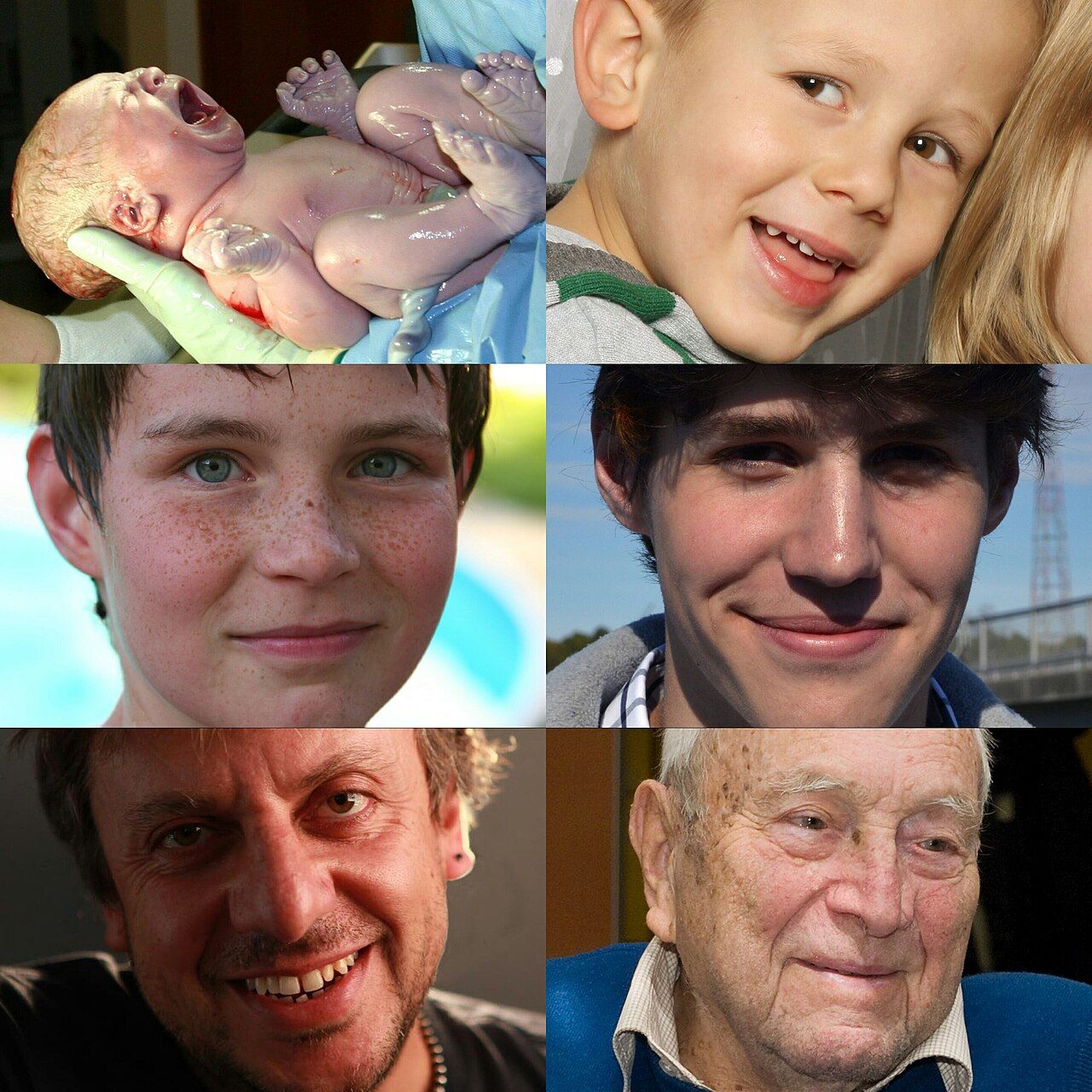
Three questions that organize the field
Developmental psychologists come back to three big questions again and again. It helps to keep them in mind like a map. The first is nature and nurture. How much of who we become comes from our genes? How much comes from experience, parents, culture, and chance? The second is continuity versus stages. Does change happen bit by bit, like walking up a ramp? Or does it happen in clear stages, like climbing a staircase? In a stage view, a child at each step thinks in a truly different way. The third is stability versus change. Do early traits last a whole life? Think of a shy temper or a sunny mood. Or can later experience truly reshape a person?
None of these questions has a neat one-word answer. For the first one, the honest answer is almost always "both." Scientists used to ask whether a trait came from nature or nurture. Now they ask how the two work together. Genes are not a blueprint that stamps out one fixed result. They are more like a set of leanings. Experience can switch them on, turn them up, or quiet them down. A newer field called epigenetics studies exactly this. It shows how the world around us can turn genes on and off. The DNA code itself does not change. So heredity and experience are woven together, right down to the level of molecules.
Nature via nurture
The clearest proof that both matter comes from studies built to pull them apart. Twin studies compare two kinds of twins. Identical twins share almost all of their genes. Fraternal twins share about half, like any brother or sister. If identical twins are more alike on a trait, genes likely play a part. Adoption studies ask a related question. Is an adopted child more like the birth parents, who gave the genes? Or more like the adoptive parents, who gave the home? Decades of this work point to the same result. Almost every trait is shaped by both. Identical twins raised apart are very alike in intelligence and temperament. Yet no trait is set by genes alone. Development is genes and environment in a constant conversation.
Cross-sectional and longitudinal designs
Development happens over time. So researchers need study designs that can capture change. There are two main kinds. Each one gains something and pays a price. A cross-sectional study compares people of different ages at the same moment. For example, a researcher might test 20-year-olds, 50-year-olds, and 80-year-olds, all this year. This is fast and cheap. But it hides a trap. The age groups differ in age, and they also grew up in different times. This is called a cohort effect. A cohort is a group born around the same time. Say today's 80-year-olds score lower on a computer task than today's 20-year-olds. That gap may come from a life with less technology. It may not come from aging at all.
A longitudinal study works the other way. It follows the same people for many years and tests them again and again as they age. This cleanly pulls apart aging and cohort. But it is slow and costly. It also suffers from attrition, which means people drop out over time. They move away, lose interest, or die. The people who stay may be extra healthy or extra motivated. That can bias the results. Much of what we know about development comes from comparing what these two designs show.
| Design | How it works | Strength | Weakness |
|---|---|---|---|
| Cross-sectional | Compare different age groups at one point in time | Fast, cheap, no waiting | Cohort effects mix up age with generation |
| Longitudinal | Follow the same people over many years | Separates true aging from cohort | Slow and costly; attrition biases the group |
- Development turns on three questions: nature-nurture, continuity vs stages, and stability vs change. The modern answer to nature-nurture is that the two interact.
- Twin and adoption studies show that almost every trait comes from both genes and environment.
- Cross-sectional designs are fast but can be fooled by cohort effects. Longitudinal designs isolate aging but lose people to attrition.
Section 2Prenatal development and infancy
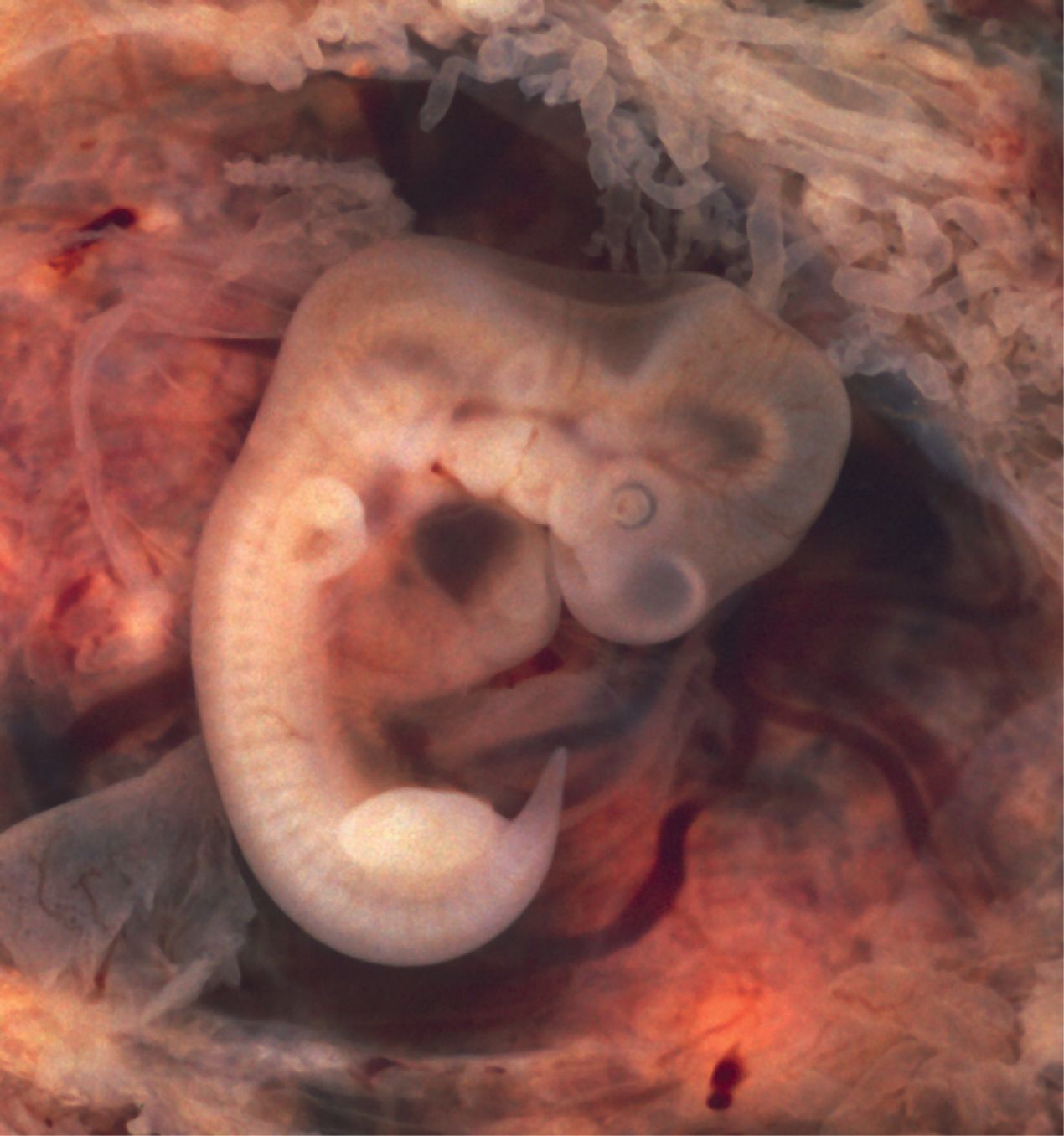
Nine months in three stages
Life before birth has three named stages. The germinal stage covers about the first two weeks after conception. The fertilized egg is called a zygote. It divides again and again as it travels down the fallopian tube. Then it attaches to the wall of the uterus. This is called implantation. The embryonic stage runs from about week 3 to week 8. It is the big building phase. The heart begins to beat. The arms, legs, brain, and inner organs all start to form. The growing baby is now called an embryo. From about week 9 until birth is the fetal stage. The baby, now called a fetus, grows a great deal. Its organs mature. It becomes able to move and hear. In time it can survive outside the womb.
Teratogens and critical periods
The growing baby is protected, but not sealed off. A teratogen is anything that can cross the placenta and harm development. Examples are some drugs, viruses, alcohol, and radiation. The damage depends a lot on timing. Each organ has a critical period. That is the window when it is forming, so it is most easily hurt. The embryonic stage is the time of greatest risk, because so much is being built at once. Alcohol is the classic example. Heavy drinking during pregnancy can cause fetal alcohol spectrum disorder (FASD). FASD can include changes in the face, slow growth, and lifelong problems with learning and behavior. No safe amount of alcohol has been found. So the standard advice is to avoid alcohol completely during pregnancy.
| Prenatal stage | Timing | What happens |
|---|---|---|
| Germinal | Conception to about 2 weeks | Zygote divides and implants in the wall of the uterus |
| Embryonic | About weeks 3 to 8 | Heart beats; organs and limbs form; most easily harmed by teratogens |
| Fetal | About week 9 to birth | Fast growth; organs mature; movement, hearing, able to survive outside the womb |
What newborns can do, and how they get moving
Newborns are far from helpless. They come with a set of automatic reflexes that help them survive. A reflex is a movement the body makes on its own. In the rooting reflex, a touch on the cheek makes the baby turn its head and open its mouth. The sucking reflex comes next. In the grasping reflex, the fingers curl tightly around anything that touches the palm. In the Moro (startle) reflex, the baby flings its arms out and back in when it feels a sudden drop. Newborns also show clear likes. They turn toward their mother's voice and the smell of her milk. They look longer at face-like patterns than at scrambled ones.
How do researchers know what a baby notices? They use habituation. A baby looks at a picture less and less each time it is shown again. That drop is habituation. When something new appears, the baby looks longer again. This shows what the baby can tell apart and remember.
Motor skills then show up in a very orderly way. This is driven mostly by maturation. Maturation means the growth of the nerves and muscles that biology has planned out. Two rules describe the pattern. Growth goes cephalocaudal, which means head to toe. Babies control the head before the trunk, and the trunk before the legs. Growth also goes proximodistal, which means from the center outward. Control of the shoulders and hips comes before fine control of fingers and toes. The well-known milestones come in nearly the same order in every culture. Babies lift the head, roll over, sit, crawl, stand, and walk around the first birthday. The exact ages vary. Maturation sets the order. Experience adjusts the timing.
- Prenatal development runs germinal → embryonic → fetal. The embryonic stage builds the organs and is the most easily harmed.
- Teratogens cross the placenta. Timing matters because each organ has a critical period. Alcohol can cause FASD.
- Newborns have survival reflexes (rooting, sucking, grasping, Moro). They prefer faces and voices, which researchers measure with habituation.
- Motor development is orderly and driven by maturation: cephalocaudal (head to toe) and proximodistal (center outward).
Section 3How thinking develops

Piaget's building blocks
No one shaped our picture of the child's mind more than Jean Piaget, a psychologist from Switzerland. His main idea was simple but powerful. Children are not small adults who just know less. They think in truly different ways at different ages. They also build their own understanding, like little scientists testing the world. The building blocks are schemas. A schema is a mental framework, like a folder in the mind that sorts what we know. Children grow their schemas in two ways. In assimilation, they fit a new experience into a schema they already have. A toddler who knows "dog" may call her first cow a "doggy." In accommodation, they change a schema when it no longer fits. She learns that this four-legged animal is something new: a "cow." Mental growth is the endless back-and-forth between these two.
The four stages
Piaget said every child passes through the same four stages in the same order. In the sensorimotor stage (birth to about age 2), babies learn about the world through their senses and actions. They look, mouth, and grasp. The big achievement of this stage is object permanence. That is knowing that things still exist when you cannot see them. Before it develops, a toy hidden under a blanket is simply gone to the baby.
In the preoperational stage (about 2 to 7), children can use words and symbols. But their reasoning is still based on hunches. They show egocentrism, which means they have trouble seeing things from another person's point of view. They also lack conservation. Conservation is knowing that an amount stays the same even when its shape changes. Pour juice from a short, wide glass into a tall, thin one. A preoperational child will say there is now "more." The height fools her.
In the concrete operational stage (about 7 to 11), children master conservation. They can reason logically about real, concrete things they can see or touch. But abstract ideas and "what if" questions are still hard. Last comes the formal operational stage (about 12 through adulthood). Now the teen can think in abstract and hypothetical ways. She can reason about ideas like justice. She can test possibilities step by step. She can think about what could be, not only what is.
| Stage | Age (about) | Big achievement | Usual limit |
|---|---|---|---|
| Sensorimotor | Birth to 2 | Object permanence | Knows the world only through senses and action |
| Preoperational | 2 to 7 | Words, symbols, pretend play | Egocentrism; lacks conservation |
| Concrete operational | 7 to 11 | Conservation; logic about real things | Has trouble with abstract or "what if" ideas |
| Formal operational | 12 to adult | Abstract and hypothetical reasoning | Not everyone uses it all the time |
Beyond Piaget
Piaget's stages are still a foundation. But 50 years of research have changed the details. Newer methods measure how long babies stare at an impossible event. Piaget only checked whether they reached for a hidden toy. The staring studies show that babies grasp object permanence and simple physics earlier than he thought. He tended to underestimate young children. Development also looks smoother, with fewer hard stage lines, than he believed.
A Russian psychologist, Lev Vygotsky, worked at the same time as Piaget. He argued that thinking is mainly social. Children learn inside the zone of proximal development. This is the gap between what a child can do alone and what she can do with help. A more skilled person gives scaffolding, which is support that fits the child's level and fades as she improves. Another line of research studies theory of mind. That is the understanding that other people have beliefs and wishes that differ from your own. It usually clicks into place around age four or five.
- Piaget: children build knowledge actively using schemas, assimilation, and accommodation.
- The four stages are sensorimotor (object permanence), preoperational (egocentrism, no conservation), concrete operational (conservation, logic about real things), and formal operational (abstract reasoning).
- Later research shows Piaget underestimated young children. Vygotsky stressed the social zone of proximal development and scaffolding.
Section 4How we form bonds
Attachment: the first bond
The strong emotional tie between a baby and a caregiver is called attachment. Learning where it comes from overturned an old belief. Behaviorists once thought babies love whoever feeds them. In that view, attachment was really about food. Harry Harlow's famous experiments with baby monkeys proved this wrong. The monkeys had two fake "mothers." One was bare wire and gave milk. The other was soft cloth and gave no food. The baby monkeys clung to the cloth mother. When scared, they ran to it for comfort. What mattered was contact comfort, not food. (These studies caused the monkeys real distress. Today they are often used to discuss the ethics of animal research.)
A British psychiatrist, John Bowlby, built this into a wider theory. He said attachment is a system that evolved to keep a helpless baby close to a protector. The caregiver becomes a secure base. The baby can explore from there and come back when needed.
Ainsworth and the Strange Situation
Mary Ainsworth worked with Bowlby. She created a way to measure attachment called the Strange Situation. In this lab test, a one-year-old is watched as the caregiver leaves and comes back a few times, with a stranger in the room. How the baby acts, especially at the reunion, shows the quality of the bond. Ainsworth described secure attachment. The securely attached baby explores freely and uses the caregiver as a base. She is upset when the caregiver leaves and is easily comforted on return. Ainsworth also described two insecure patterns. In the avoidant pattern, the baby seems not to care and avoids the caregiver at reunion. In the anxious/resistant pattern, the baby is very upset and hard to calm. She clings and pushes away at the same time.
Later, researchers Mary Main and Judith Solomon added a fourth pattern, called disorganized. These babies show confused, mixed-up behavior. Two things shape attachment security. One is how responsive the caregiver is. The other is the baby's own temperament. Temperament is a baby's inborn emotional style. Alexander Thomas and Stella Chess sorted babies into three types: easy, difficult, and slow-to-warm-up.
| Attachment style | Behavior at reunion | Uses caregiver as secure base? |
|---|---|---|
| Secure | Upset when caregiver leaves; comforted and calm at reunion | Yes |
| Avoidant | Little distress; avoids or ignores caregiver | No |
| Anxious / resistant | Very upset; clings but pushes away comfort | Mixed |
| Disorganized | Confused, mixed-up behavior; no clear plan | No clear plan |
Erikson's eight ages of life
Attachment describes the first bond. Erik Erikson mapped social growth across the whole lifespan. He proposed eight psychosocial stages. Each stage centers on a crisis. Here a crisis means a tension between two paths that the person must work out.
In infancy the crisis is trust vs mistrust. It depends mostly on whether caregivers can be counted on. Toddlers face autonomy vs shame and doubt. Preschoolers face initiative vs guilt. School-age children face industry vs inferiority. Adolescence brings the key crisis of identity vs role confusion. Young adults face intimacy vs isolation. Middle adults face generativity vs stagnation, which is about giving to the next generation. Older adults face integrity vs despair. That last task is to look back on life with peace instead of regret. Erikson's great gift was showing that development does not stop in the teen years. It goes on to the very last chapter of life.
- Harlow showed attachment rests on contact comfort, not food. Bowlby described it as an evolved secure-base system.
- Ainsworth's Strange Situation shows secure, avoidant, anxious/resistant, and disorganized attachment. Caregiver responsiveness and the baby's temperament both play a part.
- Erikson's eight psychosocial stages cover the whole lifespan. Each is a crisis, from trust vs mistrust to integrity vs despair.
Section 5Adolescence through late adulthood
Adolescence: body and identity
Adolescence starts with puberty. Puberty is a rush of hormones that turns a child's body into an adult body that can reproduce. The primary sex characteristics, which are the reproductive organs, grow and mature. The secondary sex characteristics appear. These include breasts, facial hair, a deeper voice, and body hair. Puberty also has landmark events. Menarche is the first menstrual period. Spermarche is the first ejaculation. The teen brain is also being remodeled. The limbic system, which drives emotion, matures earlier. The prefrontal cortex, which handles judgment and self-control, matures later. This gap helps explain why teens take more risks.
The main mental task of adolescence is figuring out who you are. Erikson called this identity vs role confusion. James Marcia made the idea sharper. He described four identity statuses. They depend on two things: has the young person explored options, and has she made a commitment? In diffusion, there is no exploring and no commitment. In foreclosure, there is commitment without exploring. This often means just taking on a parent's plan. In moratorium, the person is actively exploring but has not yet committed. In achievement, the person commits after real exploring. Identity is not a switch that flips once. People come back to it all through life.
Adulthood
Adulthood is the longest part of the lifespan, and the hardest to split into neat stages. Many psychologists now describe emerging adulthood. This is the late teens and twenties. In many wealthy, industrial societies, it is a time of long exploring before taking on full adult roles. In the body, most abilities peak in the twenties and then slowly decline. Menopause, the end of menstrual periods, comes around age 50.
For thinking, it helps to know two kinds of intelligence. Fluid intelligence is quick thinking and solving new problems. It tends to decline with age. Crystallized intelligence is the store of knowledge and words you build up. It tends to hold steady or even grow. Erikson placed the main adult tasks here. Early adulthood is about intimacy, which means forming close, committed relationships. Midlife is about generativity, which means mentoring, parenting, and giving back.
Aging and the end of life
Late adulthood is much more hopeful than the stereotypes suggest. Yes, thinking speed slows and some kinds of memory weaken. But many older adults keep or even gain wisdom, skill, and control over their emotions. Socioemotional selectivity theory offers one reason. As people sense that their time is growing short, they focus on the relationships and experiences that mean the most. This helps explain why older adults often report greater well-being than young adults.
The psychiatrist Elisabeth Kübler-Ross studied people facing death. She described five reactions she saw in dying patients: denial, anger, bargaining, depression, and acceptance. Her work broke a taboo and gave people words for grief. But it is often misread. People do not move through the five in a fixed order. They may skip some, repeat some, or feel other things entirely. Later research on grief agrees. Kübler-Ross herself later stressed that the stages are not a neat line. They describe common feelings. They are not a schedule everyone must keep.
| Kübler-Ross reaction | What it looks like |
|---|---|
| Denial | "This can't be happening": refusing to accept what is real |
| Anger | "Why me?": resentment and frustration |
| Bargaining | "If I just…": trying to make a deal to escape |
| Depression | Sadness and pulling away as the loss sinks in |
| Acceptance | Coming to terms with what is real, with some calm |
- Puberty brings primary and secondary sex characteristics, menarche and spermarche, and a brain still building self-control.
- Adolescence centers on identity (Erikson; Marcia's four statuses). Adulthood centers on intimacy and then generativity.
- Fluid intelligence declines with age, while crystallized intelligence holds. Older adults often report high well-being.
- Kübler-Ross's five reactions to dying describe common feelings, not a fixed order.
The chapter in one breath
- Development comes from nature and nurture working together. The field asks if change is smooth or in stages, and if early traits last.
- Cross-sectional designs are fast but can be fooled by cohort effects. Longitudinal designs isolate aging but face attrition.
- Prenatal life runs germinal → embryonic → fetal. Teratogens do the most harm during an organ's critical period.
- Newborns come with survival reflexes and clear likes. Motor skills unfold cephalocaudally and proximodistally through maturation.
- Piaget's four stages trace thinking from object permanence to abstract reasoning. Vygotsky added the social side.
- Attachment (Harlow, Bowlby, Ainsworth) rests on contact comfort and a secure base. Erikson's eight psychosocial stages cover the whole life.
- Adolescence brings puberty and the search for identity. Adulthood and aging keep crystallized intelligence and often well-being. Kübler-Ross described dying without setting a fixed order.
ReferenceWords worth knowing
Here is a quick list of the terms in this chapter. Skim it now, or come back any time a word trips you up.
- Accommodation
- Changing a schema you already have so it fits new information (Piaget).
- Assimilation
- Fitting a new experience into a schema you already have (Piaget).
- Attachment
- The strong, lasting emotional bond between a baby and a caregiver.
- Cephalocaudal
- The head-to-toe order of motor growth. Head control comes before the trunk, and the trunk before the legs.
- Conservation
- Knowing that an amount stays the same even when its shape or layout changes.
- Critical (sensitive) period
- A window when a body system is forming and is most easily shaped or harmed.
- Cross-sectional study
- A study that compares people of different ages at one point in time.
- Egocentrism
- A preoperational child's trouble seeing things from another person's point of view.
- Fetal alcohol spectrum disorder (FASD)
- Physical, learning, and behavior problems caused by alcohol before birth.
- Formal operational stage
- Piaget's last stage (about age 12 and up), marked by abstract and "what if" reasoning.
- Identity
- A clear, steady sense of who you are. Forming it is the main task of adolescence (Erikson).
- Longitudinal study
- A study that follows the same people again and again over a long time.
- Maturation
- Growth that biology has planned out, which unfolds mostly on its own schedule.
- Menarche
- A girl's first menstrual period, a landmark of puberty.
- Object permanence
- Knowing that things still exist when out of sight. It forms in the sensorimotor stage.
- Psychosocial stage
- One of Erikson's eight life stages. Each is built around a central social crisis.
- Schema
- A mental framework that sorts and makes sense of information (Piaget).
- Secure attachment
- A bond in which the baby uses the caregiver as a safe base and is comforted at reunion.
- Sensorimotor stage
- Piaget's first stage (birth to 2), when babies learn through their senses and actions.
- Strange Situation
- Ainsworth's lab test for sorting a baby's attachment style.
- Teratogen
- Anything (a drug, virus, alcohol, radiation) that can cross the placenta and harm a baby before birth.
- Zone of proximal development
- Vygotsky's term for the gap between what a child can do alone and what she can do with skilled help.
Check yourself
Motivation & Emotion
Why did you get out of bed this morning? And why did your stomach drop when you remembered a deadline? Those two questions are the heart of this chapter. One asks what pushes us to act. The other asks what we feel while we act. Motivation is the set of forces that give behavior its energy and point it toward a goal. Emotion is a short reaction of the whole body. It colors what we experience and gets us ready to respond. The two are closely linked. Hunger sends you to the kitchen. Fear sends you away from a dark alley. Often the feeling is the very thing that gets the body moving. This chapter follows how psychologists have tried to explain both. It moves from raw instinct to Maslow's pyramid, and from a growling stomach to the fast alarm in the brain.
By the end of this chapter you can
- Define motivation. Compare the instinct, drive-reduction, and arousal theories.
- Place needs in Maslow's hierarchy and explain the idea of prepotency.
- Describe how the hypothalamus and the hormones ghrelin and leptin control hunger and eating.
- Compare the James-Lange, Cannon-Bard, and Schachter-Singer theories of emotion.
- Sum up the evidence that some facial expressions of emotion are shared worldwide. Define display rules.
- Name the role of the limbic system in emotion, especially the amygdala.
- Explain how autonomic arousal gets the body ready during strong emotion.
Section 1Theories of motivation
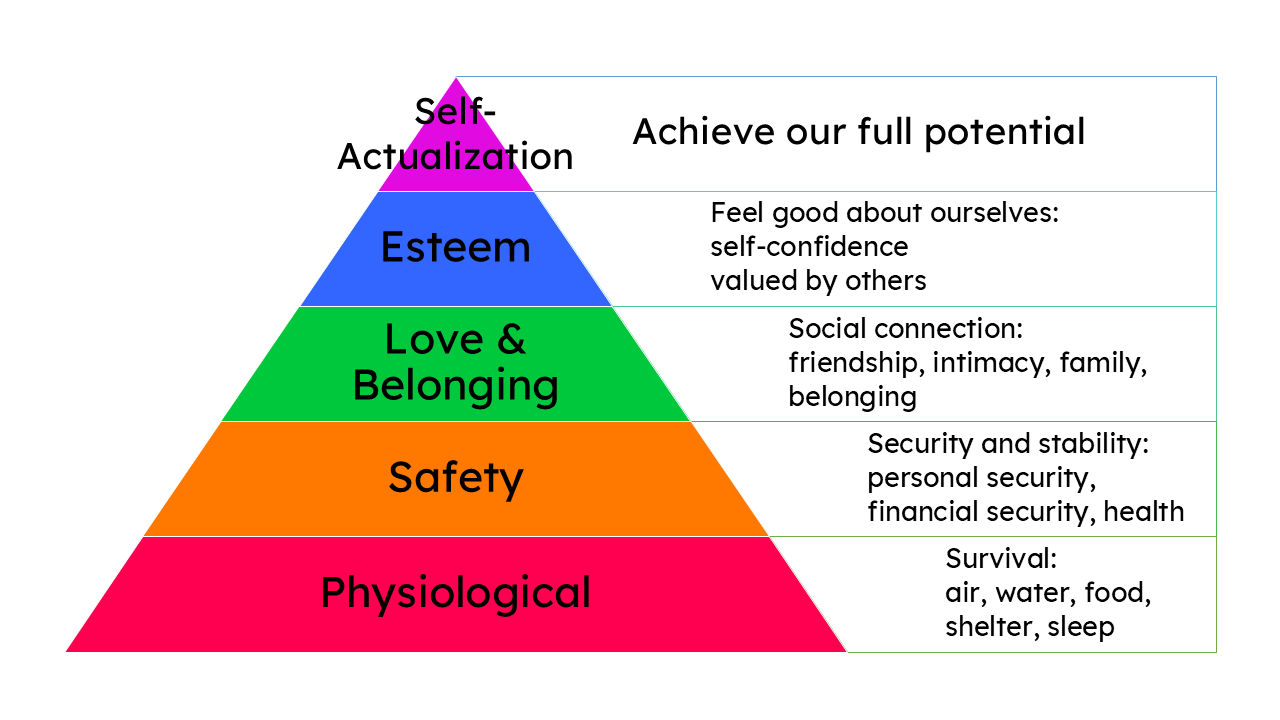
From instinct to drive
Motivation is the wanting behind the doing. It is the inner state that gives behavior energy and direction. The first scientific account was instinct theory. It said much of what we do is built in from birth. Building on Darwin, psychologists such as William James and William McDougall argued that people, like animals, have instincts. An instinct is an unlearned pattern of behavior that every member of a species shares. Instincts were said to drive action on their own.
The theory fell apart because it was too easy to use. People named an instinct for every behavior, like a "curiosity instinct" or a "parental instinct." But a label does not explain anything. It just repeats the behavior it was meant to explain. True instincts are fixed, complex, and unlearned, like a bird building a nest. They turned out to be rare in humans.
The next account looked at the body's need for balance. Drive-reduction theory came from Clark Hull. It starts with homeostasis, the body's habit of keeping a steady inner state. A body need, like a need for food, water, or warmth, creates a tense, stirred-up state called a drive. We then act to reduce that drive and get back to balance. Thirst pushes you to drink. Drinking lowers the drive. Then the push fades. Primary drives are unlearned and biological, like hunger and thirst. Secondary drives are learned because they are linked to primary rewards. The pull toward money is one example.
Arousal, incentives, and the optimal level
Drive reduction has an obvious gap. People often work to raise their arousal, not lower it. Arousal means how alert and stirred up the body and mind are. We ride roller coasters, watch scary movies, and take on hard puzzles. No body need is involved. Arousal theory fills this gap. It says we are driven to reach an optimal, or best, level of stimulation. With too little, we look for excitement. With too much, we look for calm.
A classic finding here is the Yerkes-Dodson law, from Robert Yerkes and John Dodson in 1908. It says people perform best at a medium level of arousal. The best level is lower for hard tasks than for easy ones. A little nervous energy before an exam can sharpen you. A lot of it can make your mind go blank. (Their original study used mice. Later studies support the general idea, but the curve is a rough rule, not an exact law.)
Drives push us from the inside. Incentive theory adds the pull of goals outside us. We are drawn toward rewards, like a paycheck or praise. We move away from punishments. This can happen with no inner need at all.
| Theory | Main idea | Best explains | Weakness |
|---|---|---|---|
| Instinct | Behavior comes from inborn patterns shared by a species | Fixed, unlearned behaviors | Naming an instinct does not explain it |
| Drive-reduction | Needs create drives; we act to restore homeostasis | Hunger, thirst, body temperature | Cannot explain why we seek arousal |
| Arousal | We seek an optimal level of stimulation | Curiosity, thrill-seeking, boredom | Less useful for basic drives |
| Incentive | Rewards outside us pull us forward | Working for pay, grades, praise | Plays down inner states |
Maslow's hierarchy of needs
Abraham Maslow (1943) said our many motives are not all equal. He said they are stacked in a hierarchy of needs, which is often drawn as a pyramid. At the bottom are physiological needs, the body's needs, like food, water, and sleep. Next come safety needs, like security and shelter. Then come needs for love and belonging. Then come esteem needs, like achievement and respect. At the top is self-actualization, the drive to become your fullest self.
The key claim is called prepotency. It means lower needs usually must be fairly well met before higher needs take over. A person who is starving is not much moved by worries about self-esteem. Later in life, Maslow added self-transcendence above self-actualization. That means reaching beyond yourself to serve others or a cause.
The hierarchy is easy to grasp and still very popular. Maslow never drew it as a pyramid himself, though. That picture came later from other writers. Critics also point out that the order is not strict. People sometimes give up food and safety for love or for their beliefs. Cultures also differ in which needs they value most.
- Motivation gives behavior energy and direction. Early instinct theory failed because calling a behavior an instinct explains nothing.
- Drive-reduction theory (Hull): needs create drives that we act to reduce, which restores homeostasis.
- Arousal theory and the Yerkes-Dodson law explain why we sometimes seek stimulation. Performance peaks at medium arousal.
- Maslow's hierarchy stacks needs from physiological to self-actualization. Lower needs usually come first (prepotency).
Section 2Hunger & eating
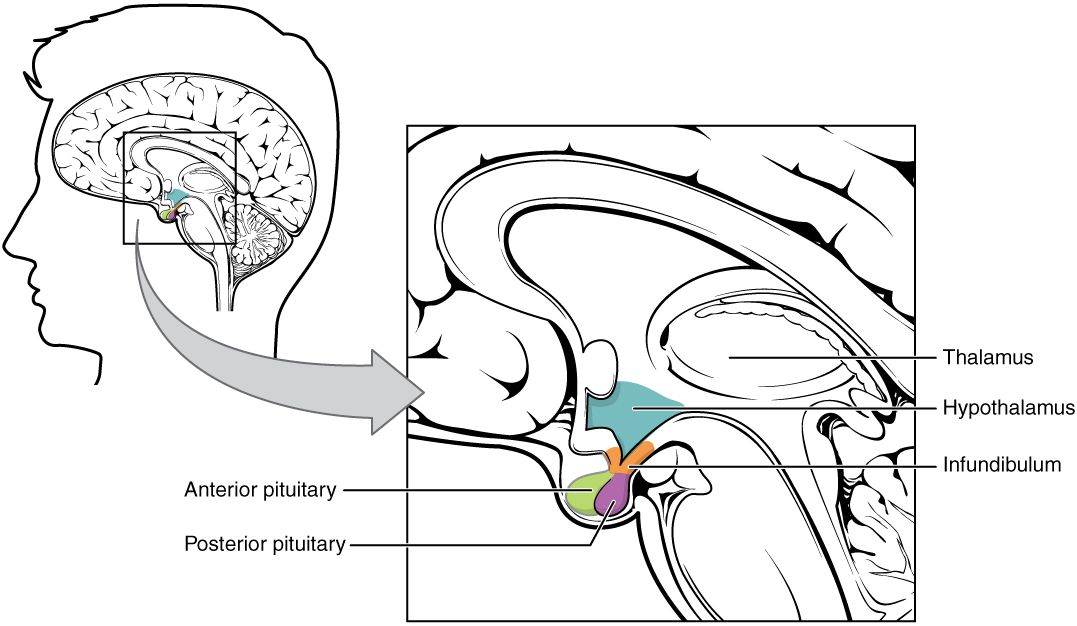
The body's hunger signals
Where does hunger come from? An early guess pointed to the stomach. In 1912 Walter Cannon and his student A. L. Washburn ran a famous test. Washburn swallowed a balloon so his stomach squeezes could be recorded. The squeezes did match the moments he felt hunger pangs. But the stomach turned out to be a messenger, not the boss. People whose stomachs have been removed by surgery still feel hungry.
The real control center is the hypothalamus. It is a small structure at the base of the brain. It keeps track of the body's fuel and runs eating. Two parts became famous from animal studies that damaged small areas of the brain. The lateral hypothalamus works like an "on" switch. Stimulate it, and an animal eats. Destroy it, and the animal may starve. The ventromedial hypothalamus works like an "off" switch, or fullness center. Destroy it, and the animal overeats a great deal. Newer work adds detail, such as a small area called the arcuate nucleus. It has some neurons that boost appetite and others that curb it. Still, the on and off idea is a useful map.
The chemistry of appetite
The hypothalamus listens to a stream of chemical signals. Glucose, or blood sugar, is a key one. When glucose falls, hunger rises. Hormones fine-tune the message. Ghrelin is released by an empty stomach. It is the "I'm hungry" hormone. It climbs before meals and drops after eating. Leptin is made by fat cells. It is a longer-term signal that says "I have enough stored," and it lowers appetite. Insulin and a gut hormone called PYY also help you feel full.
Many researchers have described a set point. This is a weight the body is said to defend. It does so by changing hunger and the basal metabolic rate, which is the calories you burn at rest. Eat too little, and your metabolism slows. That is one reason strict diets are so often undone. But the strong version of this idea has been challenged. There is not much proof that the body pulls back to one fixed number. Many researchers now prefer a settling point. In this view, weight drifts to whatever level your surroundings, diet, and habits support. It stays there because those conditions stay the same, not because the body defends a fixed figure.
| Signal | Source | Effect on eating |
|---|---|---|
| Ghrelin | Empty stomach | Raises hunger (rises before meals) |
| Leptin | Fat cells | Lowers hunger (signals stored energy) |
| Insulin | Pancreas | Helps you feel full; controls glucose |
| Low blood glucose | Bloodstream | Triggers hunger |
| Lateral hypothalamus | Brain | "On" switch: drives eating |
| Ventromedial hypothalamus | Brain | "Off" switch: signals fullness |
Psychology and culture at the table
Biology creates the drive to eat. But psychology decides much of the menu. Taste likes are partly learned. We are born liking sweet and disliking bitter. But a taste for things like cilantro or chili heat comes from exposure and culture. Cues around us matter a lot too. Bigger plates, more variety, and eating with other people all lead us to eat more. We often do not notice. We tend to finish the unit in front of us, whatever its size.
Sometimes these systems go badly wrong, and an eating disorder can develop. A person with anorexia nervosa restricts food to a dangerous degree and has a distorted view of body shape or weight. A person with bulimia nervosa has repeated binges followed by steps to make up for them, such as vomiting, fasting, or too much exercise. A person with binge-eating disorder has repeated binges without those steps. These are serious mental health conditions. They have biological, psychological, and cultural roots. They are not a matter of willpower, and they can be treated.
- The hypothalamus is the main controller. The lateral area switches eating on. The ventromedial area signals fullness.
- Ghrelin (from the stomach) raises hunger. Leptin (from fat cells) lowers it. Falling glucose triggers eating.
- Metabolism adjusts to how much you eat, which makes dieting hard. The classic set point has been challenged by the idea of a settling point shaped by surroundings and habit.
- Learned tastes, portion cues, and culture strongly shape what and how much we eat.
Section 3Theories of emotion
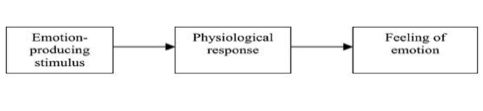
What an emotion is made of
An emotion is a short, organized response with three parts. One is a physiological part, or body part, like a racing heart or sweaty palms. One is an expressive/behavioral part, like a frown or a flinch. One is a subjective/cognitive part. That is the feeling you are aware of and how you make sense of it. The big theories of emotion agree on these parts. They disagree about the order. Which comes first, the body's reaction or the feeling? And does thinking have to happen in between?
Three classic accounts
The James-Lange theory comes from William James and a Danish doctor, Carl Lange. It makes a surprising claim: the body comes first. An event triggers a body reaction. The emotion is our sense of that reaction. James put it this way. We do not tremble because we are afraid. We feel afraid because we tremble. In this view, emotion is the body's report.
The Cannon-Bard theory comes from Walter Cannon and Philip Bard. They disagreed with James. They said body changes are too slow to be the source of emotion. They are also too alike from one emotion to the next. A pounding heart comes with fear, anger, and excitement. So the body alone cannot tell you which one you feel. Instead, they said, a part of the brain called the thalamus sends the signal to two places at the same time. It goes to the cortex, which creates the felt emotion. It also goes to the body, which creates the arousal. In this view, feeling and body changes happen together, and neither causes the other.
The Schachter-Singer two-factor theory comes from Stanley Schachter and Jerome Singer in 1962. It added a missing piece: thought. They said emotion needs two factors. One is general body arousal. The other is a mental label we give it by reading the situation. In their famous study, people got a shot of epinephrine, also called adrenaline. Then each person waited with an actor who acted either angry or very happy. The study reported that people tended to describe their arousal to match the actor's mood. The arousal was the same. The setting told them what emotion it was. Later teams had trouble repeating these results, so the study is weaker evidence than it once seemed. The idea that we label arousal using context is still influential.
| Theory | Order | Main claim |
|---|---|---|
| James-Lange | Event → body arousal → emotion | The emotion is our sense of the body's response |
| Cannon-Bard | Event → arousal and emotion at once | Feeling and body changes happen together and on their own |
| Schachter-Singer | Event → arousal + mental label → emotion | Emotion = arousal read through the situation |
Later thinkers looked more closely at the role of thought. Richard Lazarus argued that emotion always starts with an appraisal. That is a quick judgment of whether an event is good or bad for us. It can happen even when we are not aware of it. Robert Zajonc and the brain scientist Joseph LeDoux disagreed. They said some emotional reactions, especially fear, can fire before any conscious thought. Fast brain pathways skip the cortex. Section 5 picks up this idea.
- Emotion has three parts: physiological arousal, expressive behavior, and subjective feeling.
- James-Lange: the body comes first, and the feeling follows the body's reaction.
- Cannon-Bard: arousal and emotion happen at the same time and on their own.
- Schachter-Singer: emotion needs arousal plus a mental label taken from the situation.
Section 4Expressing emotion
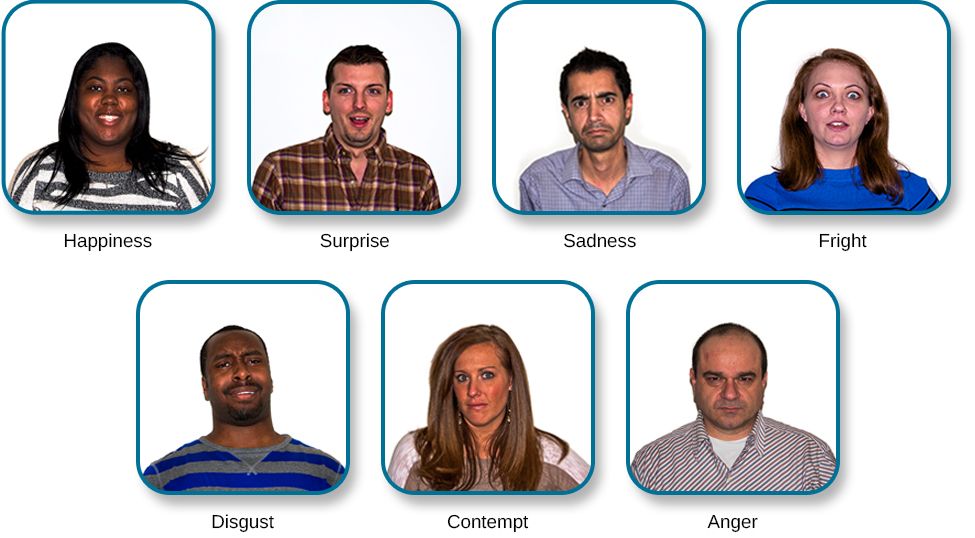
Faces the whole world reads
Charles Darwin made a bold claim in his book The Expression of the Emotions in Man and Animals (1872). He said emotional expressions are inherited, useful for survival, and shared by all people. About a hundred years later, Paul Ekman and Wallace Friesen gathered evidence. They showed photos of faces to people around the world. A small set of basic emotions was recognized far more often than chance in every culture they tested. The set was happiness, sadness, anger, fear, surprise, and disgust. Ekman later added contempt.
A key part of this work involved the Fore people of Papua New Guinea. They lived far from cities and had seen almost no Western media. Even so, they matched the same faces to the same situations. Children who were born blind give more evidence. They have never seen a smile. Yet they smile when happy and frown when frustrated. This suggests the expressions are built in, not just copied. Some newer studies with other remote groups found weaker agreement, though. So scientists still debate how universal these expressions are.
Does the face feed the feeling?
Expressions may not just show emotion. They may also shape it. The facial feedback hypothesis says that making a facial expression sends signals back to the brain. Those signals may strengthen the matching emotion, or even create it.
A well-known 1988 study tested this with a pen. Some people held a pen sideways in their teeth, which forces a smile-like shape. Others held it with their lips, which blocks a smile. The "smiling" group rated cartoons as funnier. But that result did not hold up. In 2016, seventeen labs repeated the study together with almost two thousand people. They found almost no effect. So the pen-and-cartoon result should be treated as not replicated. Later large studies suggest that posing a smile may lift mood a small amount. The broader idea, that posture and expression loop back into feeling, fits the spirit of the James-Lange theory in Section 3.
When culture edits the face
If the basic expressions are shared, why do emotional lives look so different around the world? The answer is display rules. These are norms we learn from our culture. They tell us which emotions we may show, to whom, and how strongly. Ekman and Friesen showed this in a clever study. American and Japanese students watched an upsetting film. When alone, both groups showed almost the same disgust. Then an authority figure sat in the room. Now the Japanese students covered their disgust with polite smiles much more than the Americans did. The underlying expression was the same. The rules for showing it were different.
Display rules also change with the setting and a person's role. A lot of emotional signaling also uses gestures and body language. Unlike the basic faces, these can mean very different things from one culture to the next.
| Basic emotion | Main facial clue |
|---|---|
| Happiness | Raised cheeks, smiling mouth, crinkles at the corners of the eyes |
| Sadness | Mouth turned down, inner brows raised |
| Anger | Brows lowered and pulled together; lips pressed tight |
| Fear | Wide eyes, raised brows, lips stretched back |
| Surprise | Raised brows, wide eyes, dropped jaw |
| Disgust | Wrinkled nose, raised upper lip |
- Darwin proposed that expressions are inborn. Ekman and Friesen showed that a set of basic emotions is recognized across cultures.
- Evidence for this includes the remote Fore of New Guinea and the expressions of children born blind. The debate about how universal they are continues.
- The facial feedback hypothesis says making an expression can change the emotion felt. The famous pen study did not replicate.
- Display rules are cultural norms about how and when emotions are shown.
Section 5The biology of emotion
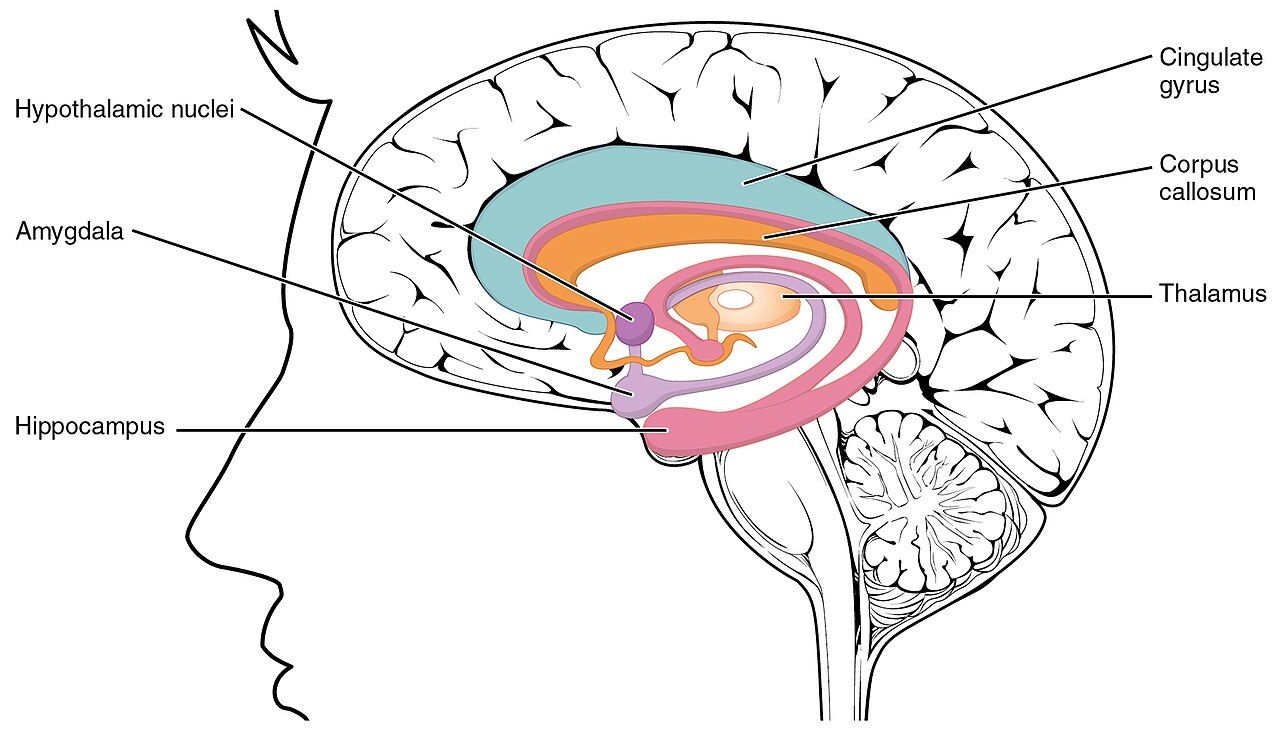
The emotional brain
Emotion lives mostly in the limbic system. This is a ring of structures curled under the outer layer of the brain, the cortex. It includes the hypothalamus, the same hunger controller from Section 2. Here it drives the body's arousal. It includes the hippocampus, which stores emotional memories. It includes the thalamus, which relays signals from the senses. Above all, it includes the amygdala.
The amygdala is the brain's threat detector. It is a pair of almond-shaped clusters. They check incoming signals for danger and trigger fear and aggression. Damage to it can wipe out normal fear. In Klüver-Bucy syndrome, monkeys had parts of the temporal lobes removed, including the amygdala. Afterward they calmly approached things they would usually flee. People with damage to the amygdala have trouble recognizing fear on other people's faces.
Two roads to fear
The brain scientist Joseph LeDoux traced two paths that a scary signal can take to the amygdala. The low road runs straight from the thalamus to the amygdala. It is fast, rough, and unconscious. It lets you jump back from a stick shaped like a snake before you know what it is. The high road goes from the thalamus up to the cortex for a careful look. Then it goes down to the amygdala. It is slower but more accurate. It lets you realize the snake was only a stick.
The low road is why emotion can outrun thought. That is the point Zajonc and LeDoux made against pure appraisal theories in Section 3. Meanwhile, the prefrontal cortex helps make sense of these signals and keeps them in check. The insula is especially active in disgust.
| Structure | Role in emotion |
|---|---|
| Amygdala | Detects threat; central to fear and aggression |
| Hypothalamus | Triggers body (autonomic) arousal |
| Hippocampus | Forms and recalls emotional memories |
| Thalamus | Relays sense signals to the cortex and amygdala |
| Prefrontal cortex | Makes sense of emotions and keeps them in check |
| Insula | Active in disgust and in sensing the body |
Arousal and the body's alarm
When the amygdala sounds an alarm, it calls on the autonomic nervous system. This is the part of the nervous system that runs the body without our control. Its sympathetic branch launches the fight-or-flight response. The adrenal glands flood the blood with epinephrine (adrenaline) and cortisol. The heart races. The pupils widen. Breathing speeds up. Digestion stops. The body is ready for action. When the threat passes, the parasympathetic branch brings back calm. It slows the heart and restarts digestion.
This is the body arousal that both the Cannon-Bard and Schachter-Singer theories talk about. It also explains the limits of the polygraph, or "lie detector." A polygraph measures arousal, such as heart rate, sweating, and breathing. But arousal comes with many emotions. So an honest person who is nervous and a calm liar can both fool it. Different emotions share a lot of the same body changes. That is exactly why context and thinking, from Section 3, do so much of the work of telling them apart.
- The limbic system (amygdala, hypothalamus, hippocampus, thalamus) is the emotional core of the brain.
- The amygdala detects threat and drives fear. Damage to it dulls fear (Klüver-Bucy syndrome).
- LeDoux's fast low road lets emotion come before conscious thought. The high road adds a careful check by the cortex.
- Sympathetic arousal (epinephrine, racing heart) prepares for fight-or-flight. The parasympathetic branch brings back calm.
The chapter in one breath
- Motivation gives behavior energy and direction. Theories run from instinct to drive-reduction (homeostasis) to arousal (best level of stimulation) to incentives.
- Maslow's hierarchy stacks needs from physiological to self-actualization. Lower needs usually come first.
- Hunger is run by the hypothalamus and by hormones. Ghrelin raises hunger and leptin lowers it, while learning and culture shape what we eat.
- An emotion mixes arousal, expression, and feeling. James-Lange, Cannon-Bard, and Schachter-Singer disagree about their order.
- Basic facial expressions are recognized across cultures (Ekman), but display rules control how they are shown.
- The limbic system, especially the amygdala, runs emotion. It has a fast path that beats conscious thought.
- Sympathetic arousal (epinephrine, fight-or-flight) is the shared body engine of strong emotion.
ReferenceWords worth knowing
Here is a quick list of the terms in this chapter. Skim it now, or come back any time a word trips you up.
- Amygdala
- An almond-shaped part of the limbic system. It detects threat and is central to fear and aggression.
- Arousal theory
- The idea that we are driven to reach a best level of stimulation, not too high and not too low.
- Basic emotions
- A small set of emotions (happiness, sadness, anger, fear, surprise, disgust) whose faces are recognized across cultures.
- Cannon-Bard theory
- The theory that body arousal and the felt emotion happen at the same time and on their own.
- Display rules
- Norms learned from culture about which emotions may be shown, to whom, and how strongly.
- Drive-reduction theory
- The idea that a body need creates a drive, which pushes us to act and restore homeostasis.
- Emotion
- A short response of the whole body, with body, expressive, and felt parts.
- Facial feedback hypothesis
- The idea that making a facial expression can change the emotion a person feels.
- Ghrelin
- A hormone released by an empty stomach that raises hunger.
- Hierarchy of needs
- Maslow's ranking of needs, from physiological at the bottom to self-actualization at the top.
- Homeostasis
- The body's habit of keeping a steady, balanced inner state.
- Instinct theory
- The early idea that behavior comes from inborn patterns shared by a species. It failed because naming an instinct does not explain the behavior.
- James-Lange theory
- The theory that emotion is our sense of a body response. The body reacts first, and the feeling follows.
- Lateral hypothalamus
- The part of the hypothalamus that acts as an "on" switch for eating.
- Leptin
- A hormone made by fat cells that signals stored energy and lowers appetite.
- Limbic system
- A group of brain structures (amygdala, hippocampus, hypothalamus, thalamus) central to emotion and motivation.
- Motivation
- The inner forces that give behavior energy and point it toward a goal.
- Schachter-Singer theory
- The two-factor theory that emotion comes from body arousal plus a mental label taken from the situation.
- Self-actualization
- The need to reach your full potential. It is the top of Maslow's hierarchy.
- Set point
- A weight the body is said to defend by changing hunger and metabolic rate. Many researchers now prefer the idea of a settling point.
- Sympathetic nervous system
- The branch of the autonomic nervous system that launches the fight-or-flight response.
- Ventromedial hypothalamus
- The part of the hypothalamus that signals fullness. It acts as an "off" switch for eating.
- Yerkes-Dodson law
- The rule that performance peaks at a medium level of arousal. The best level is lower for hard tasks than for easy ones.
Check yourself
Personality
Ask a friend to describe someone you both know. You will hear the words of personality: she is so outgoing, he never gets rattled, they are hard to pin down. Personality is why a person is still clearly themselves from day to day and from room to room. It is their usual way of thinking, feeling, and acting. It goes with them everywhere. This chapter follows a debate that has run for about one hundred years. Where does that pattern come from? Freud pointed to hidden conflicts in the unconscious. The humanists pointed to a self that wants to grow. Trait theorists counted a few main dimensions. Social-cognitive theorists saw a loop between the mind and the situation. The chapter ends with a practical problem. How do you measure something as private as a personality?
By the end of this chapter you can
- Define personality. Explain what consistency across situations and over time does and does not mean.
- Describe Freud's model of the id, ego, and superego, and his levels of awareness.
- Name the main defense mechanisms and give an everyday example of each.
- Sum up how the neo-Freudians (Jung, Adler, Horney, and Erikson) changed Freud's ideas.
- Compare the humanistic theories of Rogers and Maslow with the psychodynamic view.
- Name and describe the Big Five (OCEAN) trait dimensions.
- Explain Bandura's reciprocal determinism and Rotter's locus of control.
- Tell self-report inventories apart from projective tests, and weigh the strengths of each.
Section 1What we mean by personality
A characteristic and enduring pattern
Personality is a person's characteristic, enduring pattern of thinking, feeling, and behaving. Two words in that definition do most of the work. Characteristic means the pattern is typical of that person. It sets them apart from other people. That is why a description like "careful and warm" tells you something. Enduring means the pattern shows up again and again. It does not flicker from moment to moment. It is what is left once you set aside one bad morning or one good mood.
The idea that people come in stable types is very old. The ancient Greek doctor Hippocrates, and later Galen, said the body held four fluids, called humors. Galen linked them to four temperaments: sanguine (cheerful), choleric (quick to anger), melancholic (sad), and phlegmatic (calm). The biology was wrong. But the hunch lasted. Differences in how people react seem built in. They show up early, and they are slow to change. Modern psychology keeps the word temperament for just that idea. Temperament means the early, biology-based tendencies we see in babies, such as how easily a baby is calmed or startled. Later personality is built on top of it.
Consistency across situations and time
If personality is real, it should be consistent. But consistency has two separate meanings, and they are easy to mix up. Consistency over time means a person keeps the same place compared with other people as the years pass. The shy ten-year-old tends to become a quiet adult. Long-term studies that follow the same people for years find that this rank-order stability is high. It also grows stronger as people age. Consistency across situations means a trait shows up in different places. The careful student is also a careful worker. This second kind is weaker. It was at the center of a famous fight.
In 1968, Walter Mischel looked over the research. He pointed out a hard fact. How a person acts in one situation predicts how they act in a different situation only a little. A friendly person is not friendly to everyone, everywhere. This person-situation debate did not kill the idea of traits. It made the idea sharper. The answer that came out of it is called interactionism. Behavior comes from the person and the situation working together. Traits predict behavior best when you aggregate, which means you average many moments instead of betting on one. You are not the same in every room. But average your behavior over a hundred rooms, and a clear "you" appears.
| Perspective | Core idea | Personality is driven by… |
|---|---|---|
| Psychodynamic | Hidden conflict | Unconscious drives and early childhood (Freud, neo-Freudians) |
| Humanistic | Growth of the self | The drive to grow into your best self, plus a caring setting (Rogers, Maslow) |
| Trait | Measurable dimensions | A small set of stable traits that everyone has in different amounts (Allport, the Big Five) |
| Social-cognitive | Person meets situation | The loop among thoughts, behavior, and setting (Bandura, Rotter) |
| Biological | Built-in tendencies | Genes, temperament, and brain systems |
These views are the map for the rest of the chapter. They are not really enemies. They are different lenses pointed at the same person. A full picture of someone usually borrows from several of them at once.
- Personality is a characteristic, enduring pattern of thinking, feeling, and behaving.
- Consistency over time (rank-order stability) is strong. Consistency across situations is weaker. People shift more from place to place than from year to year.
- Mischel started the person-situation debate. It led to interactionism. Behavior comes from the person and the situation. Traits predict best when many moments are averaged.
- Temperament is the early base of personality. It is rooted in biology.
Section 2The psychodynamic view
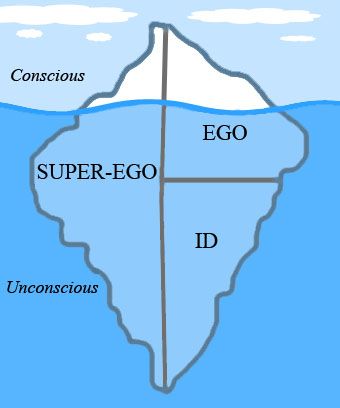
Freud and the unconscious
Sigmund Freud was a doctor in Vienna, Austria. Around 1900 he built the first complete theory of personality. He called it psychoanalysis. Its main claim still shapes how we talk about the mind: much of what drives us is unconscious, which means hidden from our own awareness. Freud pictured the mind as an iceberg. The small tip above the water is the conscious mind. It holds what you are aware of right now. Just below the surface is the preconscious. It holds things you can bring to mind easily, like a phone number. The huge part under the water is the unconscious. It holds wishes, fears, and memories, many from childhood. They push on behavior even though you cannot look at them directly. Freud believed they leak out in dreams, slips of the tongue, and symptoms.
Freud also said personality forms through a series of psychosexual stages: oral, anal, phallic, latency, and genital. Each stage centers on a different body area as a source of pleasure. He thought a child who got too much or too little at a stage could become fixated, or stuck, there. That would leave a lasting mark on the adult. The details of the stages have not held up well in research. But the broad idea, that early life shapes the lasting self, is still important.
Id, ego, and superego
Freud split personality into three parts that act on one another. The id is there from birth. It is fully unconscious. It runs on the pleasure principle: it wants what it wants, right now, with no thought for reality or results. The superego forms later. It is the inner voice of parents and society. It acts as the conscience and the ideal self, and it insists on how you should behave. Stuck between the two is the ego. It runs on the reality principle. The ego is the go-between. It finds real, socially acceptable ways to satisfy the id without setting off the superego's guilt. In this model, a healthy personality is one where the ego keeps a workable balance.
Defense mechanisms
Sometimes the ego cannot fully settle the id's demands with the superego's rules. The result is anxiety. To manage it, the ego uses defense mechanisms. These are unconscious strategies that bend reality just enough to make it bearable. Freud described them, and his daughter Anna Freud worked them out in more detail. Everyone uses them. They become a problem only when they are rigid or take over a life. One of them, sublimation, is usually seen as mature and healthy. It turns an unacceptable urge into a useful activity.
| Defense | What it does | Everyday example |
|---|---|---|
| Repression | Pushes upsetting thoughts out of awareness | Having no memory of an embarrassing childhood moment that others remember well |
| Denial | Refuses to accept a painful fact | Insisting a clearly failing relationship is "fine" |
| Projection | Sees your own unacceptable feelings in other people | A person who is cheating accuses their partner of cheating |
| Displacement | Moves an urge onto a safer target | Yelling at the dog after the boss criticizes you |
| Rationalization | Makes up a reasonable-sounding excuse for the real reason | "I didn't want that job anyway" after a rejection |
| Reaction formation | Shows the opposite of an upsetting urge | Being extra sweet to someone you resent |
| Regression | Goes back to an earlier, more childlike behavior | An adult sulking or throwing a tantrum under stress |
| Sublimation | Turns an unacceptable urge into a valued activity | Turning aggression into a competitive sport |
A note on repression. Freud thought people often bury terrible memories. Modern memory research finds the opposite for most people. Real trauma is usually remembered too well, not forgotten. Claims of fully "recovered" memories are debated. Memory can be changed by suggestion.
The neo-Freudians
Freud's early followers kept the idea of the unconscious. But they did not agree with his heavy focus on sex and aggression. They gave more weight to social and cultural forces. They are called the neo-Freudians, which means "new Freudians." Carl Jung started analytical psychology. He proposed a collective unconscious. This is a deep layer of the mind that all humans share. It is full of universal images he called archetypes, such as the hero, the mother, and the shadow. Alfred Adler coined the term inferiority complex. He said the great human motive is not sex. It is the push to stop feeling "less than" and to become capable. Karen Horney pushed back hard against Freud's view of women. She said personality is shaped by basic anxiety. That is a feeling of being alone and unsafe. It comes from childhood relationships, not from the body. Erik Erikson described eight psychosocial stages that cover the whole lifespan. Each stage poses a social crisis. Two examples are trust versus mistrust, and identity versus role confusion.
- Freud placed most of the mind in the unconscious. He split personality into three parts. The id seeks pleasure. The superego is the conscience. The ego is the go-between that deals with reality.
- Defense mechanisms are unconscious tricks the ego uses to lower anxiety. They bend reality a little. Sublimation is the mature one.
- The neo-Freudians kept the unconscious. But they stressed social forces and culture. Jung: the collective unconscious and archetypes. Adler: inferiority and striving. Horney: basic anxiety. Erikson: psychosocial stages.
- Freud's influence is huge, even though much of his specific theory lacks research support.
Section 3Humanistic and trait theories
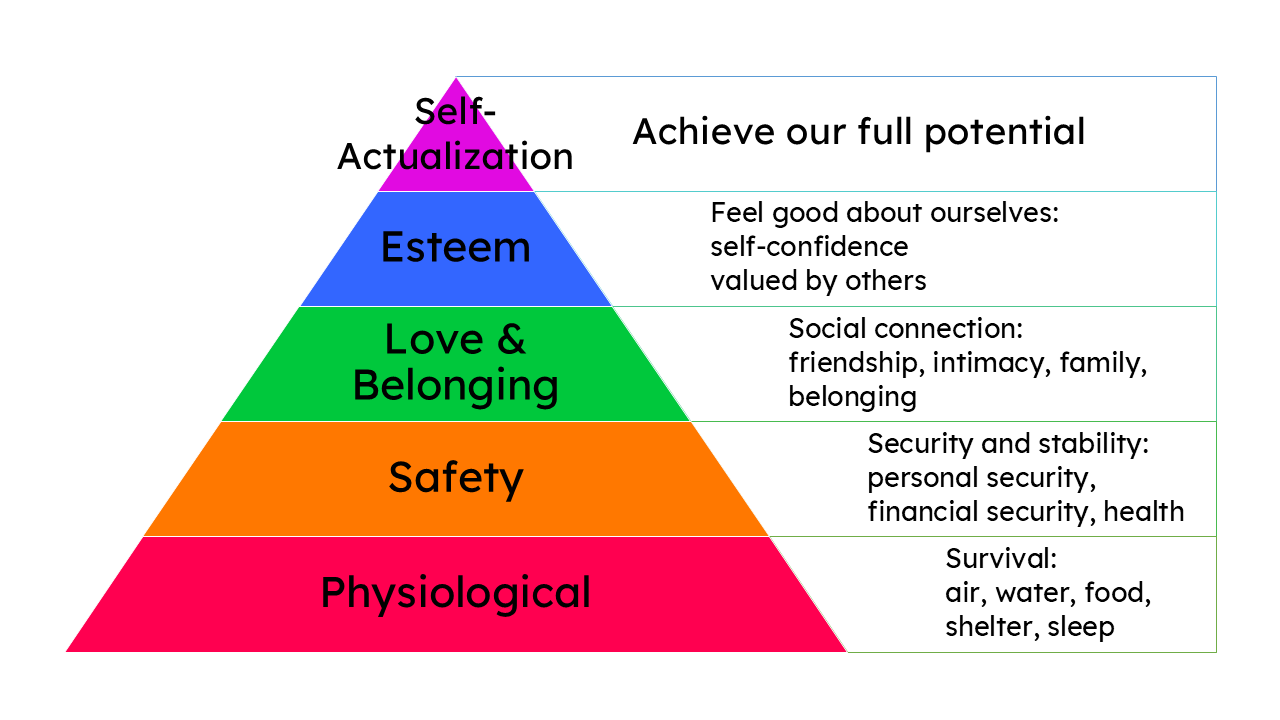
The humanistic response
By the mid-1900s, some psychologists found both psychoanalysis and behaviorism too gloomy. One saw people as buried conflicts. The other saw them as trained habits. The humanistic theorists offered a hopeful starting point instead. People are basically good. They are pulled forward by an inborn drive to grow. Abraham Maslow and Carl Rogers both called this drive self-actualization: the push to become the fullest version of yourself.
Maslow arranged human motives into a hierarchy of needs, usually drawn as a pyramid. Body needs, like food and water, sit at the bottom. Next come safety, then love and belonging, then esteem. Self-actualization is at the top. In general, lower needs must be fairly well met before higher ones feel pressing. Later research supports the broad idea but not a strict order. People can seek love or meaning even when they are hungry or unsafe.
Rogers focused on the self-concept, which is your sense of who you are. He argued that mental health depends on congruence. Congruence means a good match between your real self (who you are) and your ideal self (who you think you should be). What helps that health grow is unconditional positive regard: being accepted and valued with no strings attached. When acceptance has conditions, people twist themselves to earn it, and congruence suffers.
From types to traits
Trait theorists set aside the question of hidden causes. They asked a simpler one. What are the basic dimensions on which personalities differ, and how do we measure them? A trait is a fairly stable tendency to act in a certain way. Gordon Allport sorted traits into three kinds. Cardinal traits are a single theme that rules a whole life, and they are rare. Central traits are the handful of words you would use to describe a friend. Secondary traits are preferences that show up only in certain situations. Raymond Cattell used a math tool called factor analysis, which finds which traits tend to go together. With it he boiled the words for personality down to sixteen source traits. Hans Eysenck argued for even fewer. He stressed extraversion and neuroticism (how emotionally unsteady a person is), and he tied them to differences in how easily the brain is aroused.
The Big Five (OCEAN)
Decades of factor analysis settled on a middle number. Five broad dimensions capture most of the ways human personalities differ. This Five Factor Model, or Big Five, is remembered by the letters OCEAN. Each one is a scale. Everyone falls somewhere along it. It is not a box you are in or out of. The Big Five is the trait model with the most research support. It shows up in study after study, in many cultures and languages. It is also moderately heritable, which means genes explain a fair share of the differences between people.
| Dimension | High scorers | Low scorers |
|---|---|---|
| Openness | Curious, creative, drawn to new things and ideas | Traditional, practical, likes the familiar |
| Conscientiousness | Organized, disciplined, reliable | Spontaneous, careless, relaxed about rules |
| Extraversion | Outgoing, energetic, seeks social contact | Reserved, quiet, comfortable alone (introverted) |
| Agreeableness | Warm, trusting, cooperative, kind | Competitive, doubting, blunt |
| Neuroticism | Anxious, moody, quick to get upset | Calm, secure, even-tempered (emotionally stable) |
The Big Five describes. It does not explain. It tells you how people differ, not why. But that is still very useful. Conscientiousness predicts how well people do at work. It even predicts a longer life. Low agreeableness and high neuroticism predict trouble in close relationships. And the profile stays steady enough in adult life to be worth measuring.
- The humanistic theorists (Maslow, Rogers) focused on growth, not conflict. The goal of growth is self-actualization.
- Maslow's hierarchy of needs ranks motives. Body needs are at the bottom, and self-actualization is at the top. Rogers stressed the self-concept, congruence, and unconditional positive regard.
- A trait is a stable tendency. Allport, Cattell, and Eysenck tried to count the basic ones.
- The Big Five (OCEAN) is the trait model with the most support. The five are Openness, Conscientiousness, Extraversion, Agreeableness, and Neuroticism.
Section 4Social-cognitive theories
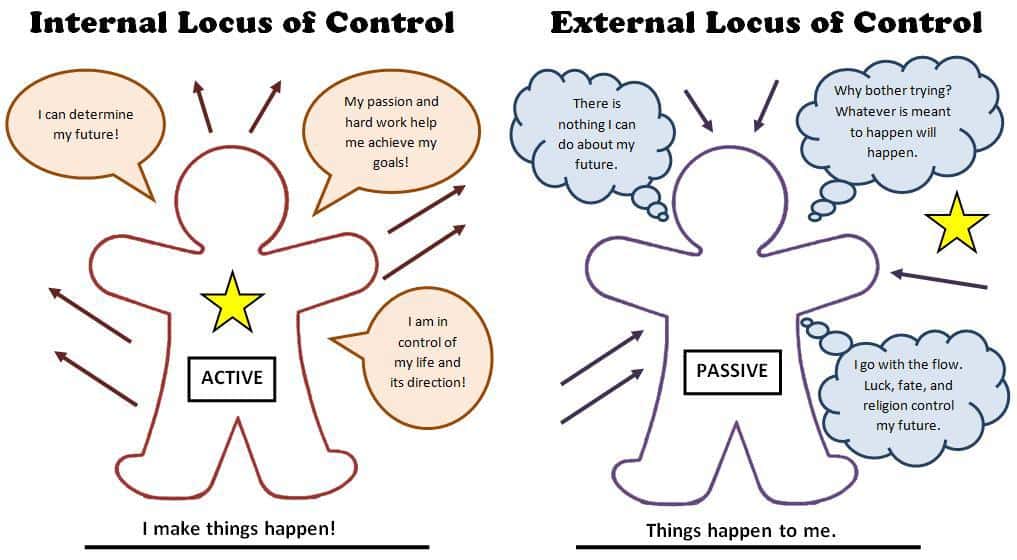
Reciprocal determinism
The social-cognitive approach grew out of learning theory. But it insisted that thinking matters. People are not just shaped by rewards. They interpret, look ahead, and choose. Its leading figure was Albert Bandura. He is the same researcher whose Bobo doll studies showed that children learn aggression by watching others. Bandura proposed reciprocal determinism. Personality comes from a constant, three-way exchange among behavior, inner personal factors (thoughts, beliefs, and expectations), and the environment. Each arrow runs both ways. Your setting shapes you. But you also pick and build your settings. A social person seeks out parties, and the parties make them even more social. In this view, personality is not a fixed core. It is a set of habits in how the three pieces feed one another.
Locus of control and self-efficacy
Two ideas capture the "personal factors" that matter most in this loop. Julian Rotter introduced locus of control. It is a person's general belief about who controls what happens in their life. People with an internal locus believe their own effort and choices drive their results. People with an external locus believe luck, fate, or powerful others decide their results. On average, internals try harder when things get tough. They also report better health and success. Still, a false sense of control has its own costs.
Bandura added self-efficacy. It is your belief that you can succeed at a specific task. It is not a general trait. It depends on the area. You can feel very capable at cooking and helpless at math. High self-efficacy leads people to try harder goals, keep going longer, and bounce back faster. Its opposite is learned helplessness. That is the passive giving up that can follow when a person fails again and again to control what happens.
| Internal locus of control | External locus of control | |
|---|---|---|
| Belief | "My results depend on me" | "My results depend on luck, fate, or others" |
| After failure | Tries a new plan, works harder | Gives up; sees effort as pointless |
| Often goes with | Higher success, better health habits | More stress, more passivity |
| Watch out for | Blaming yourself for things you could not control | Missing chances to act when acting would help |
- Reciprocal determinism is Bandura's idea. Your actions, your thoughts, and your setting all act on one another.
- People actively choose and shape their settings. They are not just molded by them.
- Locus of control (Rotter) is your belief about where results come from. Internal means from you. External means from outside forces.
- Self-efficacy is a task-specific belief that you can succeed. It strongly predicts effort and success.
Section 5Assessing personality
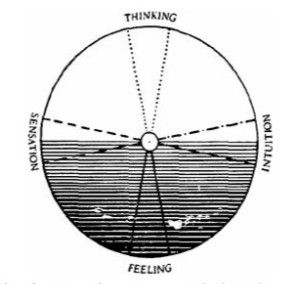
Self-report inventories
The most common way to measure personality is simply to ask. A self-report inventory is a standard questionnaire. The person rates how well many statements describe them. Everyone answers the same items. The items are scored the same way. So results can be compared with large norms, which are the scores of many other people. The best-known clinical example is the Minnesota Multiphasic Personality Inventory (MMPI). It was built to help spot mental health conditions. It has been updated many times. The newest version is the MMPI-3, from 2020. Its hundreds of items were chosen empirically, which means from data. An item was kept only if it truly told groups of people apart. The MMPI also has validity scales. They are built to catch people who lie, try to look good, or answer carelessly. Research tools such as the NEO-PI measure the Big Five in the same way.
Self-reports are easy to score in an objective way. They are reliable and quick. Their weakness is plain to see. They assume people can and will describe themselves honestly. People may not see themselves clearly. And social desirability, the pull to answer in ways that look good, can skew the results. That is exactly why serious inventories build in validity checks. A separate warning applies to popular type tests such as the Myers-Briggs, which come from Jung's types. They are fun. But they sort people into fixed boxes, and they are less reliable and less valid than scale-based measures like the Big Five. Many people get a different "type" when they retake the test.
Projective tests
Projective tests take the opposite approach. They do not ask clear questions. They show an ambiguous picture, one that could mean many things. The person is asked to make sense of it. The idea is that they will "project," or cast, their hidden feelings and motives onto it. In the Rorschach inkblot test, made by Hermann Rorschach, a person says what they see in a set of mirror-image inkblots. In the Thematic Apperception Test (TAT), made by Henry Murray and Christiana Morgan, the person tells a story about unclear scenes. Projective tests grew out of the psychodynamic tradition. That tradition cared most about the unconscious.
Their big appeal is that they are hard to fake. There is no clear "right" answer to aim for. Their big problem is measurement. Scoring depends on the scorer's judgment. Two scorers often disagree, so reliability is low. And whether the tests measure what they claim (validity) is disputed. Newer scoring systems for the Rorschach, such as the Exner system and the later R-PAS, have improved things. The tests are still used in clinics as one source of ideas to check. But most researchers trust well-tested self-report inventories more.
| Self-report inventory | Projective test | |
|---|---|---|
| Format | Clear statements the person rates | Unclear picture the person interprets |
| Examples | MMPI, NEO-PI, 16PF | Rorschach inkblots, TAT |
| Scoring | Objective, compared with norms | Depends on judgment; needs trained scorers |
| Main strength | Reliable, quick, can include validity scales | Harder to fake; may reveal what people won't say |
| Main weakness | Depends on honesty and self-insight | Lower reliability and disputed validity |
- Self-report inventories, such as the MMPI, are standard questionnaires. Scores are compared with norms. The MMPI adds validity scales to catch dishonest answers.
- Their weakness is that they need honest answers from people who know themselves. The pull to look good, called social desirability, can skew them.
- Projective tests (Rorschach, TAT) use unclear pictures to draw out unconscious material. They are hard to fake but weaker as measurement tools.
- A useful test must show reliability, which means steady scores. It must also show validity, which means it measures what it claims. The Barnum effect explains why unscientific "tests" feel convincing.
The chapter in one breath
- Personality is a person's usual and lasting way of thinking, feeling, and acting. It is more consistent over time than across situations. The person and the situation together predict behavior best.
- Freud's psychodynamic theory placed personality in the unconscious. He split it into three parts: the id, ego, and superego. Defense mechanisms help manage anxiety.
- The neo-Freudians (Jung, Adler, Horney, Erikson) kept the unconscious but stressed social and cultural forces.
- The humanists Rogers and Maslow stressed growth. Key ideas: self-actualization, the self-concept, and unconditional positive regard.
- Trait theory led to the Big Five (OCEAN). It is the best-tested way to describe how personalities differ.
- Social-cognitive theory sees personality as a loop. Thoughts, actions, and setting all shape one another. Key ideas: Bandura's reciprocal determinism, Rotter's locus of control, and self-efficacy.
- Personality is measured in two main ways. One is objective self-report inventories, such as the MMPI. The other is projective tests, such as the Rorschach and TAT. Projective tests are harder to fake but less reliable.
ReferenceWords worth knowing
A quick list of the terms in this chapter. Skim it now, or come back whenever a word trips you up.
- Archetype
- In Jung's theory, a universal image or theme passed down to all people, such as the hero or the mother. Archetypes live in the collective unconscious.
- Big Five (Five Factor Model)
- The five broad trait dimensions that capture most personality differences: Openness, Conscientiousness, Extraversion, Agreeableness, and Neuroticism (OCEAN).
- Collective unconscious
- Jung's idea of a deep layer of the mind shared by all humans. It holds archetypes passed down from our distant past.
- Defense mechanism
- An unconscious strategy the ego uses to lower anxiety by bending reality. Examples are repression, projection, and sublimation.
- Ego
- In Freud's model, the reality-based part of personality. It works out deals between the id's demands and the superego's rules.
- Id
- In Freud's model, the unconscious, pleasure-seeking part of personality. It is there from birth and wants instant satisfaction.
- Locus of control
- A person's general belief that results are controlled by their own actions (internal) or by luck, fate, or others (external).
- MMPI
- The Minnesota Multiphasic Personality Inventory. It is a widely used self-report inventory. Its items were chosen from data, and it has built-in validity scales.
- Personality
- A person's characteristic and enduring pattern of thinking, feeling, and behaving.
- Projective test
- A test that shows an unclear picture so the person casts hidden feelings and motives onto it. The Rorschach and the TAT are examples.
- Psychodynamic theory
- The family of theories, starting with Freud, that explains personality through unconscious drives and early life.
- Reciprocal determinism
- Bandura's idea that personality comes from the two-way exchange among behavior, personal factors, and the environment.
- Repression
- The defense mechanism that pushes upsetting thoughts and memories out of awareness.
- Rorschach inkblot test
- A projective test in which the person says what they see in a series of mirror-image inkblots.
- Self-actualization
- The humanistic drive to reach your fullest potential. It is the top of Maslow's hierarchy of needs.
- Self-concept
- In Rogers's theory, your overall sense of who you are. Health depends on a good match (congruence) between the real self and the ideal self.
- Self-efficacy
- Bandura's term for your belief that you can succeed at a specific task.
- Sublimation
- The usually healthy defense mechanism that turns an unacceptable urge into a socially valued activity.
- Superego
- In Freud's model, the inner conscience and ideal self. It enforces moral rules.
- Temperament
- Early, biology-based tendencies in how strongly a person reacts and in their usual mood. Later personality is built on it.
- Trait
- A fairly stable tendency to act, think, or feel in a certain way over time.
- Unconditional positive regard
- Rogers's term for accepting and valuing a person with no conditions. It helps healthy growth.
Check yourself
Social Psychology
Your situation shapes you more than you might think. Social psychology studies how other people change what we feel, believe, and do. Those people can be real, imagined, or only implied. Its most lasting finding is humbling. In the right setting, ordinary people will go along with something they know is false. They will obey an authority even when it seems cruel. They will walk past an emergency. They will turn a harmless neighbor into a feared stranger. This chapter starts with the quiet, everyday work of explaining behavior. Then it moves to the loud, high-stakes forces of the group. Along the way you will meet the studies that made the field famous: Asch's lines, Milgram's shocks, and the bystanders who did nothing. You will also see what those studies teach us. They show how to steer ourselves and others toward better choices.
By the end of this chapter you can
- Define attribution. Explain the fundamental attribution error, the actor-observer effect, and the self-serving bias.
- Describe how attitudes relate to behavior. Explain cognitive dissonance using Festinger and Carlsmith's classic study.
- Compare the central and peripheral routes to persuasion. Spot common compliance techniques.
- Sum up what Asch found about conformity and what Milgram found about obedience. Tell normative influence from informational influence.
- Explain group effects, including social facilitation, social loafing, groupthink, and deindividuation.
- Tell prejudice, stereotype, and discrimination apart. Explain how in-group/out-group thinking and the contact hypothesis shape them.
- Explain the bystander effect through diffusion of responsibility. Describe the main theories of aggression.
Section 1How we explain behavior
The attribution habit
People are always explaining things. Someone cuts you off in traffic. A coworker snaps in a meeting. A stranger drops some coins and keeps walking. In a heartbeat, your mind has come up with a why. This quick habit of giving a cause to a behavior is called attribution. The Austrian psychologist Fritz Heider introduced the idea. He described ordinary people as everyday scientists, always testing small theories about one another. Heider saw that our explanations fall into two big buckets. A dispositional (or internal) attribution puts the cause inside the person: their character, skill, mood, or intent. A situational (or external) attribution puts the cause outside the person, in the setting pressing on them.
This is not just a fine point. It decides how we respond. Suppose a student fails a test. If you read it as laziness (dispositional), you may feel scorn. If you read it as a family crisis plus a night shift (situational), you feel sympathy. Whole relationships, court verdicts, and public policies turn on which bucket we reach for. And as the next idea shows, we do not reach evenly.
The fundamental attribution error
When we explain other people's behavior, we lean too hard on disposition. We give too little weight to the situation. This lopsided habit is the fundamental attribution error (FAE). The name comes from Lee Ross. It is one of the strongest findings in the field. In a famous study, Edward Jones and Victor Harris had students read an essay. The essay either praised or criticized the Cuban leader Fidel Castro. The readers were told plainly that a coin flip had assigned the writer's side. Even so, they believed a pro-Castro essay showed truly pro-Castro views. The situation was obvious, and they ignored it anyway.
Notice what changes when the person being judged is you. The actor-observer bias works like this. We explain our own behavior by the situation. But we explain the same behavior in others by their character. "I was late because traffic was terrible. You were late because you are disorganized." Add the self-serving bias. That is taking credit for our successes but blaming outside forces for our failures. Together they show a mind that quietly guards its own image. The FAE also depends on culture. It is stronger in individualist cultures, which prize the independent person. It is weaker in collectivist cultures, which pay more attention to the situation.
| Bias | Whose behavior | What we do | Everyday example |
|---|---|---|---|
| Fundamental attribution error | Another person's | Blame character too much, situation too little | “He's just a rude person,” ignoring his bad day |
| Actor-observer bias | Ours vs. theirs | Situation for us, character for them | “I snapped because I'm stressed; she snapped because she's mean” |
| Self-serving bias | Ours | Inside causes for success, outside causes for failure | “I aced it” vs. “the test was unfair” |
| Just-world bias | A victim's | Assume people get what they deserve | Blaming the victim of a crime or illness |
- Attribution means giving a cause to behavior. The cause can be dispositional (inside the person) or situational (outside).
- The fundamental attribution error is our habit of blaming others' character too much. We ignore their situation.
- The actor-observer bias and the self-serving bias both tilt our explanations in a way that flatters us.
- The FAE is stronger in individualist cultures than in collectivist ones.
Section 2Attitudes and persuasion
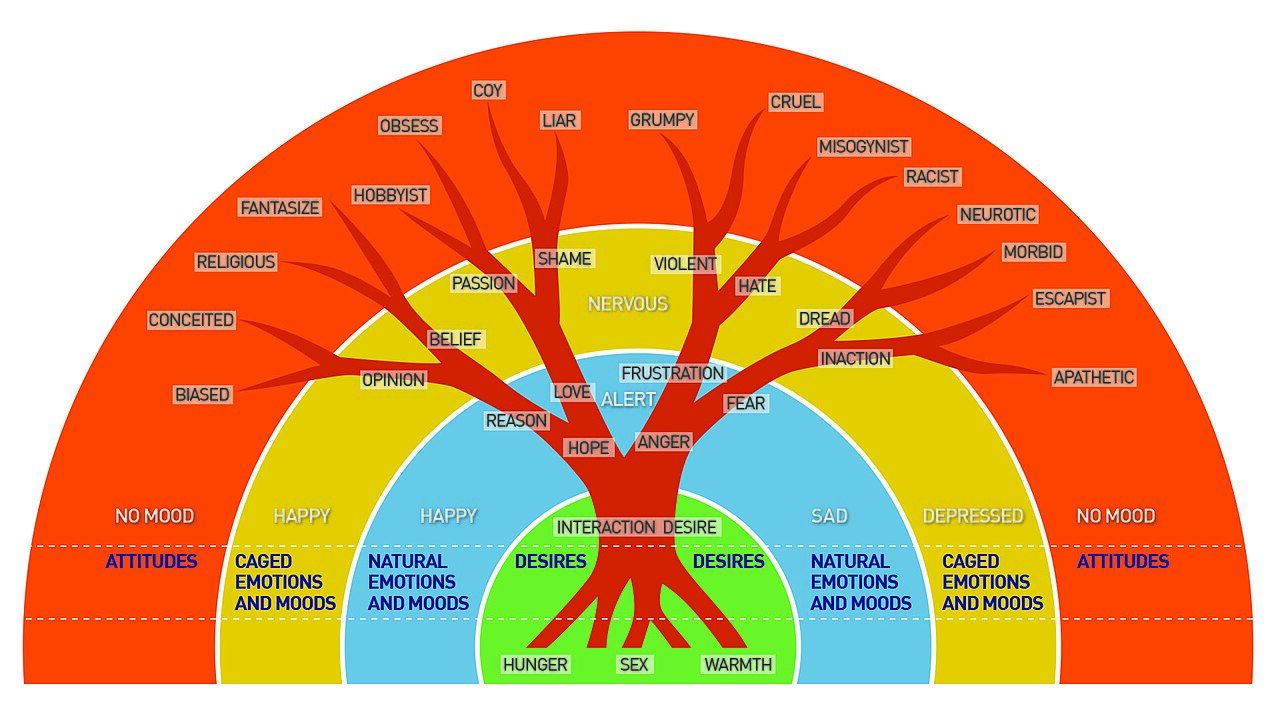
What an attitude is, and when it predicts behavior
An attitude is a judgment, good or bad, about a person, thing, or idea. It has three strands woven together. The cognitive part is what you believe. The affective part is how you feel. The behavioral part is how you tend to act. We assume attitudes drive behavior. Often they do. But the link is looser than you might expect. In a classic study in the 1930s, Richard LaPiere traveled across the United States with a young Chinese couple. They were refused service only once. Later, LaPiere wrote to the same hotels and restaurants. He asked if they would serve Chinese guests. Over ninety percent of those who wrote back said no. What people said and what they did were completely different. Attitudes predict behavior best when they are strong, when they are specific to the action, when they come from direct experience, and when outside pressures are weak.
Cognitive dissonance: when actions rewrite attitudes
We usually expect attitudes to shape behavior. One of the field's key insights is that the arrow also runs backward. Behavior shapes attitudes. Leon Festinger called this cognitive dissonance. We feel an uneasy tension when we notice two beliefs that clash, or a belief that clashes with an action. We want to ease that tension. Often we do it by quietly changing the attitude to match what we already did.
The proof is a simple study from 1959 by Festinger and James Carlsmith. People spent an hour on a very boring task: turning pegs, over and over. Then they were paid to tell the next person that the task had been fun. Some were paid twenty dollars to say it. Others were paid only one dollar. Later, they were asked how fun the task really was. The twenty-dollar group admitted it was dull. But the one-dollar group said it had truly been interesting. Why the flip? The twenty-dollar group had a good outside reason: "I did it for the money." So they felt no dissonance. The one-dollar group had no such excuse. "I said it was fun" clashed with "it was boring." The only easy fix was to decide it had been fun after all. When we have too little outside reason for what we did, our real attitudes often change.
Two roads to persuasion
Persuasion is a planned attempt to change an attitude. Richard Petty and John Cacioppo created the elaboration likelihood model. It maps two routes for persuasion. The central route works through the content of the message. That means the evidence, the logic, and how good the reasons are. It persuades people who want to think hard and are able to. The change it creates lasts. It holds up when someone argues back. The peripheral route works through cues around the message. Examples are a good-looking speaker, a celebrity, or plain repetition. Another is a long list of arguments, even weak ones. This route persuades people who are distracted, rushed, or not interested. Its effects are shallow, and they fade fast. Advertisers use both. A drug ad packs in central-route data for the doctor, and peripheral-route smiling actors for everyone else.
Research on persuasion also covers compliance techniques. These are scripts that raise the odds of getting a yes. In the foot-in-the-door technique, studied by Freedman and Fraser, you first agree to a small request. That makes you much more likely to agree to a bigger one later. You have started to see yourself as the kind of person who helps. The door-in-the-face technique is the mirror image. The persuader opens with a huge request that you will refuse. Then they follow with the smaller request they wanted all along. Now it feels like a fair compromise.
| Feature | Central route | Peripheral route |
|---|---|---|
| Persuades through | How strong the argument is | Surface cues: source, looks, repetition |
| Audience | Wants to and is able to think it through | Distracted, rushed, or not invested |
| Result | Lasting, holds up against counterarguments | Short-lived, easily reversed |
| Typical use | Expert briefings, informed decisions | Impulse ads, jingles, celebrity endorsements |
- An attitude has three parts: beliefs, feelings, and tendencies to act. It predicts behavior best when it is strong and specific, and when outside pressure is low.
- Cognitive dissonance is the discomfort of a clash between beliefs or actions. We often ease it by changing the attitude to fit the action. This is Festinger and Carlsmith's one-dollar effect.
- The central route persuades through strong arguments. The peripheral route persuades through surface cues.
- Foot-in-the-door and door-in-the-face are compliance techniques. One uses commitment. The other uses a fake compromise.
Section 3Conformity and obedience
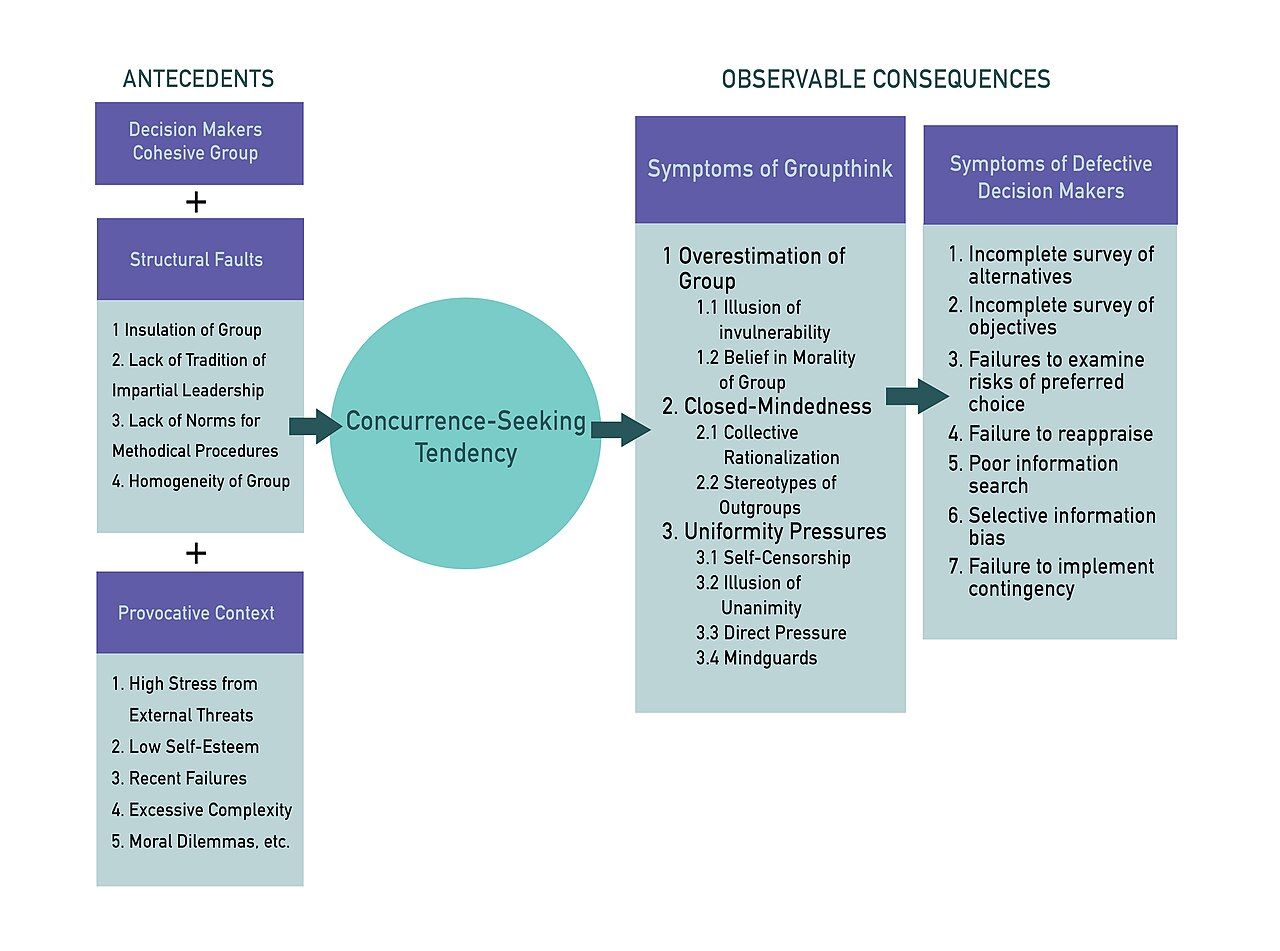
Conformity: Asch and the power of the majority
Conformity means changing our behavior or opinions to match a group. In the early 1950s, Solomon Asch made a test that seems impossible to fail. People looked at a standard line. Then they said which of three other lines matched it. The answer was obvious. Here was the twist. The other people in the room were confederates, which means actors working for the researcher. On certain trials, they all gave the same wrong answer. The real participant faced a group that all disagreed with what their own eyes saw. About seventy-five percent of real participants went along with the wrong answer at least once. Across the key trials, people went along with the group about a third of the time.
Why go along with an answer you can see is wrong? Asch's work showed two different engines. Normative social influence is conforming to be liked and accepted. You know the group is wrong, but you do not want to stand out. Informational social influence is conforming because you think the group knows something you do not. It is a real change of mind. It is strongest when a situation is unclear. Muzafer Sherif had already shown the informational kind with the autokinetic effect. In a dark room, a still point of light seems to move. People who watched it together slowly agreed on how far it "moved." Asch also found that conformity drops sharply when even one other person breaks from the group. The greatest gift a lone dissenter gives is company.
Obedience: Milgram and the man in the lab coat
Conformity gives in to peers. Obedience gives in to authority. Stanley Milgram ran some of the most troubling studies in psychology. He began in 1961 at Yale, the same year the trial of Nazi official Adolf Eichmann began. Eichmann claimed he was only following orders. Milgram told volunteers they were in a learning study. Each volunteer was given the role of "teacher." A "learner," who was really a confederate, answered questions. Each time the learner made a mistake, the teacher was told to give an electric shock. The shocks rose in fifteen-volt steps. They started at 15 volts and ended at a final switch marked 450 volts: XXX. No shocks were real, but the teachers did not know that. The learner cried out, begged to stop, complained of a heart problem, and finally went silent. Through it all, an experimenter in a gray coat calmly said, "The experiment requires that you continue." Milgram expected almost no one to go all the way. Instead, about sixty-five percent of ordinary people obeyed all the way to 450 volts.
This is not a story about monsters. It is a story about situations. Obedience went up when the authority seemed legitimate and was in the room. It went up when the institution had prestige. It went up when people could pass the blame up the chain ("I was just following orders"). And it went up when the victim was far away. It dropped sharply when the learner was in the same room. It dropped when the experimenter gave orders by phone, or when other "teachers" refused. The 65 percent figure comes from one version of the study. Across Milgram's many versions, obedience ranged widely, from almost none to more than 90 percent. A partial repeat of the study in 2009, stopping at 150 volts, found high rates, similar to Milgram's. The Stanford Prison Experiment, led by Philip Zimbardo in 1971, is often cited for the same idea: roles and settings can quickly change behavior. But it is now seen as deeply flawed. It had no control group, and guards were coached on how to act. Treat it as a cautionary story, not as strong evidence.
The group as a force of its own
Groups do more than push members toward a norm. They change how people perform, how hard they try, and how they decide. On easy or well-practiced tasks, just having others around improves performance. This is social facilitation. Norman Triplett first noticed it with bicycle racers, who rode faster with others. Robert Zajonc explained it. Others make us more aroused, and arousal strengthens our dominant response, which is whatever we do most easily. On hard or new tasks, that same arousal makes us worse. When everyone's effort is pooled and no one can be singled out, people slack off. This is social loafing. It is why a committee of eight often does the work of three. In a large, anonymous, excited crowd, people can lose self-awareness and self-control. This is deindividuation, the psychology behind mob behavior. And in the meeting room, close groups that want to agree can shut down disagreement and misjudge reality. Irving Janis named this groupthink. He traced it through failures like the Bay of Pigs invasion of 1961. A related effect is group polarization. When like-minded people talk together, their views do not soften. They grow more extreme in the direction they already leaned.
| Effect | What happens | Key study or name |
|---|---|---|
| Conformity | Match the group even against clear evidence | Asch's line judgments (~37% of trials) |
| Obedience | Follow an authority's harmful orders | Milgram (~65% to 450 V) |
| Social facilitation | Others help on easy tasks, hurt on hard ones | Triplett; Zajonc |
| Social loafing | Less effort when effort is pooled and no one is singled out | Ringelmann's rope pull; Latané |
| Groupthink | The wish to agree crushes a realistic look at facts | Janis (Bay of Pigs) |
- Asch showed strong conformity to a majority, even on an easy task. A single ally sharply cuts it.
- Normative influence is conforming to fit in. Informational influence is conforming because you think others know better.
- Milgram found that about 65% of people obeyed up to 450 volts. They thought that shock could kill. The situation drives obedience, not an evil nature.
- Groups change how people act. Five ways are social facilitation, social loafing, deindividuation, groupthink, and group polarization.
Section 4Prejudice and stereotypes
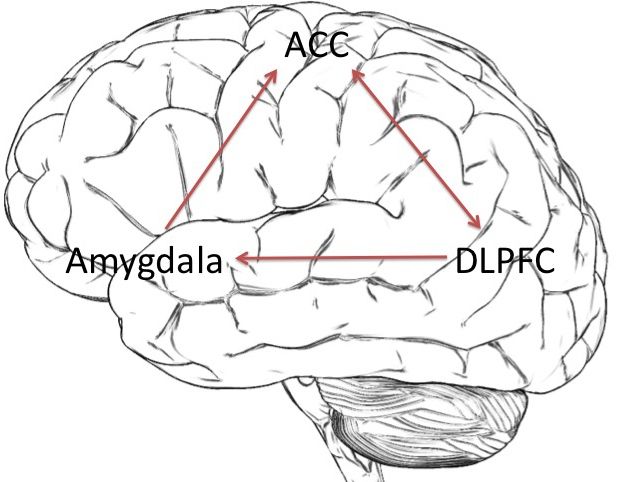
Three cousins: prejudice, stereotype, discrimination
People often use these three words as if they meant the same thing. Keeping them straight is the base of this topic. A stereotype is a belief. It is a broad idea about the members of a group, such as "accountants are dull" or "athletes are not smart." Prejudice is an attitude. It is a judgment made ahead of time, usually a negative feeling toward a group and its members. Discrimination is behavior. It is the unfair act of treating people differently because of their group. Line them up with the three parts of an attitude and they fit neatly. A stereotype is the thought. Prejudice is the feeling. Discrimination is the deed. They tend to travel together, but not always. Someone can hold a stereotype without acting on it. Laws against discrimination target the behavior, because beliefs and feelings are much harder to make laws about.
In-groups, out-groups, and the ease of “us versus them”
Prejudice is fed by a mental move so basic that no one has to teach it. We split the social world into the in-group ("us") and the out-group ("them"). Some predictable errors follow. In-group bias is our habit of favoring, trusting, and rewarding our own group. Out-group homogeneity is the false sense that "they are all alike," while "we" are all different. Henri Tajfel's social identity theory showed how little it takes to set this off. He used the minimal group paradigm. People were sorted into groups by something as small as a coin toss, or by liking one painter more than another. Right away, they began to favor their own group when handing out rewards. Part of our self-esteem comes from the groups we belong to. So lifting up our group and putting down the other one helps us feel good about ourselves. Add a fight over scarce resources, or a frustrating threat, and the out-group can easily become a scapegoat. A scapegoat is a target that gets unfairly blamed.
Reducing prejudice
If groups can create prejudice, can they also undo it? Gordon Allport proposed the contact hypothesis. It says that bringing groups together reduces prejudice, but only under certain conditions. The groups must have equal status in the situation. They must work toward common goals. They must cooperate rather than compete. And they must have the support of leaders or the law. Just being near each other is not enough. It can even make things worse. Muzafer Sherif's Robbers Cave study showed the cure. Two groups of boys at a summer camp became bitter rivals. They made peace only when the researchers created superordinate goals. These were problems neither group could solve alone, like a broken water supply. (Later writers have raised questions about how the study was run, but its main lesson has held up in other research.) In the classroom, Elliot Aronson's jigsaw technique builds in the same kind of teamwork. Each student gets one piece of the material that the others need. So success means reaching across group lines.
| Term | Type | Definition | Example |
|---|---|---|---|
| Stereotype | Belief (cognitive) | A broad idea about a group's members | “Older workers can't learn new tools” |
| Prejudice | Attitude (affective) | A prejudged, usually negative feeling toward a group | Disliking someone before meeting them |
| Discrimination | Behavior | Unfair, different treatment because of a group | Refusing to hire someone because of ethnicity |
- A stereotype is a belief. Prejudice is an attitude or feeling. Discrimination is a behavior. They are different but linked.
- In-group bias and out-group homogeneity come from splitting the world into "us" and "them." Even trivial groups can set off favoritism. This is the minimal group paradigm.
- The contact hypothesis says contact can reduce prejudice. It needs four things: equal status, common goals, teamwork, and support from leaders.
- Superordinate goals (Robbers Cave) and the jigsaw classroom use teamwork to ease conflict between groups.
Section 5Helping and hurting
Prosocial behavior and altruism
Prosocial behavior is any action meant to help another person. It can be as small as holding a door or as big as donating a kidney. Its purest form is altruism. Altruism is helping out of real concern for someone else's well-being. It happens even when it costs you, and with no reward expected. People have argued for a century about whether truly selfless helping exists. Daniel Batson's empathy-altruism hypothesis says that when we feel empathy for someone, we help for their sake, not our own. Critics reply that we help to ease our own distress, or to look good to others. Evolution-based ideas add two more motives that need no conscious plan. Kin selection means we favor relatives, who share our genes. Reciprocal altruism means helping today earns help tomorrow.
The bystander effect
Common sense says that the more people who see an emergency, the more likely someone will help. Research found something surprising. The bystander effect is the finding that each person is less likely to help when others are around. The research grew out of the 1964 murder of Kitty Genovese in New York. News reports said many neighbors saw the attack and did nothing. (Later reporting showed those early details were exaggerated. Fewer people saw it clearly, and at least one person did call for help. But the puzzle it raised was real.) Bibb Latané and John Darley ran the studies that explained it. In one, participants heard another person, over an intercom, seem to have a seizure. Those who thought they were the only listener almost always went for help. Those who thought several others were also listening helped much less, and much more slowly.
Two mechanisms do the work. Diffusion of responsibility means that as the number of bystanders grows, each person feels less personal duty. "Someone else will handle it." Pluralistic ignorance means we look at the calm faces around us to decide whether this is truly an emergency. But everyone is doing the same thing. So the whole group's inaction looks like the whole group's judgment that nothing is wrong. Latané and Darley built these into a five-step model. A bystander must (1) notice the event, (2) see it as an emergency, (3) take personal responsibility, (4) know how to help, and (5) decide to act. If any step breaks, no help comes. The best fix is to beat diffusion directly. Point to one person: "You, in the red jacket, call 911." One more point is worth knowing. A 2019 study of real street conflicts, caught on camera in three countries, found that someone stepped in about 90 percent of the time. Larger groups made it more likely that someone helped, even though each single person was less likely to.
Aggression
If helping is one edge of social behavior, aggression is the other. Aggression is behavior meant to harm someone who wants to avoid it. There are two kinds. Hostile aggression is driven by anger and aims to cause pain. Instrumental aggression is a cold means to some other goal, like hurting someone to steal from them. The causes come in layers. Biology plays a part. The amygdala, testosterone, and low serotonin are all linked to it. Next is the classic frustration-aggression hypothesis. It came from Dollard and his colleagues. Leonard Berkowitz later refined it. The idea is that blocked goals breed aggression. This is most likely when there are cues around that hint at violence. Berkowitz's weapons effect found that just seeing a gun could raise aggression. Later studies found this effect is smaller and less steady. Finally, Albert Bandura's famous Bobo doll studies showed that aggression can be learned. Children watched an adult punch and kick an inflatable doll. Later, they copied those exact acts. So violence can pass from person to person by watching and copying. It is not only frustration or instinct. That finding is still central to debates about violent media.
| Step in helping | What must happen | What blocks it |
|---|---|---|
| 1. Notice | Pay attention to the event | Distraction, hurry, a busy scene |
| 2. Interpret | See it as a real emergency | Pluralistic ignorance: others look calm |
| 3. Take responsibility | Feel it is your job to act | Diffusion of responsibility in a crowd |
| 4. Know how | Have the skills or knowledge to help | Feeling unqualified |
| 5. Decide to help | Weigh the costs and act | Fear, cost, uncertainty |
- Prosocial behavior helps others. Altruism is helping for another person's sake. It is explained by empathy (Batson), kin selection, and give-and-take.
- The bystander effect means each person helps less when more people are watching. Two causes are diffusion of responsibility and pluralistic ignorance.
- Latané and Darley's five-step model shows that helping can fail at any step. Naming one helper beats diffusion.
- Aggression has three main sources. They are biology, frustration (Berkowitz), and learning by watching (Bandura's Bobo doll).
The chapter in one breath
- Attribution explains behavior by the person or by the situation. The fundamental attribution error makes us blame the person too much and ignore the situation. That theme runs through the whole chapter.
- Attitudes predict behavior only loosely. And behavior can rewrite attitudes. That is cognitive dissonance, seen in Festinger and Carlsmith's one-dollar effect.
- Persuasion takes one of two routes. The central route uses strong arguments and lasts. The peripheral route uses surface cues and fades. Compliance techniques like foot-in-the-door use commitment.
- Asch showed conformity to a majority. Milgram showed that about 65% obeyed an order to give a shock they thought could kill. The lesson is the power of the situation, not evil people.
- Groups change their members. Five ways are social facilitation, social loafing, deindividuation, groupthink, and group polarization.
- A stereotype is a belief. Prejudice is a feeling. Discrimination is a behavior. All three grow from in-group/out-group sorting. The contact hypothesis and superordinate goals help reduce them.
- Whether we help depends a lot on how many others are around. That is the bystander effect, driven by diffusion of responsibility. Aggression comes from biology, from frustration, and from learning by watching (Bandura).
ReferenceWords worth knowing
A quick list of the terms in this chapter. Skim it now, or come back whenever a word trips you up.
- Altruism
- Helping out of real concern for someone else's well-being, even at a cost to yourself and with no reward expected.
- Attitude
- A good or bad judgment about a person, thing, or idea. It has a belief part, a feeling part, and an action part.
- Attribution
- The process of explaining what caused a behavior. The cause can be dispositional (inside the person) or situational (outside).
- Bystander effect
- The finding that each person is less likely to help in an emergency when other people are present.
- Central route to persuasion
- Persuasion through the strength and content of an argument. It creates lasting attitude change.
- Cognitive dissonance
- The uneasy tension of holding beliefs that clash, or of acting against a belief. It pushes us to change our attitudes.
- Conformity
- Changing your behavior or opinions to match a group.
- Contact hypothesis
- Allport's idea that contact between groups reduces prejudice when there is equal status, common goals, cooperation, and support from leaders.
- Deindividuation
- The loss of self-awareness and self-control that can happen in large, anonymous, excited groups.
- Diffusion of responsibility
- The drop in each person's sense of duty to act as the number of bystanders grows.
- Discrimination
- Unfair behavior that treats people differently because of their group.
- Foot-in-the-door technique
- A compliance tactic. Agreeing to a small request makes a person more willing to agree to a bigger one later.
- Fundamental attribution error
- The habit of giving too much weight to character and too little to the situation when explaining other people's behavior.
- Groupthink
- Poor decision-making in a close group, where the wish to agree overrides a realistic look at the options.
- In-group bias
- The habit of favoring and giving special treatment to members of your own group.
- Normative social influence
- Going along with a group to be liked or accepted, not because you think the group is right.
- Obedience
- Changing your behavior because a person in authority directly tells you to.
- Peripheral route to persuasion
- Persuasion through surface cues around a message, such as the source, good looks, or repetition. It creates shallow change that is easily reversed.
- Prejudice
- A judgment made ahead of time, usually a negative attitude and feeling, toward a group and its members.
- Prosocial behavior
- Any voluntary action meant to help another person.
- Self-serving bias
- Giving yourself credit for successes (inside causes) and blaming outside causes for failures.
- Social loafing
- The habit of putting in less effort when everyone's work is pooled and no one is singled out.
- Stereotype
- A broad belief about what the members of a group are like.
Check yourself
Stress, Health & Coping
A deadline. A diagnosis. A hard talk with someone you love. The events we call "stressful" are very different from each other. Yet your body answers almost all of them with the same old alarm. This chapter is about that alarm. You will learn what sets it off, which hormones it sends out, and what it does to your heart and immune system when it never shuts off. There is good news too. How you read a situation, and how you respond to it, changes a great deal. The skills of coping, connection, and resilience can be learned. Stress is not just something that happens to you. It is a back-and-forth between a demand and the resources you bring to meet it.
By the end of this chapter you can
- Define stress, and tell a stressor apart from the stress response.
- Explain Lazarus's appraisal model, with its primary and secondary appraisal.
- Describe the fight-or-flight response and the jobs of the sympathetic nervous system and adrenaline.
- Outline Selye's general adaptation syndrome, and trace the HPA axis down to cortisol.
- Explain how chronic stress harms the cardiovascular system and the immune system.
- Tell problem-focused coping from emotion-focused coping, and match each one to the situation.
- Describe how social support softens stress, and why relationships protect health.
- Sum up what positive psychology says about happiness and what goes into resilience.
Section 1What stress is
Stressor, response, and the appraisal in between
In everyday talk, "stress" means whatever is bothering us. Psychologists split the idea into two parts. A stressor is the demand or threat itself. It might be the exam, the traffic, or the argument. The stress response is what happens inside you when you meet it. Your heart races, hormones flood your blood, and your thoughts churn.
Stress, then, is best defined as the whole process. It is how we notice and respond to events we judge as threatening or challenging. The word judge is the key. The same event can flatten one person and fire up another. A stressor only becomes stressful after the brain has sized it up. Psychologists call that sizing up an appraisal.
Not all stress is bad. Hans Selye coined the word eustress for good stress. It is the stress of a challenge you feel able to meet, such as a first date, a big game, or a promotion. Its opposite is distress, the draining, harmful kind. The difference often lies less in the event and more in how you see it. Is it a threat to survive, or a challenge to rise to?
Kinds of stressors
Stressors come in several sizes. Cataclysmic events are sudden, large disasters that strike many people at once. Earthquakes, war, and a pandemic are examples.
Significant life changes are big personal shake-ups, such as a death, a divorce, or a move. Thomas Holmes and Richard Rahe built the classic Social Readjustment Rating Scale. It gives each life event a score for how much readjusting it demands. They found that a pile-up of changes predicts later illness. The link is real but modest, so a high score does not doom anyone to get sick.
Then there are the daily hassles. Think of lost keys, a rude email, and the endless small frictions of a day. Each one seems tiny. Added together, though, they may wear down health as surely as the dramatic events do. A special case is ambient stressors. These are background conditions like noise, crowding, or a long commute. They are chronic, low-level, and mostly outside our control.
| Kind of stressor | What it is | Example |
|---|---|---|
| Cataclysmic | Sudden and large; hits many people at once | Natural disaster, war, pandemic |
| Significant life change | A major personal change that takes readjusting | A death in the family, divorce, job loss, new baby |
| Daily hassle | A small irritation; harmful mainly when they pile up | Traffic, lost keys, a hard coworker |
| Ambient | A background condition; low-level but constant | Noise, crowding, air pollution, long commute |
| Acute vs. chronic | Short and passing vs. long and unrelenting | A near-miss in traffic vs. caring for a sick parent for years |
Appraisal: the mind's first move
Richard Lazarus argued that stress is a transaction, a give-and-take between a person and a situation. Two quick judgments sit in the middle. In primary appraisal you ask, "Is this a problem? Is it a threat, a challenge, or nothing to worry about?" In secondary appraisal you ask, "Can I handle it? What resources do I have?"
Stress flares when the demand looks big and your resources look small. The same demand feels like a doable challenge when you judge yourself equal to it. This is why two students facing the same exam can have opposite experiences. It is also why building skills, support, and confidence lowers stress, even when the stressors stay the same.
The fight-or-flight response
When the appraisal comes back "threat," the body acts before you finish thinking. The physiologist Walter Cannon named this the fight-or-flight response. First, the sympathetic nervous system fires. This is the branch of the nervous system that speeds the body up. Then the adrenal glands pour epinephrine into the blood. Epinephrine is the same hormone as adrenaline.
Within seconds, the heart pounds and breathing speeds up. The pupils widen, the muscles tense, and digestion stops. Blood and fuel rush to the muscles and brain. Now you can face the danger or run from it. This is a superb system for escaping a predator, and that is what it evolved to do.
Its flaw is that a traffic jam or an unanswered text can flip the very same switch. Think of a zebra that sprints away from a lion. Once it is safe, it goes back to grazing in peace. Humans, by contrast, can keep the alarm ringing for hours, days, or even years.
- A stressor is the demand. The stress response is your reaction. Stress is the whole process, including your appraisal.
- Stressors range from cataclysmic events to daily hassles. Small hassles do harm by piling up.
- Lazarus: stress depends on primary appraisal (Is it a threat?) and secondary appraisal (Can I cope?).
- The fight-or-flight response (Cannon) is a fast sympathetic surge driven by adrenaline. It is built for short emergencies.
Section 2The stress response
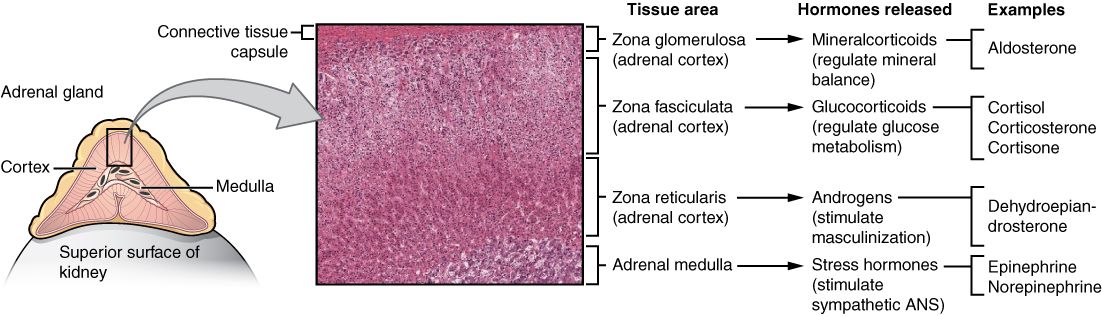
Selye's general adaptation syndrome
Hans Selye is often called the father of stress research. In the 1930s he noticed something odd about his lab rats. He exposed them to heat, cold, toxins, and injury. No matter what he did, their bodies showed the same three-part pattern. He called it the general adaptation syndrome (GAS). It is "general" because the body reacts the same way to almost any long-lasting stressor.
The GAS unfolds in three stages. In the alarm reaction, the body gathers its resources and the fight-or-flight surge takes over. In the resistance stage, the body settles into high alert. Hormones help it keep coping while the stressor goes on. You feel like you are managing, but it costs you. If the stressor never lets up, the body reaches exhaustion. Its reserves are used up and its defenses fail. The risk of illness, burnout, and breakdown climbs sharply.
| GAS stage | What is happening | How it feels and what it costs |
|---|---|---|
| Alarm | Fight-or-flight surge; resources gathered | Racing heart, high arousal, a "shock" and then a rebound |
| Resistance | Long high alert; hormones keep the body coping | Coping but running down; crankiness and tiredness build |
| Exhaustion | Reserves run out; defenses weaken | Illness, burnout, a breakdown in daily functioning |
Two roads out of the brain: the SAM and HPA axes
The stress response actually travels along two paths at two speeds. The fast path is the SAM axis, short for sympathetic-adrenal-medullary. The sympathetic nerves signal the adrenal medulla, the inner part of the adrenal gland. It releases adrenaline in seconds. This is the fight-or-flight jolt from Section 1.
The slower, longer-lasting path is the HPA axis. It is the star of the chronic-stress story. It works like a relay race. The hypothalamus, a small region deep in the brain, releases a hormone called CRH. CRH tells the pituitary gland to release ACTH. ACTH travels in the blood to the adrenal cortex, the outer layer of the adrenal gland. The adrenal cortex then pours out cortisol, the body's main stress hormone. Cortisol keeps sugar (glucose) flowing to the muscles and brain. It sharpens attention. It also turns down jobs that can wait until the emergency is over, such as immunity and digestion.
In short bursts, cortisol saves lives. The problem is that the HPA axis was built to switch off once the threat is gone. Sometimes appraisal keeps signaling "threat." The cause might be a stressful job, an unhappy relationship, or money fears. Then cortisol stays high for weeks or months. A hormone that protects you in the short run becomes harmful in the long run.
Allostatic load: the price of staying switched on
The body keeps itself steady by adjusting to change. This process is called allostasis. Each time the stress system turns on and then recovers, it is doing its job. But turning on again and again, or never turning off, takes a toll on the organs that carry the load. Researchers call this built-up wear and tear the allostatic load.
Allostatic load is the bridge in the body between "I feel stressed all the time" and the diseases that stress helps cause. Those diseases are the topic of the next section. The neuroscientist Robert Sapolsky summed up the idea in the title of his book, Why Zebras Don't Get Ulcers. A zebra's stressors end when the chase does. Ours often do not. (One note: most stomach ulcers are caused by a germ, Helicobacter pylori, or by pain-relief drugs. Stress can make them worse, but it is rarely the main cause.)
- Selye's GAS has three stages: alarm, resistance, and exhaustion.
- The fast SAM axis releases adrenaline. The slower HPA axis runs hypothalamus → pituitary → adrenal cortex → cortisol.
- Cortisol protects you in short bursts but harms you when it stays high.
- Allostatic load is the built-up wear on the body from a stress system that never switches off.
Section 3Stress and health
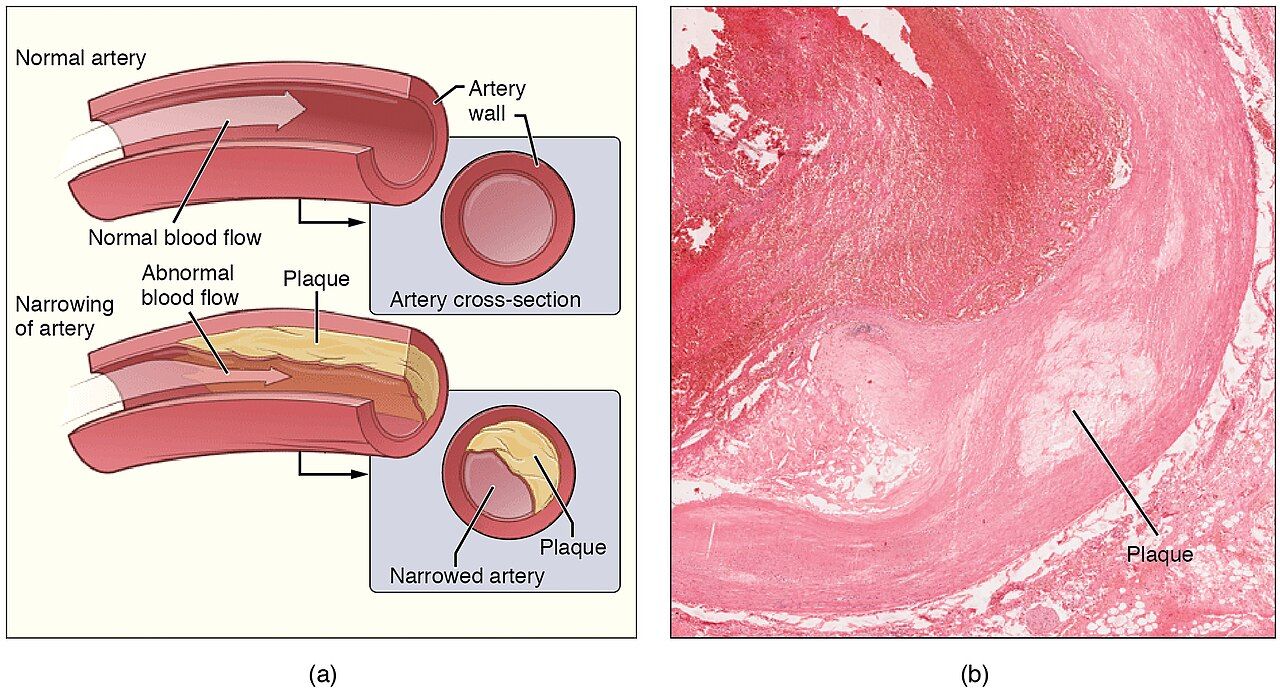
Stress and the heart
The clearest proof that stress harms the body comes from the heart and blood vessels, the cardiovascular system. Chronic stress raises blood pressure. It feeds inflammation and the plaque buildup of atherosclerosis, a narrowing of the arteries. It is now known to be a risk factor for coronary heart disease.
Two heart doctors, Meyer Friedman and Ray Rosenman, first sharpened this link. They described the Type A personality: competitive, impatient, rushed, and quick to anger. They contrasted it with the more relaxed Type B. In their Western Collaborative Group Study, Type A men got coronary heart disease at about twice the rate of Type B men. That held even after the usual risk factors were counted. Still, smoking, blood pressure, and cholesterol stayed strong predictors in the same group of men.
Later research forced a sharper change. Several large studies that followed people over time could not find the overall Type A effect at all. So researchers broke the pattern into its parts. The part that reliably predicted heart risk was not ambition or busyness. It was hostility: chronic anger, cynicism, and mistrust. A hard-working leader who enjoys the work may be fine. The one who boils with anger at every red light is not.
Stress and immunity
The field of psychoneuroimmunology studies how the mind, the nervous system, and the immune system talk to one another. They talk all the time. Cortisol is useful in the moment. But when it stays high, it suppresses the immune system, which means it holds the body's defenses back. That is why people under chronic stress get sick more easily and heal more slowly.
Janice Kiecolt-Glaser showed this in a clever study. She studied people under chronic stress: family members caring for a relative with dementia. She made a tiny wound on each person's skin. The caregivers' wounds healed much more slowly than the wounds of similar people who were not caregivers.
Sheldon Cohen went further. He gave healthy volunteers the same dose of a cold virus. The more chronic stress a person reported, the more likely that person was to actually come down with a cold. This is direct proof that stress does more than make you feel worse. It lowers your defenses.
| System | Short-term stress | Cost of chronic stress |
|---|---|---|
| Heart & vessels | Faster heartbeat and more blood pumped to fuel action | High blood pressure (hypertension), inflammation, atherosclerosis, heart disease |
| Immune | A short boost of defenses | Weaker immunity, slower healing, more infections |
| Brain | Sharper focus and stronger memory for the moment | Weaker memory and lower mood; wear on the hippocampus |
| Metabolism | Sugar released for quick energy | Belly fat, insulin resistance, higher diabetes risk |
- Chronic stress raises blood pressure and drives the inflammation and atherosclerosis behind heart disease.
- Friedman & Rosenman's Type A pattern went with about twice the rate of heart disease in their own study. The overall effect did not replicate. The part that holds up is hostility, not busyness.
- Psychoneuroimmunology shows that cortisol suppresses immunity when it stays high.
- Kiecolt-Glaser (slow wound healing) and Cohen (catching colds) link stress to real illness.
Section 4Coping
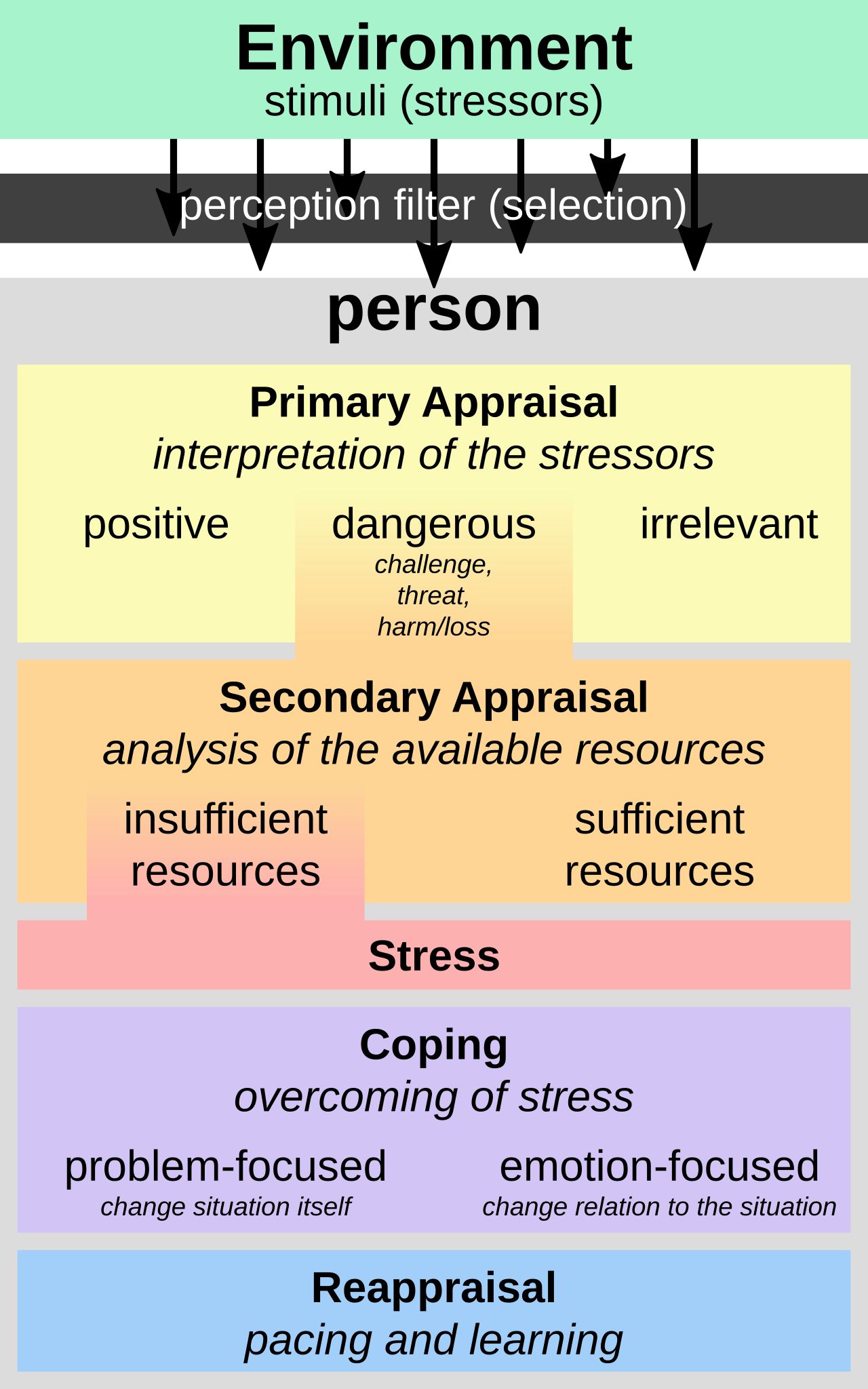
Two ways to cope
Once we appraise a stressor, we do something about it. That is coping. Richard Lazarus and Susan Folkman drew the field's central line between two kinds.
Problem-focused coping goes after the stressor itself. You make a plan, look up information, ask for an extension, fix the leaking pipe, or have the hard conversation. Emotion-focused coping manages your reaction instead. You look at the situation in a new way, seek comfort, exercise, meditate, or simply let yourself grieve. Neither one is better in general. The trick is to match the strategy to the situation.
| Feature | Problem-focused coping | Emotion-focused coping |
|---|---|---|
| Target | The stressor itself | Your feelings about it |
| Best when | The situation is controllable | The situation is uncontrollable |
| Examples | Make a plan, study, negotiate, ask for advice | Reappraise, exercise, meditate, confide in someone, accept |
| Risk if overused | Wasted effort on what cannot be changed | Avoidance; the problem grows |
Matching coping to control, and what goes wrong
Here is the rule of thumb. When you can change the situation, lead with problem-focused coping. Sometimes you cannot change it, as with a terminal diagnosis, a loss, or a past you cannot undo. Then emotion-focused coping is not weakness. It is wisdom.
Trouble comes when the two are mismatched. It comes most of all when coping slides into avoidance. Denying a problem, numbing it with alcohol, or going over and over it in your head (rumination) all feel like coping in the moment. But they leave the stressor in place and often make it worse. Avoidant coping is one of the strongest predictors of stress becoming chronic.
Social support
Of all the shields against stress, none has more evidence behind it than other people. Social support is the comfort, help, and belonging we get from our relationships. Across hundreds of studies, it predicts better health and longer life. Some reviews find its effect on the risk of dying is about as large as the effect of quitting smoking.
Support works in several ways at once. The buffering hypothesis says support cushions the blow of stressors. It offers practical help, and it also makes an event feel less threatening in the first place. Psychologists name three kinds. Emotional support is a listening ear. Informational support is advice and guidance. Instrumental support is hands-on help, like a ride, a meal, or money. Even just believing that support is there lowers the stress response.
- Problem-focused coping targets the stressor. Emotion-focused coping targets your reaction (Lazarus & Folkman).
- Use problem-focused coping for controllable stressors and emotion-focused coping for uncontrollable ones.
- Avoidance (denial, substances, rumination) backfires and predicts chronic stress.
- Social support cushions stress and strongly predicts health and long life.
Section 5Health and well-being
Positive psychology
For most of its history, psychology studied what goes wrong. Around the year 2000, Martin Seligman and his colleagues launched positive psychology. It is the scientific study of what makes life worth living: strengths, meaning, flourishing, and the conditions that help people thrive instead of just getting by.
Seligman's earlier work on learned helplessness had shed light on depression. Learned helplessness is the giving up that follows stress you cannot control. He then turned to its opposite, learned optimism. Later he proposed PERMA as the parts of a flourishing life: Positive emotion, Engagement, Relationships, Meaning, and Accomplishment. The point is not to paint on a smile. It is to widen the field's question from "How do we fix illness?" to "How do people flourish?"
Happiness: what actually moves it
Happiness researchers such as Ed Diener study subjective well-being. That is a person's own rating of how satisfied they are with life, plus their balance of good and bad feelings.
One of the field's most humbling findings is hedonic adaptation, also called the hedonic treadmill. We get used to good luck and bad luck quickly. Lottery winners tend to drift back toward how happy they were before. The drift is strong but not always complete. Newer studies of big lottery wins find some lasting gain in life satisfaction. Adaptation to serious losses, such as a lasting disability, is often only partial. So hard life events can leave a real mark.
The level we drift back to is called a set point, and it is partly inherited. Twin studies put the heritability of subjective well-being at about 30 to 40%. Sonja Lyubomirsky and her colleagues once made popular a split that gave fixed shares of happiness to genes, to life circumstances, and to intentional activity, the things we choose to do. Its own authors have since formally rejected that split. It misused a statistic about groups and underrated how much circumstances matter. So no percentage split should be quoted. What holds up is the general message. Well-being has a real inherited part. We adapt to changes in our lives faster than we expect. And what we do is the part we can act on.
| Influence on happiness | What the evidence supports | What it means |
|---|---|---|
| Genetic set point | Real and large; twin heritability of well-being about 30 to 40% | An inherited baseline we tend to return to |
| Life circumstances | Matters more than the old pie chart suggested, but we adapt | Income, looks, where you live: the effect fades as it becomes normal |
| Intentional activity | Small but repeatable gains in trials of chosen habits | Gratitude, connection, exercise, purpose: the part we can act on |
Barbara Fredrickson's broaden-and-build theory explains why good feelings are worth building. Bad feelings narrow attention so we can deal with an emergency. Good feelings broaden our thinking. Over time they build lasting resources: relationships, skills, and resilience. Those keep paying off long after the good mood fades.
The habits that reliably nudge well-being up are plain but real. They include giving thanks, exercising, sleeping enough, savoring good moments, doing kind things for others, and investing in relationships.
Building resilience
Resilience is the ability to adapt and bounce back when life is hard. It is far more common than we assume. Ann Masten studied children who did well despite hardship. She famously called resilience "ordinary magic." It comes not from rare gifts but from ordinary human resources. These include a caring relationship, a sense of being capable, and the ability to manage emotions.
Suzanne Kobasa described a resilient attitude she called hardiness. It rests on three C's. Commitment means taking part in life instead of pulling away. Control means believing you can affect what happens. Challenge means seeing change as a chance to grow, not as a threat.
Many people who live through serious hardship even report post-traumatic growth. They describe deeper relationships, new priorities, and a greater sense of strength. Resilience is not the absence of stress. It is what lets people meet stress and come through it whole.
- Positive psychology (Seligman) studies flourishing. PERMA names its parts.
- Hedonic adaptation pulls us back toward a partly inherited set point. Circumstances matter less than we expect.
- Intentional activity, such as gratitude, connection, exercise, and purpose, is the part of happiness we can act on.
- Resilience is common and can be built. Kobasa's hardiness rests on commitment, control, and challenge.
The chapter in one breath
- Stress is a process. It has a stressor (the demand), your appraisal of it, and the stress response it sets off.
- Lazarus showed that stress depends on primary appraisal (Is it a threat?) and secondary appraisal (Can I cope?). The same event can be a threat or a challenge.
- The fight-or-flight response (Cannon) fires the sympathetic system and adrenaline. Selye's GAS runs alarm → resistance → exhaustion.
- The slow HPA axis releases cortisol. Cortisol protects in short bursts but builds allostatic load when stress is chronic.
- Chronic stress harms the heart (hostility, atherosclerosis, heart disease) and the immune system (Kiecolt-Glaser, Cohen).
- Problem-focused coping suits stressors you can control. Emotion-focused coping suits ones you cannot. Avoidance backfires.
- Social support strongly cushions stress. Positive psychology shows that happiness and resilience can be built on purpose.
ReferenceWords worth knowing
Here are the key terms from this chapter. Skim them now, or come back whenever a word trips you up.
- Allostatic load
- The built-up wear and tear on the body when the stress response turns on again and again, or stays on.
- Appraisal
- The mind's judgment of a situation. It decides whether, and how much, the situation feels stressful.
- Coping
- What we think and do to handle a stressor and the feelings it brings.
- Cortisol
- The main stress hormone. The adrenal cortex releases it through the HPA axis. It helps in short bursts and harms when it stays high.
- Emotion-focused coping
- Coping that manages your feelings about a stressor. It fits best when you cannot change the situation.
- Eustress
- Good, motivating stress that comes from a challenge you feel able to meet.
- Fight-or-flight response
- Walter Cannon's name for the fast surge of the sympathetic nervous system that gets the body ready to face a threat or run from it.
- General adaptation syndrome (GAS)
- Selye's three-stage model of how the body responds to long-lasting stress: alarm, resistance, exhaustion.
- Hardiness
- Kobasa's resilient attitude, built on commitment, control, and challenge.
- Hedonic adaptation
- The pull back toward a usual level of happiness after good or bad events; the "hedonic treadmill."
- HPA axis
- The hypothalamus-pituitary-adrenal pathway that releases cortisol. It is the slow, long-lasting arm of the stress response.
- Positive psychology
- The scientific study of strengths, well-being, and the conditions that help people flourish.
- Primary appraisal
- The first judgment of a situation: Is it a threat, a challenge, or not important?
- Problem-focused coping
- Coping that acts on the stressor itself. It fits best when you can change the situation.
- Psychoneuroimmunology
- The study of how mental states, the nervous system, and the immune system affect each other.
- Resilience
- The ability to adapt and bounce back when life is hard.
- Secondary appraisal
- The judgment of whether you have the resources to cope with a stressor.
- Social support
- The comfort, advice, and hands-on help that come from your relationships. It cushions stress.
- Stress
- The process of noticing and responding to events we judge as threatening or challenging.
- Stressor
- An event or demand that can set off a stress response.
- Type A
- Friedman and Rosenman's competitive, impatient, hostile pattern, first linked to heart disease. The overall pattern did not replicate. Hostility is the part that does predict heart risk.
Check yourself
Psychological Disorders & Therapy
About one in five adults will live with a mental disorder this year. So these conditions are not rare. They are some of the most common things people go through. This chapter starts with a hard question. What makes a thought, a feeling, or an action a disorder, and not just odd or a bit of a pain? Next we tour the main families. First come anxiety, OCD, and trauma. Then come the mood and psychotic disorders. Then we turn to the good news: the treatments that work. You will meet the talk therapies that go back to Freud, Rogers, and Beck. You will also meet the drugs and other body-based treatments that changed care for good. One idea runs under all of it, and it has strong support. Mind and body, thought and brain chemistry, are two views of one system.
By the end of this chapter you can
- Explain the four tests that set a disorder apart from normal ups and downs: dysfunction, distress, deviance, and danger.
- Say what the DSM is, what it does, and where labels fall short.
- Tell the main anxiety disorders, OCD, and PTSD apart. Say why the DSM now puts them in separate chapters.
- Compare major depressive disorder, bipolar disorder, and schizophrenia, and the main ideas about their causes.
- Compare four kinds of talk therapy: psychodynamic, humanistic, behavioral, and cognitive (CBT).
- Sum up the main kinds of psychiatric medication and what each one acts on.
- Explain why the therapeutic alliance, the bond with the therapist, helps in all kinds of therapy.
- Use the biopsychosocial model and the diathesis-stress model to see why disorders start.
Section 1Defining disorders & the DSM
What makes behavior "disordered"
Almost every sign of a mental disorder is something we all feel in small doses. We all feel nervous before a test. We feel low after a loss. Many of us knock on wood. So a feeling by itself does not draw the line between a quirk and an illness. The line comes from a set of judgments about the feeling.
Clinicians often teach these judgments as the four Ds. Dysfunction means it gets in the way of daily life, like work, friends, or taking care of yourself. Distress means it makes the person truly suffer. Deviance means it is far from what the culture expects. Danger means it puts the person or others at risk. No one D is enough by itself. Grief hurts, but it is healthy. A firefighter who runs into a burning house is "deviant," or unusual, but brave. So the Ds are weighed together, and always in context.
The most important D is dysfunction. Jerome Wakefield, a professor of social work and philosophy, put it in two words: harmful dysfunction. This is a way to think through what a disorder is. It is not a lab result. It says two things must both be true. First, some inner system fails at the job it evolved to do. Second, that failure does harm that the person or their society can see. Fear that keeps you away from a snake is doing its job. Fear that keeps you shut in your home for ten years is not. This view keeps us from calling plain difference an illness. Being single, unusual, or not popular is not a disorder, however odd a culture may find it.
The DSM and how diagnosis works
To talk with each other, clinicians need a shared dictionary. In the United States, that book is the Diagnostic and Statistical Manual of Mental Disorders, or DSM. The American Psychiatric Association puts it out. It is now in its fifth edition, text revision (DSM-5-TR, 2022). For each disorder, the DSM gives a checklist. It says how many signs, for how long, and how much harm to daily life. The World Health Organization keeps a matching system called the ICD. It is now in its eleventh edition (ICD-11), and it is used all over the world.
The DSM's great strength is reliability. That means two clinicians who see the same person will likely give the same label. They agree far more often now than they did in the 1970s. Its harder, open problem is validity. Validity asks if the labels match real, separate things in nature. Or do they just name sets of signs that often blur together?
Labels are strong, and that cuts both ways. A label can open the door to care and to insurance. It can bring relief by giving a name to pain. But labels can also stick. David Rosenhan ran a famous study in 1973, On Being Sane in Insane Places. Healthy people faked one sign to get into mental hospitals. They said the label "schizophrenia" then shaped how staff saw all they did. Even taking notes was written up as a sign of illness. Later, though, researchers found big problems in how the study was done and reported. So treat it as a warning story, not as solid proof.
The lesson still holds. A label names a condition a person has. It is not the whole of who they are. That is why careful writers say "a person with schizophrenia," not "a schizophrenic." Comorbidity means having two or more disorders at once. It is very common. That is one more sign that these labels are useful tools, not sharp lines found in nature.
| The four Ds | What it asks | Caution |
|---|---|---|
| Dysfunction | Does it get in the way of work, relationships, or self-care? | The most important criterion; still needs context |
| Distress | Does it cause the person real suffering? | Some states (for example, mania) can feel good to the person |
| Deviance | Does it differ sharply from cultural norms? | Norms vary; being different is not a disorder |
| Danger | Does it put the person or others at risk? | Dramatic but actually uncommon in most disorders; people with mental disorders are more often victims of violence than causes of it |
- The four Ds are dysfunction, distress, deviance, and danger. They are weighed together and in context. Dysfunction counts most.
- A disorder is a harmful dysfunction. Just being different is not a disorder.
- The DSM (now DSM-5-TR) gives clinicians shared rules for each label. The WHO's ICD is the world version.
- The DSM has strong reliability but its validity is still argued. Labels can help and hurt. Rosenhan's study warned of this, though the study itself is now in doubt.
Section 2Anxiety, OCD & trauma
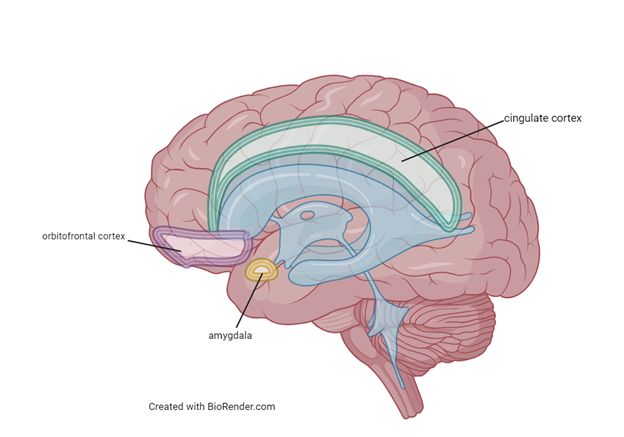
Anxiety disorders
Fear and anxiety are close cousins, but psychologists keep them apart. Fear is the alarm that goes off when a threat is here right now. It is the jolt that gets you out of the road. Anxiety is fear about the future. It is worry about a threat that has not come and may never come. In small amounts, both help us. They become anxiety disorders when they are too big for the threat, last a long time, and get in the way of life. As a group, anxiety disorders are the most common mental disorders of all.
The group has several members. Generalized anxiety disorder is worry about many things that is hard to stop. It shows up most days for at least six months. Panic disorder brings sudden panic attacks. In an attack, the heart races and the chest feels tight. A sense of doom takes over. It feels so physical that many people think they are having a heart attack. Then they dread the next attack.
Some people with panic attacks start to avoid places where it would be hard to get out or get help. That pattern is called agoraphobia. In DSM-5 and DSM-5-TR, it is its own diagnosis, though it often shows up with panic disorder. Specific phobias are strong fears of one thing or one kind of place, such as heights, spiders, or needles. The fear is much bigger than the real danger. Social anxiety disorder is a strong, lasting fear of being judged by others.
Martin Seligman's idea of biological preparedness helps explain which things people fear. Phobias tend to form around snakes, heights, and the dark. Those were real dangers for our distant ancestors. Phobias rarely form around cars or wall plugs, even though those hurt far more people today.
OCD and trauma-related disorders
Older versions of the DSM put OCD and PTSD under "anxiety." DSM-5 moved each one to its own chapter. Both involve anxiety. But each one works in its own way.
Obsessive-compulsive disorder (OCD) has two parts. Obsessions are unwanted thoughts, pictures, or urges that keep pushing into the mind. They might be fears of germs, of causing harm, or of things not being even. Compulsions are acts done over and over, like washing, checking, or counting. The person feels a strong pull to do them to calm the dread. The act brings a moment of relief. That relief rewards the whole cycle, so it gets tighter over time. Brain scans point to a loop that runs too hot. The loop links the orbitofrontal cortex, the striatum, and the thalamus.
Post-traumatic stress disorder (PTSD) can follow a brush with death, serious injury, or sexual violence. The event may have happened or only been threatened. Combat, assault, and disaster are examples. The signs fall into four groups and last more than a month. Intrusion means flashbacks and bad dreams that replay the event. Avoidance means staying away from reminders. Negative shifts in mood and thinking can mean guilt, numbness, or feeling cut off. Hyperarousal means being jumpy and always on watch for danger.
Here is a key point. Most people who live through trauma do not get PTSD. The diathesis-stress model helps explain who does. A diathesis is a built-in weak spot, from genes or from early life. A disorder starts when that weak spot meets a big enough stress.
| Disorder | DSM-5-TR chapter | Core feature |
|---|---|---|
| Generalized anxiety | Anxiety disorders | Long-lasting, hard-to-control worry about many things |
| Panic disorder | Anxiety disorders | Repeated panic attacks and fear of the next one |
| Specific phobia | Anxiety disorders | Intense fear, out of proportion, of a specific trigger |
| OCD | Obsessive-compulsive & related | Obsessions (unwanted thoughts) + compulsions (rituals) |
| PTSD | Trauma- & stressor-related | Intrusion, avoidance, mood change, and hyperarousal after trauma |
- Fear is about a threat that is here now. Anxiety looks ahead to one in the future. A disorder starts when the response is too big and gets in the way of life.
- Anxiety disorders include generalized anxiety, panic disorder, phobias, and social anxiety. They are the most common group.
- OCD pairs unwanted obsessions with compulsions that bring brief relief. PTSD follows trauma. Its signs are intrusion, avoidance, low mood, and hyperarousal.
- The diathesis-stress model explains why the same trauma harms one person and not another.
Section 3Mood & psychotic disorders
Depression and bipolar disorder
Everyone has bad days. Major depressive disorder is something else. The low mood lasts at least two weeks and will not lift. Or the person has anhedonia, which means they lose the joy they used to get from things. Other signs come too, for at least five in all. They include changes in sleep and hunger, feeling tired, feeling worthless, trouble focusing, and thoughts of death. Major depression is about twice as common in women as in men. It is one of the top causes of disability in the world.
Bipolar disorder adds the other pole. It brings times of mania. A manic episode lasts at least a week. The mood is far too high, or very irritable. Thoughts race. The person may feel grand and powerful, need little sleep, and spend or take risks in reckless ways. Bipolar I needs at least one full manic episode. Most people with bipolar I also have times of depression, but the label does not require them. Bipolar II pairs depression with hypomania, a milder high that lasts at least four days. Bipolar disorder is one of the most heritable mental disorders. That means genes play a big part.
Why do mood disorders happen? No one answer is enough. That is the point of the biopsychosocial model. It looks at the body, the mind, and the social world all at once. On the body side, the classic monoamine hypothesis links depression to low levels of three brain chemicals: serotonin, norepinephrine, and dopamine. But the truth is more complex than "a chemical imbalance."
On the mind side, Aaron Beck described a negative cognitive triad. People with depression tend to hold dark beliefs about three things: themselves, the world, and the future. They read unclear events in ways that seem to prove those beliefs. Martin Seligman's idea of learned helplessness adds to the picture. It is the giving up that follows stress a person cannot control. So does Susan Nolen-Hoeksema's work on rumination, which means going over the same worries again and again. Depression carries a real risk of suicide. Any sign of hopelessness must be taken seriously. In the United States, anyone in crisis, or worried about someone, can call or text 988 at any hour. That reaches the Suicide and Crisis Lifeline.
Schizophrenia
Schizophrenia is a psychotic disorder. Psychosis means a break from the reality other people share. Schizophrenia often starts in the late teens or early twenties. Its positive symptoms are things that are added. They include hallucinations, most often hearing voices. They also include delusions, which are fixed false beliefs that a person keeps even when the facts say no. Mixed-up speech and behavior belong here too. Its negative symptoms are things taken away. They include a flat face and voice (often called flat affect), saying very little, and avolition, a loss of drive to do things.
One old myth needs fixing. Schizophrenia is not "split personality." The name means a split between thought and reality. It does not mean many selves. Having more than one identity is a different condition, called dissociative identity disorder.
Schizophrenia is best seen through the diathesis-stress lens. Genes matter a lot. If one identical twin has it, the other has about a 33 to 50% chance, depending on the study. But genes are not fate. That same number means at least half of these twin pairs are discordant. One twin has it and the other does not.
The dopamine hypothesis came from how drugs act. Drugs that block dopamine ease the positive symptoms. Drugs that boost dopamine, like amphetamines, can bring on psychosis. Some stresses raise the risk in people who are already vulnerable. These include problems before birth, an infection in the mother while pregnant, and heavy cannabis use in the teen years. They can tip a risk in the genes into a real illness.
| Disorder | Hallmark | Leading explanation |
|---|---|---|
| Major depression | ≥2 weeks of low mood or anhedonia, plus other symptoms | Monoamines, negative cognitive triad, learned helplessness |
| Bipolar disorder | Episodes of mania (bipolar I) or hypomania (bipolar II), usually with depression | Strongly genetic; disrupted mood regulation |
| Schizophrenia | Positive (hallucinations, delusions) and negative (flat affect) symptoms | Diathesis-stress; dopamine dysregulation |
- Major depression means at least 2 weeks of low mood or anhedonia, plus other signs. It is twice as common in women.
- Bipolar disorder adds times of mania (or hypomania in bipolar II). Genes play a big part.
- Schizophrenia has positive symptoms (hallucinations, delusions) and negative symptoms (flat affect, avolition). It is not "split personality."
- The biopsychosocial and diathesis-stress models work better than any one-cause story.
Section 4Psychotherapy
Insight therapies: psychodynamic and humanistic
Psychotherapy is treatment through talking, in a planned relationship with a trained helper. There are dozens of kinds. They sort into a few big schools. The oldest is psychodynamic therapy. It grew out of Sigmund Freud's psychoanalysis. Its main idea is that today's problems grow from hidden, unconscious conflicts. These often start in childhood. To heal, in this view, you need insight. That means bringing what is hidden into the light.
Freud had three main tools. In free association, the client says whatever comes to mind, with no filter. In dream analysis, client and therapist look for hidden meaning in dreams. The therapist also watches for transference. That is when the client aims feelings about key people in their life at the therapist. Classic psychoanalysis took years. Modern psychodynamic therapy is shorter and more focused. It keeps the core belief that knowing yourself heals.
The humanistic school, led by Carl Rogers, did not share Freud's dark view of human nature. Rogers's client-centered therapy, also called person-centered therapy, starts from a hopeful idea. People have a built-in drive to grow. A warm bond can set that drive free. The therapist gives three things. Unconditional positive regard means accepting the client with no judgment. Empathy means truly getting what the client feels inside. It often uses active listening, which means saying back what the client said in your own words. Genuineness, also called congruence, means the therapist is real and honest. Abraham Maslow's idea of self-actualization, or growing into your full self, was the school's guiding star. A psychodynamic therapist explains what things mean. A humanistic therapist mostly listens, and trusts the client to find the way.
Action therapies: behavioral and cognitive
Behavioral therapy takes a different view. A problem is a learned habit, so it can be unlearned. There is no need to dig up the past. Joseph Wolpe built on Ivan Pavlov's classical conditioning. He made systematic desensitization. First, the client learns to relax deeply. Then the client climbs a "fear ladder," from mild fears up to the worst one. At each step, the client pairs calm with the thing they fear. Calm takes the place of fear, and a phobia can fade. This is called counterconditioning. Exposure therapy uses the same idea more widely. Other methods use B. F. Skinner's operant conditioning. In token economies, people earn tokens for good habits and trade them for rewards. Over time, the rewards reshape behavior.
The main approach today is cognitive behavioral therapy (CBT). It joins the behavioral school with one big cognitive idea. Our thoughts, not the events, drive how we feel. Aaron Beck's cognitive therapy teaches people to catch their quick, automatic thoughts and test them. Many of these thoughts are thinking errors. One is catastrophizing, which means expecting the worst. Another is all-or-nothing thinking. A third is overgeneralizing, which means one bad event turns into "this always happens."
Albert Ellis's rational emotive behavior therapy (REBT) made the same point with his ABC model. A is the Activating event. C is the emotional Consequence, the feeling. A does not cause C by itself. B, our Beliefs about the event, does. Irrational beliefs bring painful feelings. CBT is short-term and builds skills. It gives homework to do between sessions. It has more proof behind it than any other talk therapy for anxiety and depression.
| Approach | Founder(s) | Core idea | Signature technique |
|---|---|---|---|
| Psychodynamic | Freud | Symptoms grow from unconscious conflict | Free association, dream & transference analysis |
| Humanistic | Rogers, Maslow | People grow when they are accepted and understood | Unconditional positive regard, active listening |
| Behavioral | Wolpe, Skinner | Disorders are learned and can be unlearned | Systematic desensitization, token economy |
| Cognitive (CBT) | Beck, Ellis | Thoughts, not events, drive feelings | Challenging thinking errors; the ABC model |
- Psychodynamic therapy (Freud) seeks insight into hidden conflict. Its tools are free association, dreams, and transference.
- Humanistic therapy (Rogers) heals with unconditional positive regard, empathy, and genuineness.
- Behavioral therapy treats problems as learned habits. It uses systematic desensitization, exposure, and token economies.
- CBT (Beck, Ellis) targets thinking errors. It has the most support of any talk therapy for anxiety and depression.
Section 5Biomedical therapy & the therapeutic relationship
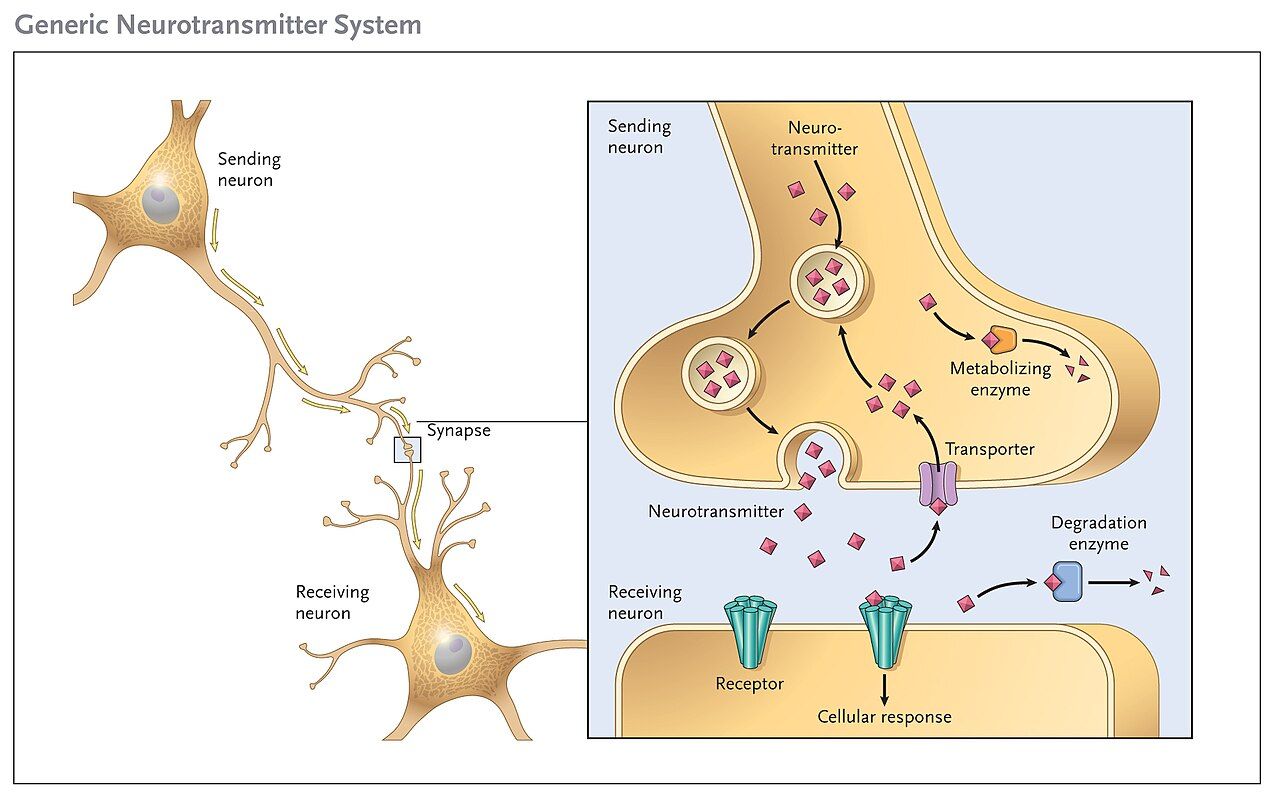
Medications and other biomedical treatments
Biomedical therapy treats disorders by acting on the body. Most often it uses psychotropic medication, which means drugs that act on the mind. Almost all of them work at the synapse, the tiny gap between nerve cells. They change how brain chemicals are sent, picked up, or cleared away.
Antidepressants are the biggest group. The SSRIs (selective serotonin reuptake inhibitors) are one kind. Fluoxetine (Prozac) is an example. An SSRI stops nerve cells from soaking serotonin back up, so it stays in the synapse longer. SSRIs treat depression. They also treat most anxiety disorders and OCD. They often take a few weeks to fully work. Anti-anxiety drugs like the benzodiazepines calm the nerves fast. But the body can come to depend on them.
Antipsychotics ease hallucinations and delusions, mostly by blocking dopamine. The first ones, such as chlorpromazine and haloperidol, changed care. But they often caused problems with movement. One lasting problem is called tardive dyskinesia. Newer drugs are called "atypicals." Clozapine and risperidone are examples. They cause fewer movement problems. They cause more weight gain and raise the risk of diabetes. Clozapine helps many people who got no help from other antipsychotics. For bipolar disorder, the mood stabilizer lithium is still a mainstay, many years after it was found. It needs regular blood tests. The gap between a helpful dose and a harmful one is small.
Some severe depression does not get better with drugs or therapy. Other options exist. In electroconvulsive therapy (ECT), a brief current sets off a short seizure in the brain. Today the person is asleep under anesthesia, with drugs to relax the muscles. It is far gentler than its grim name suggests. It works very well for people with the most severe depression. Its most common side effect is some memory loss around the time of treatment. A newer, milder tool is transcranial magnetic stimulation (TMS). It uses magnetic pulses to wake up certain parts of the brain. It needs no seizure and no anesthesia. These tools are strong but blunt. That is why they come at the end of the line, not the front.
The therapeutic relationship
Here is one of the firmest findings in all of clinical psychology. The schools of therapy have very different ideas. Yet their results are far more alike than you would guess. Mary Lee Smith and Gene Glass ran a famous meta-analysis. That is a study that pools the results of many studies. The average person in therapy did better than about 80% of people with no treatment. But no one approach clearly beat the rest. This got the nickname the dodo bird verdict. It comes from a line in Alice in Wonderland: "everyone has won, and all must have prizes." The verdict is still argued. For some problems, some methods do work better. Exposure for phobias and OCD is one example.
So if the method explains less than we thought, what explains the results? A large share comes from the therapeutic alliance. That is the bond of trust, warmth, and shared goals between client and therapist. It is one of the best predictors of getting better in every kind of therapy. So Rogers was right to stress the relationship. That holds even for therapists who reject the rest of his theory.
Two last ideas follow. First, most clinicians are eclectic or integrative. They borrow whatever tool fits the client, instead of sticking to one school. Second, the best evidence often favors combined treatment. Medicine steadies the body while therapy rebuilds thoughts and habits. This is the biopsychosocial model from earlier in the chapter, put to work. Mind and body are not two patients. They are one, and the best care treats them together.
| Drug class | Example | Mainly treats | Acts on |
|---|---|---|---|
| SSRI antidepressant | Fluoxetine (Prozac) | Depression, anxiety, OCD | Serotonin reuptake |
| Anti-anxiety | Benzodiazepines | Short-term anxiety | GABA (calms neural firing) |
| Antipsychotic | Haloperidol; clozapine | Schizophrenia, psychosis | Dopamine (mainly) |
| Mood stabilizer | Lithium | Bipolar disorder | Several systems; steadies mood swings |
- Biomedical therapy acts on the body. Most psychotropic drugs work at the synapse.
- SSRIs treat depression, anxiety, and OCD. Antipsychotics block dopamine. Lithium steadies bipolar disorder.
- ECT and TMS can help severe depression that other care has not helped.
- The therapeutic alliance predicts results in all kinds of therapy. Combined and eclectic care often works best.
The chapter in one breath
- A behavior counts as a disorder when the four Ds are weighed together. They are dysfunction, distress, deviance, and danger. Dysfunction comes first.
- The DSM gives clinicians shared, reliable rules for each label. But labels have limits, and comorbidity is common.
- Anxiety disorders (generalized, panic, phobias, social) are the most common. OCD and PTSD now have their own DSM chapters.
- Major depression and bipolar disorder are mood disorders. Schizophrenia is a psychotic disorder with positive and negative symptoms. It is not "split personality."
- The diathesis-stress and biopsychosocial models say a disorder starts when a weak spot meets stress. Body, mind, and the world around us all play a part.
- Talk therapies come in four main kinds: psychodynamic (Freud), humanistic (Rogers), behavioral (Wolpe, Skinner), and cognitive/CBT (Beck, Ellis).
- Biomedical therapy works on the brain. It includes SSRIs, antipsychotics, lithium, and ECT. The therapeutic alliance predicts success in every kind of therapy.
- The best results often come from combined, eclectic care that treats mind and body as one.
ReferenceWords worth knowing
Here are the key terms from this chapter. Skim them now, or come back whenever a word trips you up.
- Anhedonia
- The loss of interest or pleasure in things a person used to enjoy. It is a core symptom of major depression.
- Antipsychotic
- A medication that reduces hallucinations and delusions, mainly by blocking dopamine.
- Bipolar disorder
- A mood disorder with episodes of mania (bipolar I) or hypomania (bipolar II), usually along with episodes of depression.
- Cognitive behavioral therapy (CBT)
- An action therapy that joins behavioral methods with fixing distorted thinking. It is the best-supported talk therapy for anxiety and depression.
- Comorbidity
- Having two or more disorders at the same time.
- Compulsion
- A repeated behavior or mental act that a person feels driven to do to ease the anxiety from an obsession.
- Delusion
- A fixed false belief held despite clear evidence against it. It is a positive symptom of schizophrenia.
- Diathesis-stress model
- The idea that a disorder develops when a built-in vulnerability (the diathesis) meets enough stress.
- DSM
- The Diagnostic and Statistical Manual of Mental Disorders, the standard U.S. system for classifying disorders. The current version is DSM-5-TR.
- Hallucination
- A sensory experience with nothing outside causing it, such as hearing voices. It is a positive symptom of schizophrenia.
- Humanistic therapy
- An insight therapy (Rogers) that helps people grow through unconditional positive regard, empathy, and genuineness.
- Major depressive disorder
- At least two weeks of low mood or anhedonia, plus other symptoms, that get in the way of daily life.
- Mania
- A period of unusually high or irritable mood, lasting at least a week, with racing thoughts, a grand sense of self, and less need for sleep.
- Obsession
- An unwanted thought, image, or urge that keeps coming back and causes strong distress.
- Obsessive-compulsive disorder (OCD)
- A disorder that pairs obsessions with the compulsions done to relieve them.
- Post-traumatic stress disorder (PTSD)
- A trauma-related disorder marked by intrusion, avoidance, negative changes in mood and thinking, and hyperarousal after a traumatic event.
- Psychoanalysis
- Freud's psychodynamic therapy. It seeks insight into unconscious conflict through free association, dream analysis, and transference.
- Schizophrenia
- A psychotic disorder with positive symptoms (hallucinations, delusions) and negative symptoms (flat affect, avolition).
- SSRI
- A selective serotonin reuptake inhibitor, such as fluoxetine. It raises serotonin in the synapse to treat depression, anxiety, and OCD.
- Systematic desensitization
- A behavioral method that pairs relaxation with a step-by-step fear hierarchy to unlearn a phobia.
- Therapeutic alliance
- The bond of trust and shared goals between client and therapist. It strongly predicts results in all therapies.
- Unconditional positive regard
- Rogers's stance of accepting and valuing a client without judgment, no matter what they say or do.