Sensation & Perception
Right now, light is bouncing off this page and into your eyes. Air is pushing in tiny waves against your eardrums. Your clothes are pressing on your skin. Yet you do not feel a storm of raw data. You feel a calm, smooth world. This chapter is about the gap between those two things. Sensation is how your senses pick up the world and turn it into nerve signals. Perception is how your brain sorts those signals and gives them meaning. It turns them into objects, faces, songs, and ideas. We will start with the rules that every sense follows. Then we will look at vision and hearing. Next come taste, smell, touch, pain, and balance. We will end with the clever ways your brain puts it all together, and the ways it can be fooled.
By the end of this chapter you can
- Tell sensation from perception, and bottom-up from top-down processing.
- Explain transduction and say where it happens in each sense.
- Define the absolute threshold and the difference threshold, and state Weber's law.
- Sum up signal detection theory and what it adds to the idea of a fixed threshold.
- Follow light through the eye, and compare the trichromatic and opponent-process theories of color.
- Describe how the ear turns sound into signals, and how we hear pitch and loudness.
- Explain taste, smell, touch, pain (gate-control theory), and the senses of body position.
- State the Gestalt principles, and explain depth perception and perceptual constancy.
Section 1Sensation versus perception
Two steps, one smooth experience
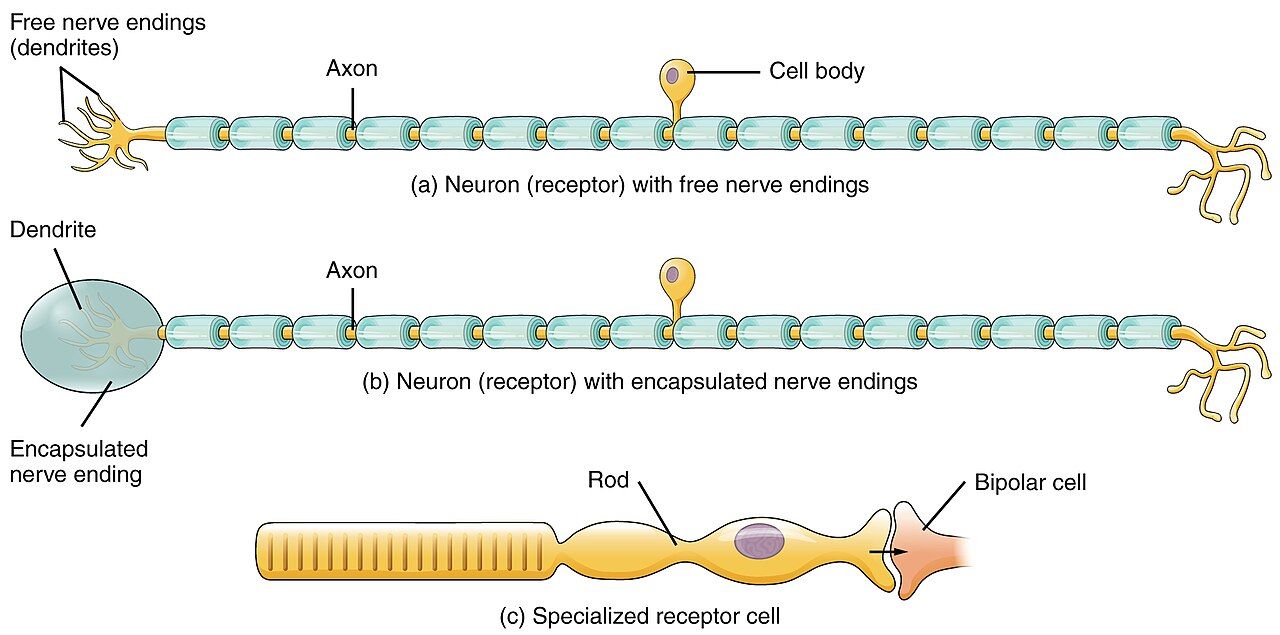
Psychologists split each moment of experience into two steps, even though the two steps feel like one. Sensation is the first step. Your sense organs pick up energy from the world around you, such as light waves, sound waves, molecules, pressure, or heat, and turn it into nerve signals. Perception is the next step. The brain picks out, sorts, and makes sense of those signals. A scatter of signals becomes your grandmother's face, or the first notes of a song you love. Two people can sense the very same thing in the same way, yet perceive it very differently. That is why it helps to keep sensation and perception apart.
The two steps match two ways that information can flow. Bottom-up processing starts with the raw signal at the sense receptors. It builds up from small pieces to a whole picture, which is how you make sense of something brand new. Top-down processing runs the other way. Your hopes, past knowledge, and the setting around you shape what you perceive. It lets you read messy handwriting and hear a mumbled word in a loud room. Almost all perception mixes the two. So your brain is not like a camera that records the world. It is more like a scientist who makes fast, smart guesses about what is out there.
Transduction: turning energy into signals
Every sense faces the same problem: the brain only understands electrical and chemical signals. But the world arrives as light, shaking air, and chemicals. The answer is transduction. Transduction means changing one kind of energy into nerve signals the body can use. Special cells called sensory receptors do this job. For example, photoreceptors in the eye turn light into signals. Hair cells in the ear turn shaking, or vibration, into signals. Receptors in the skin turn pressure and temperature into signals. Transduction is the border crossing between the physical world and the mind, and it is the first step in every chain of events that ends in something you notice.
The limits of the senses: thresholds and signal detection
Our senses are very keen, but they have limits. Psychophysics is the study of how physical energy relates to what we sense. Its founder, Gustav Fechner, gave us the words for those limits. The absolute threshold is the weakest level of a stimulus you can detect half the time. A stimulus is anything your senses can pick up. A classic example of the threshold is a single candle flame about thirty miles away on a clear, dark night. The difference threshold is the smallest change between two stimuli you can detect half the time. It is also called the just noticeable difference (JND). Ernst Weber found that this change is not a set amount. It is a set fraction of the starting stimulus. This rule is Weber's law. Add one pound to a two-pound bag, and you notice it right away, but add the same pound to a hundred-pound load, and you cannot tell.
| Idea | What it measures | Everyday example |
|---|---|---|
| Absolute threshold | The weakest stimulus you can detect 50% of the time | A candle flame about 30 miles away on a dark night |
| Difference threshold (JND) | The smallest change you can detect between two stimuli | Noticing a screen just got brighter |
| Weber's law | The JND is a set fraction of the stimulus | Add 1 lb: easy to feel on 2 lb, lost on 100 lb |
| Subliminal stimulus | A stimulus below the absolute threshold | A word flashed too fast to see on purpose |
| Sensory adaptation | A sense fades when a stimulus stays the same | Not feeling your clothes after a few minutes |
A stimulus below the absolute threshold is called subliminal. Lab studies show that subliminal words or pictures can nudge us a little, for a short time. But the effects are small. There is no good proof that hidden messages in ads can make people buy things they did not already want. Sensory adaptation is a different idea. When a stimulus stays the same, your senses slowly stop reacting to it. That is why you stop feeling your watch on your wrist.
The word "threshold" sounds like a sharp on and off line. But real detection is rarely that clean. Signal detection theory gives a more real picture. Picture a weak signal buried in background noise. Whether you catch it depends on two things. One is how keen your senses are. The other is your decision criterion. That is how ready you are to say, "Yes, I noticed it." Your criterion shifts with what you expect, what you want, how tired you are, and what a mistake would cost. The theory sorts every choice into four outcomes. A hit means the signal was there and you said yes. A miss means it was there and you said no. A false alarm means it was not there and you said yes. A correct rejection means it was not there and you said no. This explains why a worried new parent may hear a baby cry that never happened. It also explains why a skilled radiologist and a beginner can look at the same scan and reach different answers.
- Sensation picks up and codes stimuli. Perception sorts them and gives them meaning.
- Bottom-up processing builds from the raw signal. Top-down processing uses what you expect and the setting.
- Transduction changes physical energy into nerve signals at the sensory receptors.
- Absolute and difference thresholds, Weber's law, and signal detection theory describe the limits and biases of noticing things.
Section 2Vision
The eye: a camera made of living tissue
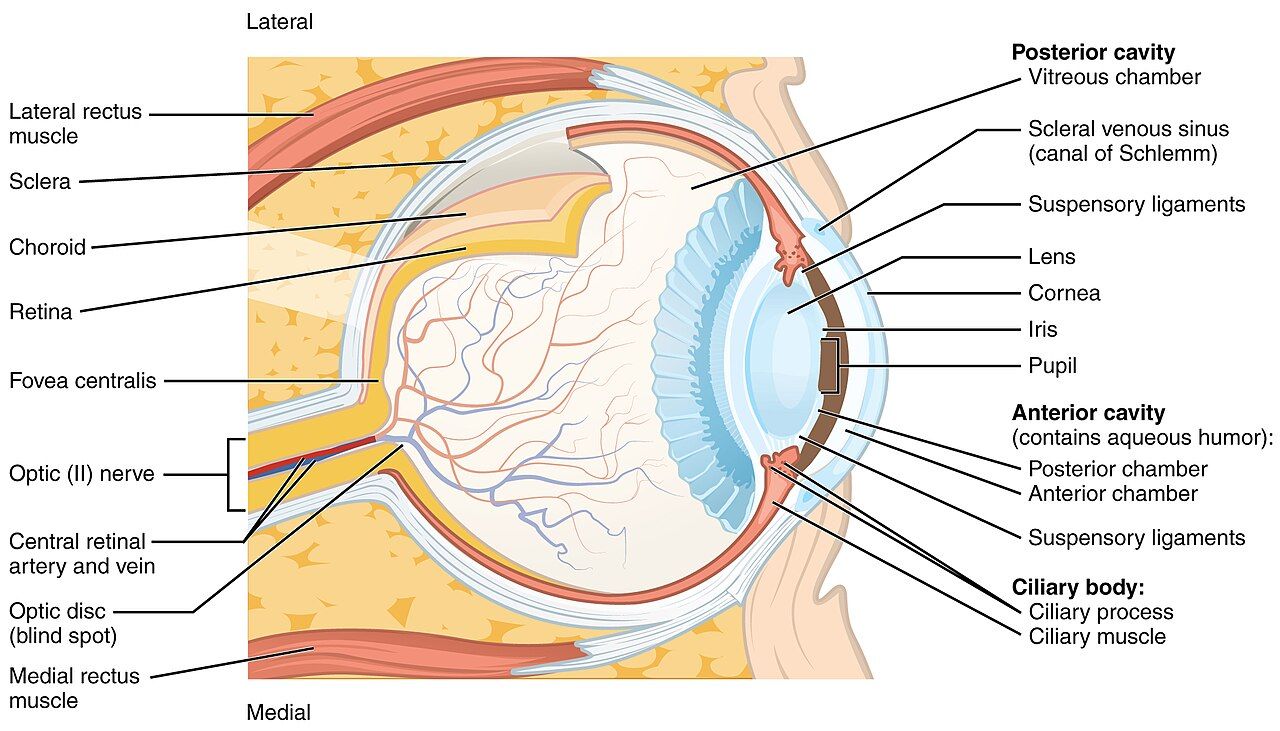
Vision begins with light. Light is one small slice of a wide band of energy called the electromagnetic spectrum. The wavelength of light, or the distance between its waves, sets the color, or hue, we see. Its intensity, or strength, sets how bright it looks. Light first hits the cornea, the clear front surface of the eye, which does most of the focusing. Next, light passes through the pupil, an opening that can get bigger or smaller. The colored muscle around it, the iris, controls its size. Behind the pupil sits the lens, which fine-tunes the focus by changing its shape. This is called accommodation. The lens casts a small, upside-down image onto the retina, a thin layer that lines the back of the eye.
The retina is where biology takes over from optics. Its photoreceptors catch the light and pass their signals to a layer of bipolar cells, which pass them on to ganglion cells. The long fibers of the ganglion cells bundle together into the optic nerve. The optic nerve carries the signals out of the eye to the brain. The spot where this nerve leaves has no receptors at all, and it is called the blind spot. Yet you never notice the hole, because your brain quietly fills it in. Your sharpest vision comes from the fovea. This is a small pit in the center of the retina, packed with receptors that pick up fine detail.
How light becomes a signal
Two kinds of photoreceptor handle transduction in the eye. They are named for their shapes. Rods number about 120 million, and they are spread around the edges of the retina. Rods are very sensitive, so they let you see in dim light, but only in shades of gray. Cones number about six million, and most of them are packed into the fovea. Cones need brighter light, but in return they give you sharp detail and color. Both kinds hold light-sensitive chemicals called photopigments. When light strikes them, these chemicals change shape. That change is the spark that starts the nerve signal. This split in jobs explains a night-sky trick. A faint star is easier to see if you look a little to one side of it. That puts its light on the rod-rich edges of your retina.
| Feature | Rods | Cones |
|---|---|---|
| Number | About 120 million | About 6 million |
| Location | Edges of the retina | Packed in the fovea |
| Light needed | Very little: work in dim light | Bright light |
| Color? | No: grays only | Yes: full color |
| Best for | Night vision and side vision | Daylight, color, fine detail |
Color vision: two theories, both true
How can three kinds of cone give us millions of colors? The trichromatic theory gives part of the answer. Thomas Young proposed it, and Hermann von Helmholtz improved it. It says the retina has three types of cone. One type responds most to short wavelengths (blue). One responds most to medium wavelengths (green). One responds most to long wavelengths (red). The brain reads the balance of activity across the three as a certain color. This explains most color mixing. It also explains red-green color blindness, which happens when one cone type is missing or does not work well. But the theory cannot explain one odd fact. Stare at a green square, then look at a white wall. You will see a red afterimage.
Ewald Hering's opponent-process theory fills in the missing piece. It says that, farther along the path to the brain, color is handled in opposing pairs. The pairs are red versus green, blue versus yellow, and black versus white. A cell that fires for green is held back by red. That is why you can never see a "reddish green." When the green side gets tired, its red partner bounces back. That bounce is the afterimage. Today, scientists agree both theories are right. They just work at different stages. The trichromatic theory describes the cones. The opponent-process theory describes the cells after them.
- The cornea and lens focus light onto the retina. Signals leave through the optic nerve, which makes a blind spot.
- Rods handle dim light and side vision. Cones handle color and fine detail, and cluster in the fovea.
- Trichromatic theory explains color at the cones. Opponent-process theory explains afterimages farther along the path.
Section 3Hearing
From pressure waves to vibration
Sound is just waves of pressure moving through the air. Two features of those waves become two parts of what we hear. The first is frequency. That is how many waves pass each second. It is measured in hertz (Hz), and we hear it as pitch. The second is amplitude. That is the height of the waves. It is measured in decibels (dB), and we hear it as loudness. Young human ears can pick up sounds from about 20 to 20,000 Hz. The ear's job is to catch these faint waves and turn them into nerve signals. It does this in a neat chain of steps.
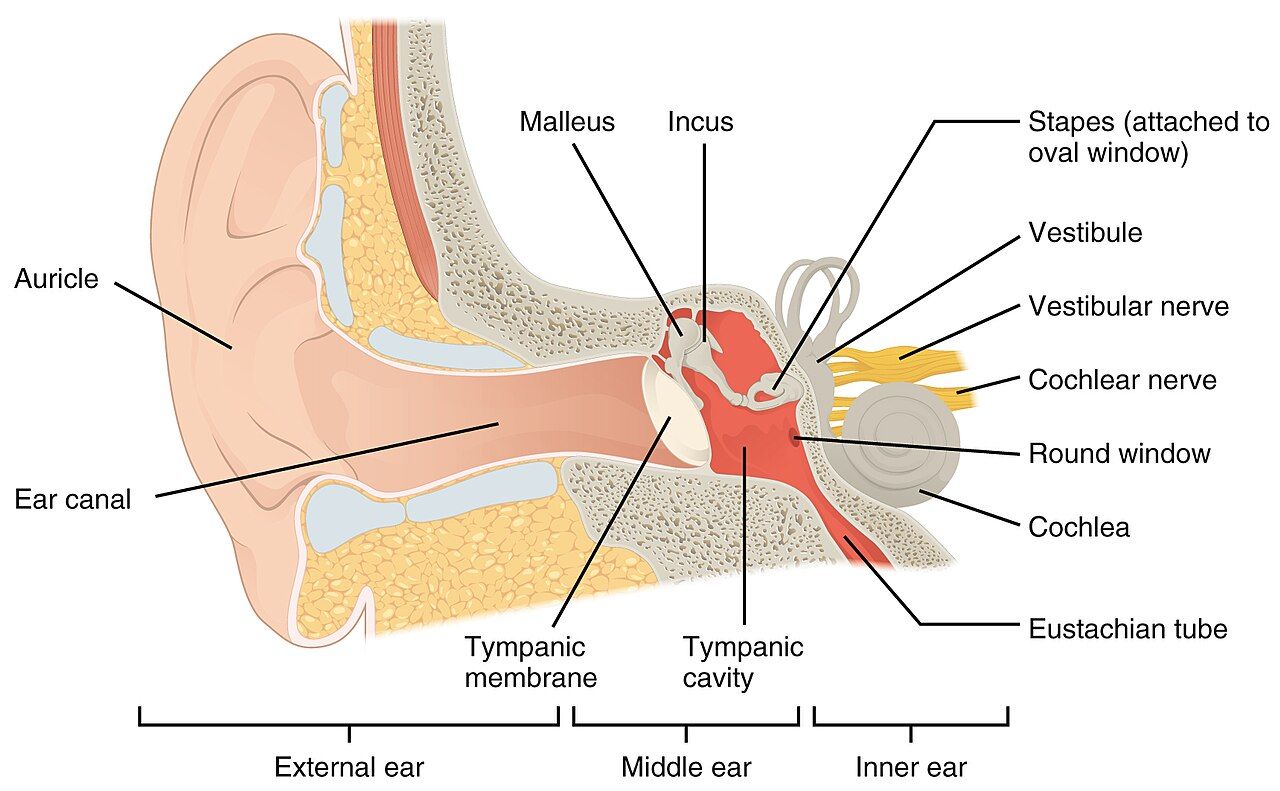
First comes the outer ear. The flap you can see, called the pinna, funnels sound down the ear canal to the eardrum. The eardrum shakes, or vibrates. Next comes the middle ear, which is filled with air and holds three tiny bones. They are the hammer, anvil, and stirrup, also called the malleus, incus, and stapes. They work like levers that make the vibration stronger and pass it to the inner ear, which is filled with fluid. There, a coiled tube called the cochlea carries the vibration as a wave. The wave rolls along the basilar membrane, which is lined with hair cells. When the membrane ripples, the hair cells bend, and that bending is the moment of transduction, when motion becomes a nerve signal. The signal travels along the auditory nerve to the brain.
How we hear pitch and loudness
Loudness is fairly easy to explain. Louder sounds bend more hair cells and make them fire faster. The brain reads more nerve activity as more volume. Pitch took two rival theories to explain. In the end, the two worked as partners. Place theory came from Helmholtz. It says the brain reads pitch from where the basilar membrane shakes the most. High sounds shake it most near the base, close to the oval window. Low sounds shake it most near the far tip, called the apex. Place theory explains high pitches very well, but it struggles with low ones. For low sounds, the shaking spreads too wide to pin down one spot.
Frequency theory, also called temporal theory, fills that gap. It says the auditory nerve fires at the same rate as the sound wave. So a 100 Hz tone makes the nerve fire 100 times per second. This works well for low pitches, but it fails for high ones. A single neuron cannot fire much faster than about 1,000 times per second. Ernest Wever described the volley principle to solve this. Teams of neurons take turns firing, one after another, so their combined "volley" can match sounds far faster than any one cell could. So the brain uses place for high pitches and frequency for low pitches. In the middle range, it uses both.
| Theory | How pitch is coded | Best explains |
|---|---|---|
| Place theory | Where the basilar membrane shakes the most | High-frequency (high-pitched) sounds |
| Frequency theory | Nerve firing rate matches the sound's frequency | Low-frequency (low-pitched) sounds |
| Volley principle | Groups of neurons take turns firing in fast volleys | Middle frequencies, above one neuron's limit |
- We hear frequency as pitch and amplitude as loudness.
- The outer ear gathers sound, the middle-ear bones make it stronger, and hair cells in the cochlea turn it into signals.
- Place theory explains high pitches, frequency theory explains low pitches, and the volley principle covers the middle.
Section 4The other senses
The chemical senses: taste and smell
Taste is also called gustation. It begins when chemicals dissolved in saliva reach the taste buds. Taste buds sit in the small bumps on your tongue and in your mouth. There are five basic tastes: sweet, sour, salty, bitter, and a savory taste called umami. Taste bud cells replace themselves about every ten days. Smell, also called olfaction, works on molecules floating in the air. These molecules reach receptor neurons high up inside the nose. Humans have about 400 types of smell receptor. Different mixes of these receptors let us tell apart a huge range of odors. Smell has a special route in the brain. Its signals go to the olfactory bulb. From there, they go on to the limbic system, the brain's center for emotion and memory. They do this without first stopping at the thalamus, the relay station that other senses pass through. That is why one scent can bring back a childhood memory so strongly. What we call "flavor" is mostly taste and smell working together. Anyone who has eaten dinner with a head cold knows this.
The skin senses and pain
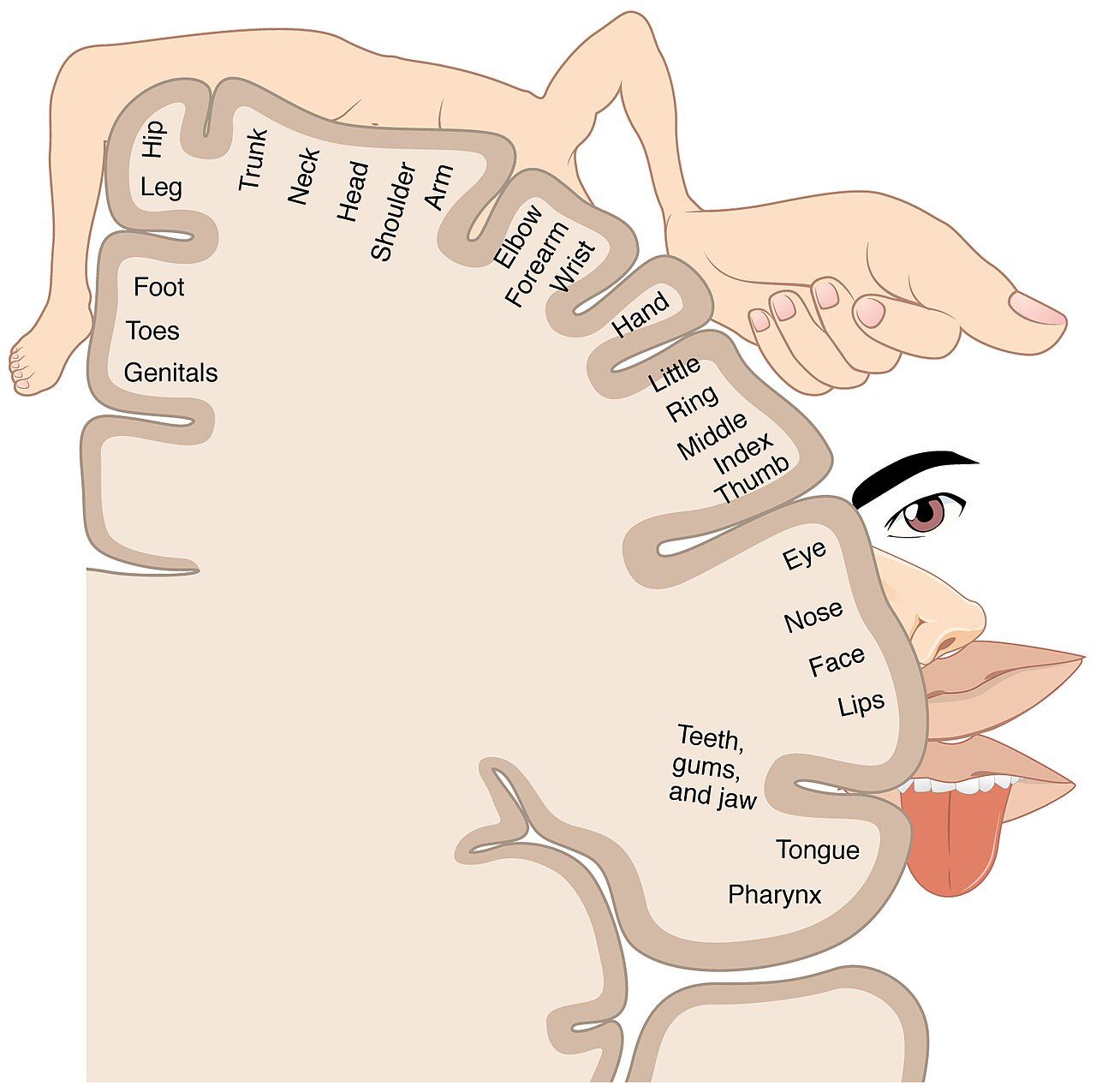
The skin reports four basic feelings: pressure, warmth, cold, and pain. Its receptors are spread unevenly across the body, which is why your fingertips and lips are far more sensitive than your back. Pain needs a closer look, because it is not a simple measure of injury. Ronald Melzack and Patrick Wall proposed the gate-control theory of pain. It says the spinal cord has a kind of nerve "gate." The gate can block pain signals or let them through to the brain. Signals from large nerve fibers carry harmless touch, like the rubbing you give a bumped shin. These signals switch on cells in the spinal cord that help close the gate. Messages from the brain matter too. Attention, worry, and what you expect can swing the gate open or shut. That is why a soldier may not notice a wound during battle. It is also why the same injury can hurt more at 3 a.m. than at noon.
Knowing where your body is
Two senses you rarely think about keep you upright and steady. Kinesthesia is also called proprioception. It uses receptors in your muscles, tendons, and joints. These track where your body parts are and how they move. It is how you can touch your nose with your eyes closed. The vestibular sense tracks balance and the position of your head. It uses the fluid-filled semicircular canals and the otolith organs of the inner ear. When you spin and stop, that fluid keeps sloshing, and you feel dizzy. On a rocking boat, your inner ear and your eyes disagree, and you can feel motion sick.
| Sense | Also called | Where it lives | Stimulus |
|---|---|---|---|
| Taste | Gustation | Taste buds on the tongue and in the mouth | Dissolved chemicals |
| Smell | Olfaction | Receptor neurons high in the nose | Molecules in the air |
| Touch | Somatosensation | Receptors throughout the skin | Pressure, warmth, cold |
| Pain | Nociception | Nociceptors (pain receptors) across the body | Things that can damage tissue |
| Body position | Kinesthesia and vestibular sense | Muscles and joints; inner-ear canals | Movement, position, gravity |
- Taste (five basic tastes) and smell are chemical senses. Smell goes straight to the limbic system, which ties odors to memory.
- The skin senses pressure, warmth, cold, and pain. Gate-control theory explains why pain can be blocked or made worse.
- Kinesthesia tracks where your limbs are. The vestibular sense (semicircular canals) controls balance.
Section 5Perceptual organization
Gestalt principles: the whole and its parts
In the early 1900s, a group of German psychologists made a bold claim. They were Max Wertheimer, Kurt Koffka, and Wolfgang Köhler. They said we do not see the world as a pile of separate bits, but as organized wholes. Their school took its name from the German word Gestalt. It means form, shape, or organized whole. Christian von Ehrenfels brought the term into psychology in 1890. Wertheimer carried it into the Berlin group with his 1912 work on apparent motion. That is the way two lights flashing one after the other look like one light moving. Koffka later summed up their main idea in a slogan: "the whole is different from the sum of its parts." In other words, the brain does not add the organization later. Organization is part of perception from the start. The Gestalt group listed the rules the brain uses to group bits into objects. The most basic rule is figure-ground. We automatically split an object (the figure) from what is behind it (the ground). Black words jumping off a white page are an example. Other rules explain how we group things. We group by nearness, by likeness, and by smooth lines. We also tend to finish shapes that have gaps.
| Principle | We tend to… | Everyday example |
|---|---|---|
| Figure-ground | Split an object from its background | Words standing out from the page |
| Proximity | Group things that are near each other | Seeing three clusters of dots, not many dots |
| Similarity | Group things that look alike | Sorting players by jersey color |
| Continuity | See smooth, unbroken lines | Two crossing lines, not four short pieces |
| Closure | Fill in gaps to see a whole object | Reading a logo with pieces missing |
| Common fate | Group things that move together | A flock of birds seen as one unit |
Depth perception: seeing a 3-D world
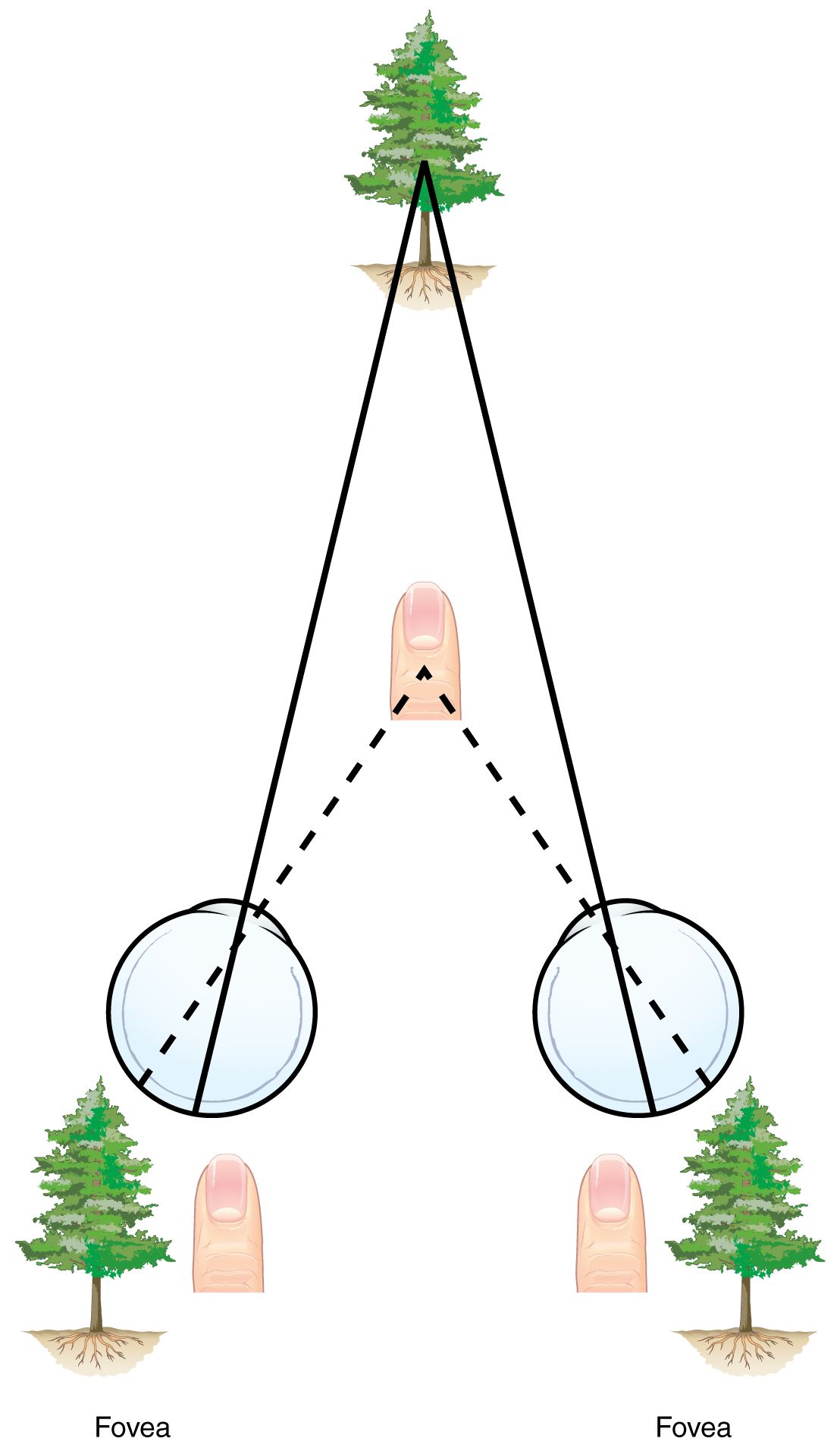
Each eye gets only a flat, two-dimensional image. Yet you see a world with depth and distance. Eleanor Gibson and Richard Walk tested this with their famous visual cliff. It was a sheet of glass laid over a sudden drop, and babies who could crawl would not crawl out over the "edge," even when a parent called. This showed that crawling babies already perceive depth. Because these babies had already been moving around, the study cannot tell us whether depth perception is fully inborn. Later work suggests that experience with crawling helps build the fear of heights. The brain builds depth from two families of clues, called cues. Binocular cues need both eyes. In retinal (binocular) disparity, the two eyes see slightly different views. The bigger the difference, the closer the object. In convergence, the eyes turn inward to look at something near. Monocular cues need only one eye. They let a flat painting look deep. They include relative size, interposition (near things block far things), linear perspective (parallel lines seem to meet in the distance), texture gradient, relative height, and motion parallax (near things seem to rush past faster than far things).
Perceptual constancy and the set of the mind
The image an object casts on your retina keeps changing. A door swinging open makes a shifting, slanted shape, and a friend walking away gets smaller and smaller. Yet you see these things as stable. This is perceptual constancy. We see objects as keeping the same size, shape, color, and lightness, even when the raw input changes. Size constancy tells you your friend is not really shrinking. Shape constancy keeps the door a rectangle in your mind. Perception is also guided from the top down by a perceptual set. A perceptual set is a readiness to see one thing instead of another, based on the setting and what you expect. Visual illusions, like the Müller-Lyer and Ponzo figures, are useful for this reason. They make these hidden rules easy to see. They trick a system that is usually right into being confidently wrong.
- Gestalt principles describe how we group parts into wholes: figure-ground, proximity, similarity, continuity, closure, and common fate.
- Depth perception uses binocular cues (retinal disparity, convergence) and monocular cues (relative size, interposition, linear perspective, motion parallax).
- Perceptual constancy keeps objects stable when the input changes. A perceptual set lets what we expect shape what we perceive.
The chapter in one breath
- Sensation picks up and codes stimuli through transduction. Perception sorts them and gives them meaning, mixing bottom-up and top-down processing.
- The absolute and difference thresholds, Weber's law, and signal detection theory describe how well, and how reliably, we notice faint stimuli.
- In vision, the cornea and lens focus light onto the retina. There, rods and cones turn it into signals. Color comes from trichromatic coding at the cones and opponent-process coding after them.
- In hearing, the middle-ear bones make vibration stronger, and hair cells in the cochlea turn it into signals. Place and frequency theories, plus the volley principle, explain pitch.
- The chemical senses (taste, smell) and the skin senses feed perception too. Gate-control theory shows that pain is adjusted, not just measured.
- Kinesthesia and the vestibular sense track body position and balance.
- Gestalt principles, binocular and monocular depth cues, and perceptual constancy show that perception is built by the brain. That is exactly why illusions work.
ReferenceWords worth knowing
Here are the key terms from this chapter. Skim them now, or come back whenever a word trips you up.
- Absolute threshold
- The weakest stimulus you can detect 50% of the time.
- Binocular disparity
- The small difference between the images the two eyes get. The brain uses it as a two-eye cue to work out depth.
- Bottom-up processing
- Perception that starts with raw sense input and builds up to a whole picture.
- Cochlea
- The coiled, fluid-filled tube of the inner ear. Its hair cells turn sound into nerve signals.
- Cones
- Photoreceptors packed in the fovea. They detect color and fine detail in bright light.
- Difference threshold
- The smallest difference between two stimuli you can detect 50% of the time. Also called the just noticeable difference (JND).
- Gate-control theory
- The idea (Melzack and Wall) that the spinal cord has a nerve "gate" that blocks pain signals or lets them reach the brain.
- Gestalt psychology
- A school named for the German word Gestalt (form, shape, organized whole). It holds that we perceive organized wholes, not separate parts. Its slogan: "the whole is different from the sum of its parts."
- Kinesthesia
- The sense of where your body parts are and how they move. Also called proprioception.
- Olfaction
- The sense of smell. Molecules in the air trigger receptors whose signals go straight to the limbic system.
- Opponent-process theory
- The theory (Hering) that color is handled in opposing pairs: red-green, blue-yellow, and black-white. It explains afterimages.
- Perception
- The process of sorting and making sense of sense information, so it becomes meaningful objects and events.
- Perceptual constancy
- Seeing objects as keeping the same size, shape, color, and lightness, even when the image on the retina changes.
- Place theory
- The theory that pitch is coded by where the basilar membrane shakes the most. It best explains high pitches.
- Rods
- Photoreceptors around the edges of the retina. They work in dim light but see only shades of gray.
- Sensation
- The process in which sense receptors pick up stimuli and code them as nerve signals.
- Sensory adaptation
- Becoming less sensitive to a stimulus that stays the same over time.
- Signal detection theory
- A model of noticing. Whether you catch a faint signal depends on both how keen your senses are and your decision criterion, or how ready you are to say yes.
- Transduction
- Changing one form of energy into nerve signals the nervous system can use.
- Trichromatic theory
- The theory (Young-Helmholtz) that color vision comes from three cone types, tuned to short (blue), medium (green), and long (red) wavelengths.
- Vestibular sense
- The sense of balance and head position. It is based in the semicircular canals and otolith organs of the inner ear.
- Weber's law
- The rule that the difference threshold is a set fraction of the starting stimulus, not a set amount.