Learning
Think about the language you speak, the fear you feel at the sound of a dentist's drill, and the pull of a phone buzzing in your pocket. All of these were learned. Learning is the process by which experience makes a lasting change in what a living thing knows or does. Psychologists have spent more than a hundred years mapping how it works. This chapter tells that story. It moves from Pavlov's drooling dogs, to Skinner's levers, to Bandura's blow-up clown doll. Along the way, you will learn the words you need to spot conditioning in classrooms, casinos, and your own habits. Once you know these few ideas, a great deal of human and animal behavior stops looking like a mystery.
By the end of this chapter you can
- Define learning and tell it apart from reflex, instinct, maturation, and fatigue.
- Compare associative learning with non-associative kinds, such as habituation and sensitization.
- Map out classical conditioning using the US, UR, CS, and CR. Describe acquisition, extinction, spontaneous recovery, generalization, and discrimination.
- Explain Thorndike's law of effect and how Skinner built it into operant conditioning.
- Tell reinforcement from punishment, and positive from negative. Explain why negative reinforcement is not punishment.
- Describe shaping by successive approximations.
- Compare the four schedules of reinforcement and the pattern of behavior each one produces.
- Sum up Bandura's Bobo doll study and the four steps of observational learning.
Section 1What learning is
A working definition
Psychologists define learning as a fairly lasting change in behavior or knowledge that comes from experience. Each part of that sentence matters. First, the change must last. A change that is gone in a moment does not count. Second, it must come from experience. That rules out three look-alikes. One is maturation, or growing up. A baby walks mostly because its nervous system has matured, not because it practiced. Another is reflexes and instincts. You were born able to blink, so blinking is not learned. The last is a passing state, like fatigue or the effect of a drug. Learning is what is left once you take away growing up, being born knowing, and being tired.
Associative learning
The main engine in this chapter is associative learning. This means forming a link in the mind between two events, so one comes to signal or cause the other. It comes in two big forms. In classical conditioning, a living thing links two stimuli. A stimulus is any event it can sense. One stimulus becomes a signal that another is coming. In operant conditioning, a living thing links a behavior to its consequence, or what happens after it. Rewards and penalties then reshape what it does. Almost all the training people do with animals, children, and themselves runs on one of these two tracks.
The other kinds
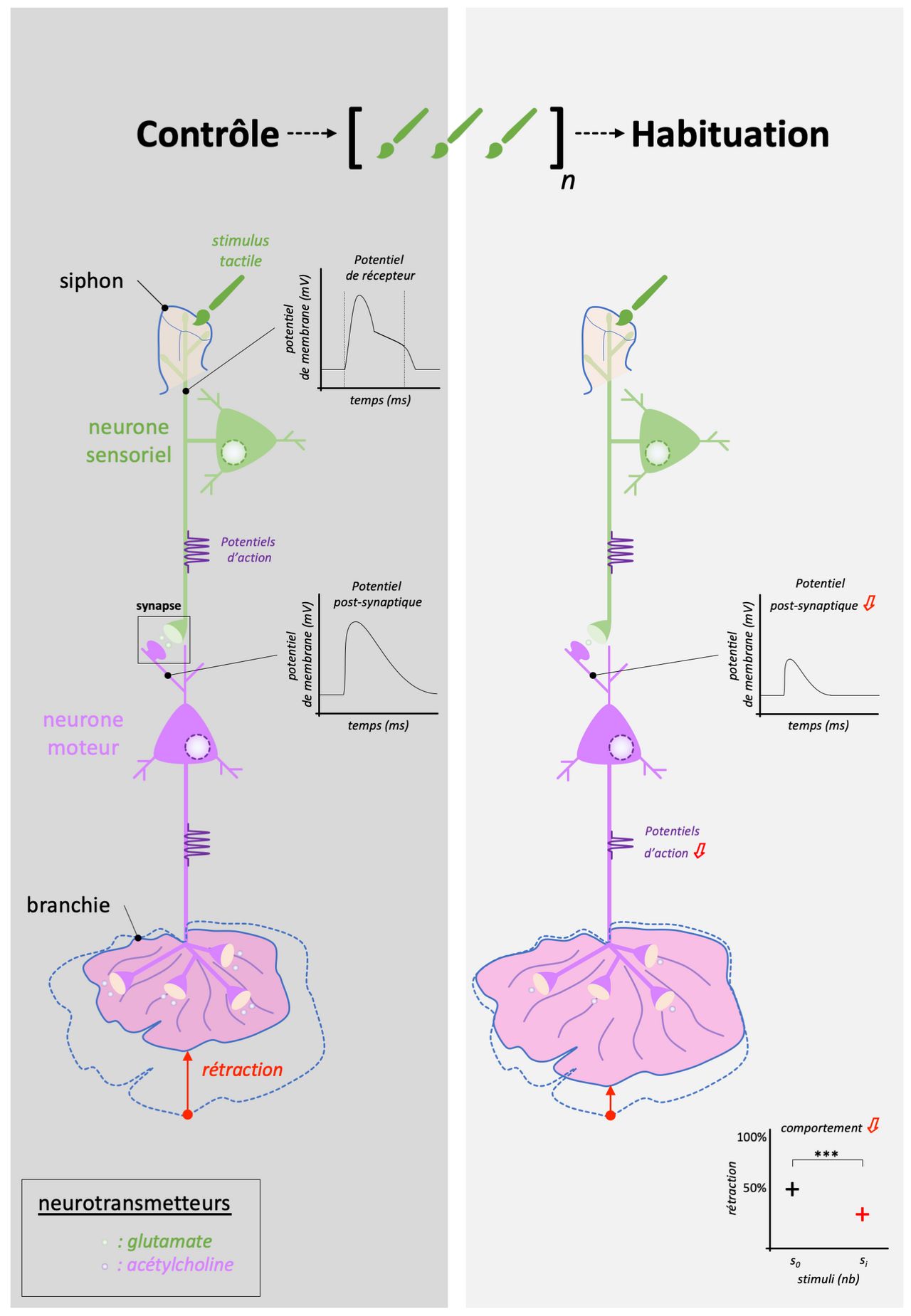
Not all learning is associative. The simplest kind is non-associative learning. It involves just one stimulus that repeats. In habituation, a response gets smaller as the stimulus repeats. A few minutes after you walk into the kitchen, you stop hearing the hum of the refrigerator. In sensitization, a response gets bigger. After a sudden clap of thunder, small noises make you jump. There are also richer kinds of learning. They include observational learning (Section 5). They also include latent learning, which is learning that stays hidden until there is a reason to show it. Early behaviorists gave this kind of learning too little credit. The behaviorist John B. Watson wanted psychology to study only what could be seen. Later, the field brought the mind back in. But the visible processes in this chapter are still its base.
| Kind of learning | What is linked or changed | Everyday example |
|---|---|---|
| Habituation | Response to one repeated stimulus decreases | You stop noticing a ticking clock |
| Sensitization | Response to one repeated stimulus increases | Jumpier at every creak after a scare |
| Classical conditioning | Two stimuli become linked | Mouth waters at a pizza shop's jingle |
| Operant conditioning | A behavior is linked to its consequence | Studying hard because it earns good grades |
| Observational learning | Behavior copied from a model | A toddler copies a parent's phone habits |
- Learning is a lasting change in behavior or knowledge that comes from experience, not maturation, reflex, or fatigue.
- Associative learning links events: classical conditioning (two stimuli) and operant conditioning (a behavior and its consequence).
- Non-associative learning involves one repeated stimulus: habituation (the response falls) and sensitization (the response rises).
- Observational and cognitive learning show that learning is more than simple stimulus and response.
Section 2Classical conditioning

Pavlov's lucky accident
Ivan Pavlov was a Russian physiologist, a scientist who studies how the body works. He studied digestion. That work won him a Nobel Prize in 1904. Then his dogs changed his plans. They began to drool not just at food, but at the sight of the lab helper who fed them. They even drooled at the sound of footsteps coming, before any food showed up. Pavlov did not brush this off. He built the rest of his career on it. He paired a signal that meant nothing, like a metronome, buzzer, or tone, with meat powder. Then he measured, drop by drop, how the dogs learned to expect the meal.
The four parts: US, UR, CS, CR
The logic is simple once you name the four parts. Food in the mouth makes a dog drool on its own. The food is the unconditioned stimulus (US). The drooling it causes is the unconditioned response (UR). Neither one is learned. "Unconditioned" means no training needed. At first, a metronome means nothing to the dog. It is a neutral stimulus. But sound the metronome just before the food, again and again. Soon the dog drools at the metronome alone. Now the metronome is a conditioned stimulus (CS). The drooling it now causes is the conditioned response (CR). This response was learned through the pairing.
Acquisition, extinction, and generalization
Acquisition is the stage when the link between the CS and the US is built. It works best when the CS comes just before the US, every time. Now stop the pairing. Sound the metronome again and again with no food. The CR gets weaker and then stops. This is extinction. Yet the learning is not erased. After a rest, the metronome can bring back a burst of drooling. This comeback is called spontaneous recovery. Two more processes complete the picture. In stimulus generalization, stimuli that are like the CS also cause the CR. A dog trained to a 1000-Hz tone will also drool to a 1200-Hz tone. In discrimination, the animal learns to respond only to the exact CS.
The best-known human example is the "Little Albert" study by John B. Watson and Rosalie Rayner in 1920. A baby was conditioned to fear a white rat. Each time he reached for the rat, the researchers struck a steel bar to make a loud, scary clang. Soon the rat alone made him cry. His fear then spread, or generalized, to a rabbit, a dog, a fur coat, and a Santa Claus mask with a beard. The study is famous, but it has serious problems. It tested only one child. It was loosely controlled, and no one has repeated it. The researchers also never removed the fear they had created. Today, ethics rules would not allow a study like it.
| Term | What it is | Pavlov's dog | Everyday example |
|---|---|---|---|
| Unconditioned stimulus (US) | Causes a response on its own, no learning needed | Meat powder | Smell of baking bread |
| Unconditioned response (UR) | Automatic reaction to the US | Drooling at food | Mouth watering at the smell |
| Conditioned stimulus (CS) | Once neutral; now predicts the US | Metronome | The bakery's doorbell |
| Conditioned response (CR) | Learned reaction to the CS | Drooling at the metronome | Mouth watering at the doorbell |
- Pavlov found that a neutral signal paired with a US comes to cause a learned response.
- The US→UR pair is not learned. The CS→CR pair is learned through pairing.
- Acquisition builds the link, extinction fades it, and spontaneous recovery brings it back for a time.
- Generalization spreads the CR to similar stimuli. Discrimination narrows it to the exact CS.
Section 3Operant conditioning
Thorndike's law of effect
Classical conditioning is about signals. Operant conditioning is about consequences. Its roots go back to Edward Thorndike. He put hungry cats in "puzzle boxes." A cat could get out only by working a latch. On the first try, a cat clawed and wriggled at random. Over many tries, it got out faster and faster. It zeroed in on the action that worked. Thorndike summed this up in the law of effect. Behaviors followed by pleasing results get stronger and happen more often. Behaviors followed by unpleasant results get weaker. Consequences pick which behaviors survive, the way a gardener picks which plants to keep.
Skinner and the operant chamber
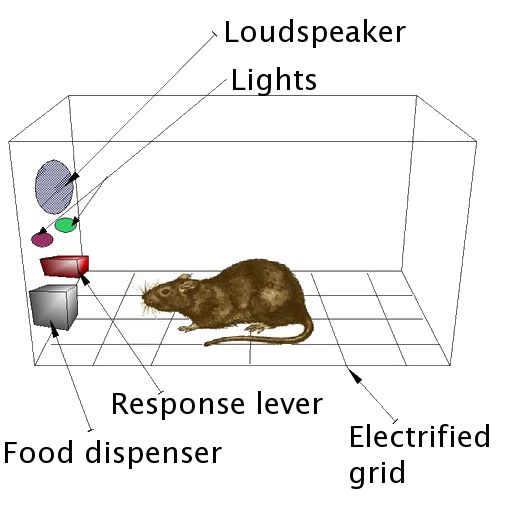
B. F. Skinner turned that idea into a careful science. He came up with the word operant, because the behavior "operates" on the world to produce results. He built the operant chamber, often called the "Skinner box." Inside, a rat presses a lever or a pigeon pecks a lit-up key. A machine then gives food and records every response. Compare this with Pavlov. Classical conditioning works on automatic, reflex responses, like drooling, blinking, or fear. Operant conditioning works on voluntary behaviors, ones the animal chooses to do to earn rewards or avoid trouble.
Reinforcement, punishment, positive, negative
Every consequence has two features. The first is its effect. Reinforcement makes a behavior more likely. Punishment makes it less likely. The second is whether something is added or taken away. Positive means a stimulus is added. Negative means a stimulus is removed. Here, the words do not mean "good" or "bad." Cross the two features, and you get four cases, shown in the table below. Reinforcers also come in two kinds. Primary reinforcers meet a body need directly, like food, water, or warmth. Secondary reinforcers, also called conditioned reinforcers, include money, grades, praise, and the click of a training clicker. They gain their power only by being linked with primary reinforcers.
| Consequence | Positive: add a stimulus | Negative: remove a stimulus |
|---|---|---|
| Reinforcement (behavior increases) | Positive reinforcement: give a treat for sitting | Negative reinforcement: the seatbelt buzzer stops when you buckle |
| Punishment (behavior decreases) | Positive punishment: a scolding for texting in class | Negative punishment: losing phone time after breaking a rule |
Punishment can stop a behavior for a while. But it has known drawbacks. It shows what not to do, but not what to do instead. Harsh physical punishment is linked with more fear, anxiety, and aggression in children. That is why most experts suggest pairing any punishment with reinforcement of a better behavior.
- Thorndike's law of effect: pleasing results strengthen a behavior, and unpleasant results weaken it.
- Skinner studied this as operant conditioning of voluntary behavior in the operant chamber.
- Reinforcement increases behavior. Punishment decreases it. Positive adds a stimulus. Negative removes one.
- Primary reinforcers meet body needs. Secondary reinforcers (money, praise) work by being linked to them.
Section 4Shaping and schedules of reinforcement
Shaping a new behavior
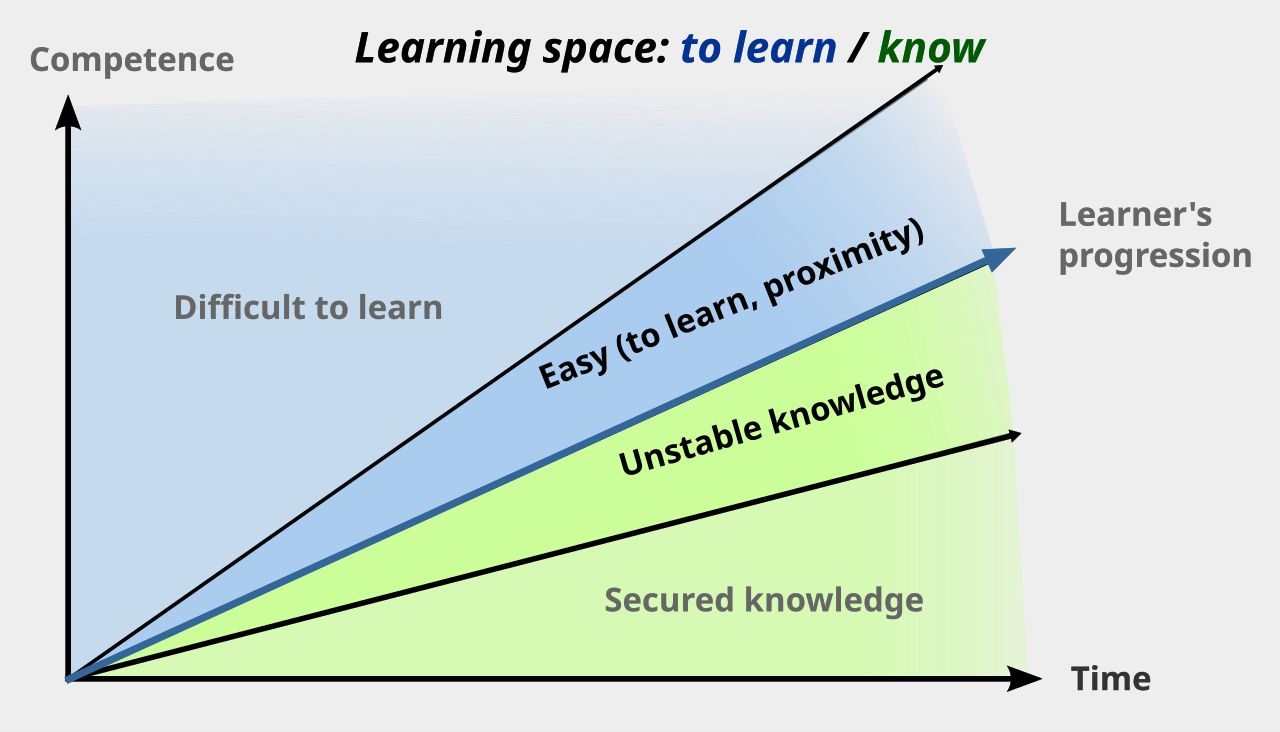
A rat will not walk over and press a lever on its own. So how do you reward a behavior that has never happened? The answer is shaping. In shaping, you reward successive approximations. These are small steps that move closer and closer to the goal. First, reward the rat just for turning toward the lever. Then reward it only for walking up to the lever. Then only for touching it. At last, reward it only for a full press. Each step builds on the one before. The same method teaches a dolphin to leap through a hoop. It helps a child learn to write letters. It helps a person recovering from a stroke learn to walk again. Complex behavior is built one rewarded step at a time.
How often to reinforce
Once a behavior exists, how often you reward it changes everything. In continuous reinforcement, every correct response earns a reward. This gives the fastest learning. But it also gives the fastest extinction once the rewards stop. People give up on a vending machine that always worked the first time it fails. In partial, or intermittent, reinforcement, only some responses earn a reward. This builds behavior that is very hard to extinguish. The effect is so reliable that it has its own name: the partial reinforcement effect. It is why a slot machine, which pays off only now and then, keeps a person playing long after they would have left a broken vending machine.
The four schedules
Partial reinforcement comes in four types. Two questions define them. First, is the reward tied to the number of responses? That is a ratio schedule. Or is it tied to the passing of time? That is an interval schedule. Second, is the rule fixed, meaning it stays the same? Or is it variable, meaning it changes in a way you cannot predict? Each of the four mixes gives its own pattern of responding. Variable-ratio schedules give the highest, steadiest rates. They are also the hardest to extinguish. Fixed-interval schedules give a telltale "scallop." Responding drops right after a reward and speeds up as the next reward time gets close.
| Schedule | Reward given | Response pattern | Real-world example |
|---|---|---|---|
| Fixed ratio (FR) | After a set number of responses | High rate; short pause after each reward | Pay per piece made; buy ten, get one free |
| Variable ratio (VR) | After an unpredictable number of responses | Highest, steadiest; very hard to extinguish | Slot machines; lottery tickets |
| Fixed interval (FI) | First response after a set time | "Scalloped": slow, then faster near the deadline | Cramming before a scheduled exam |
| Variable interval (VI) | First response after an unpredictable time | Slow and steady | Checking for a text; pop quizzes |
- Shaping builds a new behavior by rewarding successive approximations toward a goal.
- Continuous reinforcement is learned fastest but extinguished fastest. Partial reinforcement resists extinction.
- Schedules are ratio (based on responses) or interval (based on time), and fixed or variable.
- Variable-ratio gives the highest, most stubborn responding. It is the psychology behind gambling.
Section 5Observational learning
Learning without doing
In conditioning, the learner has to act and feel the result. But people learn a great deal just by watching. Albert Bandura called this observational learning, or modeling. He made it the center of his social-cognitive theory. The key point is that the watcher does not need any reward at all. It is enough to see a model, or another person, do the behavior. We also take in results that happen to someone else. Seeing a model rewarded can make us more likely to copy them. This is called vicarious reinforcement. Seeing a model punished makes us less likely to copy them. This is called vicarious punishment. In Bandura's own data, the second effect was the stronger and more reliable one.
The Bobo doll experiment
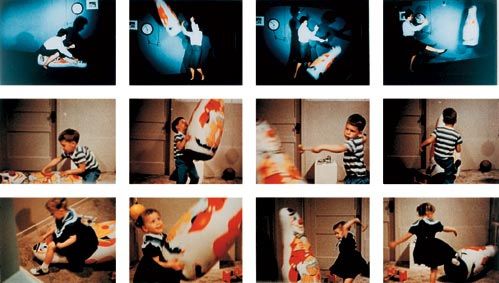
Bandura's classic study in 1961 made the point hard to forget. Preschool children watched an adult with a blow-up doll named Bobo. Some children saw the adult attack the doll. The adult punched it, kicked it, hit it with a mallet, and shouted, "Sock him!" Other children saw the adult play calmly. Later, each child was left alone with the doll. Children who had watched the aggressive model copied the very same attacks, often using the same words. Some even made up new attacks. Children who had seen the calm model mostly did not.
Later versions of the study added results for the model, and the effect was lopsided. Children who saw the model punished copied much less. Children who saw the model rewarded copied about as much as children who saw no result at all. Then Bandura showed something even more important. He offered every child a reward for showing what they had seen. Now all the groups did the acts equally well. All of them had learned the behavior by watching. The results for the model only changed how willing they were to perform it. This went against strict behaviorism. Learning had happened with no reward to the child at all. Later researchers have pointed out a limit. Hitting a toy built to be hit is not the same as hurting a person. So the study shows copying clearly, but it says less about real-world violence.
The four steps of modeling
Bandura said that turning watching into doing takes four steps. First, you must pay attention to the model. Second, you must retain, or remember, what was done. Third, you must be physically able to reproduce it. Fourth, you need the motivation to do it, often from the reward you expect. Miss any one step, and the behavior will not appear. Modeling helps explain how children pick up language, manners, kindness, prejudice, and aggression. It is why role models, teachers, and people in the media carry so much weight. We are built to copy the people we watch.
| Step | What must happen | Example: learning to cook from a chef |
|---|---|---|
| Attention | Notice and focus on the model | Watch how the chef holds the knife |
| Retention | Store a memory of the behavior | Picture the method later at home |
| Reproduction | Be able to copy it | Have the hand control to chop safely |
| Motivation | Have a reason to do it | Want the praise a good meal earns |
- Bandura showed that people learn by watching models, without being rewarded themselves.
- In the Bobo doll study, children copied an adult's aggression. Seeing the model punished cut down copying. Seeing the model rewarded added little over seeing no result.
- When every child was later offered a reward, the differences went away. This shows the difference between learning and performance.
- Vicarious reinforcement and punishment shape whether we copy what we see.
- Modeling needs attention, retention, reproduction, and motivation.
The chapter in one breath
- Learning is a lasting change in behavior or knowledge that comes from experience. It is not reflex, instinct, maturation, or fatigue.
- Associative learning links events. Non-associative learning (habituation, sensitization) involves one repeated stimulus.
- In classical conditioning (Pavlov), a neutral stimulus paired with a US becomes a CS that causes a CR. Key processes are acquisition, extinction, spontaneous recovery, generalization, and discrimination.
- Operant conditioning (Thorndike's law of effect, Skinner) shapes voluntary behavior through its consequences.
- Reinforcement increases behavior, and punishment decreases it. Positive adds a stimulus, and negative removes one. Negative reinforcement is not punishment.
- Shaping rewards successive approximations. The four schedules (FR, VR, FI, VI) give different response patterns, and variable-ratio is the most stubborn.
- Observational learning (Bandura's Bobo doll) shows we learn by watching models, through attention, retention, reproduction, and motivation.
ReferenceWords worth knowing
Here are the key terms from this chapter. Skim them now, or come back whenever a word trips you up.
- Acquisition
- The first stage of conditioning, when the link is being built between a conditioned stimulus and an unconditioned stimulus (or between a behavior and its consequence).
- Associative learning
- Learning that links two events: two stimuli in classical conditioning, or a behavior and its consequence in operant conditioning.
- Classical conditioning
- Learning in which a neutral stimulus, paired with an unconditioned stimulus, comes to cause a conditioned response. Pavlov studied it first.
- Conditioned response (CR)
- The learned reaction to a stimulus that used to be neutral and is now conditioned.
- Conditioned stimulus (CS)
- A stimulus that was once neutral. After being paired with an unconditioned stimulus, it comes to cause a conditioned response.
- Extinction
- The weakening and fading of a conditioned response when the CS is no longer paired with the US (or a behavior is no longer reinforced).
- Fixed-interval schedule
- Rewarding the first response after a set amount of time has passed. It gives a scalloped response pattern.
- Fixed-ratio schedule
- Rewarding after a set number of responses. It gives a high rate with a short pause after each reward.
- Generalization
- When stimuli that are like the conditioned stimulus also cause the conditioned response.
- Habituation
- A non-associative drop in response to a stimulus that repeats and is harmless.
- Law of effect
- Thorndike's rule that behaviors followed by pleasing results get stronger, and those followed by unpleasant results get weaker.
- Learning
- A fairly lasting change in behavior or knowledge that comes from experience.
- Negative reinforcement
- Strengthening a behavior by removing something unpleasant. Do not confuse it with punishment.
- Observational learning
- Learning by watching and copying a model, without being rewarded directly. It is central to Bandura's theory.
- Operant conditioning
- Learning in which the results of a voluntary behavior make it more or less likely to happen again.
- Positive reinforcement
- Strengthening a behavior by adding something pleasant after it happens.
- Punishment
- Any consequence that makes a behavior less likely to happen again.
- Reinforcement
- Any consequence that makes a behavior more likely to happen again.
- Shaping
- Building a new behavior by rewarding successive approximations, or closer and closer steps, toward the target behavior.
- Spontaneous recovery
- When an extinguished conditioned response comes back after a rest period.
- Unconditioned stimulus (US)
- A stimulus that causes a response naturally and automatically, with no learning.
- Variable-ratio schedule
- Rewarding after an unpredictable number of responses. It gives the highest rate of responding and the hardest to extinguish.