Respiratory Drugs & Eye/Ear
Breathing is the one thing a person cannot put off. When an airway narrows, the clock starts. The drugs you grab in the next sixty seconds are not the same drugs the person takes every morning to keep the airway from narrowing in the first place. This chapter sorts breathing drugs by the most important split of all: rescue versus controller. Then it covers the bronchodilators, the inhaled steroids, and the crowded shelf of cough, cold, and allergy products people buy without asking anyone. It ends with eye and ear drops. A drop is a real drug with real effects on the whole body. And putting drops in the right way is a skill that often falls to you alone. Learn the two airway targets first. Every drug that follows aims at one of them.
By the end of this chapter you can
- Explain bronchoconstriction (tight airways) and airway inflammation as the two separate drug targets in asthma and COPD.
- Tell a rescue drug from a controller drug, and explain why the difference is about safety, not just words.
- Compare SABAs, LABAs, anticholinergics, and theophylline by how fast they work, their role, and their main side effects.
- Teach the right way to use a metered-dose inhaler, a spacer, and the rinse-and-spit rule for inhaled steroids.
- Read peak flow zones, and see that using a rescue inhaler too often means poor control.
- Compare first- and second-generation antihistamines, and give safe advice on decongestants, cough suppressants, and expectorants.
- Describe how glaucoma drugs lower the pressure inside the eye, and why timolol eye drops can slow a heart or close an airway.
- Give and teach eye drops and ear drops the right way, including punctal occlusion and pulling the outer ear the right way.
Section 1Airway physiology, asthma & COPD
A tube with a muscle around it
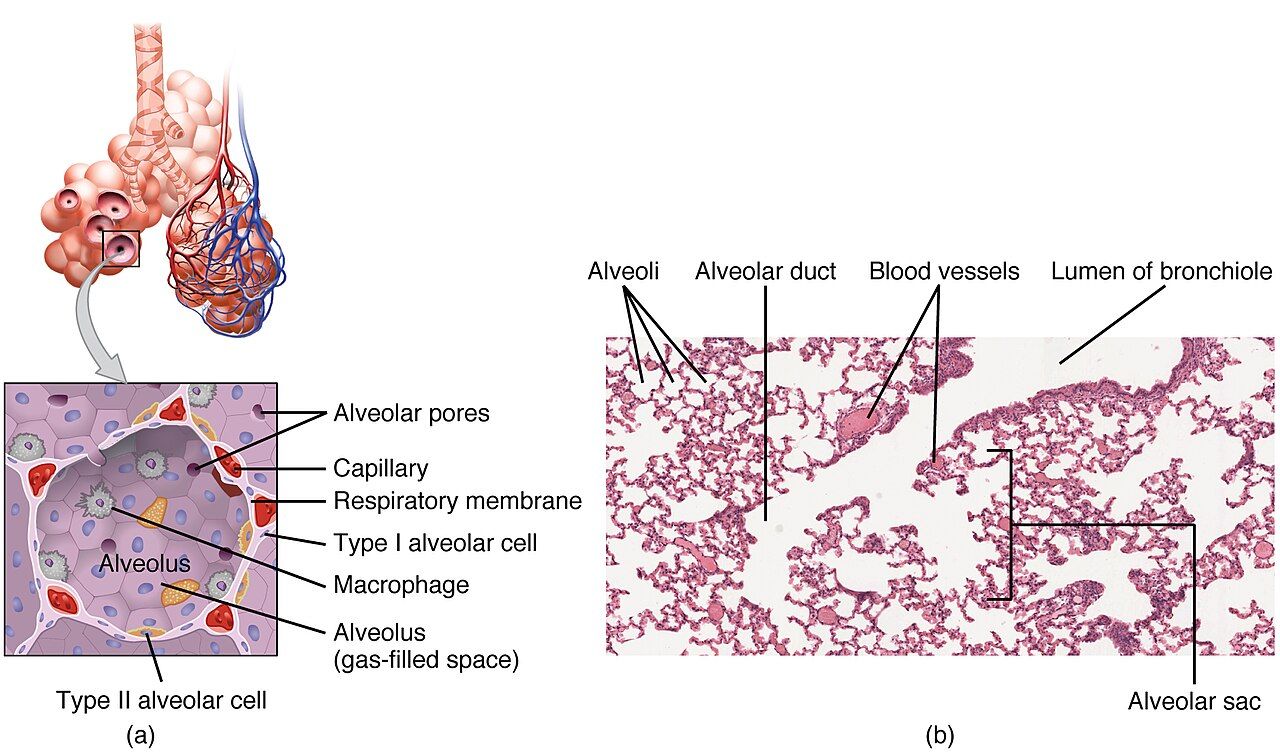
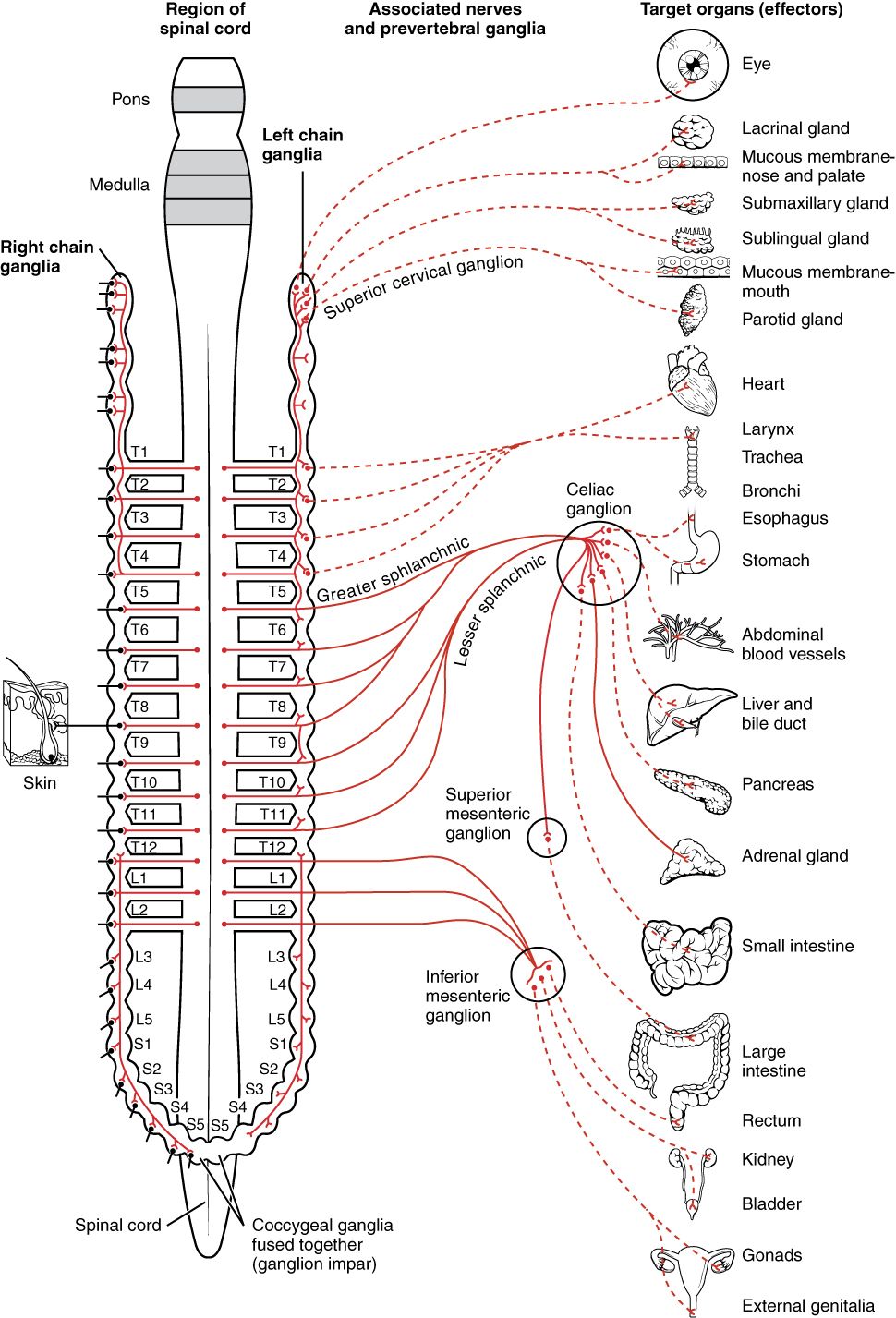
Picture the airway as a branching tree of tubes that gets narrower with every split. From the mid-sized airways (bronchi) down to the smallest ones (bronchioles), each tube is wrapped in a ring of airway smooth muscle. That muscle has a job. It fine-tunes where air goes, and it takes orders from the autonomic nervous system. The parasympathetic nerves release acetylcholine onto M3 muscarinic receptors, and the muscle squeezes. This is bronchoconstriction, plus a squirt of mucus. Epinephrine in the blood hits beta-2 adrenergic receptors, and the muscle relaxes. This is bronchodilation. Two switches, opposite directions. Nearly every bronchodilator in this chapter either flips the beta-2 switch on or holds the M3 switch off.
Airflow through a tube is very sensitive to the tube's width. Narrow an airway a little, and resistance climbs steeply. That is why a person can go from talking in sentences to talking in single words within minutes. It is also why a drug that widens the tube even a little brings a dramatic improvement. And it explains why the same disease is far more dangerous in a toddler, whose airways are small to begin with.
Asthma and COPD: same organ, different problem
Asthma is two problems stacked on top of each other. The dramatic one is bronchoconstriction. The muscle clamps down in response to a trigger, such as cold air, exercise, pet dander, smoke, aspirin, or a virus. The quiet one, running underneath at all times, is long-lasting airway inflammation. The airway lining is swollen, mucus plugs build up, and allergy cells (eosinophils and mast cells) crowd in. The muscle spasm is what the person feels. The inflammation is what makes the muscle twitchy in the first place. This twitchy state is called airway hyperresponsiveness. Treat only the spasm, and you are mopping the floor with the faucet running. Key point: the blockage in asthma mostly goes away with treatment. A breathing test (spirometry) shows this when a bronchodilator opens the airway.
COPD is a different animal. It is chronic bronchitis plus emphysema, most often from tobacco. Here the blockage mostly does not go away. The walls of the air sacs have been destroyed, and the lungs have lost their spring. The airways collapse on breathing out, which traps air. Inflammation is there too. But it is driven more by neutrophils and responds much less to steroids than asthma's does. So the focus flips. In asthma, the inhaled steroid is the backbone. In COPD, the long-acting bronchodilators are the backbone. Inhaled steroids are added only for some, mostly people with frequent flare-ups, because in COPD they carry a real pneumonia risk.
| Feature | Asthma | COPD |
|---|---|---|
| Typical cause | Allergy / hyperresponsive airways; often starts young | Tobacco smoke (or long-term irritant exposure); usually after 40 |
| Obstruction | Largely reversible with a bronchodilator | Largely irreversible and progressive |
| Dominant cells | Eosinophils, mast cells | Neutrophils, macrophages |
| Course | Episodic: well between attacks | Daily symptoms with acute exacerbations |
| Backbone drug | Inhaled corticosteroid (controller) | Long-acting bronchodilator (LAMA and/or LABA) |
| Steroid response | Strong | Weak; ICS raises pneumonia risk |
Two targets, two jobs
Everything below follows from this. There are two problems, so there are two kinds of drugs, and patients must be able to tell them apart. A rescue (reliever) drug relaxes muscle right now and does nothing for inflammation. A controller (maintenance) drug calms inflammation over days to weeks and does nothing during an attack. People die from this mix-up. One person grabs a steroid inhaler during an attack and waits for relief that is not coming. Another feels fine on a rescue inhaler and quietly drops the controller that was keeping them fine.
- Airway smooth muscle squeezes through M3 muscarinic receptors and relaxes through beta-2 receptors. These are the two levers every bronchodilator pulls.
- Asthma = tight airways that can open again on top of long-lasting inflammation. COPD = mostly permanent, driven by smoking, and helped less by steroids.
- Two targets means two drug jobs: rescue (relax the muscle now) and controller (calm inflammation over weeks).
- A silent chest, exhaustion, drowsiness, or one-word speech in an asthma attack means breathing failure is close.
Section 2Bronchodilators
Beta-2 agonists: the fastest way to open a tube
A beta-2 agonist copies epinephrine at the beta-2 receptor on airway smooth muscle. It relaxes the muscle within minutes. The prototype short-acting beta-2 agonist (SABA) is albuterol. It is called salbutamol outside the United States. It starts working in about 5 minutes and lasts 4 to 6 hours. This is the rescue inhaler. It is also the drug used before exercise for airways that tighten with exercise. In a severe attack, it is given nonstop by nebulizer. Levalbuterol is the purified form of albuterol and is sold as gentler on the heart. In practice the difference is small.
The side effects are simply beta action leaking past the lung. Expect tremor, the most common complaint. Warn patients it is not an allergy. Expect a fast heart rate and a pounding heart, restlessness, and headache. Two effects on body chemistry matter more than most people expect. First, beta-2 action drives potassium into cells. So repeated or nonstop albuterol causes low potassium. Watch the potassium and the heart monitor in a severe, nonstop asthma attack (status asthmaticus). Second, it raises blood sugar. That push of potassium into cells is exactly why albuterol is also used, outside of breathing care, as an add-on for sudden high potassium.
Long-acting beta-2 agonists (LABAs), salmeterol and formoterol, hold the receptor for about 12 hours. Newer drugs such as vilanterol and indacaterol last 24 hours. They are daily control drugs, given on a schedule. Salmeterol starts slowly, which makes it useless in an attack. Here is the safety rule that must never be broken: a LABA is never used alone in asthma. Using a LABA alone in asthma was linked to more asthma deaths. So in asthma, a LABA is always used with an inhaled steroid, usually in one combination inhaler, for exactly that reason. In COPD, which works differently, a LABA alone is fine. Formoterol is the exception on speed. It starts fast. That is why some budesonide/formoterol plans use one inhaler as both controller and reliever.
Anticholinergics: holding the other switch off
Beta-2 agonists press the "relax" switch. Anticholinergics (antimuscarinics) block the "squeeze" switch. They sit in M3 receptors so acetylcholine cannot reach them. They open the airway a little more slowly than albuterol, but they also dry secretions as a bonus. Nerve signals that squeeze the airway play a big part in COPD. So these drugs help more in COPD than in asthma. Ipratropium is the short-acting one (SAMA). It is often paired with albuterol in one nebulizer solution or combination inhaler, because the pair works better than either alone in a flare-up. Tiotropium, umeclidinium, aclidinium, and glycopyrrolate are the long-acting ones (LAMAs). They are taken once or twice a day for control, never for rescue.
These molecules carry a charge and are poorly absorbed. So their whole-body anticholinergic effects are milder than with pills, but not zero. Expect a dry mouth. Offer sugar-free candy and good mouth care. Warn about trouble passing urine in men with a large prostate, and constipation in older adults. One practical point: if the mist gets into the eye, it can cause blurred vision, a wide pupil, and eye pain. It can even set off an attack of narrow-angle glaucoma. So use a mouthpiece instead of a loose face mask when you can, and keep the mist out of the eyes.
Theophylline: the drug with no margin
Theophylline is a methylxanthine, a chemical cousin of caffeine. It relaxes airway smooth muscle and mildly boosts the drive to breathe. It was once a mainstay. Now it is a last resort, for one reason: a narrow therapeutic index. The goal blood level is about 5 to 15 mcg/mL (older books say 10 to 20). The margin above it is thin. Side effects climb steeply once levels pass 20 mcg/mL. Early toxicity looks like too much coffee: nausea, vomiting, poor sleep, restlessness, and a fast heart rate. Serious toxicity means heart rhythm problems and seizures. In an older adult, a seizure can be the first sign. There is no antidote. Treatment is support, with activated charcoal and control of seizures and rhythm problems.
Theophylline is also a magnet for interactions. It is cleared by CYP1A2. Ciprofloxacin, cimetidine, erythromycin, and fluvoxamine push levels up. Rifampin, phenytoin, carbamazepine, and, importantly, cigarette smoking speed its breakdown and push levels down. That sets a neat trap. Picture a smoker who is stable on theophylline and then quits, or is admitted to a smoke-free hospital. They can drift into toxicity within days on the same dose. Teach patients to limit caffeine, which adds to the same symptoms. A related note: roflumilast is a PDE4 inhibitor pill. It is used in severe COPD with chronic bronchitis to cut flare-ups. It is not a bronchodilator and not a rescue drug. It causes weight loss, diarrhea, and mood changes worth screening for.
| Class | Prototype | Onset / role | Key effect | Safety alert |
|---|---|---|---|---|
| SABA | Albuterol | ~5 min; RESCUE | Beta-2 agonist → smooth muscle relaxes | Tremor, tachycardia, hypokalemia, hyperglycemia; must be carried at all times |
| LABA | Salmeterol, formoterol | 12 h; maintenance only | Sustained beta-2 agonism | Never alone in asthma: must be paired with an ICS; not for an attack |
| SAMA | Ipratropium | 15 to 30 min; acute add-on | Blocks M3 → less constriction & mucus | Dry mouth; keep mist out of the eyes; caution in BPH, narrow-angle glaucoma |
| LAMA | Tiotropium | 24 h; maintenance only | Long M3 blockade: COPD backbone | Not for rescue; dry mouth, urinary retention, constipation |
| Methylxanthine | Theophylline | Oral; last-line maintenance | Relaxes muscle; stimulates respiratory drive | Level 5 to 15 mcg/mL (toxic above ~20); N/V → arrhythmia → seizure; no antidote; smoking lowers levels, ciprofloxacin raises them |
| PDE4 inhibitor | Roflumilast | Oral; COPD exacerbation prevention | Anti-inflammatory, not bronchodilator | Weight loss, diarrhea, mood/psychiatric changes |
- Albuterol is the rescue drug and works in minutes. Expect tremor, a fast heart rate, low potassium, and high blood sugar.
- LABAs are never used alone in asthma. They are always combined with an inhaled steroid.
- Ipratropium and tiotropium block M3 receptors and matter more in COPD. Expect dry mouth, and keep the mist out of the eyes.
- Theophylline has a narrow window (5 to 15 mcg/mL). Nausea and poor sleep warn you, and seizures and rhythm problems kill. Smoking and ciprofloxacin swing levels hard.
Section 3Inhaled corticosteroids & controllers
Inhaled corticosteroids: the backbone
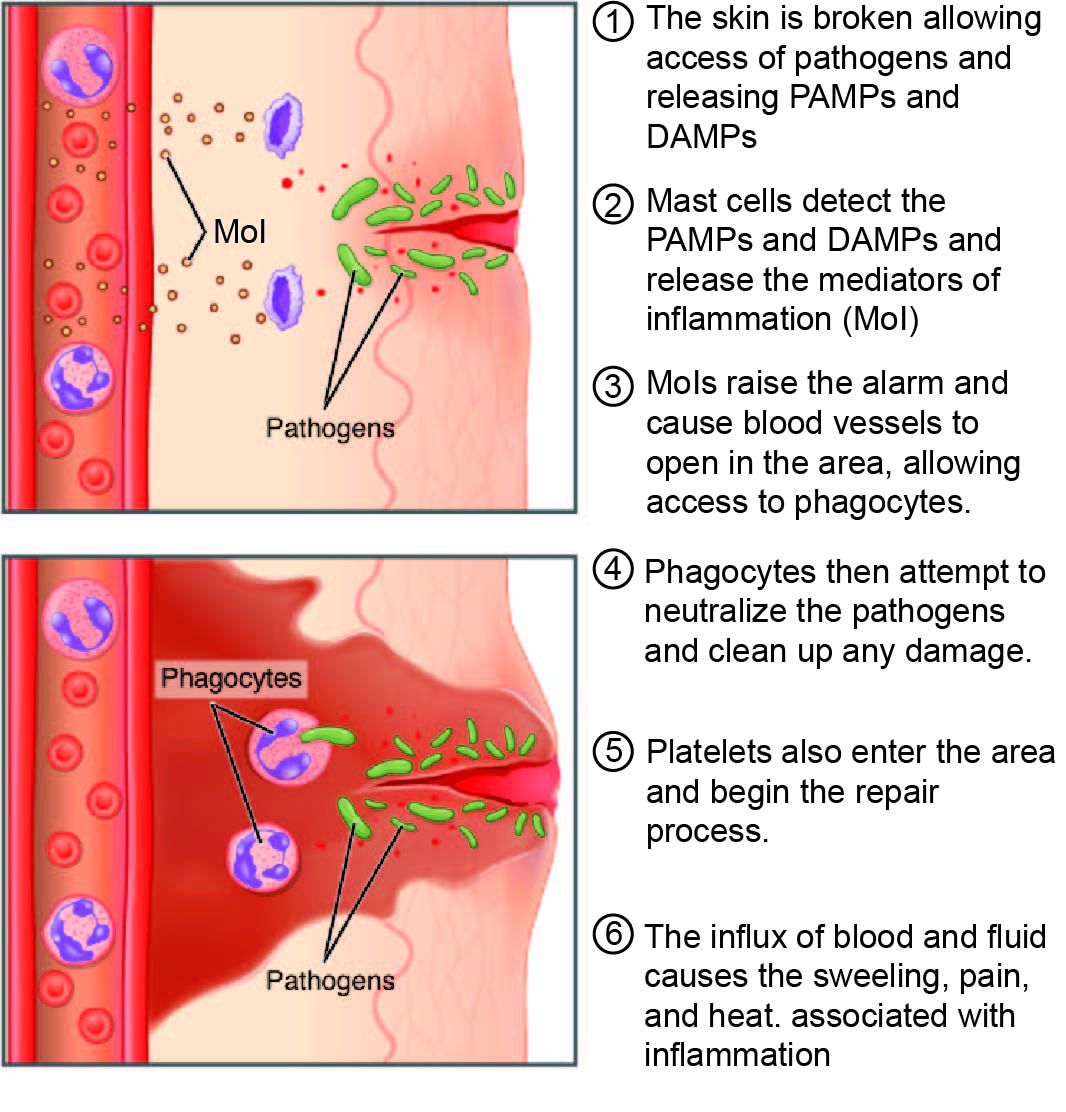
Inhaled corticosteroids (ICS) include fluticasone, budesonide, beclomethasone, mometasone, and ciclesonide. They are the strongest anti-inflammatory drugs for asthma. They are the base of every step of treatment above the mildest. They work at the level of the genes. They calm inflammation chemicals, lower eosinophils, and shrink swelling in the lining. Over time, they also help beta-2 receptors respond again, so the rescue inhaler works better. That way of working explains the most important teaching point. An ICS is slow. It takes days to start working and one to two weeks, sometimes longer, for the full benefit. It is useless in an attack. Patients must take it every day, even when they feel perfectly well. That is exactly when people stop taking it.
The drug goes to the lung instead of being swallowed. So its effects on the whole body are far smaller than with prednisone pills. But the drug that lands in the mouth still matters. The two classic local effects are thrush in the mouth (oral candidiasis), with white patches and a sore mouth, and dysphonia, a hoarse voice from the steroid acting on the voice box muscles. Two habits prevent most of both. Rinse the mouth and spit after every dose, and use a spacer. At high doses over long periods, whole-body effects come back. These include slightly slower growth in children (check height at visits), bone loss, cataracts, and glaucoma. So we use the lowest dose that keeps control. In COPD, add one more: ICS use raises the risk of pneumonia.
The rest of the controller shelf
Combination inhalers put an ICS and a LABA in one device. Examples are fluticasone/salmeterol, budesonide/formoterol, and fluticasone/vilanterol. They improve both control and remembering doses, and they make sure the LABA is never taken alone. Triple therapy adds a LAMA in the same inhaler for severe disease.
Leukotriene modifiers are pills, which patients love. Montelukast blocks the leukotriene receptor. It is taken once a day in the evening. It helps people who also have hay fever, airways that tighten with exercise, or aspirin-exacerbated respiratory disease. It carries a boxed warning for serious mood and behavior changes. These include agitation, depression, nightmares, and suicidal thinking. Ask about mood and sleep at every visit, in children as well as adults. Tell families exactly what to watch for. Zafirlukast is similar. Zileuton blocks the making of leukotrienes and needs liver enzyme checks. None of these is a rescue drug.
Cromolyn calms mast cells. It only prevents. It stops the release of allergy chemicals and must be taken before exposure, such as before exercise or a known allergen, never during symptoms. Biologics are for severe asthma that is poorly controlled. They are given as shots in a setting where the patient can be watched. Omalizumab (anti-IgE) has a boxed warning for anaphylaxis, so watch the patient after the dose and have epinephrine ready. Mepolizumab (anti-IL-5), benralizumab (anti-IL-5 receptor), and dupilumab target asthma driven by eosinophils and "type 2" inflammation. Dupilumab blocks the IL-4 receptor alpha piece, so it blocks both IL-4 and IL-13 signals. Last come steroids by mouth or IV: prednisone pills or IV methylprednisolone. They are the workhorse of flare-ups. A short burst needs no taper. Courses longer than about two weeks must be tapered to let the adrenal system recover. Watch the blood sugar of every person with diabetes you start on a steroid burst.
| Class | Prototype | Role | Safety alert |
|---|---|---|---|
| Inhaled corticosteroid | Fluticasone, budesonide | Controller backbone: daily, asthma | Rinse and spit; use a spacer; thrush, hoarseness; not for an attack; monitor child growth |
| ICS + LABA | Fluticasone/salmeterol | Daily control when ICS alone is not enough | Still not rescue (unless a formoterol-based reliever regimen is ordered); same rinse rule |
| Leukotriene modifier | Montelukast | Oral add-on; asthma + allergic rhinitis | Boxed warning: neuropsychiatric events: ask about mood, sleep, agitation |
| 5-lipoxygenase inhibitor | Zileuton | Oral alternative | Monitor liver enzymes |
| Mast cell stabilizer | Cromolyn | Prophylaxis only: before exercise/allergen | Worthless once symptoms start; must be scheduled |
| Biologic | Omalizumab, mepolizumab | Severe, refractory asthma | Omalizumab: boxed warning: anaphylaxis; observe after injection, epinephrine available |
| Systemic corticosteroid | Prednisone | Exacerbation burst; severe disease | Hyperglycemia, infection risk, mood; taper if used beyond ~2 weeks |
Technique is the drug
An inhaler the patient cannot use correctly is a fake pill with a copay. Studies keep finding that most patients get it wrong, and so do a worrying share of clinicians. Teach the metered-dose inhaler (MDI) steps clearly, then have the patient show you. Shake the canister. Breathe all the way out. Seal the lips around the mouthpiece or spacer. Press as you start a slow, deep breath in. Hold that breath about 10 seconds. Wait about one minute between puffs. A spacer should be the default for any MDI. It removes the need for perfect hand and breath timing. It puts more drug in the lung and drops far less steroid on the throat. Dry powder inhalers (DPIs) flip one rule. The breath in must be fast and hard to break up the powder. The patient must never breathe out into the device, because moisture clumps the dose. Teach patients to track doses with the counter. The old trick of floating the canister in water does not work.
Peak flow monitoring gives the patient a clear number before symptoms get loud. First, find the person's best number. Then the zones read like a traffic light. Green is 80 to 100% of personal best: good control, keep going. Yellow is 50 to 79%: caution, so take the rescue inhaler and follow the action plan. Red is below 50%: a medical alert, so take the rescue inhaler now and get help. Every person with asthma should leave with a written action plan that names their drugs by job, not just by color.
- ICS is the controller backbone in asthma. It starts slowly, is taken daily even when well, and is never used as rescue.
- Prevent thrush and hoarseness with rinse-and-spit plus a spacer. High-dose, long-term ICS adds risks to growth, bone, cataracts, glaucoma, and (in COPD) pneumonia.
- Montelukast carries a boxed warning for mood and behavior effects. Omalizumab carries one for anaphylaxis. Zileuton needs liver test checks.
- MDI = slow, deep breath with a spacer. DPI = fast, hard breath, and never breathe out into it. Peak flow zones: green 80 to 100%, yellow 50 to 79%, red under 50%.
Section 4Cough, cold & allergy drugs
Antihistamines: two generations, one receptor
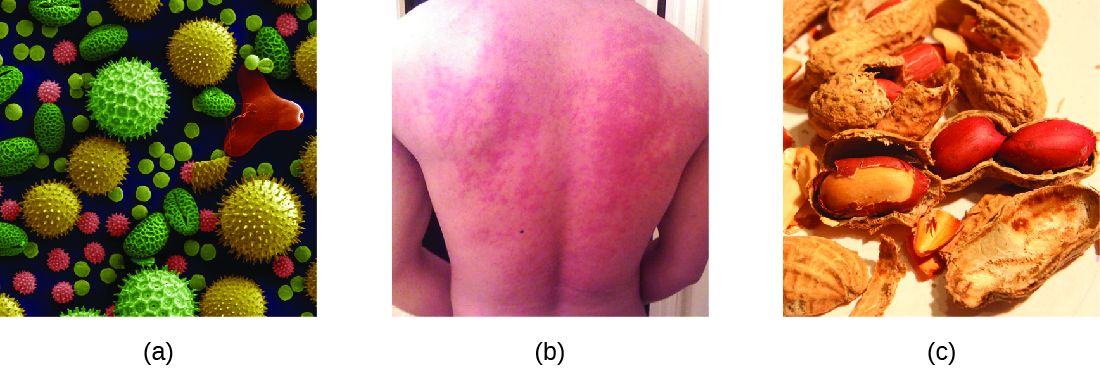
An allergen links up IgE antibodies on a mast cell. The cell bursts open and dumps histamine. Histamine acts on H1 receptors to cause the familiar package: itching, sneezing, runny nose, watery eyes, hives, and widened vessels. Antihistamines block H1. Two facts frame everything you teach about them. First, they block the receptor, but they do not remove histamine already bound. So they work far better taken before exposure than after symptoms peak. Second, antihistamines do not treat anaphylaxis. Epinephrine treats anaphylaxis. An antihistamine only softens the hives and itching afterward. Mixing up those two has killed people.
First-generation drugs include diphenhydramine, chlorpheniramine, hydroxyzine, and promethazine. They pass easily into the brain and are strongly anticholinergic. They cause strong sleepiness, which is why diphenhydramine is quietly sold as a sleep aid. They also cause dry mouth, blurred vision, constipation, and trouble passing urine. They are on the Beers criteria as drugs to avoid in older adults. In older adults, they add to confusion, falls, and trouble passing urine. In young children, they can cause excitement instead of sleep. Two special alarms come with promethazine. It has boxed warnings for severe tissue injury, including gangrene, when it leaks out of the vein or goes into an artery. Dilute it, give it slowly into a large, free-flowing line, and stop at once for burning or pain. It is also not allowed under 2 years of age because it can cause fatal slowed breathing.
Second-generation drugs include loratadine, cetirizine, fexofenadine, and levocetirizine. They barely enter the brain. So they cause far less sleepiness and far fewer anticholinergic effects. They are taken once a day. They are the right choice for someone who has to drive, study, or work. Cetirizine is the one most likely to cause some drowsiness. Here is a clear counseling point. Fexofenadine absorbs much less if taken with fruit juice (apple, orange, grapefruit) or too close to an antacid. Take it with water. For hay fever (allergic rhinitis), the most effective drugs are not antihistamines at all. They are steroid nose sprays (fluticasone, mometasone, triamcinolone). Teach that they need daily use for days before the full effect. Teach patients to aim the spray away from the wall between the nostrils (the septum), toward the ear on the same side. That prevents nosebleeds and, rarely, a hole in the septum.
Decongestants, antitussives, and the rest of the aisle
Decongestants are alpha-adrenergic agonists. They act mainly on alpha-1 receptors and narrow the swollen vessels in the nose lining. Pseudoephedrine pills work, but they act on the whole body. They raise blood pressure and heart rate and cause poor sleep and jitters. So they call for caution in high blood pressure, heart artery disease, an overactive thyroid, diabetes, an enlarged prostate (BPH), and narrow-angle glaucoma. Pseudoephedrine is kept behind the pharmacy counter because it can be used to make methamphetamine. Phenylephrine pills replaced it on open shelves. But the evidence says it barely works at approved doses by mouth. That is worth knowing when a patient says "the cold medicine did nothing." Nose sprays (oxymetazoline, phenylephrine) work beautifully. They carry the firmest rule in this section: no more than 3 days. After that, stopping causes rebound congestion (rhinitis medicamentosa) that is worse than the first stuffiness. People get trapped using the spray to treat the spray.
Cough suppressants (antitussives) quiet the cough reflex. That is right for a dry, worn-out, sleep-ruining cough. It is wrong for a wet cough that brings up mucus. You do not want to stop a person from clearing their airways. Dextromethorphan acts in the brain. It is safe at label doses but can be misused at high doses. It can add to serotonin syndrome when combined with MAOIs, SSRIs, or linezolid. Codeine is an opioid cough drug with all the opioid baggage: sleepiness, constipation, and slowed breathing. It carries a boxed warning. It is not allowed in children under 12. It is not allowed in anyone under 18 after tonsil or adenoid removal. Some people are ultrarapid CYP2D6 metabolizers. They turn codeine into morphine fast enough to stop breathing. Benzonatate is different. It numbs stretch sensors in the airway. It must be swallowed whole. Chewing or sucking the capsule numbs the mouth and throat and risks choking. Even a few capsules can kill a small child, so keep it locked up.
Two more are worth naming. Guaifenesin is an expectorant. It thins mucus so a cough can move it. It only works if the patient drinks plenty of fluid. That is the whole teaching point. Acetylcysteine is a mucolytic. It breaks the chemical bonds (disulfide bonds) that hold thick mucus together. It smells strongly of rotten eggs, so warn the patient. Have suction ready, because it can loosen a large amount of mucus at once. (The same molecule, given IV or by mouth, is the antidote for acetaminophen overdose. That is a useful hook.) Last, remember the rule for young children. Store-bought cough and cold mixes are not advised for young children. They are not allowed under 2 years and are labeled against use under 4. They carry real risk and have never been shown to help. Honey (over age 1), fluids, and moist air are the honest advice.
| Class | Prototype | Key effect | Safety alert |
|---|---|---|---|
| Antihistamine, 1st gen | Diphenhydramine | H1 block; crosses into CNS | Sedation + anticholinergic; Beers in elders; paradoxical excitation in kids; no driving |
| promethazine | Promethazine | H1 block, antiemetic | Boxed: gangrene with extravasation; contraindicated under 2 years |
| Antihistamine, 2nd gen | Loratadine, cetirizine, fexofenadine | Peripheral H1 block | Minimal sedation; fexofenadine: not with fruit juice or antacids |
| Intranasal steroid | Fluticasone nasal | Best drug for allergic rhinitis | Daily use, days for effect; aim away from the septum → epistaxis |
| Decongestant, oral | Pseudoephedrine | Alpha-1 → nasal vasoconstriction | Raises BP/HR, insomnia; caution in HTN, CAD, hyperthyroid, BPH, glaucoma |
| Decongestant, topical | Oxymetazoline | Fast, potent nasal vasoconstriction | 3 days maximum: rebound congestion beyond that |
| Antitussive, central | Dextromethorphan | Suppresses cough reflex | Abuse potential; serotonin syndrome with MAOIs/SSRIs; not for a productive cough |
| Antitussive, opioid | Codeine | Central cough suppression | Boxed: contraindicated under 12, and under 18 post-tonsillectomy; sedation, constipation |
| Antitussive, local | Benzonatate | Numbs airway stretch receptors | Swallow whole: never chew; fatal to small children; store locked |
| Expectorant | Guaifenesin | Thins secretions | Only works with generous fluid intake |
| Mucolytic | Acetylcysteine | Breaks mucus disulfide bonds | Rotten-egg odor; have suction ready; also the acetaminophen antidote |
- Antihistamines block H1 and do not treat anaphylaxis. Epinephrine does. They also work best taken before exposure.
- First-generation drugs cause sleepiness and are anticholinergic (on the Beers list for older adults). Second-generation drugs (loratadine, cetirizine, fexofenadine) mostly do not.
- Nose spray decongestants: 3 days at most, or rebound stuffiness. Pseudoephedrine pills raise BP and heart rate.
- Benzonatate is swallowed whole. Codeine has a boxed warning and is not allowed under 12. Guaifenesin only works with fluids.
Section 5Eye & ear drops
Glaucoma: a plumbing problem
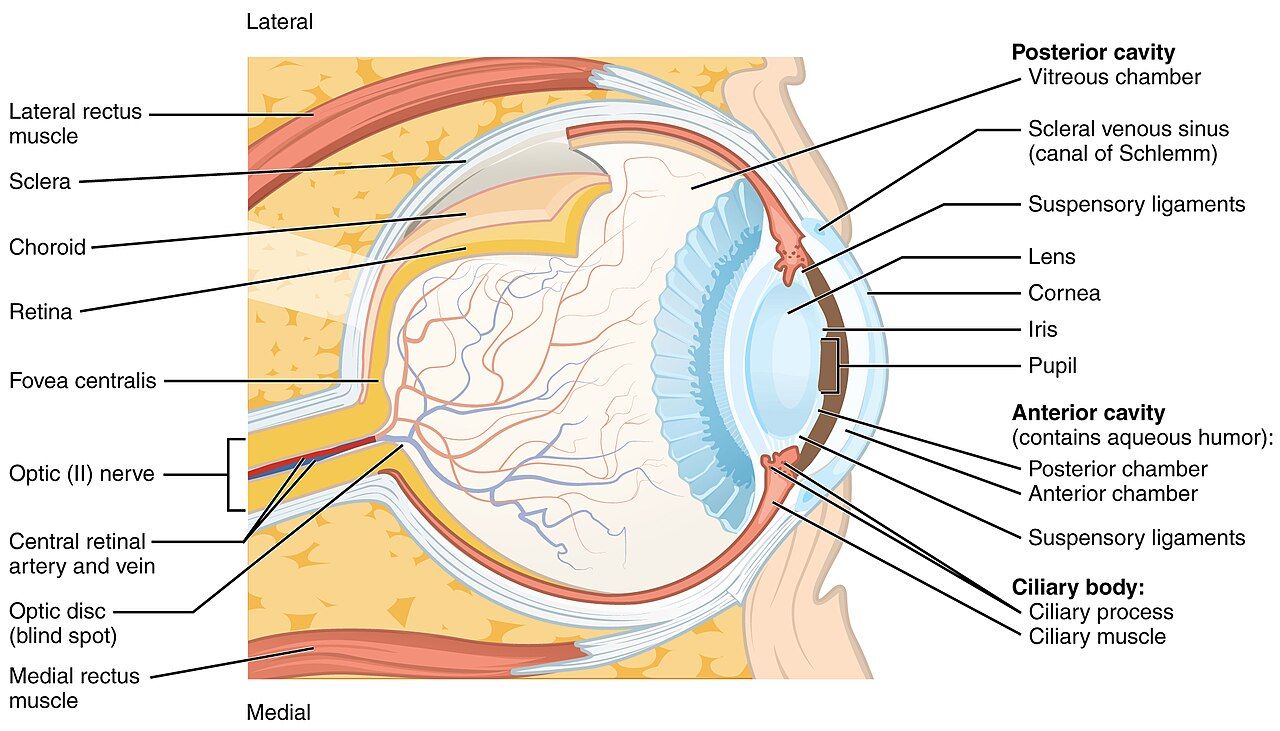
The front of the eye makes a clear fluid all the time, called aqueous humor. It feeds the cornea and lens. Then it drains out through the angle where the iris meets the cornea. Pressure inside the eye (intraocular pressure, IOP) is simply the balance between how fast fluid is made and how fast it leaves. In glaucoma, drainage cannot keep up. Pressure rises, and the optic nerve is slowly choked. It happens painlessly, from the edges of vision inward. That is why glaucoma is called the silent thief of sight. It is also why patients cannot feel whether their drops are working. In open-angle glaucoma, the common long-term type, the drain is sluggish. In angle-closure glaucoma, the iris physically blocks the angle, and pressure spikes. The patient shows up with a red, rock-hard, terribly painful eye. The pupil is stuck half open. There are halos, headache, and vomiting. That is an emergency. Vision is lost in hours, not months.
Eye pressure is fluid made minus fluid out. So every drug in the class does one of two things. Prostaglandin analogs include latanoprost, bimatoprost, and travoprost. They help fluid drain out through another path. They are first-line and given once a day at bedtime. Warn patients about changes in looks, or they will stop the drug. These include a permanent brown color in the iris, darker eyelid skin, and longer, thicker lashes, sometimes in only one eye. Beta blockers such as timolol lower how much fluid is made. They are the hidden danger in this chapter. A drop that drains down the tear duct is absorbed into the whole body without ever passing the liver. Timolol drops have caused a slow heart rate, low blood pressure, and life-threatening airway tightening. Screen for asthma, COPD, heart block, and a slow heart rate before the drop goes in, and teach punctal occlusion. Alpha-2 agonists (brimonidine) both lower how much fluid is made and help it drain. They are not allowed under 2 years of age and are used with care in older children. In the very young, they can cause deep brain slowing, a slow heart rate, and pauses in breathing. Carbonic anhydrase inhibitors, such as dorzolamide drops and acetazolamide pills, lower how much fluid is made. They are sulfonamides, so ask about sulfa allergy. The pill form causes tingling, a metal taste, potassium loss, and too much acid in the blood. Cholinergic drugs that shrink the pupil (miotics), such as pilocarpine, pull the iris out of the angle. They are still useful in sudden angle closure. They cause dim, blurry vision and an ache above the eyes. Netarsudil is a Rho kinase inhibitor that helps fluid drain. It often reddens the eye.
| Class | Prototype | How it lowers IOP | Safety alert |
|---|---|---|---|
| Prostaglandin analog | Latanoprost | Increases outflow (uveoscleral) | First-line, once daily at bedtime; permanent iris/lid darkening, lash growth: warn or they quit |
| Beta blocker | Timolol | Decreases aqueous production | Systemically absorbed: bradycardia, bronchospasm; screen asthma/COPD/heart block; punctal occlusion |
| Alpha-2 agonist | Brimonidine | Decreases production + increases outflow | Dry mouth, drowsiness; avoid in infants: CNS depression, apnea |
| Carbonic anhydrase inhibitor | Dorzolamide (topical), acetazolamide (oral) | Decreases production | Sulfa agents; oral: paresthesias, metallic taste, hypokalemia, metabolic acidosis |
| Cholinergic miotic | Pilocarpine | Miosis opens the drainage angle | Dim/blurred vision, brow ache; fall risk at night; used in acute angle closure |
| Rho kinase inhibitor | Netarsudil | Increases trabecular outflow | Conjunctival redness is common and expected |
Getting the drop where it belongs
A drop that lands on a cheek is a missed dose that the chart will record as given. Teach and do the steps with care. Wash your hands and check that the label says "ophthalmic." Have the patient sit or lie with the head tilted back and eyes looking up. Pull the lower lid down to form a pouch, the conjunctival sac. Put one drop into it. Hold the bottle about an inch above, and never touch the tip to the eye, lashes, or fingers, which would make the bottle dirty. Have the patient close the eye gently. Squeezing pumps the drug out. Then apply punctal occlusion. Press lightly on the inner corner of the eye, near the nose, for 1 to 2 minutes. This one move keeps the drug in the eye and out of the blood. It is the difference between timolol treating an eye and timolol dropping a heart rate. The eye holds only about one drop. So a second drop of the same drug is waste. When two different drops are due, wait at least 5 minutes between them, or the second washes out the first. Give clear solutions before cloudy suspensions, and always put ointments last. Ointment blurs vision, so bedtime is ideal. It also seals the surface against anything that comes after. Take contact lenses out first. Each patient gets their own bottle, never shared.
Ear (otic) drops have their own rules, and the first one is absolute. Eye drops may be used in the ear, but ear drops must never go in the eye. Eye products are sterile and made for eye tissue. Ear products are not, and they will injure a cornea. Next, warm the bottle to about body temperature by rolling it in your hands. Cold fluid against the eardrum stirs up the balance organ in the inner ear. That causes dizziness, nausea, and a spinning feeling. Straighten the ear canal by pulling the outer ear (pinna) up and back for adults and children over about 3. Pull it down and back for babies and younger children, whose canals angle a different way. Drip the drops against the side of the canal so air can escape. Keep the patient lying on the other side for 3 to 5 minutes. If a cotton ball is used, place it loosely at the opening only. Never pack it in, or it soaks up the dose.
The drugs themselves are a short list. Ofloxacin ear drops and ciprofloxacin/dexamethasone treat outer ear infection (otitis externa) and infected ear tubes. The steroid part calms swelling and pain. Neomycin/polymyxin B/hydrocortisone works well but harms hearing. It is not allowed when the eardrum has a hole or ear tubes are in place. Neomycin reaching the middle ear can damage hearing for good. Check for a hole, drainage, or tubes before putting anything in. If you are unsure, stop and ask. Carbamide peroxide softens earwax by foaming. It is not an antibiotic. It must not be used on an ear that is draining or has a hole in the eardrum. And note that numbing ear drops are no longer an approved choice in many settings. Pain medicine by mouth is the safer route for ear pain.
- Eye pressure = fluid made minus fluid out. Latanoprost (first-line, bedtime) helps fluid drain. Timolol and dorzolamide lower how much is made.
- Timolol eye drops are absorbed into the whole body. A slow heart rate and airway tightening are real. Screen for asthma or COPD and teach punctal occlusion.
- Eye drops go in the conjunctival sac: one drop, the tip touches nothing, 5 minutes between different drops, and ointments last.
- Ear drops: warm the drops; pull the outer ear up and back (adult) or down and back (young child); never put ear drops in an eye; drops with neomycin are not allowed with a hole in the eardrum.
The chapter in one breath
- The airway has two drug targets: tight muscle (M3 squeezes, beta-2 relaxes) and inflammation. That is why every patient carries two kinds of inhaler.
- Rescue means albuterol, in minutes. Controller means an inhaled steroid, over weeks. Mixing them up is a deadly error, not a slip of the tongue.
- Albuterol brings tremor, a fast heart rate, low potassium, and high blood sugar. LABAs are never given alone in asthma. Ipratropium and tiotropium block M3 and anchor COPD treatment.
- Theophylline has almost no margin: 5 to 15 mcg/mL, nausea and poor sleep first, then rhythm problems and seizures. Smoking and ciprofloxacin move the level hard.
- Inhaled steroids need daily use, rinse-and-spit, and a spacer. Montelukast carries a boxed warning for mood and behavior changes. Teaching technique and peak flow zones (green, yellow, red) is the job.
- Antihistamines do not treat anaphylaxis. First-generation drugs cause sleepiness and are on the Beers list. Nose spray decongestants get 3 days before rebound. Benzonatate is swallowed whole.
- Glaucoma drugs either cut fluid making or open drainage. Latanoprost is first-line, and timolol eye drops can slow the heart or tighten the airways of the whole body.
- Technique is the drug: the conjunctival sac, one drop, punctal occlusion, 5 minutes between drops, and ointment last. Warm ear drops, and pull the outer ear up and back in adults and down and back in young children.
ReferenceWords worth knowing
A quick list of the terms in this chapter. Skim it now, or come back when a word trips you up.
- Airway hyperresponsiveness
- The twitchy, easily triggered state of long-inflamed airway smooth muscle; the reason controllers cut down attacks.
- Aqueous humor
- The clear fluid made in the front of the eye and drained at the angle; the balance of fluid made and fluid out sets the pressure inside the eye.
- Beta-2 agonist
- A drug that turns on beta-2 receptors on airway smooth muscle to open the airway, such as albuterol (short-acting) or salmeterol (long-acting).
- Bronchoconstriction
- Narrowing of the airway when airway smooth muscle squeezes, driven by acetylcholine at M3 muscarinic receptors.
- Bronchodilator
- Any drug that relaxes airway smooth muscle and widens the airway: beta-2 agonists, antimuscarinics, and methylxanthines.
- Conjunctival sac
- The pouch made by pulling down the lower eyelid; the right target for an eye drop, never the cornea itself.
- Controller (maintenance) drug
- A drug taken every day on a schedule that calms airway inflammation over days to weeks, such as an inhaled steroid; useless in an attack.
- Dysphonia
- Hoarseness or a change in the voice; a local side effect of inhaled steroids, lowered by a spacer and rinse-and-spit.
- Expectorant
- A drug such as guaifenesin that thins mucus so a cough can clear it; needs plenty of fluid to work.
- Glaucoma
- Damage to the optic nerve linked to high pressure in the eye; long-term open-angle disease is painless, while sudden angle closure is an emergency that threatens sight.
- Intraocular pressure (IOP)
- Pressure inside the eye, set by fluid made minus fluid out; the target every glaucoma drug can change.
- LABA
- Long-acting beta-2 agonist (salmeterol, formoterol); for daily control only, and never used alone in asthma.
- LAMA
- Long-acting muscarinic antagonist (tiotropium, umeclidinium); a once- or twice-daily control bronchodilator and the backbone of COPD treatment.
- Methylxanthine
- A bronchodilator related to caffeine, mainly theophylline; narrow therapeutic index with a goal level of about 5 to 15 mcg/mL.
- Mucolytic
- A drug such as acetylcysteine that breaks up thick mucus by cutting its disulfide bonds.
- Ototoxicity
- Drug damage to hearing or balance; the reason ear drops with neomycin are not allowed with a hole in the eardrum.
- Peak expiratory flow
- The fastest speed a person can blow out, compared with their personal best: green 80 to 100%, yellow 50 to 79%, red below 50%.
- Punctal occlusion
- Gentle pressure on the inner corner of the closed eye for 1 to 2 minutes after a drop, which keeps the drug in the eye and out of the blood.
- Rebound congestion (rhinitis medicamentosa)
- Worse nasal stuffiness caused by using a decongestant nose spray for more than about 3 days.
- Rescue (reliever) drug
- A fast-acting bronchodilator, with albuterol as the prototype, used for sudden symptoms; it treats the spasm, not the inflammation.
- SABA
- Short-acting beta-2 agonist (albuterol); starts in about 5 minutes and lasts 4 to 6 hours. This is the rescue inhaler.
- Spacer
- A holding chamber attached to a metered-dose inhaler that removes the need for perfect timing, puts more drug in the lung, and drops less steroid in the mouth and throat.