Digestion, Absorption & Transport
A sandwich is not nutrition yet. It becomes nutrition only after your body takes it apart. Between the first bite and the moment a glucose molecule slips into a tiny blood vessel, there is a long chemical take-apart line. It is several meters long. Muscles grind. Acids unfold proteins. Enzymes cut certain bonds. The lining is folded so cleverly that a tube as wide as your thumb has the surface of a small room. This chapter follows food down that line, organ by organ. Then it follows the freed nutrients into blood and lymph, through the liver, and past the trillions of gut bacteria that finish the parts we cannot. Once you know this path, a nutrition label stops being a list of numbers. It becomes a story about what your body can really reach and use.
By the end of this chapter you can
- Trace a swallowed lump of food through every organ of the gastrointestinal tract and say what each one adds.
- Tell mechanical from chemical digestion, and explain hydrolysis as the reaction behind all nutrient breakdown.
- Describe how carbohydrate, protein and fat are each broken down to units the body can absorb, and give the energy each one yields (4, 4 and 9 kcal/g).
- Name the main digestive enzymes and secretions, where each is made, and what each acts on.
- Explain how plicae, villi and microvilli add to the surface for absorbing, and match key nutrients to where they are absorbed.
- Compare the blood (hepatic portal) and lymph routes out of the intestine, and describe the liver's first-pass role.
- Sum up what the gut microbiota does, and sort well-supported claims from early ones.
- Explain why a nutrient that is in a food is not always bioavailable, which means absorbed and usable.
Section 1The GI tract: mouth to anus
One long tube, plus helpers
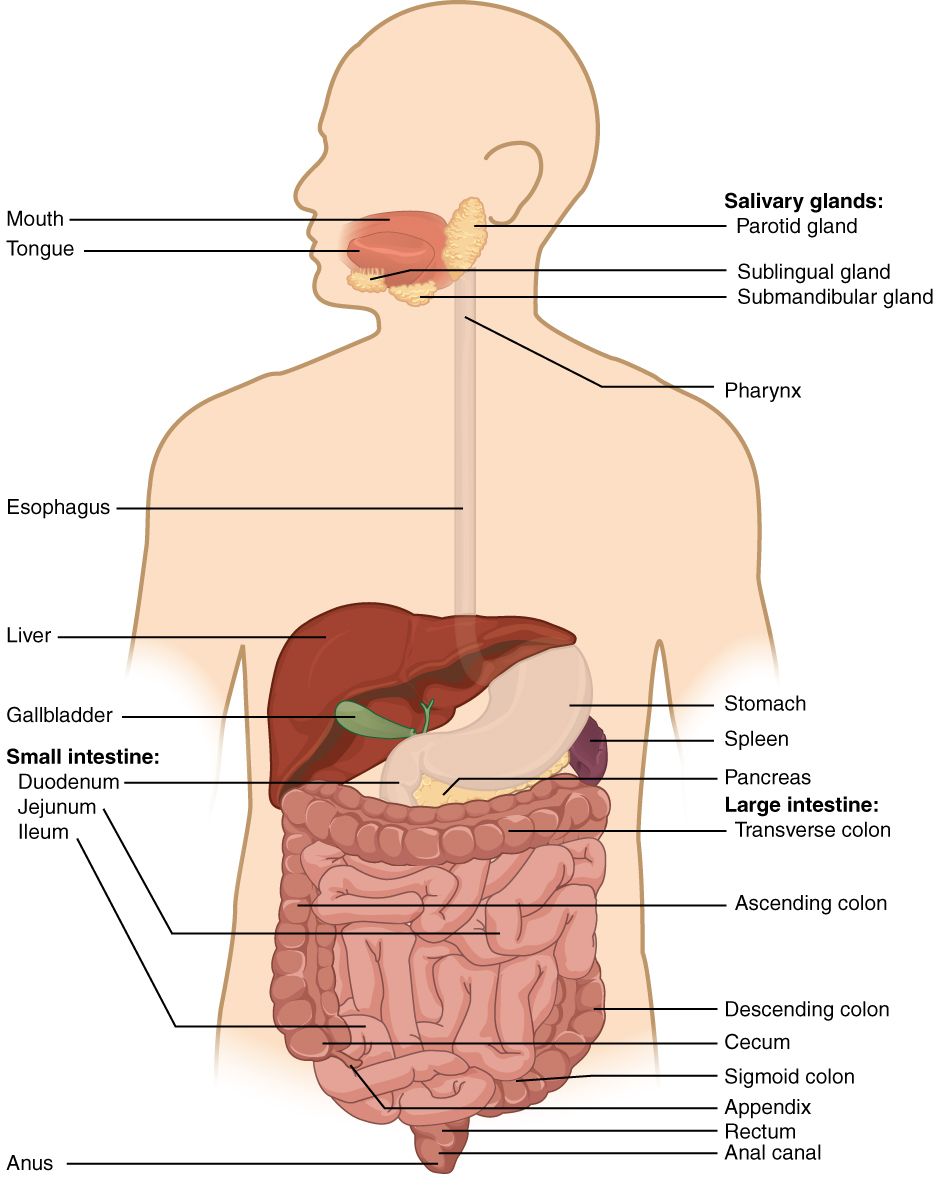
The gastrointestinal (GI) tract is also called the alimentary canal. It is one long, unbroken tube of muscle that runs from the mouth to the anus. Books often say it is about nine meters long. But that number comes from measuring dead bodies. After death the muscles relax and the gut stretches. In a living person, with muscle tone in place, the whole tract is closer to five meters. Here is a strange fact worth a pause. The inside of that tube is really outside your body. Food in your stomach has not entered you yet. It sits in a space your body controls but does not yet own. Nothing counts as nutrition until it crosses the single layer of cells that lines the intestine. That crossing is called absorption. The whole tract exists to make it happen.
Next to the canal sit the accessory organs. These are the salivary glands, liver, gallbladder and pancreas. Food never passes through them. Instead, they make fluids and send them into the tube through small pipes called ducts. Losing an accessory organ, such as a gallbladder, does not break the pathway. But it changes how well one part of it runs.
Station by station
In the mouth, teeth cut and grind the food. The tongue mixes it with saliva into a soft lump you can swallow, called a bolus. The pharynx (throat) and esophagus (food pipe) only move food along. A flap called the epiglottis covers the airway. Then a wave of muscle squeezing, called peristalsis, pushes the bolus down in a few seconds. It works whether you are standing or lying flat. Next, a ring of muscle called the lower esophageal sphincter opens to let the food in. Then it closes to keep acid from the stomach from washing back up.
The stomach is a mixing tub and a holding tank. It churns food with acid and enzymes into a soupy mix called chyme. Then it lets the chyme out through another ring of muscle, the pyloric sphincter, in small, measured squirts. This usually takes about two to four hours. It takes longer for meals rich in fat and protein. This measuring matters more than it sounds. The small intestine can only handle so much at once. So the stomach's job is as much traffic control as digestion.
The small intestine is where the real work happens. It is about three meters long in a living person, and longer after death when muscle tone is gone. It has three parts. The short duodenum comes first. Here, juice from the pancreas and bile arrive, and most chemical digestion takes place. The jejunum is next. It absorbs most of the nutrients. The ileum comes last. It finishes the job and handles two special items: vitamin B12 and recycled bile salts. Chyme spends about three to five hours here.
The large intestine, or colon, gets what is left. It absorbs water and electrolytes, which are minerals such as sodium and potassium that carry an electric charge in body fluids. It is home to the most crowded group of microbes in the body. It also packs the leftovers into stool. This takes anywhere from ten hours to two or three days. The rectum stores stool. The anus controls its exit with two rings of muscle. The inner one works on its own. The outer one is under your control.
| Organ | Main job | Key secretion | Usual time spent there |
|---|---|---|---|
| Mouth | Breaks food into pieces; forms the bolus; starch digestion starts | Saliva (amylase, lipase, mucus) | Seconds to a minute |
| Esophagus | Moves food by peristalsis | Mucus only | About 5 to 10 seconds |
| Stomach | Churning; unfolding protein; measured release of chyme | HCl, pepsinogen, gastric lipase, intrinsic factor, mucus | About 2 to 4 hours |
| Small intestine | Most digestion and nearly all absorption | Brush-border enzymes, mucus, bicarbonate; gets bile & pancreatic juice | About 3 to 5 hours |
| Large intestine | Absorbs water & electrolytes; microbes ferment leftovers; forms stool | Mucus; products made by microbes | About 10 to 59 hours |
| Liver & gallbladder | Accessory: break up fat; process absorbed nutrients | Bile (about 500 to 600 mL/day) | - |
| Pancreas | Accessory: supplies most digestive enzymes and bicarbonate | Pancreatic juice (about 1.5 L/day) | - |
- The alimentary canal is one unbroken tube. The space inside it, the lumen, is really outside the body until nutrients are absorbed.
- Accessory organs (salivary glands, liver, gallbladder, pancreas) add fluids through ducts but never hold food.
- The stomach mixes and measures out food. The small intestine does most digestion and nearly all absorption. The colon takes back water and ferments leftovers.
- Sphincters are the valves that make flow one-way and measured. They are the lower esophageal, pyloric, ileocecal and anal sphincters.
Section 2Mechanical and chemical digestion
Two kinds of breakdown
Mechanical digestion makes pieces smaller without changing their chemistry. It includes chewing, called mastication. It includes the stomach's churning. It includes segmentation, a back-and-forth mixing in the small intestine. It also includes bile breaking fat into tiny drops. Its purpose is surface area. Enzymes can only work on the outside of a piece. Break one large fat drop into thousands of small ones, and it is digested far faster. Yet not one chemical bond has been touched.
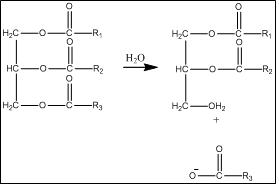
Chemical digestion changes the molecules themselves. Almost all of it is one reaction repeated millions of times. It is called hydrolysis. In hydrolysis, a water molecule is added across a bond. That splits one large molecule into two smaller ones. Every digestive enzyme in the body is a hydrolase, an enzyme that does hydrolysis. Starch, protein and fat are built very differently. But the way to take them apart is the same.
The two kinds of digestion work together and need each other. Chewing a nut well opens up far more surface for enzymes from the pancreas. Whole nuts swallowed nearly whole give up less of their fat. This is one reason whole almonds give fewer usable calories than almond butter made from the same almonds. This is a fact about the body, not advice. Both are perfectly good foods.
What happens to each nutrient class
Carbohydrates. Starch we can digest is a chain of glucose units. Salivary amylase, an enzyme in saliva, starts cutting it in the mouth. Stomach acid then shuts it off. Pancreatic amylase takes over in the small intestine. But it only breaks starch down to short chains and disaccharides, which are sugars made of two units. The last cut is made by enzymes fixed in the intestine's brush border, a fuzzy layer on the lining cells. Lactase splits lactose into glucose and galactose. Sucrase splits sucrose into glucose and fructose. Maltase splits maltose into two glucoses. Only monosaccharides, single sugar units, can be absorbed. Fiber is the exception that proves the rule. Human enzymes cannot split its bonds at all. So it reaches the colon whole.
Protein. Stomach acid denatures proteins. That means it unfolds them so their bonds can be reached. Acid also turns on pepsin, an enzyme that cuts long protein chains into shorter pieces called peptides. In the duodenum, enzymes from the pancreas keep cutting. They are trypsin, chymotrypsin and carboxypeptidase. Enzymes in the brush border, called peptidases, finish the job. The products the body can absorb are free amino acids, plus pieces two and three units long, called di- and tripeptides. These small pieces have their own carrier.
Fat. Fat does not mix with water, which makes it the hardest case. Bile from the liver breaks large fat drops into a fine mix. Next, pancreatic lipase, with a helper called colipase, splits triglycerides, the main fats in food. The products are monoglycerides and free fatty acids. These products, along with cholesterol and fat-soluble vitamins, are packed into tiny balls of bile salts called micelles. Micelles carry them to the surface of the intestine. Healthy adults absorb well over 95 percent of the fat they eat.
Alcohol and water need no digestion. Both are already small enough to cross membranes. That is why some alcohol is absorbed in the stomach and reaches the blood within minutes.
| Nutrient | Broken down to | Where mostly | Energy yield |
|---|---|---|---|
| Carbohydrate | Monosaccharides (glucose, fructose, galactose) | Mouth starts; small intestine finishes | 4 kcal/g |
| Protein | Amino acids; di- and tripeptides | Stomach starts; small intestine finishes | 4 kcal/g |
| Fat (triglyceride) | Monoglycerides + free fatty acids | Small intestine (bile + pancreatic lipase) | 9 kcal/g |
| Alcohol | Not digested: absorbed as is | Stomach and small intestine | 7 kcal/g |
| Fiber | Not split by human enzymes | Fermented by microbes in the colon | About 2 kcal/g at most, by an indirect route |
| Vitamins & minerals | Freed from the food matrix; not broken down | Throughout | 0 kcal/g |
| Water | Not digested | Absorbed throughout, mostly small intestine | 0 kcal/g |
- Mechanical digestion creates surface area. Chemical digestion breaks bonds by hydrolysis.
- Before absorption, carbohydrate must become monosaccharides, protein must become amino acids and small peptides, and fat must become monoglycerides and fatty acids.
- Energy yields: carbohydrate 4, protein 4, fat 9, alcohol 7 kcal per gram.
- Fiber resists human enzymes fully and passes to the colon. This is the basis for its special effects.
Section 3Enzymes and secretions

Every enzyme has an address and a target
Digestive enzymes are picky. Each one knows one kind of bond and ignores everything else. They are much easier to learn if you file each under two questions. Which cell made it? And which bond does it cut? Their names help. The ending -ase marks an enzyme. The front part names its substrate, the thing it acts on. Amylase attacks amylose (starch). Lipase attacks lipids. Lactase attacks lactose. Protease attacks protein.
Enzymes that digest protein pose a clear danger. They could digest the organs that make them. The body solves this with zymogens. A zymogen is an enzyme made in an "off" form. The stomach's chief cells release pepsinogen. Acid turns it into pepsin only inside the gut space. The pancreas releases trypsinogen. It turns on only when it meets enteropeptidase, an enzyme fixed to the lining of the duodenum. Trypsin then turns on the rest of the pancreas's protein enzymes. Acute pancreatitis, a sudden swelling of the pancreas, is mainly what happens when this safety lock fails and the enzymes turn on too early.
The three great secretions
Gastric juice comes from the stomach lining. Parietal cells release hydrochloric acid. This keeps the stomach at about pH 1.5 to 3.5. The pH scale measures acid; the lower the number, the stronger the acid. This level is strong enough to unfold protein and kill most swallowed microbes. It also frees iron and vitamin B12 from the food proteins that hold them. The same cells make intrinsic factor. This protein is needed for B12 to be absorbed later on. Chief cells make pepsinogen and gastric lipase. Mucous cells spread a blanket of mucus that is alkaline, the opposite of acid. This keeps the stomach from digesting itself.
Pancreatic juice is the hardest worker. About 1.5 liters flow each day. It carries amylase, lipase, proteases and nucleases, which break down DNA and RNA. It also carries a large load of bicarbonate, which cancels out the acid coming from the stomach. That step is a must. Pancreatic enzymes work near neutral pH, and acid destroys them.
Bile is made all the time by the liver, about 500 to 600 mL a day. The gallbladder stores it and makes it stronger. It is released into the duodenum when fat arrives. Bile has no enzymes at all. Its bile salts act like soap. One end likes water and the other end likes fat. So they break fat into fine drops. They also build the micelles that carry fat to the surface where it is absorbed. Most bile salts are then taken back up in the ileum and sent back to the liver. This loop is the enterohepatic circulation. The body's supply of bile salts is only a few grams. It gets recycled about twice per meal, or six to ten times a day.
Gut hormones run all of this. Hormones are chemical messengers carried in the blood. Gastrin boosts acid when food arrives. Secretin is released when acid hits the duodenum. It calls for bicarbonate from the pancreas. Cholecystokinin (CCK) is released when fat and protein arrive. It makes the gallbladder squeeze and the pancreas release enzymes. It also helps you feel full. The tract is not a passive pipe. It senses what arrives and adjusts.
| Secretion / enzyme | Source | Acts on | Product or effect |
|---|---|---|---|
| Salivary amylase | Salivary glands | Starch | Shorter chains, maltose |
| Hydrochloric acid | Parietal cells (stomach) | Proteins; microbes; bound minerals | Unfolds protein; turns on pepsin; frees iron & B12 |
| Intrinsic factor | Parietal cells (stomach) | Vitamin B12 | Needed for B12 uptake in the ileum |
| Pepsin (from pepsinogen) | Chief cells (stomach) | Protein | Large protein pieces (polypeptides) |
| Pancreatic amylase | Pancreas | Starch | Disaccharides, short chains |
| Pancreatic lipase (+ colipase) | Pancreas | Triglycerides | Monoglycerides + free fatty acids |
| Trypsin, chymotrypsin, carboxypeptidase | Pancreas (as zymogens) | Polypeptides | Short peptides, amino acids |
| Bicarbonate | Pancreatic duct cells | Acidic chyme | Raises pH so pancreatic enzymes can work |
| Bile salts | Liver (stored in gallbladder) | Fat drops | Break up fat and form micelles: not an enzyme |
| Lactase, sucrase, maltase | Brush border (small intestine) | Disaccharides | Monosaccharides |
| Peptidases, enteropeptidase | Brush border (small intestine) | Peptides; trypsinogen | Amino acids; turns on trypsin |
- Enzymes are named for their substrates, and each cuts one type of bond.
- Protein enzymes are released in an "off" form, as zymogens, and turned on only in the gut space. This protects the organs that make them.
- The pancreas supplies most digestive enzymes plus the bicarbonate that lets them work.
- Bile has no enzymes. It acts like soap, and its salts are recycled through the enterohepatic circulation.
Section 4Absorption: the small intestine's surface
Three levels of folding
The surface of the small intestine is enlarged three times over. First, the wall itself is folded into round ridges, called plicae circulares. They also swirl the chyme so it stays in contact longer. Second, the whole lining is covered with villi. These are finger-like bumps about half a millimeter to one and a half millimeters tall. Third, each lining cell that absorbs, called an enterocyte, has a thick pile of even tinier bumps on its top side. These are microvilli, and together they form the brush border. Each level multiplies the one below it. So a plain tube becomes a surface many, many times larger.
How much larger? This is a good place to watch a textbook number get fixed. Older books give big multipliers. They say about 3 times for the plicae, 10 times for the villi and 20 times for the microvilli. That is about 600 times in all. They arrive at a total "the size of a tennis court," about 250 to 300 m2. Careful measuring has changed both parts of that claim. The measured multipliers are smaller. They are closer to 1.6, 6.5 and 13 times, or about 130 times combined. The small intestine's total lining surface comes out near 30 m2. That is about the floor of a small studio apartment. A number repeated with confidence for years is not always right. And 30 m2 is still an amazing amount of surface for an organ that fits in your belly.
The brush border is not just surface. It is also a chemical workbench. The last disaccharide-splitting and peptide-splitting enzymes sit in the microvilli's membrane. So the last cut and the absorbing happen in the same tiny spot. Damage the brush border and you lose digestion and absorption together. That is exactly what happens in celiac disease. In people with certain genes, the immune system reacts to gluten, a protein in wheat, barley and rye. The reaction flattens the villi. Then the gut fails to absorb iron, folate, calcium and fat well. This is called malabsorption.
Getting across the cell
Crossing the enterocyte is not one process but several. Passive diffusion moves small, fat-soluble things from where there is more to where there is less. Fatty acids, some water and alcohol cross this way. Facilitated diffusion uses a carrier protein but no energy. Fructose enters this way through a carrier called GLUT5. Active transport spends energy to move nutrients "uphill," from where there is less to where there is more. Glucose and galactose ride a carrier called SGLT1, which moves sodium and glucose together. Most amino acids use similar sodium-linked carriers. Di- and tripeptides have their own carrier, driven by hydrogen ions. That is why small peptides are often absorbed faster than the same amount of free amino acids.
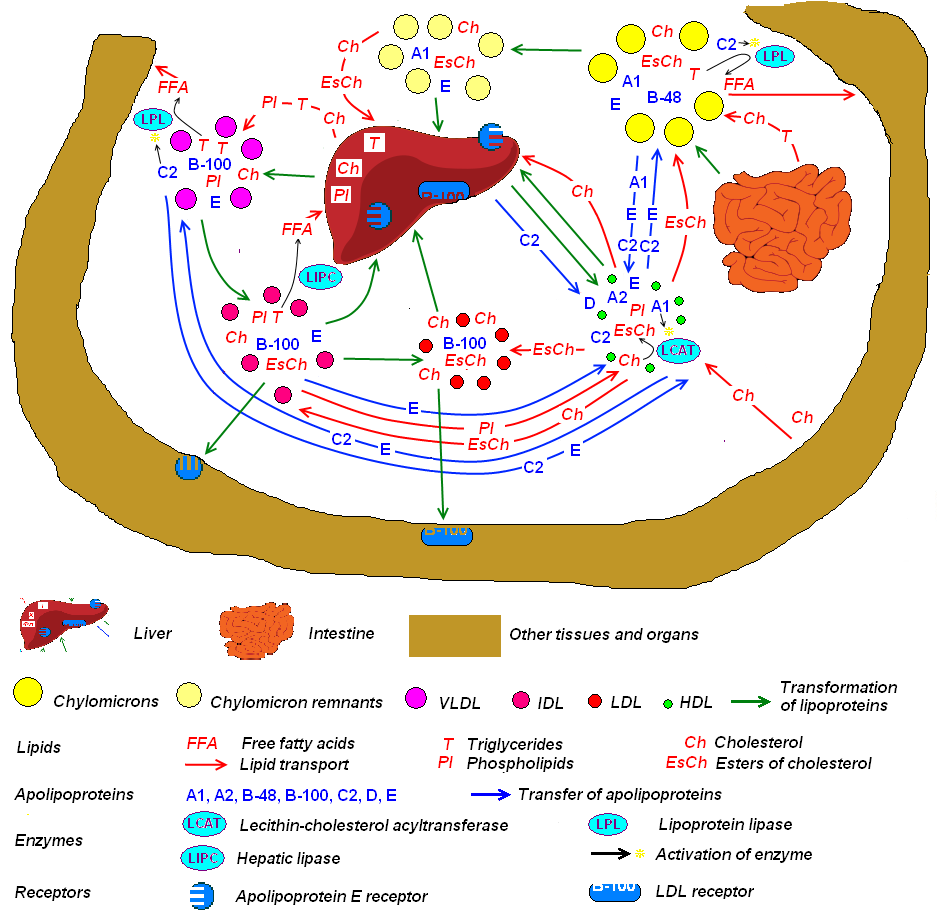
Fat takes a different path. Fatty acids and monoglycerides move out of micelles and into the enterocyte. Inside the cell, they are rebuilt into triglycerides. Then they are packed with protein and cholesterol into large particles called chylomicrons. These are too large to enter a capillary, the smallest kind of blood vessel. So they leave by a different door entirely (Section 5).
Absorption also has a map. Iron and calcium are taken up mainly in the duodenum. Most sugars, amino acids and fats are absorbed in the jejunum. Vitamin B12 and bile salts are absorbed only in the last part of the ileum, called the terminal ileum. The colon absorbs water and electrolytes, plus vitamin K and biotin made by microbes. So losing one part of the intestine causes a certain, predictable pattern of deficiency. It does not cause general malnutrition.
| Site | Mainly absorbed here | Notes |
|---|---|---|
| Mouth & stomach | Alcohol, small amounts of water, a few drugs | Very little; not a real absorbing surface |
| Duodenum | Iron, calcium, magnesium, some glucose | Iron uptake goes up when stores are low |
| Jejunum | Most monosaccharides, amino acids, fats, water-soluble vitamins | The main absorbing workhorse |
| Ileum | Vitamin B12 (with intrinsic factor); bile salts | Very site-specific: no backup anywhere else |
| Colon | Water, sodium, potassium; vitamin K and biotin made by microbes; short-chain fatty acids | Takes back about 1 to 1.5 L of fluid each day |
- Plicae, villi and microvilli enlarge the absorbing area about a hundred times. The best current measure puts the total near 30 m2, not the old "tennis court" figure.
- The brush border makes the last digestive cuts and absorbs, all in the same spot.
- Nutrients cross by passive diffusion, facilitated diffusion or active transport, depending on size, whether they dissolve in fat or water, and which way the gradient runs.
- Absorption is site-specific. B12 and bile salts are absorbed in the terminal ileum; iron and calcium in the duodenum.
Section 5Transport, the liver, and the microbiota
Two exits: blood and lymph
Once a nutrient is inside an enterocyte, it still has to reach the rest of the body. There are exactly two routes. Water-soluble nutrients take the first route. These are monosaccharides, amino acids, water-soluble vitamins, minerals, and short- and medium-chain fatty acids. They enter the capillary in the center of each villus. The hepatic portal vein then carries them straight to the liver. Fat-soluble products cannot use that door. Chylomicrons are too big for the gaps in capillary walls. So they enter the lacteal, a lymph vessel in the center of the villus. Lymph is a clear fluid that flows in its own set of vessels. The chylomicrons travel through the lymph system to the thoracic duct. This duct empties into a large vein near the left collarbone.
The result is neat. Fat enters the general blood flow before it reaches the liver. Everything water-soluble is checked by the liver first. That first check is called the first-pass effect. It is why the liver works like the body's border control for nutrients. It also explains why pills taken by mouth are often given at higher doses than shots. Part of the pill's dose is broken down before it ever reaches the rest of the body.
What the liver does with the delivery
The liver receives the whole stream of nutrients and smooths it out. It stores extra glucose as glycogen, a starch-like store, and releases it between meals. This keeps blood glucose very steady. It handles amino acids. It turns the nitrogen from extra ones into urea for the kidneys to remove. It builds lipoproteins, particles of fat and protein, to ship fat back out. It stores vitamins A, D and B12 and the mineral iron. It makes bile. It also changes drugs, alcohol and other compounds. That is why a meal does not send your blood chemistry swinging wildly. The liver flattens the peaks before the rest of you sees them.
The gut microbiota
The colon is home to the most crowded group of microbes known in nature. The best current estimate is about 3.8 × 10¹³ bacterial cells. That is about the same number as the human cells in the body. It corrects the old "ten to one" claim, which never had good support. All together they weigh only a couple hundred grams. But they have a large effect on the body's chemistry.
Here is what they have been shown to do. They ferment the fiber and resistant starch (starch that escapes digestion) that our own enzymes cannot touch. Fermenting means breaking down food without oxygen. This makes short-chain fatty acids: acetate, propionate and butyrate. These make the colon more acidic. Butyrate in particular is the favorite fuel of the colon's own lining cells. The microbes also make modest amounts of vitamin K and several B vitamins. They take up space and food that harmful germs, called pathogens, would otherwise use. This is called competitive exclusion. They also help train the gut's immune system. Fermenting also makes gas. That is a normal side effect of feeding your microbes, not a problem.
Here the evidence needs sorting. Strong evidence supports the benefits of dietary fiber itself. Large reviews that pool many studies, called meta-analyses, link more fiber to fewer deaths from heart disease and less colorectal cancer. Those two links come from cohort studies that follow people forward in time. So the pattern is steady and grows with the dose, but it is still from watching people. The effects on bowel movements and on blood fats and glucose come from randomized trials. Strong evidence also supports fecal microbiota transplant for Clostridioides difficile infection that keeps coming back. In this treatment, stool from a healthy donor is placed in the patient's gut. It is a specific medical therapy given by specialists. Moderate evidence, tied to certain strains, supports some probiotics for lowering diarrhea caused by antibiotics. Probiotics are live microbes taken for a health effect. Even there the picture is mixed. Two large randomized trials of probiotics for sudden stomach illness in children found no benefit. Results also do not carry over between strains, doses or products. Early evidence covers most of the rest. Many studies link the makeup of the gut microbes to obesity, mood, autoimmune disease and problems with how the body handles energy. But they mostly come from watching people or from studies in rats and mice. In humans, we usually do not know which is the cause and which is the effect. Store-bought "microbiome tests" that promise a personal diet are far ahead of the science.
What is reliable and practical is this. Diets that are steadily higher in fiber-rich plant foods go along with more varied microbe communities and better long-term health. These foods are vegetables, fruit, legumes, whole grains and nuts. The fiber goal is set as an Adequate Intake of about 14 g per 1,000 kcal. That works out to about 25 g/day for adult women and 38 g/day for adult men aged 19 to 50. It is somewhat lower after age 50, about 21 and 30 g/day. Most adults eat about half that much. Adding fiber slowly, with enough fluid, is usually easier on the gut than a sudden jump.
| Feature | Blood route (portal) | Lymph route (lacteal) |
|---|---|---|
| Carries | Monosaccharides, amino acids, minerals, water-soluble vitamins, short- & medium-chain fatty acids | Chylomicrons: triglycerides, cholesterol, fat-soluble vitamins A, D, E, K |
| Vessel entered | Capillary in the center of the villus | Lacteal in the center of the villus |
| First stop | Liver, by the hepatic portal vein | Thoracic duct, then a vein near the left collarbone |
| Liver first pass? | Yes: checked and processed before the general blood flow | No: skips the liver at first |
| Speed | Fast, minutes | Slower: blood triglycerides peak about 2 to 4 hours after a fatty meal |
- Water-soluble nutrients leave by the hepatic portal vein to the liver. Fats leave as chylomicrons through the lymph system and skip the first pass.
- The liver smooths out the nutrient stream. It stores glycogen, makes urea, builds lipoproteins, stores vitamins and iron, and makes bile.
- The microbiota ferments fiber into short-chain fatty acids, makes some vitamin K and B vitamins, and keeps out harmful germs.
- Fiber's health benefits are strongly supported. Most claims linking certain microbes to certain diseases are still early.
The chapter in one breath
- The GI tract is one unbroken tube whose inside space is really outside the body. Accessory organs add fluids without ever holding food.
- The stomach mixes and measures out food. The small intestine does most digestion and nearly all absorption. The colon takes back water and ferments leftovers.
- Mechanical digestion creates surface area. Chemical digestion is hydrolysis, and every digestive enzyme is a hydrolase.
- Carbohydrate must become monosaccharides, protein amino acids and small peptides, and fat monoglycerides and fatty acids. Yields are 4, 4 and 9 kcal/g, with alcohol at 7.
- The pancreas supplies most enzymes plus acid-cancelling bicarbonate. Bile has no enzymes and works like soap. It is recycled through the enterohepatic circulation.
- Plicae, villi and microvilli enlarge the surface about a hundred times, to about 30 m2. Absorption is site-specific: B12 and bile salts only in the terminal ileum.
- Water-soluble nutrients go to the liver by the portal vein for a first pass. Fat enters the lymph as chylomicrons and skips it.
- The microbiota ferments fiber into short-chain fatty acids. Fiber's benefits are well proven, while most microbiome-disease claims are still early.
ReferenceWords worth knowing
These are the terms this chapter leans on. Skim them now to get to know the words. Come back whenever a word in the text will not stay put.
- Absorption
- The movement of digested nutrients across the gut lining into blood or lymph. It is the moment food really enters the body.
- Bile
- A fluid made by the liver and stored in the gallbladder. It breaks up fat and forms micelles. It contains bile salts, cholesterol and pigments, but no enzymes.
- Bioavailability
- The share of a nutrient in food that is really absorbed and ready for use. It depends on the food matrix and the rest of the meal.
- Bolus
- The soft, chewed lump of food, wet with saliva, that is swallowed.
- Brush border
- The thick layer of microvilli on the top surface of enterocytes. It holds the last digestive enzymes and the carriers that absorb nutrients.
- Chylomicron
- A fat-and-protein particle built in the enterocyte to carry absorbed fat. It is too large for capillaries, so it leaves by the lymph.
- Chyme
- The soupy mix of partly digested food and stomach fluids that the stomach releases into the duodenum.
- Emulsification
- Breaking large fat drops into a fine mix of small drops. This gives lipase more surface to work on.
- Enterocyte
- An absorbing cell of the small intestine's lining.
- Enterohepatic circulation
- The recycling loop in which bile salts are taken back up in the ileum and returned to the liver for reuse.
- First-pass effect
- The liver's processing of absorbed substances that arrive by the hepatic portal vein, before they reach the general blood flow.
- Hepatic portal vein
- The blood vessel that carries nutrient-rich blood from the intestines straight to the liver.
- Hydrolysis
- The reaction that splits a bond by adding water. It is the chemical basis of nearly all nutrient digestion.
- Intrinsic factor
- A protein from the stomach's parietal cells. It is needed for vitamin B12 to be absorbed in the terminal ileum.
- Lacteal
- The lymph vessel in the center of each villus that takes in chylomicrons.
- Micelle
- A tiny ball of bile salts that carries fatty acids, monoglycerides, cholesterol and fat-soluble vitamins to the absorbing surface.
- Microbiota (gut)
- The community of microbes living in the digestive tract, most crowded in the colon.
- Peristalsis
- The wave of muscle squeezing that pushes contents forward along the GI tract.
- Segmentation
- Rhythmic squeezing of the small intestine that mixes chyme with digestive fluids without pushing it forward. It brings chyme into contact with the absorbing surface.
- Short-chain fatty acid (SCFA)
- Acetate, propionate or butyrate. Colon bacteria make them when they ferment fiber and resistant starch. Butyrate is the favorite fuel of colon lining cells.
- Villi
- Finger-like bumps on the small intestine's lining that greatly increase the absorbing surface.
- Zymogen
- An enzyme made in an "off" form, such as pepsinogen or trypsinogen. It is turned on only after it is safely outside the cell that made it.
Check yourself
Want the longer wording? Read this chapter in the full textbook.