Digestion, Absorption & Transport
A sandwich is not nutrition. It becomes nutrition only after your body takes it apart. Between the first bite and the moment a glucose molecule crosses into a capillary lies a chemical disassembly line several meters long — muscles that grind, acids that unfold proteins, enzymes that cut specific bonds, and a lining folded so cleverly that a tube the width of your thumb presents a surface the size of a small room. This chapter follows food through that line, organ by organ, and then follows the freed nutrients into blood and lymph, through the liver, and past the trillions of resident bacteria that finish the parts we cannot. Understanding this pathway is what turns a nutrition label from a list of numbers into a story about what your body can actually reach and use.
By the end of this chapter you can
- Trace a bolus of food through every organ of the gastrointestinal tract and state what each contributes.
- Distinguish mechanical from chemical digestion, and explain hydrolysis as the reaction behind all nutrient breakdown.
- Describe how carbohydrate, protein, and fat are each broken down to their absorbable units, and state the energy each yields (4, 4, and 9 kcal/g).
- Name the major digestive enzymes and secretions, where each is made, and what each acts on.
- Explain how plicae, villi, and microvilli amplify absorptive surface area, and match key nutrients to their absorption sites.
- Contrast the blood (hepatic portal) and lymphatic routes out of the intestine, and describe the liver's first-pass role.
- Summarize what the gut microbiota does, and separate well-supported claims from preliminary ones.
- Explain why a nutrient that is present in food is not automatically a nutrient that is bioavailable.
Section 1The GI tract — mouth to anus
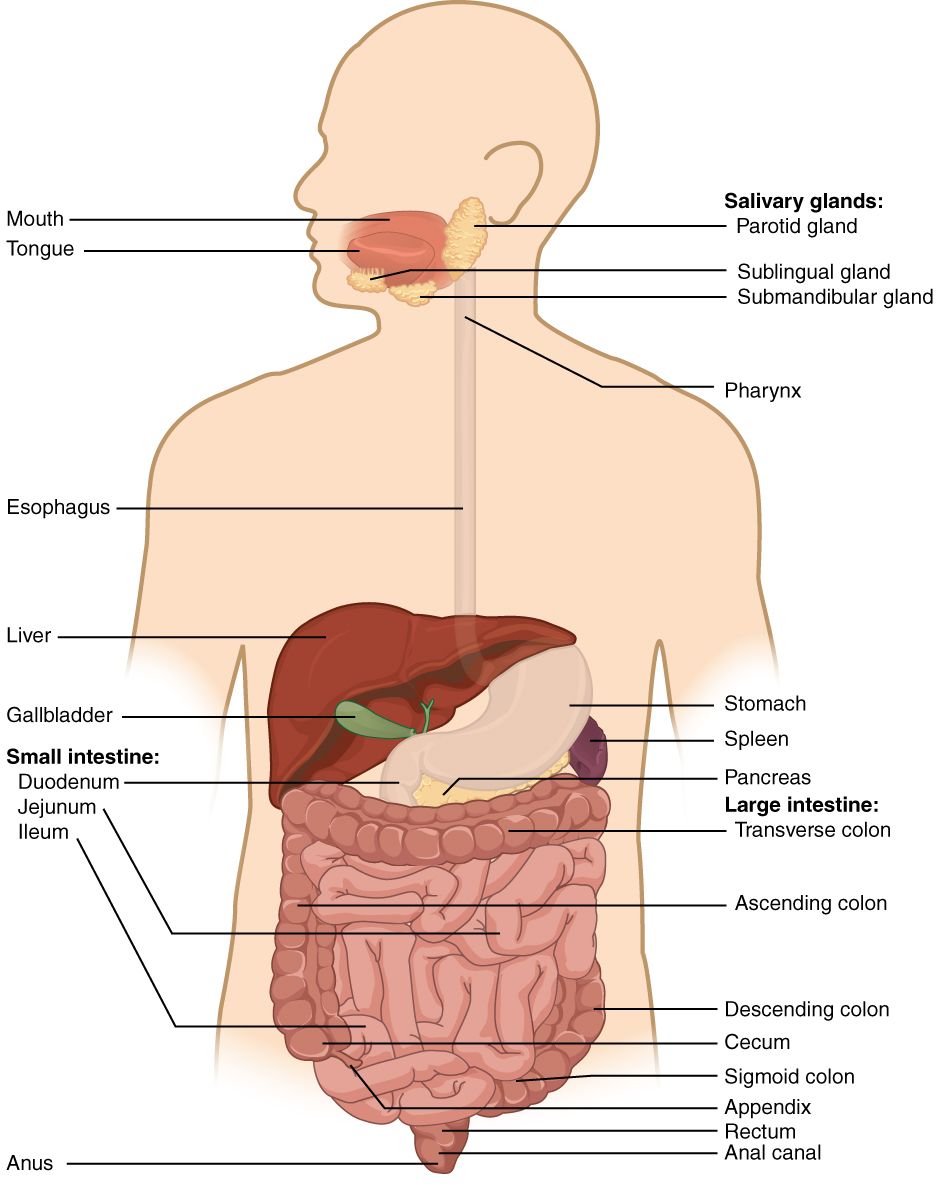
One long tube, plus helpers
The gastrointestinal (GI) tract, or alimentary canal, is a continuous muscular tube running from mouth to anus. Textbooks often quote about nine meters, but that number comes from cadaver measurement, where the loss of muscle tone lets the intestine stretch; in a living person with tone intact the whole tract is closer to five meters. It is worth pausing on a strange fact: the inside of that tube is topologically outside your body. Food sitting in your stomach has not entered you yet. It has entered a chamber that your body controls but does not yet own. Nothing counts as nutrition until it crosses the single layer of cells lining the intestine — and that crossing, called absorption, is the event the entire tract exists to make possible.
Alongside the canal sit the accessory organs — salivary glands, liver, gallbladder, and pancreas. Food never passes through them. Instead they manufacture secretions and deliver them into the tube through ducts. Losing an accessory organ (a gallbladder, say) does not break the pathway, but it changes how well one part of it runs.
Station by station
In the mouth, teeth shear and grind while the tongue mixes food with saliva into a swallowable bolus. The pharynx and esophagus are pure transport: the epiglottis covers the airway, and a wave of peristalsis pushes the bolus down in a few seconds, whether you are upright or lying flat. The lower esophageal sphincter then opens to admit it and closes to keep acidic stomach contents from washing back up.
The stomach is a mixing vat and a holding tank. It churns food with acid and enzymes into a soupy chyme and then releases it through the pyloric sphincter in small, metered squirts — typically over about two to four hours, longer for meals rich in fat and protein. This metering matters more than it sounds: the small intestine can only work on so much at once, so the stomach's job is as much traffic control as digestion.
The small intestine is where the real work happens. About three meters long in a living person (longer at autopsy, when muscle tone is gone), it has three segments: the short duodenum, where pancreatic juice and bile arrive and most chemical digestion occurs; the jejunum, where the bulk of nutrients are absorbed; and the ileum, which finishes the job and handles two specialty items — vitamin B12 and recycled bile salts. Chyme spends roughly three to five hours here.
The large intestine (colon) receives what is left. It absorbs water and electrolytes, hosts the densest microbial community in the body, and compacts residue into stool over anywhere from ten hours to two or three days. The rectum stores stool and the anus, with its internal (involuntary) and external (voluntary) sphincters, controls its exit.
| Organ | Main contribution | Key secretion | Typical dwell time |
|---|---|---|---|
| Mouth | Mechanical breakdown; bolus formation; starch digestion begins | Saliva (amylase, lipase, mucus) | Seconds to a minute |
| Esophagus | Transport by peristalsis | Mucus only | About 5–10 seconds |
| Stomach | Churning; protein denaturation; metered release of chyme | HCl, pepsinogen, gastric lipase, intrinsic factor, mucus | About 2–4 hours |
| Small intestine | Most digestion and nearly all absorption | Brush-border enzymes, mucus, bicarbonate; receives bile & pancreatic juice | About 3–5 hours |
| Large intestine | Water & electrolyte absorption; microbial fermentation; stool formation | Mucus; microbial products | About 10–59 hours |
| Liver & gallbladder | Accessory — emulsify fat; process absorbed nutrients | Bile (about 500–600 mL/day) | — |
| Pancreas | Accessory — supplies most digestive enzymes and bicarbonate | Pancreatic juice (about 1.5 L/day) | — |
- The alimentary canal is one continuous tube; its lumen is functionally outside the body until nutrients are absorbed.
- Accessory organs (salivary glands, liver, gallbladder, pancreas) contribute secretions through ducts but never contain food.
- The stomach mixes and meters; the small intestine does most digestion and nearly all absorption; the colon reclaims water and ferments residue.
- Sphincters — lower esophageal, pyloric, ileocecal, anal — are the valves that make one-way, metered flow possible.
Section 2Mechanical and chemical digestion
Two kinds of breakdown
Mechanical digestion makes pieces smaller without changing their chemistry: chewing (mastication), the stomach's churning, the rhythmic back-and-forth mixing of the small intestine called segmentation, and the emulsifying action of bile on fat droplets. Its purpose is surface area. Enzymes can only work at the outside of a particle, so a single large fat globule broken into thousands of small ones is digested vastly faster even though not one chemical bond has been touched.
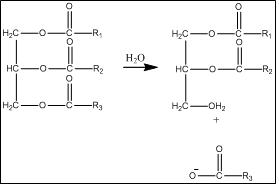
Chemical digestion changes the molecules themselves. Almost all of it is a single reaction repeated millions of times: hydrolysis, in which a water molecule is inserted across a bond to split one large molecule into two smaller ones. Every digestive enzyme in the body is a hydrolase. Starch, protein, and fat differ enormously in structure, but the logic of taking them apart is identical.
The two kinds of digestion work together and depend on each other. Chewing a nut properly exposes far more surface for pancreatic enzymes; whole nuts swallowed nearly intact deliver measurably less of their fat, which is one reason whole almonds yield fewer usable calories than almond butter made from the same almonds. This is a physiology observation, not a recommendation — both foods are perfectly good food.
What happens to each nutrient class
Carbohydrates. Digestible starch is a chain of glucose units. Salivary amylase begins clipping it in the mouth, is silenced by stomach acid, and pancreatic amylase finishes the job in the small intestine — but only down to short chains and disaccharides. The final cut is made by enzymes anchored in the intestinal brush border: lactase splits lactose to glucose plus galactose, sucrase splits sucrose to glucose plus fructose, maltase splits maltose to two glucoses. Only monosaccharides can be absorbed. Fiber is the exception that proves the rule: human enzymes cannot hydrolyze its bonds at all, so it reaches the colon intact.
Protein. Stomach acid denatures proteins — unfolding them so their bonds are reachable — and activates pepsin, which cuts long chains into shorter peptides. Pancreatic proteases (trypsin, chymotrypsin, carboxypeptidase) continue in the duodenum, and brush-border peptidases finish. The absorbable products are free amino acids plus di- and tripeptides, which have their own transporter.
Fat. Fat is not water-soluble, which makes it the hardest case. Bile from the liver emulsifies large fat droplets into a fine suspension; pancreatic lipase, helped by colipase, then hydrolyzes triglycerides into monoglycerides and free fatty acids. These, with cholesterol and fat-soluble vitamins, are packaged into tiny bile-salt spheres called micelles that ferry them to the intestinal surface. Healthy adults absorb well over 95 percent of the fat they eat.
Alcohol and water need no digestion. Both are already small enough to cross membranes, which is why alcohol is absorbed partly in the stomach and reaches the bloodstream within minutes.
| Nutrient | Broken down to | Where mostly | Energy yield |
|---|---|---|---|
| Carbohydrate | Monosaccharides (glucose, fructose, galactose) | Mouth begins; small intestine finishes | 4 kcal/g |
| Protein | Amino acids; di- and tripeptides | Stomach begins; small intestine finishes | 4 kcal/g |
| Fat (triglyceride) | Monoglycerides + free fatty acids | Small intestine (bile + pancreatic lipase) | 9 kcal/g |
| Alcohol | Not digested — absorbed as is | Stomach and small intestine | 7 kcal/g |
| Fiber | Not hydrolyzed by human enzymes | Fermented by microbes in the colon | About 2 kcal/g at most, indirectly |
| Vitamins & minerals | Released from the food matrix; not broken down | Throughout | 0 kcal/g |
| Water | Not digested | Absorbed throughout, mostly small intestine | 0 kcal/g |
- Mechanical digestion buys surface area; chemical digestion breaks bonds by hydrolysis.
- Carbohydrate must reach monosaccharides, protein reaches amino acids and small peptides, fat reaches monoglycerides and fatty acids before absorption.
- Energy yields: carbohydrate 4, protein 4, fat 9, alcohol 7 kcal per gram.
- Fiber resists human enzymes entirely and passes to the colon — the basis for its distinct effects.
Section 3Enzymes and secretions

Every enzyme has an address and a target
Digestive enzymes are specific: each recognizes one kind of bond and ignores everything else. Learning them is much easier if you file each one under two questions — which cell made it, and which bond does it cut. Their names help. The suffix -ase marks an enzyme, and the stem names the substrate: amylase attacks amylose (starch), lipase attacks lipids, lactase attacks lactose, protease attacks protein.
Protein-digesting enzymes pose an obvious hazard: they would digest the organs that make them. The body solves this with zymogens — inactive precursors. The stomach's chief cells release pepsinogen, which acid converts to pepsin only inside the lumen. The pancreas releases trypsinogen, which is activated only when it meets enteropeptidase anchored to the duodenal lining; trypsin then activates the rest of the pancreatic proteases. Acute pancreatitis is, in essence, what happens when this safety interlock fails and the enzymes activate early.
The three great secretions
Gastric juice comes from the stomach lining. Parietal cells secrete hydrochloric acid, holding the stomach at roughly pH 1.5–3.5 — acidic enough to denature protein, kill most swallowed microbes, and free iron and vitamin B12 from the food proteins they are bound to. The same cells make intrinsic factor, a protein without which B12 cannot be absorbed downstream. Chief cells make pepsinogen and gastric lipase; mucous cells lay down the alkaline mucus blanket that keeps the stomach from digesting itself.
Pancreatic juice is the workhorse: about 1.5 liters a day carrying amylase, lipase, proteases, and nucleases — plus a large load of bicarbonate that neutralizes arriving acid. That neutralization is not optional; pancreatic enzymes work near neutral pH and are destroyed in acid.
Bile is made continuously by the liver (about 500–600 mL/day), concentrated and stored in the gallbladder, and released into the duodenum when fat arrives. Bile contains no enzymes at all. Its bile salts are detergents: one end water-loving, the other fat-loving, so they break fat into fine droplets and build the micelles that carry fat to the absorptive surface. Most bile salts are then reclaimed in the ileum and returned to the liver — the enterohepatic circulation, which recycles a bile-salt pool of only a few grams roughly twice per meal, six to ten times a day.
All of this is choreographed by gut hormones. Gastrin ramps up acid when food arrives. Secretin, released when acid hits the duodenum, calls for pancreatic bicarbonate. Cholecystokinin (CCK), released by fat and protein, triggers gallbladder contraction and pancreatic enzyme release and contributes to the feeling of fullness. The tract is not a passive pipe; it is a sensing organ that measures what arrives and adjusts.
| Secretion / enzyme | Source | Acts on | Product or effect |
|---|---|---|---|
| Salivary amylase | Salivary glands | Starch | Shorter chains, maltose |
| Hydrochloric acid | Parietal cells (stomach) | Proteins; microbes; bound minerals | Denatures protein; activates pepsin; frees iron & B12 |
| Intrinsic factor | Parietal cells (stomach) | Vitamin B12 | Required for B12 uptake in the ileum |
| Pepsin (from pepsinogen) | Chief cells (stomach) | Protein | Large polypeptides |
| Pancreatic amylase | Pancreas | Starch | Disaccharides, short chains |
| Pancreatic lipase (+ colipase) | Pancreas | Triglycerides | Monoglycerides + free fatty acids |
| Trypsin, chymotrypsin, carboxypeptidase | Pancreas (as zymogens) | Polypeptides | Short peptides, amino acids |
| Bicarbonate | Pancreatic duct cells | Acidic chyme | Raises pH so pancreatic enzymes can work |
| Bile salts | Liver (stored in gallbladder) | Fat droplets | Emulsification and micelle formation — not an enzyme |
| Lactase, sucrase, maltase | Brush border (small intestine) | Disaccharides | Monosaccharides |
| Peptidases, enteropeptidase | Brush border (small intestine) | Peptides; trypsinogen | Amino acids; activates trypsin |
- Enzymes are named for their substrates and each cuts one specific bond type.
- Proteases are secreted as inactive zymogens and activated only in the lumen, protecting the organs that make them.
- The pancreas supplies most digestive enzymes plus the bicarbonate that makes them functional.
- Bile contains no enzymes — it is a detergent, and its salts are recycled via the enterohepatic circulation.
Section 4Absorption — the small intestine's surface
Three levels of folding
The small intestine's absorptive surface is amplified three times over. First, the wall itself is thrown into circular ridges (plicae circulares), which also spiral the chyme so it stays in contact longer. Second, the entire lining is carpeted with villi — finger-like projections about half a millimeter to a millimeter and a half tall. Third, each individual absorptive cell (enterocyte) wears a dense pile of microvilli on its apical face, the brush border. Each level multiplies the level beneath it, so a plain tube becomes a surface orders of magnitude larger.
How much larger, exactly? This is a good place to watch a textbook number get corrected. Older texts assign generous multipliers — about 3× for the plicae, 10× for villi, and 20× for microvilli, roughly 600-fold in all — and arrive at a total "the size of a tennis court" (about 250–300 m2). Careful morphometric measurement has revised both halves of that claim. The measured multipliers are more modest (closer to 1.6×, 6.5×, and 13×, or about 130-fold combined), and the small intestine's total mucosal surface comes out near 30 m2 — about the floor of a small studio apartment. A number repeated confidently for decades is not automatically correct. And 30 m2 is still an extraordinary amount of surface for an organ that fits inside your abdomen.
The brush border is not just surface. It is a chemical workbench: the final disaccharidases and peptidases are embedded in the microvillar membrane, so the last cut and the absorption happen in the same square micrometer. Damage the brush border and you lose digestion and absorption together — which is exactly what happens in celiac disease, where an immune reaction to gluten in genetically susceptible people flattens the villi and produces malabsorption of iron, folate, calcium, and fat.
Getting across the cell
Crossing the enterocyte is not one process but several. Passive diffusion moves small, fat-soluble items down their gradients — fatty acids, some water, alcohol. Facilitated diffusion uses a carrier protein but no energy; fructose enters this way through the GLUT5 transporter. Active transport spends energy to move nutrients against a gradient; glucose and galactose ride the sodium-glucose cotransporter SGLT1, and most amino acids use similar sodium-linked carriers. Di- and tripeptides get their own proton-driven transporter, which is why peptides are often absorbed faster than an equivalent mix of free amino acids.
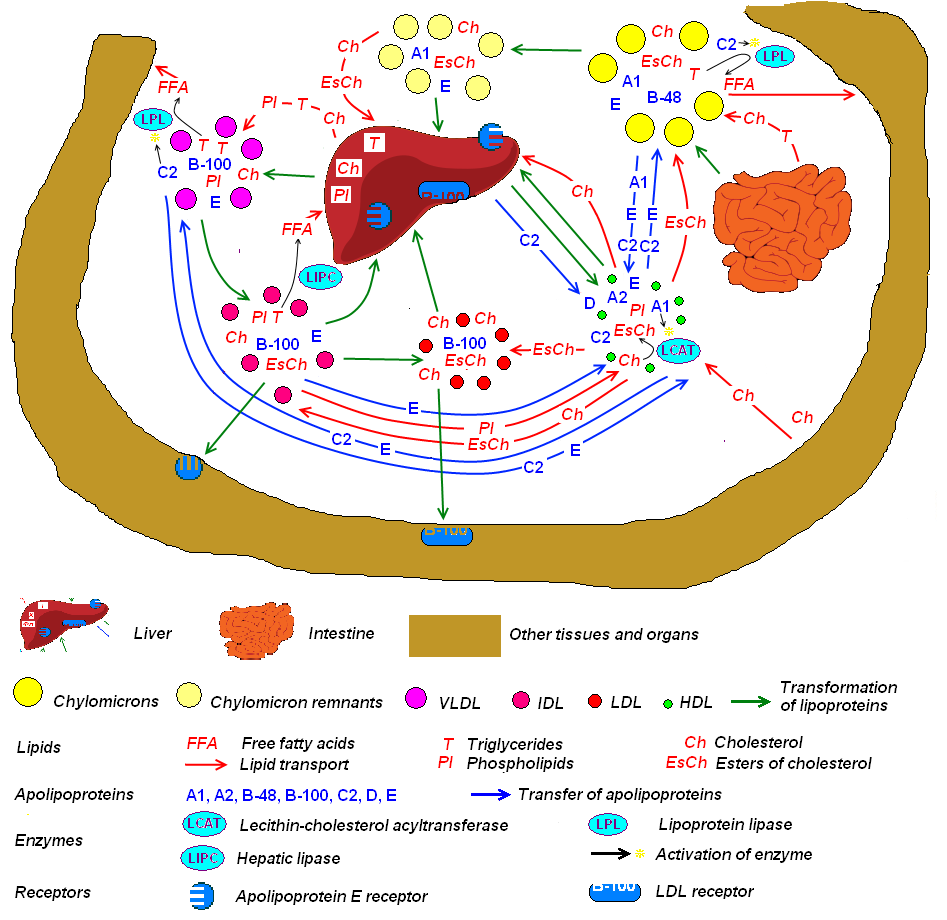
Fat takes a different path. Fatty acids and monoglycerides diffuse out of micelles into the enterocyte, are reassembled into triglycerides inside the cell, and are then packaged with protein and cholesterol into chylomicrons — too large for a capillary, so they leave by a different door entirely (Section 5).
Absorption also has geography. Iron and calcium are taken up mainly in the duodenum; most sugars, amino acids, and fats in the jejunum; vitamin B12 and bile salts specifically in the terminal ileum; water, electrolytes, and microbially produced vitamin K and biotin in the colon. Losing a specific segment of intestine therefore causes a specific, predictable pattern of deficiency rather than general malnutrition.
| Site | Chiefly absorbed here | Notes |
|---|---|---|
| Mouth & stomach | Alcohol, small amounts of water, a few drugs | Minimal — not a real absorptive surface |
| Duodenum | Iron, calcium, magnesium, some glucose | Iron uptake is up-regulated when stores are low |
| Jejunum | Most monosaccharides, amino acids, fats, water-soluble vitamins | The main absorptive workhorse |
| Ileum | Vitamin B12 (with intrinsic factor); bile salts | Highly site-specific — no backup elsewhere |
| Colon | Water, sodium, potassium; microbial vitamin K and biotin; short-chain fatty acids | Reclaims roughly 1–1.5 L of fluid daily |
- Plicae, villi, and microvilli amplify absorptive area roughly a hundredfold; the best current measurement puts the total near 30 m2, not the older "tennis court" figure.
- The brush border performs the final digestive cuts and absorption at the same site.
- Nutrients cross by passive diffusion, facilitated diffusion, or active transport, depending on size, solubility, and gradient.
- Absorption is site-specific — B12 and bile salts in the terminal ileum, iron and calcium in the duodenum.
Section 5Transport, the liver, and the microbiota
Two exits: blood and lymph
Once a nutrient is inside an enterocyte it must still get to the rest of the body, and there are exactly two routes. Water-soluble nutrients — monosaccharides, amino acids, water-soluble vitamins, minerals, and short- and medium-chain fatty acids — enter the capillary in the core of each villus and are carried by the hepatic portal vein straight to the liver. Fat-soluble products cannot use that door. Chylomicrons are too large for capillary pores, so they enter the villus's central lacteal, a lymphatic vessel, and travel through the lymphatic system to the thoracic duct, which empties into a large vein near the left collarbone.
The consequence is elegant: fat enters the general circulation before reaching the liver, while everything water-soluble is inspected by the liver first. That inspection is called the first-pass effect, and it explains why the liver is the body's metabolic customs house — and why oral medications are often dosed higher than injected ones, since a fraction is metabolized before it ever reaches the rest of the body.
What the liver does with the delivery
The liver receives the entire nutrient stream and buffers it. It stores excess glucose as glycogen and releases it between meals, keeping blood glucose remarkably steady. It handles amino acids, converting the nitrogen of surplus ones into urea for the kidneys to excrete. It assembles lipoproteins to ship fat back out. It stores vitamins A, D, and B12 and the mineral iron. It manufactures bile. And it chemically modifies drugs, alcohol, and other compounds. This is why a meal does not send your blood chemistry lurching: the liver flattens the peaks before the rest of you sees them.
The gut microbiota
The colon houses the densest microbial community known in nature. Best current estimates put the total at roughly 3.8 × 10¹³ bacterial cells — about the same order as the number of human cells in the body, revising the widely repeated "ten to one" claim, which was never well supported. Their combined mass is only a couple hundred grams, but their metabolic reach is large.
What they demonstrably do: ferment the fiber and resistant starch our own enzymes cannot touch, producing short-chain fatty acids (acetate, propionate, and butyrate) that acidify the colon — and butyrate in particular is the preferred fuel of the colon's own lining cells; synthesize modest amounts of vitamin K and several B vitamins; occupy niches and consume resources that would otherwise be available to pathogens (competitive exclusion); and help train the intestinal immune system. Fermentation also produces gas — a normal by-product of feeding your microbes, not a malfunction.
Here the evidence needs sorting. Strong evidence supports the benefits of dietary fiber itself: large meta-analyses link higher fiber intake to lower cardiovascular mortality and lower colorectal cancer incidence — those two come from prospective cohorts, so the pattern is consistent and dose-related but still observational — while the effects on laxation and on blood lipids and glucose come from randomized trials. Strong evidence also supports fecal microbiota transplant for recurrent Clostridioides difficile infection, a specific medical therapy delivered under specialist care. Moderate and strain-specific evidence supports certain probiotics for reducing antibiotic-associated diarrhea. Even there the picture is mixed: two large randomized trials of probiotics for acute gastroenteritis in children found no benefit, and results do not transfer between strains, doses, or products. Preliminary evidence covers most of the rest: the many reported associations between microbiome composition and obesity, mood, autoimmunity, and metabolic disease are largely observational or from rodent studies, and causal direction in humans is usually unresolved. Commercial "microbiome tests" that promise a personalized diet are far ahead of the science.
What is reliable and practical: diets consistently higher in fiber-rich plant foods — vegetables, fruit, legumes, whole grains, nuts — are associated with more diverse microbial communities and better long-term health outcomes. The recommended fiber intake is expressed as an Adequate Intake of about 14 g per 1,000 kcal, which works out to roughly 25 g/day for adult women and 38 g/day for adult men aged 19–50, and somewhat lower after age 50 (about 21 and 30 g/day). Most adults consume around half of that. Increasing fiber gradually, with adequate fluid, is generally better tolerated than a sudden jump.
| Feature | Blood route (portal) | Lymph route (lacteal) |
|---|---|---|
| Carries | Monosaccharides, amino acids, minerals, water-soluble vitamins, short- & medium-chain fatty acids | Chylomicrons: triglycerides, cholesterol, fat-soluble vitamins A, D, E, K |
| Vessel entered | Capillary in the villus core | Central lacteal in the villus |
| First destination | Liver, via the hepatic portal vein | Thoracic duct, then a vein near the left collarbone |
| Liver first pass? | Yes — screened and processed before general circulation | No — bypasses the liver initially |
| Speed | Fast, minutes | Slower — blood triglycerides peak roughly 2–4 hours after a fatty meal |
- Water-soluble nutrients leave via the hepatic portal vein to the liver; fats leave as chylomicrons through the lymphatic system and bypass the first pass.
- The liver buffers the nutrient stream — storing glycogen, making urea, building lipoproteins, storing vitamins and iron, and making bile.
- The microbiota ferments fiber into short-chain fatty acids, makes some vitamin K and B vitamins, and resists pathogen colonization.
- Fiber's health benefits are strongly supported; most specific microbiome–disease claims remain preliminary.
The chapter in one breath
- The GI tract is one continuous tube whose lumen is functionally outside the body; accessory organs add secretions without ever holding food.
- The stomach mixes and meters, the small intestine does most digestion and nearly all absorption, and the colon reclaims water and ferments residue.
- Mechanical digestion creates surface area; chemical digestion is hydrolysis, and every digestive enzyme is a hydrolase.
- Carbohydrate must become monosaccharides, protein amino acids and small peptides, fat monoglycerides and fatty acids; yields are 4, 4, and 9 kcal/g, with alcohol at 7.
- The pancreas supplies most enzymes plus neutralizing bicarbonate; bile holds no enzymes and works as a detergent, recycled through the enterohepatic circulation.
- Plicae, villi, and microvilli amplify surface roughly a hundredfold to about 30 m2, and absorption is site-specific — B12 and bile salts only in the terminal ileum.
- Water-soluble nutrients go to the liver by the portal vein for a first pass; fat enters the lymph as chylomicrons and skips it.
- The microbiota ferments fiber into short-chain fatty acids; fiber's benefits are well established, while most microbiome–disease claims are still preliminary.
ReferenceWords worth knowing
These are the terms this chapter leans on. Skim them now to prime the vocabulary, then come back whenever a word in the text refuses to hold still.
- Absorption
- The movement of digested nutrients across the intestinal lining into blood or lymph — the moment food actually enters the body.
- Bile
- A liver secretion, stored in the gallbladder, that emulsifies fat and forms micelles; it contains bile salts, cholesterol, and pigments but no enzymes.
- Bioavailability
- The proportion of a nutrient in food that is actually absorbed and available for use, which depends on the food matrix and the rest of the meal.
- Bolus
- The soft, chewed, saliva-moistened mass of food that is swallowed.
- Brush border
- The dense layer of microvilli on the apical surface of enterocytes, carrying the final digestive enzymes and the absorptive transporters.
- Chylomicron
- A lipoprotein particle assembled in the enterocyte to carry absorbed fat; too large for capillaries, so it exits via the lymph.
- Chyme
- The semi-liquid mixture of partly digested food and gastric secretions released from the stomach into the duodenum.
- Emulsification
- The mechanical breaking of large fat globules into a fine suspension of small droplets, increasing the surface available to lipase.
- Enterocyte
- An absorptive cell of the small intestinal lining.
- Enterohepatic circulation
- The recycling loop in which bile salts are reabsorbed in the ileum and returned to the liver for reuse.
- First-pass effect
- The liver's processing of absorbed substances arriving by the hepatic portal vein before they reach the general circulation.
- Hepatic portal vein
- The vessel that carries nutrient-rich blood from the intestines directly to the liver.
- Hydrolysis
- The reaction that splits a bond by adding water; the chemical basis of essentially all nutrient digestion.
- Intrinsic factor
- A protein from the stomach's parietal cells that is required for vitamin B12 absorption in the terminal ileum.
- Lacteal
- The lymphatic vessel in the core of each villus that receives chylomicrons.
- Micelle
- A tiny bile-salt sphere that ferries fatty acids, monoglycerides, cholesterol, and fat-soluble vitamins to the absorptive surface.
- Microbiota (gut)
- The community of microorganisms living in the digestive tract, most densely in the colon.
- Peristalsis
- The wave of muscular contraction that propels contents forward along the GI tract.
- Segmentation
- Rhythmic non-propulsive contractions of the small intestine that mix chyme with secretions and expose it to the absorptive surface.
- Short-chain fatty acid (SCFA)
- Acetate, propionate, or butyrate — produced when colonic bacteria ferment fiber and resistant starch; butyrate is the colonocyte's preferred fuel.
- Villi
- Finger-like projections of the small intestinal lining that greatly increase absorptive surface area.
- Zymogen
- An inactive enzyme precursor, such as pepsinogen or trypsinogen, activated only after it is safely outside the cell that made it.