Late Antiquity and the Rise of Christianity
Between roughly 200 and 600 CE the Roman world did not simply collapse—it was rebuilt, twice, and by the end it was unrecognizable. Soldiers made and unmade emperors at knifepoint. Diocletian answered the chaos with the largest bureaucratic reorganization the ancient world had seen. Constantine then attached the state to a persecuted minority religion, and within eighty years that religion was legally the only one. Meanwhile Gothic, Vandal and Frankish war-bands moved inside the frontier and turned into kingdoms, so that by 500 the western provinces answered to kings rather than emperors, and Roman taxation was giving way to land and personal service. This chapter asks two hard questions historians still argue about: why did Christianity win, and did Rome fall or change? The answers matter, because the institutions that carried Greek and Roman learning into the Middle Ages—bishoprics, monasteries, canon law, the Latin Bible—were all forged in these four centuries.
By the end of this chapter you can
- Explain the causes and consequences of the third-century crisis, including military anarchy, currency debasement and plague.
- Describe how Diocletian’s tetrarchy, provincial reorganization and tax reforms changed how the empire was governed.
- Evaluate the evidence for and significance of Constantine’s conversion and the legal turn from persecution to patronage.
- Trace how Christianity acquired a canon, a creed, a clergy and an enforcement apparatus, and identify the disputes settled at Nicaea (325) and Chalcedon (451).
- Analyze the origins and appeal of monasticism, from Egyptian hermits to the Rule of St. Benedict.
- Reconstruct the migrations and settlements of Goths, Vandals and Franks and explain why the western imperial office ended in 476.
- Compare competing scholarly models of the “fall”—catastrophe, transformation and Pirenne’s displacement thesis—and weigh the evidence for each.
- Assess the intellectual legacy of Augustine of Hippo and the ways late antique institutions transmitted classical learning.
- Situate the Roman world within its wider neighborhood, especially Sasanian Persia and the eastern Mediterranean that survived.
Section 1The Third-Century Crisis and the Remaking of the State
Fifty years of emergency
In 235 mutinous soldiers murdered the emperor Severus Alexander in his camp at Mainz on the Rhine, and for the next fifty years no ruler could count on dying in bed. Somewhere between twenty and thirty men were proclaimed emperor between 235 and 284; most reigned for months. Modern historians call this stretch the third-century crisis, and while the label flattens real regional variation—Britain and Africa had a quieter time than the Danube—the core problem is not in doubt. The Roman state had never developed a legal rule for succession. When the army discovered that it could sell the purple, the army kept selling it.
Three external pressures turned instability into emergency. In the east, the Parthian dynasty fell in 224 to the Sasanians, an aggressive Persian house with imperial ambitions of its own; in 260 Shapur I captured the emperor Valerian alive at Edessa and carved the humiliation into cliff faces at Naqsh-e Rustam. On the Rhine and Danube, loose confederations with new names—Alamanni, Franks, Goths—raided deep and repeatedly, reaching Athens in 267. And an epidemic remembered as the Plague of Cyprian tore through the empire from roughly 249 to 262, following the Antonine Plague of the previous century.
The fiscal consequences compounded everything. To pay troops, emperors debased the silver coinage: the antoninianus, notionally a double denarius, fell from roughly fifty percent silver when Caracalla introduced it in 215 to under five percent by the 260s, and prices in the surviving Egyptian papyri rise sharply. Debasement did not cause inflation single-handedly, but it destroyed confidence in coined money and pushed the state toward requisitioning goods and services directly. Cities stopped erecting inscriptions and public buildings, a habit that had defined Roman civic life for three centuries; the archaeological silence is one of the crisis’s clearest fingerprints.
Yet the empire did not break apart permanently, and that is the underappreciated half of the story. Regional commands did secede—a Gallic Empire under Postumus from 260, and Palmyra under Zenobia after 267—but Aurelian (r. 270–275) reconquered Palmyra in 272 and the Gallic provinces in 274, earning the title restitutor orbis, restorer of the world. He also walled the city of Rome, an admission that the capital was no longer beyond reach. The recovery was military and it was expensive, and it set the terms for what came next.
Diocletian: bureaucracy as the answer to civil war
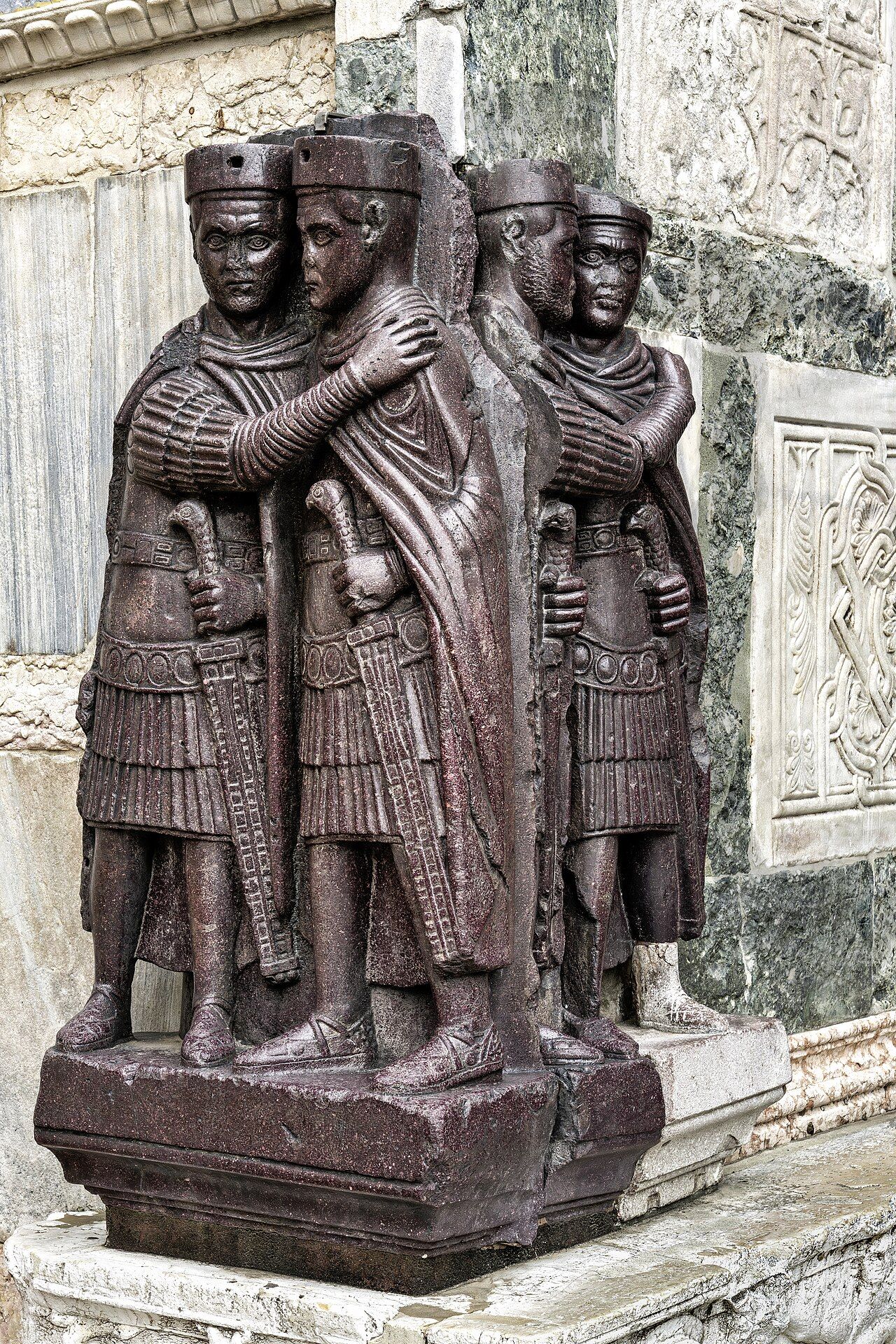
Diocletian, a Dalmatian officer of humble birth, took power in 284 and held it for twenty-one years—then did something no Roman emperor had done: he retired, in 305, to a fortified palace at Split. His reign is the hinge of the period. His diagnosis was that the empire was too large for one man to defend and too tempting for any general to leave alone, so he multiplied the imperial office. In 286 he raised Maximian to Augustus in the west; in 293 each Augustus took a junior colleague and designated heir, a Caesar—Galerius in the east, Constantius in the west. This four-ruler college is the tetrarchy. Each ruler had a field army and a mobile capital: Nicomedia, Sirmium, Milan, Trier. Rome kept its Senate and its prestige and lost its centrality.
Underneath the tetrarchy Diocletian rebuilt administration from the ground up. He roughly doubled the number of provinces, from about fifty to close to one hundred, so that no single governor commanded enough territory to rebel; grouped them into twelve dioceses under vicars; and separated civil from military authority so that the man who collected taxes was not the man who commanded soldiers. He standardized taxation through a system usually called capitatio-iugatio, assessing land in notional units of productive capacity and heads of labor, then issuing a periodic budget (the indictio) that told each region what to deliver—often in kind rather than coin. The army grew substantially, though the true figure is disputed; estimates run from roughly 400,000 to 600,000 men, up from something near 350,000 in the second century.
Two policies failed conspicuously. The Edict on Maximum Prices of 301 fixed ceiling prices for over a thousand goods and services on pain of death; Lactantius says merchants withdrew goods from the market and the edict was quietly abandoned. And in 303 Diocletian launched the Great Persecution, the most systematic assault the Roman state ever mounted on Christianity—churches demolished, scriptures burned, clergy imprisoned, and eventually universal sacrifice demanded. It was pursued hardest in the east and half-heartedly in Constantius’s Gaul and Britain. Eight years later, dying of a horrible illness, Galerius issued an edict of toleration admitting the policy had not worked and asking Christians to pray for him.
| Problem in the 3rd century | Diocletian’s answer | Long-run effect |
|---|---|---|
| Usurpation by provincial commanders | Split civil and military commands; halve province size | Fewer regional revolts; a much larger officialdom |
| One emperor cannot defend three frontiers | Tetrarchy: two Augusti, two Caesars, four capitals | Effective defense; collapsed as a succession rule by 306 |
| Worthless silver coinage | New coin denominations; tax collected in kind | Reliable supply to the army; monetized trade weakened |
| Runaway prices | Edict on Maximum Prices (301) | Failure; goods vanished from open markets |
| Religious nonconformity read as disloyalty | Great Persecution (303–311) | Failure; produced martyrs, and the Donatist schism in Africa |
The third-century crisis nearly destroyed the empire through succession violence, invasion and monetary collapse, and the state that emerged under Diocletian was more centralized, more bureaucratic, more militarized and more coercive than the one it replaced.
Section 2Constantine and the Christian Turn
What happened at the Milvian Bridge
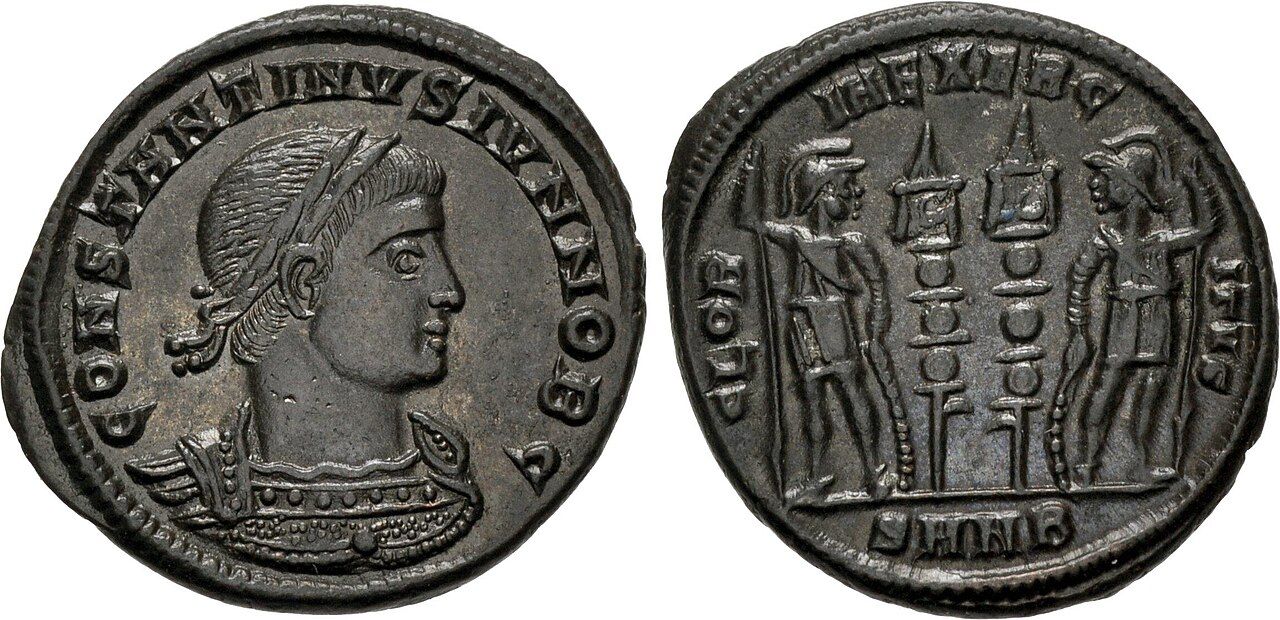
On 28 October 312, Constantine defeated his rival Maxentius at the Milvian Bridge north of Rome and became master of the western empire. Two contemporaries describe a religious experience before the battle, and they do not agree. Lactantius, writing within a few years, reports a dream instructing Constantine to mark his soldiers’ shields with a heavenly sign. Eusebius of Caesarea, writing a quarter century later in his Life of Constantine and claiming the emperor swore to it, describes a cross of light in the midday sky with the words “by this conquer,” followed by a dream. The discrepancy is exactly what you would expect from a story that grew. What is not in dispute is what Constantine did afterward: he began funding churches, favoring Christian clergy and using the Chi-Rho monogram on his standards.
In 313 Constantine and his eastern colleague Licinius met at Milan and agreed on a policy of full religious liberty, restoring confiscated Christian property. The so-called Edict of Milan was not technically an edict and probably not issued at Milan—we know it from a letter Licinius circulated in the east—but the substance is real: Christianity became a licit religion with legal standing to own property and receive bequests. That last point mattered enormously. A church that can inherit estates becomes, over generations, an institution with income, buildings and staff.
Constantine defeated Licinius in 324 and ruled alone until 337. He never made Christianity compulsory. Traditional sacrifice continued; he held the pagan office of pontifex maximus; the coinage carried Sol Invictus into the 320s. What he did was tilt every incentive. Clergy were exempted from the crushing municipal obligations that ruined the local gentry. Bishops received real judicial power to hear cases (the episcopalis audientia). A law of 321 made the “venerable day of the Sun” a day of rest for city dwellers—deliberately ambiguous between Christian and solar piety. He poured money into basilicas at Rome, and his building program in Palestine, publicized by his mother Helena’s pilgrimage there in the 320s, produced the Church of the Holy Sepulchre and a booming trade in relics of the True Cross.
He also built a city. Dedicated in 330 on the site of Greek Byzantium, Constantinople commanded the Bosporus, sat astride the land route to the Danube and the sea route to the east, and had a Senate of its own. It was planned as a Christian capital, though Constantine also stocked it with pagan statuary stripped from across the Greek world. Its foundation is arguably more consequential than the conversion: it gave the wealthier, more urbanized eastern half of the empire a permanent center of gravity, and when the west lost its emperors, the east had a capital that would hold for eleven centuries.
From toleration to establishment, 313–392
The road from tolerated minority to state church took eighty years and was not straight. Constantine’s sons legislated against sacrifice with more zeal than enforcement. Then in 361 his nephew Julian, raised Christian and privately converted to Neoplatonic paganism, became sole emperor and tried to reverse the whole project—restoring temple funding, organizing a pagan clergy modeled on Christian charity, and barring Christians from teaching classical literature on the ground that they did not believe the gods those texts honored. Julian died on campaign in Persia in 363 after twenty months. His failure is instructive: the pagan revival had no comparable organization, no scripture, no poor-relief network, and no successor.
The decisive legislation came from Theodosius I. His edict Cunctos populos of 380 commanded all peoples to hold the faith professed by the bishops of Rome and Alexandria—that is, Nicene Christianity—and branded dissenters heretics. Laws of 391 and 392 banned sacrifice outright, closed temples and criminalized even private household cult. Enforcement was uneven and local violence often outran the law: the Serapeum of Alexandria was destroyed by a Christian crowd in 391, and in 415 the philosopher Hypatia was murdered by a mob in the same city. In 384 the prefect Symmachus pleaded for the restoration of the Altar of Victory in the Senate house with the line that there cannot be only one road to so great a mystery; Bishop Ambrose of Milan answered, and Ambrose won. Six years later Ambrose forced Theodosius himself to do public penance for a massacre at Thessalonica—a bishop disciplining an emperor, and a precedent western churchmen would cite for a thousand years.
| Date | Ruler / event | Legal status of Christianity |
|---|---|---|
| 250 | Decius requires universal sacrifice with certificates | First empire-wide persecution; many lapse |
| 303–311 | Great Persecution under Diocletian and Galerius | Illegal; clergy jailed, scriptures burned |
| 311 | Edict of Galerius (Serdica) | Tolerated; persecution admitted a failure |
| 313 | Agreement of Constantine and Licinius (“Edict of Milan”) | Fully licit; property restored; may inherit |
| 325 | Council of Nicaea | Favored; emperor convenes and enforces doctrine |
| 361–363 | Julian | Tolerated but defunded and mocked |
| 380 | Theodosius I, Cunctos populos | Nicene Christianity the required faith of the empire |
| 391–392 | Theodosian laws on sacrifice | Traditional cult banned, publicly and privately |
Constantine converted the state’s incentives rather than its subjects, and the eighty years from the Edict of Milan to Theodosius’s bans show a minority faith becoming an established church through law, money and imperial patronage.
Section 3Building a Church: Canon, Creed, Clergy and the Desert

Why Christianity spread
Before Constantine, Christianity grew without armies, temples or state money, and explaining that growth is a genuine historical problem. We should be honest about the numbers: nobody counted Christians, and modern estimates for the year 300 range from a few percent of the empire’s roughly fifty to sixty million people to as much as ten percent, with wide regional variation—dense in Asia Minor, Syria and Egypt, thin in the Latin countryside. The sociologist Rodney Stark modeled a steady forty percent per decade growth rate; critics such as Ramsay MacMullen argue the curve was lumpier and more dependent on elite conversions.
What made it attractive is easier to reconstruct. Christianity offered exclusive membership in a world of casual religious pluralism—you joined, you were baptized, you belonged, and you were expected to leave the old gods. It offered organized charity: bishops ran distributions of food, buried the poor, ransomed captives and organized nursing that grew, in the fourth century, into the first public hospitals; in plague years Christians who tended the sick were noticed even by hostile observers. It offered women unusual scope—widows and virgins had recognized roles, deaconesses served in the east, and wealthy women such as Melania the Elder and Marcella funded whole movements. And it offered a portable, textual, translatable identity that worked equally in a Syriac village and a Roman townhouse.
Persecution helped more than it hurt, though it was real and terrifying. Because Roman religion was a civic obligation, refusal to sacrifice looked like treason, and prosecutions ran from Nero’s scapegoating in 64 through Decius’s universal sacrifice order in 250 to Diocletian’s campaign. But persecution was episodic and geographically patchy, and the accounts of martyrs—Perpetua and Felicity at Carthage in 203, Polycarp at Smyrna—circulated as literature that made conviction visible. The costlier problem was internal: what to do with the lapsi, those who had sacrificed under pressure. In North Africa that quarrel became the Donatist schism, a rival church that refused sacraments from clergy who had handed over scriptures, and which persisted for centuries despite imperial force.
Fixing what Christians believed
An emerging church had to answer three questions: which books count, who decides, and what exactly do we say about Jesus. The canon settled slowly and largely by usage rather than decree; the earliest surviving list of exactly our twenty-seven New Testament books is Athanasius’s Easter letter of 367, and disputes over Hebrews and Revelation lingered. Authority concentrated in the bishop, one per city, claiming succession from the apostles, with the bishops of Rome, Alexandria, Antioch and later Constantinople and Jerusalem enjoying special weight. Jerome’s Latin translation, the Vulgate, begun in 382, gave the west a single authoritative text for a millennium.
Doctrine was hammered out in councils, and the fights were ferocious because the stakes were understood as salvation itself. Around 318 an Alexandrian priest named Arius argued that if the Son was begotten, there was a time when he did not exist; the Son was therefore the highest creature, not co-eternal God. Constantine, alarmed at a dispute splitting his new eastern provinces, summoned some three hundred bishops to Nicaea in 325, and the council declared the Son homoousios—of the same substance—with the Father. That did not end it. Arian and semi-Arian parties dominated the eastern court for decades, Athanasius of Alexandria was exiled five times, and Gothic peoples evangelized in this period by the missionary Ulfilas adopted the non-Nicene form, which is why later Gothic and Vandal kings ruled Nicene subjects as fellow Christians of the wrong kind.
The next round asked how divinity and humanity coexisted in Christ. Ephesus (431) condemned Nestorius and affirmed Mary as Theotokos, God-bearer. Chalcedon (451) defined Christ as one person in two natures, unconfused and undivided. Chalcedon settled the Greek and Latin churches and permanently divided the Christian east: the Coptic, Syriac Orthodox, Armenian and Ethiopian churches rejected it and are properly called Miaphysite (the older label “Monophysite” is a polemical caricature of their position), while the Church of the East in Persia went its own way after Ephesus. Those divisions still exist. They also had political consequences: Egypt and Syria entered the seventh century estranged from Constantinople.
| Council | Year | Question at issue | Outcome and fallout |
|---|---|---|---|
| Nicaea I | 325 | Is the Son co-eternal with the Father? | Homoousios affirmed; Arianism condemned but thrives for 60 years |
| Constantinople I | 381 | Status of the Holy Spirit; Arianism | Nicene creed in its familiar form; Trinity settled for the empire |
| Ephesus | 431 | Is Mary Theotokos? Unity of Christ’s person | Nestorius deposed; Church of the East separates |
| Chalcedon | 451 | One person, how many natures? | Two natures in one person; Miaphysite churches separate permanently |
The desert and the Rule
Once Christianity became safe and fashionable, the most demanding Christians went looking for a harder version of it, and they found it in the Egyptian desert. Antony (c. 251–356) withdrew to the wilderness around 285; Athanasius’s Life of Antony, written about 360 and quickly translated into Latin, turned him into a bestseller and a template. Around 320 Pachomius did something organizationally new at Tabennisi: he gathered ascetics into a walled community with a written rule, shared meals, assigned work and an abbot. Hermit life is eremitic; community life is cenobitic, and it was the cenobitic form that would matter for European history.
The movement spread fast. Basil of Caesarea wrote rules in Greek that bound monasteries to service—hospitals, orphanages, poor relief. Macrina, Basil’s sister, ran an ascetic household that her brother Gregory of Nyssa memorialized; Melania the Younger liquidated one of the largest private fortunes in the empire to fund monasteries. John Cassian carried Egyptian practice to southern Gaul around 415. And around 530 a Roman-educated Italian named Benedict of Nursia wrote a short, moderate, remarkably practical rule for a monastery at Monte Cassino: stability of place, obedience to an elected abbot, a balanced day of prayer, reading and manual labor, and—crucially—no heroic extremes. The Rule of St. Benedict was one of several competing rules for two centuries before Carolingian rulers made it standard, but its moderation is exactly why it scaled. Monasteries became the west’s libraries, schools, agricultural improvers and copying houses. Nearly every classical Latin text you can read today survives because a monk copied it.
Christianity won not only converts but institutions—a canon, a creed defined at Nicaea and Chalcedon, a hierarchy of bishops and a monastic movement—and those institutions, not imperial favor alone, are what let it outlive the empire that adopted it.
Section 4Migration, Settlement and the End of the Western Empire
376 and after: a frontier that stopped holding
In 376 a large body of Goths under Fritigern appeared on the north bank of the Danube asking for asylum. They were fleeing the Huns, nomadic horse-archers pressing westward off the steppe, and the emperor Valens admitted them—partly from compassion, mostly because he wanted recruits. Roman officers then extorted and starved them so badly that, according to Ammianus Marcellinus, refugees sold children for dog meat. The Goths revolted. On 9 August 378 at Adrianople they destroyed the eastern field army and killed Valens. It was the worst Roman defeat since Cannae, and the empire never fully replaced those men.
What followed is better understood as accommodation than conquest. In 382 Theodosius settled the Goths inside the empire as foederati—allied troops under their own leaders, paid and supplied by Rome. This is the pattern for everything that comes next: barbarian groups did not batter down the frontier so much as move inside it and then bargain, serve, revolt and bargain again. Their identities were fluid; a “Goth” might be a Roman deserter, a Hun, or the son of a provincial. Recent scholarship (Walter Goffart, Guy Halsall) stresses that these peoples were partly created by the process of dealing with Rome; Peter Heather counters that the groups were real, large and genuinely destructive. Both sides agree the old picture of tidal waves of foreign nations is wrong.
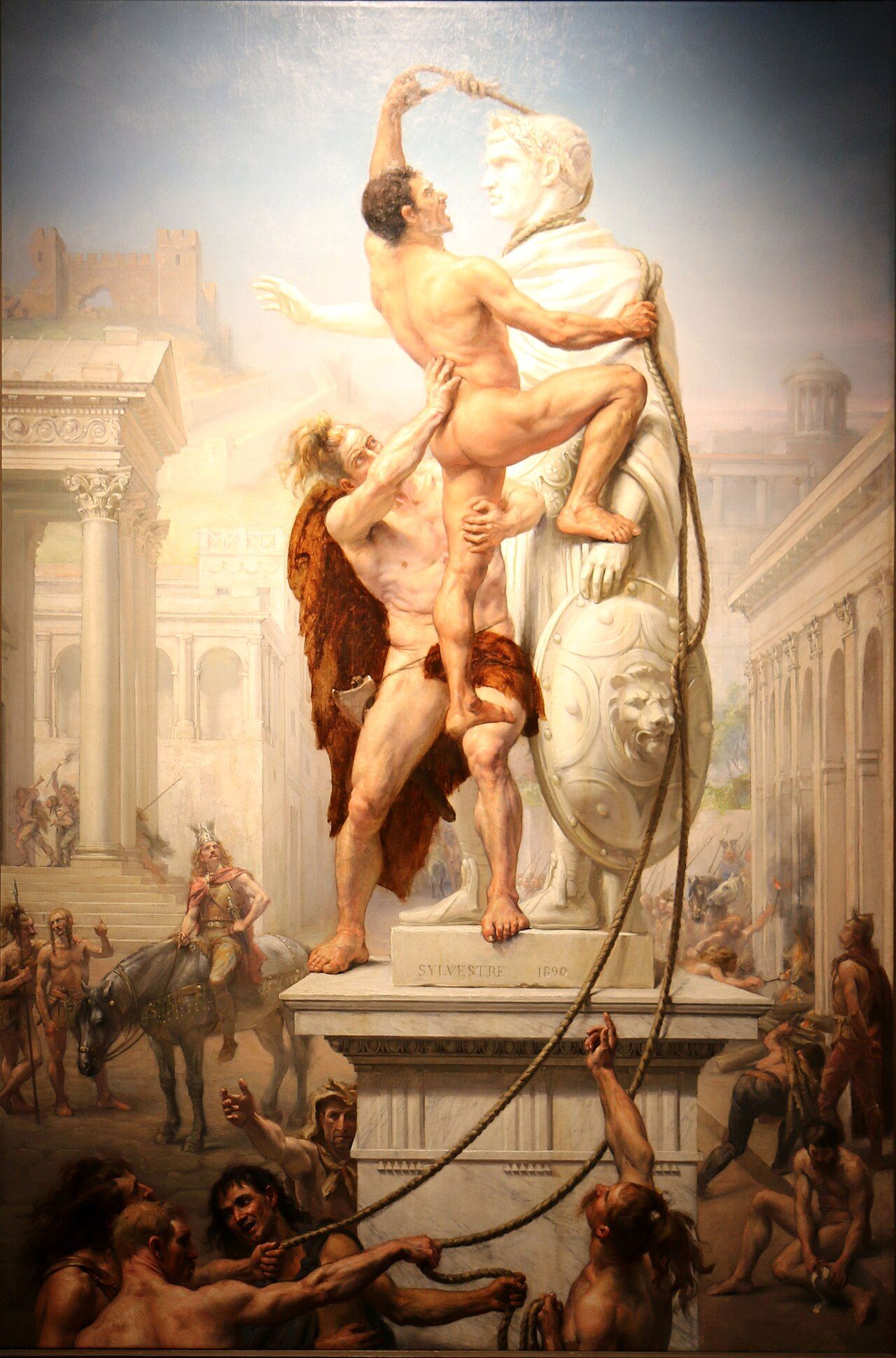
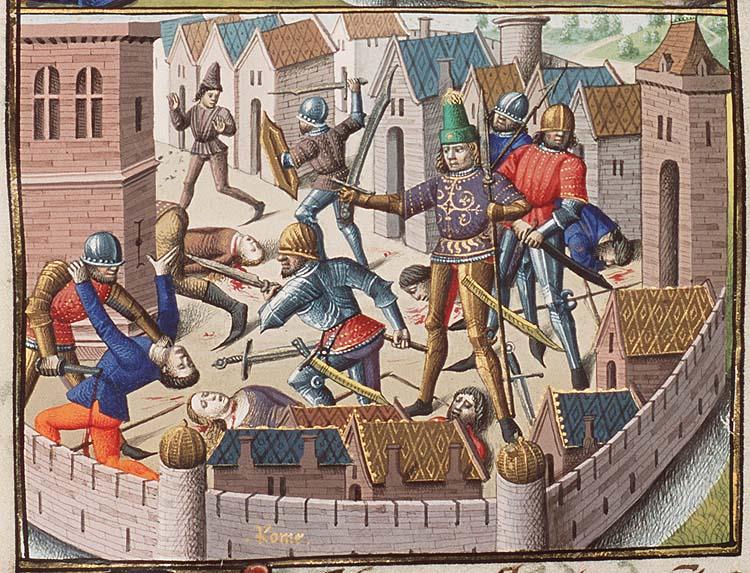
The decisive breach came on the last night of 406, when Vandals, Alans and Suebi crossed a Rhine unguarded because troops had been pulled to Italy. They moved through Gaul into Spain by 409, and in 429 the Vandals under Geiseric crossed to Africa, taking Carthage in 439. That was the fatal blow. North Africa supplied Rome’s grain and the western treasury’s richest tax base; losing it meant the west could no longer pay armies to recover anything else. Meanwhile Alaric’s Visigoths, denied a settlement, sacked Rome for three days in August 410—militarily trivial, since the capital was Ravenna by then, psychologically enormous. Jerome in Bethlehem wrote that his voice failed him. Augustine began The City of God in response.
Attila united the Huns in the 440s, extracted enormous tribute from Constantinople, and invaded Gaul in 451, where a coalition under the Roman general Aetius and the Visigothic king Theodoric fought him to a standstill at the Catalaunian Plains. He ravaged Italy in 452 and died in 453; his empire fragmented within two years. Its main effect was to have pushed other peoples into Roman territory. Then the western court destroyed itself: Valentinian III murdered Aetius in 454 and was murdered in turn in 455, the Vandals sacked Rome that same year, and the last twenty-one years produced nine emperors, most of them creatures of their generals. On 4 September 476 the commander Odoacer deposed the boy emperor Romulus Augustulus and, rather than appoint a replacement, sent the imperial regalia to Constantinople and asked to govern Italy as the eastern emperor’s representative.
Did Rome fall?
Contemporaries did not experience 476 as the end of anything. There was still a Roman emperor; he was in Constantinople. Italy was still administered by a Roman Senate, Roman law and Roman tax officials, now under a Germanic king. When Theodoric the Ostrogoth killed Odoacer in 493 and ruled Italy until 526, he issued edicts in Latin, kept the consulship and employed Roman aristocrats such as Boethius and Cassiodorus. The successor kingdoms wrote down law codes that mixed Roman and customary rules. Clovis, king of the Franks, converted to Nicene rather than Arian Christianity around 496—a date scholars dispute, with some arguing for 508—and that choice aligned him with the Gallo-Roman bishops and made the Frankish kingdom the durable one.
So historians divide. Edward Gibbon in 1776 blamed Christianity and barbarism for a genuine catastrophe. Henri Pirenne argued in the 1930s that Mediterranean unity survived the Germanic kingdoms and was severed only by the Arab conquests of the seventh century—“without Muhammad, Charlemagne is inconceivable.” Peter Brown’s The World of Late Antiquity (1971) reframed the whole period as a creative transformation rather than a decline, and that view dominated for a generation. Bryan Ward-Perkins pushed back hard in 2005 with archaeology: standardized pottery, tile roofs, coin use, long-distance trade in bulk goods, literacy on ordinary objects and even cattle size all decline sharply in the fifth-century west, and in Britain to sub-Iron-Age levels. Kyle Harper has added disease and climate—the Plague of Cyprian, the Justinianic plague of 541, and cooling after the 530s—though the scale of those effects is actively debated. The defensible synthesis: the eastern empire transformed and survived; the western economy contracted severely and material living standards for most people fell; and cultural and religious life kept producing new things throughout.
| Successor kingdom | Where | Roughly | Fate |
|---|---|---|---|
| Visigoths | Aquitaine, then Spain | 418–711 | Pushed south by Franks at Vouillé (507); ends with Arab conquest |
| Vandals | North Africa, Sicily, Sardinia | 429–534 | Destroyed by Justinian’s general Belisarius |
| Ostrogoths | Italy | 493–553 | Annihilated in the Gothic War; Italy left in ruins |
| Franks | Northern Gaul, then most of Gaul | from c. 481 | Survives and expands; becomes the Carolingian empire |
| Anglo-Saxons | Lowland Britain | from c. 450 | Multiple kingdoms; re-Christianized from 597 |
| Burgundians | Rhone valley | c. 443–534 | Absorbed by the Franks |
The western empire ended through a long process of accommodation, fiscal starvation after the loss of Africa and internal political murder rather than a single conquest, and whether that counts as a fall or a transformation depends on whether you weigh political continuity or material decline.
Section 5What Late Antiquity Made
Augustine and the Latin mind
Augustine of Hippo (354–430) is the most influential Latin writer between Cicero and Aquinas, and the arc of his life is the period in miniature. Born in Roman North Africa to a pagan father and a Christian mother, trained as a rhetorician, he spent nine years as a Manichaean, taught in Rome and Milan, heard Ambrose preach, and converted in 386. He became bishop of Hippo in 395 and died in 430 while Vandals besieged the city. His Confessions (c. 397–400) is arguably the first sustained interior autobiography in western literature—a book about memory, desire and a mind arguing with itself.
Three of his positions shaped everything downstream. Against the Donatists he argued that the validity of a sacrament rests on Christ, not on the holiness of the priest, which is why the medieval church could survive corrupt clergy without dissolving. Against Pelagius, who held that God would not command what people are unable to do and that human nature retains a real capacity to choose righteousness, Augustine insisted on inherited sinfulness and the necessity of grace, setting the terms for debates that would explode again in the sixteenth century. And in The City of God, written between 413 and 426 to answer pagans who blamed the sack of Rome on the abandonment of the old gods, he separated the earthly city from the heavenly one. No empire is the kingdom of God; political order is necessary, provisional and not to be worshipped. That distinction between spiritual and temporal authority is a genuinely load-bearing idea in western political thought, and it is one reason medieval Europe never quite managed a fully sacred monarchy.
He did not work alone. Ambrose established that a bishop could face down an emperor. Jerome gave the west its Bible. Gregory the Great (pope 590–604) organized papal estates, wrote a manual of pastoral care that was still assigned centuries later, and sent Augustine of Canterbury to England, where he landed in 597. Boethius, awaiting execution around 524 on Theodoric’s orders, wrote The Consolation of Philosophy and translated enough Aristotelian logic to keep it alive in the Latin west; Cassiodorus founded the monastery of Vivarium and made manuscript copying a sacred duty. These were not men preserving a corpse. They were choosing what to carry.
The world that survived
It is easy to forget that the empire did not end. The eastern half, governed from Constantinople, kept its tax system, its cities, its army and its Greek high culture. Its emperors still called themselves Roman; so did their subjects, for another thousand years. Justinian (r. 527–565) had Roman law compiled into the Corpus Iuris Civilis between 529 and 534—the single most consequential legal act in European history, because its rediscovery in eleventh-century Bologna gave continental Europe its legal framework. He built Hagia Sophia in five years, reconquered Africa and Italy at appalling cost, and then watched the bubonic plague arrive in 541. Chapter 5 takes up that story.
Beyond the Roman frontier lay the other great power of the age, Sasanian Persia, which the textbooks slight. Sasanian shahs ruled from Ctesiphon over a Zoroastrian state with its own aristocracy, its own academy at Gundeshapur, and its own religious minorities—including a large Christian Church of the East that, cut off from Constantinople after Ephesus, evangelized as far as India and China. Rome and Persia fought intermittently for four centuries and exhausted each other in the great war of 602–628, which goes a long way toward explaining why the Arab armies of the 630s found both of them worn out and short of troops. Late antiquity also saw the Christianization of Armenia (traditionally 301, the first state to adopt the faith), Georgia and Ethiopia, and the vigorous continuation of Judaism, whose rabbis in Roman Palestine and Sasanian Babylonia compiled the two Talmuds in exactly these centuries.
What, then, did late antiquity leave the Middle Ages? A religion with a fixed creed, a professional clergy, a legal apparatus and a monastic engine. A Latin Bible and a Latin liturgy that made western Europe a single cultural zone despite political fragmentation. A theory of two authorities. A body of Roman law preserved in the east. A Mediterranean split three ways within another century, into Latin, Greek and Arabic worlds. And a lesson historians keep relearning: complex societies rarely die of one wound. They lose the ability to pay for themselves, and then everything else follows.
Late antiquity handed the Middle Ages its most durable institutions—the papacy and episcopate, the monastery, the Latin Bible, Augustinian theology and codified Roman law—which is why the period is better read as a foundation than as an ending.
The chapter in one breath
The Roman empire of 200 CE and the Christian Mediterranean of 600 CE are not the same civilization, and the four centuries between them explain the difference. Fifty years of military anarchy, plague and monetary collapse forced a rebuild; Diocletian supplied it with a tetrarchy, a doubled bureaucracy and taxation in kind, and paid for it with coercion, including the empire’s last and worst persecution of Christians. Constantine then reversed course, and by tilting law, money and status toward the church he set in motion an eighty-year process that ended with Theodosius outlawing traditional cult in 391. Christianity used that window to finish becoming an institution—canon, creed, councils at Nicaea and Chalcedon, bishops, and a monastic movement that would carry Latin learning through the next five centuries. Meanwhile Goths, Vandals and Franks moved inside the frontier, the loss of North Africa in 439 gutted western finances, and the western imperial office quietly lapsed in 476 without ending Roman law, language or landholding. The east endured. The west contracted materially and reorganized around bishops, monasteries and kings—the raw material of the Middle Ages.
Words worth knowing
| Term | What it means |
|---|---|
| Third-century crisis | The period c. 235–284 of rapid imperial turnover, invasion, plague and currency debasement. |
| Tetrarchy | Diocletian’s rule of four—two senior Augusti and two junior Caesars, each with a region and a capital. |
| Diocese | A grouping of provinces created by Diocletian; later borrowed as the name for a bishop’s territory. |
| Edict on Maximum Prices | Diocletian’s 301 attempt to cap prices empire-wide; unenforceable and abandoned. |
| Great Persecution | The systematic anti-Christian campaign of 303–311; the last and most severe. |
| Chi-Rho | Monogram of the first two Greek letters of “Christ,” adopted by Constantine as a military standard. |
| Edict of Milan | The 313 agreement of Constantine and Licinius granting religious freedom and restoring church property. |
| Constantinople | Constantine’s new eastern capital, dedicated 330 on the Bosporus; the Roman empire’s center for a millennium. |
| Arianism | The teaching of Arius that the Son is a created being subordinate to the Father; condemned at Nicaea in 325. |
| Homoousios | “Of the same substance”—the Nicene term for the Son’s relation to the Father. |
| Council of Chalcedon | The 451 council defining Christ as one person in two natures; rejected by the Miaphysite churches. |
| Miaphysite | The Christology of the Coptic, Syriac, Armenian and Ethiopian churches; one united nature of Christ. |
| Donatism | North African schism holding that sacraments from clergy who lapsed under persecution were invalid. |
| Cenobitic monasticism | Communal monastic life under a rule and an abbot, pioneered by Pachomius c. 320. |
| Rule of St. Benedict | Benedict’s moderate c. 530 monastic rule balancing prayer, study and labor; became the western standard. |
| Vulgate | Jerome’s Latin Bible, begun 382; the authoritative western text for over a thousand years. |
| Foederati | Barbarian groups settled inside the empire as allied troops under their own leaders. |
| Adrianople | The 378 battle where Goths destroyed the eastern field army and killed the emperor Valens. |
| The City of God | Augustine’s 413–426 work distinguishing the earthly from the heavenly city and desacralizing empire. |
| Pirenne thesis | The argument that Mediterranean unity survived the Germanic kingdoms and broke only with the Arab conquests. |
| Corpus Iuris Civilis | Justinian’s 529–534 codification of Roman law; the basis of later continental European legal systems. |