Motivation & Emotion
Why did you get out of bed this morning? And why did your stomach drop when you remembered a deadline? Those two questions are the heart of this chapter. One asks what pushes us to act. The other asks what we feel while we act. Motivation is the set of forces that give behavior its energy and point it toward a goal. Emotion is a short reaction of the whole body. It colors what we experience and gets us ready to respond. The two are closely linked. Hunger sends you to the kitchen. Fear sends you away from a dark alley. Often the feeling is the very thing that gets the body moving. This chapter follows how psychologists have tried to explain both. It moves from raw instinct to Maslow's pyramid, and from a growling stomach to the fast alarm in the brain.
By the end of this chapter you can
- Define motivation. Compare the instinct, drive-reduction, and arousal theories.
- Place needs in Maslow's hierarchy and explain the idea of prepotency.
- Describe how the hypothalamus and the hormones ghrelin and leptin control hunger and eating.
- Compare the James-Lange, Cannon-Bard, and Schachter-Singer theories of emotion.
- Sum up the evidence that some facial expressions of emotion are shared worldwide. Define display rules.
- Name the role of the limbic system in emotion, especially the amygdala.
- Explain how autonomic arousal gets the body ready during strong emotion.
Section 1Theories of motivation
From instinct to drive
Motivation is the wanting behind the doing. It is the inner state that gives behavior energy and direction. The first scientific account was instinct theory. It said much of what we do is built in from birth. Building on Darwin, psychologists such as William James and William McDougall argued that people, like animals, have instincts. An instinct is an unlearned pattern of behavior that every member of a species shares. Instincts were said to drive action on their own.
The theory fell apart because it was too easy to use. People named an instinct for every behavior, like a "curiosity instinct" or a "parental instinct." But a label does not explain anything. It just repeats the behavior it was meant to explain. True instincts are fixed, complex, and unlearned, like a bird building a nest. They turned out to be rare in humans.
The next account looked at the body's need for balance. Drive-reduction theory came from Clark Hull. It starts with homeostasis, the body's habit of keeping a steady inner state. A body need, like a need for food, water, or warmth, creates a tense, stirred-up state called a drive. We then act to reduce that drive and get back to balance. Thirst pushes you to drink. Drinking lowers the drive. Then the push fades. Primary drives are unlearned and biological, like hunger and thirst. Secondary drives are learned because they are linked to primary rewards. The pull toward money is one example.
Arousal, incentives, and the optimal level
Drive reduction has an obvious gap. People often work to raise their arousal, not lower it. Arousal means how alert and stirred up the body and mind are. We ride roller coasters, watch scary movies, and take on hard puzzles. No body need is involved. Arousal theory fills this gap. It says we are driven to reach an optimal, or best, level of stimulation. With too little, we look for excitement. With too much, we look for calm.
A classic finding here is the Yerkes-Dodson law, from Robert Yerkes and John Dodson in 1908. It says people perform best at a medium level of arousal. The best level is lower for hard tasks than for easy ones. A little nervous energy before an exam can sharpen you. A lot of it can make your mind go blank. (Their original study used mice. Later studies support the general idea, but the curve is a rough rule, not an exact law.)
Drives push us from the inside. Incentive theory adds the pull of goals outside us. We are drawn toward rewards, like a paycheck or praise. We move away from punishments. This can happen with no inner need at all.
| Theory | Main idea | Best explains | Weakness |
|---|---|---|---|
| Instinct | Behavior comes from inborn patterns shared by a species | Fixed, unlearned behaviors | Naming an instinct does not explain it |
| Drive-reduction | Needs create drives; we act to restore homeostasis | Hunger, thirst, body temperature | Cannot explain why we seek arousal |
| Arousal | We seek an optimal level of stimulation | Curiosity, thrill-seeking, boredom | Less useful for basic drives |
| Incentive | Rewards outside us pull us forward | Working for pay, grades, praise | Plays down inner states |
Maslow's hierarchy of needs
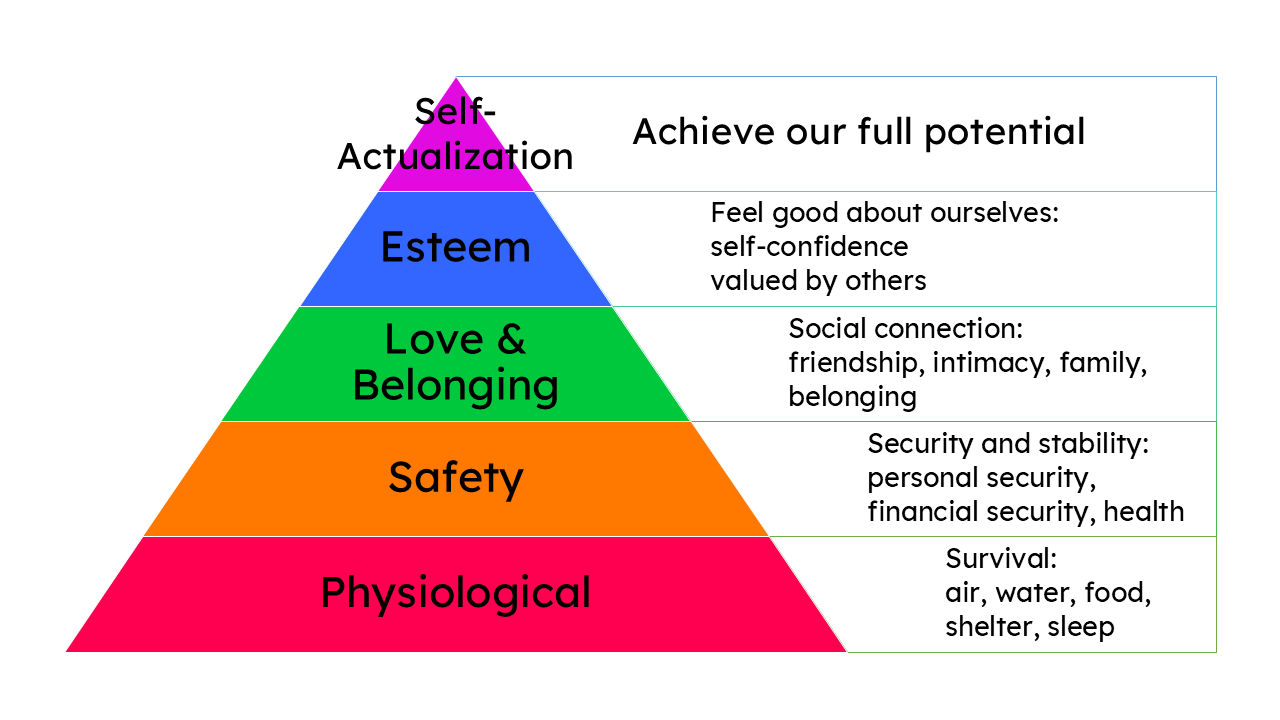
Abraham Maslow (1943) said our many motives are not all equal. He said they are stacked in a hierarchy of needs, which is often drawn as a pyramid. At the bottom are physiological needs, the body's needs, like food, water, and sleep. Next come safety needs, like security and shelter. Then come needs for love and belonging. Then come esteem needs, like achievement and respect. At the top is self-actualization, the drive to become your fullest self.
The key claim is called prepotency. It means lower needs usually must be fairly well met before higher needs take over. A person who is starving is not much moved by worries about self-esteem. Later in life, Maslow added self-transcendence above self-actualization. That means reaching beyond yourself to serve others or a cause.
The hierarchy is easy to grasp and still very popular. Maslow never drew it as a pyramid himself, though. That picture came later from other writers. Critics also point out that the order is not strict. People sometimes give up food and safety for love or for their beliefs. Cultures also differ in which needs they value most.
- Motivation gives behavior energy and direction. Early instinct theory failed because calling a behavior an instinct explains nothing.
- Drive-reduction theory (Hull): needs create drives that we act to reduce, which restores homeostasis.
- Arousal theory and the Yerkes-Dodson law explain why we sometimes seek stimulation. Performance peaks at medium arousal.
- Maslow's hierarchy stacks needs from physiological to self-actualization. Lower needs usually come first (prepotency).
Section 2Hunger & eating
The body's hunger signals
Where does hunger come from? An early guess pointed to the stomach. In 1912 Walter Cannon and his student A. L. Washburn ran a famous test. Washburn swallowed a balloon so his stomach squeezes could be recorded. The squeezes did match the moments he felt hunger pangs. But the stomach turned out to be a messenger, not the boss. People whose stomachs have been removed by surgery still feel hungry.
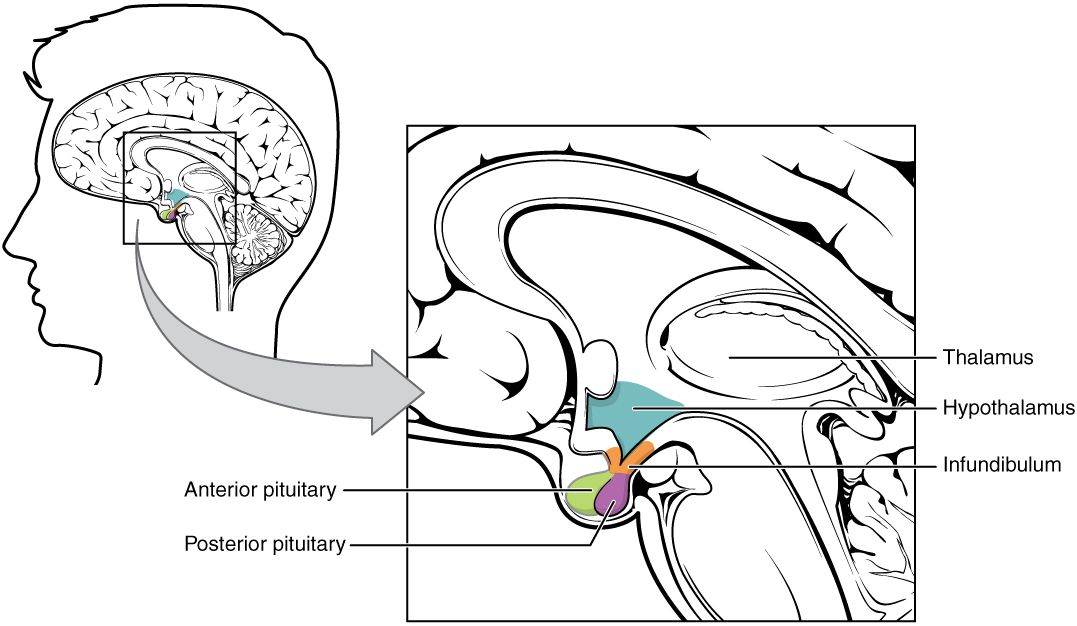
The real control center is the hypothalamus. It is a small structure at the base of the brain. It keeps track of the body's fuel and runs eating. Two parts became famous from animal studies that damaged small areas of the brain. The lateral hypothalamus works like an "on" switch. Stimulate it, and an animal eats. Destroy it, and the animal may starve. The ventromedial hypothalamus works like an "off" switch, or fullness center. Destroy it, and the animal overeats a great deal. Newer work adds detail, such as a small area called the arcuate nucleus. It has some neurons that boost appetite and others that curb it. Still, the on and off idea is a useful map.
The chemistry of appetite
The hypothalamus listens to a stream of chemical signals. Glucose, or blood sugar, is a key one. When glucose falls, hunger rises. Hormones fine-tune the message. Ghrelin is released by an empty stomach. It is the "I'm hungry" hormone. It climbs before meals and drops after eating. Leptin is made by fat cells. It is a longer-term signal that says "I have enough stored," and it lowers appetite. Insulin and a gut hormone called PYY also help you feel full.
Many researchers have described a set point. This is a weight the body is said to defend. It does so by changing hunger and the basal metabolic rate, which is the calories you burn at rest. Eat too little, and your metabolism slows. That is one reason strict diets are so often undone. But the strong version of this idea has been challenged. There is not much proof that the body pulls back to one fixed number. Many researchers now prefer a settling point. In this view, weight drifts to whatever level your surroundings, diet, and habits support. It stays there because those conditions stay the same, not because the body defends a fixed figure.
| Signal | Source | Effect on eating |
|---|---|---|
| Ghrelin | Empty stomach | Raises hunger (rises before meals) |
| Leptin | Fat cells | Lowers hunger (signals stored energy) |
| Insulin | Pancreas | Helps you feel full; controls glucose |
| Low blood glucose | Bloodstream | Triggers hunger |
| Lateral hypothalamus | Brain | "On" switch: drives eating |
| Ventromedial hypothalamus | Brain | "Off" switch: signals fullness |
Psychology and culture at the table
Biology creates the drive to eat. But psychology decides much of the menu. Taste likes are partly learned. We are born liking sweet and disliking bitter. But a taste for things like cilantro or chili heat comes from exposure and culture. Cues around us matter a lot too. Bigger plates, more variety, and eating with other people all lead us to eat more. We often do not notice. We tend to finish the unit in front of us, whatever its size.
Sometimes these systems go badly wrong, and an eating disorder can develop. A person with anorexia nervosa restricts food to a dangerous degree and has a distorted view of body shape or weight. A person with bulimia nervosa has repeated binges followed by steps to make up for them, such as vomiting, fasting, or too much exercise. A person with binge-eating disorder has repeated binges without those steps. These are serious mental health conditions. They have biological, psychological, and cultural roots. They are not a matter of willpower, and they can be treated.
- The hypothalamus is the main controller. The lateral area switches eating on. The ventromedial area signals fullness.
- Ghrelin (from the stomach) raises hunger. Leptin (from fat cells) lowers it. Falling glucose triggers eating.
- Metabolism adjusts to how much you eat, which makes dieting hard. The classic set point has been challenged by the idea of a settling point shaped by surroundings and habit.
- Learned tastes, portion cues, and culture strongly shape what and how much we eat.
Section 3Theories of emotion
What an emotion is made of
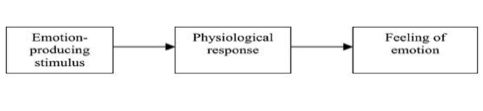
An emotion is a short, organized response with three parts. One is a physiological part, or body part, like a racing heart or sweaty palms. One is an expressive/behavioral part, like a frown or a flinch. One is a subjective/cognitive part. That is the feeling you are aware of and how you make sense of it. The big theories of emotion agree on these parts. They disagree about the order. Which comes first, the body's reaction or the feeling? And does thinking have to happen in between?
Three classic accounts
The James-Lange theory comes from William James and a Danish doctor, Carl Lange. It makes a surprising claim: the body comes first. An event triggers a body reaction. The emotion is our sense of that reaction. James put it this way. We do not tremble because we are afraid. We feel afraid because we tremble. In this view, emotion is the body's report.
The Cannon-Bard theory comes from Walter Cannon and Philip Bard. They disagreed with James. They said body changes are too slow to be the source of emotion. They are also too alike from one emotion to the next. A pounding heart comes with fear, anger, and excitement. So the body alone cannot tell you which one you feel. Instead, they said, a part of the brain called the thalamus sends the signal to two places at the same time. It goes to the cortex, which creates the felt emotion. It also goes to the body, which creates the arousal. In this view, feeling and body changes happen together, and neither causes the other.
The Schachter-Singer two-factor theory comes from Stanley Schachter and Jerome Singer in 1962. It added a missing piece: thought. They said emotion needs two factors. One is general body arousal. The other is a mental label we give it by reading the situation. In their famous study, people got a shot of epinephrine, also called adrenaline. Then each person waited with an actor who acted either angry or very happy. The study reported that people tended to describe their arousal to match the actor's mood. The arousal was the same. The setting told them what emotion it was. Later teams had trouble repeating these results, so the study is weaker evidence than it once seemed. The idea that we label arousal using context is still influential.
| Theory | Order | Main claim |
|---|---|---|
| James-Lange | Event → body arousal → emotion | The emotion is our sense of the body's response |
| Cannon-Bard | Event → arousal and emotion at once | Feeling and body changes happen together and on their own |
| Schachter-Singer | Event → arousal + mental label → emotion | Emotion = arousal read through the situation |
Later thinkers looked more closely at the role of thought. Richard Lazarus argued that emotion always starts with an appraisal. That is a quick judgment of whether an event is good or bad for us. It can happen even when we are not aware of it. Robert Zajonc and the brain scientist Joseph LeDoux disagreed. They said some emotional reactions, especially fear, can fire before any conscious thought. Fast brain pathways skip the cortex. Section 5 picks up this idea.
- Emotion has three parts: physiological arousal, expressive behavior, and subjective feeling.
- James-Lange: the body comes first, and the feeling follows the body's reaction.
- Cannon-Bard: arousal and emotion happen at the same time and on their own.
- Schachter-Singer: emotion needs arousal plus a mental label taken from the situation.
Section 4Expressing emotion
Faces the whole world reads
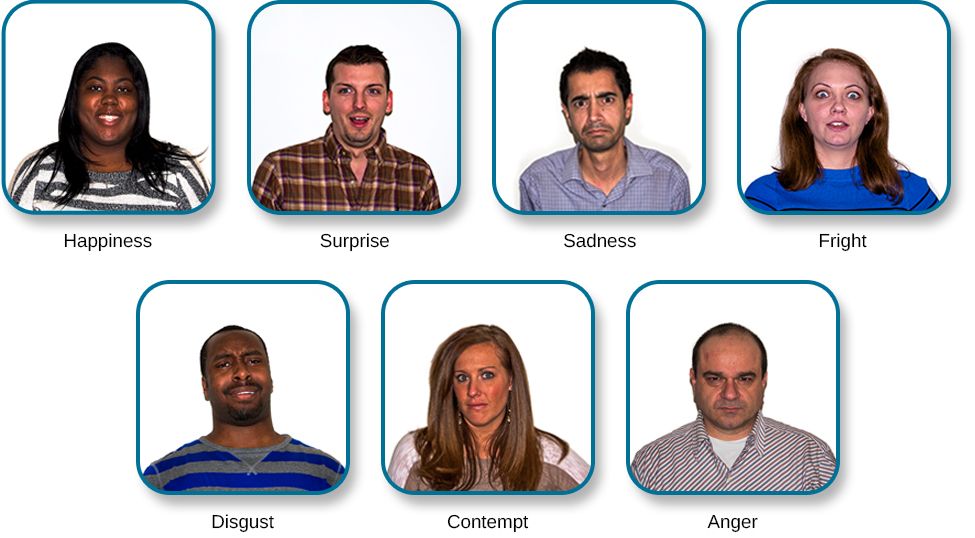
Charles Darwin made a bold claim in his book The Expression of the Emotions in Man and Animals (1872). He said emotional expressions are inherited, useful for survival, and shared by all people. About a hundred years later, Paul Ekman and Wallace Friesen gathered evidence. They showed photos of faces to people around the world. A small set of basic emotions was recognized far more often than chance in every culture they tested. The set was happiness, sadness, anger, fear, surprise, and disgust. Ekman later added contempt.
A key part of this work involved the Fore people of Papua New Guinea. They lived far from cities and had seen almost no Western media. Even so, they matched the same faces to the same situations. Children who were born blind give more evidence. They have never seen a smile. Yet they smile when happy and frown when frustrated. This suggests the expressions are built in, not just copied. Some newer studies with other remote groups found weaker agreement, though. So scientists still debate how universal these expressions are.
Does the face feed the feeling?
Expressions may not just show emotion. They may also shape it. The facial feedback hypothesis says that making a facial expression sends signals back to the brain. Those signals may strengthen the matching emotion, or even create it.
A well-known 1988 study tested this with a pen. Some people held a pen sideways in their teeth, which forces a smile-like shape. Others held it with their lips, which blocks a smile. The "smiling" group rated cartoons as funnier. But that result did not hold up. In 2016, seventeen labs repeated the study together with almost two thousand people. They found almost no effect. So the pen-and-cartoon result should be treated as not replicated. Later large studies suggest that posing a smile may lift mood a small amount. The broader idea, that posture and expression loop back into feeling, fits the spirit of the James-Lange theory in Section 3.
When culture edits the face
If the basic expressions are shared, why do emotional lives look so different around the world? The answer is display rules. These are norms we learn from our culture. They tell us which emotions we may show, to whom, and how strongly. Ekman and Friesen showed this in a clever study. American and Japanese students watched an upsetting film. When alone, both groups showed almost the same disgust. Then an authority figure sat in the room. Now the Japanese students covered their disgust with polite smiles much more than the Americans did. The underlying expression was the same. The rules for showing it were different.
Display rules also change with the setting and a person's role. A lot of emotional signaling also uses gestures and body language. Unlike the basic faces, these can mean very different things from one culture to the next.
| Basic emotion | Main facial clue |
|---|---|
| Happiness | Raised cheeks, smiling mouth, crinkles at the corners of the eyes |
| Sadness | Mouth turned down, inner brows raised |
| Anger | Brows lowered and pulled together; lips pressed tight |
| Fear | Wide eyes, raised brows, lips stretched back |
| Surprise | Raised brows, wide eyes, dropped jaw |
| Disgust | Wrinkled nose, raised upper lip |
- Darwin proposed that expressions are inborn. Ekman and Friesen showed that a set of basic emotions is recognized across cultures.
- Evidence for this includes the remote Fore of New Guinea and the expressions of children born blind. The debate about how universal they are continues.
- The facial feedback hypothesis says making an expression can change the emotion felt. The famous pen study did not replicate.
- Display rules are cultural norms about how and when emotions are shown.
Section 5The biology of emotion
The emotional brain
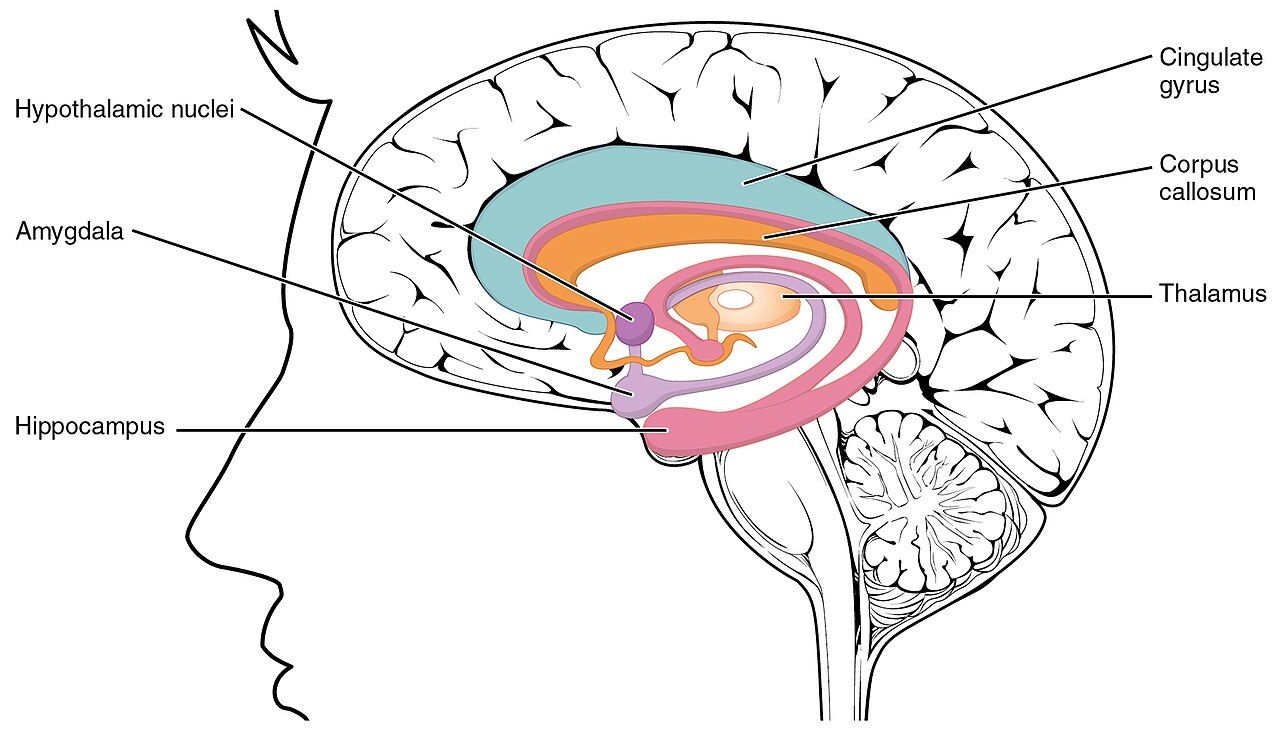
Emotion lives mostly in the limbic system. This is a ring of structures curled under the outer layer of the brain, the cortex. It includes the hypothalamus, the same hunger controller from Section 2. Here it drives the body's arousal. It includes the hippocampus, which stores emotional memories. It includes the thalamus, which relays signals from the senses. Above all, it includes the amygdala.
The amygdala is the brain's threat detector. It is a pair of almond-shaped clusters. They check incoming signals for danger and trigger fear and aggression. Damage to it can wipe out normal fear. In Klüver-Bucy syndrome, monkeys had parts of the temporal lobes removed, including the amygdala. Afterward they calmly approached things they would usually flee. People with damage to the amygdala have trouble recognizing fear on other people's faces.
Two roads to fear
The brain scientist Joseph LeDoux traced two paths that a scary signal can take to the amygdala. The low road runs straight from the thalamus to the amygdala. It is fast, rough, and unconscious. It lets you jump back from a stick shaped like a snake before you know what it is. The high road goes from the thalamus up to the cortex for a careful look. Then it goes down to the amygdala. It is slower but more accurate. It lets you realize the snake was only a stick.
The low road is why emotion can outrun thought. That is the point Zajonc and LeDoux made against pure appraisal theories in Section 3. Meanwhile, the prefrontal cortex helps make sense of these signals and keeps them in check. The insula is especially active in disgust.
| Structure | Role in emotion |
|---|---|
| Amygdala | Detects threat; central to fear and aggression |
| Hypothalamus | Triggers body (autonomic) arousal |
| Hippocampus | Forms and recalls emotional memories |
| Thalamus | Relays sense signals to the cortex and amygdala |
| Prefrontal cortex | Makes sense of emotions and keeps them in check |
| Insula | Active in disgust and in sensing the body |
Arousal and the body's alarm
When the amygdala sounds an alarm, it calls on the autonomic nervous system. This is the part of the nervous system that runs the body without our control. Its sympathetic branch launches the fight-or-flight response. The adrenal glands flood the blood with epinephrine (adrenaline) and cortisol. The heart races. The pupils widen. Breathing speeds up. Digestion stops. The body is ready for action. When the threat passes, the parasympathetic branch brings back calm. It slows the heart and restarts digestion.
This is the body arousal that both the Cannon-Bard and Schachter-Singer theories talk about. It also explains the limits of the polygraph, or "lie detector." A polygraph measures arousal, such as heart rate, sweating, and breathing. But arousal comes with many emotions. So an honest person who is nervous and a calm liar can both fool it. Different emotions share a lot of the same body changes. That is exactly why context and thinking, from Section 3, do so much of the work of telling them apart.
- The limbic system (amygdala, hypothalamus, hippocampus, thalamus) is the emotional core of the brain.
- The amygdala detects threat and drives fear. Damage to it dulls fear (Klüver-Bucy syndrome).
- LeDoux's fast low road lets emotion come before conscious thought. The high road adds a careful check by the cortex.
- Sympathetic arousal (epinephrine, racing heart) prepares for fight-or-flight. The parasympathetic branch brings back calm.
The chapter in one breath
- Motivation gives behavior energy and direction. Theories run from instinct to drive-reduction (homeostasis) to arousal (best level of stimulation) to incentives.
- Maslow's hierarchy stacks needs from physiological to self-actualization. Lower needs usually come first.
- Hunger is run by the hypothalamus and by hormones. Ghrelin raises hunger and leptin lowers it, while learning and culture shape what we eat.
- An emotion mixes arousal, expression, and feeling. James-Lange, Cannon-Bard, and Schachter-Singer disagree about their order.
- Basic facial expressions are recognized across cultures (Ekman), but display rules control how they are shown.
- The limbic system, especially the amygdala, runs emotion. It has a fast path that beats conscious thought.
- Sympathetic arousal (epinephrine, fight-or-flight) is the shared body engine of strong emotion.
ReferenceWords worth knowing
Here is a quick list of the terms in this chapter. Skim it now, or come back any time a word trips you up.
- Amygdala
- An almond-shaped part of the limbic system. It detects threat and is central to fear and aggression.
- Arousal theory
- The idea that we are driven to reach a best level of stimulation, not too high and not too low.
- Basic emotions
- A small set of emotions (happiness, sadness, anger, fear, surprise, disgust) whose faces are recognized across cultures.
- Cannon-Bard theory
- The theory that body arousal and the felt emotion happen at the same time and on their own.
- Display rules
- Norms learned from culture about which emotions may be shown, to whom, and how strongly.
- Drive-reduction theory
- The idea that a body need creates a drive, which pushes us to act and restore homeostasis.
- Emotion
- A short response of the whole body, with body, expressive, and felt parts.
- Facial feedback hypothesis
- The idea that making a facial expression can change the emotion a person feels.
- Ghrelin
- A hormone released by an empty stomach that raises hunger.
- Hierarchy of needs
- Maslow's ranking of needs, from physiological at the bottom to self-actualization at the top.
- Homeostasis
- The body's habit of keeping a steady, balanced inner state.
- Instinct theory
- The early idea that behavior comes from inborn patterns shared by a species. It failed because naming an instinct does not explain the behavior.
- James-Lange theory
- The theory that emotion is our sense of a body response. The body reacts first, and the feeling follows.
- Lateral hypothalamus
- The part of the hypothalamus that acts as an "on" switch for eating.
- Leptin
- A hormone made by fat cells that signals stored energy and lowers appetite.
- Limbic system
- A group of brain structures (amygdala, hippocampus, hypothalamus, thalamus) central to emotion and motivation.
- Motivation
- The inner forces that give behavior energy and point it toward a goal.
- Schachter-Singer theory
- The two-factor theory that emotion comes from body arousal plus a mental label taken from the situation.
- Self-actualization
- The need to reach your full potential. It is the top of Maslow's hierarchy.
- Set point
- A weight the body is said to defend by changing hunger and metabolic rate. Many researchers now prefer the idea of a settling point.
- Sympathetic nervous system
- The branch of the autonomic nervous system that launches the fight-or-flight response.
- Ventromedial hypothalamus
- The part of the hypothalamus that signals fullness. It acts as an "off" switch for eating.
- Yerkes-Dodson law
- The rule that performance peaks at a medium level of arousal. The best level is lower for hard tasks than for easy ones.