Lifespan Development
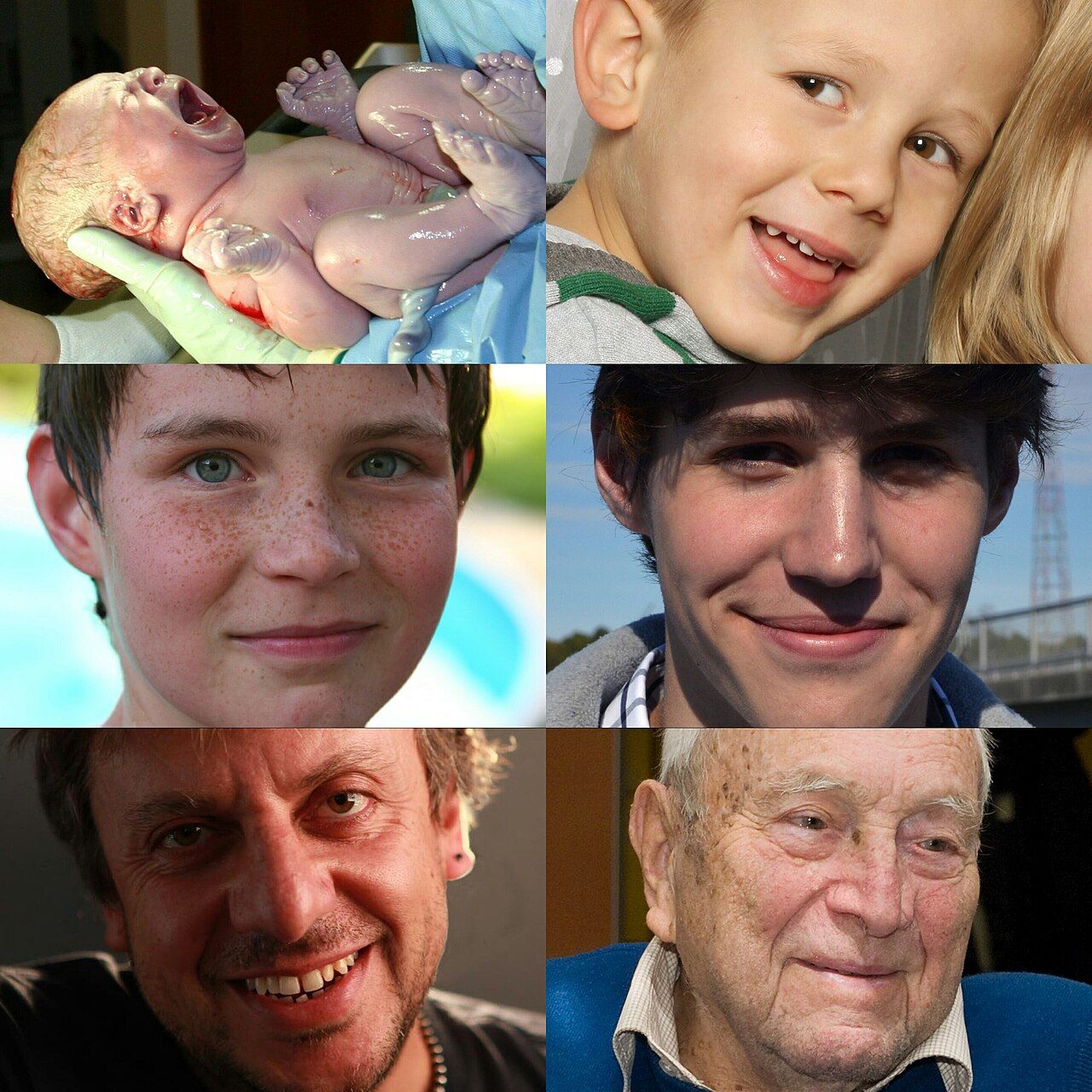
You are not the same person you were at age three. You will not be the same person at age eighty. Yet something about you stays the same the whole way through. Developmental psychology is the study of how people grow and change from conception to death. It asks how one fertilized cell becomes a person who thinks, feels, and lives with others. It also asks how that person keeps changing in every decade after. This chapter follows that path. First it asks how scientists study development at all. Then it watches the body and brain form before birth. Next it traces how children learn to think and to love. Last, it follows life through the teen years, adulthood, and the end of life. Along the way you will meet key researchers: Piaget, Ainsworth, Erikson, and Kübler-Ross. Their work still shapes how we understand a human life.
By the end of this chapter you can
- Explain the nature-nurture debate. Say why psychologists now see it as genes and experience working together, not as a contest.
- Tell continuous theories from stage theories. Tell cross-sectional studies from longitudinal studies.
- Describe the three prenatal stages. Explain how teratogens harm a growing baby.
- Sum up newborn reflexes and skills, and the set order of motor development.
- Lay out Piaget's four stages of thinking. Point out where later research changed his ideas.
- Compare the attachment styles seen in Ainsworth's Strange Situation. Place them next to Erikson's psychosocial stages.
- Explain the changes of puberty, the search for identity, and how the body and mind change in adulthood and aging.
- Describe Kübler-Ross's account of dying. Explain why it is not a fixed order that everyone must follow.
Section 1How we study development
Three questions that organize the field
Developmental psychologists come back to three big questions again and again. It helps to keep them in mind like a map. The first is nature and nurture. How much of who we become comes from our genes? How much comes from experience, parents, culture, and chance? The second is continuity versus stages. Does change happen bit by bit, like walking up a ramp? Or does it happen in clear stages, like climbing a staircase? In a stage view, a child at each step thinks in a truly different way. The third is stability versus change. Do early traits last a whole life? Think of a shy temper or a sunny mood. Or can later experience truly reshape a person?
None of these questions has a neat one-word answer. For the first one, the honest answer is almost always "both." Scientists used to ask whether a trait came from nature or nurture. Now they ask how the two work together. Genes are not a blueprint that stamps out one fixed result. They are more like a set of leanings. Experience can switch them on, turn them up, or quiet them down. A newer field called epigenetics studies exactly this. It shows how the world around us can turn genes on and off. The DNA code itself does not change. So heredity and experience are woven together, right down to the level of molecules.
Nature via nurture
The clearest proof that both matter comes from studies built to pull them apart. Twin studies compare two kinds of twins. Identical twins share almost all of their genes. Fraternal twins share about half, like any brother or sister. If identical twins are more alike on a trait, genes likely play a part. Adoption studies ask a related question. Is an adopted child more like the birth parents, who gave the genes? Or more like the adoptive parents, who gave the home? Decades of this work point to the same result. Almost every trait is shaped by both. Identical twins raised apart are very alike in intelligence and temperament. Yet no trait is set by genes alone. Development is genes and environment in a constant conversation.
Cross-sectional and longitudinal designs
Development happens over time. So researchers need study designs that can capture change. There are two main kinds. Each one gains something and pays a price. A cross-sectional study compares people of different ages at the same moment. For example, a researcher might test 20-year-olds, 50-year-olds, and 80-year-olds, all this year. This is fast and cheap. But it hides a trap. The age groups differ in age, and they also grew up in different times. This is called a cohort effect. A cohort is a group born around the same time. Say today's 80-year-olds score lower on a computer task than today's 20-year-olds. That gap may come from a life with less technology. It may not come from aging at all.
A longitudinal study works the other way. It follows the same people for many years and tests them again and again as they age. This cleanly pulls apart aging and cohort. But it is slow and costly. It also suffers from attrition, which means people drop out over time. They move away, lose interest, or die. The people who stay may be extra healthy or extra motivated. That can bias the results. Much of what we know about development comes from comparing what these two designs show.
| Design | How it works | Strength | Weakness |
|---|---|---|---|
| Cross-sectional | Compare different age groups at one point in time | Fast, cheap, no waiting | Cohort effects mix up age with generation |
| Longitudinal | Follow the same people over many years | Separates true aging from cohort | Slow and costly; attrition biases the group |
- Development turns on three questions: nature-nurture, continuity vs stages, and stability vs change. The modern answer to nature-nurture is that the two interact.
- Twin and adoption studies show that almost every trait comes from both genes and environment.
- Cross-sectional designs are fast but can be fooled by cohort effects. Longitudinal designs isolate aging but lose people to attrition.
Section 2Prenatal development and infancy
Nine months in three stages
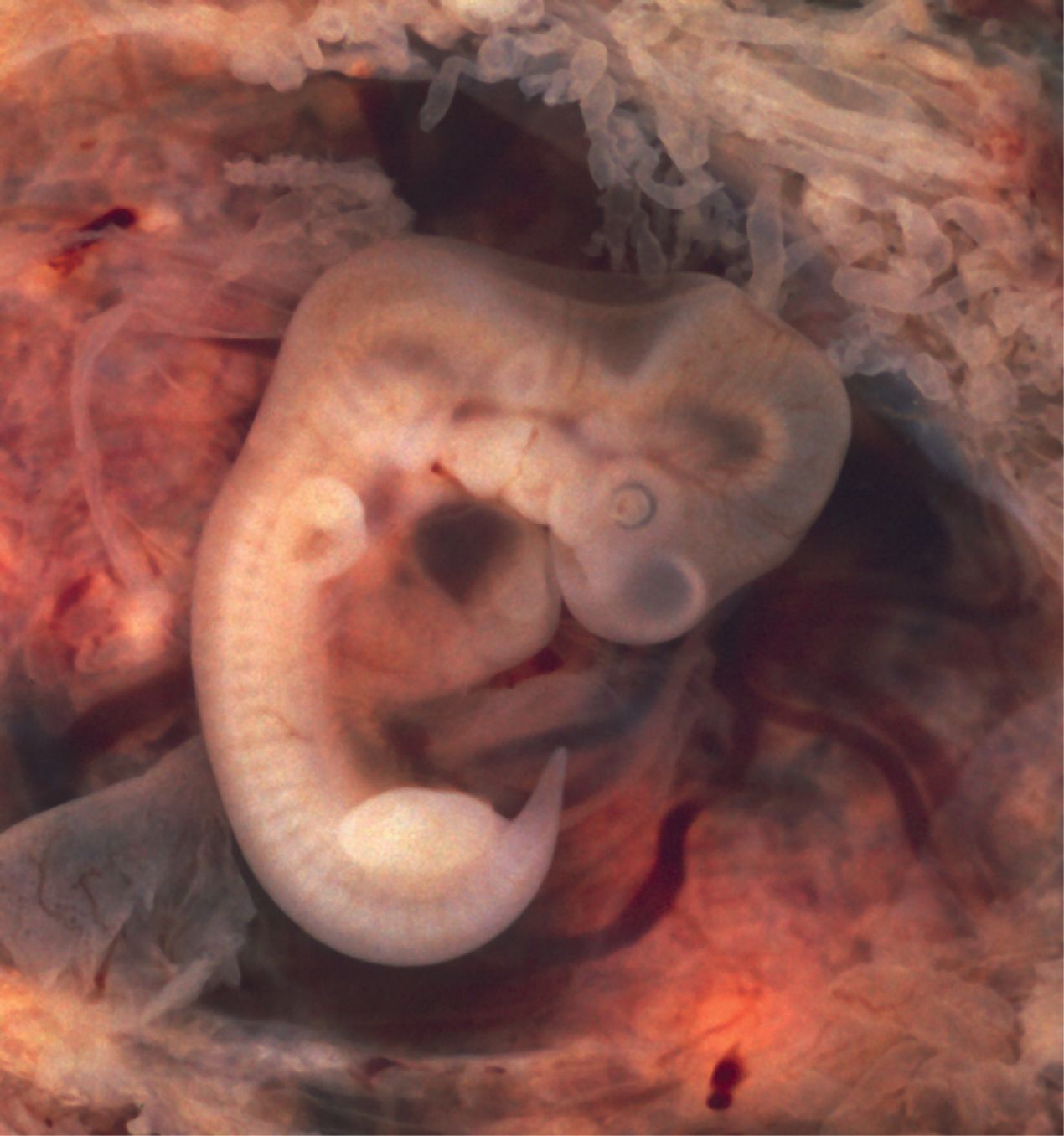
Life before birth has three named stages. The germinal stage covers about the first two weeks after conception. The fertilized egg is called a zygote. It divides again and again as it travels down the fallopian tube. Then it attaches to the wall of the uterus. This is called implantation. The embryonic stage runs from about week 3 to week 8. It is the big building phase. The heart begins to beat. The arms, legs, brain, and inner organs all start to form. The growing baby is now called an embryo. From about week 9 until birth is the fetal stage. The baby, now called a fetus, grows a great deal. Its organs mature. It becomes able to move and hear. In time it can survive outside the womb.
Teratogens and critical periods
The growing baby is protected, but not sealed off. A teratogen is anything that can cross the placenta and harm development. Examples are some drugs, viruses, alcohol, and radiation. The damage depends a lot on timing. Each organ has a critical period. That is the window when it is forming, so it is most easily hurt. The embryonic stage is the time of greatest risk, because so much is being built at once. Alcohol is the classic example. Heavy drinking during pregnancy can cause fetal alcohol spectrum disorder (FASD). FASD can include changes in the face, slow growth, and lifelong problems with learning and behavior. No safe amount of alcohol has been found. So the standard advice is to avoid alcohol completely during pregnancy.
| Prenatal stage | Timing | What happens |
|---|---|---|
| Germinal | Conception to about 2 weeks | Zygote divides and implants in the wall of the uterus |
| Embryonic | About weeks 3 to 8 | Heart beats; organs and limbs form; most easily harmed by teratogens |
| Fetal | About week 9 to birth | Fast growth; organs mature; movement, hearing, able to survive outside the womb |
What newborns can do, and how they get moving
Newborns are far from helpless. They come with a set of automatic reflexes that help them survive. A reflex is a movement the body makes on its own. In the rooting reflex, a touch on the cheek makes the baby turn its head and open its mouth. The sucking reflex comes next. In the grasping reflex, the fingers curl tightly around anything that touches the palm. In the Moro (startle) reflex, the baby flings its arms out and back in when it feels a sudden drop. Newborns also show clear likes. They turn toward their mother's voice and the smell of her milk. They look longer at face-like patterns than at scrambled ones.
How do researchers know what a baby notices? They use habituation. A baby looks at a picture less and less each time it is shown again. That drop is habituation. When something new appears, the baby looks longer again. This shows what the baby can tell apart and remember.
Motor skills then show up in a very orderly way. This is driven mostly by maturation. Maturation means the growth of the nerves and muscles that biology has planned out. Two rules describe the pattern. Growth goes cephalocaudal, which means head to toe. Babies control the head before the trunk, and the trunk before the legs. Growth also goes proximodistal, which means from the center outward. Control of the shoulders and hips comes before fine control of fingers and toes. The well-known milestones come in nearly the same order in every culture. Babies lift the head, roll over, sit, crawl, stand, and walk around the first birthday. The exact ages vary. Maturation sets the order. Experience adjusts the timing.
- Prenatal development runs germinal → embryonic → fetal. The embryonic stage builds the organs and is the most easily harmed.
- Teratogens cross the placenta. Timing matters because each organ has a critical period. Alcohol can cause FASD.
- Newborns have survival reflexes (rooting, sucking, grasping, Moro). They prefer faces and voices, which researchers measure with habituation.
- Motor development is orderly and driven by maturation: cephalocaudal (head to toe) and proximodistal (center outward).
Section 3How thinking develops

Piaget's building blocks
No one shaped our picture of the child's mind more than Jean Piaget, a psychologist from Switzerland. His main idea was simple but powerful. Children are not small adults who just know less. They think in truly different ways at different ages. They also build their own understanding, like little scientists testing the world. The building blocks are schemas. A schema is a mental framework, like a folder in the mind that sorts what we know. Children grow their schemas in two ways. In assimilation, they fit a new experience into a schema they already have. A toddler who knows "dog" may call her first cow a "doggy." In accommodation, they change a schema when it no longer fits. She learns that this four-legged animal is something new: a "cow." Mental growth is the endless back-and-forth between these two.
The four stages
Piaget said every child passes through the same four stages in the same order. In the sensorimotor stage (birth to about age 2), babies learn about the world through their senses and actions. They look, mouth, and grasp. The big achievement of this stage is object permanence. That is knowing that things still exist when you cannot see them. Before it develops, a toy hidden under a blanket is simply gone to the baby.
In the preoperational stage (about 2 to 7), children can use words and symbols. But their reasoning is still based on hunches. They show egocentrism, which means they have trouble seeing things from another person's point of view. They also lack conservation. Conservation is knowing that an amount stays the same even when its shape changes. Pour juice from a short, wide glass into a tall, thin one. A preoperational child will say there is now "more." The height fools her.
In the concrete operational stage (about 7 to 11), children master conservation. They can reason logically about real, concrete things they can see or touch. But abstract ideas and "what if" questions are still hard. Last comes the formal operational stage (about 12 through adulthood). Now the teen can think in abstract and hypothetical ways. She can reason about ideas like justice. She can test possibilities step by step. She can think about what could be, not only what is.
| Stage | Age (about) | Big achievement | Usual limit |
|---|---|---|---|
| Sensorimotor | Birth to 2 | Object permanence | Knows the world only through senses and action |
| Preoperational | 2 to 7 | Words, symbols, pretend play | Egocentrism; lacks conservation |
| Concrete operational | 7 to 11 | Conservation; logic about real things | Has trouble with abstract or "what if" ideas |
| Formal operational | 12 to adult | Abstract and hypothetical reasoning | Not everyone uses it all the time |
Beyond Piaget
Piaget's stages are still a foundation. But 50 years of research have changed the details. Newer methods measure how long babies stare at an impossible event. Piaget only checked whether they reached for a hidden toy. The staring studies show that babies grasp object permanence and simple physics earlier than he thought. He tended to underestimate young children. Development also looks smoother, with fewer hard stage lines, than he believed.
A Russian psychologist, Lev Vygotsky, worked at the same time as Piaget. He argued that thinking is mainly social. Children learn inside the zone of proximal development. This is the gap between what a child can do alone and what she can do with help. A more skilled person gives scaffolding, which is support that fits the child's level and fades as she improves. Another line of research studies theory of mind. That is the understanding that other people have beliefs and wishes that differ from your own. It usually clicks into place around age four or five.
- Piaget: children build knowledge actively using schemas, assimilation, and accommodation.
- The four stages are sensorimotor (object permanence), preoperational (egocentrism, no conservation), concrete operational (conservation, logic about real things), and formal operational (abstract reasoning).
- Later research shows Piaget underestimated young children. Vygotsky stressed the social zone of proximal development and scaffolding.
Section 4How we form bonds
Attachment: the first bond
The strong emotional tie between a baby and a caregiver is called attachment. Learning where it comes from overturned an old belief. Behaviorists once thought babies love whoever feeds them. In that view, attachment was really about food. Harry Harlow's famous experiments with baby monkeys proved this wrong. The monkeys had two fake "mothers." One was bare wire and gave milk. The other was soft cloth and gave no food. The baby monkeys clung to the cloth mother. When scared, they ran to it for comfort. What mattered was contact comfort, not food. (These studies caused the monkeys real distress. Today they are often used to discuss the ethics of animal research.)
A British psychiatrist, John Bowlby, built this into a wider theory. He said attachment is a system that evolved to keep a helpless baby close to a protector. The caregiver becomes a secure base. The baby can explore from there and come back when needed.
Ainsworth and the Strange Situation
Mary Ainsworth worked with Bowlby. She created a way to measure attachment called the Strange Situation. In this lab test, a one-year-old is watched as the caregiver leaves and comes back a few times, with a stranger in the room. How the baby acts, especially at the reunion, shows the quality of the bond. Ainsworth described secure attachment. The securely attached baby explores freely and uses the caregiver as a base. She is upset when the caregiver leaves and is easily comforted on return. Ainsworth also described two insecure patterns. In the avoidant pattern, the baby seems not to care and avoids the caregiver at reunion. In the anxious/resistant pattern, the baby is very upset and hard to calm. She clings and pushes away at the same time.
Later, researchers Mary Main and Judith Solomon added a fourth pattern, called disorganized. These babies show confused, mixed-up behavior. Two things shape attachment security. One is how responsive the caregiver is. The other is the baby's own temperament. Temperament is a baby's inborn emotional style. Alexander Thomas and Stella Chess sorted babies into three types: easy, difficult, and slow-to-warm-up.
| Attachment style | Behavior at reunion | Uses caregiver as secure base? |
|---|---|---|
| Secure | Upset when caregiver leaves; comforted and calm at reunion | Yes |
| Avoidant | Little distress; avoids or ignores caregiver | No |
| Anxious / resistant | Very upset; clings but pushes away comfort | Mixed |
| Disorganized | Confused, mixed-up behavior; no clear plan | No clear plan |
Erikson's eight ages of life
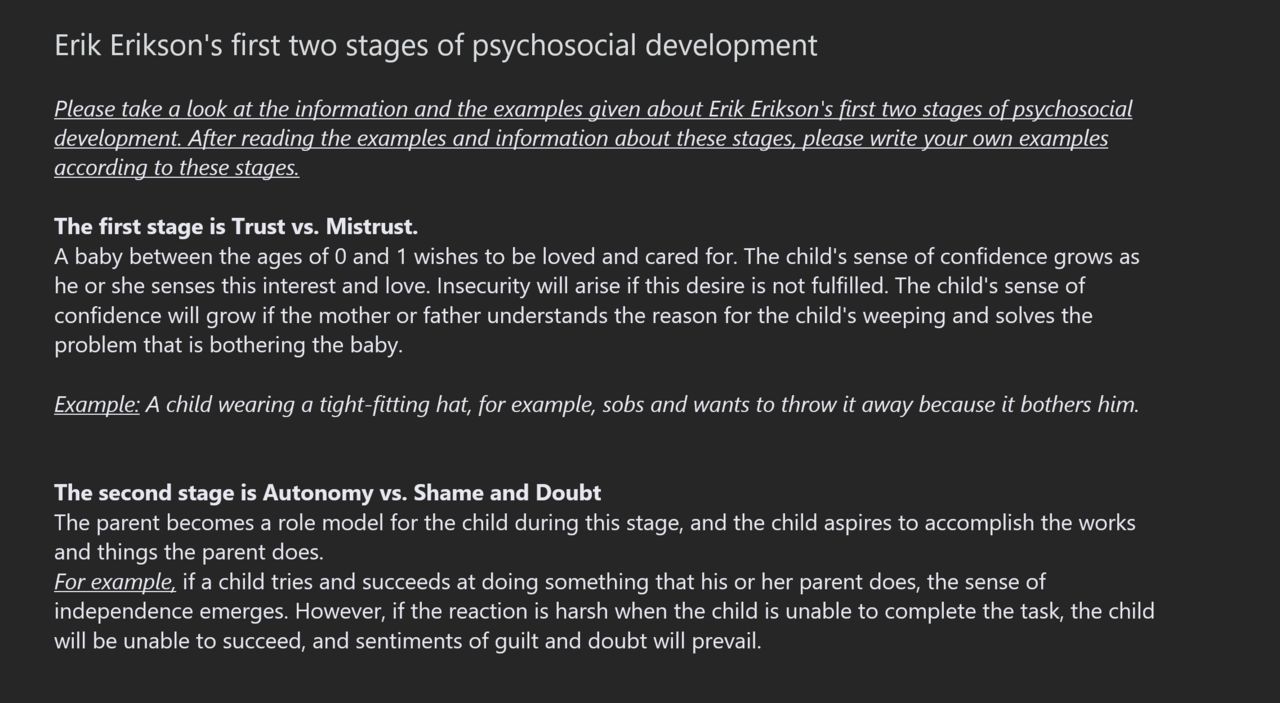
Attachment describes the first bond. Erik Erikson mapped social growth across the whole lifespan. He proposed eight psychosocial stages. Each stage centers on a crisis. Here a crisis means a tension between two paths that the person must work out.
In infancy the crisis is trust vs mistrust. It depends mostly on whether caregivers can be counted on. Toddlers face autonomy vs shame and doubt. Preschoolers face initiative vs guilt. School-age children face industry vs inferiority. Adolescence brings the key crisis of identity vs role confusion. Young adults face intimacy vs isolation. Middle adults face generativity vs stagnation, which is about giving to the next generation. Older adults face integrity vs despair. That last task is to look back on life with peace instead of regret. Erikson's great gift was showing that development does not stop in the teen years. It goes on to the very last chapter of life.
- Harlow showed attachment rests on contact comfort, not food. Bowlby described it as an evolved secure-base system.
- Ainsworth's Strange Situation shows secure, avoidant, anxious/resistant, and disorganized attachment. Caregiver responsiveness and the baby's temperament both play a part.
- Erikson's eight psychosocial stages cover the whole lifespan. Each is a crisis, from trust vs mistrust to integrity vs despair.
Section 5Adolescence through late adulthood
Adolescence: body and identity
Adolescence starts with puberty. Puberty is a rush of hormones that turns a child's body into an adult body that can reproduce. The primary sex characteristics, which are the reproductive organs, grow and mature. The secondary sex characteristics appear. These include breasts, facial hair, a deeper voice, and body hair. Puberty also has landmark events. Menarche is the first menstrual period. Spermarche is the first ejaculation. The teen brain is also being remodeled. The limbic system, which drives emotion, matures earlier. The prefrontal cortex, which handles judgment and self-control, matures later. This gap helps explain why teens take more risks.
The main mental task of adolescence is figuring out who you are. Erikson called this identity vs role confusion. James Marcia made the idea sharper. He described four identity statuses. They depend on two things: has the young person explored options, and has she made a commitment? In diffusion, there is no exploring and no commitment. In foreclosure, there is commitment without exploring. This often means just taking on a parent's plan. In moratorium, the person is actively exploring but has not yet committed. In achievement, the person commits after real exploring. Identity is not a switch that flips once. People come back to it all through life.
Adulthood
Adulthood is the longest part of the lifespan, and the hardest to split into neat stages. Many psychologists now describe emerging adulthood. This is the late teens and twenties. In many wealthy, industrial societies, it is a time of long exploring before taking on full adult roles. In the body, most abilities peak in the twenties and then slowly decline. Menopause, the end of menstrual periods, comes around age 50.
For thinking, it helps to know two kinds of intelligence. Fluid intelligence is quick thinking and solving new problems. It tends to decline with age. Crystallized intelligence is the store of knowledge and words you build up. It tends to hold steady or even grow. Erikson placed the main adult tasks here. Early adulthood is about intimacy, which means forming close, committed relationships. Midlife is about generativity, which means mentoring, parenting, and giving back.
Aging and the end of life
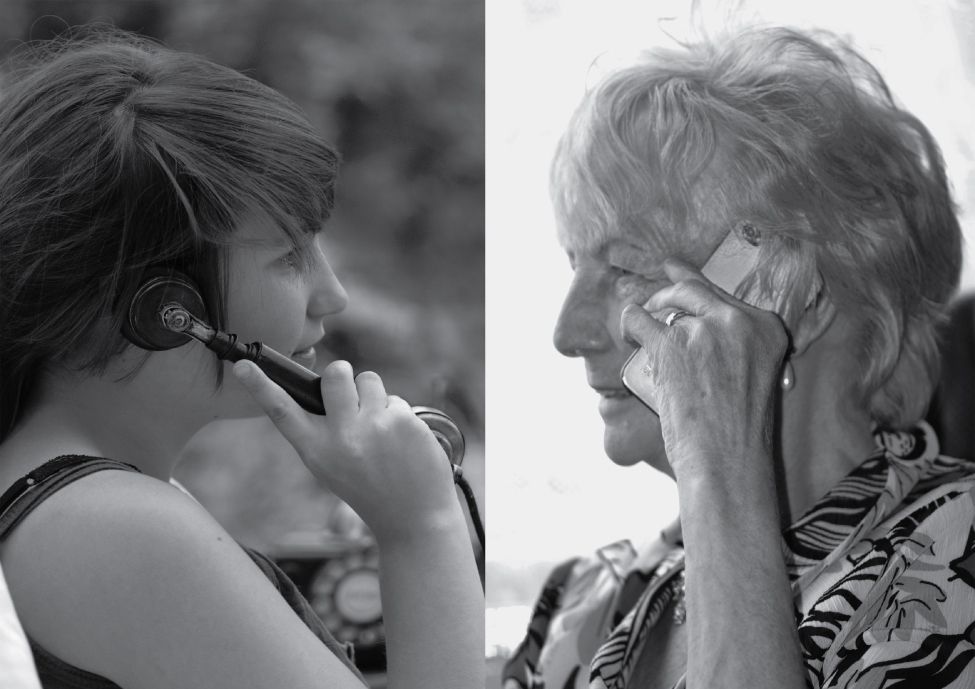
Late adulthood is much more hopeful than the stereotypes suggest. Yes, thinking speed slows and some kinds of memory weaken. But many older adults keep or even gain wisdom, skill, and control over their emotions. Socioemotional selectivity theory offers one reason. As people sense that their time is growing short, they focus on the relationships and experiences that mean the most. This helps explain why older adults often report greater well-being than young adults.
The psychiatrist Elisabeth Kübler-Ross studied people facing death. She described five reactions she saw in dying patients: denial, anger, bargaining, depression, and acceptance. Her work broke a taboo and gave people words for grief. But it is often misread. People do not move through the five in a fixed order. They may skip some, repeat some, or feel other things entirely. Later research on grief agrees. Kübler-Ross herself later stressed that the stages are not a neat line. They describe common feelings. They are not a schedule everyone must keep.
| Kübler-Ross reaction | What it looks like |
|---|---|
| Denial | "This can't be happening": refusing to accept what is real |
| Anger | "Why me?": resentment and frustration |
| Bargaining | "If I just…": trying to make a deal to escape |
| Depression | Sadness and pulling away as the loss sinks in |
| Acceptance | Coming to terms with what is real, with some calm |
- Puberty brings primary and secondary sex characteristics, menarche and spermarche, and a brain still building self-control.
- Adolescence centers on identity (Erikson; Marcia's four statuses). Adulthood centers on intimacy and then generativity.
- Fluid intelligence declines with age, while crystallized intelligence holds. Older adults often report high well-being.
- Kübler-Ross's five reactions to dying describe common feelings, not a fixed order.
The chapter in one breath
- Development comes from nature and nurture working together. The field asks if change is smooth or in stages, and if early traits last.
- Cross-sectional designs are fast but can be fooled by cohort effects. Longitudinal designs isolate aging but face attrition.
- Prenatal life runs germinal → embryonic → fetal. Teratogens do the most harm during an organ's critical period.
- Newborns come with survival reflexes and clear likes. Motor skills unfold cephalocaudally and proximodistally through maturation.
- Piaget's four stages trace thinking from object permanence to abstract reasoning. Vygotsky added the social side.
- Attachment (Harlow, Bowlby, Ainsworth) rests on contact comfort and a secure base. Erikson's eight psychosocial stages cover the whole life.
- Adolescence brings puberty and the search for identity. Adulthood and aging keep crystallized intelligence and often well-being. Kübler-Ross described dying without setting a fixed order.
ReferenceWords worth knowing
Here is a quick list of the terms in this chapter. Skim it now, or come back any time a word trips you up.
- Accommodation
- Changing a schema you already have so it fits new information (Piaget).
- Assimilation
- Fitting a new experience into a schema you already have (Piaget).
- Attachment
- The strong, lasting emotional bond between a baby and a caregiver.
- Cephalocaudal
- The head-to-toe order of motor growth. Head control comes before the trunk, and the trunk before the legs.
- Conservation
- Knowing that an amount stays the same even when its shape or layout changes.
- Critical (sensitive) period
- A window when a body system is forming and is most easily shaped or harmed.
- Cross-sectional study
- A study that compares people of different ages at one point in time.
- Egocentrism
- A preoperational child's trouble seeing things from another person's point of view.
- Fetal alcohol spectrum disorder (FASD)
- Physical, learning, and behavior problems caused by alcohol before birth.
- Formal operational stage
- Piaget's last stage (about age 12 and up), marked by abstract and "what if" reasoning.
- Identity
- A clear, steady sense of who you are. Forming it is the main task of adolescence (Erikson).
- Longitudinal study
- A study that follows the same people again and again over a long time.
- Maturation
- Growth that biology has planned out, which unfolds mostly on its own schedule.
- Menarche
- A girl's first menstrual period, a landmark of puberty.
- Object permanence
- Knowing that things still exist when out of sight. It forms in the sensorimotor stage.
- Psychosocial stage
- One of Erikson's eight life stages. Each is built around a central social crisis.
- Schema
- A mental framework that sorts and makes sense of information (Piaget).
- Secure attachment
- A bond in which the baby uses the caregiver as a safe base and is comforted at reunion.
- Sensorimotor stage
- Piaget's first stage (birth to 2), when babies learn through their senses and actions.
- Strange Situation
- Ainsworth's lab test for sorting a baby's attachment style.
- Teratogen
- Anything (a drug, virus, alcohol, radiation) that can cross the placenta and harm a baby before birth.
- Zone of proximal development
- Vygotsky's term for the gap between what a child can do alone and what she can do with skilled help.