Psychological Research
How do we know what we think we know about the mind? Not from gut feeling. Not from tradition. Not from the loudest, most confident person in the room. Those sources have a poor track record. Psychology earns the word science because it tests its ideas against evidence. It gathers that evidence with methods built to catch our own mistakes. This chapter shows how psychologists ask questions that can be answered. It shows how they describe behavior and how they measure links between things. It shows how they run experiments that can truly reveal a cause. It also explains the rules that protect the people, and the animals, who make that knowledge possible.
By the end of this chapter you can
- Explain why psychology relies on the scientific method, and describe the scientific attitude.
- Tell a theory from a hypothesis, and explain why claims must be falsifiable.
- Define an operational definition, and explain why replication matters.
- Compare the three descriptive methods: case study, naturalistic observation, and survey. Give a strength and a limit of each.
- Read a correlation coefficient and a scatterplot. Explain why correlation does not prove causation.
- Pick out the independent and dependent variables, the control and experimental groups, random assignment, and the job of a placebo.
- Sum up the ethics rules for research: informed consent, the IRB, deception and debriefing, and humane animal care.
Section 1The scientific method
Why psychology needs a method
Everyone is an amateur psychologist. We explain why a friend snapped. We guess how a crowd will act. We feel sure we understand ourselves. The trouble is that this everyday confidence is wrong often enough to be risky.
Take hindsight bias, the “I knew it all along” feeling. It makes any outcome seem obvious after it happens. So common sense can “explain” a result and its opposite equally well. We also notice evidence that fits our beliefs and miss the rest. Human judgment makes these mistakes in steady, predictable ways. That is exactly why the scientific method exists. It is a set of habits for asking questions so that the world, not our wishes, decides the answer.
At the heart of the method is the scientific attitude. It blends three things. The first is curiosity, a real wish to find out. The second is skepticism, which means not accepting a claim until the evidence is in. The third is humility, a willingness to be shown wrong. Psychology became its own science in 1879. That year Wilhelm Wundt opened the first psychology laboratory, in Leipzig. He began measuring mental processes instead of just guessing about them. That shift, from armchair opinion to controlled observation, is what this whole chapter is about.
Theory versus hypothesis
People swap these two words in everyday talk. In science they mean very different things. A theory is an explanation that ties many observations together and predicts new ones. It is a big idea that is well supported by evidence. A hypothesis is a specific prediction that can be tested. A theory, or even a hunch, can produce one. It is a single claim you can go out and check.
Here is an example. A theory of stress might lead to this hypothesis: “Students who sleep fewer than six hours before an exam will score lower than students who sleep eight.” The hypothesis is what you test. The theory is what the pile of results supports or weakens over time.
A scientific claim must be falsifiable. That means it is stated clearly enough that some possible result could prove it wrong. Think about this claim: “People act the way they do because of hidden forces we can never observe.” It explains everything, so it predicts nothing. No result could ever count against it. So it is not scientific. A good hypothesis takes a risk. It says ahead of time what result would count as failure.
| Theory | Hypothesis | |
|---|---|---|
| What it is | A broad explanation that ties many findings together | One specific prediction that can be tested |
| Scope | Wide: covers many situations | Narrow: one situation, one prediction |
| Example | Sleep helps lock in memories | Students who sleep 8 hours recall more word pairs than students who sleep 4 hours |
| Tested by | The weight of many studies over time | One well-designed study |
Operational definitions and replication
Say you want to test “sleep improves memory.” First you must say exactly what you mean by sleep and by memory. An operational definition states a variable in terms of the exact steps used to measure it or change it. A variable is anything that can vary, or change, from person to person. Here, “sleep” might become “hours of sleep written in a sleep diary.” “Memory” might become “the number of word pairs recalled correctly after 24 hours.”
Operational definitions do two jobs at once. They force you to be concrete. And they let anyone else run your exact study. That is the point of replication, which means repeating a study to see if the finding holds. The best replications use new people and new settings. A result that shows up once may be a fluke. A result that shows up again and again is one you can start to trust.
In the 2010s, large teams tried to repeat many well-known psychology studies. Many of the findings did not hold up, or turned out much weaker than first reported. This became known as the “replication crisis.” The field answered by tightening its methods. Many researchers now publish their plans before they collect data, use larger samples, and share their data. That is the scientific attitude at work, correcting its own mistakes.
- The scientific method exists because gut feeling is unreliable. Hindsight bias is one reason why.
- The scientific attitude is curiosity plus skepticism plus humility.
- A theory is a broad explanation. A hypothesis is one testable prediction. Both must be falsifiable.
- Operational definitions make each variable measurable and repeatable. That makes replication possible.
Section 2Descriptive research
When you want to describe, not explain
Sometimes the goal is not to find a cause. The goal is just to describe what people are like or what they do. Descriptive research paints an accurate picture of behavior. It comes in three main forms: the case study, naturalistic observation, and the survey. None of them can tell you why a behavior happens. But each one captures something that neater methods miss.
Case studies and naturalistic observation
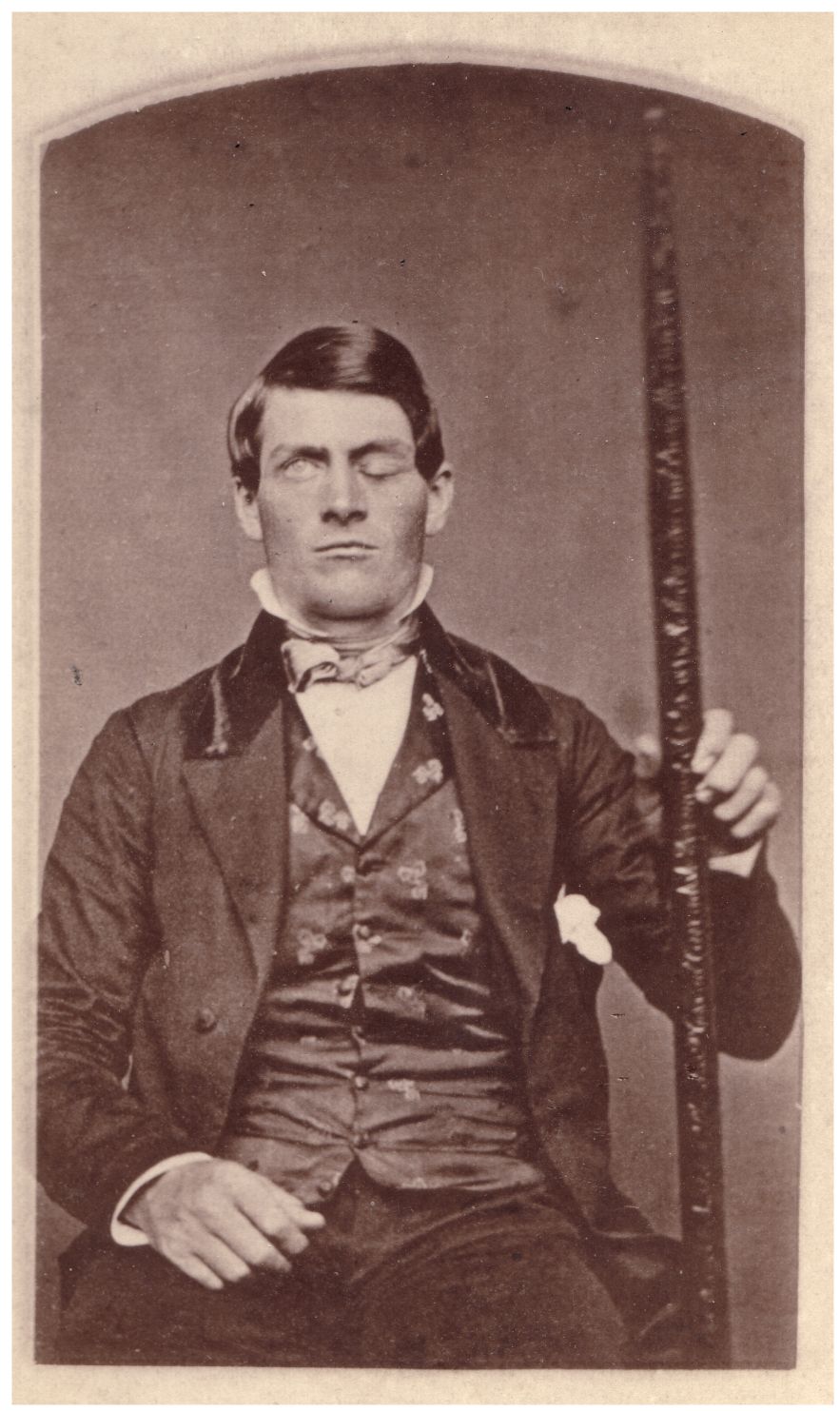
A case study looks at one person, or a small group, in great depth. The classic example is Phineas Gage. He was a railroad foreman. In 1848, a three-foot iron rod blasted through his frontal lobe, the front part of his brain. He survived. Afterward, people who knew him said he became rude and reckless. His case gave an early, vivid clue that the frontal lobes help control judgment and self-control. Later historians found that many retold versions of his story were exaggerated. In fact, Gage recovered enough to work for years as a stagecoach driver in Chile. That twist itself teaches a lesson about case studies.
Case studies are very valuable for rare conditions. They are also good for sparking new hypotheses. But they carry a built-in danger. One person may be unusual. What is true of them may not generalize, or apply, to anyone else.
Naturalistic observation means watching behavior as it happens in its real setting, without stepping in. A researcher might watch children on a playground, drivers at a crossing, or shoppers in a store. Its strength is realism. You see what people really do, not what they say they would do. Its limit is that you cannot control anything. Two separate problems can also bend what you find.
The first problem is reactivity, also called the observer effect. People who know they are being watched act differently. That is why researchers try to stay out of sight. You may hear this called the Hawthorne effect. The name comes from old studies at the Hawthorne factory, where workers were said to work harder just because they were being studied. Later re-checks of the original lighting data found little support for that story. Those studies also changed working conditions and attention, not just watching. The second problem is observer bias. Here the researcher's own expectations shape what gets noticed and written down. To guard against it, researchers define the behaviors ahead of time. They also have the scoring done by coders who do not know the hypothesis.
Surveys and sampling
A survey asks many people the same questions. It gathers a lot of data quickly and cheaply. It is the only practical way to study attitudes, habits, or opinions across a large group. But a survey is only as good as its sample.
The whole group you care about is the population. The smaller group you actually question is the sample. For the sample to speak for the population, you need a random sample. In a random sample, every member of the population has an equal chance of being picked. Skip that step and you get bias. A poll of only your friends will mislead you. So will a poll of only the people who chose to answer.
Surveys have other weak spots. The wording of a question can change the answers. And people may shade their answers to look good. That is called social desirability bias.
| Method | What it does | Strength | Main limit |
|---|---|---|---|
| Case study | Studies one person or group in depth | Rich detail; great for rare cases and new hypotheses | May not generalize; one unusual case |
| Naturalistic observation | Watches behavior in its real setting | Very realistic; behavior is genuine | No control; being watched can change behavior |
| Survey | Asks many people the same questions | Large samples, fast and cheap | Sampling and wording bias; people may shade answers |
Why does a random sample matter so much? Draw samples yourself below. Compare a random sample with a convenience sample, and watch how far each guess lands from the truth.
- Descriptive research describes behavior. It cannot show a cause.
- A case study gives depth on one person, such as Phineas Gage, but may not generalize.
- Naturalistic observation is realistic but has no control. Watch for reactivity, when people change because they are watched. Watch for observer bias, when the researcher's hopes bend the scoring.
- A survey needs a random sample of the population to avoid bias.
Section 3Correlation
The correlation coefficient
Often we cannot control the thing we want to study. We cannot randomly make people rich, or lonely, or left-handed. But we can still measure whether two things move together. Correlation measures how strong and in what direction two variables are linked. It is summed up by one number, the correlation coefficient. It is written r, and it runs from −1.0 to +1.0.
The sign tells you the direction. A positive correlation means the two rise and fall together. More study hours go with higher grades. A negative correlation means one rises as the other falls. More absences go with lower grades. The size of the number tells you the strength. That means how close it is to 1, in either direction. An r of +0.85 is a strong link. An r near 0 means the two are basically unrelated. Here is the key point: −0.70 is a stronger link than +0.30. Strength is the distance from zero, not the sign.
Reading a scatterplot
A scatterplot shows the raw link as a cloud of dots. Each dot is one person. One variable goes on each axis. If the dots slope upward from left to right, the correlation is positive. If they slope downward, it is negative. The more tightly the dots hug a straight line, the stronger the correlation. Then r is close to ±1. A shapeless blob of dots means no link at all.
Always look at the scatterplot before you trust the number. Here is why. The value of r only measures straight-line links. A strong curved pattern, such as an upside-down U, can give an r near zero.
Why correlation is not causation
Here is the most important idea in this chapter: a correlation, no matter how strong, cannot prove that one variable causes the other. When two things travel together, three explanations stay open. First, A might cause B. Second, B might cause A. That is the directionality problem. Third, and most often missed, a hidden third variable might cause both. A third variable that muddies a result is also called a confound.
Ice-cream sales and drowning deaths are strongly correlated. But ice cream does not drown anyone. Hot summer weather raises both, each on its own. Self-esteem goes with success. But which causes which? Or does a supportive home life boost both? Whenever a headline dresses up a correlation as a cause, ask two questions. Could it run the other way? Could a third variable be pulling the strings?
| Coefficient | Direction | Meaning | Everyday example |
|---|---|---|---|
| r = +0.90 | Positive, strong | Rise together, tightly | Height and arm span |
| r = +0.30 | Positive, weak | Loosely rise together | Study time and final grade |
| r = 0.00 | None | No straight-line link | Shoe size and IQ |
| r = −0.80 | Negative, strong | One goes up, the other goes down | Class absences and grade |
- The correlation coefficient (r) runs from −1 to +1. The sign gives the direction. The distance from 0 gives the strength.
- A scatterplot shows the link as dots. Tighter dots mean a stronger correlation.
- Correlation does not prove causation. Watch for a reversed direction and for a third variable (a confound).
- Only an experiment can show a cause.
Section 4The experiment
Independent and dependent variables
The experiment is the only method that can reveal cause and effect. Here is why. The researcher actively changes one thing and holds everything else steady. Then the researcher watches what changes as a result.
The factor the researcher changes on purpose is the independent variable (IV). It is the possible cause. The behavior that is then measured is the dependent variable (DV). It is the possible effect. It gets its name because it may depend on the IV. Say you want to test whether caffeine speeds up reaction time. The caffeine dose is the IV. You set it. Reaction time is the DV. You record it. Here is a quick way to keep them straight: you change the independent variable, and you measure the dependent variable.
Control and experimental groups, random assignment
An experiment needs a comparison. The experimental group gets the treatment, such as the caffeine. The control group is treated the same in every way, except that it does not get the treatment. Then any difference in the DV between the groups can be traced to the IV. But that only works if the two groups were alike to begin with.
That is the job of random assignment. It means sorting people into groups purely by chance, such as by a coin flip or a list of random numbers. Then differences between people, such as age, drive, or how well they slept, spread out evenly across both groups. They do not pile up in one group. Random assignment is what sets a true experiment apart from every descriptive or correlational method. It is exactly why an experiment can support a claim about cause and a correlation cannot.
Do not mix this up with random sampling, from the survey section. Sampling is about who gets into the study. Assignment is about which group they land in.
Placebos, blinding, and confounds
People often feel better just because they believe they are being treated. This is the placebo effect. To separate a drug's real action from that belief, the control group gets a placebo. A placebo is a fake look-alike with no active ingredient, such as a sugar pill. If the experimental group improves more than the placebo group, that extra improvement is the treatment's true effect.
Expectations can also leak in from the researcher. So the strongest designs are double-blind. In a double-blind study, neither the participant nor the person collecting the data knows who got the real treatment. They find out only when the study ends. All of these steps guard against confounding variables. A confounding variable is any factor besides the IV that differs between the groups. It offers another possible explanation for the results.
| Part | What it is | Caffeine example |
|---|---|---|
| Independent variable | The factor the researcher changes (cause) | Caffeine or no caffeine |
| Dependent variable | The behavior measured (effect) | Reaction time in milliseconds |
| Experimental group | Gets the treatment | Drinks coffee with caffeine |
| Control group | Gets no treatment, or a placebo | Drinks decaf that looks the same |
| Random assignment | Chance sorts people into groups | A coin flip decides each person's group |
- An experiment changes the independent variable and measures the dependent variable. It is the only way to show a cause.
- The experimental group gets the treatment. The control group does not, or it gets a placebo.
- Random assignment makes the groups alike at the start. That rules out differences that were there before.
- Placebo controls and double-blind designs guard against expectations and confounds.
Section 5Research ethics
Protecting human participants
Research studies people, so it can harm them. History holds ugly proof. Nazi doctors ran cruel experiments on prisoners, and the trials that followed produced the Nuremberg Code. In the United States, the Public Health Service ran the Tuskegee study from 1932 to 1972. It deceived Black men who had syphilis and kept treatment from them for decades, even after penicillin became the standard cure.
Out of that history came a firm set of ethics rules. In the U.S., they rest on the Belmont Report (1979). It names three principles: respect for persons, beneficence, and justice. Beneficence means doing good and avoiding harm. Justice means sharing the risks and benefits of research fairly.
The cornerstone is informed consent. Before taking part, people must learn enough about the study's steps and risks to make a free, informed choice. They may quit at any time with no penalty. Some people cannot legally consent, such as children. Then a parent or guardian gives permission, and the child also agrees in a way that fits their age. That agreement is called assent. Whatever is learned, each person's data must be kept confidential, or private.
The IRB, deception, and debriefing
No researcher gets to be the only judge of their own study's ethics. Before a study can start, an Institutional Review Board (IRB) must approve it. An IRB is a committee that reviews the plan. It weighs the risks against the likely benefits. It can require changes, or it can refuse outright.
Some studies need mild deception. Telling people the true purpose would spoil the very behavior being measured. Solomon Asch could not have studied conformity if everyone knew his “other participants” were actors. Deception is allowed only under three conditions. The knowledge gained must justify it. No less deceptive method would work. And it must cause no lasting harm.
Whenever deception is used, people get a debriefing at the end. Ideally, they get one after any study. A debriefing explains the study's real purpose and the reason for any deception. It also gives a chance to ask questions. The Milgram obedience experiments, which people still debate today, are a big reason the field takes debriefing so seriously.
The care of animal subjects
Some questions cannot be studied in people without causing harm. About seven percent of psychological research uses animals. That work gave us basic knowledge about learning, the brain, and stress. Animal research comes with its own strict duties. A study must be justified. It must use the fewest animals needed. And it must keep pain and distress as low as possible. These duties are often called the “three Rs”: replace, reduce, refine.
In the United States, a separate committee reviews and oversees animal studies. It is called the Institutional Animal Care and Use Committee (IACUC). Federal law also sets standards for housing and humane treatment. The bottom line is the same for all research, human or animal. The knowledge sought must be weighed honestly against the cost to those who are studied.
| Safeguard | What it requires | Why it exists |
|---|---|---|
| Informed consent | People freely agree after learning the risks and steps | Respect for persons; freedom to choose |
| IRB review | An outside board approves the study first | Weighs risk against benefit; no one polices only themselves |
| Deception limits | Used only when needed and harmless | Some behaviors change if the purpose is known |
| Debriefing | A full explanation is given afterward | Corrects any deception; restores understanding |
| Confidentiality | Personal data is kept private | Protects people from exposure |
| Animal care (IACUC, 3 Rs) | Justify the study, use fewer animals, reduce suffering | Humane treatment of animal subjects |
- Informed consent lets people agree freely after they learn the risks. They can quit at any time.
- An IRB must approve research with people before it starts. It weighs risks against benefits.
- Deception is allowed only when needed and harmless. It must always be followed by a debriefing.
- Animal research follows humane standards: the three Rs and IACUC oversight.
The chapter in one breath
- Psychology uses the scientific method because gut feeling is unreliable. Hindsight bias bends it. The scientific attitude is curiosity, skepticism, and humility.
- A theory is a broad explanation. A hypothesis is a specific, falsifiable prediction. It is written in operational definitions so it can be replicated.
- Descriptive research includes the case study, naturalistic observation, and the survey. It describes behavior but cannot show a cause. Surveys need a random sample.
- Correlation (r, from −1 to +1) shows how two variables move together on a scatterplot. But correlation does not prove causation.
- The experiment changes an independent variable and measures a dependent variable. It compares an experimental group with a control group.
- Random assignment, a placebo control, and double-blind designs make the experiment the only method that can reveal a cause.
- Ethical research needs informed consent, IRB approval, limited deception with debriefing, privacy, and humane animal care.
ReferenceWords worth knowing
A quick guide to the terms in this chapter. Skim it now, or come back whenever a word trips you up.
- Case study
- A deep look at one person or a small group. It is rich in detail but hard to generalize.
- Confounding variable
- A factor other than the independent variable that differs between groups. It offers another possible explanation for the results.
- Control group
- The people in an experiment who do not get the treatment, or who get a placebo. They serve as the comparison.
- Correlation
- A measure of how strongly, and in what direction, two variables are linked.
- Correlation coefficient (r)
- A number from −1.0 to +1.0 that sums up a correlation. The sign gives the direction. The distance from zero gives the strength.
- Debriefing
- The explanation given to people after a study. It tells them the true purpose and the reason for any deception.
- Dependent variable
- The behavior measured in an experiment. It is the possible effect.
- Experiment
- A method that changes an independent variable and controls other factors to show cause and effect.
- Falsifiable
- Stated clearly enough that some possible result could prove it wrong. Scientific claims must be falsifiable.
- Hypothesis
- A specific prediction that can be tested. It often comes from a theory.
- Independent variable
- The factor the researcher changes on purpose. It is the possible cause.
- Informed consent
- A person's free agreement to take part after learning the study's steps and risks.
- Institutional Review Board (IRB)
- A committee that reviews research with people. It must approve a study before it starts.
- Naturalistic observation
- Watching and recording behavior in its natural setting without stepping in.
- Observer bias
- Errors in what a researcher notices or records, caused by the researcher's own expectations.
- Operational definition
- A statement of a variable in terms of the exact steps used to measure it or change it.
- Placebo
- A fake treatment with no active ingredient, given to a control group. It separates real effects from expectation.
- Random assignment
- Sorting people into experimental and control groups by chance, so the groups start out alike.
- Random sample
- A sample in which every member of the population has an equal chance of being picked.
- Reactivity (observer effect)
- A change in people's behavior caused by knowing they are being watched.
- Replication
- Repeating a study to see if its findings hold, ideally with new people and new settings.
- Scientific method
- The self-correcting process of testing ideas against evidence, to cut down the errors of gut feeling.
- Survey
- A descriptive method that gathers data by asking many people the same questions.
- Theory
- A broad explanation that ties many observations together and produces hypotheses we can test.