Cardiovascular Drugs I
Blood has one job that is nearly impossible. It must stay liquid everywhere, yet turn solid in exactly one place, at exactly the right moment. The drugs in this chapter live on both sides of that line. Some thin the blood. Some help it clot. Some rebuild it. Some quietly lower the pressure that wears down a person's arteries year after year. Almost every one of them is a high-alert drug. An error does not cause a rash. It causes a bleed or a stroke. This chapter covers the clotting cascade and the anticoagulants and antiplatelets that block it. It covers the antidotes that reverse them and the drugs that rebuild blood. It also covers the blood pressure drugs. You will hang, adjust, hold, and teach these more than any other class in your career.
By the end of this chapter you can
- Describe hemostasis (vessel narrowing, the platelet plug, and the clotting cascade) and find where each anticoagulant acts.
- Compare heparin, low-molecular-weight heparin, warfarin, and the DOACs by how they work, the test that checks them, and their antidote.
- Explain how aspirin and clopidogrel differ from anticoagulants, and why dual antiplatelet therapy must not be stopped casually.
- Give the care priorities for alteplase, including time windows, reasons not to give it, and watching for bleeding.
- Describe erythropoiesis-stimulating agents, filgrastim, and the main blood products, with their key warnings and transfusion safety steps.
- Explain how cardiac output, systemic vascular resistance, baroreceptors, and the RAAS set blood pressure.
- Name the prototype, main effect, and key side effect of each main blood pressure drug class.
- Check for orthostatic hypotension and build a real adherence plan with a patient who feels perfectly fine.
Section 1Hemostasis and anticoagulants
How the body builds a clot
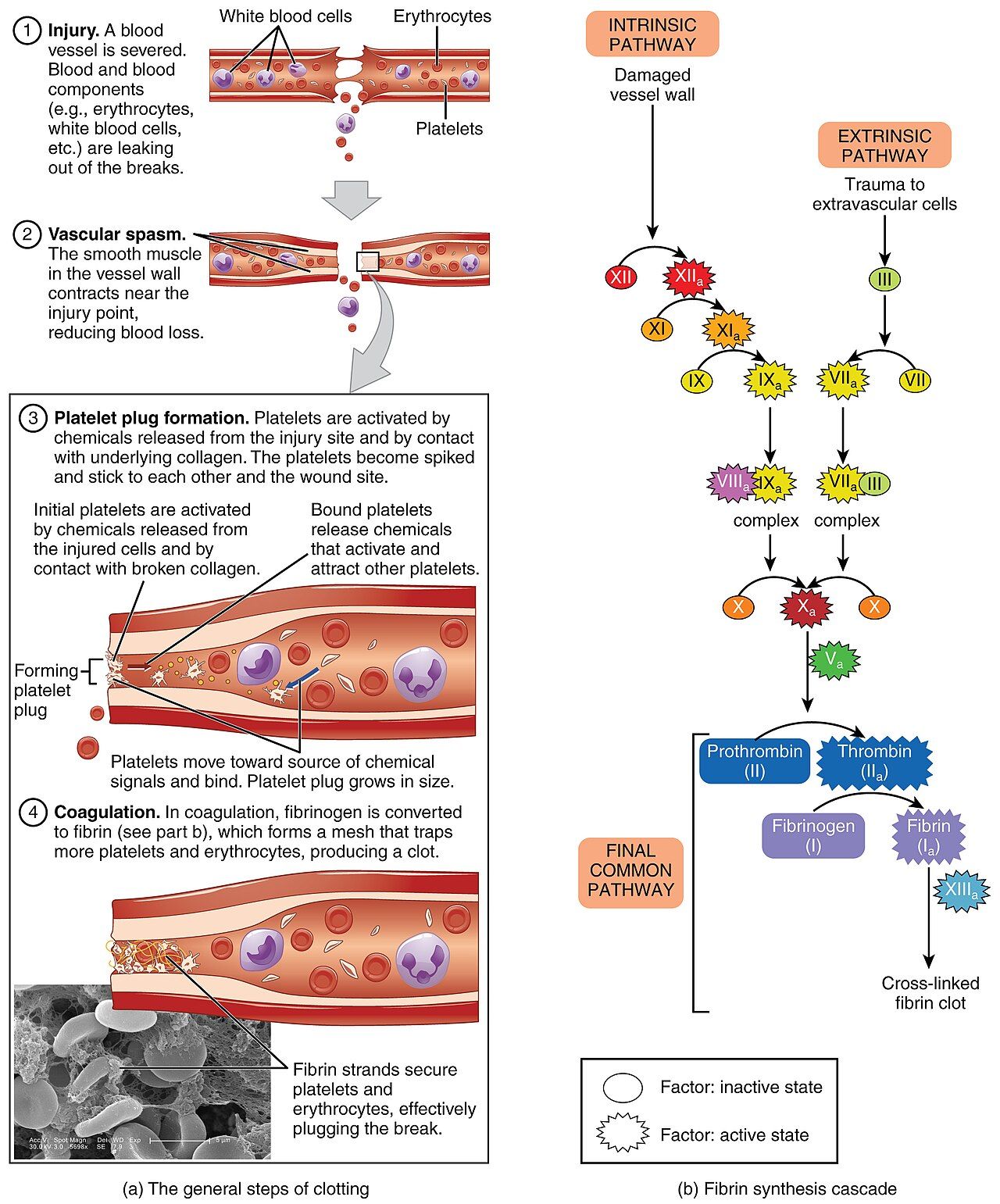
Cut a vessel, and three things happen in order. First, the vessel wall clamps down. This is vasoconstriction, and it narrows the hole. Second, platelets stick to the exposed collagen. They switch on, change shape, and glue themselves to one another. This makes a soft, short-term platelet plug. That plug will stop a paper cut, but it is fragile. A cough or a spike in blood pressure can blow it off. So third, the body reinforces it with the coagulation cascade. This is a chain of blood proteins. It ends by weaving a mesh of fibrin through the platelet plug and locking it in place.
The cascade has two on-ramps and one shared exit. The extrinsic pathway is the fast one. Damaged tissue releases tissue factor, which switches on factor VII. The intrinsic pathway is the slower one. It starts when blood touches a damaged surface inside the vessel. Both feed into the common pathway. There, factor X becomes factor Xa. Xa turns prothrombin (factor II) into thrombin. Thrombin turns fibrinogen into fibrin. Thrombin is the engine of the whole system. Factor Xa is the gate just before it. That is exactly why so many drugs aim at those two proteins.
Two lab tests match those two on-ramps, and you will read them for the rest of your career. PT/INR follows the extrinsic and common pathways. It is the warfarin test. aPTT follows the intrinsic and common pathways. It is the heparin test. Here is a memory hook that works. PeT the extrinsic dog (PT → extrinsic → warfarin). The PTT is for the intrinsic tubing (aPTT → intrinsic → heparin).
One more idea before the drugs. Nothing here dissolves a clot that is already there. Anticoagulants stop clots from forming and from growing. They do not melt the clot in the patient's leg. The body's own clot-dissolving system does that, slowly, over weeks. A patient may ask, "Is this shot breaking up my clot?" The honest answer is that it is holding the line while the body cleans up.
Heparins: fast, injectable, reversible
Unfractionated heparin (UFH) works indirectly. It binds antithrombin and makes it about a thousand times better at turning off thrombin and factor Xa. It does not affect how the liver makes clotting factors. So it works within minutes. IV heparin is almost instant. That is why it is the drug of choice when you need to stop clotting now, and might need to shut it off just as fast. Its half-life is short, about 60 to 90 minutes. So stopping the drip is itself a partial reversal. Check it with the aPTT (usual goal 1.5 to 2.5 times control) or an anti-Xa level, per your facility's protocol and dosing chart. The antidote is protamine sulfate.
The problem that defines heparin is heparin-induced thrombocytopenia (HIT). It goes against what you would expect, and it kills people. An immune response, usually 5 to 10 days in, drops the platelet count by 50% or more. And instead of bleeding, it causes clotting. A falling platelet count on heparin is never something to watch overnight. All heparin is stopped, including flushes and heparin-coated catheters. A non-heparin anticoagulant such as argatroban is started. Starting and repeat platelet counts are your job, not a lab formality.
Low-molecular-weight heparin (LMWH) has the prototype enoxaparin (Lovenox). It is heparin cut into shorter chains. These block factor Xa much more than thrombin. That gives a predictable dose under the skin based on weight. It needs no routine aPTT, lasts longer, and has a lower HIT risk. That is what let anticoagulation move out of the hospital. Give it deep under the skin in the belly "love handle," at least 2 inches from the belly button. Do not push out the air bubble in the prefilled syringe. That bubble clears the drug from the needle track and lowers bruising. Do not draw back, and do not rub the site. LMWH leaves through the kidneys, so it builds up dangerously when the kidneys are weak. It also has a boxed warning about bleeding around the spinal cord (spinal/epidural hematoma) with spinal or epidural anesthesia or a spinal tap. Fondaparinux and the DOACs share this warning. So timing around an epidural is always a team decision. Fondaparinux is a man-made indirect factor Xa inhibitor given under the skin. Like heparin, it works through antithrombin. That is why it is not a DOAC, and why protamine does not reverse it. It has almost no reliable reversal drug, which matters when choosing it.
Warfarin: slow, oral, and endlessly interactive
Warfarin (Coumadin) blocks vitamin K epoxide reductase, the enzyme that recycles vitamin K in the liver. Without recycled vitamin K, the liver cannot finish building the clotting factors that need vitamin K. These are factors II, VII, IX, and X (the "1972" factors). It also blocks the body's natural anticlotting proteins C and S. Notice what that means. Warfarin does nothing to the factors already in the blood. It takes 3 to 5 days for those to wear out before the patient is truly protected. That is why a patient with a new clot is bridged. They get heparin or LMWH until the INR is in range on two days in a row.
Check warfarin with the PT/INR. The usual goal is an INR of 2.0 to 3.0. A mechanical mitral valve or certain higher-risk cases may aim for 2.5 to 3.5. The antidote is vitamin K (phytonadione). For serious or life-threatening bleeding, add 4-factor prothrombin complex concentrate (PCC). PCC replaces the missing factors in minutes instead of hours. Fresh frozen plasma is an older choice when PCC is not available.
The route matters, and it is a decision point for you. A high INR without bleeding is handled by holding doses. If vitamin K is ordered at all, it is given by mouth (usually 2.5 to 5 mg). Major bleeding gets phytonadione 5 to 10 mg IV together with 4-factor PCC. Vitamin K restarts the liver's factor making over hours. PCC replaces the factors now. Giving PCC without vitamin K lets the INR bounce back as the concentrate wears off. The IV and IM routes carry a boxed warning. Severe, sometimes fatal allergy-like (anaphylactoid) reactions have happened, even with the first dose. So the IV dose is diluted and run in slowly, no faster than 1 mg/min. Keep the patient on a monitor with emergency equipment close by. Watch for flushing, low blood pressure, chest tightness, or shortness of breath. Never push it fast because the moment feels urgent. The PCC is what buys the minutes.
Warfarin is the great magnet for interactions. It binds heavily to protein and is broken down by CYP450. So antibiotics, amiodarone, azole antifungals, NSAIDs, herbs, alcohol, and even a change in appetite can move the INR. People most often get one teaching point backward. Patients are not told to avoid foods with vitamin K. They are told to be consistent. A person who eats a salad every day is easy to dose. A person who eats no greens for a month and then goes on a kale kick will swing from bleeding to clotting. Warfarin also causes birth defects. It is not allowed in pregnancy. Heparin and LMWH do not cross the placenta and are used instead.
DOACs: the modern default
Direct oral anticoagulants (DOACs) skip the liver-building detour and block a clotting protein directly. Dabigatran (Pradaxa) blocks thrombin directly. Apixaban (Eliquis), rivaroxaban (Xarelto), and edoxaban block factor Xa directly. The "-xaban" ending names the target: Xa ban. They start working fast, have few food interactions, use set doses, and need no routine INR checks. Patients love that. But it quietly removes the safety net that regular lab visits used to give.
Reversal drugs exist, but they have changed. Idarucizumab (Praxbind) reverses dabigatran. Andexanet alfa (Andexxa) was made to reverse apixaban and rivaroxaban. It was withdrawn from the US market in December 2025, after a trial showed more clots and clot-related deaths with it. For major bleeding on a factor Xa inhibitor, 4-factor PCC is now the usual choice. The care details matter here. Dabigatran must stay in its original bottle or blister pack. It soaks up moisture and breaks down. An opened bottle is thrown out after 4 months. The capsules are never opened or crushed, since that greatly raises absorption. Rivaroxaban's treatment doses are taken with food so they absorb. DOACs leave through the kidneys to different degrees. They need dose changes or avoidance in kidney disease. They are not used for mechanical heart valves or moderate to severe mitral stenosis. Those patients still get warfarin. Missed doses matter more than with warfarin. The short half-life means a patient is unprotected within a day. That is exactly why every DOAC carries a boxed warning that stopping early raises the risk of clots.
| Class | Prototype | Key effect | Monitor | Antidote | Safety alert |
|---|---|---|---|---|---|
| Unfractionated heparin | heparin (IV/SC) | Potentiates antithrombin → blocks thrombin and Xa | aPTT or anti-Xa; platelets | Protamine sulfate | Watch for HIT: falling platelets means stop, don't wait. High-alert; independent double check. |
| LMWH | enoxaparin | Mostly anti-Xa; predictable SC dosing | None routine; anti-Xa if obese/renal/pregnant | Protamine (partial only) | Deep SC in abdomen, don't expel the bubble, don't massage. Renal dosing. Spinal hematoma warning. |
| Indirect Xa inhibitor | fondaparinux | Selective Xa inhibition via antithrombin (not a DOAC) | None routine; anti-Xa if needed | None reliable: protamine does not work | Avoid in significant renal impairment; no reversal is a real risk. Spinal hematoma warning. |
| Vitamin K antagonist | warfarin | Blocks synthesis of factors II, VII, IX, X + protein C/S | PT/INR (goal 2 to 3) | Vitamin K (phytonadione): PO for high INR without bleeding; 5 to 10 mg IV + 4-factor PCC for major bleed | Starts in 3 to 5 days → bridge. Steady vitamin K intake. Huge list of interactions. Causes birth defects. IV phytonadione: run in at ≤1 mg/min because of the boxed anaphylactoid warning. |
| Direct thrombin inhibitor | dabigatran | Blocks thrombin directly | None routine | Idarucizumab | Original bottle only; discard 4 months after opening; never crush or open capsules. |
| Direct Xa inhibitor | apixaban, rivaroxaban | Blocks factor Xa directly | None routine; renal function | 4-factor PCC for major bleeding (andexanet alfa was withdrawn from the US market in 2025) | Rivaroxaban treatment doses with food. Not for mechanical valves. Missed doses matter fast. |
| Parenteral DTI (HIT) | argatroban | Direct thrombin inhibition, hepatic clearance | aPTT | None | The go-to when heparin is off the table for HIT. |
- Hemostasis = vessel narrowing → platelet plug → fibrin mesh. Thrombin and factor Xa are the drug targets.
- aPTT → heparin (intrinsic). PT/INR → warfarin (extrinsic). Antidotes: protamine and vitamin K.
- Anticoagulants stop clots from forming and growing. They do not dissolve a clot that is already there.
- HIT causes clots, not bleeding. A 50% platelet drop on heparin means stop all heparin.
- Warfarin needs 3 to 5 days and bridging. DOACs need no routine checks, but they need kidney-based dosing and every dose taken.
Section 2Antiplatelets and thrombolytics
Two kinds of clot, two kinds of drug
Here is the idea that makes this section click. Clots in fast-moving artery blood are made mostly of platelets. They form on a burst fatty plaque and cause heart attacks and most strokes. Clots in slow-moving vein blood are made mostly of fibrin. They form in a leg vein or a fluttering upper heart chamber (atrial fibrillation). They cause DVT, PE, and strokes from clots that start in the heart. That is why a patient with a heart stent goes home on aspirin and clopidogrel. A patient with atrial fibrillation goes home on apixaban. Different clot, different drug. Giving the wrong one is not a small miss.
Aspirin and the P2Y12 inhibitors
Aspirin shuts off cyclooxygenase-1 (COX-1) inside the platelet for good. That stops thromboxane A2, the signal platelets use to call in other platelets and clump together. "For good" is the whole story. A platelet has no nucleus, so it cannot make new COX. One dose disables that platelet for its whole 7 to 10 day life. The effect only wears off as the marrow releases fresh platelets. So a low dose (81 mg) is enough for prevention. Aspirin is usually held about 7 days before planned surgery. A patient who took aspirin this morning still has the effect next week. In a suspected heart attack, the patient chews a tablet without a coating: 162 to 325 mg. That is often four 81 mg tablets or one 325 mg tablet. Chewing gets it absorbed in minutes when minutes matter. A coated tablet (enteric-coated) defeats the whole point.
Aspirin's costs are in the gut: upset stomach, ulcers, and GI bleeding. Ringing in the ears is an early sign of aspirin toxicity. It is not given to children and teens with a viral illness because of Reye syndrome. It is avoided in aspirin-exacerbated respiratory disease (the triad of asthma, nasal polyps, and aspirin sensitivity).
Clopidogrel (Plavix) blocks the platelet's P2Y12 ADP receptor. This is a different clumping signal. That is why aspirin plus clopidogrel truly add up. The pair is called dual antiplatelet therapy (DAPT). Clopidogrel is a prodrug that must be switched on by CYP2C19. People who are poor metabolizers get less protection. So do people who take a strong CYP2C19 blocker like omeprazole. Pantoprazole is the safer PPI to pair with it. Prasugrel is stronger. But it is not allowed after a past stroke or TIA because of bleeding in the brain. Ticagrelor wears off on its own and is taken twice a day. It is known for causing shortness of breath that is harmless but scary to patients. The aspirin given with it must stay at a low dose. The glycoprotein IIb/IIIa inhibitors (eptifibatide, tirofiban) block the last shared step of clumping. They are IV drugs used in the heart cath lab.
The most important DAPT teaching is this: a patient with a recent heart stent must not stop DAPT on their own. Stopping early can clot the stent and cause a huge heart attack. If a dentist or surgeon wants it held, that choice goes back to cardiology. It is not a bedside call, and it is not the patient's call.
Thrombolytics: the clot-busters
Thrombolytics are the one group here that actually dissolves a clot. Alteplase (tPA) and tenecteplase (TNK) are tissue plasminogen activators. They turn plasminogen into plasmin, the enzyme that digests fibrin. That is fantastic when the fibrin is blocking a brain artery. It is a disaster when the fibrin is the scab holding a recent surgical site together. And the drug cannot tell the difference. Every reason not to give it follows from that one fact.
Time is the drug. For a stroke from a blocked artery (acute ischemic stroke), IV alteplase is given within 3 hours of when the person was last known to be well. In selected patients, the window stretches to 4.5 hours. A head CT without contrast must first rule out bleeding. Giving a thrombolytic into a bleeding brain is fatal. For a STEMI (a major heart attack), clot-busting is the backup plan when the cath lab cannot open the artery in time. Ideally it is given within 30 minutes of arrival. The firm reasons not to give it center on bleeding you cannot press on. These include any past bleeding in the brain and a known brain blood vessel defect or cancer. They also include a stroke from a blocked artery within 3 months, active internal bleeding, a suspected tear in the aorta, and a major closed head injury within 3 months.
Care during and after a thrombolytic is mainly a bleeding watch with a brain exam attached. Start IVs, draw labs, and place any lines before the drip. Then leave the patient alone. No artery sticks and no shots into the muscle. No urinary catheter or nose tube unless truly needed. Hold pressure on any site far longer than usual. Do frequent brain checks and blood pressures. Blood pressure is kept below the ordered limit, because high pressure on tPA can turn the stroke into a bleed. A sudden headache, vomiting, a change in mental state, or a new brain sign means stop the drip and call. Keep bleeding precautions in mind too. Use a soft toothbrush and an electric razor. No rectal temperatures or suppositories. Prevent falls.
| Class | Prototype | Key effect | Safety alert |
|---|---|---|---|
| COX-1 inhibitor | aspirin | Irreversibly blocks thromboxane A2 for the platelet's 7 to 10 day life | Chew 162 to 325 mg of a non-coated tablet for a suspected heart attack. GI bleeding, ringing ears. No aspirin in children with a viral illness (Reye). Hold about 7 days before surgery. |
| P2Y12 inhibitor | clopidogrel | Blocks ADP-mediated aggregation; prodrug via CYP2C19 | Pair with pantoprazole, not omeprazole. Never stop DAPT after a stent without cardiology. |
| P2Y12 (others) | prasugrel, ticagrelor | More potent/reversible ADP blockade | Prasugrel contraindicated with prior stroke/TIA. Ticagrelor → dyspnea, BID dosing, low-dose ASA only. |
| GP IIb/IIIa inhibitor | eptifibatide, tirofiban | Blocks the final common aggregation step | IV, cath-lab; monitor platelets: can drop profoundly. |
| Other antiplatelet | cilostazol, dipyridamole | PDE inhibition → antiplatelet + vasodilation | Cilostazol for claudication; contraindicated in heart failure. Headache is common. |
| Thrombolytic | alteplase, tenecteplase | Plasminogen → plasmin → digests existing fibrin | Head CT first. Stroke window 3 to 4.5 h. Lines and labs before the drip. No needle sticks. Brain and BP checks. A sudden headache = stop. |
- Artery clots are mostly platelets (antiplatelets). Vein clots are mostly fibrin (anticoagulants).
- Aspirin's COX-1 block is permanent. One dose lasts that platelet's 7 to 10 day life.
- Clopidogrel is a CYP2C19 prodrug. Pair it with pantoprazole, and never stop DAPT after a stent without cardiology.
- Alteplase actually dissolves fibrin. CT first, a tight time window, lines before the drip, and constant brain and bleeding checks.
Section 3Hematopoietic agents and blood products
Pushing the marrow
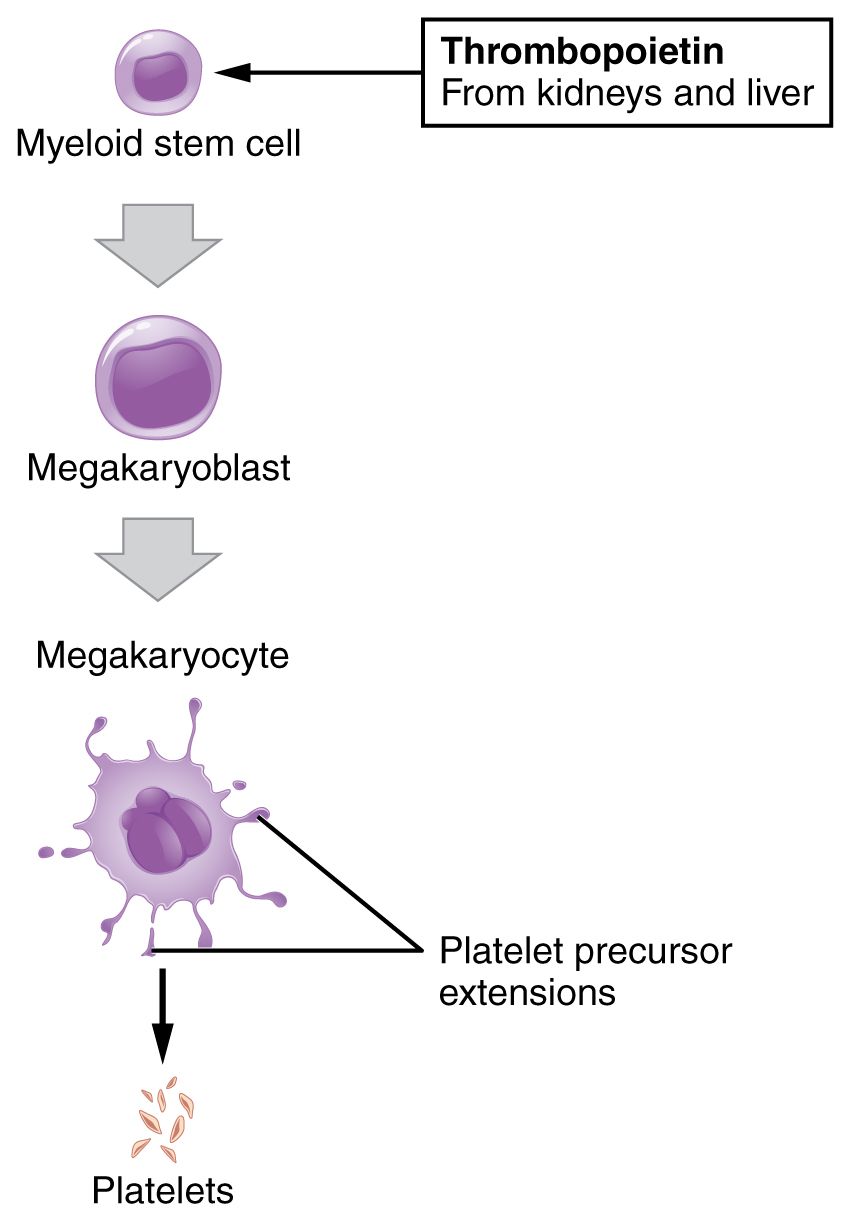
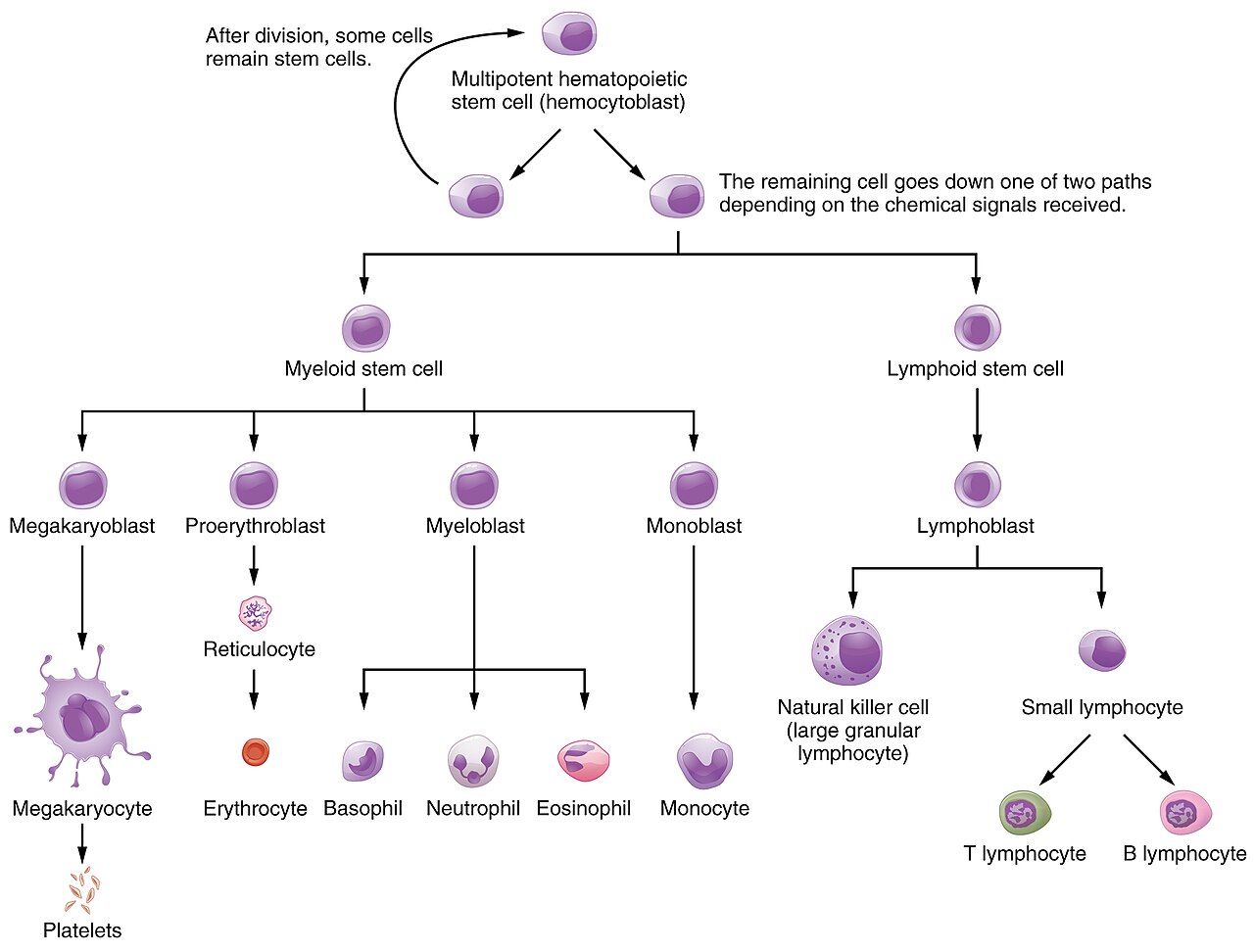
Every blood cell comes from one blood-forming stem cell in the bone marrow. Each branch of that family tree has its own growth signal. Drug makers built copies of those signals. So we can now push a certain cell line. Erythropoietin pushes red cells. Filgrastim pushes neutrophils. Romiplostim pushes platelets. These are not transfusions. They are instructions. They take days to weeks to work. And they only work if the marrow can respond and has the raw materials on hand.
Erythropoiesis-stimulating agents (ESAs) include epoetin alfa (Epogen, Procrit) and the longer-acting darbepoetin alfa (Aranesp). They replace the erythropoietin a failing kidney can no longer make. They are used mainly for anemia from chronic kidney disease and anemia from chemotherapy. Their boxed warning is one to understand, not just memorize. Pushing hemoglobin too high or too fast raises death, heart attack, stroke, blood clots, and tumor growth. Thicker blood clots more. So we do not bring hemoglobin up to normal. We use the lowest dose that avoids a transfusion. Hold or lower the dose for a hemoglobin above about 11 g/dL, or a rise of more than about 1 g/dL in 2 weeks. ESAs also raise blood pressure, so check BP before each dose. And ESAs fail without iron. You can shout at the marrow all day, but with no iron to work with, no hemoglobin gets built. Check iron stores first, using ferritin and transferrin saturation. Do not shake the vial. It is a protein, and shaking damages it.
Filgrastim (Neupogen) is granulocyte colony-stimulating factor (G-CSF). It drives the marrow to pump out neutrophils. This shortens the time of low neutrophils after chemotherapy and lowers fever with neutropenia. Pegfilgrastim (Neulasta) is the long-acting form given once per cycle. Timing is the classic test point. Give it at least 24 hours after the chemotherapy dose, not with it. Chemotherapy kills dividing cells, and you have just told the marrow to divide. The key side effect is bone pain, often deep in the breastbone and pelvis. It is a sign the drug is working. It usually responds to acetaminophen or an NSAID (if allowed). Watch for the rare but serious burst spleen. Signs are pain in the upper left belly or the tip of the shoulder. Also watch for ARDS, a severe lung injury. Measure results with the absolute neutrophil count (ANC), not the white count. Sargramostim (GM-CSF) acts more broadly. Romiplostim and eltrombopag are thrombopoietin agonists for immune thrombocytopenia, an immune drop in platelets.
Blood products: when you cannot wait for the marrow
Growth factors take days. When a patient is bleeding now, you give them the cells. Each product answers a different need, and matching the product to the need is the point. Packed red blood cells carry oxygen. Platelets plug. Fresh frozen plasma supplies all the clotting factors. Cryoprecipitate is the concentrated fibrinogen part. Albumin holds fluid in the blood vessels. It does nothing for clotting or oxygen.
Transfusion safety is one of the most step-by-step jobs you do, and for good reason. Deaths come from human errors in identifying the patient, not from the biology. Here is the backbone, always following your facility's policy. Check the order and consent. Do a type and crossmatch. Use a large IV (18 to 20 gauge for red cells). Run only 0.9% normal saline through the Y-tubing. Dextrose bursts red cells, and lactated Ringer's has calcium that can clot the line. Do a two-person check at the bedside, comparing the patient's ID band, the unit, and the paperwork. Take starting vital signs. Then start slowly and stay with the patient for the first 15 minutes. That is when a deadly acute hemolytic reaction shows itself. Recheck vital signs per policy. Finish each unit within 4 hours. Never add drugs to blood.
Learn the reactions by their fingerprints. Acute hemolytic (wrong ABO type) comes within minutes. Signs are fever, chills, pain in the side or back, dark urine, low blood pressure, and a sense of doom. Febrile nonhemolytic is the most common. It is a fever rise with chills, from the donor's white cells. Allergic reactions range from hives and itching (mild) up to anaphylaxis. Anaphylaxis is more likely in people with IgA deficiency. TACO (circulatory overload) brings shortness of breath, crackles in the lungs, swollen neck veins (JVD), and high blood pressure. It is too much fluid too fast. It classically happens in small or older people or those with heart failure. TRALI is a sudden lung injury within 6 hours. It brings shortness of breath, low oxygen, and low blood pressure. It is a leading cause of death from transfusion. TACO and TRALI both drown the patient. Blood pressure is what tells them apart at the bedside.
The first action for any suspected reaction never changes. Stop the transfusion. Keep the IV open with normal saline using new tubing. Check the patient and take vital signs. Tell the provider and the blood bank. Send back the unit, the tubing, and the needed samples. Stopping first is not optional. Every extra milliliter of a mismatched unit means more red cells destroyed.
| Product / agent | Prototype | Key effect | Safety alert |
|---|---|---|---|
| ESA | epoetin alfa, darbepoetin | Stimulates red cell production (days-weeks) | Boxed warning: death, heart attack, stroke, VTE, and tumor growth if Hgb is pushed too high. Hold if Hgb is above about 11. Check iron and BP. Don't shake the vial. |
| G-CSF | filgrastim, pegfilgrastim | Raises neutrophils → shortens neutropenia | Give ≥ 24 h after chemo. Bone pain = working. Follow the ANC. Splenic rupture is rare but real. |
| TPO agonist | romiplostim, eltrombopag | Raises platelet count in ITP | Monitor platelets; rebound thrombocytopenia on abrupt stop. |
| Packed RBCs | - | Restores oxygen-carrying capacity | Type & cross, NS only, two-person check, stay 15 min, finish in 4 h. |
| Platelets | - | Corrects thrombocytopenia / platelet dysfunction | Infuse briskly; never refrigerate; check post-transfusion count. |
| Fresh frozen plasma | - | Replaces all clotting factors | Must be thawed; ABO compatible; watch for TACO with volume. |
| Cryoprecipitate | - | Concentrated fibrinogen, VIII, XIII, vWF | Think fibrinogen replacement: DIC, massive transfusion. |
| Albumin | 5% / 25% | Pulls and holds fluid in the vascular space | No clotting factors, no oxygen carriage. Fluid overload risk: watch lungs. |
- Growth factors instruct the marrow and take days. Blood products replace cells now.
- ESAs carry a boxed warning. Don't bring hemoglobin up to normal. Check iron and BP, and hold if Hgb is above about 11 g/dL.
- Filgrastim goes in at least 24 h after chemo. Bone pain means it is working. Follow the ANC.
- Transfusion: NS only, a two-person ID check, stay 15 minutes, a 4-hour limit, and stop first for any reaction.
- TACO = overload with high blood pressure. TRALI = lung injury with low blood pressure.
Section 4Blood pressure and antihypertensives
What actually sets the pressure
Every blood pressure drug works by moving one of two numbers in one equation:
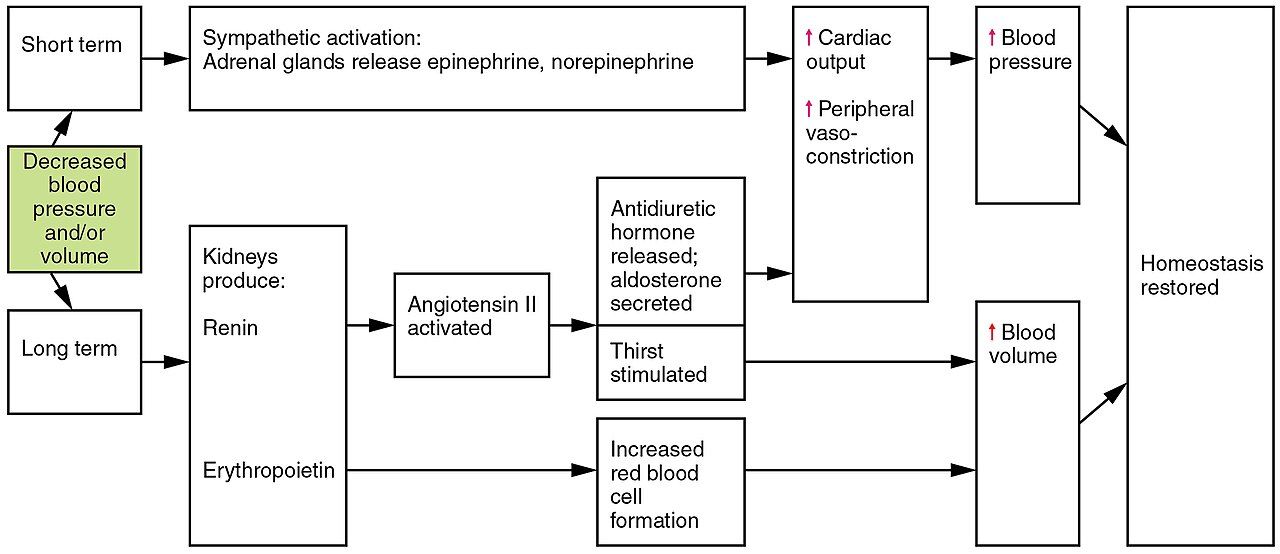
Blood pressure = cardiac output × systemic vascular resistance. Cardiac output is how much blood the heart pumps each minute. It equals heart rate × stroke volume. Stroke volume depends on three things. They are preload (the blood coming back), contractility (the squeeze), and afterload (what the heart pushes against). So there are exactly four levers. You can drain the tank: diuretics lower fluid volume, which lowers preload. You can slow and soften the pump: beta blockers lower rate and squeeze. You can widen the pipes: vasodilators, CCBs, ACE inhibitors, and ARBs lower resistance. Or you can cut the hormone signal telling the body to do all of the above: RAAS blockers. Once you see a drug's lever, you can predict both its benefit and its side effects without memorizing them apart.
The body defends its blood pressure with two systems you will fight all the time. The baroreceptor reflex is the fast one. Stretch sensors in the neck artery (carotid sinus) and the aortic arch sense a pressure drop within seconds. They fire the sympathetic system. Heart rate goes up, and vessels narrow. This reflex catches you when you stand up. It also causes a reflex fast heart rate when a vasodilator drops pressure suddenly. The RAAS is the slow one. The kidney senses low blood flow and releases renin. Renin turns angiotensinogen into angiotensin I. ACE, mostly in the lung, turns it into angiotensin II, a fierce vessel narrower. Angiotensin II then sets off aldosterone, which holds on to sodium and water. It also sets off ADH, which holds on to water. Pressure goes up. Blocking this loop at any point is the backbone of modern blood pressure treatment.
Why bother? High blood pressure does its damage silently for decades. Then it shows up as a stroke, heart attack, heart failure, kidney failure, or blindness. The patient feels nothing. That one fact is the whole problem in care: the disease is invisible, and the treatment has side effects the patient can feel. It is the subject of the next section.
The classes, and what each one costs
Thiazide diuretics (hydrochlorothiazide, chlorthalidone) block the sodium-chloride pump in the distal convoluted tubule of the kidney. Less sodium means less water, less volume, and less preload. Over time they also widen vessels a little. They are cheap, taken by mouth, and first-line. Their cost is in body chemistry. Above all they cause low potassium. They also cause low sodium, high calcium, high uric acid (gout flares), high blood sugar, and high blood fats. Loop diuretics (furosemide) are stronger. They work at the thick ascending limb of the loop of Henle. They keep working when the kidneys are weak. They are the drugs for fluid overload and heart failure more than routine high blood pressure. They waste potassium and calcium. They can harm hearing (ototoxicity), above all when pushed IV too fast. Potassium-sparing drugs hold potassium back. Spironolactone, an aldosterone blocker, is the main one. That is useful, and it is why spironolactone's main danger is high potassium. It can also cause breast growth in men. Give all diuretics in the morning, so the patient is not up all night.
ACE inhibitors (lisinopril, the "-pril" family) block the change of angiotensin I to II. Less angiotensin II means wider vessels and less aldosterone. They protect people with heart failure, diabetic kidney disease, and a past heart attack. ACE also breaks down bradykinin. So blocking it lets bradykinin build up. That is why 10 to 20% of patients get a maddening dry, hacking cough. It is also why a small number get angioedema. This is swelling of the lips, tongue, and airway, and it is a true emergency. Less aldosterone means the body puts out less potassium. So expect high potassium, and teach patients to avoid salt substitutes made with potassium. Low blood pressure with the first dose is real. ACE inhibitors are not allowed in pregnancy. They cause fetal kidney injury and death.
ARBs (losartan, the "-sartan" family) block the angiotensin II receptor instead of the enzyme. They give the same benefit further down the line. But bradykinin is untouched, so there is no cough. That is exactly why patients get switched from a "-pril" to a "-sartan." ARBs still cause high potassium and are still not allowed in pregnancy. ACE inhibitors and ARBs are not combined.
Calcium channel blockers (CCBs) come in two types. The dihydropyridines (amlodipine, the "-dipine" family) act on the smooth muscle of the vessels. They just widen vessels. So expect ankle swelling (peripheral edema), flushing, headache, and a reflex fast heart rate. The non-dihydropyridines (diltiazem, verapamil) act on the heart too. They slow the heart's signals and weaken its squeeze. So expect a slow heart rate, heart block, worse heart failure, and verapamil's well-known constipation. Grapefruit juice raises the levels of several of these.
Beta blockers (metoprolol, atenolol, the "-olol" family) dull the sympathetic drive. They lower heart rate, squeeze strength, and renin release. Cardioselective drugs (metoprolol, atenolol, bisoprolol) prefer beta-1 in the heart. Nonselective drugs (propranolol) also hit beta-2. They can tighten the airways in asthma. Watch for a slow heart rate and tiredness. Watch for the sneaky one too. Beta blockers hide the fast heart rate and tremor of low blood sugar. So a patient with diabetes may lose their early warning, though sweating still gets through. Never stop a beta blocker suddenly. It can cause a rebound fast heart rate, high blood pressure, angina, or even a heart attack. Alpha-1 blockers (doxazosin, "-osin") relax vessels and the prostate. They cause dramatic fainting on standing with the first dose, so the first dose is given at bedtime. Central alpha-2 agonists (clonidine) lower the sympathetic signal from the brain. They cause sleepiness and dry mouth. They cause severe rebound high blood pressure if stopped suddenly, as a patch or a pill. Direct vasodilators (hydralazine, minoxidil) relax the small arteries directly. They cause a reflex fast heart rate and fluid buildup. So they are usually paired with a beta blocker and a diuretic. Sodium nitroprusside is the ICU emergency drip. It works almost instantly and is adjusted by an artery line reading. It must be kept from light. With long, high-dose use, it can build up as cyanide and thiocyanate.
| Class | Prototype (suffix) | Key effect | Safety alert |
|---|---|---|---|
| Thiazide diuretic | hydrochlorothiazide | ↓ Na/water → ↓ preload; first-line | Hypokalemia, hyponatremia, ↑ glucose, ↑ uric acid (gout). Dose in the morning. Sulfa cross-sensitivity. |
| Loop diuretic | furosemide | Potent volume removal; works in renal impairment | K and Ca loss; ototoxicity if pushed fast IV. Daily weight is the best measure. |
| K-sparing / aldosterone antagonist | spironolactone | Blocks aldosterone → keeps K | Hyperkalemia: no salt substitutes, no routine K supplement. Gynecomastia. |
| ACE inhibitor | lisinopril (-pril) | Blocks angiotensin I → II; renal + cardiac protection | Cough, angioedema (airway emergency), hyperkalemia, first-dose hypotension. Contraindicated in pregnancy. |
| ARB | losartan (-sartan) | Blocks the angiotensin II receptor | No cough: the swap for ACE intolerance. Still hyperkalemia; still contraindicated in pregnancy. |
| CCB: dihydropyridine | amlodipine (-dipine) | Vasodilation only | Peripheral edema, flushing, headache, reflex tachycardia. Grapefruit. |
| CCB: non-dihydropyridine | diltiazem, verapamil | Vasodilation + ↓ rate and contractility | Bradycardia, heart block, worsens HF. Verapamil → constipation. Hold for low HR per parameters. |
| Beta-blocker | metoprolol (-olol) | ↓ HR, ↓ contractility, ↓ renin | Bradycardia, fatigue; masks hypoglycemia; nonselective agents worsen asthma. Never stop abruptly. |
| Alpha-1 blocker | doxazosin (-osin) | Vasodilation; relaxes prostate | First-dose syncope: give at bedtime, rise slowly. |
| Central alpha-2 agonist | clonidine | ↓ Central sympathetic outflow | Sedation, dry mouth; severe rebound hypertension if stopped abruptly. Rotate patch sites. |
| Direct vasodilator | hydralazine, minoxidil | Direct arteriolar relaxation | Reflex tachycardia + fluid retention → usually paired with a beta-blocker and a diuretic. |
| Nitrovasodilator (IV) | nitroprusside | Immediate, titratable arterial + venous dilation | ICU only; arterial line; protect from light; cyanide/thiocyanate toxicity with prolonged high dose. |
- BP = CO × SVR. Every blood pressure drug drains fluid, slows the pump, widens the pipes, or blocks the RAAS.
- The baroreceptor reflex defends pressure in seconds (reflex fast heart rate). The RAAS defends it over hours.
- ACE inhibitors → cough, angioedema, high potassium. ARBs → same benefit, no cough. Both are not allowed in pregnancy.
- Dihydropyridine CCBs → ankle swelling. Non-dihydropyridines → slow heart rate and constipation.
- Beta blockers hide low blood sugar and must never be stopped suddenly. Clonidine causes rebound high blood pressure.
Section 5Antihypertensive care at the bedside
The number you write down is part of the treatment
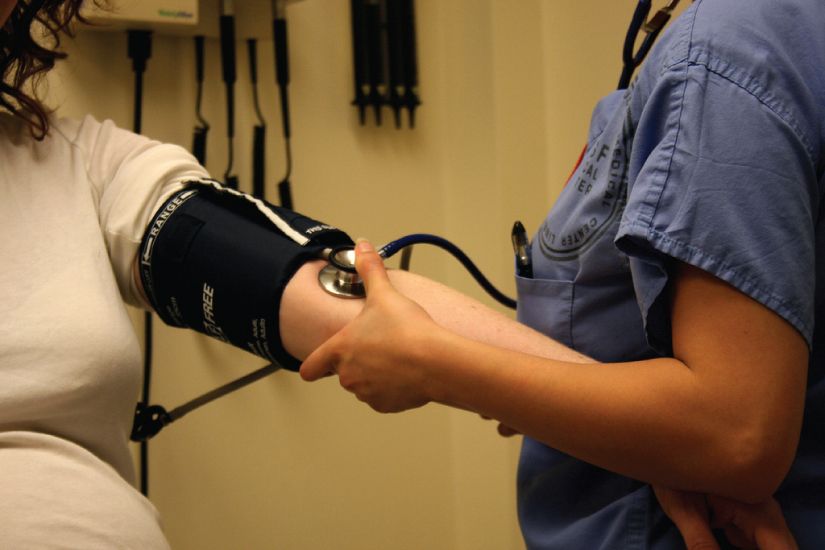
A blood pressure drug is adjusted to a number that you produce. If the number is wrong, the dose is wrong. Poor technique can move a reading by 10 to 30 mmHg. That is more than most single drugs do. So technique is not a formality:
- Cuff size is the biggest error. A cuff that is too small reads falsely high. One that is too large reads falsely low. The inflatable bladder should wrap about 80% of the arm.
- Have the patient sit for 5 minutes with the back supported and feet flat on the floor. Crossed legs raise the reading. The arm should be bare and supported at heart level, since a dangling arm reads high. No talking during the reading.
- No caffeine, smoking, or exercise for 30 minutes before. The bladder should be empty.
- Take two readings at least a minute apart and average them. Check both arms at the first visit, and use the higher arm after that.
- Know your hold rules before you pour the pill. If there is no hold rule for a drug that can crash a pressure, that is a question to ask, not something to assume.
Around the drug itself, follow the labs and vital signs for each class. Check potassium and kidney function for ACE inhibitors, ARBs, spironolactone, and diuretics. Take an apical pulse for a full minute before a beta blocker or a non-dihydropyridine CCB. A common hold is a pulse under 60, or as ordered. Check a daily weight for anyone on a diuretic. Use the same time, scale, and clothing. A 1 kg change is about a liter of fluid, and weight catches it earlier than a lung exam. Check the ankles of the amlodipine patient. Ask about cough in the lisinopril patient. Look at the tongue and lips of anyone new on an ACE inhibitor.
Orthostatic hypotension: the side effect that breaks hips
Nearly every drug in the last section can drop a person's pressure when they stand up. Orthostatic hypotension is a fall of ≥ 20 mmHg systolic or ≥ 10 mmHg diastolic within 3 minutes of standing. This is not just a textbook definition. It is behind the 3 a.m. fall, the broken hip, and the brain bleed in a patient who is also on a blood thinner. The science is simple. Standing drops about half a liter of blood into the legs. The baroreceptor reflex normally fixes it in seconds. Beta blockers dull the heart rate half of that reflex. Alpha blockers dull the vessel-narrowing half. Diuretics remove the fluid the reflex needs to work with. The patient's own fix has been turned off by drugs.
Measure it the right way. Take BP and pulse lying down after a few minutes of rest. Then take them sitting. Then take them standing, at 1 minute and again at 3 minutes. Stay with the patient, with a gait belt or a chair behind them. The point of the test is to bring on a near-faint. Ask about symptoms, not just the number. Ask about lightheadedness, gray or tunnel vision, or a "wave" on standing.
What you teach is what protects them. Change positions slowly and use the three-stage rise. Lie, then sit, then dangle the legs for a full minute, then stand with support. Pump the ankles before rising. Take extra care getting up after a hot shower or a big meal, since both pull blood away from the brain. Give first doses and dose increases at bedtime, above all for alpha blockers. Call for help before getting up at night, and turn the light on. Drink enough fluid unless it is limited. No alcohol on top of the drug. Wear compression stockings if ordered. And keep the room safe: bed low, call light in reach, path clear, and non-skid shoes.
Adherence: the hardest part of the whole chapter
About half of people on long-term blood pressure drugs are not taking them as prescribed a year later. It is not because they are careless. Look at it from their side. The disease has no symptoms, and the drug has plenty. Before treatment they felt fine. Now they are dizzy, tired, coughing, passing urine all day, and swollen at the ankles. They may have sexual side effects nobody warned them about. All of this is to prevent a stroke they cannot picture having. Stopping is a sensible response to that math. Your job is to change the math, not to lecture.
Here is what actually helps. Name the trade honestly: "This doesn't make you feel better. It keeps you from having a stroke." Predict the side effects out loud, so when they come they feel expected, not like a betrayal. Teach that a side effect is a reason to call, not to quit. A cough can mean a switch to an ARB. Swelling can mean a lower dose. Pair the dose with something they already do every day. Give them a home BP log. A person with numbers becomes a partner instead of a subject. Simplify to once-daily or combination pills where you can. And ask about cost, plainly. The most common reason a prescription is not taken is that it was never filled.
And teach the rules that do not bend. Never stop a beta blocker or clonidine suddenly. That can cause rebound high blood pressure, a fast heart rate, angina, or a heart attack, and with clonidine, a blood pressure crisis. No potassium salt substitutes on an ACE inhibitor, ARB, or spironolactone. Beware of store-bought NSAIDs. They weaken blood pressure drugs and strain the kidney. Beware of decongestants like pseudoephedrine, which raise pressure. Avoid grapefruit juice with certain CCBs. Get up slowly, always. Report a cough that will not go away, any swelling of the face or tongue (go to the ER), a pulse under 60, a weight gain of more than 2 to 3 lb in a day or 5 lb in a week, or fainting. If pregnancy is possible, talk about it before starting an ACE inhibitor or an ARB. And do not stop because the numbers look good. The numbers look good because of the drug.
| If the patient is on… | Assess / monitor | Teach |
|---|---|---|
| Thiazide or loop diuretic | K, Na, renal function, daily weight, I&O, orthostatics | Take in the morning; potassium-rich foods; report muscle cramps, weakness, palpitations; rise slowly. |
| Spironolactone | K (hyperkalemia), renal function | No salt substitutes or K supplements; report breast tenderness. |
| ACE inhibitor / ARB | K, creatinine, BP, cough, lips & tongue | Cough → call (switchable). Swelling of face/tongue → ED now. No salt substitutes. Not in pregnancy. |
| Amlodipine (dihydropyridine) | Ankle/pedal edema, BP, headache | Elevate legs; report worsening swelling; avoid grapefruit juice. |
| Diltiazem / verapamil | Apical pulse 1 full minute, BP, HF signs, bowel pattern | Report pulse < 60 or dizziness; fiber and fluid for constipation. |
| Beta-blocker | Apical pulse, BP, glucose in diabetics, wheeze | Never stop abruptly. Hypoglycemia may feel different: check the meter, don't trust the tremor. |
| Doxazosin / clonidine | Orthostatic BP, sedation, fall risk | First dose at bedtime; dangle before standing; never stop clonidine abruptly; rotate patch sites. |
- An accurate BP is part of the treatment: right cuff, 5 minutes of rest, feet flat, arm at heart level, no talking, and the average of two readings.
- Orthostatic hypotension = a drop of ≥ 20 systolic or ≥ 10 diastolic within 3 minutes of standing. Measure lying, sitting, and standing at 1 and 3 min, and guard the patient.
- Teach the slow three-stage rise with a full minute of dangling. Give first doses of alpha blockers at bedtime.
- Not taking the drug makes sense when the disease is silent and the drug is not. Predict side effects, teach "call, don't quit," and use a home BP log.
- Never stop a beta blocker or clonidine suddenly. Avoid potassium salt substitutes, NSAIDs, and decongestants.
The chapter in one breath
- Hemostasis is vessel narrowing → platelet plug → fibrin mesh. Nearly every drug here aims at thrombin or factor Xa, and nearly every one is high-alert.
- aPTT tracks heparin (antidote protamine). PT/INR tracks warfarin (antidote vitamin K, plus PCC for major bleeding). DOACs need no routine checks but do need kidney-based dosing, every dose taken, and their own reversal plan.
- A falling platelet count on heparin is HIT. It clots instead of bleeding, and all heparin comes off.
- Artery clots are mostly platelets (aspirin, clopidogrel, and DAPT after a stent, never stopped casually). Vein clots are mostly fibrin (anticoagulants). Only thrombolytics dissolve fibrin already formed, on a harsh clock and with a long list of reasons not to give them.
- ESAs and filgrastim instruct the marrow over days. Don't bring hemoglobin up to normal, check iron and BP, and give G-CSF at least 24 hours after chemo. Blood products replace cells now, with the rules of NS only, a two-person check, staying 15 minutes, and a 4-hour limit.
- For any suspected transfusion reaction, stop the transfusion first. TACO is overload with high blood pressure. TRALI is lung injury with low blood pressure.
- BP = CO × SVR. Drugs drain the tank, slow the pump, widen the pipes, or block the RAAS. The ending (-pril, -sartan, -dipine, -olol, -osin) tells you the class, the side effect, and the teaching.
- The bedside work of high blood pressure is an accurate cuff reading, an orthostatic check, and an honest talk about taking the drug with a patient whose disease has never once made them feel sick.
ReferenceWords worth knowing
A quick list of the terms in this chapter. Skim it now, or come back when a word trips you up.
- Absolute neutrophil count (ANC)
- The number of germ-fighting neutrophils in the blood; the value that shows whether filgrastim is working and whether a patient is neutropenic.
- Afterload
- The resistance the heart must push against to pump blood out; lowered by vasodilators, CCBs, ACE inhibitors, and ARBs.
- Angioedema
- Fast swelling of the lips, tongue, face, or airway; an airway emergency and a firm reason to stop an ACE inhibitor for good.
- Anticoagulant
- A drug that stops fibrin clots from forming or growing; it does not dissolve a clot that is already there.
- Antiplatelet
- A drug that keeps platelets from clumping; the treatment for platelet-rich artery clots.
- aPTT
- Activated partial thromboplastin time: the test that follows the intrinsic and common pathways, used to check unfractionated heparin.
- Baroreceptor reflex
- The second-to-second reflex from the carotid sinus and aortic arch that brings blood pressure back by raising heart rate and narrowing vessels; dulled by many blood pressure drugs.
- Cardiac output
- Heart rate × stroke volume; one of the two factors that, with systemic vascular resistance, sets blood pressure.
- DAPT (dual antiplatelet therapy)
- Aspirin plus a P2Y12 inhibitor, standard after a heart stent; stopping it early risks a clot in the stent.
- DOAC
- Direct oral anticoagulant: dabigatran (blocks thrombin) or the "-xaban" drugs (block factor Xa); no routine checks, dosed by kidney function, with their own reversal plans.
- Fibrinolysis
- Breakdown of a fibrin clot by plasmin; the process thrombolytics speed up.
- Hemostasis
- The body's step-by-step way of stopping bleeding: vessel narrowing, a platelet plug, then a strengthening fibrin mesh.
- Heparin-induced thrombocytopenia (HIT)
- An immune reaction to heparin, usually 5 to 10 days in, that drops platelets by ≥ 50% and, against what you would expect, causes clots; all heparin must stop.
- High-alert medication
- A drug with a higher risk of serious harm when used in error; anticoagulants, thrombolytics, and IV blood pressure drugs all qualify.
- INR
- International normalized ratio: the standard PT used to dose warfarin; usual goal 2.0 to 3.0.
- Orthostatic hypotension
- A drop of ≥ 20 mmHg systolic or ≥ 10 mmHg diastolic within 3 minutes of standing; behind many falls caused by drugs.
- Preload
- The blood coming back to the heart that stretches it before it squeezes; lowered by diuretics and vein-widening drugs.
- RAAS
- Renin-angiotensin-aldosterone system: the hormone loop (renin → angiotensin II → aldosterone) that raises blood pressure, and that most first-line blood pressure drugs break.
- Systemic vascular resistance (SVR)
- The resistance of the small arteries to blood flow; the "width of the pipes" half of the blood pressure equation.
- TACO
- Transfusion-associated circulatory overload: shortness of breath, crackles, swollen neck veins, and high blood pressure from too much fluid too fast.
- Thrombolytic
- A drug such as alteplase that turns plasminogen into plasmin and dissolves fibrin already formed; the drug class with the highest bleeding risk in this chapter.
- TRALI
- Transfusion-related acute lung injury: shortness of breath and low oxygen with low blood pressure within 6 hours of a transfusion; a leading cause of death from transfusion.