Infection & Epidemiology
A single sick patient is a story about one person. A ward full of them is a story about a system — how a microbe found a home, slipped out of one body, traveled, and settled into the next. This chapter zooms out from the individual infection to the pattern: the six-link chain of infection that every outbreak follows, the reservoirs microbes hide in, the routes they travel, and the language epidemiologists use to count and track disease across a population. Then it zooms back in to the bedside, where the most dangerous infections a patient can catch are often the ones we hand them — and where breaking a single link in that chain is the most powerful thing a nurse does all shift.
By the end of this chapter you can
- Name the six links in the chain of infection and give a nursing action that breaks each one.
- Distinguish the major types of reservoir — human, animal, and environmental — and explain what a carrier is.
- Compare the five modes of transmission: contact, droplet, airborne, vehicle, and vector.
- Define incidence and prevalence and explain why they answer different questions.
- Distinguish endemic, epidemic (outbreak), and pandemic disease.
- Identify the four major healthcare-associated infections (CAUTI, CLABSI, SSI, VAP) and the bundle that prevents each.
- Explain standard precautions and the three categories of transmission-based precautions, and choose the right one for a given organism.
Section 1The chain of infection
Why think in a chain
Infection is never a single event. For a microbe to make a new person sick, a whole sequence of things has to line up: the microbe must exist, it must be living somewhere, it must get out of that somewhere, travel by some route, get into a new person, and find that person vulnerable enough to take hold. Epidemiologists picture this sequence as the chain of infection — six links that must all connect for transmission to succeed. The reason this model matters so much to nurses is its most hopeful feature: break any one link and the whole chain fails. You do not have to sterilize the world; you just have to interrupt the microbe at the weakest, most reachable point.
The six links
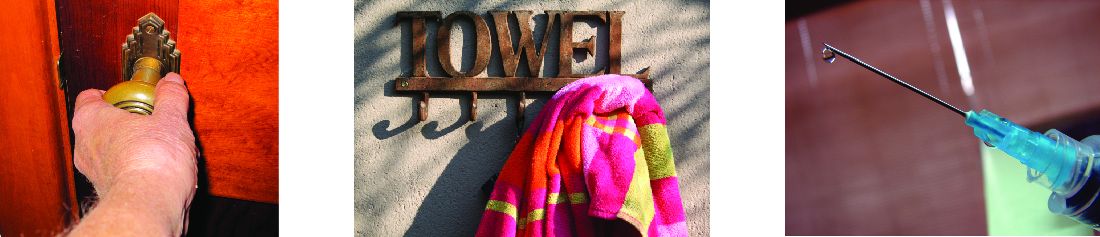
Read the chain in order and you can see where a nurse stands in it. The infectious agent is the microbe itself. Its reservoir is the place it normally lives and multiplies — a person, an animal, the soil, a sink drain. The portal of exit is how it leaves the reservoir (respiratory droplets, stool, blood, wound drainage). The mode of transmission is the route it travels (touch, droplets, air, a shared object, an insect). The portal of entry is how it gets into the next person — often the very same routes running in reverse, plus the artificial doorways we create with catheters, IV lines, and surgical incisions. Finally, the susceptible host is a person whose defenses are low enough to be colonized and infected. Notice how many links live on the nurse's side of the bed.
| Link | What it is | Nursing action that breaks it |
|---|---|---|
| Infectious agent | The pathogen (bacterium, virus, fungus, parasite) | Appropriate antimicrobials; treat & identify the organism |
| Reservoir | Where the microbe lives & multiplies | Clean the environment; treat carriers; remove standing water & soiled linen |
| Portal of exit | How it leaves the reservoir | Cover coughs; contain drainage & body fluids; dressings over wounds |
| Mode of transmission | The route to a new host | Hand hygiene; PPE; isolation; disinfect shared equipment |
| Portal of entry | How it enters the next person | Aseptic technique; catheter & line care; keep skin intact; remove devices early |
| Susceptible host | A person with lowered defenses | Vaccinate; nutrition; glycemic control; treat underlying illness |
- Transmission requires six links to connect: agent → reservoir → portal of exit → mode of transmission → portal of entry → susceptible host.
- Breaking any single link stops the infection — you don't have to break them all.
- The mode of transmission link is the one nurses control most directly, and hand hygiene is its master key.
- Devices (catheters, lines, tubes) create new portals of entry that don't exist in nature.
Section 2Reservoirs & transmission
Where microbes hide: reservoirs
A reservoir is the habitat where a pathogen normally lives, grows, and multiplies, waiting for a chance to spread. Reservoirs come in three kinds. Human reservoirs include people who are visibly sick, but also — and more dangerously — carriers, people who harbor and shed a microbe without symptoms. "Typhoid Mary" (Mary Mallon) infected roughly 50 people — three of whom died — across the households and institutions she cooked for, all while feeling perfectly well; today, an asymptomatic staff member colonized with MRSA can do something similar. Animal reservoirs give us zoonoses — diseases that jump from animals to humans, such as rabies, Lyme disease, and salmonellosis. Environmental reservoirs are non-living: soil harbors Clostridium tetani and fungal spores; water harbors Legionella, which famously breeds in cooling towers and warm hospital plumbing.
How microbes travel: the five modes
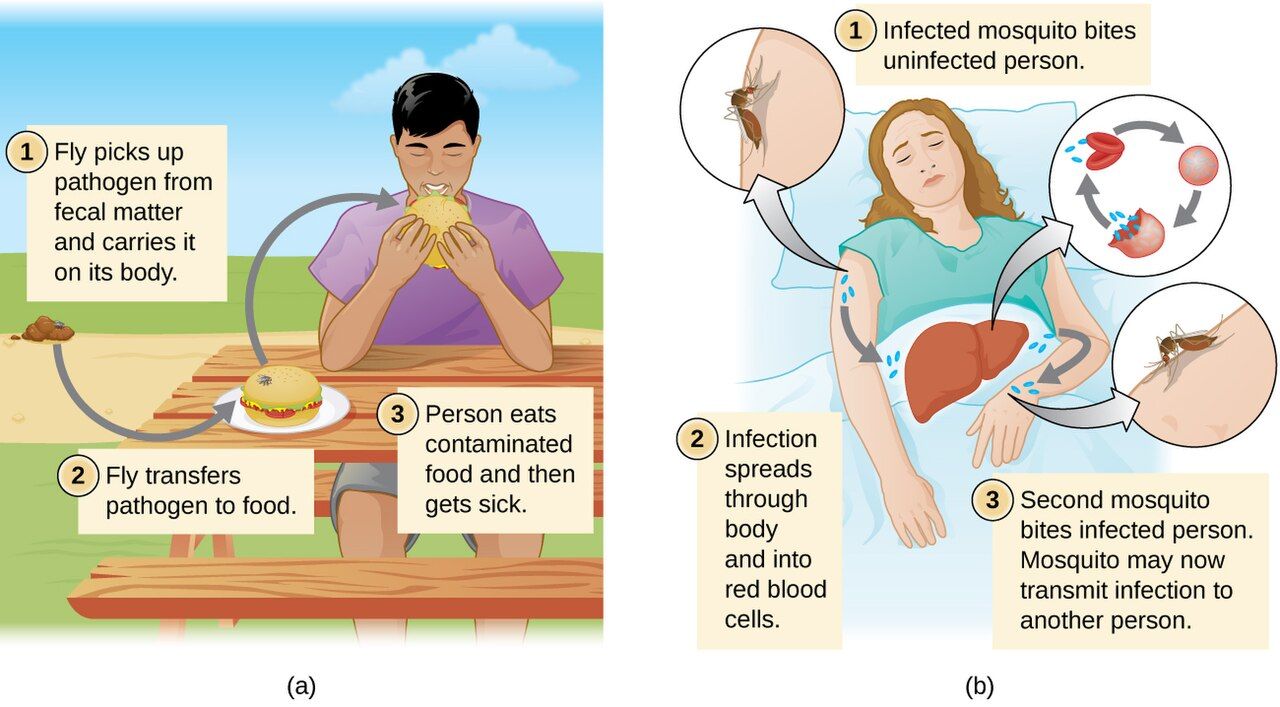
Once a microbe exits its reservoir it needs a route to the next host, and there are five to know. Contact is the most common: direct contact means skin-to-skin or body-fluid transfer (a handshake, a kiss, sex), while indirect contact runs through a contaminated object called a fomite — a bed rail, a stethoscope, a shared glucometer. Droplet transmission carries large respiratory droplets a short distance (classically within about 1–2 meters, roughly 3–6 feet) when someone coughs, sneezes, or talks; the droplets are too heavy to float and fall quickly. Airborne transmission is the dangerous cousin: tiny droplet nuclei stay suspended in the air for long periods and travel on air currents, so tuberculosis, measles, and varicella can infect someone who was never near the patient. Vehicle transmission uses a shared medium — food, water, blood, or IV fluids — to reach many people at once (a single contaminated batch causes an outbreak). Vector transmission uses a living carrier, usually an arthropod: mechanically (a fly tracking microbes on its feet) or biologically (a mosquito in which the pathogen actually multiplies, as with malaria).
| Mode | How it spreads | Classic example | Precaution |
|---|---|---|---|
| Contact (direct) | Skin-to-skin or fluid-to-fluid | MRSA, scabies, herpes | Gloves & gown; hand hygiene |
| Contact (indirect) | Via a contaminated fomite | C. difficile, norovirus, RSV | Disinfect shared equipment |
| Droplet | Large droplets, short range (<2 m) | Influenza, pertussis, meningococcus | Surgical mask; ~2 m spacing |
| Airborne | Tiny nuclei suspended & drifting | Tuberculosis, measles, varicella | N95; negative-pressure room (add gown & gloves for varicella) |
| Vehicle | Shared food, water, blood, fluids | Salmonella, hepatitis A, HIV | Food/water safety; blood screening |
| Vector | Living carrier (usually an arthropod) | Malaria, Lyme, West Nile | Repellent; nets; vector control |
- A reservoir is where a microbe lives; reservoirs are human (including symptom-free carriers), animal (zoonoses), or environmental (soil, water).
- The five modes are contact (direct/indirect via a fomite), droplet, airborne, vehicle, and vector.
- Droplets fall within ~2 m (mask); airborne nuclei drift (N95 + negative-pressure room).
- Vehicle transmission can infect many people from one contaminated source — the signature of a point-source outbreak.
Section 3Epidemiology basics
Counting disease: incidence and prevalence
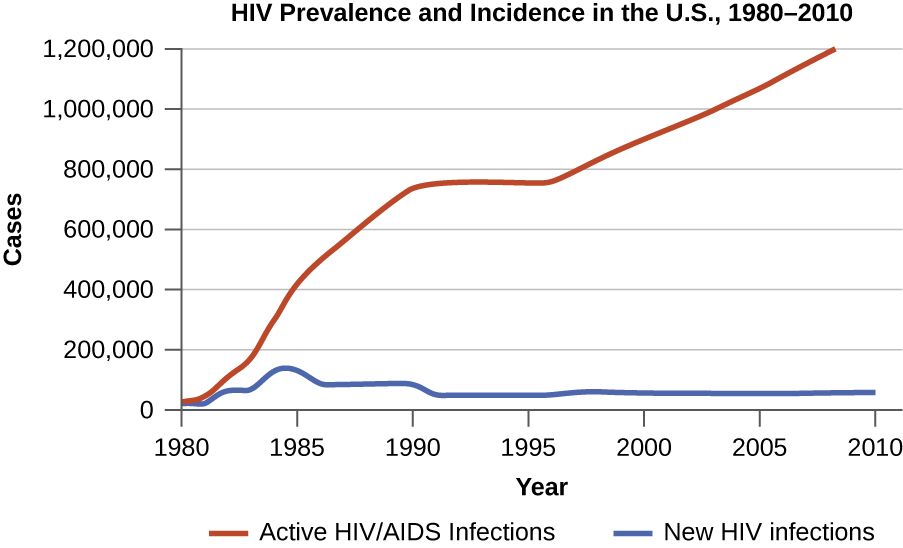
Epidemiology is the study of how disease is distributed in populations and what drives that distribution — the science behind every outbreak investigation and every public-health decision. Its two most fundamental numbers are easy to mix up. Incidence is the number of new cases that appear in a population during a set period of time; it measures how fast a disease is arriving. Prevalence is the total number of cases — new and old — present at a given moment; it measures how much disease is out there right now. A brief, intense illness like influenza has high incidence during flu season but low prevalence at any snapshot, because people recover quickly. A chronic condition like HIV has low incidence but high and climbing prevalence, because cases accumulate and persist. Two more terms round out the vocabulary: morbidity is the amount of illness in a population, and mortality is the amount of death.
Patterns over place and time: endemic, epidemic, pandemic
Epidemiologists also describe the pattern a disease shows. A disease is endemic when it is constantly present in a region at a fairly steady, expected level — the common cold is endemic everywhere; malaria is endemic in parts of the tropics. An epidemic (often called an outbreak when it is smaller or more local) is a rise in cases above the expected baseline for that place and time. When an epidemic crosses countries and continents to affect a large part of the world, it is a pandemic — COVID-19 being the defining example of this generation. A disease that appears only occasionally and irregularly, with no steady pattern, is called sporadic. These are not just labels: the moment case counts climb above the endemic baseline, public-health systems switch from routine surveillance into outbreak response.
| Term | Meaning | Example |
|---|---|---|
| Incidence | New cases in a period | 1,200 new flu cases this week |
| Prevalence | All current cases at a moment | 38 million people living with HIV |
| Sporadic | Occasional, irregular cases | Tetanus in a vaccinated country |
| Endemic | Steady, expected background level | Malaria in tropical regions |
| Epidemic / outbreak | Cases above the expected baseline | A measles outbreak in a school |
| Pandemic | Epidemic spanning countries/continents | COVID-19, 1918 influenza |
- Incidence counts new cases over time; prevalence counts all existing cases at a moment.
- Short, curable illnesses have high incidence but low prevalence; chronic ones have low incidence but high prevalence.
- Endemic = steady baseline; epidemic/outbreak = above baseline; pandemic = epidemic across many countries.
- Morbidity is illness; mortality is death — both are core public-health measures.
Section 4Healthcare-associated infections
The infections we hand to patients
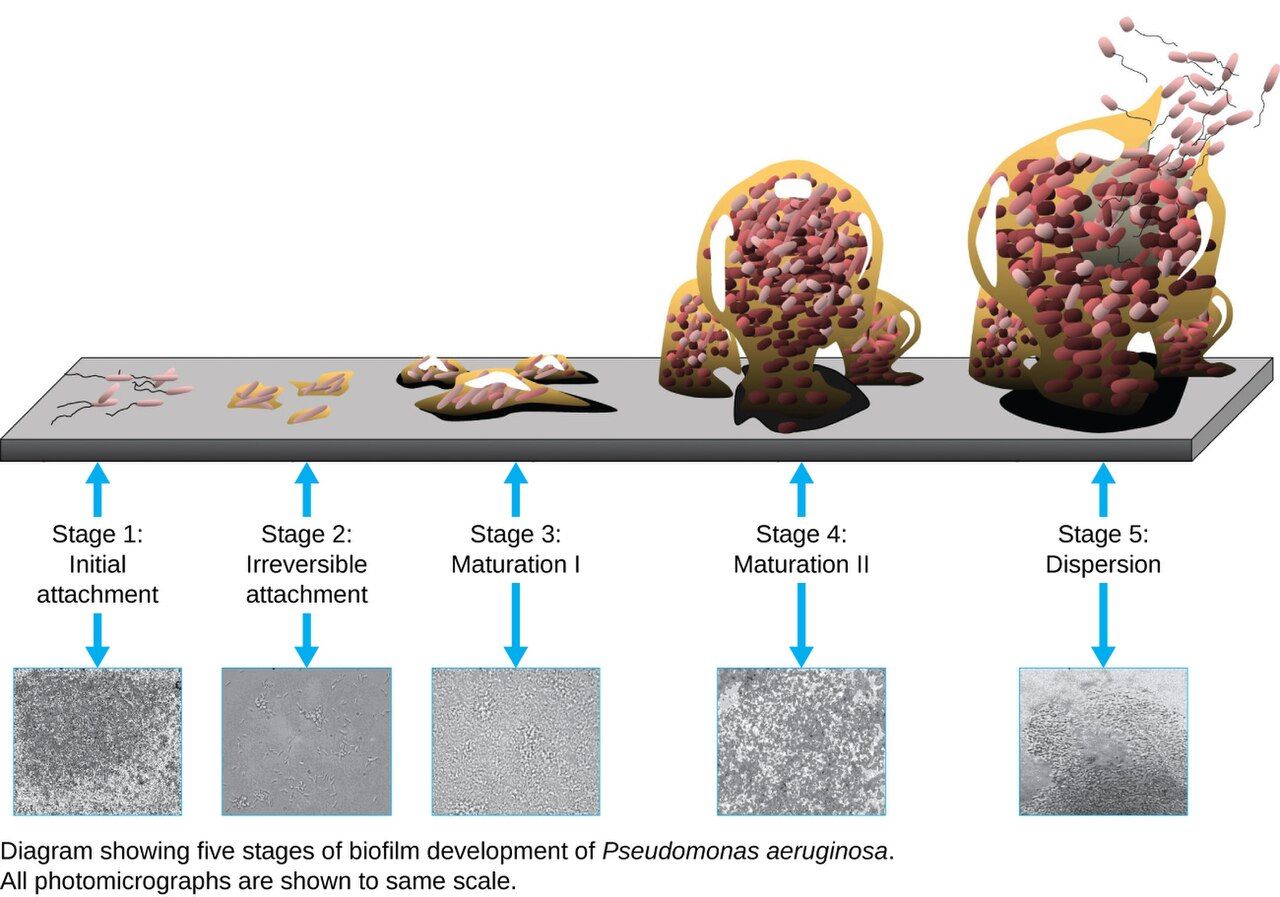
A healthcare-associated infection (HAI) is an infection a patient acquires while receiving care — one they did not have, and were not incubating, on admission. HAIs are common: on any given day, roughly 1 in 31 hospitalized patients in the United States has at least one. They are also, for the most part, preventable, which is exactly why they are tracked, reported, and taken so seriously. Most of the big HAIs share a villain: the biofilm. When we thread a catheter into a bladder or a line into a vein, microbes colonize the plastic and build a slimy, drug-resistant biofilm along its surface — a fortress antibiotics and immune cells struggle to breach. Every indwelling device is both a portal of entry and a biofilm scaffold, which is why the guiding rule is blunt: if the device isn't needed, it comes out.
The big four — and the bundles that stop them
Four HAIs dominate. CAUTI (catheter-associated urinary tract infection) follows the indwelling urinary catheter — the single most-used, and most over-used, device in the hospital. CLABSI (central-line–associated bloodstream infection) is less common but far deadlier, because it delivers microbes straight into the bloodstream. SSI (surgical-site infection) develops in a wound after an operation. VAP (ventilator-associated pneumonia) strikes patients whose breathing tube bypasses the natural filters of the upper airway. For each, prevention isn't one trick but a bundle — a small set of evidence-based steps done together, every time, with nothing skipped. Bundles work because HAIs are chains too, and a bundle breaks several links at once.
| HAI | Device / cause | Prevention bundle (nursing core) |
|---|---|---|
| CAUTI | Indwelling urinary catheter | Insert only if truly needed; sterile insertion; keep bag below bladder; remove ASAP |
| CLABSI | Central venous line | Full-barrier insertion; chlorhexidine skin prep; scrub the hub; daily line-necessity review |
| SSI | Surgical incision | Timely pre-op antibiotics; clippers (not razors); glucose & normothermia; sterile dressing care |
| VAP | Endotracheal tube / ventilator | Head of bed 30–45°; minimize sedation with a daily sedation interruption & readiness-to-extubate assessment; regular oral care with toothbrushing (routine chlorhexidine is no longer recommended); early enteral nutrition; change the circuit only when visibly soiled |
- An HAI is acquired during care; about 1 in 31 inpatients has one on any given day, and most are preventable.
- The big four are CAUTI, CLABSI, SSI, and VAP — three of the four are device-associated.
- Biofilms on indwelling devices shelter microbes from drugs and immune defenses.
- Bundles — and early device removal — are the proven way to drive HAI rates down.
Section 5Breaking the chain
Standard precautions: the floor for everyone
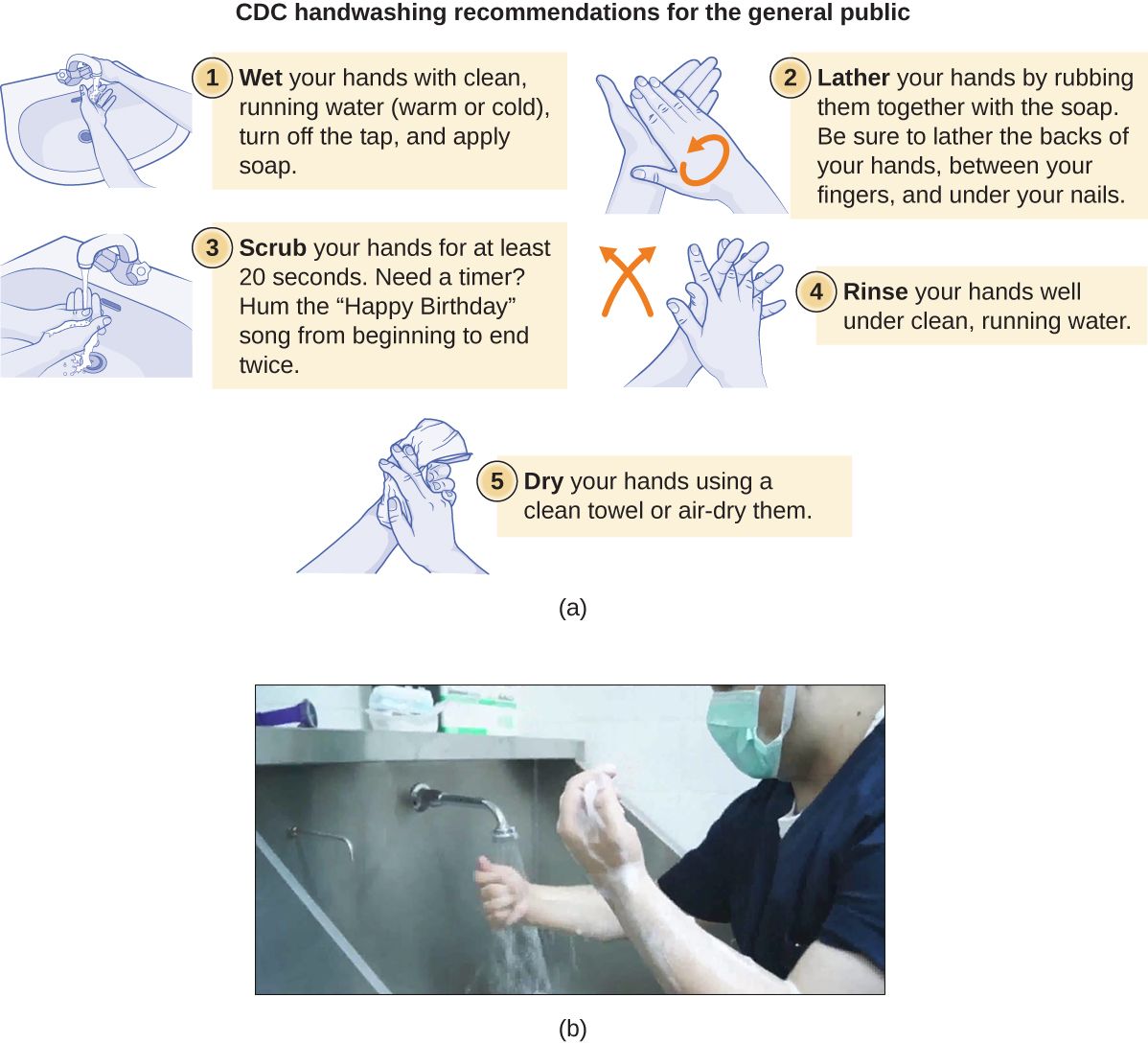
Infection control rests on a two-tier system. The base tier is standard precautions, and its founding assumption is deliberately paranoid: treat the blood and body fluids of every patient as potentially infectious, regardless of diagnosis, because you cannot tell by looking who is carrying what. Standard precautions apply to all patients, all the time, and include hand hygiene before and after every contact, PPE (gloves, gown, mask, or eye protection) whenever you might contact body fluids, respiratory hygiene / cough etiquette, safe injection practices (one needle, one syringe, one time), and safe handling of soiled equipment and linens. This tier alone, done faithfully, breaks the transmission link for the majority of hospital microbes.
Transmission-based precautions: adding a tier for known threats
When a patient is known or suspected to carry a highly transmissible organism, you add a second tier layered on top of standard precautions. There are three categories, matched to the three high-risk modes of transmission. Contact precautions (gown and gloves; dedicated equipment) counter organisms spread by touch and fomites — MRSA, VRE, C. difficile, RSV. Droplet precautions (surgical mask within ~2 m) counter influenza, pertussis, and meningococcal disease. Airborne precautions (an N95 respirator and a negative-pressure room with the door closed) counter the drifting-nuclei diseases — tuberculosis, measles, varicella. A useful memory hook for the airborne set is "My Chicken Hez TB": Measles, Chickenpox (varicella), Herpes zoster (disseminated), TB. Note one wrinkle in that list: varicella and disseminated zoster require Airborne plus Contact precautions, because the vesicle fluid is infectious by direct touch and on linens and dressings — so you add gown and gloves. TB and measles are airborne only. Staff without evidence of immunity to measles or varicella should not enter those rooms at all. Choosing the wrong tier — or none — leaves the chain intact.
| Precaution | PPE / room | Example organisms |
|---|---|---|
| Standard (all patients) | Hand hygiene; PPE as risk dictates | Assume all blood/body fluids infectious |
| Contact | Gown + gloves; dedicated equipment | MRSA, VRE, C. difficile, RSV, scabies |
| Droplet | Surgical mask within ~2 m; private room | Influenza, pertussis, N. meningitidis |
| Airborne | N95 + negative-pressure room, door closed — add gown and gloves for varicella and disseminated zoster | Tuberculosis, measles (airborne only); varicella and disseminated zoster (airborne plus contact) |
- Standard precautions apply to every patient and treat all body fluids as infectious — hand hygiene is their core.
- Transmission-based precautions add a tier: Contact (gown/gloves), Droplet (mask), Airborne (N95 + negative-pressure room; add gown and gloves for varicella or disseminated zoster).
- Match the precaution to the mode: airborne threats need an N95, not a surgical mask.
- Spore formers like C. difficile require soap-and-water handwashing and bleach cleaning — alcohol gel won't do.
The chapter in one breath
- The chain of infection has six links — agent, reservoir, portal of exit, transmission, portal of entry, susceptible host — and breaking any one stops transmission.
- Reservoirs are human (including symptom-free carriers), animal (zoonoses), or environmental (soil, water).
- The five modes of transmission are contact (direct/indirect via a fomite), droplet, airborne, vehicle, and vector; droplet and airborne need different masks.
- Incidence counts new cases; prevalence counts all current cases — they answer different questions.
- Disease patterns run endemic (steady) → epidemic/outbreak (above baseline) → pandemic (across continents).
- HAIs — CAUTI, CLABSI, SSI, VAP — affect ~1 in 31 inpatients, ride on biofilm-coated devices, and fall with bundles and early device removal.
- Standard precautions protect against every patient; transmission-based precautions (Contact, Droplet, Airborne) add protection against known threats.
ReferenceWords worth knowing
A quick reference for the terms in this chapter — skim it now, or circle back whenever a word trips you up.
- Airborne precautions
- Isolation for pathogens spread by droplet nuclei; requires an N95 respirator and a negative-pressure room (TB, measles, varicella) — varicella and disseminated zoster also need contact precautions.
- Carrier
- A person who harbors and can transmit a pathogen without showing symptoms.
- CAUTI
- Catheter-associated urinary tract infection; the most common device-associated HAI.
- Chain of infection
- The six-link sequence — agent, reservoir, portal of exit, transmission, portal of entry, susceptible host — required for an infection to spread.
- CLABSI
- Central-line–associated bloodstream infection; less common but highly lethal.
- Contact precautions
- Gown, gloves, and dedicated equipment for organisms spread by touch or fomites (MRSA, VRE, C. difficile).
- Droplet precautions
- A surgical mask within close range for pathogens spread by large respiratory droplets (influenza, pertussis).
- Endemic
- Constantly present in a population at a steady, expected level.
- Epidemic (outbreak)
- A rise in cases above the expected baseline for a place and time.
- Epidemiology
- The study of how disease is distributed in populations and what determines that distribution.
- Fomite
- An inanimate object that carries a pathogen from one host to another (bed rail, stethoscope, glucometer).
- Healthcare-associated infection (HAI)
- An infection acquired while receiving care, not present or incubating on admission.
- Incidence
- The number of new cases arising in a population over a defined period.
- Pandemic
- An epidemic that spreads across countries and continents to affect much of the world.
- Portal of entry
- The route by which a pathogen enters a new host (respiratory tract, broken skin, a catheter).
- Portal of exit
- The route by which a pathogen leaves its reservoir (coughing, stool, blood, wound drainage).
- Prevalence
- The total number of existing cases in a population at a given moment.
- Reservoir
- The habitat where a pathogen normally lives and multiplies: human, animal, or environmental.
- Standard precautions
- Baseline infection control applied to all patients, treating all body fluids as potentially infectious.
- Susceptible host
- A person whose defenses are low enough to allow a pathogen to take hold.
- Vector
- A living carrier — usually an arthropod — that transmits a pathogen mechanically or biologically.
- Zoonosis
- A disease transmitted from animals to humans (rabies, Lyme disease, salmonellosis).