The Integumentary System
The skin is the first body system a student can actually see, and that makes it the best place to convert word-building theory into working vocabulary. Every chart entry about a wound, a rash, a bruise or a burn is assembled from a small set of roots — derm/o, cutane/o, kerat/o, melan/o, onych/o, trich/o — bolted to suffixes you already met in Chapter 2 and prefixes you met in Chapter 3. This chapter gives you the layers and appendages by name, the color and lesion vocabulary clinicians use to describe what they see, the pathology terms for infection, inflammation and neoplasm, the diagnostic and surgical procedures performed on skin, and the abbreviations that appear on a real wound-care note. Learn the parts and you will decode terms you have never seen. Memorize the list only, and every new term becomes a new problem.
By the end of this chapter you can
- Name the layers of the skin and build terms from derm/o, dermat/o, cutane/o and -dermis.
- Decode terms for the accessory structures using onych/o, ungu/o, trich/o, pil/o, seb/o and hidr/o.
- Translate the color roots cyan/o, erythr/o, leuk/o, melan/o, xanth/o and alb/o into clinical descriptions.
- Distinguish primary lesions (macule, papule, vesicle, bulla, pustule, wheal, nodule) from secondary lesions such as ulcer, fissure and excoriation.
- Break down integumentary pathology terms including onychomycosis, seborrhea, cellulitis, xeroderma and melanoma.
- Explain diagnostic and surgical procedures — biopsy, dermatoplasty, Mohs surgery, debridement, cryosurgery — from their word parts.
- Apply the singular and plural rules governing bulla/bullae, nevus/nevi, keratosis/keratoses and comedo/comedones.
- Interpret the abbreviations a wound or dermatology note actually uses, including BCC, SCC, TBSA, I&D and STSG.
- Correct the classic confusions: hidr/o versus hydr/o, myc/o versus my/o versus myel/o, and pruritus versus any word ending in -itis.
Section 1Skin, Layers and Appendages: The Core Combining Forms
Three roots for one organ
English medicine inherited words from both Greek and Latin, and skin ended up with one root from each. The Greek gives us derm/o and dermat/o; the Latin gives us cutane/o. All three mean skin, and all three are alive in modern charting. The rule of thumb is that the Greek roots take Greek suffixes and the Latin root takes the Latin adjective ending -ous. So you will see dermat/itis (der-mah-TYE-tis) — skin + inflammation — but never a word such as cutaneitis. Conversely you will see sub/cutane/ous (sub-kyoo-TAY-nee-us) — under + skin + pertaining to — but not subdermous.
The two Greek forms divide the labor in a way worth noticing early. Derm/o tends to appear when skin is being described as a layer or a quality: epi/derm/is is the outer layer, xer/o/derma (zee-roh-DER-mah) is dry skin, py/o/derma (pye-oh-DER-mah) is pus-producing skin disease. Dermat/o tends to appear when the skin is the object of a specialty, a disease process or a procedure: dermat/o/logy, dermat/o/logist, dermat/osis, dermat/o/plasty. Neither pattern is absolute, but if you are guessing at a spelling, that tendency will be right far more often than it is wrong.
Notice too the suffix pair -derma and -dermis. Both descend from the same Greek word, but -derma names a skin condition (scleroderma, pyoderma, leukoderma) while -dermis names a skin layer (epidermis, dermis, hypodermis). One letter carries the entire distinction, and readers of your notes will assume you meant exactly what you typed.
| Word part | Meaning | Example term | What the example means |
|---|---|---|---|
| derm/o | skin | hypo/derm/ic | pertaining to under the skin |
| dermat/o | skin | dermat/o/logist | physician who specializes in the skin |
| cutane/o | skin (Latin) | sub/cutane/ous | pertaining to under the skin |
| -derma | skin condition | scler/o/derma | hardening of the skin |
| -dermis | layer of skin | epi/dermis | the layer upon the skin |
| epi- | upon, above | epi/derm/al | pertaining to the outer skin layer |
| hypo- | below, deficient | hypo/dermis | the layer beneath the skin |
| kerat/o | horny tissue, hard | kerat/osis | abnormal condition of thickened horny tissue |
| squam/o | scale | squam/ous | pertaining to scale-like (flat) cells |
| ichthy/o | fish, scaly | ichthy/osis | abnormal condition of fish-like scaling skin |
The layers, from surface to depth
The epidermis (ep-ih-DER-mis) is avascular — it contains no blood vessels of its own — and is built from stacked squamous (SKWAY-mus) cells that flatten and fill with keratin as they migrate upward. That single fact explains a great deal of vocabulary. Because the epidermis is squamous, the cancer arising from it is squamous cell carcinoma. Because it is keratinized, a thickened callus is a keratosis and an inherited scaling disorder is ichthyosis (ik-thee-OH-sis), literally an abnormal condition of fish-like skin. The deepest epidermal layer, the stratum basale, houses the melanocytes (meh-LAN-oh-sytes) — melan/o/cyte = black + cell — that manufacture the pigment melanin.
The dermis beneath it is the working floor of the organ: collagen, elastin, blood vessels, sensory receptors, and the roots of hair and glands. Its older Latin name, the corium, still surfaces in histology reports. Below that lies the hypodermis, also called the subcutaneous layer or superficial fascia, made largely of fat. Fat carries three roots you must recognize on sight: adip/o, lip/o and steat/o. Fatty tissue is adip/ose; a benign fatty tumor is a lip/oma (lih-POH-mah); fatty stool is steat/o/rrhea. Three roots, one substance, and the choice among them is convention rather than logic — which is precisely why they must be learned as a set.
Glands, hair and nails
Two gland families live in the dermis. The sebaceous (seh-BAY-shus) glands secrete sebum, the oily substance that lubricates hair and skin; their root is seb/o. The sudoriferous (soo-dor-IF-er-us) glands secrete sweat; their roots are hidr/o from Greek and sudor/i from Latin. Assemble the pieces and seb/o/rrhea (seb-oh-REE-ah) is flow or discharge of sebum, hyper/hidr/osis (hye-per-hye-DROH-sis) is excessive sweating, and dia/phoresis (dye-ah-foh-REE-sis) — a term you will hear at every bedside — is profuse sweating built from a different root entirely, -phoresis, meaning carrying or bearing.
Hair has two roots, trich/o from Greek and pil/o from Latin. Trich/o/myc/osis is an abnormal fungal condition of the hair; a pil/o/nid/al cyst (pye-loh-NYE-dal) is literally a hair nest, an accurate description of that sacral lesion. Nails likewise carry two, onych/o from Greek and ungu/o from Latin. Onych/o/myc/osis (on-ih-koh-my-KOH-sis) breaks down as nail + fungus + abnormal condition, the fungal nail infection you will meet on a dozen charts a week, and peri/ungu/al means surrounding the nail. The white crescent at the nail base is the lunula (LOO-nyoo-lah), little moon, and the cuticle folded over the nail root is the eponychium — epi/onych/ium, upon the nail.
| Word part | Meaning | Example term | What the example means |
|---|---|---|---|
| onych/o | nail | onych/o/lysis | separation or loosening of the nail from its bed |
| ungu/o | nail (Latin) | sub/ungu/al | pertaining to under the nail |
| trich/o | hair | trich/o/till/o/mania | compulsion to pull out one’s own hair |
| pil/o | hair (Latin) | pil/o/sebace/ous | pertaining to the hair follicle and its oil gland |
| seb/o | sebum, oil | seb/o/rrhea | excessive flow of sebum |
| hidr/o | sweat | hidr/aden/itis | inflammation of a sweat gland |
| sudor/i | sweat (Latin) | sudor/i/fer/ous | pertaining to carrying sweat |
| adip/o | fat | adip/ose | pertaining to fat; fatty tissue |
| lip/o | fat | lip/oma | benign tumor of fatty tissue |
| steat/o | fat | steat/itis | inflammation of fatty tissue |
| myc/o | fungus | dermat/o/myc/osis | abnormal fungal condition of the skin |
| rhytid/o | wrinkle | rhytid/ectomy | surgical removal of wrinkles (face lift) |
Skin vocabulary rests on three roots for the organ itself — derm/o, dermat/o, cutane/o — plus paired Greek and Latin roots for each appendage, so learning them in matched sets is far faster than learning them one word at a time.
Section 2Color, Lesions and the Language of Description
Color roots do diagnostic work
Color words in medicine are not decorative. When a nurse charts that a patient is cyanotic, that is a statement about oxygenation, and it travels faster and more precisely than a sentence would. Six color roots carry nearly all of this traffic: cyan/o (blue), erythr/o (red), leuk/o (white), melan/o (black), xanth/o (yellow) and alb/o or albin/o (white). Each combines with the same handful of suffixes you already own.
Take cyan/osis (sye-ah-NOH-sis): blue + abnormal condition. Add the prefix peri- and you get peri/oral cyanosis, blueness around the mouth. Take erythr/o and build erythr/ema — actually spelled erythema (er-ih-THEE-mah) — redness of the skin, then extend it to erythemat/ous, the adjective you will write far more often than the noun. Take leuk/o and build leuk/o/derma, a white skin condition, or leuk/o/plakia (loo-koh-PLAY-kee-ah), white patches on a mucous membrane that carry premalignant significance. Take xanth/o and build xanth/oma (zan-THOH-mah), a yellow fatty deposit in the skin, or xanth/o/derma, yellow skin.
Two yellow words deserve separate attention because they are not built from xanth/o at all. Jaundice (JAWN-dis) comes from French, and its Greek twin is icterus (IK-ter-us); the adjective is icteric. Both describe yellow discoloration of skin and sclerae from bilirubin. A student who has learned only xanth/o will be baffled by a chart that says scleral icterus present, so keep the pair in the same mental drawer.
| Word part | Meaning | Example term | What the example means |
|---|---|---|---|
| cyan/o | blue | cyan/osis | abnormal bluish condition of the skin |
| erythr/o | red | erythr/o/derma | widespread redness of the skin |
| leuk/o | white | leuk/o/plakia | white patch on a mucous membrane |
| melan/o | black, dark | melan/o/cyte | cell that produces the dark pigment melanin |
| xanth/o | yellow | xanth/oma | yellowish fatty tumor or plaque in the skin |
| alb/o, albin/o | white | albin/ism | condition of absent pigment |
| poli/o | gray | poli/osis | abnormal condition of whitened or gray hair |
| chrom/o, chromat/o | color, pigment | a/chromat/ic | pertaining to without color; lacking pigment |
| xer/o | dry | xer/o/derma | dry skin |
| py/o | pus | py/o/genic | producing pus |
| necr/o | death (of tissue) | necr/osis | abnormal condition of tissue death |
| scler/o | hardening | scler/o/derma | hardening of the skin |
Primary lesions: what appeared on skin that was normal
A lesion is any pathologic change in tissue. Dermatology divides lesions into primary, meaning they arose directly on previously normal skin, and secondary, meaning they developed out of a primary lesion through scratching, infection, healing or time. Describing a rash accurately in primary-lesion terms is a genuine clinical skill, and it is almost entirely a vocabulary skill.
The flat lesions come first. A macule (MAK-yool) is a flat, discolored spot less than one centimeter across — a freckle, a measles spot, a flat mole. A larger flat area is a patch. Raise the lesion and it becomes a papule (PAP-yool), a solid elevation under one centimeter; a broad flat-topped elevation formed when papules merge is a plaque (PLAK), the classic finding in psoriasis. Go deeper and larger and you have a nodule, and larger still a tumor.
Then the fluid-filled group. A vesicle (VES-ih-kul) is a small blister holding clear fluid; over one centimeter it is a bulla (BULL-ah), plural bullae (BULL-ee). Fill either with pus rather than serum and it is a pustule. A wheal (WHEEL) is the transient raised edematous lesion of an allergic reaction — a hive; many wheals together are urticaria (er-tih-KAIR-ee-ah). A cyst is an encapsulated sac of fluid or semisolid material, which is why cyst/o also names the bladder, itself a fluid sac.
| Primary lesion | Pronunciation | What it is | Everyday example |
|---|---|---|---|
| Macule | MAK-yool | flat discolored spot under 1 cm | freckle, flat nevus |
| Patch | PATCH | flat discolored area over 1 cm | vitiligo, cafe-au-lait spot |
| Papule | PAP-yool | solid raised lesion under 1 cm | wart, small acne bump |
| Plaque | PLAK | raised flat-topped area over 1 cm | psoriasis |
| Nodule | NOD-yool | solid raised lesion extending deeper into dermis | lipoma, dermatofibroma |
| Vesicle | VES-ih-kul | fluid-filled blister under 1 cm | herpes simplex, poison ivy |
| Bulla (pl. bullae) | BULL-ah | fluid-filled blister over 1 cm | second-degree burn |
| Pustule | PUS-tyool | elevated lesion containing pus | impetigo, pustular acne |
| Wheal | WHEEL | transient raised edematous lesion | hive, mosquito bite |
| Cyst | SIST | encapsulated sac of fluid or semisolid | epidermoid cyst |
Secondary lesions and the words for what skin does next
Secondary lesions record history. A crust is dried serum, blood or pus on the surface — the scab. Scale is flaking of the stratum corneum. An erosion is loss of epidermis only and heals without a scar; an ulcer goes deeper, through the dermis, and does scar. A fissure is a linear crack, the painful split at the heel or the corner of the mouth. Excoriation (eks-kor-ee-AY-shun) is a scratch mark — skin that the patient removed. Lichenification (lye-ken-ih-fih-KAY-shun) is the thickened, leathery, accentuated skin marking produced by chronic rubbing, named for the flat, clinging appearance of lichen on a rock. Atrophy here means thinning, and a scar, or cicatrix (SIK-ah-triks), is the fibrous replacement tissue. An overgrown scar that spreads beyond the original wound edges is a keloid (KEE-loyd).
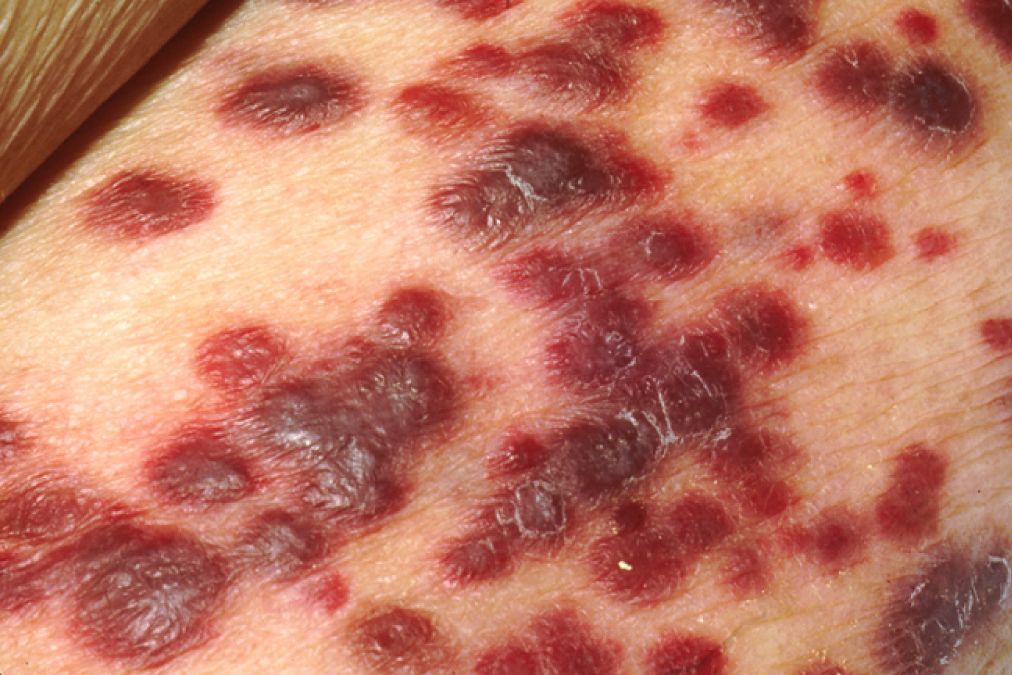
Four more descriptive terms come up constantly and are commonly confused. Pruritus (proo-RYE-tus) means itching — note the spelling, it ends -us, not -itis, because it is not inflammation of anything. Purpura (PUR-pyoo-rah) is bleeding into the skin, seen as purple discoloration that does not blanch under pressure; the small version is petechiae (peh-TEE-kee-ee), singular petechia, and the large flat version is ecchymosis (ek-ih-MOH-sis), plural ecchymoses — a bruise. Edema is swelling from fluid in the tissues. Together these four words let you describe most of what goes wrong on a skin surface without naming a single disease.
Before any diagnosis is made, skin findings are recorded in a fixed descriptive vocabulary — color root plus lesion type plus distribution — and mastering those words lets you chart accurately even when you do not yet know what the rash is.
Section 3Pathology: Infection, Inflammation and Growth
Infections: bacteria, fungi and viruses on the skin
Most skin infection terms are a pathogen root plus a location plus a condition suffix, and once you see the pattern you can decode terms you have never met. Cellul/itis (sel-yoo-LYE-tis) is inflammation of cells — specifically a spreading bacterial infection of the dermis and subcutaneous tissue, usually streptococcal or staphylococcal. Follicul/itis is inflammation of hair follicles. A furuncle (FYOO-rung-kul), or boil, is a deep infection of a single follicle; several furuncles coalescing into one drainage complex form a carbuncle (KAR-bung-kul). An abscess is a walled-off collection of pus, and the standard treatment carries its own abbreviation, I&D, incision and drainage.
Two bacterial genus roots are worth owning outright because they appear across every body system. Staphyl/o means cluster, from the Greek for a bunch of grapes, which is exactly what Staphylococcus looks like on Gram stain. Strept/o means twisted or chain, describing Streptococcus. So staphyl/o/coccus is a cluster-forming round bacterium and strept/o/coccus is a chain-forming one — the shape is written into the name. Impetigo (im-peh-TYE-goh), the honey-crusted superficial infection common in children, is caused by both organisms.
Fungal terms rest on myc/o. Dermat/o/myc/osis is a fungal skin condition; onych/o/myc/osis is a fungal nail condition. The everyday clinical word is tinea (TIN-ee-ah), Latin for a gnawing worm, and it takes a location word: tinea pedis is athlete’s foot, tinea capitis the scalp, tinea corporis the body (ringworm), tinea cruris the groin (jock itch), tinea unguium the nails. There is no worm involved in any of them; the name records a very old wrong guess that stuck. Viral terms include verruca (veh-ROO-kah), a wart, plural verrucae; herpes simplex, the cold sore; and herpes zoster (ZOS-ter), shingles, the reactivation of varicella along a single dermatome.
| Word part | Meaning | Example term | What the example means |
|---|---|---|---|
| staphyl/o | cluster (grapelike) | staphyl/o/coccus | round bacterium growing in clusters |
| strept/o | twisted chain | strept/o/coccus | round bacterium growing in chains |
| bacteri/o | bacteria | bacteri/cid/al | pertaining to killing bacteria |
| myc/o | fungus | onych/o/myc/osis | abnormal fungal condition of the nail |
| vir/o | virus | anti/vir/al | pertaining to acting against a virus |
| cellul/o | little cell | cellul/itis | inflammation of the cells of the skin and subcutis |
| follicul/o | small sac, follicle | follicul/itis | inflammation of hair follicles |
| py/o | pus | py/o/derma | any pus-producing skin disease |
| -cocc(us) | berry-shaped bacterium | enter/o/coccus | berry-shaped bacterium of the intestine |
| -mycosis | abnormal fungal condition | dermat/o/mycosis | fungal disease of the skin |
Inflammatory and chronic skin conditions
Dermatitis is the general term, and most clinical dermatitis terms simply add a modifier. Contact dermatitis follows exposure to an irritant or allergen. Atopic dermatitis is the chronic itchy condition commonly called eczema (EK-zeh-mah). Seborrheic dermatitis (seb-oh-REE-ik) is the flaking of oil-rich areas — scalp, brows, nasolabial folds — and its name decodes straight from seb/o + -rrhea + -ic, pertaining to a flow of sebum. Psoriasis (soh-RYE-ah-sis) is the chronic autoimmune condition producing well-demarcated silvery plaques, most often on extensor surfaces. Urticaria is hives. Acne vulgaris is inflammation of the pilosebaceous unit, and its lesions come with their own words: a comedo (KOM-eh-doh), plural comedones (koh-meh-DOH-neez), is the plugged follicle, open as a blackhead and closed as a whitehead.
Pigment and hair conditions round out the set. Vitiligo (vit-ih-LYE-goh) is patchy loss of melanocytes producing sharply bordered depigmented macules. Albinism is a congenital inability to produce melanin. Melasma is the brown facial patterning associated with pregnancy and hormonal therapy. Alopecia (al-oh-PEE-shee-ah) is hair loss, and alopecia areata is the patchy autoimmune form. Hirsutism (HER-soot-izm) is excessive hair growth in a male pattern on a female patient, and hypertrichosis — hyper/trich/osis, excessive + hair + condition — is generalized excess hair without that pattern implication.
Growths, cancers and tissue loss
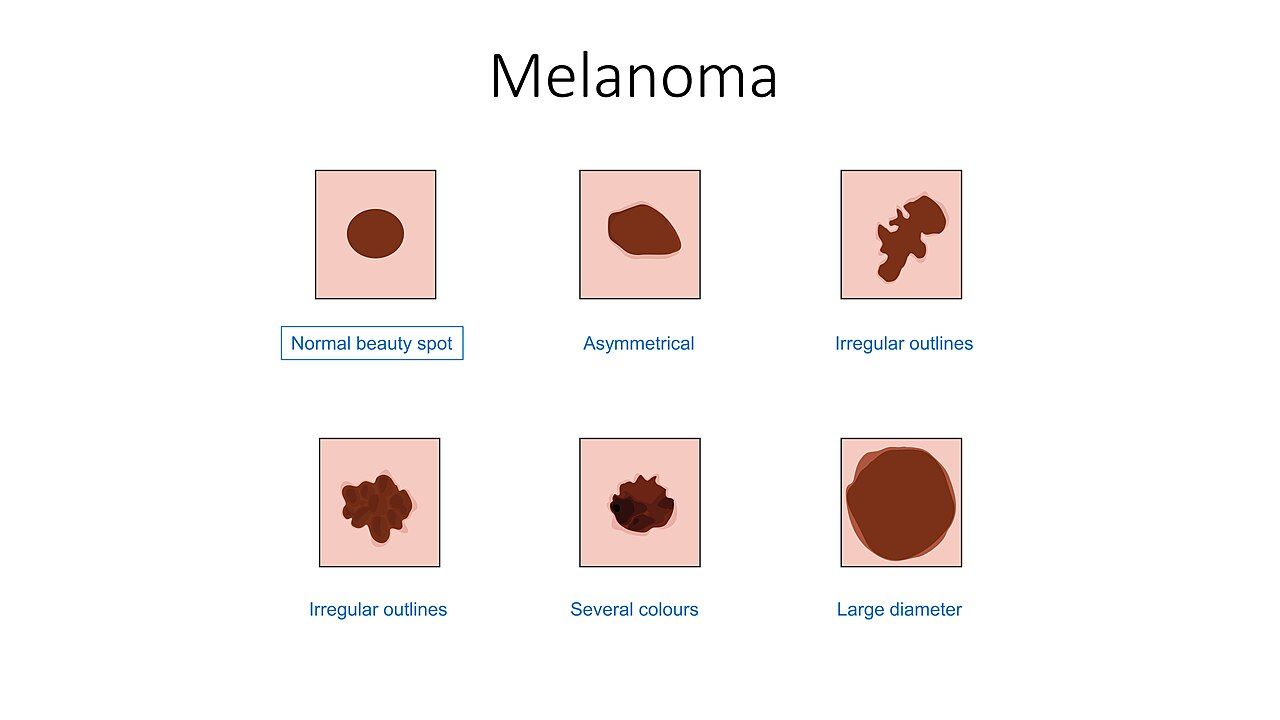
A nevus (NEE-vus), plural nevi (NEE-vye), is a mole. Most are harmless, but the vocabulary of change matters: an atypical or dysplastic nevus is one whose architecture is disordered. The three skin cancers you must be able to name and spell are basal cell carcinoma (BCC), the most common and least likely to metastasize; squamous cell carcinoma (SCC), from the keratinocytes of the epidermis; and malignant melanoma (mel-ah-NOH-mah), melan/oma = black + tumor, the least common of the three but responsible for most skin-cancer deaths. The screening mnemonic is ABCDE: asymmetry, border irregularity, color variation, diameter over six millimeters, evolution over time.
Non-cancerous growths include the keloid, the lipoma, the seborrheic keratosis (a benign stuck-on plaque of older skin), and the actinic keratosis — actin/o means ray or radiation, so this is a sun-induced precancerous scaly lesion, and it matters because a share of them progress to SCC. On the loss side, a pressure injury, formerly decubitus ulcer (deh-KYOO-bih-tus) and still often charted as a bedsore, is tissue breakdown over a bony prominence; the older Latin name comes from decumbere, to lie down. Gangrene (GANG-green) is necrosis with putrefaction, and necrosis itself is simply necr/osis, an abnormal condition of tissue death. Burns are graded by depth — superficial, partial-thickness, full-thickness — and by TBSA, total body surface area, estimated with the rule of nines.
| Term | Pronunciation | Word parts | Meaning |
|---|---|---|---|
| melanoma | mel-ah-NOH-mah | melan/oma | black (pigmented) tumor of melanocytes |
| xeroderma | zee-roh-DER-mah | xer/o/derma | dry skin condition |
| scleroderma | skleer-oh-DER-mah | scler/o/derma | hardening of the skin |
| onychocryptosis | on-ih-koh-krip-TOH-sis | onych/o/crypt/osis | hidden nail; ingrown toenail |
| paronychia | par-oh-NIK-ee-ah | par/onych/ia | infection of tissue beside the nail |
| hyperkeratosis | hye-per-ker-ah-TOH-sis | hyper/kerat/osis | excessive thickening of horny tissue |
| dermatofibroma | der-mah-toh-fye-BROH-mah | dermat/o/fibr/oma | benign fibrous tumor of the skin |
| epidermolysis | ep-ih-der-MOL-ih-sis | epi/derm/o/lysis | separation or breakdown of the epidermis |
| anhidrosis | an-hi-DROH-sis | an/hidr/osis | absence of sweating |
| trichomycosis | trik-oh-my-KOH-sis | trich/o/myc/osis | fungal condition of the hair |
One caution before leaving pathology: melan/o is not only a skin root. It means black, so it appears wherever something is abnormally dark. Melena (MEL-eh-nah or meh-LEE-nah) is black tarry stool from digested upper-gastrointestinal blood — a bleeding emergency, not a dermatologic finding. A familiar root in an unfamiliar system should slow you down, not speed you up.
Skin pathology terms are built from a pathogen or process root plus a structure root plus a condition suffix, so onych/o/myc/osis, dermat/o/myc/osis and trich/o/myc/osis are one pattern applied to three locations rather than three separate facts.
Section 4Diagnostic and Surgical Procedures
Looking, sampling and testing
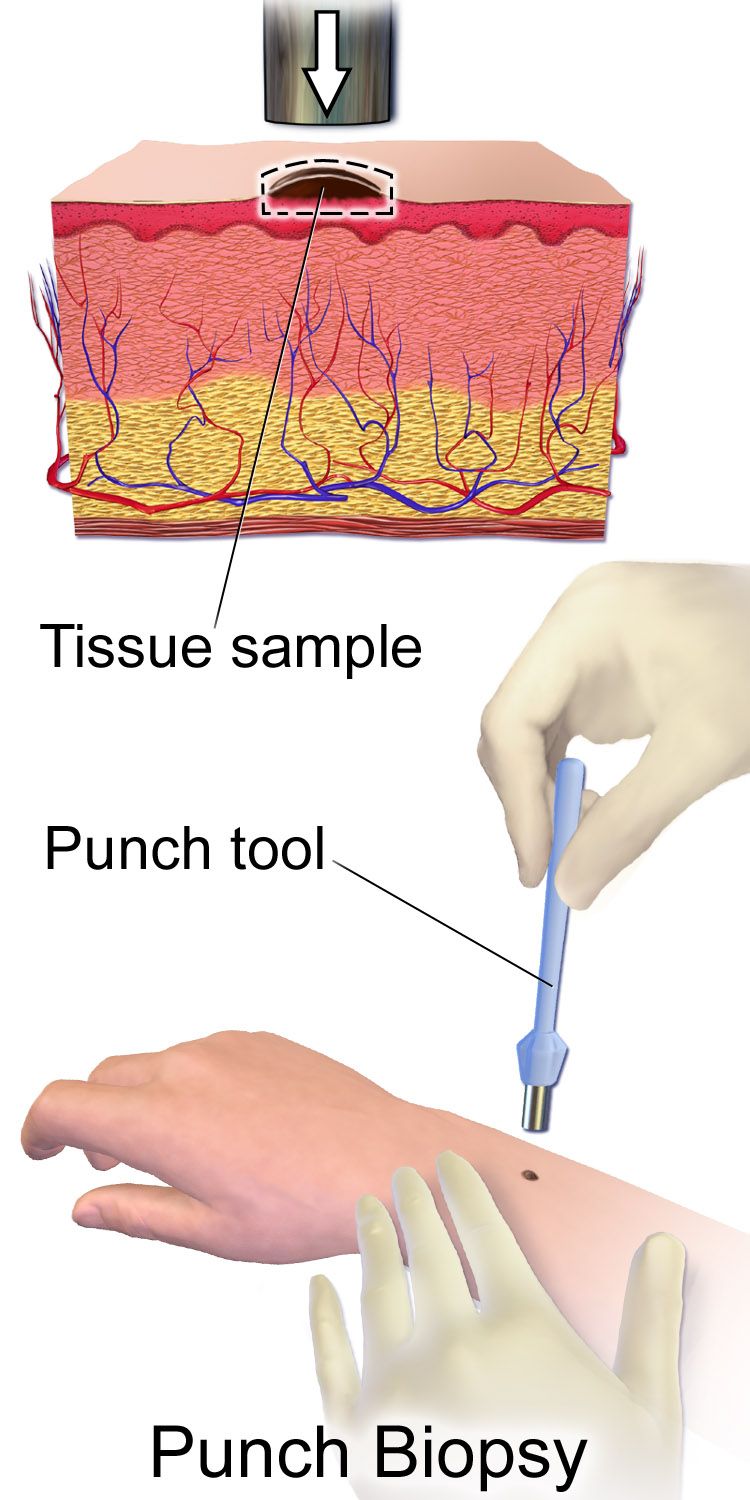
The defining diagnostic procedure of this system is the biopsy (BYE-op-see), bi/opsy = life + view, the removal of tissue from a living patient for microscopic examination. Its four common forms are worth knowing by name because they appear verbatim on procedure notes. A shave biopsy takes a thin horizontal slice of the surface. A punch biopsy uses a circular blade to remove a full-thickness cylinder including dermis. An incisional biopsy removes part of a lesion; an excisional biopsy removes all of it. The prefix difference tells you everything: in- means into, so you cut into the lesion; ex- means out, so you take the lesion out.
Non-invasive testing has its own small vocabulary. Dermatoscopy (der-mah-TOS-koh-pee) — dermat/o/scopy, skin + process of viewing — is magnified polarized examination of a lesion; the instrument is a dermatoscope, and remember from Chapter 2 that -scope names the instrument while -scopy names the procedure. A Wood lamp examination uses ultraviolet light to make certain fungi and pigment changes fluoresce. A KOH prep dissolves keratin with potassium hydroxide so that fungal hyphae become visible under the microscope. Patch testing applies suspected allergens to the back under occlusion to identify contact allergens, and a culture and sensitivity (C&S) grows the organism from a wound swab and tests which antibiotics kill it.
| Word part | Meaning | Example term | What the example means |
|---|---|---|---|
| -opsy | process of viewing | bi/opsy | viewing living tissue under a microscope |
| -scopy | process of visual examination | dermat/o/scopy | magnified examination of a skin lesion |
| -scope | instrument for viewing | dermat/o/scope | the instrument used for that examination |
| -ectomy | surgical removal, excision | lip/ectomy | surgical removal of fatty tissue |
| -tomy | incision, cutting into | eschar/o/tomy | incision through burn eschar to relieve pressure |
| -stomy | surgical creation of an opening | col/o/stomy | opening created between colon and body surface |
| -plasty | surgical repair or reshaping | dermat/o/plasty | surgical repair of the skin |
| -desis | surgical binding or fusion | arthr/o/desis | surgical fusion of a joint |
| cry/o | cold | cry/o/surgery | destruction of tissue by freezing |
| electr/o | electricity | electr/o/desiccation | drying and destroying tissue with electric current |
| -therapy | treatment | phot/o/therapy | treatment using light |
| dermat/o + -logy | study of skin | dermat/o/logy | the medical specialty of the skin |
Removing, destroying and repairing tissue
Surgical dermatology is mostly a set of ways to remove abnormal tissue with the smallest possible cost to normal tissue. Curettage (kyoo-reh-TAHZH) scrapes a lesion away with a spoon-shaped curette, and it is usually paired with electrodesiccation to burn the base — the combination is charted as ED&C. Cryosurgery uses liquid nitrogen to freeze a lesion; cry/o means cold, which is also why cryotherapy and cryopreservation mean what they do. Mohs micrographic surgery removes a tumor in thin horizontal layers, each mapped and examined microscopically before the next is taken, which spares the maximum normal tissue on the face; it is an eponym, named for Frederic Mohs, and unlike many eponyms it remains the standard name with no descriptive replacement in use.
Debridement (dih-BREED-ment or day-breed-MON) is removal of dead, damaged or contaminated tissue from a wound, and it is the workhorse of wound care. It comes in several forms named for the mechanism: sharp (instruments), enzymatic (topical agents), autolytic (the body’s own enzymes under an occlusive dressing) and mechanical. In burn care, an escharotomy (es-kah-ROT-oh-mee) incises the leathery dead tissue called eschar (ES-kar) when circumferential burn is constricting the limb or chest. Note the decode: eschar/o/tomy is cutting into eschar, not removing it — the incision relieves pressure, and that is the whole point of the procedure.
Repair terms use -plasty. Dermatoplasty is surgical repair of the skin. Rhytidectomy (rit-ih-DEK-toh-mee) is rhytid/ectomy, removal of wrinkles — a face lift. Blepharoplasty (BLEF-ah-roh-plas-tee) is surgical repair of the eyelid, from blephar/o. Lipectomy removes fatty tissue and liposuction aspirates it. Dermabrasion sands away the superficial layers to smooth scarring, and chemical peel does the same with a caustic agent.
Grafts and the prefixes that classify them
When skin cannot close a defect on its own, it is replaced with a graft, and the prefixes that classify grafts are among the highest-yield in the whole book because they recur in transplant, blood banking and immunology. Auto- means self, so an autograft uses the patient’s own skin. Allo- means other or different, so an allograft (also called a homograft) comes from another human, often cadaveric. Xen/o means foreign or strange, specifically from a different species, so a xenograft (ZEN-oh-graft), historically called a heterograft, comes from an animal — porcine skin is the classic example. A synthetic or biosynthetic graft is manufactured.
Grafts are also classified by thickness, and the abbreviations are charted constantly. A split-thickness skin graft (STSG) takes epidermis plus part of the dermis and is used for large areas because the donor site heals on its own. A full-thickness skin graft (FTSG) takes epidermis and the entire dermis, gives a better cosmetic and functional result, and requires the donor site to be closed surgically. A flap, by contrast, is moved with its own blood supply still attached. And negative pressure wound therapy (NPWT), the vacuum-assisted dressing, is not a graft at all but prepares a wound bed to accept one.
| Prefix or root | Meaning | Graft term | Tissue source |
|---|---|---|---|
| auto- | self | autograft | the patient’s own body |
| allo- | other, different | allograft (homograft) | another human, often a cadaver donor |
| xen/o | foreign, other species | xenograft (heterograft) | an animal, classically porcine |
| homo- | same | homograft | same species (older term for allograft) |
| hetero- | different | heterograft | different species (older term for xenograft) |
| syn- | together, joined | synthetic graft | manufactured material |
Procedure terms tell you the mechanism before you ever read the note body: the suffix says whether tissue was viewed, cut into, removed or repaired, and the prefix on a graft says where the replacement tissue came from.
Section 5Charting the Skin: Plurals, Abbreviations and Real Documentation
Plurals you will actually have to write
Integumentary terms keep their Greek and Latin plurals more stubbornly than almost any other system, partly because so many of them are old descriptive nouns rather than modern compounds. The rules are few, and they are the same rules that will serve you in every later chapter, so it is worth fixing them here where the examples are concrete.
Words ending in -a take -ae: one bulla, several bullae; one verruca, several verrucae; one petechia, several petechiae. Words ending in -us take -i: one nevus, several nevi; one fungus, several fungi. Words ending in -um take -a: one stratum, several strata; one labium, two labia. Words ending in -is take -es by changing the i to an e: one keratosis, several keratoses (ker-ah-TOH-seez); one diagnosis, several diagnoses. Words ending in -ix or -ex take -ices: one cicatrix, several cicatrices (sik-ah-TRY-seez); one apex, several apices. Words ending in -oma take -omata in strict usage, though English plurals now dominate in charts: fibroma becomes fibromata or, far more commonly, fibromas. And comedo takes the unusual comedones, which is worth memorizing outright because it fits no pattern you can generalize.
| Singular ending | Plural ending | Skin example (singular) | Plural |
|---|---|---|---|
| -a | -ae | bulla | bullae (BULL-ee) |
| -a | -ae | petechia | petechiae (peh-TEE-kee-ee) |
| -us | -i | nevus | nevi (NEE-vye) |
| -um | -a | stratum | strata |
| -is | -es | keratosis | keratoses (ker-ah-TOH-seez) |
| -is | -es | ecchymosis | ecchymoses (ek-ih-MOH-seez) |
| -ix, -ex | -ices | cicatrix | cicatrices (sik-ah-TRY-seez) |
| -oma | -omata (or -omas) | fibroma | fibromata / fibromas |
| -o | -ones | comedo | comedones (koh-meh-DOH-neez) |
| -nx | -nges | phalanx | phalanges (fah-LAN-jeez) |
The abbreviations on a real skin or wound note
Abbreviations are where accuracy stops being academic. Every institution keeps a list of approved abbreviations and a shorter list of forbidden ones, and skin documentation contains several of each. Two deserve early warning. SC and SQ for subcutaneous appear on the Institute for Safe Medication Practices error-prone list because they have been misread as SL (sublingual) and as the number 5; the recommended form is to write subcut or subcutaneously in full. Similarly U for unit is prohibited outright. The safest habit is simple: abbreviate anatomy and diagnoses if your institution allows it, and spell out routes and units.
Pressure injury staging has also changed language, and the change matters for exams and for charting. The National Pressure Injury Advisory Panel replaced pressure ulcer with pressure injury (PI) because the earliest stage involves no ulceration at all, and it added the categories deep tissue pressure injury (DTPI) and unstageable, the latter meaning the wound base is obscured by slough or eschar so depth cannot be determined. Staging runs 1 through 4 in Arabic numerals under current guidance.
| Abbreviation | Stands for | What it means in practice |
|---|---|---|
| BCC | basal cell carcinoma | most common skin cancer, rarely metastasizes |
| SCC | squamous cell carcinoma | cancer of epidermal keratinocytes |
| MM | malignant melanoma | pigment-cell cancer with high metastatic potential |
| AK | actinic keratosis | sun-induced precancerous scaly lesion |
| Bx | biopsy | tissue sampled for microscopic diagnosis |
| I&D | incision and drainage | abscess opened and pus evacuated |
| ED&C | electrodesiccation and curettage | lesion scraped, then base destroyed by current |
| TBSA | total body surface area | percentage of skin burned, by rule of nines |
| STSG / FTSG | split- / full-thickness skin graft | graft depth taken from the donor site |
| NPWT | negative pressure wound therapy | vacuum-assisted wound closure dressing |
| PI / DTPI | pressure injury / deep tissue pressure injury | current terminology replacing pressure ulcer |
| C&S | culture and sensitivity | organism identified and antibiotics tested |
| KOH | potassium hydroxide prep | bedside test for fungal hyphae |
| HSV / VZV | herpes simplex virus / varicella-zoster virus | viruses of cold sores and of chickenpox and shingles |
| MRSA | methicillin-resistant Staphylococcus aureus | resistant organism common in skin abscesses |
| ung | ointment (Latin unguentum) | topical preparation form on a medication order |
| subcut | subcutaneous | preferred spelling; avoid SC and SQ |
Reading a note the way a clinician reads it
Put the chapter together on a single sentence of real charting: Pt with erythematous, well-demarcated plaque, 3 cm, left pretibial area, with surrounding warmth and edema; no fluctuance; wound C&S sent; started on antibiotics for presumed cellulitis. You now decode every clinically loaded word in it. Erythematous is red. A plaque is a raised flat-topped lesion over one centimeter. Pretibial is in front of the tibia, from Chapter 4. Fluctuance is the boggy feel of a fluid collection, and its absence is the reason no I&D is being planned. Cellulitis is inflammation of the cells of the dermis and subcutis. Nothing in that sentence is decoration; each word rules something in or out.
Two final habits will protect you. First, when you meet an unfamiliar skin term, split it at the combining vowel and read it from the suffix backward — dermat/o/myc/osis reads as abnormal condition, of fungus, of the skin. Second, when a term is close to another term you already know, say both out loud before you write either one. The pairs that catch students in this system are always the ones that differ by one letter or one vowel, and hearing them separated is the fastest way to keep them separated on paper.
Charting the skin demands three things at once — correct plurals, institution-approved abbreviations and current terminology such as pressure injury — and getting any one of them wrong changes what the next reader believes about the patient.
The chapter in one breath
The integumentary system gave you three roots for skin — derm/o and dermat/o from Greek, cutane/o from Latin — and paired Greek and Latin roots for every appendage: onych/o and ungu/o for nail, trich/o and pil/o for hair, hidr/o and sudor/i for sweat, with seb/o for oil and adip/o, lip/o and steat/o for fat. Onto those you bolted the color roots that do diagnostic work, the descriptive lesion vocabulary that lets you chart a rash before anyone has named it, and the pathology terms built by stacking a pathogen root, a structure root and a condition suffix — which is why onychomycosis, dermatomycosis and trichomycosis are one idea in three locations. Procedure suffixes then told you what was done: -scopy viewed it, -tomy cut into it, -ectomy removed it, -plasty repaired it, and auto-, allo- and xen/o said where replacement tissue came from. Finally you learned the plurals and the abbreviations a real wound note uses. The through-line is unchanged from Chapter 1: decode, do not memorize.
Words worth knowing
| Term | What it means |
|---|---|
| alopecia (al-oh-PEE-shee-ah) | Loss of hair, partial or complete; alopecia areata is the patchy autoimmune form. |
| bulla (BULL-ah), pl. bullae | A fluid-filled blister larger than one centimeter. |
| cellulitis (sel-yoo-LYE-tis) | Cellul/itis: spreading bacterial inflammation of the dermis and subcutaneous tissue. |
| cicatrix (SIK-ah-triks), pl. cicatrices | A scar; fibrous tissue that replaces normal tissue after injury. |
| comedo (KOM-eh-doh), pl. comedones | A plugged pilosebaceous follicle; open is a blackhead, closed is a whitehead. |
| debridement (dih-BREED-ment) | Removal of dead, damaged or contaminated tissue from a wound. |
| ecchymosis (ek-ih-MOH-sis), pl. ecchymoses | A flat non-blanching area of bleeding into the skin; a bruise. |
| eschar (ES-kar) | The leathery dead tissue overlying a deep burn or wound. |
| hyperhidrosis (hye-per-hye-DROH-sis) | Hyper/hidr/osis: excessive sweating. |
| ichthyosis (ik-thee-OH-sis) | Ichthy/osis: an abnormal condition of dry, fish-scale-like skin. |
| keloid (KEE-loyd) | An overgrown scar that extends beyond the original wound margins. |
| keratosis (ker-ah-TOH-sis), pl. keratoses | Kerat/osis: thickened horny tissue; actinic keratosis is the sun-induced precancerous form. |
| melanoma (mel-ah-NOH-mah) | Melan/oma: malignant tumor of melanocytes, the deadliest common skin cancer. |
| nevus (NEE-vus), pl. nevi | A mole; a benign pigmented lesion of the skin. |
| onychomycosis (on-ih-koh-my-KOH-sis) | Onych/o/myc/osis: fungal infection of the nail. |
| paronychia (par-oh-NIK-ee-ah) | Par/onych/ia: infection of the soft tissue beside the nail fold. |
| petechiae (peh-TEE-kee-ee), sing. petechia | Pinpoint non-blanching hemorrhages in the skin. |
| pruritus (proo-RYE-tus) | Itching; note the ending is -us, not -itis. |
| seborrhea (seb-oh-REE-ah) | Seb/o/rrhea: excessive flow of sebum from the oil glands. |
| xerosis (zee-ROH-sis) | Xer/osis: abnormally dry skin. |