Infancy: Body & Mind
No other stretch of life changes as fast as the first two years. A newborn who cannot hold up her own head becomes, in roughly twenty-four months, a walking, talking person who hunts for a hidden toy and names the family dog. This chapter follows that transformation from the outside in and the inside out — the body that grows head-first, the brain that wires itself against experience, the reflexes that give way to reaching and walking, the senses that come online at different speeds, the first flickers of thought, and the extraordinary emergence of language. Nothing here is trivial; every milestone you will meet is a foundation the rest of development is built on.
By the end of this chapter you can
- Describe the pace and pattern of physical growth in the first two years, including the cephalocaudal and proximodistal directions.
- Explain how the infant brain develops through synaptogenesis, synaptic pruning, and myelination, and what experience-expectant plasticity means.
- Distinguish newborn reflexes from voluntary movement and identify the major survival and primitive reflexes.
- Sequence the major gross- and fine-motor milestones from head control to walking and the pincer grasp.
- Summarize what infants can see, hear, smell, and taste, and the perceptual preferences they show.
- Describe Piaget's sensorimotor stage, its substages, and the gradual emergence of object permanence.
- Trace the roots of language from cooing and babbling to first words and telegraphic speech.
- Compare learning, nativist, and social-interactionist accounts of how language emerges.
Section 1Growth and the brain
How the body grows
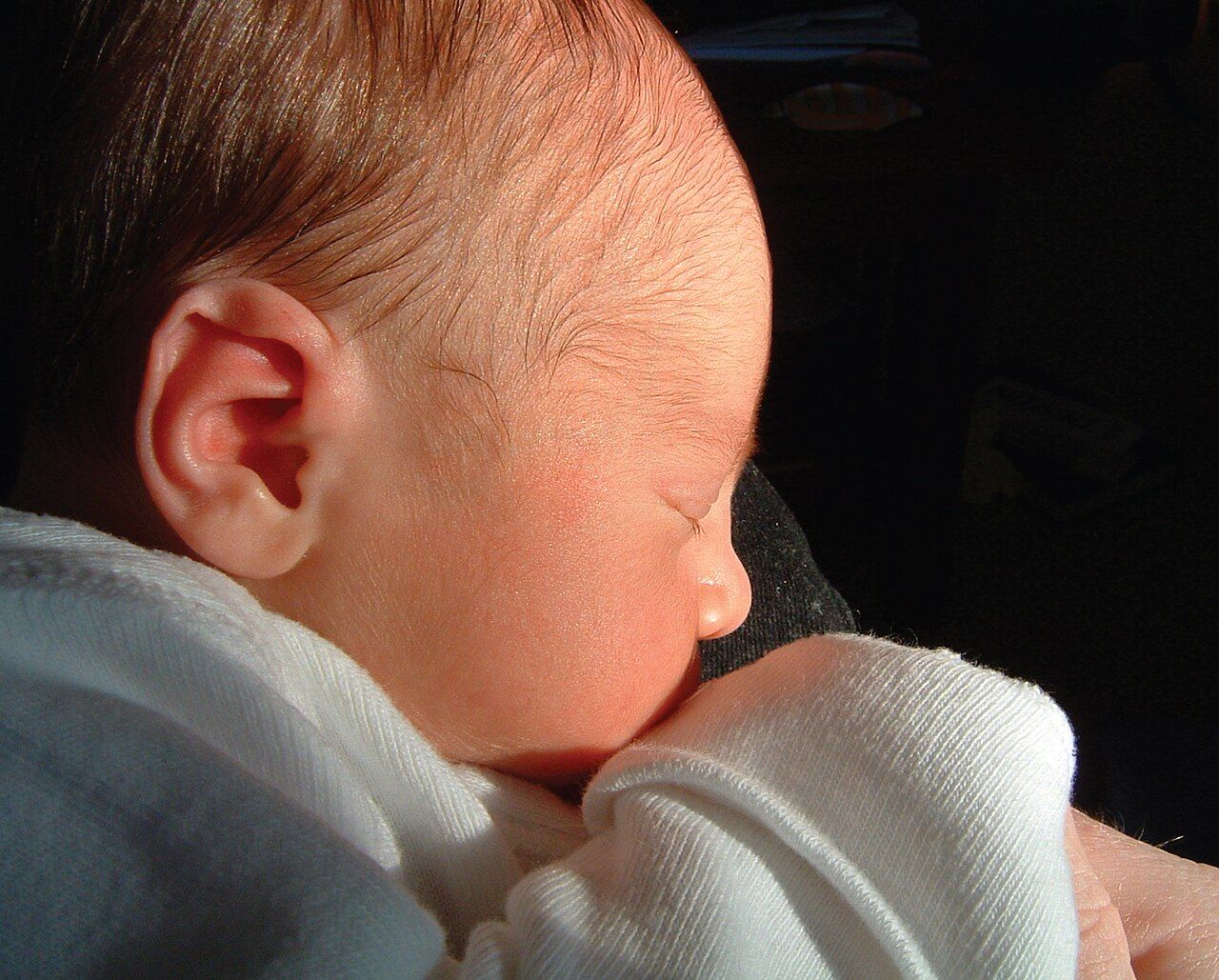
The average newborn arrives weighing about 7.5 pounds (3.4 kg) and measuring roughly 20 inches (50 cm). Growth from there is faster than it will ever be again: most babies double their birth weight by about 5 months and triple it by their first birthday, while adding half again to their length. If that pace continued, a two-year-old would be the size of a small car by kindergarten — which is exactly why growth slows so sharply after infancy.
Growth is not only fast, it is orderly, and it follows two directions worth memorizing. The cephalocaudal principle means growth and control proceed from the head downward — a newborn's head is a full quarter of her body length, and she masters her head, then trunk, then legs. The proximodistal principle means development proceeds from the center outward — the shoulders and hips come under control before the hands and feet, and the whole arm swipes before a single finger points. These two rules quietly explain the order of nearly every motor milestone in the next section.
Building the brain
If the body's growth is dramatic, the brain's is staggering. At birth the brain is only about 25% of its adult weight; by age two it has reached roughly 75%. Yet the newborn already has most of the neurons she will ever own — on the order of 85 billion. What changes is not the number of neurons so much as the connections between them. In a burst called synaptogenesis, neurons sprout an exuberant tangle of synapses, at a peak rate estimated in the tens of thousands of new connections per second across the first months of life. The infant brain deliberately overbuilds, making far more links than it will keep.
Two later processes turn that overgrowth into a working brain. Synaptic pruning eliminates the connections that go unused — a "use it or lose it" sculpting in which experience decides which circuits survive. And myelination, the wrapping of axons in a fatty insulating sheath, speeds neural transmission dramatically; it begins prenatally and continues for years, moving (as growth does) from lower, older brain regions upward toward the cortex. Together, overproduction, pruning, and insulation make the brain both efficient and exquisitely tuned to the world the child actually lives in.
Experience shapes the wiring
Because pruning is guided by use, early experience is not a decoration on brain development — it is part of the mechanism. Psychologists distinguish experience-expectant plasticity, in which the brain counts on inputs virtually every infant receives (patterned light, voices, being handled) to fine-tune universal systems like vision and hearing, from experience-dependent plasticity, in which the brain wires itself around the particular experiences a given child happens to have (a specific language, a specific face). The practical upshot is the idea of a sensitive period: a window during which the right input has an outsized effect, and its absence can leave a lasting gap.
| By this age | Weight | Length/height | Brain (of adult size) |
|---|---|---|---|
| Birth | ~7.5 lb (3.4 kg) | ~20 in (50 cm) | ~25% |
| 5 months | Double birth weight | — | — |
| 12 months | Triple birth weight | ~50% longer than birth | ~65–70% |
| 24 months | ~4× birth weight | ~half of adult height | ~75% |
- Infants grow faster than at any later age — weight doubles by ~5 months, triples by ~12 months.
- Growth follows the cephalocaudal (head-to-foot) and proximodistal (center-to-periphery) directions.
- The brain reaches ~75% of adult size by age two through synaptogenesis, pruning, and myelination.
- Pruning is guided by experience, so early input shapes the brain during sensitive periods.
Section 2Motor development

Born moving: the reflexes
Newborns are not blank and still; they arrive with a repertoire of automatic, stereotyped movements called reflexes. Some are clearly protective survival reflexes: the rooting reflex turns the baby's head toward a cheek that is stroked, the sucking reflex follows, and together they make feeding possible before any of it is learned. Others are primitive reflexes whose purpose is less obvious — the Moro (startle) reflex flings the arms out and back at a sudden loss of support; the palmar grasp closes the hand around anything that touches the palm; the stepping reflex produces walking-like movements when the baby is held upright; and the asymmetrical tonic neck reflex throws one arm out in a "fencing" posture when the head turns.
Most primitive reflexes disappear on a schedule over the first half-year as the cortex matures and takes command of movement. That disappearance is itself diagnostic: a reflex that never appears, or one that lingers well past its expected exit, can be an early sign of a neurological problem. Reflexes, in other words, are both the newborn's starter kit and one of the first windows clinicians have onto how the brain is coming together.
Gross motor: from head to foot
Voluntary gross motor skills — the large movements of the whole body — emerge in a sequence that follows the cephalocaudal rule almost perfectly. Head control comes first (steady by about 2 months), then rolling over (~4 months), sitting without support (~6 months), crawling (~8 months), pulling to stand (~9 months), cruising along furniture, and finally independent walking around the first birthday. The sequence is remarkably consistent across the world; the timing is not. First unaided steps can normally appear anywhere from about 9 to 17 months, and caregiving practices matter — babies given daily practice at sitting or stepping, as in some cultures, reach those milestones earlier.
Modern researchers no longer see this march as simple biological unfolding. In dynamic systems theory, associated with Esther Thelen, each new skill emerges from the interaction of many factors at once — muscle strength, body proportions, balance, motivation, and the specific task — rather than from a maturational clock ticking alone. Walking appears when a baby who wants to reach across the room finally has the leg strength and postural control to make it happen.
Fine motor: the road to the pincer grasp
Fine motor skills — the small, precise movements of the hands and fingers — develop along the proximodistal path from whole-arm to fingertip. A newborn's grasp is a reflex; by about 3 months an infant can bat at a dangling toy, by 4–5 months reach and rake objects into the palm, and by around 9 months oppose thumb and forefinger in a delicate pincer grasp that can pick up a single crumb. That opposable pinch is a quietly momentous achievement — it is the hand movement that later makes writing, buttoning, and tool use possible.
| Approx. age | Gross motor | Fine motor |
|---|---|---|
| 2 months | Holds head steady when upright | Hands begin to open from fists |
| 4 months | Rolls over | Reaches for and bats at objects |
| 6 months | Sits without support | Rakes objects; passes between hands |
| 8–9 months | Crawls; pulls to stand | Pincer grasp emerges |
| 12 months | Stands alone; first steps | Puts objects into a container; releases on purpose |
| 18–24 months | Walks well; runs; climbs stairs | Scribbles; stacks a few blocks |
- Newborns begin with reflexes — survival reflexes (rooting, sucking) and primitive reflexes (Moro, grasp, stepping) that mostly fade by ~4–6 months.
- Gross motor milestones follow the cephalocaudal order: head, roll, sit, crawl, stand, walk.
- Fine motor skills follow the proximodistal path, culminating in the pincer grasp (~9 months).
- Dynamic systems theory frames each skill as emerging from many interacting factors, not a fixed maturational clock; timing varies with practice and culture.
Section 3Sensation and perception
Vision comes into focus
Of all the senses, vision is the least ready at birth. A newborn's acuity is roughly 20/400 — she sees at 20 feet what an adult with sharp vision sees at 400 — and she focuses best at about 8 to 12 inches, which happens to be the distance to a caregiver's face during feeding. Color vision is limited at first and reaches near-adult richness by about 2 to 4 months. Acuity then improves rapidly, approaching adult levels within the first year as the eye and the visual cortex mature. The newborn's world is not a blur of nothing; it is a soft, close-up, high-contrast world centered on the people holding her.
Researchers read the preverbal mind through where babies look. Using the preferential-looking method, Robert Fantz showed that even newborns gaze longer at some patterns than others — they prefer contours, curves, complexity, and, above all, the arrangement of features that makes up a human face. This face bias is present in crude form within hours of birth and helps guarantee that the very first thing a baby attends to is the caregiver she depends on.
The senses that arrive ready
Hearing, by contrast, is well developed before birth. The fetus can hear in the last trimester, and newborns already prefer their mother's voice to a stranger's and prefer the language and stories they were exposed to in the womb — evidence that learning begins prenatally. Newborns turn toward sounds, discriminate a wide range of speech sounds, and show a striking preference for the sing-song, high-pitched, exaggerated speech that adults naturally use with babies.
Smell and taste are also remarkably mature. Newborns turn toward the scent of their own mother's milk and away from foul odors, and they show a clear preference for sweet tastes over sour or bitter ones — a bias that suits an infant whose first and ideal food is sweet breast milk. And the senses do not work in isolation: infants show early intermodal perception, matching what they hear to what they see, such as looking longer at a face whose lip movements match a sound they are hearing.
Depth, and what babies prefer
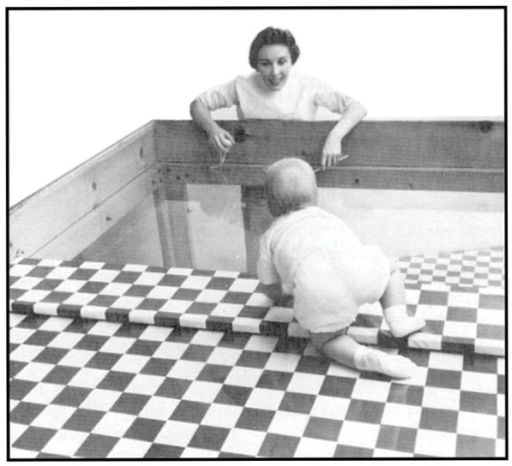
The most famous demonstration of infant perception is the visual cliff, built by Eleanor Gibson and Richard Walk. A baby is placed on a sturdy glass surface, half of which sits over a patterned floor and half over an apparent drop. Most infants old enough to crawl will not venture out over the "deep" side even when a parent beckons — evidence that by the time they are mobile, they perceive depth and treat the drop as real. Interestingly, wariness of the cliff seems tied to the experience of self-produced movement: babies grow cautious of heights after, not before, they begin to crawl.
| Sense | At birth | Reaches near-adult level |
|---|---|---|
| Vision | Blurry (~20/400); focuses best at 8–12 in | Acuity within ~1 year; color by 2–4 months |
| Hearing | Well developed; prefers mother's voice | Refined over the first year |
| Smell | Recognizes mother's scent; avoids foul odors | Mature at birth |
| Taste | Prefers sweet; rejects bitter/sour | Mature at birth |
| Touch | Highly sensitive; basis of reflexes | Mature at birth |
- Vision is the least mature sense at birth (~20/400), sharpest at face distance, and reaches near-adult acuity within a year.
- Infants prefer faces (Fantz's preferential looking), their mother's voice, sweet tastes, and familiar scents.
- Hearing, smell, and taste are largely functional at birth; learning even begins prenatally.
- The visual cliff shows that crawling infants perceive depth, wariness rising with self-produced movement.
Section 4Sensorimotor cognition
Thinking by doing
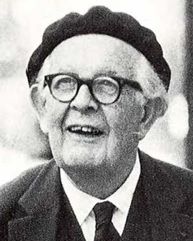
Jean Piaget called the first two years the sensorimotor stage — the first of his four stages of cognitive development, followed by the preoperational, concrete operational, and formal operational stages of childhood and adolescence. The name captures his central claim: infants think with their senses and their actions rather than with symbols and words. A baby "knows" a rattle not as an idea but as something to be grasped, shaken, mouthed, and dropped. Through this handling the infant builds schemes — organized patterns of action — and gradually adapts them to a widening world.
Much of that adapting runs on what Piaget called circular reactions: the infant stumbles onto an interesting result and repeats it over and over. Primary circular reactions center on the baby's own body (sucking a thumb); secondary ones act on objects (shaking a rattle to hear it again); tertiary ones, near the end of infancy, become little experiments (dropping a spoon from different heights to see what happens). In that last playful variation Piaget saw the birth of curiosity and, eventually, of thought itself.
The six substages
Piaget divided the sensorimotor stage into six substages, each a step away from pure reflex and toward genuine mental representation. The infant moves from exercising built-in reflexes, to habits centered on her own body, to acting on the outside world, to combining actions into intentional goal-directed sequences, to actively experimenting, and finally — at around 18 to 24 months — to mental representation, the ability to picture things and actions in the mind. The arrival of representation is the true finish line of infancy: it makes possible language, pretend play, and deferred imitation, in which a toddler copies an action she saw hours or days earlier.
| Substage (approx. age) | Hallmark |
|---|---|
| 1. Reflexes (0–1 mo) | Exercising and refining inborn reflexes |
| 2. Primary circular reactions (1–4 mo) | Repeating pleasurable actions on own body |
| 3. Secondary circular reactions (4–8 mo) | Repeating actions that affect objects |
| 4. Coordination of secondary schemes (8–12 mo) | Intentional, goal-directed behavior; first clear object permanence |
| 5. Tertiary circular reactions (12–18 mo) | Trial-and-error experimentation |
| 6. Mental representation (18–24 mo) | Symbolic thought; deferred imitation; pretend play begins |
Object permanence and its limits
The signature achievement of the sensorimotor stage is object permanence — understanding that objects continue to exist when they cannot be seen, heard, or touched. Piaget argued that young infants lack it entirely: hide a toy under a cloth from a 5-month-old and, for her, it is simply gone ("out of sight, out of mind"). Around 8 months babies begin to search for hidden objects, but they make a revealing mistake Piaget named the A-not-B error: having found a toy under cloth A several times, they keep reaching for A even after watching it hidden under cloth B. Only by the end of infancy is object permanence fully secure.
Later researchers argued that Piaget underestimated infants because his tasks demanded motor skills babies did not yet have. Using gentler violation-of-expectation methods — measuring how long babies stare at "impossible" events — Renée Baillargeon and others found signs of object permanence months earlier than reaching tasks suggest. The modern verdict keeps Piaget's stages as a brilliant map of the sequence of cognition while revising his timetable: infants often know more, and know it sooner, than his reaching tests could reveal.
- Piaget's sensorimotor stage (birth–2) is the first of four stages; infants think through sensing and acting, building schemes.
- Learning advances through primary, secondary, and tertiary circular reactions across six substages.
- Object permanence emerges gradually; the A-not-B error (~8–12 months) shows it is not yet complete.
- Newer methods (Baillargeon) reveal object permanence earlier than Piaget's reaching tasks implied — his sequence holds, his timetable was conservative.
Section 5The roots of language
Before the first word
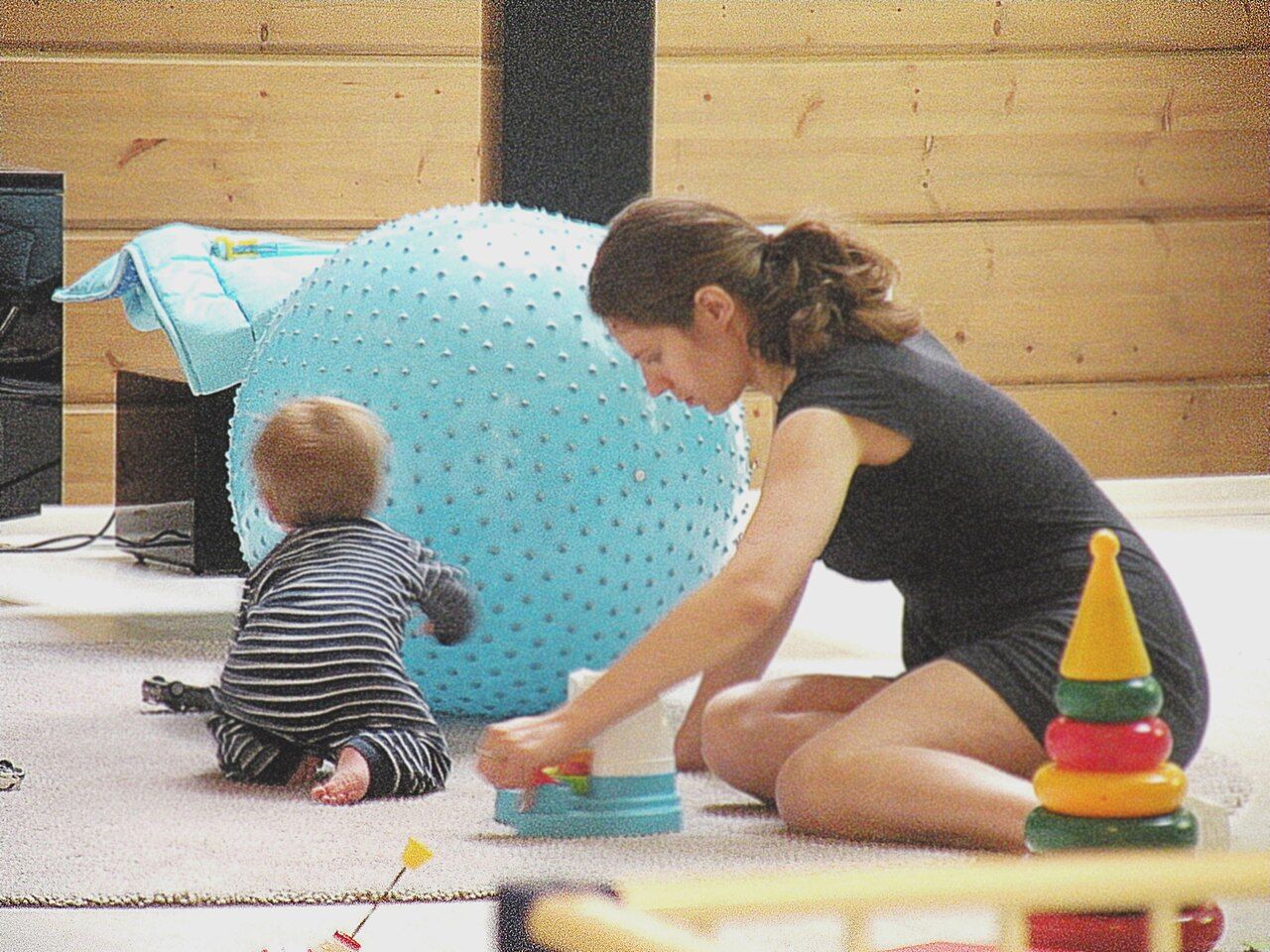
Language does not begin with words; it begins with sound and turn-taking. In the first weeks infants cry and make reflexive noises. Around 2 months comes cooing — drawn-out vowel sounds ("oooh," "aaah") produced in contentment and often traded back and forth with a delighted adult. Around 6 months cooing gives way to babbling: repeated consonant-vowel strings like "ba-ba-ba" and "da-da-da." Strikingly, babies everywhere — including deaf infants, who babble with their hands when exposed to sign language — begin with a similar universal repertoire before their babble drifts toward the particular sounds of the language around them.
Underneath the noise, comprehension runs ahead of production. Infants understand words before they can say them, and their ears are busy learning structure. Newborns can discriminate the speech sounds of every language; but over the first year, in a process called perceptual narrowing (documented by Janet Werker and colleagues), they lose the ability to hear contrasts their native language ignores and sharpen the ones it uses — going from "citizens of the world" to specialists in their mother tongue. Babies also track the statistics of speech, using which syllables tend to follow which to find the boundaries between words in a stream of talk.
From first words to two
The first words typically arrive around the first birthday and are usually names for important people, objects, and events ("mama," "dog," "bye"). Early on a single word does the work of a whole sentence — a holophrase in which "milk!" may mean "I want milk," "that is milk," or "my milk is gone," disambiguated only by context and gesture. Vocabulary grows slowly at first, then many toddlers show a naming explosion or vocabulary spurt in the second year. By around 24 months children combine two words into telegraphic speech — "more juice," "doggy gone" — stripped, like a telegram, to the words that carry the meaning.
How language emerges
How infants accomplish all this so fast is one of the great debates in the field, and three broad answers frame it. The learning view, associated with B. F. Skinner, held that children acquire language through imitation and reinforcement — adults reward sounds and words, shaping speech like any other behavior. The nativist view, argued forcefully by Noam Chomsky, countered that children learn grammar far too quickly and creatively for reinforcement alone; he proposed an inborn language acquisition device and a universal grammar that prepare the human brain to acquire whatever language it meets. The social-interactionist view, in the spirit of Lev Vygotsky, stresses that language grows out of the communicative relationship itself — children are driven to connect, and caregivers scaffold them within it.
That scaffolding has a characteristic sound. Adults across cultures speak to babies in child-directed speech (often called "parentese") — higher-pitched, slower, sing-song, with exaggerated vowels and simple, repetitive phrasing. Far from being silly, it captures infant attention, marks word boundaries, and highlights the sounds of the language, and infants reliably prefer it. Most researchers now see language as the product of all three forces together: a brain prepared to learn language, immersed in a flood of speech, inside a relationship that makes communicating irresistible.
| Approx. age | Language milestone |
|---|---|
| Birth | Crying and reflexive sounds; prefers speech and mother's voice |
| ~2 months | Cooing — vowel sounds in social exchange |
| ~6 months | Babbling — consonant-vowel strings ("ba-ba") |
| ~8–10 months | Understands some words; uses gestures (pointing, waving) |
| ~12 months | First words; single-word holophrases |
| ~18 months | Vocabulary spurt (naming explosion) |
| ~24 months | Two-word telegraphic speech ("more juice") |
- Prelinguistic sequence: crying → cooing (~2 mo) → babbling (~6 mo) → first words (~12 mo).
- Comprehension precedes production, and perceptual narrowing tunes the infant ear to the native language over the first year.
- Single-word holophrases give way to two-word telegraphic speech by ~24 months.
- Language reflects learning (Skinner), nativist (Chomsky), and social-interactionist (Vygotsky) forces together, aided by child-directed speech.
The chapter in one breath
- Infancy brings the fastest growth of life — weight triples in a year — following the cephalocaudal and proximodistal directions.
- The brain overbuilds connections through synaptogenesis, then sculpts them by experience-guided pruning and speeds them by myelination, reaching ~75% of adult size by age two.
- Movement begins as reflexes and gives way to voluntary gross (head→walk) and fine (reach→pincer grasp) motor skills, in a fixed sequence but flexible timing.
- The senses come online at different speeds — vision slowest, hearing/smell/taste nearly ready — and infants prefer faces, the mother's voice, and sweetness; the visual cliff reveals depth perception.
- In Piaget's sensorimotor stage, infants think through action and gradually master object permanence, with the A-not-B error marking its incompleteness.
- Language grows from cooing and babbling to first words and telegraphic speech, tuned by perceptual narrowing and nourished by child-directed speech.
- Body and mind advance together, each milestone a foundation the next stage of development is built upon.
ReferenceWords worth knowing
A quick reference for the terms in this chapter — skim it now, or circle back whenever a word trips you up.
- A-not-B error
- An infant's mistake of reaching for a hidden object where it was previously found (location A) rather than where it was just hidden (location B); a sign that object permanence is not yet complete.
- Babbling
- The repetition of consonant-vowel syllables ("ba-ba-ba") that begins around 6 months, at first universal, then narrowing toward the native language.
- Cephalocaudal principle
- The head-to-foot direction of growth and motor control — the head develops before the trunk, which develops before the legs.
- Child-directed speech
- The higher-pitched, slower, sing-song speech ("parentese") adults use with infants, which captures attention and highlights the sounds of language.
- Circular reaction
- In Piaget's theory, an infant's repetition of an action that produced an interesting result; primary (own body), secondary (objects), and tertiary (experimentation) forms appear in turn.
- Cooing
- Drawn-out vowel sounds produced in contentment beginning around 2 months, often exchanged with a caregiver.
- Deferred imitation
- Copying an action seen at an earlier time; evidence of mental representation, emerging near the end of the sensorimotor stage.
- Fine motor skills
- Small, precise movements of the hands and fingers, such as grasping and the pincer grasp.
- Gross motor skills
- Large movements involving the whole body, such as sitting, crawling, and walking.
- Holophrase
- A single word used to express a whole thought ("milk!"), typical of the earliest word use.
- Myelination
- The coating of axons in a fatty sheath that greatly speeds neural transmission; begins prenatally and continues for years.
- Object permanence
- The understanding that objects continue to exist even when they cannot be perceived; a hallmark of the sensorimotor stage.
- Perceptual narrowing
- The first-year process by which infants lose sensitivity to speech (and face) distinctions their environment does not use, and sharpen the ones it does.
- Pincer grasp
- Picking up small objects with opposed thumb and forefinger, emerging around 9 months.
- Proximodistal principle
- The center-to-periphery direction of development — control of the trunk and shoulders precedes control of the hands and fingers.
- Reflex
- An automatic, involuntary response to a stimulus; newborns show survival reflexes (rooting, sucking) and primitive reflexes (Moro, grasp, stepping).
- Scheme
- In Piaget's theory, an organized pattern of thought or action used to make sense of experience.
- Sensorimotor stage
- Piaget's first stage of cognitive development (birth–2), in which infants know the world through sensing and acting.
- Synaptic pruning
- The elimination of unused neural connections, guided by experience — a "use it or lose it" refinement of the brain.
- Synaptogenesis
- The rapid formation of synapses (connections between neurons), which peaks in infancy.
- Telegraphic speech
- Two-word utterances ("more juice") that keep only the essential words, appearing around 24 months.
- Visual cliff
- An apparatus with a glass-covered apparent drop-off, used by Gibson and Walk to test depth perception in crawling infants.