Infancy: Social & Emotional
Long before a baby can walk or speak, a whole emotional life is already underway. In the first year, an infant sorts the world into what is safe and what is not, learns whose face means comfort, and begins the lifelong project of managing feeling. This chapter follows four threads that braid together across infancy and toddlerhood — the temperament a child is born with, the attachment they form to a caregiver, the earliest crises of trust and independence, and the emotions that unfold on a surprisingly regular schedule. Woven through all of them is a single truth: development is a relationship, not a solo performance. The people who hold, feed, comfort, and respond to a baby are not the backdrop to this story; they are half of it.
By the end of this chapter you can
- Define temperament and describe the easy, difficult, and slow-to-warm-up profiles.
- Explain goodness of fit and why it predicts outcomes better than temperament alone.
- Summarize Bowlby's attachment theory and the ideas of the secure base and internal working model.
- Describe Ainsworth's Strange Situation and the four attachment patterns it reveals.
- State the central conflict and virtue of Erikson's first two psychosocial stages.
- Lay out the rough timetable of emotional development and explain social referencing.
- Explain how responsive caregiving, non-parental childcare, and early adversity shape the developing infant.
Section 1Temperament

What temperament is
Ask any parent of two children and you will hear the same thing: they were different from day one. One nursed on a schedule, slept through the night, and greeted strangers with a grin; the other startled at every sound, cried hard and long, and took a week to accept a new food. That early, biologically based style of responding to the world — how intensely a baby reacts, how quickly they settle, how they approach the unfamiliar — is called temperament. It is not the same as personality, which is built over years from temperament plus experience, values, and choices. Temperament is the raw material: the emotional and behavioral tendencies a child shows before the world has had much chance to shape them.
The classic map of temperament comes from the New York Longitudinal Study, begun in the 1950s by Alexander Thomas and Stella Chess. They rated babies on nine dimensions — activity level, rhythmicity (regularity of sleeping and eating), approach or withdrawal to new things, adaptability, intensity of reaction, threshold of responsiveness, quality of mood, distractibility, and attention span. When they looked at how these traits clustered, three recognizable profiles emerged, along with a large group of children who did not fit neatly into any one of them.
Three classic profiles
About forty percent of the babies were easy: regular in their rhythms, positive in mood, and quick to accept new people and situations. Roughly ten percent were difficult: irregular, intense, slow to adapt, and prone to negative moods and loud protest. Another fifteen percent were slow-to-warm-up: mild but wary, tending to withdraw from novelty at first and needing repeated, low-pressure exposure before they came around. The remaining third were a blend that resisted a single label — a reminder that these categories describe tendencies, not fixed types.
| Style | Share of babies | What it looks like | Caregiving that fits |
|---|---|---|---|
| Easy | ~40% | Regular routines, cheerful mood, adapts readily to new foods, people, places | Enjoyable and low-friction; still needs attention, not just convenience |
| Difficult | ~10% | Irregular, intense reactions, slow to adapt, frequent negative mood and hard crying | Patience, calm, predictable structure; avoid escalating the intensity |
| Slow-to-warm-up | ~15% | Mild but cautious; withdraws from novelty, warms with gentle repeated exposure | Gradual, pressure-free introductions; do not push or label as “shy” |
| Blend / unclassified | ~35% | Mix of traits that does not fall cleanly into one profile | Read the individual child rather than the category |
A related line of work by Jerome Kagan focused on one dimension in particular: behavioral inhibition, the tendency to react to unfamiliar people and events with caution, wariness, and physiological arousal. Highly inhibited infants — roughly the same group Thomas and Chess would call slow-to-warm-up — show measurable differences in heart rate and stress reactivity, and are somewhat more likely to be reserved later in childhood. Yet even here the link is a tendency, not a sentence: many inhibited babies grow into comfortable, sociable children, especially when caregivers gently support rather than force their approach to the new.
Goodness of fit
The most useful idea Thomas and Chess left us is not the list of types but the concept of goodness of fit — the match between a child's temperament and the demands, expectations, and style of their environment. A slow-to-warm-up toddler thrust into a loud, ever-changing daycare with a brisk caregiver has a poor fit and may struggle; the same child in a calm room with an adult who allows a slow approach has a good fit and may thrive. What predicts a child's outcome is rarely the temperament in isolation. It is whether the people around the child adjust to who the child actually is.
- Temperament is the early, biologically based style of emotional and behavioral response; personality is built on top of it.
- Thomas and Chess named three profiles — easy (~40%), difficult (~10%), and slow-to-warm-up (~15%) — with a large blended group.
- Kagan's behavioral inhibition describes wary, physiologically reactive infants who often, but not always, stay reserved.
- Goodness of fit — temperament matched to environment — predicts outcomes better than temperament alone.
Section 2Attachment

Bowlby: the biology of the bond
The British psychiatrist John Bowlby proposed that the tie between an infant and a caregiver is not a byproduct of feeding, as earlier theories held, but an evolved behavioral system in its own right. A human infant cannot survive alone; the ones who stayed close to a protector — who cried when separated, smiled to draw the adult near, and clung when frightened — were the ones who lived. Attachment, in Bowlby's view, is the emotional machinery that keeps a helpless baby near a source of protection. Its biological goal is proximity; its felt goal is security.
Two of Bowlby's ideas travel everywhere in this field. The first is the secure base: a trusted caregiver serves as a home port from which the infant ventures out to explore, returning for reassurance when the world gets frightening. Watch a securely attached toddler at a playground and you will see the pattern — a foray toward the slide, a glance back to check the parent is still there, then a bolder foray. The second is the internal working model: from thousands of small interactions, the baby builds an unconscious template of what relationships are like — whether people can be counted on, whether the self is worth responding to — a model that quietly shapes expectations of others for years. Bowlby also argued that roughly the first two to three years are a sensitive period for forming this first bond, with some continuing sensitivity to about age five — a claim later research softened but did not overturn. Harry Harlow's famous studies with infant monkeys, who clung to a soft cloth “mother” over a wire one that fed them, drove home Bowlby's central point: what the infant seeks first is not food but contact comfort.
Ainsworth's Strange Situation
Bowlby's collaborator Mary Ainsworth turned the theory into something measurable. Her laboratory procedure, the Strange Situation, is a carefully staged sequence of about eight brief episodes for a roughly one-year-old: the baby and caregiver enter an unfamiliar room, a stranger joins them, the caregiver leaves and returns, leaves again, and returns once more. The point is not the separation itself but the reunion — how the baby uses the caregiver, and especially how the baby behaves when the caregiver comes back, reveals the quality of the bond.
Ainsworth found that securely attached babies used the parent as a secure base, protested at separation, and were readily comforted at reunion — then went back to play. Others showed organized but insecure patterns: some seemed indifferent, some inconsolable. Years later, Mary Main and Judith Solomon identified a fourth group whose behavior had no coherent strategy at all.
Four patterns of attachment
| Pattern | In the Strange Situation | Typical caregiving history | Roughly (Western samples) |
|---|---|---|---|
| Secure (B) | Explores using parent as base; distressed at separation; comforted quickly at reunion, then resumes play | Sensitive, consistent, responsive to signals | ~60–65% |
| Insecure-avoidant (A) | Little distress at separation; ignores or avoids parent at reunion; treats stranger similarly | Consistently unresponsive, rejecting, or intrusive | ~15–20% |
| Insecure-resistant / ambivalent (C) | Very distressed at separation; seeks yet resists contact at reunion — clings and pushes away, hard to soothe | Inconsistent — responsive sometimes, unavailable other times | ~10–15% |
| Disorganized (D) | Contradictory, confused behavior — freezing, approaching then backing away; no coherent strategy | Frightening, frightened, or abusive/neglectful care | ~5–15% |
The strongest predictor of a secure attachment is caregiver sensitivity — the knack of reading a baby's signals accurately and responding promptly and warmly. It is not about being perfect or endlessly available; it is about being reliably readable. Attachment patterns also vary across cultures in their proportions — more avoidant classifications appear in samples that prize early independence, more resistant ones where infants are rarely apart from mothers — a caution against reading the categories as universal grades rather than descriptions.
- Bowlby saw attachment as an evolved system for keeping infants near protection, giving us the secure base and internal working model.
- Ainsworth's Strange Situation reads attachment quality from the infant's behavior at reunion.
- The four patterns are secure, insecure-avoidant, insecure-resistant, and disorganized.
- Caregiver sensitivity — accurate, prompt, warm responding — is the best predictor of security.
Section 3Trust and autonomy
Erikson's psychosocial vision
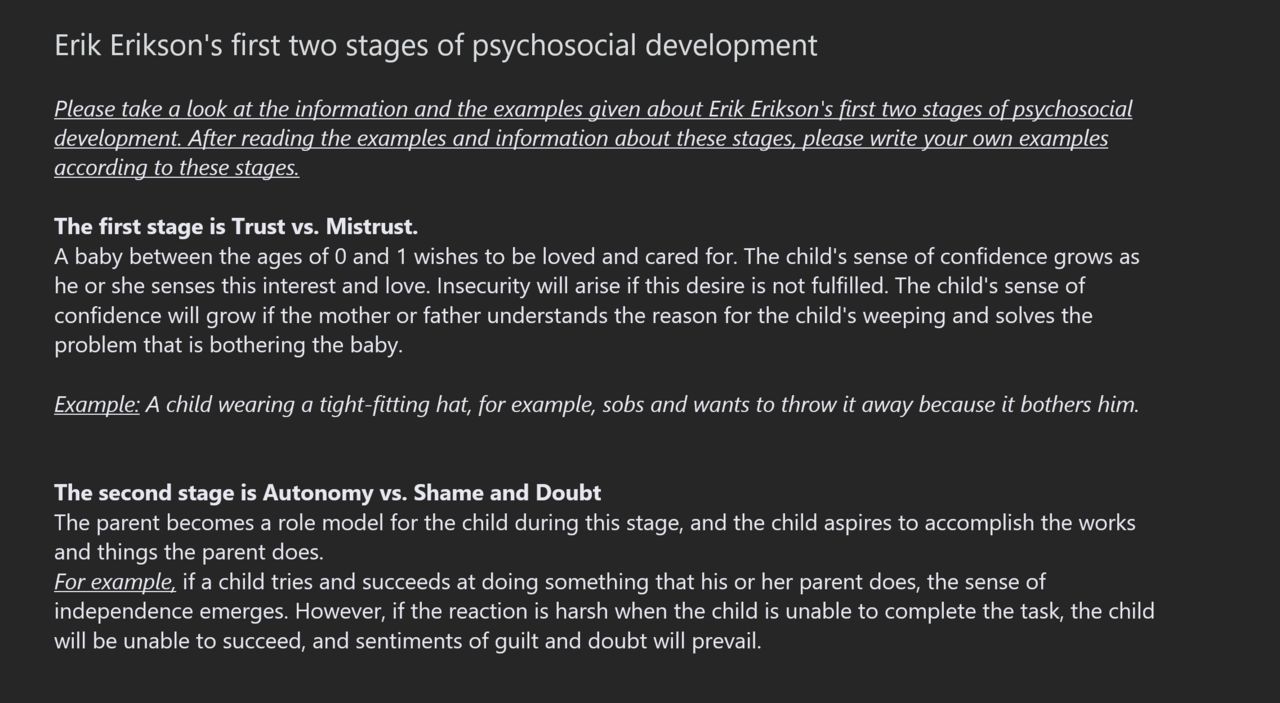
Erik Erikson reimagined development as a lifelong series of eight psychosocial stages, each organized around a central tension between two pulls. At every stage the person faces a “crisis” — not a catastrophe, but a turning point — and how it is resolved leaves the person with a lasting strength, or virtue, and colors how the next crisis is met. Where Freud emphasized bodily drives, Erikson emphasized the social world: the crises are worked out in relationships, first with caregivers, later with peers, partners, and society. The first two stages fall squarely in the years this chapter covers, and they map beautifully onto the attachment and temperament themes we have just met.
Stage 1: Trust versus mistrust
The first stage, spanning roughly the first year, pits trust against mistrust. The infant's whole question is elemental: Is the world a dependable place? When hunger is met with feeding, distress with comfort, and cold with warmth — reliably, warmly, and soon enough — the baby builds a bedrock sense that needs will be answered and people can be counted on. Erikson called the resulting strength hope. When care is neglectful, harsh, or wildly unpredictable, the infant instead learns a wary, guarded stance toward the world. Notice how closely this echoes attachment: the sensitive, responsive caregiving that produces a secure attachment is the same caregiving that resolves the trust crisis in favor of hope.
Stage 2: Autonomy versus shame and doubt
The second stage, roughly ages one to three, brings autonomy versus shame and doubt. The toddler is suddenly mobile, willful, and capable — walking, climbing, feeding themselves, insisting “me do it” and, gloriously, “no.” The task is to develop a sense of independent will: the confidence that one can act on the world and make things happen. Caregivers who allow safe exploration and reasonable choices — which shirt, which snack, a chance to try the zipper before help arrives — foster autonomy and its virtue, will. Caregivers who are over-controlling, mocking, or impatient with a toddler's fumbling and accidents can instead instill shame and doubt, a nagging sense that one's own impulses are bad and one's efforts inadequate. Even toilet training, Erikson's chosen example, is really about this larger question of who controls the child's own body and choices.
| Stage | Age | Central conflict | Virtue if resolved | If unresolved |
|---|---|---|---|---|
| 1. Trust vs. mistrust | Birth–~1 yr | Is the world dependable? | Hope | Wariness, insecurity, difficulty trusting |
| 2. Autonomy vs. shame & doubt | ~1–3 yr | Can I act on my own? | Will | Shame, self-doubt, over-dependence |
Erikson did not think a stage was ever “finished.” A person who leaves infancy with a good balance — mostly trust, with a healthy sliver of caution; mostly autonomy, with the humility to accept help — carries that resolution forward as a resource. Later experiences can revise an early outcome in either direction, but the tone set in the first years is the one everything else is added to.
- Erikson described eight psychosocial stages, each a crisis whose resolution yields a lasting virtue.
- Stage 1, trust vs. mistrust (infancy), asks whether the world is dependable; its virtue is hope.
- Stage 2, autonomy vs. shame and doubt (toddlerhood), builds independent will; its virtue is will.
- The trust crisis mirrors attachment; supporting a toddler's safe exploration fosters autonomy.
Section 4Emotional development

The timetable of feeling
Emotions do not all arrive at once; they unfold on a schedule that is remarkably consistent across babies. The basic (primary) emotions — interest, distress, disgust, and soon joy, anger, sadness, surprise, and fear — appear in the first months and are recognizable on the face. Newborns show contentment and distress almost immediately. By around six to eight weeks comes the social smile, the first smile aimed at a human face rather than reflexively during sleep, and one of the most reinforcing events in a parent's life. Laughter follows near four months. Anger and sadness become clearly readable by the middle of the first year, and fear emerges around six to nine months — announced by two famous milestones, stranger anxiety (wariness of unfamiliar people) and separation anxiety (distress when the caregiver leaves), both of which peak in the second half of the first year and into the second.
A second wave, the self-conscious (secondary) emotions — embarrassment, envy, and empathy, then pride, shame, and guilt — requires something the baby does not yet have: a sense of self and, later, an awareness of standards. Embarrassment and simple empathy appear around eighteen months, roughly when toddlers first recognize themselves in a mirror. Pride, shame, and guilt, which depend on measuring the self against a rule, wait until closer to age two or three. You cannot feel proud of an accomplishment or ashamed of a spill until you have a “me” to attach the feeling to.
| Emotion | Roughly when it appears | What it depends on |
|---|---|---|
| Distress, contentment, interest, disgust | Birth | Innate, reflexive; present from the start |
| Social smile (joy) | ~6–8 weeks | Attention to the human face |
| Anger, sadness, surprise | ~4–6 months | Growing perception and expectation |
| Fear — stranger & separation anxiety | ~6–9 months | Memory, attachment, and awareness of who is safe |
| Empathy, embarrassment (self-conscious) | ~18 months | Sense of self (mirror self-recognition) |
| Pride, shame, guilt | ~2–3 years | Self plus awareness of standards and rules |
Reading other people: social referencing
Somewhere around eight to ten months, infants begin doing something socially sophisticated: when they meet an ambiguous, uncertain situation, they look to a trusted adult's face and use that person's emotional expression to decide what to do. This is social referencing. In the classic “visual cliff” studies, babies at the edge of an apparent drop-off would cross toward mother if her face showed joy or interest, but freeze and retreat if her face showed fear. The infant is, in effect, borrowing the caregiver's appraisal of the world — a powerful early channel for learning what is safe, what is dangerous, and how one is supposed to feel about the unfamiliar. It also means an anxious caregiver and a calm one can hand a baby very different emotional lessons about the same event.
Learning to manage feeling
Feeling an emotion is one thing; managing it is another, and emotional regulation — the ability to modulate the intensity and duration of feeling — develops slowly and, at first, entirely from the outside. A newborn cannot calm itself; it depends on a caregiver to rock, shush, feed, and soothe. This early co-regulation is where regulation is learned: through thousands of episodes of being soothed, the infant gradually internalizes the ability to settle. By the end of infancy, toddlers show the first crude self-soothing strategies — looking away from something upsetting, seeking a blanket or a thumb, toddling to a parent. A child's temperament sets the difficulty of the task, but the caregiver supplies most of the early answer.
- Basic emotions appear in the first months (social smile ~6–8 weeks; fear, with stranger and separation anxiety, ~6–9 months).
- Self-conscious emotions (embarrassment, empathy, then pride, shame, guilt) require a sense of self and, later, standards.
- Social referencing (~8–10 months) means using a caregiver's facial expression to interpret an uncertain situation.
- Emotional regulation begins as caregiver-supplied co-regulation and is gradually internalized.
Section 5The caregiving context
Responsive relationships: serve and return
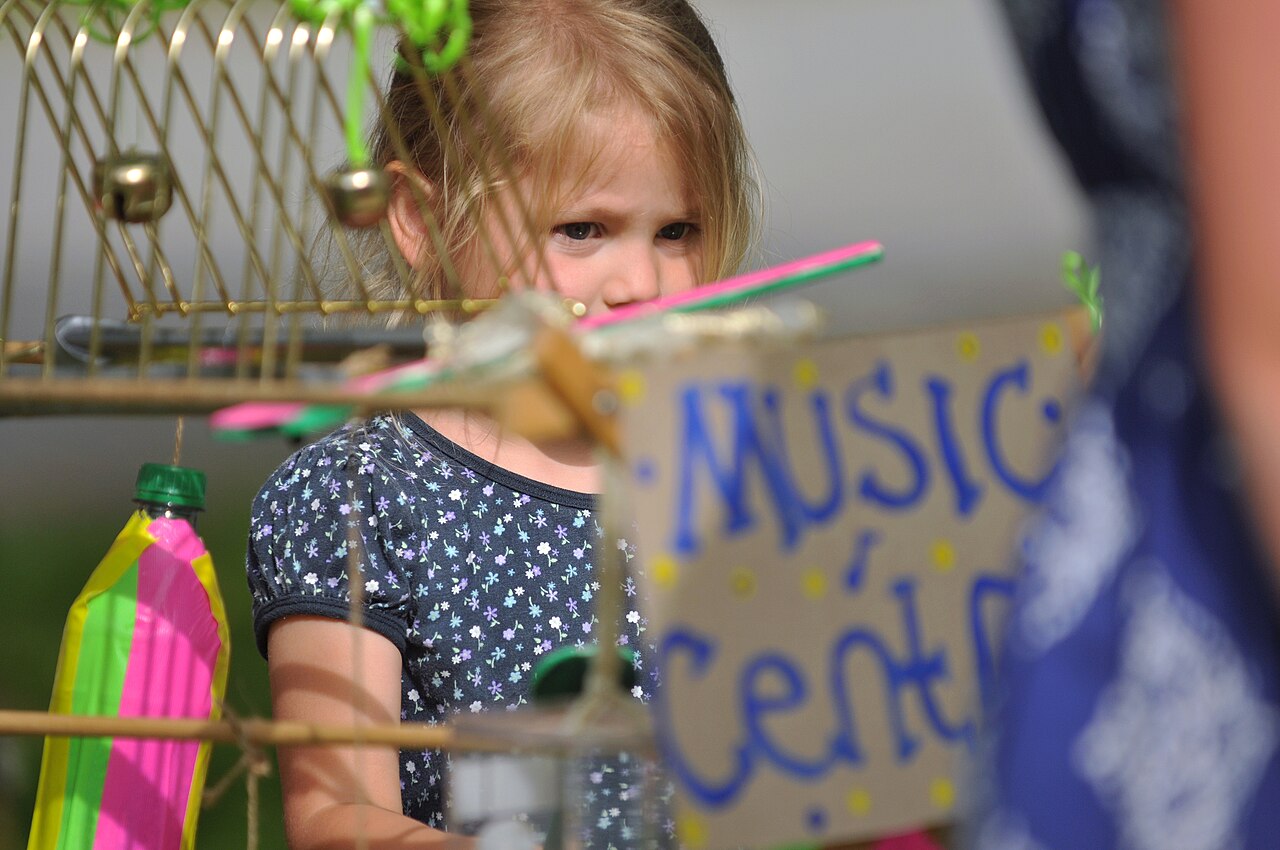
Everything in this chapter points to a single mechanism: the developing infant is built through back-and-forth interaction with responsive people. Developmental scientists call this serve-and-return — the baby “serves” with a coo, a gaze, a reach, or a cry, and the caregiver “returns” by answering in kind. These tiny exchanges, repeated thousands of times a day, are the raw experience from which attachment, emotional regulation, and even brain architecture take shape. Edward Tronick's still-face experiment shows how much the return matters: when a mother who has been playing warmly suddenly holds a blank, unresponsive face, her baby within seconds grows agitated, works hard to win her back, and then, failing, withdraws in distress. Infants do not merely enjoy responsive interaction; they depend on it and protest its absence.
Crucially, the responsive person need not be the mother, and need not be only one person. Fathers, grandparents, older siblings, and other regular caregivers — what anthropologists call alloparents — can all serve as attachment figures, and babies commonly form a small hierarchy of attachments rather than a single one. Cultures distribute infant care very differently, from the intensive one-caregiver model to communities where a baby is passed among many hands, and healthy development occurs across this whole range. What matters is not the configuration but whether the child has at least one stable, responsive relationship.
When care happens elsewhere
Because so many infants spend part of the day in non-parental childcare, the question of its effects has been studied intensively, most famously in a large longitudinal study of early childcare. That research separates two questions — how good the care is and how much of it there is — and they gave different answers. Quality is what predicts thinking and talking: high-quality care — responsive caregivers, low child-to-adult ratios, stable staff, safe and stimulating rooms, and warm verbal interaction — is associated with better cognitive and language outcomes and does not, on its own, weaken the parent-child attachment. Quantity told a separate story: more cumulative hours in non-parental care, particularly center-based care, showed a small association with more externalizing (acting-out) behavior, and that link held even when the care was of high quality. Both effects were modest — smaller than the influence of family circumstances and the sensitivity of parenting at home, which remains the strongest single influence on a child. The reassuring headline is that a securely attached baby can flourish in a good childcare setting.
| Feature of high-quality care | Why it matters |
|---|---|
| Low child-to-adult ratio | Each infant can get prompt, individual, responsive attention |
| Stable, consistent caregivers | Lets the baby form a secure relationship rather than starting over |
| Warm, responsive interaction | Provides the serve-and-return that builds regulation and language |
| Safe, clean, stimulating space | Supports exploration without hazard — a secure base to venture from |
| Rich talk and reading | Feeds early language, the strongest cognitive payoff of good care |
Deprivation, stress, and resilience
The clearest evidence for how much relationships matter comes, tragically, from their absence. Studies of infants raised in severely depriving institutions — the Romanian orphanages of the late twentieth century are the best documented — found profound delays in growth, cognition, language, and attachment. Yet the same research delivered a hopeful counterpart: children moved into responsive foster families, especially before roughly age two, recovered substantially, evidence both for a sensitive period in early relationship-building and for genuine plasticity afterward. Short of such extremes, chronic toxic stress — the sustained adversity of poverty, neglect, or a caregiver's untreated depression — can dysregulate a baby's developing stress system and shape development for the worse.
The protective factor, again and again, is a relationship. A single stable, responsive caregiver can buffer a child against remarkable adversity, which is why resilience is best understood not as a trait a lucky child is born with but as something built by the people around them. The practical message of this chapter is therefore also its most hopeful: the surest way to support an infant's social and emotional development is to protect and strengthen the relationships that surround them.
- Serve-and-return interaction is the engine of early development; the still-face experiment shows how much infants depend on it.
- Babies can attach to multiple caregivers (alloparents); what matters is at least one stable, responsive relationship.
- In childcare research, quality predicts cognitive and language gains, while more cumulative hours (especially center-based) show a small link to externalizing behavior even in good settings; family and parenting outweigh both.
- Severe deprivation harms development, but responsive relationships drive recovery and build resilience.
The chapter in one breath
- Temperament is the early, biological style of responding — easy, difficult, or slow-to-warm-up — but goodness of fit with the environment predicts outcomes better than the trait alone.
- Bowlby cast attachment as an evolved system for staying near protection, giving us the secure base and the internal working model.
- Ainsworth's Strange Situation reveals four patterns — secure, insecure-avoidant, insecure-resistant, and disorganized — with caregiver sensitivity the best predictor of security.
- Erikson's first stage is trust vs. mistrust (virtue: hope); his second is autonomy vs. shame and doubt (virtue: will).
- Emotions unfold on a schedule: the social smile by ~6–8 weeks, fear and stranger/separation anxiety by ~6–9 months, and self-conscious emotions after a sense of self emerges.
- Social referencing lets babies read a caregiver's face to interpret uncertain situations, and emotional regulation starts as caregiver co-regulation.
- Development runs on responsive relationships; quality childcare can help, severe deprivation harms, and a stable, responsive bond builds resilience.
ReferenceWords worth knowing
A quick reference for the terms in this chapter — skim it now, or circle back whenever a word trips you up.
- Attachment
- The enduring emotional bond between an infant and a caregiver that keeps the infant near a source of protection and comfort.
- Autonomy versus shame and doubt
- Erikson's second psychosocial stage (~1–3 yr), in which toddlers develop independent will; its virtue is will.
- Difficult temperament
- A profile marked by irregular routines, intense reactions, slow adaptation, and frequent negative mood (Thomas & Chess).
- Disorganized attachment
- An insecure pattern with contradictory, confused reunion behavior and no coherent strategy, often linked to frightening care.
- Easy temperament
- A profile marked by regular rhythms, positive mood, and ready adaptation to new people and situations.
- Emotional regulation
- The ability to modulate the intensity and duration of emotion; it begins as caregiver co-regulation and is gradually internalized.
- Goodness of fit
- The match between a child's temperament and the demands and style of their environment; a strong predictor of outcomes.
- Insecure-avoidant attachment
- A pattern in which the infant shows little separation distress and ignores or avoids the caregiver at reunion.
- Insecure-resistant attachment
- A pattern (also called ambivalent) in which the infant is very distressed and both seeks and resists contact at reunion.
- Internal working model
- The mental template of relationships an infant builds from early interactions, shaping later expectations of self and others.
- Secure attachment
- A pattern in which the infant uses the caregiver as a secure base and is readily comforted at reunion; linked to sensitive care.
- Secure base
- A trusted caregiver from whom the infant ventures out to explore and to whom the infant returns for reassurance.
- Self-conscious emotions
- Secondary emotions (embarrassment, empathy, pride, shame, guilt) that require a sense of self and awareness of standards.
- Sensitive period
- A window in development during which a given experience — such as forming a first attachment — has an especially strong effect.
- Separation anxiety
- Distress an infant shows when a primary caregiver leaves, emerging around 6–9 months and peaking around 14–18 months.
- Serve-and-return
- The reciprocal back-and-forth of infant signals and caregiver responses that drives early social, emotional, and brain development.
- Slow-to-warm-up temperament
- A profile of mild but cautious babies who withdraw from novelty at first and warm with gentle, repeated exposure.
- Social referencing
- Using a trusted person's emotional expression to interpret and respond to an uncertain situation (from ~8–10 months).
- Strange Situation
- Ainsworth's laboratory procedure of separations and reunions used to classify an infant's attachment pattern.
- Stranger anxiety
- Wariness or fear of unfamiliar people, emerging around 6–9 months as a normal cognitive and emotional milestone.
- Temperament
- The early-appearing, biologically based style of emotional and behavioral response on which personality is later built.
- Trust versus mistrust
- Erikson's first psychosocial stage (infancy), resolved toward trust by dependable care; its virtue is hope.