Rational Expressions
A rational expression is nothing more exotic than a fraction whose top and bottom happen to contain variables. If you can add ½ + ⅓, you already own the machinery for everything in this chapter — the only new work is factoring first so you can see what the pieces really are. There is one genuinely new idea, and it is important: because a denominator can never equal zero, every rational expression comes with a short list of forbidden values of the variable, and you have to name them out loud. That single habit prevents almost every mistake students make here, including the notorious "answer" at the end of a rational equation that turns out not to be an answer at all. Take this chapter slowly, factor everything, and it will feel less like new algebra and more like arithmetic you already trust.
By the end of this chapter you can
- Define a rational expression and find its excluded values by setting each denominator equal to zero.
- Simplify a rational expression by factoring completely and dividing out common factors.
- Explain why you may cancel factors but never terms, and catch that error in your own work.
- Multiply and divide rational expressions, including flipping the divisor and tracking every restriction.
- Build a least common denominator (LCD) from factored denominators and use it to add and subtract.
- Simplify a complex fraction by two different methods and choose the faster one for a given problem.
- Solve rational equations by clearing denominators with the LCD.
- Test every candidate solution and discard any extraneous solution.
Section 1Simplifying rational expressions
What a rational expression is
A rational expression is a quotient of two polynomials — one polynomial over another, written P/Q. The word "rational" here has nothing to do with being sensible; it comes from ratio. These are all rational expressions:
(3)/(x) (x + 5)/(x − 2) (x2 − 9)/(x2 + x − 12) (2x + 1)/(7)
That last one has a constant denominator, which is legal — a polynomial of degree zero is still a polynomial. What is never legal is a denominator that equals zero. Division by zero is not "infinity" and it is not "zero"; it is simply undefined, an operation that produces no number at all. Everything careful we do in this chapter flows from respecting that one rule.
Excluded values come first, not last
An excluded value (also called a restriction) is any number that makes a denominator equal zero. Those numbers are thrown out of the domain of the expression. Find them before you simplify anything, because simplifying can hide them — a factor you cancel is gone from the page but its restriction still applies.
To find them, set each denominator equal to zero, factor, and solve. For (x2 − 9)/(x2 + x − 12), the denominator factors as (x + 4)(x − 3), so the product is zero when x + 4 = 0 or x − 3 = 0 — that is, when x = −4 or x = 3. The restrictions are x ≠ −4 and x ≠ 3.
Simplify by factoring, then dividing out factors
The engine of simplification is the fundamental principle of fractions: (a · c)/(b · c) = (a)/(b), as long as b ≠ 0 and c ≠ 0. In words: a factor that appears on both the top and the bottom divides out to 1. Notice the word factor — something being multiplied. That word is doing all the work, and Section 1's pearl explains why.
Worked example 1. Simplify (x2 − 9)/(x2 + x − 12) and state the restrictions.
- Factor the denominator and list restrictions. x2 + x − 12 = (x + 4)(x − 3), because 4 · (−3) = −12 and 4 + (−3) = 1. Set each factor to zero: x = −4 and x = 3. So x ≠ −4 and x ≠ 3.
- Factor the numerator. x2 − 9 is a difference of squares: x2 − 32 = (x + 3)(x − 3).
- Rewrite the whole expression in factored form. [(x + 3)(x − 3)] / [(x + 4)(x − 3)]
- Divide out the common factor. The factor (x − 3) appears on top and on bottom, and it divides out to 1: [(x + 3) · 1] / [(x + 4) · 1]
- Write the answer with its restrictions. (x + 3)/(x + 4), where x ≠ −4 and x ≠ 3.
Check it numerically. Pick any allowed number — say x = 0. Original: (02 − 9)/(02 + 0 − 12) = (−9)/(−12) = 3/4. Simplified: (0 + 3)/(0 + 4) = 3/4. They match, so the simplification is right. This 30-second check catches nearly every algebra slip, and you should do it every time until it feels unnecessary.
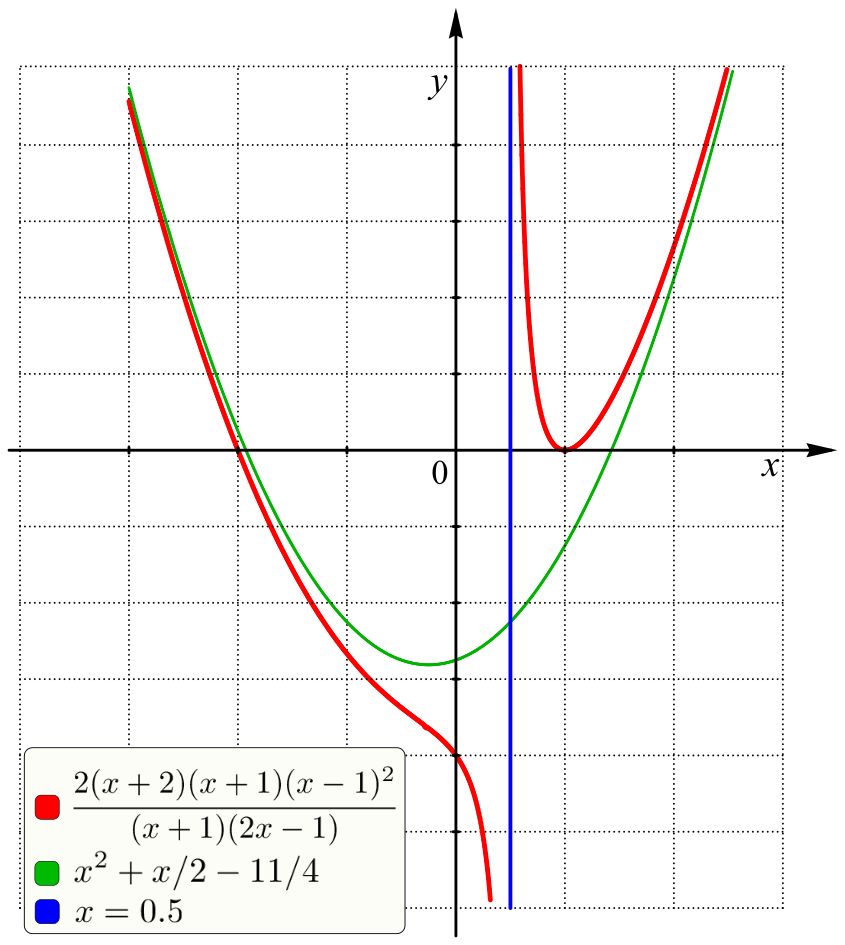
Why keep the restriction x ≠ 3 when the simplified form (x + 3)/(x + 4) is perfectly happy at x = 3? Because the two expressions are only equal where both are defined. The original is undefined at x = 3, so the graph of the original has a hole there — exactly the situation in this section's figure.
Worked example 2. Simplify (3 − x)/(x2 − 9).
- Factor and restrict. x2 − 9 = (x − 3)(x + 3), so x ≠ 3 and x ≠ −3.
- Notice the opposites. The numerator 3 − x is the opposite of x − 3. Factor out −1: 3 − x = −1(x − 3). Verify by distributing: −1 · x = −x and −1 · (−3) = +3, giving −x + 3 = 3 − x. Correct.
- Rewrite. [−1(x − 3)] / [(x − 3)(x + 3)]
- Divide out (x − 3). −1/(x + 3), with x ≠ 3 and x ≠ −3.
Check. At x = 0: original = (3 − 0)/(0 − 9) = 3/(−9) = −1/3. Simplified = −1/(0 + 3) = −1/3. Match.
| Pattern | Shape | Factored form | Example |
|---|---|---|---|
| Common factor | every term shares something | ab + ac = a(b + c) | 6x2 + 9x = 3x(2x + 3) |
| Difference of squares | a2 − b2 | (a + b)(a − b) | x2 − 25 = (x + 5)(x − 5) |
| Trinomial, lead 1 | x2 + bx + c | (x + m)(x + n), mn = c, m + n = b | x2 + 7x + 12 = (x + 3)(x + 4) |
| Trinomial, lead ≠ 1 | ax2 + bx + c | split the middle term, then group | 2x2 + 7x + 3 = (2x + 1)(x + 3) |
| Perfect square | a2 ± 2ab + b2 | (a ± b)2 | x2 + 6x + 9 = (x + 3)2 |
| Difference of cubes | a3 − b3 | (a − b)(a2 + ab + b2) | x3 − 8 = (x − 2)(x2 + 2x + 4) |
| Opposites | b − a vs. a − b | b − a = −1(a − b) | 3 − x = −1(x − 3) |
- A rational expression is one polynomial divided by another; the denominator may never be zero.
- Find excluded values first, from the original denominators, and carry them into your final answer.
- Simplify by factoring completely, then dividing out common factors.
- Opposites differ by a factor of −1: b − a = −1(a − b).
Section 2Multiplying and dividing

Multiplication: the rule you already know
Multiplying fractions is the friendliest operation there is: multiply straight across. (a)/(b) · (c)/(d) = (ac)/(bd). With numbers you probably already cancel before multiplying — for 4/9 · 3/8 you would cancel the 4 with the 8 and the 3 with the 9 to get 1/3 · 1/2 = 1/6, rather than multiplying to 12/72 and then reducing. Rational expressions demand that same discipline, only more so: if you multiply out (x + 2)(x + 3)(x − 1)(x − 2) first, you will be staring at a fourth-degree polynomial you then have to re-factor. Factor first. Cancel second. Multiply last.
Worked example 3. Multiply (x2 + 5x + 6)/(x2 − 4) · (x2 − 3x + 2)/(x2 + 4x + 3).
- Factor all four polynomials.
x2 + 5x + 6 = (x + 2)(x + 3) [2 · 3 = 6, 2 + 3 = 5]
x2 − 4 = (x − 2)(x + 2) [difference of squares]
x2 − 3x + 2 = (x − 1)(x − 2) [(−1)(−2) = 2, −1 + (−2) = −3]
x2 + 4x + 3 = (x + 1)(x + 3) [1 · 3 = 3, 1 + 3 = 4] - List restrictions from both denominators. (x − 2)(x + 2) = 0 gives x = 2 and x = −2; (x + 1)(x + 3) = 0 gives x = −1 and x = −3. So x ≠ 2, −2, −1, −3.
- Write it as one big fraction.
[(x + 2)(x + 3)(x − 1)(x − 2)] / [(x − 2)(x + 2)(x + 1)(x + 3)] - Divide out matching factors. (x + 2) cancels with (x + 2); (x + 3) cancels with (x + 3); (x − 2) cancels with (x − 2). What survives on top is (x − 1); what survives on the bottom is (x + 1).
- Answer. (x − 1)/(x + 1), with x ≠ 2, −2, −1, −3.
Check at x = 0. First fraction: (0 + 0 + 6)/(0 − 4) = 6/(−4) = −3/2. Second fraction: (0 − 0 + 2)/(0 + 0 + 3) = 2/3. Product: (−3/2)(2/3) = −6/6 = −1. Simplified form: (0 − 1)/(0 + 1) = −1/1 = −1. Match.
Division: multiply by the reciprocal
To divide, flip the second fraction and multiply: (a)/(b) ÷ (c)/(d) = (a)/(b) · (d)/(c). The flipped fraction (d)/(c) is the reciprocal of (c)/(d). Flip only the divisor — the fraction after the division sign — and flip it before you cancel anything.
Division brings one extra restriction that trips people up. You cannot divide by zero, so the divisor itself must not be zero, which means its numerator also generates a restriction. In (a)/(b) ÷ (c)/(d) you must have b ≠ 0, d ≠ 0, and c ≠ 0.
Worked example 4. Divide (x2 − 16)/(x2 + 6x + 9) ÷ (x − 4)/(x + 3).
- Factor everything. x2 − 16 = (x − 4)(x + 4); x2 + 6x + 9 = (x + 3)2; the other two are already factored.
- Restrictions. (x + 3)2 = 0 gives x = −3. The divisor's denominator x + 3 gives x = −3 again. The divisor's numerator x − 4 = 0 gives x = 4, which we must also exclude because dividing by zero is not allowed. So x ≠ −3 and x ≠ 4.
- Flip the divisor and change to multiplication.
[(x − 4)(x + 4)] / [(x + 3)2] · (x + 3)/(x − 4) - Write as one fraction. [(x − 4)(x + 4)(x + 3)] / [(x + 3)(x + 3)(x − 4)]
- Cancel. (x − 4) cancels; one (x + 3) on top cancels one (x + 3) on the bottom, leaving a single (x + 3) below.
- Answer. (x + 4)/(x + 3), with x ≠ −3 and x ≠ 4.
Check at x = 0. Dividend: (0 − 16)/(0 + 0 + 9) = −16/9. Divisor: (0 − 4)/(0 + 3) = −4/3. Now divide: (−16/9) ÷ (−4/3) = (−16/9) · (−3/4) = 48/36 = 4/3. Simplified form: (0 + 4)/(0 + 3) = 4/3. Match.
| Step | Multiplying | Dividing |
|---|---|---|
| 1 | Factor every numerator and denominator completely | Factor every numerator and denominator completely |
| 2 | List restrictions from both denominators | List restrictions from both denominators and from the divisor's numerator |
| 3 | — | Flip the divisor and change ÷ to · |
| 4 | Divide out factors common to top and bottom | Divide out factors common to top and bottom |
| 5 | Multiply what's left; leave it factored | Multiply what's left; leave it factored |
| 6 | State restrictions with the answer | State restrictions with the answer |
- Multiply straight across, but factor and cancel first.
- Divide by multiplying by the reciprocal of the divisor — flip only the second fraction.
- In division, the divisor's numerator also creates an excluded value.
- Leave the answer in factored form unless you are told otherwise.
Section 3Adding and subtracting
Same denominator: the easy case
When the denominators already match, add or subtract the numerators and keep the denominator: (a)/(d) + (b)/(d) = (a + b)/(d). Then simplify the result if it factors. There is one hazard even here, and it involves subtraction — see this section's pearl before you go further.
Building the least common denominator
When denominators differ, you need a least common denominator (LCD): the smallest expression that every denominator divides into evenly. Building one is mechanical:
- Factor every denominator completely.
- Make a list of every distinct factor that appears anywhere.
- Raise each factor to the highest power it reaches in any single denominator.
- Multiply those together. That product is the LCD.
This is the same procedure you use with plain numbers. For 6 and 8: 6 = 2 · 3 and 8 = 23. The distinct factors are 2 and 3; the highest powers are 23 and 31; so the LCD is 8 · 3 = 24. Nothing changes when the factors are binomials instead of primes.
| Denominators | Factored | Distinct factors, highest power | LCD |
|---|---|---|---|
| 6 and 8 | 2 · 3 and 23 | 23, 3 | 24 |
| 4x and 6x2 | 22x and 2 · 3x2 | 22, 3, x2 | 12x2 |
| x and x + 2 | x and (x + 2) | x, (x + 2) | x(x + 2) |
| x2 − 9 and x + 3 | (x − 3)(x + 3) and (x + 3) | (x − 3), (x + 3) | (x − 3)(x + 3) |
| x2 + 6x + 9 and x2 − 9 | (x + 3)2 and (x − 3)(x + 3) | (x + 3)2, (x − 3) | (x + 3)2(x − 3) |
Notice row 4: because (x + 3) is already inside x2 − 9, the LCD is not (x2 − 9)(x + 3). Taking each factor only to its highest power is what makes the common denominator least, and it saves you a round of cancelling at the end.
Rewriting and combining
Once you have the LCD, rewrite each fraction with that denominator by multiplying its top and bottom by whatever factor is missing. Multiplying top and bottom by the same nonzero thing does not change the value — it is multiplying by 1 in disguise.
Worked example 5. Add (2)/(x − 3) + (5)/(x + 2).
- Restrictions. x − 3 = 0 gives x = 3; x + 2 = 0 gives x = −2. So x ≠ 3 and x ≠ −2.
- LCD. The factors (x − 3) and (x + 2) are different and each appears once, so the LCD is (x − 3)(x + 2).
- Rewrite each fraction. The first is missing (x + 2); the second is missing (x − 3).
(2)/(x − 3) · (x + 2)/(x + 2) = [2(x + 2)] / [(x − 3)(x + 2)]
(5)/(x + 2) · (x − 3)/(x − 3) = [5(x − 3)] / [(x − 3)(x + 2)] - Add the numerators. 2(x + 2) + 5(x − 3) = 2x + 4 + 5x − 15 = 7x − 11.
- Answer. (7x − 11) / [(x − 3)(x + 2)], with x ≠ 3 and x ≠ −2. The numerator does not share a factor with the denominator (7x − 11 = 0 only at x = 11/7), so nothing cancels.
Check at x = 0. Original: 2/(0 − 3) + 5/(0 + 2) = −2/3 + 5/2. Common denominator 6: −4/6 + 15/6 = 11/6. Answer form: [7(0) − 11] / [(0 − 3)(0 + 2)] = (−11)/(−6) = 11/6. Match.
Worked example 6. Subtract (x)/(x2 − 9) − (2)/(x + 3).
- Factor and restrict. x2 − 9 = (x − 3)(x + 3), so x ≠ 3 and x ≠ −3.
- LCD. Distinct factors are (x − 3) and (x + 3), each to the first power: LCD = (x − 3)(x + 3).
- Rewrite. The first fraction already has the LCD. The second is missing (x − 3):
(2)/(x + 3) · (x − 3)/(x − 3) = [2(x − 3)] / [(x − 3)(x + 3)] - Subtract, with parentheses. The numerator becomes x − [2(x − 3)]. Distribute inside first: 2(x − 3) = 2x − 6. Now subtract the whole thing: x − (2x − 6) = x − 2x + 6 = −x + 6, which we can also write as 6 − x.
- Answer. (6 − x) / [(x − 3)(x + 3)], with x ≠ 3 and x ≠ −3.
Check at x = 0. Original: 0/(0 − 9) − 2/(0 + 3) = 0 − 2/3 = −2/3. Answer form: (6 − 0) / [(0 − 3)(0 + 3)] = 6/(−9) = −2/3. Match.
- Like denominators: combine numerators, keep the denominator, then simplify.
- Build the LCD from factored denominators: every distinct factor, raised to its highest power.
- Rewrite each fraction by multiplying top and bottom by the missing factor — that is multiplying by 1.
- When subtracting, parenthesize the second numerator and distribute the minus sign.
Section 4Complex fractions
What a complex fraction is
A complex fraction (sometimes called a compound fraction) is a fraction that has fractions inside it — in the numerator, the denominator, or both. It looks intimidating and it is not. Here is one:
[ (1)/(x) + (1)/(3) ] ÷ [ (1)/(x) − (1)/(3) ]
Written stacked with a long horizontal bar, that same expression is a complex fraction; written with a division sign, as above, it is obviously just a division problem. That is the whole secret: the main fraction bar means "divided by." There are two standard ways to untangle one, and both give the same answer.
Method 1 — combine, then divide
Turn the numerator into a single fraction. Turn the denominator into a single fraction. Then divide, which means multiply by the reciprocal. This method uses only skills from Sections 2 and 3.
Worked example 7, Method 1. Simplify [ (1)/(x) + (1)/(3) ] ÷ [ (1)/(x) − (1)/(3) ].
- Combine the top. LCD of x and 3 is 3x. (1)/(x) = (3)/(3x) and (1)/(3) = (x)/(3x). Sum: (3 + x)/(3x).
- Combine the bottom. Same LCD: (3)/(3x) − (x)/(3x) = (3 − x)/(3x).
- Divide. [(3 + x)/(3x)] ÷ [(3 − x)/(3x)] = [(3 + x)/(3x)] · [(3x)/(3 − x)]
- Cancel. The 3x on top cancels the 3x on the bottom, leaving (3 + x)/(3 − x).
- Restrictions. x ≠ 0 (it sits under a 1 in the original). Also the bottom of the big fraction may not be zero: (1)/(x) − (1)/(3) = 0 when x = 3, so x ≠ 3.
Method 2 — multiply top and bottom by the LCD
Find the LCD of all the little fractions inside, then multiply the whole numerator and the whole denominator by it. Every small fraction gets wiped out in one stroke. This is usually faster.
Worked example 7, Method 2. Same problem, other route. The little fractions are 1/x and 1/3, so the LCD is 3x.
- Multiply the numerator by 3x, distributing. 3x · [(1)/(x) + (1)/(3)] = 3x · (1)/(x) + 3x · (1)/(3) = 3 + x.
- Multiply the denominator by 3x, distributing. 3x · [(1)/(x) − (1)/(3)] = 3 − x.
- Assemble. (3 + x)/(3 − x) — identical to Method 1, with the same restrictions x ≠ 0 and x ≠ 3.
Check at x = 1. Top of the original: 1/1 + 1/3 = 4/3. Bottom: 1/1 − 1/3 = 2/3. Divide: (4/3) ÷ (2/3) = (4/3) · (3/2) = 12/6 = 2. Simplified form: (3 + 1)/(3 − 1) = 4/2 = 2. Match, both methods confirmed.
Worked example 8. Simplify [ 1 − (9)/(x2) ] ÷ [ 1 + (3)/(x) ] using Method 2.
- Find the LCD of the inner fractions. Denominators are x2 and x; the highest power of x is x2, so the LCD is x2.
- Multiply the numerator by x2. x2 · 1 − x2 · (9)/(x2) = x2 − 9.
- Multiply the denominator by x2. x2 · 1 + x2 · (3)/(x) = x2 + 3x.
- Now simplify the ordinary rational expression. (x2 − 9)/(x2 + 3x) = [(x − 3)(x + 3)] / [x(x + 3)] = (x − 3)/(x).
- Restrictions. x ≠ 0 from the inner denominators. The bottom of the big fraction, 1 + (3)/(x), equals zero when x = −3, so x ≠ −3 as well.
Check at x = 1. Top: 1 − 9/1 = −8. Bottom: 1 + 3/1 = 4. Divide: −8/4 = −2. Simplified: (1 − 3)/1 = −2. Match.
| Method 1: combine then divide | Method 2: multiply by the LCD | |
|---|---|---|
| Step 1 | Combine the numerator into one fraction | Find the LCD of every small fraction inside |
| Step 2 | Combine the denominator into one fraction | Multiply the entire numerator by that LCD |
| Step 3 | Flip the bottom fraction and multiply | Multiply the entire denominator by that LCD |
| Step 4 | Factor and cancel | Factor and cancel |
| Best when | Top and bottom are already single fractions | There are several small fractions to clear |
| Watch out for | Flipping the wrong fraction | Forgetting to distribute the LCD to every term |
- A complex fraction has fractions inside its numerator, denominator, or both.
- The main fraction bar is a division sign — that reframing alone solves most of the confusion.
- Method 1: combine top, combine bottom, multiply by the reciprocal.
- Method 2: multiply top and bottom by the LCD of all inner fractions; usually faster.
Section 5Rational equations
An equation is a different job than an expression
Sections 1 through 4 asked you to simplify — to rewrite one expression in a tidier equivalent form. A rational equation asks something different: find the values of the variable that make a statement true. An equation has an equals sign, and that equals sign gives you a power you do not have with expressions — you may multiply both sides by the same nonzero quantity. Choose the LCD as that quantity and every denominator disappears at once.
The procedure is short:
- Factor all denominators and list the excluded values first. This step is not optional here; it is the whole safety net.
- Find the LCD of every denominator in the equation.
- Multiply every term on both sides by the LCD and cancel, leaving an equation with no fractions.
- Solve the resulting linear or quadratic equation.
- Compare each candidate to your excluded list. Any candidate that appears there is an extraneous solution and must be thrown out.
A full solution, start to finish
Worked example 9. Solve (2)/(x + 1) + (1)/(x − 1) = (4)/(x2 − 1).
- Factor and exclude. x2 − 1 = (x − 1)(x + 1). The denominators are (x + 1), (x − 1), and (x − 1)(x + 1), so x ≠ 1 and x ≠ −1.
- LCD. The distinct factors are (x − 1) and (x + 1), each to the first power: LCD = (x − 1)(x + 1).
- Multiply every term by the LCD.
First term: (x − 1)(x + 1) · (2)/(x + 1) → the (x + 1) cancels → 2(x − 1)
Second term: (x − 1)(x + 1) · (1)/(x − 1) → the (x − 1) cancels → (x + 1)
Right side: (x − 1)(x + 1) · (4)/[(x − 1)(x + 1)] → everything cancels → 4 - The fraction-free equation. 2(x − 1) + (x + 1) = 4
- Solve it. Distribute: 2x − 2 + x + 1 = 4. Combine like terms: 3x − 1 = 4. Add 1 to both sides: 3x = 5. Divide by 3: x = 5/3.
- Screen against the excluded list. Is 5/3 equal to 1 or −1? No. It survives.
Verify in the original equation with x = 5/3. Then x + 1 = 8/3, x − 1 = 2/3, and x2 − 1 = 25/9 − 9/9 = 16/9.
Left side: 2 ÷ (8/3) = 2 · (3/8) = 6/8 = 3/4. And 1 ÷ (2/3) = 3/2 = 6/4. Sum: 3/4 + 6/4 = 9/4.
Right side: 4 ÷ (16/9) = 4 · (9/16) = 36/16 = 9/4.
Both sides equal 9/4, so x = 5/3 is the solution.
Extraneous solutions, and why they appear
Multiplying both sides by the LCD is legal only when the LCD is not zero — and at an excluded value, it is zero. So the fraction-free equation you produce is not quite the same equation you started with; it can be true at values where the original was never even defined. Those impostors are extraneous solutions. They are not mistakes in your algebra; they are a predictable side effect of the method, which is precisely why the final screening step is mandatory.
Worked example 10. Solve (x2)/(x − 3) = (9)/(x − 3).
- Exclude. x − 3 = 0 when x = 3, so x ≠ 3. Write it down now.
- LCD. Both denominators are (x − 3), so the LCD is (x − 3).
- Multiply both sides by (x − 3). On the left, (x − 3) · (x2)/(x − 3) = x2. On the right, (x − 3) · (9)/(x − 3) = 9. The equation becomes x2 = 9.
- Solve. Subtract 9: x2 − 9 = 0. Factor: (x − 3)(x + 3) = 0. Candidates: x = 3 and x = −3.
- Screen. x = 3 is on the excluded list — it is extraneous and gets crossed out. Substituting it into the original would give 9/0, which is undefined. x = −3 is not excluded, so it stays.
- Verify x = −3. Left: (−3)2/(−3 − 3) = 9/(−6) = −3/2. Right: 9/(−3 − 3) = 9/(−6) = −3/2. Equal.
Solution: x = −3 only. Notice that a perfectly sound algebraic process handed you two candidates and one of them was a fake. If you had skipped step 5 you would have reported an answer that makes the original equation meaningless.
Sometimes every candidate is extraneous. Solve (x)/(x − 3) = (3)/(x − 3) + 2: multiplying by (x − 3) gives x = 3 + 2(x − 3) = 3 + 2x − 6 = 2x − 3, so −x = −3 and x = 3. But x ≠ 3. Every candidate is rejected, so the honest answer is no solution — which is a complete, correct answer, not a sign you did something wrong.
Where these equations come from
Rational equations show up whenever quantities combine as rates. Suppose one pump fills a tank in 6 hours and a second pump fills the same tank in 3 hours. Working together, how long do they need? In one hour the first pump does 1/6 of the job and the second does 1/3, and together they finish 1/t of the job per hour, where t is the total time. So (1)/(6) + (1)/(3) = (1)/(t), with t ≠ 0. The LCD of 6, 3, and t is 6t. Multiply every term: 6t · (1/6) = t; 6t · (1/3) = 2t; 6t · (1/t) = 6. The equation is t + 2t = 6, so 3t = 6 and t = 2 hours. Sanity check: two hours is less than the faster pump's 3 hours on its own, which is exactly what you would expect from adding help.
| Rational expression | Rational equation | |
|---|---|---|
| Has an "="? | No | Yes |
| Your job | Rewrite it in simplest form | Find the values that make it true |
| May you clear denominators? | No — that would change the value | Yes — multiply both sides by the LCD |
| Role of the LCD | Rewrite each fraction to combine them | Wipe out all denominators at once |
| Answer looks like | Another expression, plus restrictions | A number, several numbers, or "no solution" |
| Final step | State the excluded values | Screen candidates and discard extraneous ones |
- To solve a rational equation, multiply every term on both sides by the LCD to clear all fractions.
- List excluded values first, straight from the factored denominators.
- An extraneous solution solves the cleared equation but is excluded in the original; discard it.
- If every candidate is extraneous, the correct answer is no solution.
The chapter in one breath
- A rational expression is a polynomial over a polynomial, and the denominator may never be zero — so every one comes with excluded values.
- Simplify by factoring completely and dividing out common factors; you may cancel factors but never terms.
- Restrictions come from the original denominators, and they survive even when the factor that produced them cancels.
- Multiply straight across after factoring and cancelling; divide by flipping the divisor, which also makes the divisor's numerator an excluded value.
- To add or subtract, build the LCD — every distinct factor to its highest power — rewrite each fraction, then combine numerators, parenthesizing when you subtract.
- A complex fraction is just a division problem: combine top and bottom then multiply by the reciprocal, or multiply top and bottom by the LCD of the inner fractions.
- To solve a rational equation, clear denominators by multiplying both sides by the LCD, then solve the fraction-free equation.
- Always screen candidates against the excluded list; an extraneous solution is discarded, and if all of them go, the answer is no solution.
ReferenceWords worth knowing
A quick reference for the vocabulary in this chapter — skim it now, or circle back whenever a word slows you down.
- Common denominator
- A single denominator shared by two or more fractions, needed before they can be added or subtracted.
- Complex fraction
- A fraction whose numerator, denominator, or both contain fractions; also called a compound fraction.
- Cross-multiplication
- A shortcut for the special case (a)/(b) = (c)/(d): multiply to get ad = bc. It applies only when a single fraction equals a single fraction.
- Denominator
- The bottom of a fraction — the part that may never equal zero.
- Difference of squares
- The pattern a2 − b2 = (a + b)(a − b), the most frequently used factoring tool in this chapter.
- Domain
- The set of input values for which an expression is defined; for a rational expression, all real numbers except the excluded values.
- Excluded value
- Any value of the variable that makes a denominator zero and is therefore removed from the domain.
- Extraneous solution
- A candidate that satisfies the equation after denominators are cleared but is an excluded value of the original; it must be discarded.
- Factor
- A quantity being multiplied. Only factors may be divided out of a fraction — terms may not.
- Fundamental principle of fractions
- (ac)/(bc) = (a)/(b) whenever b ≠ 0 and c ≠ 0; the rule that permits cancelling.
- Greatest common factor (GCF)
- The largest factor shared by every term of a polynomial; always the first thing to pull out when factoring.
- Least common denominator (LCD)
- The smallest expression every denominator divides into evenly: each distinct factor raised to its highest power.
- Lowest terms
- The form of a rational expression in which numerator and denominator share no common factor other than 1.
- Numerator
- The top of a fraction.
- Opposite factors
- Expressions such as b − a and a − b that differ by a factor of −1, so their quotient is −1.
- Polynomial
- A sum of terms of the form (number)(variable raised to a whole-number power), such as x2 + x − 12.
- Rational equation
- An equation containing at least one rational expression; solved by clearing denominators with the LCD.
- Rational expression
- A quotient of two polynomials, P/Q, with Q ≠ 0.
- Reciprocal
- The multiplicative inverse of a fraction, formed by exchanging numerator and denominator; the reciprocal of (c)/(d) is (d)/(c).
- Restriction
- Another name for an excluded value, usually written alongside a simplified answer as "x ≠ …".