MORAL REASONING AND ARGUMENT
Most moral disputes are not fights between good people and bad people. They are collisions between arguments — some careful, some sloppy, most never laid out clearly enough for anyone to inspect. This chapter hands you the tools to open an argument up: to separate the claim from the reasons offered for it, to find the unstated principle doing the heavy lifting, to tell a valid inference from a persuasive one, and to test a conclusion by asking what else it would commit you to. You will meet David Hume’s warning about sliding from is to ought, Stephen Toulmin’s anatomy of everyday reasoning, the counterexample method that philosophers have used since Socrates, and John Rawls’s idea that principles and judgements should be adjusted against each other until they fit. By the end you should be able to disagree productively — which is a rarer and more useful skill than winning.
By the end of this chapter you can
- Break a moral claim into premises and a conclusion, and reconstruct arguments in standard form.
- Identify the bridging premise or warrant that links a factual claim to a moral one, using the Toulmin model.
- Explain the is–ought gap and distinguish it from Moore’s naturalistic fallacy and the appeal to nature.
- Distinguish validity from soundness, and deductive from inductive and abductive reasoning.
- Diagnose at least eight informal fallacies that recur in ethical debate, including equivocation, false dilemma and the slippery slope.
- Test a principle with a counterexample, a thought experiment, an argument from analogy, and the universalizability test.
- Apply reflective equilibrium to revise either a principle or a judgement when the two conflict.
- Separate factual disagreement from evaluative disagreement and locate the crux of a dispute.
- Recognise motivated reasoning and moral dumbfounding in your own reasoning and respond to them honestly.
Section 1The Anatomy of a Moral Argument
Argument means something narrower than you think
In ordinary speech an argument is a quarrel. In ethics it is something much drier and much more useful: a set of statements in which one or more premises are offered as reasons to accept a conclusion. Raising your voice is not an argument. Neither is a strongly worded opinion, an anecdote told with feeling, or a link to an article. If nothing is being offered in support of anything else, there is no argument on the table — only a position.
This matters practically. On a hospital unit, in a boardroom, at a school committee meeting, people frequently talk past one another because nobody has bothered to write down what is actually being claimed. Consider a real and unremarkable exchange: a charge nurse says, “We can’t tell the daughter her mother’s diagnosis — the patient asked us not to.” That single sentence contains a conclusion (do not disclose), a factual premise (the patient made a request), and an unstated moral premise (competent patients’ confidentiality requests should be honoured even when family members are distressed). Only the third is genuinely contestable, and it is the one nobody said out loud.
Putting an argument into standard form — numbering the premises, drawing a line, writing the conclusion underneath — feels pedantic for about ten minutes and then becomes indispensable. It forces you to supply the missing pieces. An argument with a suppressed premise is called an enthymeme, and in moral discourse nearly every argument you encounter in the wild is an enthymeme. The suppressed premise is where the action is.
Toulmin’s map of everyday reasoning
Formal logic captures mathematical proof beautifully and everyday moral argument rather badly. The British philosopher Stephen Toulmin, in The Uses of Argument (1958), proposed a model closer to how a lawyer or a clinician actually reasons. Toulmin splits an argument into six parts: the claim (what you want accepted), the grounds (the facts you start from), the warrant (the general principle licensing the move from grounds to claim), the backing (what supports the warrant itself), the qualifier (“probably”, “in most cases”), and the rebuttal (the conditions under which the claim would fail).
Toulmin’s insight was that real arguments are rarely all-or-nothing. A physician does not conclude that a patient certainly has sepsis; she concludes that sepsis is probable enough to warrant treatment now, unless a specific alternative explanation emerges. Moral reasoning has the same texture. “You generally ought to keep a promise” is a warrant with a built-in qualifier and an open list of rebuttals — coercion, changed circumstances, a competing duty of greater weight.
The most useful column in Toulmin’s table is warrant. Ask any speaker, “What general rule would have to be true for your facts to support your conclusion?” and you will surface the real disagreement in a single question. Two people can agree entirely about the facts of a case and still differ, because they hold different warrants. Two people can share a warrant and differ because they disagree about the grounds. These are different problems and they require different remedies.
| Toulmin part | Question it answers | Example from a staffing dispute |
|---|---|---|
| Claim | What are you asking me to accept? | The unit should refuse the sixth admission tonight. |
| Grounds | What facts are you starting from? | Two nurses called out; the ratio would go to 1:7. |
| Warrant | What rule licenses that move? | Staff should not accept assignments that predictably endanger patients. |
| Backing | Why accept the warrant? | Professional codes, licensure duty, evidence linking ratios to mortality. |
| Qualifier | How strong is the claim? | Ordinarily — absent a declared mass-casualty event. |
| Rebuttal | When would it fail? | If refusal would leave patients with no care at all. |
Deductive, inductive, abductive
Arguments come in three broad shapes, and confusing them causes most of the bad tempers in ethics seminars. A deductive argument claims that if the premises are true the conclusion must be true. An inductive argument claims only that the premises make the conclusion probable — generalising from cases, projecting a trend, extrapolating from a sample. An abductive argument, sometimes called inference to the best explanation, says that a conclusion is the most plausible account of what we observe.
Moral arguments almost always mix all three. The moral principle at the core is usually deductive in form. The factual premises feeding it are usually inductive: how likely is harm, how often does this policy backfire, what did the trial data show. And the choice of which principle to apply is often abductive: which framework best explains the whole pattern of our confident judgements? Criticising a moral argument well means aiming your criticism at the right layer. It is a category error to demand mathematical certainty from an empirical premise, and equally a category error to treat a contested moral principle as if it were an established statistic.
An argument is premises offered in support of a conclusion, and the most important premise in a moral argument is usually the general principle nobody bothered to state.
Section 2From Facts to Values: The Is–Ought Problem
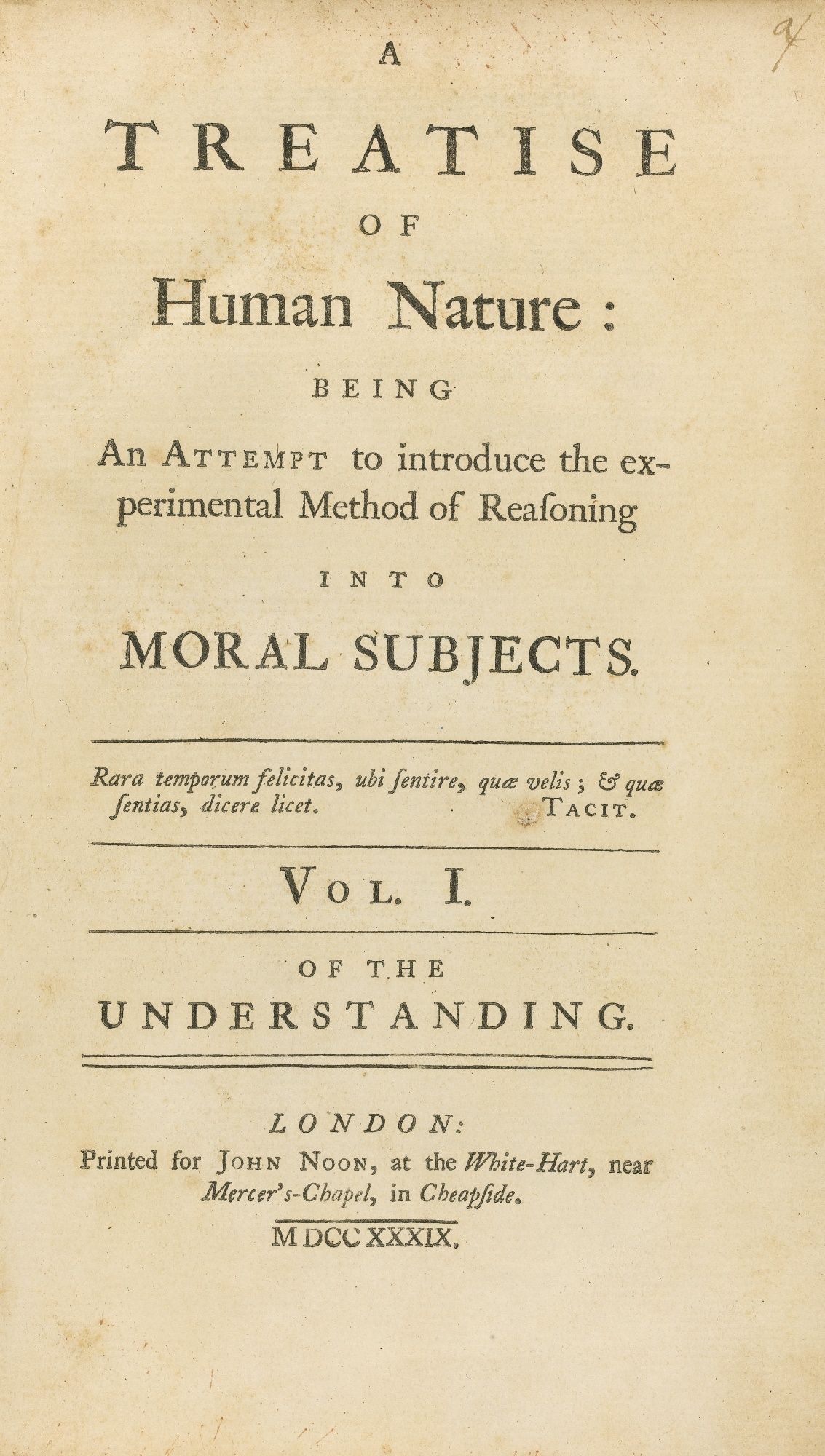
Hume’s paragraph
Near the end of Book III, Part I, Section I of A Treatise of Human Nature (1739–40), David Hume notes that authors writing about morality proceed for a while with ordinary statements about what is and then, without warning, every proposition becomes one about what ought to be. He observes that this change is imperceptible but of the last consequence, and asks that a reason be given for it. That single paragraph founded what is now called the is–ought gap or Hume’s Law: no set of purely descriptive premises entails an evaluative conclusion.
Test it. “This drug relieves pain” does not by itself entail “you should prescribe it.” “Ninety per cent of hospitals do it this way” does not entail “it is right.” “Humans evolved to favour kin” does not entail “favouring kin is permissible.” In each case a further premise is required, and that premise is evaluative: relieving pain matters, common practice is presumptively acceptable, evolved dispositions are morally authoritative. State the bridge and you can examine it. Leave it buried and you have smuggled a value in disguised as a fact.
Not every philosopher accepts Hume’s Law in its strongest form. John Searle argued in 1964 that the institution of promising generates an ought from an is: saying “I promise” is a fact that creates an obligation. Others reply that the institution itself carries a hidden normative premise. Philippa Foot and other neo-Aristotelians argue that facts about what a creature needs to flourish are already value-laden. Some scholars also dispute the standard reading of the passage itself, holding that Hume was attacking a particular style of moral argument rather than announcing an unbridgeable logical gap. The debate is live and unresolved; what is not in dispute is the practical lesson. Whenever an argument moves from data to duty, look for the bridge.
Three cousins that are not the same thing
Students routinely collapse three distinct errors. The is–ought gap is a logical point about entailment. G. E. Moore’s naturalistic fallacy, from Principia Ethica (1903), is a different and more specific claim: that good cannot be defined in terms of any natural property such as pleasure or evolutionary fitness. Moore’s test was the open question argument — if “good” simply meant “pleasant”, then “this is pleasant, but is it good?” would be as senseless as asking “this is a bachelor, but is he unmarried?” It is not senseless, so the definition fails. Many contemporary philosophers think Moore’s argument proves less than he supposed, but the label stuck.
The third cousin is the appeal to nature: the rhetorical move from “natural” to “good” and from “unnatural” to “wrong”. It appears in debates about food, sexuality, medication, contraception, gene editing and end-of-life care. It fails twice over. First, it needs the bridging premise that naturalness confers value, and that premise is hard to defend once you list natural things — cholera, drought, infant mortality — that nobody praises. Second, “natural” is ambiguous between at least four senses: occurring without human intervention, statistically typical, functionally proper, and morally uncorrupted. Arguments that slide between these senses are committing equivocation, which Section 3 takes up.
Building the standard moral syllogism
The workhorse structure in applied ethics has three lines: a moral principle, a factual premise, and a conclusion. Peter Singer’s famous argument in “Famine, Affluence, and Morality” (Philosophy & Public Affairs, 1972) has exactly this shape. Premise one: if it is in our power to prevent something very bad from happening without sacrificing anything of comparable moral importance, we ought to do it. Premise two: by donating a modest portion of our income we can prevent suffering and death without comparable sacrifice. Conclusion: we ought to donate. Singer illustrates premise one with the drowning-child case — walking past a shallow pond, you would wade in to pull out a drowning child, and muddying your clothes is not a comparable sacrifice.
Notice how the structure organises the objections. You can attack the principle (is proximity or special relationship morally relevant after all?). You can attack the factual premise (does aid reliably prevent death, or does it sometimes entrench bad governance?). You can accept both and dispute the strength of the conclusion (a duty, or a laudable extra?). Each of those is a different conversation. Without the standard form they get mashed into one shouting match.
| Argument | Moral premise | Factual premise | Where critics usually push |
|---|---|---|---|
| Singer on famine relief (1972) | Prevent very bad things at small comparable cost | Donations do prevent death cheaply | Effectiveness of aid; demandingness of the duty |
| Rachels on euthanasia (1975) | If two acts differ only in a morally irrelevant way, they are morally alike | Killing and letting die differ only in mechanism | The factual premise: intention and role differ too |
| Mandatory staff vaccination | Professionals must not impose avoidable risk on vulnerable patients | Vaccination measurably reduces transmission to patients | Size of the transmission effect; scope of employer authority |
| Supervised injection sites | Reducing preventable death outweighs symbolic disapproval | Sites reduce overdose deaths without raising drug use | Contested epidemiology; displacement effects |
No pile of facts by itself yields a moral conclusion — find the bridging value premise, state it plainly, and then argue about it.
Section 3Validity, Soundness and the Fallacies That Keep Coming Back
Valid is not the same as true
A deductive argument is valid when the conclusion follows necessarily from the premises — when it would be impossible for the premises to be true and the conclusion false. Validity says nothing about whether the premises are true. “All physicians are immortal; Dr Chen is a physician; therefore Dr Chen is immortal” is perfectly valid and obviously worthless. An argument is sound when it is valid and all its premises are true. Soundness is what you actually want; validity is the cheaper half.
The everyday payoff is that there are only two ways to reject a deductive moral argument: deny a premise, or show the inference is invalid. If you can do neither, you are rationally obliged either to accept the conclusion or to explain what else has gone wrong. This is uncomfortable, and it is the engine of philosophical progress. When a valid argument leads somewhere you refuse to go, that refusal is itself evidence — evidence that one of the premises is false. Philosophers call this running the argument backwards, or tollensing the ponens.
Two conditional forms are valid: modus ponens (if P then Q; P; therefore Q) and modus tollens (if P then Q; not Q; therefore not P). Two are invalid and constantly mistaken for the real thing: affirming the consequent (if P then Q; Q; therefore P) and denying the antecedent (if P then Q; not P; therefore not Q). “If a treatment is futile we may withhold it; this treatment is not futile; therefore we may not withhold it” denies the antecedent — there may be other good reasons to withhold, such as refusal by the patient.
The fallacies that dominate moral debate
An informal fallacy is a pattern of reasoning that is persuasive but defective in content rather than form. The list below is not exhaustive, but these eleven account for a startling proportion of what circulates in public ethical argument. Learn to name them, because naming is most of the cure.
Two deserve extra attention because they are so often misdiagnosed. The slippery slope is not automatically a fallacy. It is fallacious when the causal chain from first step to feared outcome is merely asserted; it is legitimate when the chain is supported by mechanism or evidence. Debates about assisted dying illustrate both. Critics predicted expansion after the Dutch Termination of Life on Request and Assisted Suicide Act, passed in 2001, took effect in April 2002; the regional review committees recorded 8,720 cases in 2022, roughly five per cent of all deaths in the country, and the eligible categories have been interpreted more broadly over time. Whether that constitutes a slope, a plateau, or an expected uptake of a newly lawful option is exactly the sort of question that requires data and careful definition rather than rhetorical gravity.
The second is the appeal to authority. Deferring to an expert is not fallacious; it is how anyone functions in a technical world. It becomes fallacious when the authority is outside their field, when the field itself lacks consensus, when the authority has an undisclosed interest, or when the appeal replaces reasons the audience could evaluate. A cardiologist’s view on stent indications carries weight. The same cardiologist’s view on immigration policy carries only whatever her arguments carry.
| Fallacy | What goes wrong | Ethics-flavoured example |
|---|---|---|
| Ad hominem | Attacks the arguer instead of the argument | “She only defends triage protocols because she is an administrator.” |
| Straw man | Refutes a distorted version of the position | “So you think patients should just be left to die at home.” |
| False dilemma | Presents two options when more exist | “Either full disclosure or lying to the family.” |
| Equivocation | Shifts the meaning of a key term mid-argument | “Life begins at conception” sliding between biological life and personhood |
| Begging the question | Assumes the conclusion in a premise | “Abortion is wrong because it kills an innocent person.” |
| Hasty generalisation | Generalises from an unrepresentative sample | “My uncle recovered without surgery, so surgery is overused.” |
| Appeal to nature | Treats “natural” as equivalent to “good” | “Pain in childbirth is natural, so analgesia is a distortion.” |
| Slippery slope (weak form) | Asserts a causal chain without support | “Allow one exception and consent collapses entirely.” |
| Tu quoque | Deflects criticism by alleging hypocrisy | “You eat meat, so you cannot criticise animal research.” |
| Appeal to consequences | Argues a claim is false because believing it would be bad | “If determinism were true nobody could be blamed, so it is false.” |
| Appeal to authority (weak form) | Defers to an expert outside their field, in a field lacking consensus, or with an undisclosed interest | “A Nobel laureate in physics says the embryo is a person, so it is.” |
Definitions are where arguments hide
An enormous share of ethical disagreement is definitional. “Person”, “harm”, “futile”, “consent”, “discrimination”, “natural”, “death” — each of these has an ordinary sense, a technical sense, and a contested moral sense, and arguments slide between them. When Mary Anne Warren proposed in 1973 that the concept of personhood is marked by traits such as consciousness, reasoning, self-motivated activity, capacity to communicate and self-awareness, she was not merely stipulating; she was offering a criterion that could be tested against cases. That is the right way to argue about definitions.
The wrong way is what logicians call persuasive definition: building your conclusion into the meaning of a word so that disagreement sounds like ignorance. Calling every unwanted medical intervention “assault” or every hard conversation “abuse” wins the argument by fiat and teaches nobody anything. If a definition would make your opponent’s position self-evidently absurd, that is a signal to slow down, not to press ahead.
Validity concerns the shape of an argument and soundness concerns its content — and most moral arguments fail on content, through hidden equivocations, false dilemmas and unsupported causal chains.
Section 4Testing a Principle: Counterexamples, Analogies and Thought Experiments
The counterexample method
The oldest tool in moral philosophy is also the simplest. Someone proposes a general principle; you construct a case in which the principle gives an answer almost everyone rejects. If the case is genuine, the principle is refuted, or at least must be qualified. Socrates uses the method throughout Plato’s dialogues — in Republic Book I, Cephalus offers “justice is telling the truth and paying your debts”, and Socrates asks whether you should return a borrowed weapon to a friend who has since gone out of his mind.
Counterexamples are how principles get refined rather than merely defeated. “Always tell the truth” meets the case of the murderer at the door and becomes “there is a strong presumption in favour of truthfulness, defeasible when disclosure would make you complicit in grave wrongdoing.” That is progress. The principle survives in a more careful form. Beware, though, of the temptation to add so many exceptions that the principle no longer rules anything out. A principle that accommodates every case predicts nothing and teaches nothing; a theory rescued by unlimited ad hoc exceptions has been saved at the price of saying anything.
A good counterexample has three properties. It is possible — not necessarily actual, but coherent. It is clear — the intuitive verdict is not itself contested. And it is targeted — it isolates the feature in dispute rather than importing a dozen distracting details. A counterexample that changes five variables at once tells you nothing about which one mattered.
Thought experiments and arguments from analogy
The trolley case began as a single paragraph in Philippa Foot’s 1967 essay on abortion and the doctrine of double effect, and was elaborated by Judith Jarvis Thomson in 1976 and 1985. Its purpose is often misunderstood. Foot was not asking what you would do on a real tramway; she was isolating a variable — the difference between harm you intend as a means and harm you foresee as a side effect — by holding the numbers constant. The scenario is artificial on purpose, in the way a laboratory is artificial on purpose.
An argument from analogy runs: case A and case B share features F; we agree A is wrong; therefore B is wrong. Thomson’s violinist in “A Defense of Abortion” (1971) is the most discussed example in modern philosophy: you wake to find your circulatory system connected to an unconscious violinist who will die if you disconnect within nine months. Thomson argues that even granting the violinist’s right to life, you are not obliged to remain plugged in — a right to life is not a right to the use of another person’s body. Critics answer by attacking the analogy: pregnancy usually involves prior voluntary action, a parental relationship, and killing rather than merely disconnecting. Whether these disanalogies are morally relevant is precisely the dispute, which is what a good analogy does — it converts a vague quarrel into a specific one.
James Rachels used the same technique in the New England Journal of Medicine in 1975. Smith drowns his six-year-old cousin in the bath for an inheritance; Jones intends exactly the same, but the child slips, strikes his head and falls face down in the water, so Jones simply stands by — ready to push the head back under if he has to, which he never does. Rachels contends that if you judge Jones no better than Smith, then the bare distinction between killing and letting die carries no moral weight, and the standard doctrine permitting withdrawal of treatment but forbidding active euthanasia rests on sand. Objectors reply that Rachels’s pair holds intention fixed and thereby proves less than it seems — in clinical practice, intentions and role obligations differ systematically between the two categories. That exchange is a model of how careful argument proceeds.
Universalizability and reflective equilibrium
A second family of tests asks what a principle would commit you to if applied consistently. R. M. Hare, in Freedom and Reason (1963), made universalizability the core of moral reasoning: if you judge an act right in one case, you must judge it right in every case that is similar in the morally relevant respects, including cases where you occupy the other role. This is the disciplined ancestor of “how would you feel if it were you?” It is not an appeal to sympathy but to consistency — and consistency is a demand you cannot decline without abandoning the pretence of reasoning.
Finally, John Rawls gave a name in A Theory of Justice (1971) to a procedure he had sketched two decades earlier: reflective equilibrium. When a principle and a considered judgement conflict, you may revise either. Neither has automatic priority. You work back and forth — adjusting the principle to accommodate the judgement, or abandoning the judgement because the principle is better supported — until the whole set coheres. Wide reflective equilibrium, a refinement developed by Norman Daniels, adds a third element: background theories about persons, society and knowledge that must also fit.
This method has been criticised, notably by Peter Singer, as a sophisticated way of preserving prejudice: if your starting intuitions are shaped by an unjust culture, coherence with them may simply systematise that injustice. Defenders reply that the method includes the option of discarding intuitions that cannot survive scrutiny, and that no alternative method starts from nowhere. The disagreement is genuine and unresolved. What is agreed is that a judgement you can no longer defend, and a principle you cannot live with, cannot both be kept.
| Test | What it asks | Classic instance | Failure mode |
|---|---|---|---|
| Counterexample | Does the principle give an unacceptable verdict anywhere? | Socrates and the borrowed weapon | Bizarre cases that prove nothing about real ones |
| Isolating thought experiment | Which single feature is doing the moral work? | Foot’s tram case, 1967 | Changing several variables at once |
| Argument from analogy | Are the cases alike in the relevant respects? | Thomson’s violinist, 1971 | Ignoring morally relevant disanalogies |
| Universalizability | Could you accept this rule from every position? | Hare, Freedom and Reason, 1963 | Describing the act so narrowly that only you fit |
| Reflective equilibrium | Do principles and judgements cohere overall? | Rawls, 1971 | Entrenching inherited bias as coherence |
Principles earn their keep by surviving cases — test them with targeted counterexamples, honest analogies and consistent universalisation, and revise whichever side of the conflict is weaker.
Section 5Reasoning Well When It Is Hard
The intuitive dog and its rational tail
Psychology complicates the tidy picture. In “The Emotional Dog and Its Rational Tail” (Psychological Review, 2001), Jonathan Haidt argued that moral judgement is usually an immediate intuitive response, with conscious reasoning arriving afterwards as advocacy rather than investigation. His research team documented moral dumbfounding: participants presented with harmless-but-taboo scenarios insisted the acts were wrong, offered reasons, watched those reasons dismantled, and then held the judgement anyway while admitting they could not say why.
Two conclusions are often drawn, and only one is warranted. The unwarranted conclusion is that reasoning is pointless. The warranted one is that reasoning is fragile and needs support — it works better slowly, in writing, in groups with dissenting members, and when the reasoner is not personally on the hook. It is also worth noting that residual conviction after your reasons fail is not always irrational. A strong intuition can be evidence that a real moral consideration is present which you have not yet articulated. The honest response is to say so, rather than to invent a bad reason on the spot.
Motivated reasoning is the specific hazard. In a well-known 1979 study, Charles Lord, Lee Ross and Mark Lepper gave students with opposing views on capital punishment the same mixed body of evidence; both groups rated the study supporting their prior view as better designed, and both reported ending up more confident than before. The biased evaluation of evidence has replicated robustly; the further claim that mixed evidence actively polarises attitudes has proved less reliable, and later work finds it inconsistently. If even the milder effect happens with a topic as abstract as deterrence statistics, expect worse when your job, your identity or your family is involved.
Separating what we disagree about
Productive disagreement begins by sorting the dispute into layers. Is the disagreement factual — about what happened, what will happen, or how likely something is? Is it conceptual — about what a term means? Is it evaluative — about which considerations matter and how much? Or is it about application — agreed principle, disputed fit? Each layer has its own repair.
Take supervised consumption facilities. Vancouver’s Insite opened in 2003 as North America’s first legally sanctioned site. A 2011 study in The Lancet by Brandon Marshall and colleagues reported a substantial fall in overdose mortality within 500 metres of the facility after opening; other researchers have questioned the comparison periods and the attribution. Notice what follows. Much of the public argument is framed as a values clash — compassion versus enabling — but a large part of it is an empirical dispute about effect sizes and study design. Sorting the layers does not dissolve the moral question, but it tells each side what evidence would move them, which is the definition of a productive disagreement.
Then locate the crux: the specific claim such that, if you changed your mind about it, you would change your conclusion. Asking “what would change your mind?” is not a debating trick. If neither side can answer, the discussion is not an inquiry and should be renamed. If both can answer, you have converted an argument into a research question.
A working procedure
Here is a sequence that holds up under pressure, whether you are on an ethics committee, writing a paper, or standing in a corridor with four minutes to decide. First, state the question as a decision, not a topic — not “confidentiality” but “should we tell this daughter this diagnosis today?” Second, gather the facts and mark the uncertain ones as uncertain. Third, identify who has a stake, including those not in the room. Fourth, write the strongest argument for the option you dislike — the principle of charity requires interpreting others’ positions in their best form, and steelmanning means improving them beyond what was said. Fifth, name the moral principles in play and check for hidden equivocation. Sixth, test the leading option with a counterexample and a universalisation. Seventh, decide, record the reasoning, and name what would trigger reconsideration.
Two closing cautions. Documented reasoning is worth far more than remembered reasoning; the Tuskegee syphilis study ran from 1932 until Jean Heller’s Associated Press report of 25 July 1972 even though its findings were published in medical journals throughout — because no independent body was ever required to review the justification and say whether it held. And a decision can be correct and still cost something. Bernard Williams called what remains moral residue — the legitimate regret that survives a right choice. Feeling it is not evidence that you reasoned badly. Feeling nothing might be.
| Layer of disagreement | Telltale sign | What actually helps |
|---|---|---|
| Factual | Both sides cite different studies or numbers | Agree in advance what evidence would settle it |
| Conceptual | The same word is used with different senses | Define terms explicitly; test definitions against cases |
| Evaluative | Facts agreed, verdicts still opposed | Surface and compare the competing warrants |
| Applicational | Shared principle, disputed fit to this case | Compare with settled cases on either side |
| Motivational | Confidence rises as evidence gets mixed | Write the opposing case; invite a genuine dissenter |
Good moral reasoning is a discipline of process — slow it down, write it down, sort the layers of disagreement, and argue against your own preferred answer before you commit to it.
The chapter in one breath
An argument is premises offered in support of a conclusion, and in ethics the decisive premise is usually the one nobody stated: the general principle that licenses moving from facts to a verdict. Toulmin called it the warrant; Hume warned that it can never be derived from description alone, and that warning — the is–ought gap — remains the single most useful diagnostic in applied ethics, distinct from Moore’s naturalistic fallacy and from the everyday appeal to nature. Once an argument is written in standard form, criticism becomes precise: deny a premise, or show the inference invalid. Validity concerns shape, soundness concerns content, and most real arguments fail on content through equivocation, false dilemmas, straw men and causal chains asserted rather than shown. Principles are then tested against cases — by counterexample, by isolating thought experiments like Foot’s tram and Thomson’s violinist, by Hare’s universalizability, and by Rawls’s reflective equilibrium, in which principle and judgement are adjusted against each other. Psychology adds the final caution: intuition arrives first and reasoning often follows as advocacy, so the remedy is procedural — write it down, sort factual from evaluative disagreement, find the crux, and steelman the view you intend to reject.
Words worth knowing
| Term | What it means |
|---|---|
| Premise | A statement offered as a reason to accept a conclusion. |
| Conclusion | The statement an argument is trying to establish. |
| Standard form | An argument rewritten with numbered premises above a line and the conclusion below. |
| Enthymeme | An argument with one premise left unstated, usually the moral one. |
| Warrant | In Toulmin’s model, the general rule licensing the move from grounds to claim. |
| Is–ought gap | Hume’s point that descriptive premises alone never entail an evaluative conclusion. |
| Naturalistic fallacy | Moore’s claim that “good” cannot be defined by any natural property such as pleasure. |
| Appeal to nature | Treating “natural” as equivalent to “good” without arguing for the link. |
| Appeal to authority | Fallacious only when the expert is outside their field, the field lacks consensus, the interest is undisclosed, or the appeal replaces evaluable reasons. |
| Validity | Property of a deductive argument whose conclusion must be true if its premises are. |
| Soundness | Validity plus premises that are actually true. |
| Modus tollens | Valid form: if P then Q; not Q; therefore not P. |
| Equivocation | Shifting the meaning of a key term partway through an argument. |
| Begging the question | Assuming the conclusion within one of the premises. |
| False dilemma | Presenting two options as exhaustive when others exist. |
| Counterexample | A case in which a proposed principle yields a verdict almost everyone rejects. |
| Disanalogy | A morally relevant difference that breaks an argument from analogy. |
| Universalizability | Hare’s requirement that a judgement apply to all relevantly similar cases, including role reversals. |
| Reflective equilibrium | Rawls’s method of adjusting principles and considered judgements until they cohere. |
| Moral dumbfounding | Retaining a moral judgement after being unable to defend any reason for it. |
| Moral residue | Legitimate regret that persists even after a correct but costly decision. |