Nationalism, Imperialism and the Nineteenth Century
Between the fall of Napoleon in 1815 and the guns of August 1914, Europeans rebuilt the political map twice — once inside their own continent and once across most of the planet. Two new engines drove the century. The first was nationalism, the conviction that humanity divides naturally into peoples, and that each people deserves a state of its own. The second was industrial power, which gave a handful of governments steel, steam, telegraph cables, quinine and machine guns, and with them the ability to project force farther and faster than any empire in history. This chapter follows both engines: how a romantic idea about language and folk poetry hardened into the ruthless statecraft of Cavour and Bismarck; how factories and sewers and mass electorates rewrote domestic politics; how Europe took roughly ninety percent of Africa in thirty years; and why the same nationalism that built states also cracked them open by 1914.
By the end of this chapter you can
- Explain the aims of the Congress of Vienna and why the Concert of Europe could contain revolution for a generation but not defeat it.
- Trace how Romantic nationalism — Herder’s Volk, philology, folklore collecting — became a political program, and evaluate the scholarly debate over whether nations are ancient or modern inventions.
- Account for the causes and near-total failure of the Revolutions of 1848, including the collapse of the Frankfurt Parliament.
- Compare the unifications of Italy and Germany, and define Realpolitik with evidence from Cavour, Garibaldi and Bismarck.
- Describe the Second Industrial Revolution and connect steel, chemicals, electricity and the sanitary movement to urban mortality, public health nursing and mass politics.
- Distinguish liberalism, conservatism, Marxist socialism, revisionism, anarchism and social Catholicism as competing answers to the “social question.”
- Explain the New Imperialism — its technologies, ideologies and the Berlin Conference — and assess the Hobson–Lenin economic thesis against alternative explanations.
- Analyze how nationalism destabilized the Habsburg, Ottoman and Russian empires and fed the alliance system that broke in 1914.
- Evaluate anti-colonial and minority responses, from Adwa and the Indian National Congress to the Dreyfus affair and political Zionism.
Section 1The Nation Imagined: Restoration, Romanticism and 1848
The Vienna settlement and its enemies
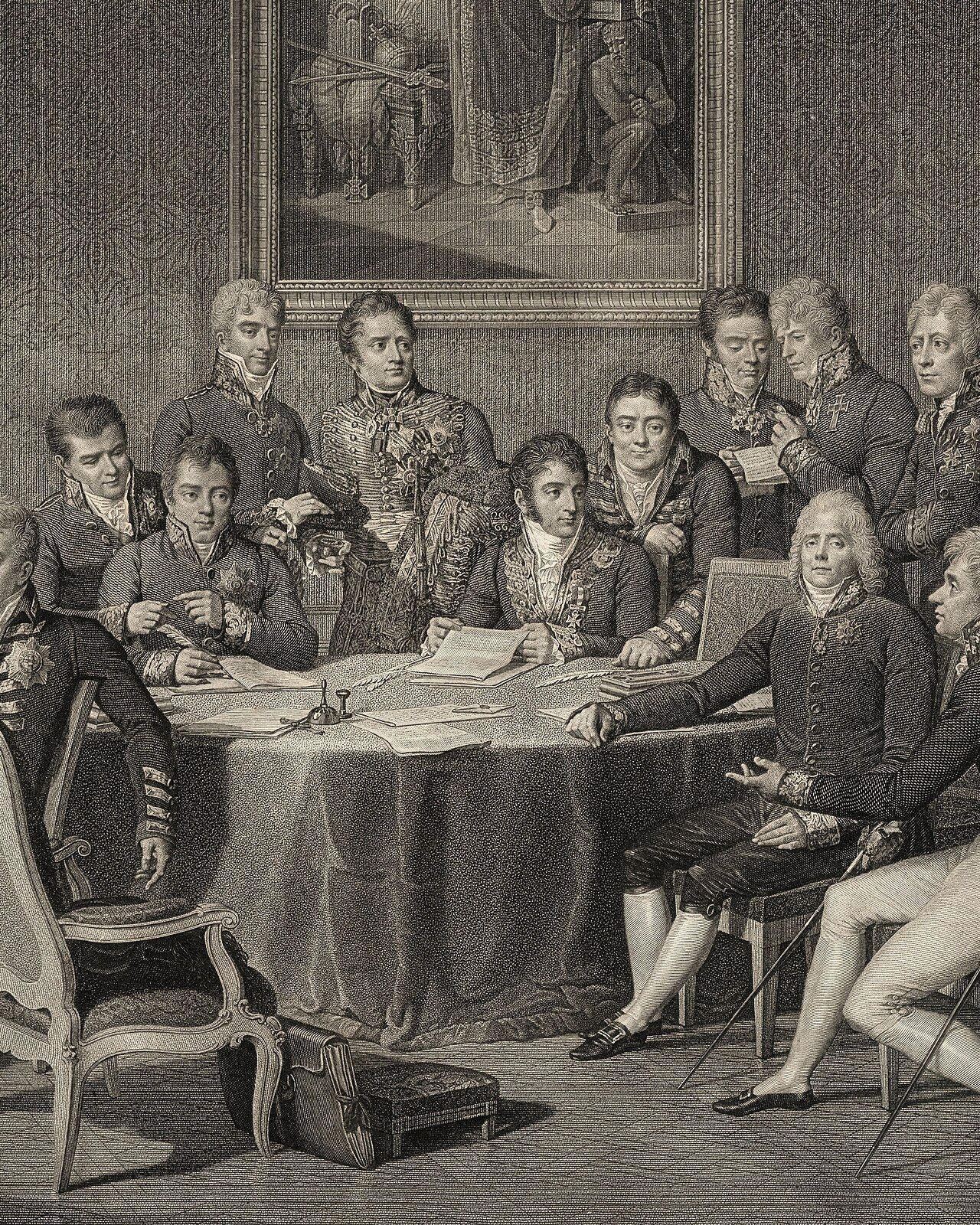
Napoleon’s defeat left the victors with a problem they had never faced: how to unbuild a revolution. From September 1814 to June 1815 the Congress of Vienna assembled under the Austrian foreign minister Klemens von Metternich, with Britain’s Castlereagh, Russia’s Alexander I, Prussia’s Hardenberg and, remarkably, the defeated French represented by Talleyrand. Their instincts were conservative but not stupid. They did not crush France; they restored the Bourbons, kept France inside the great-power club, and built a ring of stronger buffer states around her — an enlarged Netherlands, a Prussian foothold on the Rhine, Piedmont-Sardinia strengthened with Genoa. The guiding ideas were legitimacy (restore rightful dynasties), compensation and a rough balance of power in which no single state could dominate.
What Vienna deliberately refused to honor was national feeling. Italy was left as a patchwork of eight states with Austria controlling Lombardy and Venetia directly. The three-hundred-odd German states of the old Holy Roman Empire were consolidated into a loose German Confederation of thirty-nine, presided over by Austria. Poland was partitioned again, most of it as a Russian-ruled kingdom. Belgians were handed to a Dutch king. The settlement worked, in its own terms, better than anyone expected: no general European war occurred for ninety-nine years, and none between the Congress powers themselves until the Crimean War of 1853–56. But the price was permanent low-grade rebellion.
Metternich policed that rebellion through the Concert of Europe, a habit of great-power consultation, and through censorship at home. After a nationalist student murdered the playwright August von Kotzebue in 1819, the Carlsbad Decrees dissolved student societies, put university lecturers under surveillance and imposed press censorship across the Confederation. Secret societies flourished anyway — the Italian Carbonari, the Greek Philiki Hetairia. The system also had a fatal inconsistency: Britain, France and Russia backed Greek independence from the Ottoman Empire (a nationalist revolt) because it suited their interests, sinking the Ottoman-Egyptian fleet at Navarino in 1827 and securing Greek statehood by 1832. Legitimacy, it turned out, was negotiable.
Where nations come from: Herder, philology and folklore
Before nationalism was a political movement it was a theory of culture. Johann Gottfried Herder (1744–1803) argued that humanity is not one undifferentiated mass improvable by universal reason but a garden of distinct peoples, each with a Volksgeist — a spirit expressed in its language, songs, proverbs and law. Language, for Herder, was not a tool but the soul of a people made audible. This was a claim about authenticity, and it was initially anti-imperial in flavor: it defended small cultures against French cultural dominance.
Napoleon militarized it. After Prussia’s humiliation at Jena, Johann Gottlieb Fichte delivered his Addresses to the German Nation in occupied Berlin in the winter of 1807–08, telling Germans they were an Urvolk with an original language and therefore a destiny. Scholars supplied the raw material. Jacob and Wilhelm Grimm published their collected household tales in 1812 and began a monumental German dictionary in 1838; parallel work produced Serbian folk-song collections (Vuk Karadžić), Finnish epic (the Kalevala, 1835), and standardized Czech, Hungarian and Norwegian literary languages. A grammar could be a political act. Where a printed standard language existed, a nation could be argued into existence around it.
The political translation came from Giuseppe Mazzini, who founded Young Italy in 1831 and preached that each nation had a God-given mission and that a Europe of free nations would be a Europe at peace. Mazzini was a democrat and an internationalist; the later career of nationalism — exclusionary, biological, militarized — would have appalled him. That distinction between civic nationalism (the nation as a community of citizens who consent) and ethnic nationalism (the nation as descent and blood) is imperfect but genuinely useful, and the nineteenth century drifted steadily from the first toward the second.
Pearl. Nations feel timeless from the inside, which is exactly what makes them modern. Benedict Anderson called the nation an “imagined community” — imagined because you will never meet most of your compatriots, yet feel kinship with them — and the essays Eric Hobsbawm and Terence Ranger collected in The Invention of Tradition (1983) showed how many “ancient” national traditions were manufactured in the nineteenth century — Hugh Trevor-Roper on kilts and clan tartans, David Cannadine on royal ceremonial. Not everyone agrees: Anthony Smith argued that modern nations grew from real, older ethnic cores (ethnies) rather than out of nothing. The honest position is that nationalism used genuine older materials to build something genuinely new.
1848: the springtime that failed
Palermo had already risen in January 1848. In February a banquet campaign for suffrage reform in Paris turned into a street rising; Louis-Philippe abdicated and a republic was declared. Within weeks the shock traveled the telegraph and the railway to Vienna, where Metternich fled in March, and on to Berlin, Milan, Venice, Budapest and Prague. The causes stacked: the “hungry forties” potato blight and grain failure of 1845–47, a credit and industrial slump, artisan displacement, censorship, and the refusal of monarchs to concede constitutions. In a matter of months more than fifty states saw uprisings.
Within eighteen months nearly all of it was reversed. The German liberals elected a Frankfurt Parliament in May 1848 — 585 delegates, heavily professorial, arguing for a year over borders and rights. Their central question, “Grossdeutsch or Kleindeutsch” (a Germany including Austria’s German lands, or a smaller Germany under Prussia), had no answer that Austria would accept. When they finally offered the imperial crown to Frederick William IV of Prussia in April 1849, he refused it: a crown from the gutter, offered by professors rather than princes, carried no legitimacy he recognized. In Hungary, Lajos Kossuth’s revolutionary government was crushed in August 1849 by Habsburg forces with a Russian army of some 200,000 in support. In Italy, Piedmont’s Charles Albert lost at Custoza (1848) and Novara (1849); Mazzini’s Roman Republic fell in July 1849 — to a French army sent by a republic, protecting the Pope. In Paris, the June Days pitted General Cavaignac’s regular army and the newly raised Mobile Guard, backed by bourgeois National Guard units, against unemployed workers, and killed several thousand; by December 1852 Louis-Napoleon had made himself Emperor Napoleon III.
Why did the revolutions fail so completely? Three reasons matter more than the rest. Liberals wanted constitutions and property rights; workers wanted bread and jobs; once the workers moved, the middle classes chose order. Nationalism divided the revolutionaries against each other — Germans in Frankfurt voted to keep Polish Posen, Hungarians denied Croat and Romanian claims, and the Habsburgs survived partly by playing subject nationalities off one another. And the armies mostly stayed loyal to their monarchs. The lasting lesson, absorbed above all by Cavour and Bismarck, was that liberals and nationalists could not deliver unity by moral argument; a state with an army would have to do it for them.
| 1848 — where | What was demanded | Outcome by 1852 |
|---|---|---|
| France | Suffrage, republic, right to work | Second Republic, then Napoleon III’s Second Empire |
| Habsburg Austria | Constitution, end of censorship | Metternich gone, absolutism restored under Franz Joseph; serfdom abolished (the one lasting gain) |
| Hungary | Independence under Kossuth | Crushed 1849 with Russian military help |
| German states | Unification, liberal constitution | Frankfurt Parliament dissolved; Prussian crown refused |
| Italian states | Expel Austria, unify, republic in Rome | Austrian and French restoration; Piedmont keeps its constitution |
Vienna built a durable peace by ignoring nationality, and 1848 proved that ignoring nationality was not the same as defeating it — but also that idealism without an army changed nothing.
Section 2Made by War: The Unifications of Italy and Germany
Cavour’s calculation and Garibaldi’s gamble
Italian unification — the Risorgimento — succeeded when it stopped being Mazzini’s and became Piedmont’s. Camillo Benso di Cavour, prime minister of Piedmont-Sardinia from 1852, was a modernizing liberal aristocrat, not a romantic: he built railways, cut tariffs, reformed banking, and understood that Piedmont alone could never beat Austria. So he bought an ally. He sent 18,000 Piedmontese troops to the Crimean War in 1855 for no Italian interest whatsoever, purely to earn a seat at the peace table. At the secret meeting at Plombières in July 1858 he and Napoleon III agreed that France would fight Austria if Austria could be maneuvered into appearing the aggressor. Cavour duly provoked; Austria duly issued an ultimatum; war came in 1859.
The French and Piedmontese won bloody victories at Magenta and Solferino — Solferino’s carnage so appalled the Swiss businessman Henry Dunant that he founded what became the Red Cross in 1863 — and then Napoleon III abruptly made a separate peace at Villafranca, frightened by Prussian mobilization and by revolutions in central Italy he had not authorized. Piedmont got Lombardy, not Venetia. But the central Italian duchies held plebiscites and joined anyway; Cavour paid France with Nice and Savoy in 1860.
Then came the improvisation. In May 1860 Giuseppe Garibaldi sailed from Genoa with roughly a thousand red-shirted volunteers, landed in Sicily, and by September had taken Naples — toppling a Kingdom of the Two Sicilies of some nine million people, helped by Sicilian peasant revolt and Bourbon incompetence. Cavour was horrified: a republican hero marching on Rome could bring French intervention. He sent the Piedmontese army south to intercept, and at Teano in October 1860 Garibaldi handed his conquests to King Victor Emmanuel II and retired to his farm. The Kingdom of Italy was proclaimed in March 1861. Venetia followed in 1866 as Prussia’s payoff for the Austro-Prussian War; Rome only in 1870, when French troops left to fight Prussia and Italian forces walked in through a breach at Porta Pia.
Pearl. “We have made Italy; now we must make Italians” is usually quoted as Massimo d’Azeglio’s, and the attribution is shaky — the surviving phrasing in his memoirs is close but not identical. The underlying fact is not shaky at all. At unification perhaps only 2.5 percent of the population habitually spoke standard Italian rather than a regional language, illiteracy in the south exceeded 80 percent, and the new state fought a counterinsurgency in the south (the brigantaggio, 1861–65) that killed more Italians than all the wars of unification combined. Building a nation-state is not the same as having a nation.
Bismarck, Realpolitik and three wars
Otto von Bismarck became minister-president of Prussia in September 1862 in the middle of a constitutional crisis: the liberal-majority parliament refused to fund army expansion, so Bismarck simply collected the taxes without a budget. Days into the job he told a budget committee that the great questions of the day would be settled not by speeches and majority votes — that was the error of 1848 — but by iron and blood. The phrase defined Realpolitik: policy set by calculation of power and interest rather than by ideology, sentiment or legitimist principle.
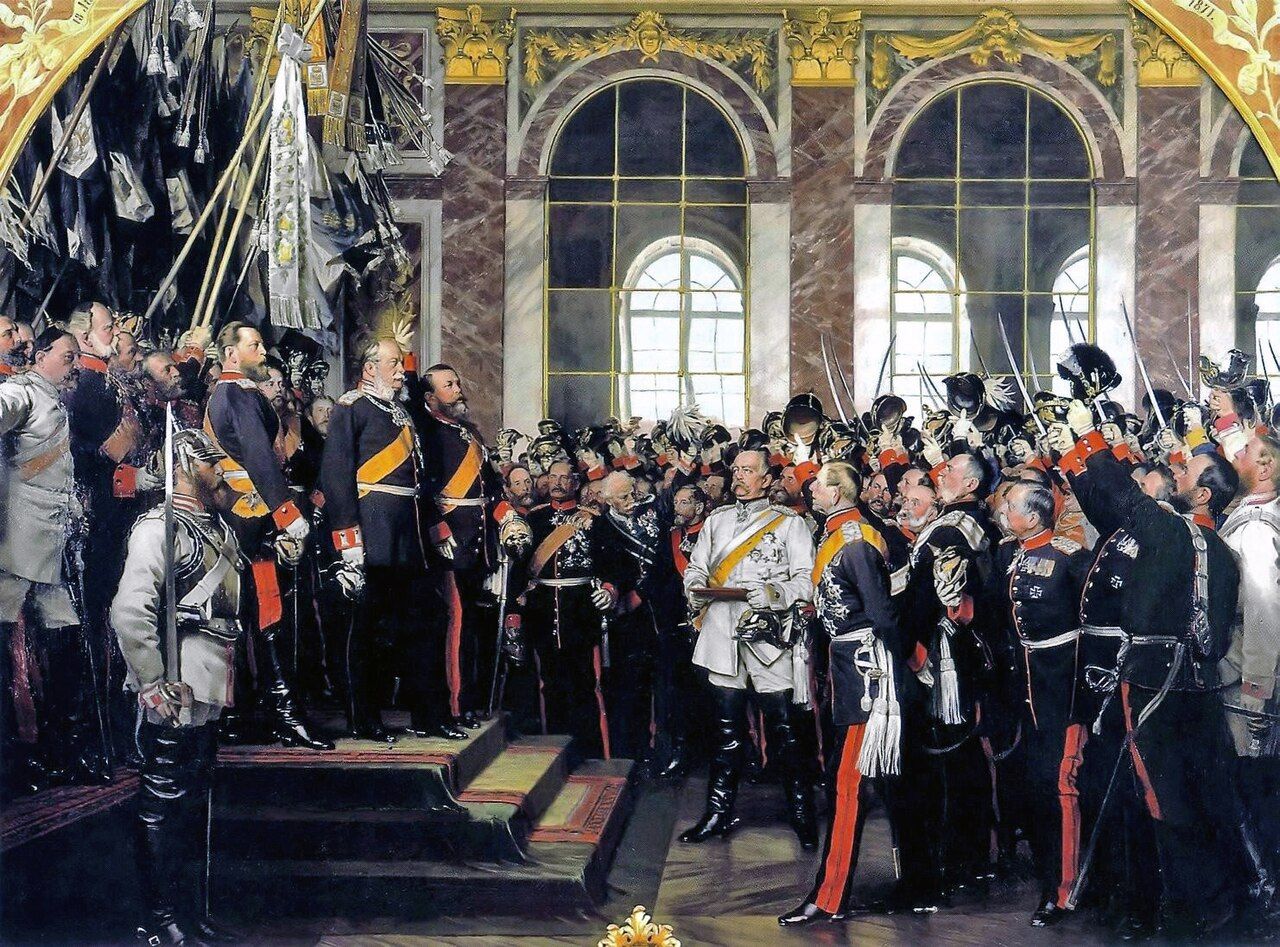
Three short wars in seven years did the work. In 1864 Prussia and Austria jointly seized Schleswig and Holstein from Denmark — and the deliberately messy joint administration of the duchies gave Bismarck his pretext against Austria. In 1866 the Austro-Prussian War lasted seven weeks; Prussia’s railways, breech-loading needle guns and Moltke’s general staff destroyed the Austrian army at Königgrätz on 3 July. Bismarck then insisted on lenient terms — no territory taken from Austria proper, no triumphal entry into Vienna — because he wanted Austria neutral later, not vengeful. Austria was excluded from Germany; the North German Confederation formed in 1867 under Prussia. Finally, in 1870, Bismarck edited a telegram from his king at Ems to make a routine diplomatic exchange read as a mutual insult, published it, and France declared war. The Franco-Prussian War was catastrophic for France: Napoleon III captured at Sedan on 2 September 1870, Paris besieged and starved through the winter, an indemnity of five billion francs, and the annexation of Alsace and most of Lorraine over the explicit protest of their inhabitants. The German Empire was proclaimed at Versailles on 18 January 1871.
Was Bismarck a master planner? Older accounts made him a chess player executing a design from 1862. Most historians now read him as a superb opportunist — a man who created options, waited, and improvised brilliantly, and who himself said statesmanship consisted of listening for God’s footsteps and grabbing the coat-tail. What is certain is the shape of what he built: a federal empire with universal male suffrage for the Reichstag but a chancellor responsible to the Kaiser alone, an army outside parliamentary control, and Prussia dominant within it. He then spent twenty years defending it — the Kulturkampf against Catholic institutional independence (largely abandoned by the early 1880s as a failure), the Anti-Socialist Laws of 1878–1890, and, most consequentially, the world’s first national social insurance system: sickness insurance in 1883, accident insurance in 1884, old-age and disability pensions in 1889. That was not benevolence. It was an attempt to detach workers from socialism by making the state, not the party, the source of security.
| Year | Italy | Germany |
|---|---|---|
| 1834 | Mazzini’s Young Italy conspiracies fail | Zollverein customs union creates a Prussian-led economic Germany |
| 1848–49 | Charles Albert defeated; Roman Republic crushed | Frankfurt Parliament collapses; crown refused |
| 1859–64 | War with Austria; Lombardy gained; Garibaldi takes the south (1860) | Bismarck takes office (1862); Danish War (1864) |
| 1866 | Venetia acquired as a byproduct of Prussia’s war | Königgrätz; Austria excluded from Germany |
| 1870–71 | Rome taken when French garrison withdraws; capital moved 1871 | Sedan; Empire proclaimed at Versailles; Alsace-Lorraine annexed |
| Method | Diplomacy plus foreign alliance plus popular insurgency, then absorbed by a monarchy | State-directed war by a professional army; liberals co-opted after the fact |
What unification cost
Both new states were smaller than their nationalist rhetoric. Italy left Italian-speakers in Austrian Trieste and Trentino (the irredenta, the “unredeemed”), and its seizure of Rome put it in open conflict with the papacy for nearly sixty years; Pius IX declared himself a prisoner of the Vatican and forbade Catholics to vote in national elections. Germany excluded millions of German-speaking Austrians and included resentful Poles, Danes and Alsatians. Both states responded with programs of forcible assimilation — language laws in Prussian Poland, conscription and schooling as Italianizing machines.
The international consequences were larger still. France now had a permanent grievance and a lost province. Austria, shut out of Germany, turned toward the Balkans, where it collided with Russia. And a united Germany, with the largest army and soon the largest industrial economy in Europe, sat in the middle of the continent as a structural problem that no balance of power had been designed to hold. Bismarck spent the rest of his career building alliances to keep France isolated; his successors dismantled them within two years of his dismissal in 1890.
Italy and Germany were unified not by the liberals and romantics who imagined them but by conservative statesmen using armies, alliances and manipulated crises — and the manner of their making shaped, and destabilized, European politics for the next forty years.
Section 3Steel, Cities and the Politics of the Masses
The Second Industrial Revolution
The first industrial revolution ran on coal, iron, cotton and the steam engine, and it was largely British. The Second Industrial Revolution, roughly 1870–1914, ran on steel, chemicals, electricity and the internal combustion engine, and its leaders were Germany and the United States. The difference was not just scale but method: this was the first industrialization driven by organized science. Henry Bessemer’s converter (1856) and the Siemens–Martin open-hearth furnace made cheap steel possible; the Gilchrist–Thomas process (1878) allowed the use of phosphoric ores, which happened to be exactly what Lorraine and Luxembourg had. German steel output, well behind Britain’s in 1870, was roughly double it by 1913.
Chemistry became an industry with a laboratory attached. William Perkin’s accidental synthesis of mauve dye in 1856 launched synthetic dyes; by 1900 German firms — BASF, Bayer, Hoechst — controlled the overwhelming majority of world dye production and, with them, the beginnings of the pharmaceutical industry (Bayer marketed aspirin in 1899). Electricity moved from curiosity to infrastructure: practical incandescent lighting by 1879–1880, alternating-current transmission in the 1890s, electric trams reshaping where working people could afford to live. Transport and communication collapsed distance: a working transatlantic telegraph cable in 1866, the Suez Canal in 1869, compound marine engines, and refrigerated shipping from the 1880s that let Argentine beef and New Zealand mutton feed British cities.
Two consequences ran straight into politics. First, the price deflation and profit squeeze of 1873–1896 — contemporaries called it the Great Depression — ended the free-trade consensus; Germany returned to protective tariffs in 1879, France and others followed, and Britain became the lonely exception. Second, production concentrated. Cartels, trusts and investment banks replaced the family firm; by 1900 a German steel or chemical works employed thousands and coordinated prices with its rivals. Big capital summoned big labor, and big labor summoned mass parties.
| Innovation | Date | Why it changed the century |
|---|---|---|
| Bessemer converter | 1856 | Cheap steel — rails, ships, girders, artillery, skyscrapers |
| Transatlantic telegraph | 1866 | News and orders cross the Atlantic in minutes; global markets and imperial command |
| Suez Canal | 1869 | Cuts London–Bombay by roughly 40 percent; makes Egypt strategically irresistible |
| Germ theory and antisepsis | 1860s–1880s | Pasteur, Lister, Koch — surgery survivable, disease causation identified, nursing professionalized |
| Maxim machine gun | 1884 | Self-powered automatic fire; decisive asymmetry in colonial warfare |
| Electric power and traction | 1880s–1900s | Factories freed from waterwheels and shafting; suburbs, night work, mass lighting |
| Synthetic chemicals | 1856–1913 | Dyes, drugs, fertilizer and explosives — and German industrial leadership |
The city and the sanitary state
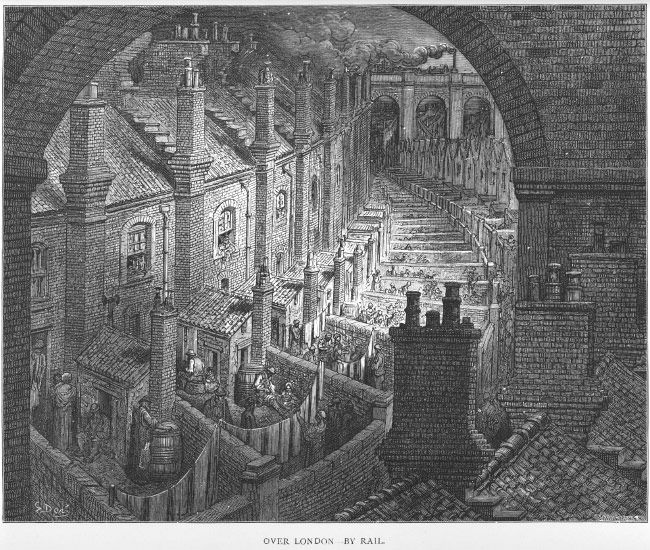
Europe’s population roughly doubled in the century, and the increase piled into cities. London grew from about one million in 1800 to some 6.5 million by 1900; Berlin from about 170,000 to nearly two million. The early results were lethal. In the worst districts of Manchester and Liverpool in the 1840s, average age at death for laborers’ families fell into the teens, dragged down by infant mortality; cholera epidemics swept Europe in 1832, 1848–49, 1854 and 1866.
The response created the modern public-health state — and it is worth noticing that it largely preceded the germ theory that eventually justified it. Edwin Chadwick’s 1842 Report on the Sanitary Condition of the Labouring Population argued from a mistaken theory (miasma, bad air) to correct policy: drainage, clean water, refuse removal. Britain’s first Public Health Act followed in 1848. In 1854 John Snow mapped cholera deaths around the Broad Street pump in Soho and made the case for waterborne transmission by spatial evidence rather than microscopy. After the “Great Stink” of 1858, Joseph Bazalgette built London’s 82 miles of intercepting sewers. Then the biology arrived: Louis Pasteur’s work on fermentation and microbial disease in the 1860s, Joseph Lister’s carbolic antisepsis in 1867, and Robert Koch’s identification of the tubercle bacillus in 1882 and the cholera vibrio in 1883.
Nursing became a profession in the same decades and by a similar logic. Florence Nightingale arrived at the British barrack hospital at Scutari in 1854, where mortality was driven far less by battle wounds than by typhus, typhoid, cholera and dysentery in an overcrowded building sitting on defective sewers. Her most durable contribution was not the lamp but the arithmetic: she compiled mortality statistics, popularized the polar-area diagram to display seasonal causes of death, and used them to force sanitary reform on the army. Her Notes on Nursing (1859) and the Nightingale Training School at St Thomas’ (1860) established nursing as trained, salaried, evidence-using work. Between roughly 1880 and 1914 European urban death rates fell sharply — a change attributable more to water, sewers, milk regulation and housing than to any drug, since effective antibacterials were still decades away.
Pearl. A common misconception is that nineteenth-century mortality fell because doctors learned to cure disease. Overwhelmingly it fell because engineers and inspectors stopped disease from spreading — clean water, sewage separation, pasteurized and inspected milk, less crowding, better nutrition. Nightingale herself resisted germ theory for years and still saved enormous numbers of lives, because her sanitary interventions were correct regardless of why they worked. Good practice can outrun correct theory; that is an argument for measuring outcomes, not for ignoring mechanisms.
Ideologies for a mass electorate
Politics had to change because the electorate did. Britain’s Reform Acts of 1832, 1867 and 1884 expanded the franchise from roughly one adult male in ten before 1832 to about one in five after it, one in three after 1867 and about three in five after 1884, with the secret ballot from 1872. The German Empire had universal male suffrage for the Reichstag from 1871; France had had it since 1848, retained under the Second Empire and inherited by the Third Republic in 1870. Mass literacy, cheap newspapers and mass parties followed. So did the “social question”: what does the state owe people who own nothing but their labor?
Karl Marx and Friedrich Engels had given one answer in the Communist Manifesto of 1848 and in Capital (volume one, 1867): history is driven by class struggle, capitalism concentrates wealth while immiserating workers, and it will be overthrown. The organized movement that followed him was more cautious than his rhetoric. The German Social Democratic Party, illegal in effect from 1878 to 1890, became the largest party in the Reichstag by 1912 with about 35 percent of the vote — and did so by winning elections, running newspapers, libraries, choirs and cycling clubs. In 1899 Eduard Bernstein published the argument that made this explicit: wages were rising, the middle class was not disappearing, and socialism should therefore be pursued by reform through parliament. Karl Kautsky and others attacked this revisionism as a betrayal, and the split between reformist social democracy and revolutionary Marxism, opened here, would define the twentieth-century left.
Other answers competed. Liberals shifted from pure laissez-faire toward the “new liberalism” of state-provided minimums (Britain’s old-age pensions in 1908, national insurance in 1911). Conservatives discovered that nationalism and welfare could bind workers to the existing order — Bismarck’s insurance laws, Disraeli’s social legislation. Anarchists rejected the state itself and, in the “propaganda of the deed” wave between 1894 and 1901, assassinated a French president, a Spanish prime minister, an Austrian empress, an Italian king and an American president. And the Catholic Church entered the field with Leo XIII’s encyclical Rerum Novarum (1891), which condemned both socialism and unrestrained capitalism and defended a living wage and the right to organize.
| Position | Diagnosis of the problem | Preferred remedy |
|---|---|---|
| Classical liberalism | State interference and privilege | Free markets, free trade, constitutional government, limited franchise |
| New liberalism | Poverty blocks real freedom | Pensions, insurance, factory regulation within capitalism |
| Conservatism | Disorder and rootlessness | Monarchy, church, army, nation — plus state welfare to buy loyalty |
| Marxist socialism | Private ownership of the means of production | Class organization and eventual revolutionary transfer of ownership |
| Revisionism | Marx’s predictions were empirically failing | Trade unions, ballots, incremental reform |
| Anarchism | The state itself is coercion | Abolition of the state; some factions embraced assassination |
| Social Catholicism | Both greed and class hatred violate human dignity | Living wage, unions, family, private property with obligations |
Women, work and the vote
Industrial capitalism sorted women’s lives by class. Working-class women had always worked; now they worked in textile mills, matchworks, domestic service and, by 1900, in the new white-collar jobs created by the typewriter and the telephone exchange. Middle-class ideology, meanwhile, elevated the “separate spheres” doctrine that a respectable woman’s domain was the home — a norm that described a minority and disciplined everyone.
Legal change came first in property and family law. Britain’s Married Women’s Property Acts of 1870 and 1882 ended the rule that a wife’s earnings and possessions belonged to her husband. Access to education and the professions opened slowly and unevenly: Elizabeth Garrett Anderson qualified in medicine in Britain in 1865 by exploiting a loophole the Society of Apothecaries then closed; Marie Curie, a Polish woman working in France, shared the Nobel Prize in Physics in 1903 and took the Chemistry prize alone in 1911. Nursing and teaching, both coded feminine and both underpaid, became the mass professional entries.
Suffrage came last and hardest. Millicent Fawcett’s National Union of Women’s Suffrage Societies (1897) campaigned constitutionally; Emmeline Pankhurst’s Women’s Social and Political Union (1903) turned to window-breaking, arson and hunger strikes met by force-feeding. New Zealand granted national women’s suffrage in 1893, Australia in 1902, Finland in 1906 (with the right to stand for election); most of Europe and the United States conceded only during or after the First World War. Historians still argue whether militancy accelerated British suffrage or delayed it — the evidence genuinely cuts both ways.
Steel, sewers and suffrage belong in the same story: industrial concentration created the urban working masses, sanitary reform kept them alive, and mass electorates forced every political tradition — liberal, conservative, socialist and Catholic — to answer for their conditions.
Section 4The New Imperialism
Why so fast, and why then
Europeans had traded on African coasts for four centuries without conquering the interior. Between about 1880 and 1900 they took almost all of it. Three enabling changes explain the timing. Medically, the prophylactic use of quinine from the 1850s cut European mortality in West Africa from catastrophic to merely bad. Militarily, breech-loading rifles, then repeaters, then the Maxim gun of 1884 produced a lethality gap so wide that at Omdurman in 1898 a Mahdist army lost on the order of 11,000 dead against 48 British and Egyptian fatalities. Logistically, steamships, railways, the Suez Canal and the telegraph made distant administration possible and made distant crises look urgent in European capitals within hours.
The motives were mixed and genuinely contested. Economic arguments — raw materials (rubber, cotton, tin, copper, palm oil), markets, and outlets for investment — mattered, but the colonies that were seized fastest were often the least profitable. Strategic logic mattered enormously: Britain occupied Egypt in 1882 after the Urabi nationalist revolt largely to secure the canal route to India, then found itself pushed up the Nile to protect Egypt, then into Sudan to protect the Nile. Prestige mattered: for Italy, Germany and Belgium, colonies were credentials of great-power status. And ideology supplied the permission structure — a “civilizing mission,” missionary enthusiasm, and the pseudo-science that misapplied Darwin to human societies. Herbert Spencer’s phrase “survival of the fittest” was recruited to argue that conquest was nature’s verdict; Kipling’s “White Man’s Burden” (1899) dressed domination as duty.
The Scramble, Berlin and the Congo
The Berlin Conference of November 1884 to February 1885, convened by Bismarck, brought fourteen states together to regulate the partition of Africa. No African was present. It did not itself draw the borders, but it set the rules — free navigation on the Congo and Niger, notification of claims, and the principle that coastal claims required “effective occupation” — which converted the race into a legal obligation to march inland. A large share of the resulting borders are straight lines drawn without reference to who lived there, cutting through language groups, kingdoms and grazing routes; the consequences persist.
The conference also recognized Leopold II of Belgium’s claim to what he named the Congo Free State — not a Belgian colony but the personal possession of a European king, presented to the world as a humanitarian and anti-slavery project. It became a forced-labor rubber operation. Villages were assigned quotas; hostages were taken; the Force Publique was required to account for cartridges by producing severed hands. The missionary and diplomatic evidence assembled by Edmund Dene Morel, and the official British consular report by Roger Casement in 1904, forced Belgium to annex the territory from its own king in 1908. Estimates of the death toll vary widely — Adam Hochschild’s widely cited figure of about ten million represents a population decline from killings, starvation, exhaustion and epidemic disease over roughly two decades, and demographers dispute both the baseline and the attribution. That there was mass atrocity on a colossal scale is not disputed. Nor was the Congo unique: German forces under Lothar von Trotha issued an explicit extermination order against the Herero in 1904 and drove Herero and Nama populations into the Omaheke desert, an episode now widely classified as the twentieth century’s first genocide.
Pearl. Empire is often defended as having been, on balance, an economic project that paid. For the imperial powers as a whole, it usually did not. Britain’s largest returns on foreign investment came from the United States, Argentina and the self-governing dominions, not from tropical Africa, while the costs of garrisons, railways and administration were carried by all taxpayers. The gains were real but concentrated — in shipping firms, chartered companies, settler landholders, arms makers and army careers. That is precisely J. A. Hobson’s 1902 argument: empire socialized the costs and privatized the profits.
Asia: India, China, Japan
Asia showed three different outcomes. India was the model of direct rule. After the rebellion of 1857 — sparked among sepoys by rifle cartridges greased with animal fat, but fed by annexations, land settlements and religious anxiety — the East India Company was abolished and the Crown took over in 1858; Victoria was proclaimed Empress of India in 1877. British India got railways (about 25,000 miles by 1900, over 30,000 by 1910), a telegraph network, codified law, English-language universities and an Indian Civil Service that Indians could enter only in tiny numbers. It also got deindustrialization of its textile handloom sector, revenue systems that offered no cushion, and famines — 1876–78 and 1896–1902 — in which millions died while grain was exported and officials cited market principles. Historians disagree sharply over the net economic effect of British rule; they no longer seriously disagree that famine policy was a moral catastrophe.
China was not colonized but was pried open. Britain fought the First Opium War (1839–42) to compel China to accept a drug trade it had banned; the Treaty of Nanjing took Hong Kong, opened five treaty ports and imposed an indemnity. A second war (1856–60) ended with the sacking of the Summer Palace. Layered on top came the unequal treaties — extraterritoriality, fixed tariffs, most-favored-nation clauses — and internal catastrophe in the Taiping Rebellion (1850–64), which killed perhaps twenty million. After defeat by Japan in 1895, the powers carved out spheres of influence; the anti-foreign Boxer Uprising of 1899–1901 was crushed by an eight-nation expedition and punished with a crushing indemnity.
Japan drew the opposite lesson and acted on it. Commodore Perry’s squadron forced Japanese ports open in 1853–54; within fifteen years the Meiji Restoration (1868) had abolished the shogunate and the samurai class privileges, imported European legal codes, built state industries then sold them to private combines, instituted universal conscription and compulsory schooling, and adopted a constitution in 1889. Japan then joined the imperialists: it defeated China in 1894–95, annexed Taiwan, and in 1904–05 destroyed Russian forces at Mukden and annihilated the Baltic Fleet at Tsushima. Ethiopia had already humbled Italy at Adwa in 1896, but this was the first time in the modern era that an Asian power had beaten a European great power in a full-scale war, and the news electrified nationalists from Cairo to Calcutta.
| Case | Form of control | Consequence to remember |
|---|---|---|
| Egypt (Britain, 1882) | Occupation with nominal Ottoman-Khedival sovereignty | Strategic protection of Suez pulled Britain up the Nile into Sudan |
| Congo (Leopold II, 1885–1908) | Personal fief, then Belgian colony | Rubber quotas, mutilation and mass death; first global human-rights campaign |
| India (Britain, 1858–1947) | Direct Crown rule plus princely states | Railways and law codes alongside famine and exclusion; birth of Congress nationalism |
| China (multiple, 1842–1901) | Treaty ports, extraterritoriality, spheres of influence | Sovereignty hollowed out without formal colonization |
| Japan | Escaped, then imperialized | Meiji reform, victory over Russia 1905, model for Asian nationalists |
| Ethiopia | Successful resistance | Menelik II destroys an Italian army at Adwa, 1 March 1896 |
Explaining empire, and resisting it
Three families of explanation compete. Hobson (1902) and then Lenin (1916) made empire a function of capitalism: surplus capital at home, seeking higher returns, drove annexation, and Lenin called imperialism the highest stage of capitalism. Critics point out that capital exports mostly went elsewhere and that annexation frequently preceded investment. A second school, associated with Ronald Robinson and John Gallagher, argued that Europeans generally preferred informal influence and were dragged into formal rule by crises on the periphery — local collaborators failing, nationalist revolts, frontier instability. A third emphasizes European domestic politics: prestige, popular jingoism in a newspaper age, and diplomatic rivalry, with Africa as a low-cost arena for competition that could not safely be conducted in Europe. Most historians today use some blend, and weight it differently case by case.
Resistance was constant and is often written out. Ethiopia’s Menelik II, having modernized his artillery and played the powers against each other, destroyed an invading Italian army at Adwa in 1896 and kept his independence. The Mahdist state ruled Sudan for over a decade. Samori Touré fought the French in West Africa for sixteen years. The Indian National Congress, founded in 1885 by moderate professionals petitioning for a share in government, radicalized after the 1905 partition of Bengal into the Swadeshi boycott movement. Egyptian, Vietnamese, Filipino and Korean nationalists drew on European nationalist vocabulary and turned it back on its authors. Nationalism, exported as a European doctrine, became the most effective anti-European weapon of the following century.
The New Imperialism was made possible by industrial technology and medicine, driven by a mixture of strategy, prestige and profit rather than any single cause, justified by racial pseudo-science, and answered almost immediately by the same nationalist logic that had built Europe’s own nation-states.
Section 5Empires Under Strain, 1890–1914
Multinational empires in a national age
Three empires straddling eastern and southeastern Europe were structurally incompatible with nationalism. The Habsburg monarchy, defeated by Prussia in 1866, bought Hungarian loyalty with the Ausgleich of 1867, creating the dual monarchy of Austria-Hungary: two parliaments, two governments, one emperor-king, shared army and foreign policy. It stabilized the Hungarians and enraged everyone else — Czechs, Poles, Slovaks, Croats, Serbs, Romanians, Slovenes, Italians. Language became the battlefield: the Badeni decrees of 1897, requiring officials in Bohemia to know Czech as well as German, brought parliamentary obstruction, street violence and the fall of the government. Austria introduced universal male suffrage in 1907, which converted national conflict into electoral conflict without resolving it.
The Ottoman Empire had been reforming since the Tanzimat decrees of 1839, which promised legal equality regardless of religion — a direct challenge to the older millet system of confessional self-government. A constitution in 1876 was suspended in 1878 by Abdülhamid II. Territory drained steadily: Greece broke away by 1832, and after the Russo-Turkish war of 1877–78 and the Congress of Berlin, Serbia, Romania and Montenegro won full independence and Bulgaria autonomy. The Young Turk revolution of 1908 restored the constitution and then, under the pressure of further defeats, turned toward Turkish nationalism — a trajectory that would end in the Armenian genocide of 1915.
Russia had abolished serfdom in 1861 and industrialized rapidly under Witte in the 1890s, but its politics did not follow. Defeat by Japan triggered the revolution of 1905: Bloody Sunday in January, when troops fired on a peaceful petition march to the Winter Palace; a general strike; the first workers’ soviets; and the October Manifesto conceding a parliament, the Duma, whose powers Nicholas II promptly narrowed. Stolypin’s land reforms tried to create a conservative peasant proprietor class and were cut short by his assassination in 1911.
Race, religion and the politics of exclusion
Nationalism produced not only demands for statehood but also definitions of who did not belong. Older religious anti-Judaism was recast in the 1870s and 1880s as racial antisemitism — the term itself was popularized by the German agitator Wilhelm Marr in 1879 — and mass politics gave it electoral traction, most visibly in Karl Lueger’s Vienna. In the Russian Empire, the assassination of Alexander II in 1881 was followed by waves of pogroms and the May Laws of 1882, which tightened residence and occupation restrictions; the Kishinev pogrom of 1903 killed dozens and drew international protest. Roughly two million Jews emigrated from the Russian Empire between 1881 and 1914, most to the United States.
In France, the Dreyfus affair exposed how deep the fracture ran even in a republic. Captain Alfred Dreyfus, an Alsatian Jewish artillery officer, was convicted of treason in 1894 on forged and flimsy evidence and sent to Devil’s Island. When the army learned the real culprit’s identity, it covered up rather than admit error. Émile Zola’s open letter J’accuse in January 1898 split France into Dreyfusards (republic, individual rights, civilian courts) and anti-Dreyfusards (army, church, nation). Dreyfus was finally exonerated in 1906. The affair pushed the Third Republic toward the formal separation of church and state in 1905, and it hardened the conviction of the Viennese journalist Theodor Herzl, who covered the case, that assimilation would not protect Jews. His Der Judenstaat (1896) and the first Zionist Congress at Basel in 1897 launched political Zionism as an organized movement.
Pearl. It is tempting to read 1900 as a straight road to 1933. Resist that. Antisemitic parties actually lost ground in Germany in the elections just before 1914, and Imperial Germany was in many ways a more comfortable place for Jews than the Russian Empire. What the period did establish was a vocabulary — nation as biology, minority as contamination, science as the authority for both — that later movements found lying ready to hand. The danger was the availability of the ideas, not their inevitability.
Alliances, arms and the Balkan fuse
Bismarck’s post-1871 system was designed to keep France isolated and Austria and Russia from fighting: the Dual Alliance with Austria-Hungary (1879), the Triple Alliance adding Italy (1882), and the Reinsurance Treaty with Russia (1887). His successors let the Reinsurance Treaty lapse in 1890, and the logic reversed. Republican France and autocratic Russia — ideological opposites — allied in 1894. Germany’s decision under Tirpitz to build a battle fleet from 1898 turned Britain from a benevolent bystander into an opponent; the launch of HMS Dreadnought in 1906 restarted the naval race from zero and Britain won it. Britain settled colonial quarrels with France in the Entente Cordiale of 1904 and with Russia in 1907. By 1907 Europe had two armed blocs, and Germany had persuaded itself it was encircled.
Two Moroccan crises (1905, 1911) in which Germany tried to break the Entente only tightened it. The real fuse was in the Balkans, where Ottoman retreat left a vacuum that Austria-Hungary and Russia both wanted, and where Serbia had become a magnet for South Slav nationalism. Austria annexed Bosnia-Herzegovina outright in 1908, humiliating Serbia and Russia. The Balkan Wars of 1912–13 expelled the Ottomans from nearly all of Europe and doubled Serbia’s size. Vienna concluded that Serbia was an existential threat that must be dealt with by force. On 28 June 1914, Gavrilo Princip, a Bosnian Serb linked to a Serbian officers’ secret society, shot Archduke Franz Ferdinand in Sarajevo. Within five weeks the alliance system, mobilization timetables that treated speed as survival, and the German general staff’s plan to knock out France before Russia could deploy turned a regional quarrel into a continental war.
| Pressure | Mechanism | Why it mattered in 1914 |
|---|---|---|
| Alliance blocs | Triple Alliance vs. Franco-Russian alliance and the Ententes | Turned any two-power quarrel into a five-power war |
| Mobilization planning | Railway timetables, plans that could not be paused | Compressed the time available for diplomacy to days |
| Naval and arms race | Tirpitz’s fleet; conscript army expansion | Made Britain a committed opponent; fed “better now than later” thinking |
| Balkan nationalism | Serbian expansion; South Slav irredentism inside Austria-Hungary | Gave Vienna a motive to destroy Serbia and Russia a motive to protect it |
| Domestic politics | Mass nationalist press, elites fearing socialism | Raised the cost of visible retreat for every government |
Pearl. Historians have never settled the blame question, and you should know the shape of the argument rather than a verdict. Fritz Fischer (1961) placed primary responsibility on German bids for world power; A. J. P. Taylor emphasized mobilization timetables; Christopher Clark’s The Sleepwalkers (2012) spreads responsibility across all the capitals, Belgrade and Vienna included; others stress Austrian recklessness or Russian mobilization. What almost everyone now rejects is the idea that the war was an accident nobody chose. Real people made deliberate decisions with the information they had.
The same principle that created Italy and Germany — that a people deserves a state — corroded the Habsburg, Ottoman and Russian empires from inside, and when it fused with the alliance system and rigid war plans in the Balkans, it detonated.
The chapter in one breath
The nineteenth century took an idea about culture and turned it into the organizing principle of world politics. Herder’s claim that peoples are defined by language became Mazzini’s claim that peoples deserve states, and when the amateur revolutionaries of 1848 failed to deliver, professionals with armies did it instead: Cavour by alliance and manipulation, Bismarck by three calculated wars. Both new nation-states were smaller and messier than their myths, and both left grievances that would matter in 1914. Meanwhile the Second Industrial Revolution — steel, chemicals, electricity, telegraphy — concentrated Europeans in cities that first killed them and then, through sanitary engineering, professional nursing and germ theory, kept them alive in unprecedented numbers. Mass survival produced mass electorates, and every ideology from Marxism to social Catholicism scrambled to answer them. The same industrial power, aimed outward, let Europe seize nearly all of Africa in a generation and hollow out Chinese sovereignty, justified by a racial pseudo-science that dressed conquest as duty. But nationalism travels. It armed Japanese, Indian, Egyptian and Ethiopian resistance abroad, and inside Europe it pulled the Habsburg, Ottoman and Russian empires apart. The century that invented the nation-state ended by handing it a world war.
Words worth knowing
| Term | What it means |
|---|---|
| Congress of Vienna | The 1814–15 settlement that redrew Europe after Napoleon on principles of legitimacy, compensation and balance of power, deliberately ignoring nationality. |
| Concert of Europe | The habit of great-power consultation after 1815 to manage crises and suppress revolution; it kept general war away for decades. |
| Volksgeist | Herder’s idea of the distinctive “spirit” of a people, expressed above all in its language and folklore. |
| Civic vs. ethnic nationalism | The nation as a community of consenting citizens, versus the nation as shared descent, language and blood. |
| Frankfurt Parliament | The 1848–49 elected German assembly whose offer of an imperial crown was refused by Prussia’s king, ending liberal unification. |
| Risorgimento | The nineteenth-century movement and process of Italian unification, completed between 1859 and 1870. |
| Realpolitik | Politics conducted by calculation of power and interest rather than by ideology or moral principle; Bismarck’s signature method. |
| Zollverein | The Prussian-led German customs union from 1834 that built economic unity ahead of political unity. |
| Kulturkampf | Bismarck’s 1870s campaign against the political and institutional independence of the Catholic Church in Germany; largely abandoned as a failure. |
| Second Industrial Revolution | The 1870–1914 wave of steel, chemicals, electricity and internal combustion, driven by organized science and led by Germany and the United States. |
| Sanitary movement | The nineteenth-century public-health campaign for drainage, clean water and refuse removal, which cut urban mortality before germ theory explained why. |
| Revisionism | Bernstein’s 1899 argument that socialism should be achieved by parliamentary reform because Marx’s predictions were not coming true. |
| Rerum Novarum | Leo XIII’s 1891 encyclical rejecting both socialism and unrestrained capitalism and defending a living wage and workers’ associations. |
| New Imperialism | The rapid formal partition of Africa and much of Asia, roughly 1870–1914, enabled by industrial technology and quinine. |
| Berlin Conference | The 1884–85 meeting of fourteen states that set rules for the partition of Africa, including “effective occupation,” with no African participation. |
| Unequal treaties | Agreements imposed on China (and others) granting extraterritoriality, fixed tariffs and treaty ports, stripping sovereignty without formal colonization. |
| Meiji Restoration | Japan’s 1868 political revolution and program of state-led industrialization, conscription and legal reform that made it a great power. |
| Ausgleich | The 1867 compromise creating dual-monarchy Austria-Hungary, which satisfied Hungarians and inflamed every other nationality. |
| Pogrom | An organized mob attack on a Jewish community, most notoriously in the Russian Empire after 1881. |
| Irredentism | The claim that territory inhabited by co-nationals under foreign rule must be “redeemed” and joined to the nation-state. |