Gender & Sexuality
A form asks your “gender” when it really wants to know your sex — and in that small slip lives one of sociology’s biggest ideas. Your body is biological, but almost everything a society expects of that body — how you dress, who you love, what work you do, whether you cry — is learned, taught, and enforced. This chapter separates sex from gender, follows gender as it is drilled into us from the gender-reveal party onward, measures the stubborn gaps in pay and power that gender still produces, and turns the three great sociological paradigms loose on both gender and sexuality. By the end you will see that the most “natural” feeling categories in your life are also among the most socially built.
By the end of this chapter you can
- Distinguish sex from gender and explain what it means to call gender a social construction.
- Describe how gender is learned through the agents of socialization.
- Explain gender stratification in work, pay, and power using terms like the pay gap, occupational segregation, and the glass ceiling.
- Apply the functionalist, conflict, and symbolic-interactionist paradigms to gender.
- Summarize what feminist theory adds to the study of gender.
- Define sexual orientation and describe it as a continuum rather than a strict binary.
- Explain how sexual attitudes and social views of sexuality vary across cultures and change over time.
- Name the theorists behind each idea — Mead, Durkheim, Marx, Engels, Parsons, Cooley, Goffman — and place them correctly.
Section 1Sex and gender
The distinction that starts it all
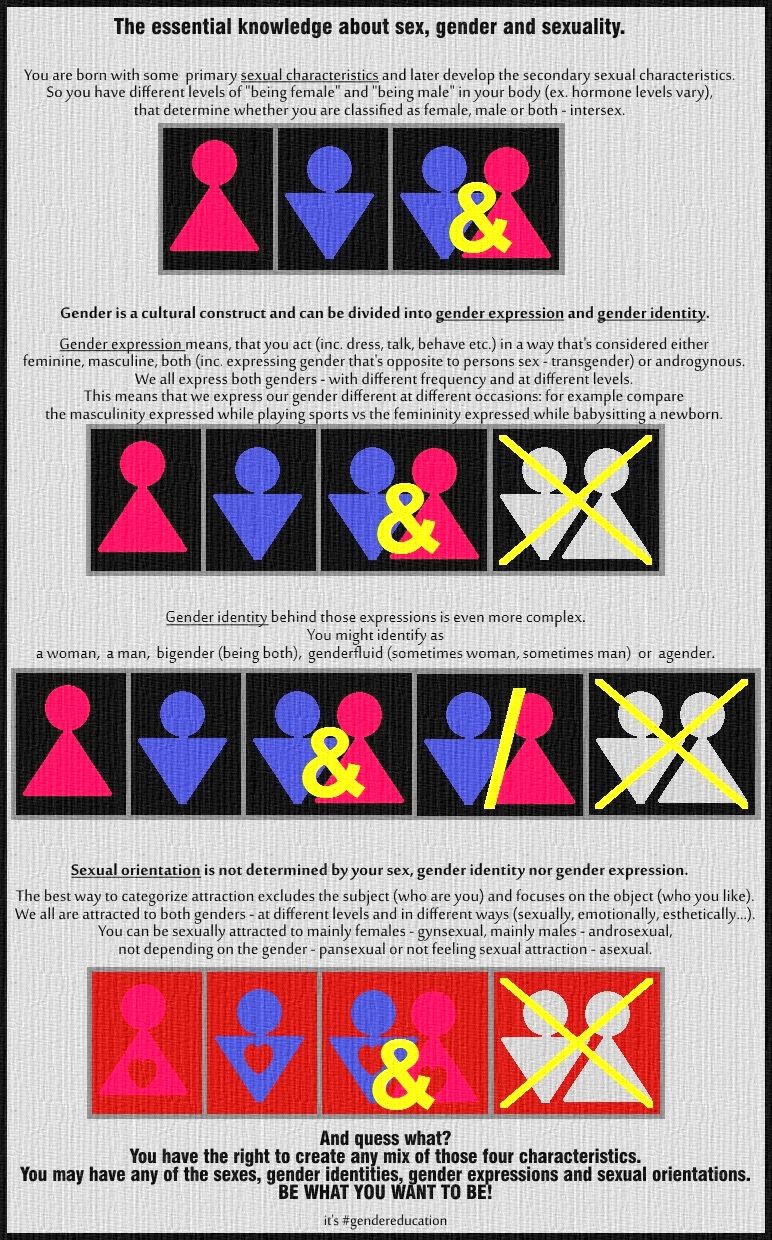
Everyday speech treats sex and gender as the same word. Sociologists insist on splitting them, because the split is where the whole discipline earns its keep. Sex is biological: the chromosomes (typically XX or XY), hormones, gonads, and anatomy a person is born with. Some people are intersex, born with reproductive or sexual anatomy that doesn’t fit the neat male/female boxes — a first hint that even biology is less tidy than we assume.
Gender, by contrast, is social and cultural: the roles, behaviors, expectations, and meanings a society layers on top of sex. “Masculine” and “feminine” are gender words, not sex words. Two further terms sharpen the picture. Gender identity is a person’s internal sense of their own gender — when it matches the sex assigned at birth we say cisgender, and when it differs, transgender. Gender expression is the outward presentation — clothing, voice, mannerisms — through which we signal gender to others.
Gender as a social construction
Here is the sociological punchline: if gender simply followed from biology, it would look the same in every society. It does not. What counts as manly in one culture is womanly in another. The anthropologist Margaret Mead, in her classic 1935 study of three New Guinea peoples, found the gentle Arapesh raising both sexes to be nurturing, the fierce Mundugumor raising both to be aggressive, and the Tchambuli reversing Western expectations — women were the brisk, practical providers and men the vain, emotional decorators. Temperaments we call “masculine” or “feminine,” she argued, are culturally patterned, not fixed by nature.
Cultures disagree even about how many genders there are. The hijra of South Asia, the Two-Spirit roles recognized by some Native American nations, and the muxe of Zapotec Mexico are long-standing third-gender categories. To say gender is socially constructed is to say it is built and maintained by human societies rather than dictated by chromosomes. Sociologists Candace West and Don Zimmerman captured this in the phrase “doing gender”: gender is less something you are than something you continually do, and are held accountable for doing, in everyday interaction.
| Sex | Gender | |
|---|---|---|
| Basis | Biology | Society & culture |
| Given by | Chromosomes, hormones, anatomy | Socialization, norms, interaction |
| Categories | Male, female, intersex | Man, woman, and others — varies by culture |
| Same everywhere? | Largely yes | No — differs widely across time and place |
| Example | XY chromosomes | The expectation that “men don’t cry” |
- Sex is biological (chromosomes, hormones, anatomy); gender is the social meaning built on top of it.
- Gender identity is one’s inner sense of gender (cisgender or transgender); gender expression is the outward presentation.
- Because gender varies across cultures — Mead’s New Guinea peoples, third-gender roles — it is a social construction, not a biological given.
- West and Zimmerman’s “doing gender” frames gender as an ongoing performance.
Section 2Gender socialization

The agents that teach gender
No baby is born preferring trucks to dolls. Gender socialization is the lifelong process by which we learn our society’s gender norms and come to experience them as our own preferences. It starts before birth — the gender-reveal party is a socialization ritual — and it never entirely stops. Sociologists trace the teaching to a familiar set of agents of socialization: the family, peers, schools, the mass media, and religion.
The family is first and most powerful. Three classic studies, often blurred together, show how early the labelling begins. Rubin, Provenzano, and Luria (1974) asked parents to describe their own newborns within a day of birth: daughters came out “delicate” and fine-featured, sons “strong” and better coordinated — though the babies did not differ in size or condition. Condry and Condry (1976) showed adults a videotape of one infant reacting to a jack-in-the-box; viewers told the baby was a boy read the reaction as “anger,” those told it was a girl read the same footage as “fear.” And in the “Baby X” experiments (Seavey, Katz, and Zalk, 1975), adults handed an infant in a gender-neutral outfit reached for a doll or a football depending on the label they had been given — description turning into treatment. Parents dress, name, praise, and assign chores along gender lines. Peers then police the boundaries (“that’s a girl toy”), schools deliver a hidden curriculum in which teachers call on boys more and steer students toward gendered subjects, media supply a steady stream of stereotyped heroes and helpers, and religion assigns gendered roles in doctrine and ritual.
The looking-glass self, gendered
How does an outside expectation become an inside identity? Two founders of American sociology give the answer. Charles Horton Cooley called the self a looking-glass self: we build our self-image out of how we imagine others see us. A girl told again and again that she is “so pretty” and a boy told he is “so strong” assemble gendered selves from those reflections. George Herbert Mead added that children learn by taking the role of the other in play — trying on the mother, the doctor, the soldier — and absorbing the gender scripts attached to each. Reward and punishment (social sanctions), imitation of role models, and the very structure of language do the rest.
| Agent | How it teaches gender | Everyday example |
|---|---|---|
| Family | Differential treatment, chores, modeling | Pink vs. blue; daughters assigned the dishes |
| Peers | Policing, inclusion and exclusion | “Boys don’t play with dolls” |
| Schools | Hidden curriculum, tracking | Boys nudged toward math and science |
| Media | Representation, repeated stereotypes | The rescuing hero, the rescued damsel |
| Religion | Doctrine and assigned ritual roles | Gender-restricted leadership |
- Gender socialization is the lifelong learning of gender norms, delivered by the agents of socialization.
- The family is the earliest and strongest agent; peers, schools (hidden curriculum), media, and religion reinforce it.
- Cooley’s looking-glass self and Mead’s role-taking explain how outside expectations become inner identity.
- Because the lessons feel like personal preference, they are easy to mistake for “human nature.”
Section 3Gender stratification
Work and the pay gap
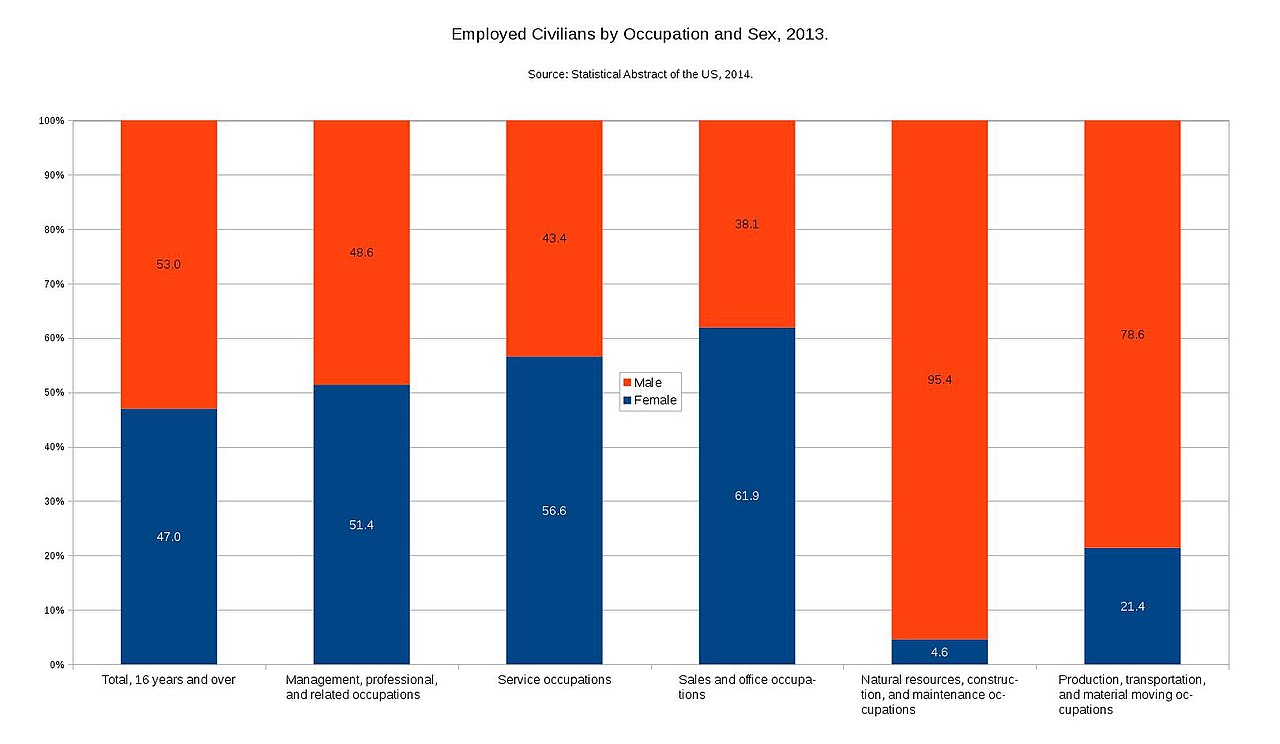
Gender stratification is the unequal distribution of wealth, power, and privilege between men and women. Its most measured face is the gender pay gap: in the United States, women working full-time earn roughly 82 to 84 cents for every dollar earned by men, and the gap is wider for Black and Latina women. Part of the gap comes from occupational segregation. Horizontally, women are concentrated in lower-paid “pink-collar” fields — nursing, teaching, clerical work, caregiving — while men dominate higher-paid trades and management. Vertically, women who enter a field often hit the glass ceiling, an invisible barrier to the top. The mirror image is the glass escalator: men who enter female-dominated fields tend to ride upward into supervisory posts faster than their women colleagues.
Power, politics, and the double burden
Beyond the paycheck, gender stratification shows up in power. Women remain underrepresented in legislatures, corporate boards, and executive suites almost everywhere. Sociologists name the underlying system patriarchy — a social order in which men hold disproportionate authority. At home the inequality continues: Arlie Hochschild called it the second shift, the disproportionate share of housework and childcare that employed women perform after the paid workday ends. Globally, the feminization of poverty describes how women — especially single mothers and elderly women — are overrepresented among the poor.
Why does the gap persist? Two explanations compete. The human-capital account points to differences in experience, hours, and field choice. The discrimination account notes that even after those factors are controlled, a stubborn unexplained residual remains — and audit studies, in which identical résumés with male and female names draw different callbacks, keep exposing bias directly. Most sociologists conclude that both forces are at work, with discrimination doing more than the market likes to admit.
| Dimension | Sociological term | What it means |
|---|---|---|
| Kinds of jobs | Occupational segregation | Women and men cluster in different fields |
| Earnings | Gender pay gap | Women earn less per dollar than men |
| Advancement | Glass ceiling / glass escalator | Invisible barrier for women; fast track for men |
| Home | Second shift | Women’s unpaid domestic “double day” |
| Wealth | Feminization of poverty | Women overrepresented among the poor |
| Authority | Patriarchy | Men’s disproportionate social power |
- Gender stratification is the unequal distribution of wealth, power, and privilege by gender.
- The pay gap reflects occupational segregation, the glass ceiling, and outright discrimination — not choices alone.
- The second shift and the feminization of poverty extend inequality into the home and across the globe.
- Patriarchy names the system of men’s disproportionate power.
Section 4Theories of gender

The functionalist view
Recall that functionalism, in the tradition of Comte and Durkheim, sees society as a system of interlocking parts that each serve a purpose. Applied to gender, Talcott Parsons and Robert Bales argued that the mid-century nuclear family ran smoothly because adults specialized: men filled instrumental roles (breadwinning, leadership, task focus) and women filled expressive roles (nurturing, emotional support, holding the family together). The two sets of roles were meant to be complementary, echoing Durkheim’s claim that a division of labor breeds social solidarity. The obvious critique — pressed hard by everyone who came after — is that this account mistakes one era’s middle-class arrangement for a universal law, and quietly justifies the inequality it describes.
The conflict view
Where functionalists see harmony, conflict theory sees a power struggle. Building on Marx, Friedrich Engels argued in The Origin of the Family, Private Property and the State that women’s subordination arose with private property: once men had wealth to pass on, they controlled women’s labor and sexuality to secure legitimate heirs. In this lens men are the dominant group and women the subordinate one, and patriarchy delivers men real material advantages — cheaper labor, unpaid care, social authority. Feminist theory extends the conflict frame; its slogan “the personal is political” insists that private inequalities are structured by public power.
The interactionist view
Symbolic interactionism zooms from society down to the sidewalk. Gender, in this view, is produced and reproduced in face-to-face encounters. West and Zimmerman’s “doing gender” belongs here: masculinity and femininity are ongoing accomplishments, not fixed traits. Erving Goffman, in Gender Advertisements, dissected the tiny rituals of gender display — who reaches for the door, whose body is posed as submissive in an ad — through which we broadcast gender. Cooley and George Herbert Mead supply the foundation: the self is social, assembled from interaction. The critique is the mirror of functionalism’s — brilliant on the how of daily life, weaker on the vast structures that frame it.
| Functionalism | Conflict theory | Symbolic interactionism | |
|---|---|---|---|
| Level of analysis | Macro | Macro | Micro |
| View of gender | Complementary roles that stabilize society | A system of inequality that benefits men | An identity performed in interaction |
| Key thinkers | Parsons & Bales; Durkheim | Engels, Marx, feminists | West & Zimmerman, Goffman, Mead |
| Guiding question | What function do gender roles serve? | Who benefits from gender inequality? | How is gender created in everyday life? |
| Main critique | Excuses inequality; ignores change | Underplays cooperation and agency | Neglects large-scale structures |
- Functionalists (Parsons & Bales, after Durkheim) see complementary instrumental and expressive roles — and are criticized for excusing inequality.
- Conflict theorists (Engels, after Marx; feminists) see gender as a power system that benefits men.
- Interactionists (West & Zimmerman, Goffman, Mead) see gender done in everyday encounters.
- Feminist theory is a family of lenses — liberal, socialist, radical — not one position.
Section 5Sexuality
Sexual attitudes and scripts
Sexuality — sexual attitudes, desires, and practices — feels intensely private, yet sociology shows it is thoroughly social. Every society supplies sexual scripts: culturally provided guidelines for who may do what, with whom, and when. Societies range from restrictive, permitting sex only within marriage and for reproduction, to permissive. Ira Reiss mapped how standards for premarital sex differ, and the historical trend in many countries is unmistakable: acceptance of premarital sex, cohabitation, and same-sex relationships has risen sharply across recent generations. What a society calls scandalous is a moving target, which is exactly why sociologists treat sexual morality as data rather than as a fixed fact.
Sexual orientation as a continuum
Sexual orientation is an enduring pattern of romantic or sexual attraction — heterosexual, homosexual (gay or lesbian), bisexual, or asexual. It is distinct from gender identity: whom you are attracted to is a different question from who you are. Alfred Kinsey’s mid-twentieth-century surveys reframed orientation with the Kinsey scale, a 0-to-6 continuum from exclusively heterosexual to exclusively homosexual. His central sociological point still holds: orientation is better modeled as a spectrum than as a strict either/or, and same-sex attraction and experience are far more common than public talk admitted.
Changing social views
Societies do not merely have orientations — they rank them. Heteronormativity is the built-in assumption that heterosexuality is the natural default; heterosexism and homophobia are the prejudice and hostility that stigmatize sexual minorities. Yet the social views themselves shift, sometimes fast. The American Psychiatric Association removed homosexuality from its list of mental disorders in 1973, and in 2015 the U.S. Supreme Court legalized same-sex marriage nationwide in Obergefell v. Hodges. Queer theory pushes further, questioning whether fixed sexual categories should be taken for granted at all. The three paradigms each take a turn: functionalists note that sexual norms channel reproduction and stabilize family life; conflict and feminist theorists ask who controls sexuality and expose the sexual double standard; interactionists study how meanings like “virginity” or “coming out” are socially constructed.
| Term | Meaning |
|---|---|
| Heterosexual | Attraction to a different sex or gender |
| Homosexual (gay/lesbian) | Attraction to the same sex or gender |
| Bisexual | Attraction to more than one sex or gender |
| Asexual | Little or no sexual attraction to others |
| Kinsey scale | A 0–6 continuum from exclusively hetero- to exclusively homosexual |
| Heteronormativity | The assumption that heterosexuality is the default |
- Sexuality is governed by cultural sexual scripts that range from restrictive to permissive and shift over time.
- Sexual orientation — hetero-, homo-, bi-, asexual — is a continuum (the Kinsey scale), distinct from gender identity.
- Heteronormativity, heterosexism, and homophobia stigmatize sexual minorities, but social views change (APA 1973; Obergefell 2015).
- Each paradigm reads sexuality differently — function, power, or everyday meaning.
The chapter in one breath
- Sex is biological; gender is the social meaning built on top of it, and because it varies across cultures it is a social construction.
- Gender socialization teaches those meanings through family, peers, schools, media, and religion, turning outside expectations into inner identity (Cooley, Mead).
- Gender stratification shows up as the pay gap, occupational segregation, the glass ceiling, the second shift, and patriarchy.
- Functionalists see complementary roles, conflict theorists see male power, interactionists see gender “done” in interaction.
- Feminist theory — liberal, socialist, radical — extends the conflict lens to insist the personal is political.
- Sexuality is guided by cultural sexual scripts; sexual orientation is a continuum (the Kinsey scale).
- Social views of sexuality — heteronormativity, homophobia — are real but changeable (APA 1973; Obergefell 2015).
ReferenceWords worth knowing
A quick reference for the terms in this chapter — skim it now, or circle back whenever a word trips you up.
- Asexual
- Experiencing little or no sexual attraction to others.
- Cisgender
- Having a gender identity that matches the sex assigned at birth.
- Conflict theory (of gender)
- The view that gender is a system of inequality that gives men power and advantage over women.
- Doing gender
- West and Zimmerman’s idea that gender is an ongoing performance accomplished in interaction, not a fixed trait.
- Expressive role
- In Parsons’s functionalism, the nurturing, emotional, cohesion-building role historically assigned to women.
- Feminist theory
- A family of perspectives (liberal, socialist, radical) analyzing and challenging gender inequality.
- Feminization of poverty
- The overrepresentation of women, especially single mothers and the elderly, among the poor.
- Gender
- The social and cultural roles, expectations, and meanings attached to being male or female.
- Gender identity
- A person’s internal sense of their own gender.
- Gender socialization
- The lifelong process of learning and internalizing a society’s gender norms.
- Gender stratification
- The unequal distribution of wealth, power, and privilege between men and women.
- Glass ceiling
- An invisible barrier that keeps women (and minorities) from reaching top positions.
- Heteronormativity
- The assumption that heterosexuality is the natural or default orientation.
- Instrumental role
- In Parsons’s functionalism, the breadwinning, task-focused, leadership role historically assigned to men.
- Intersex
- Born with sexual or reproductive anatomy that does not fit typical male or female definitions.
- Kinsey scale
- A 0–6 continuum representing sexual orientation from exclusively heterosexual to exclusively homosexual.
- Occupational segregation
- The concentration of women and men in different kinds of jobs.
- Patriarchy
- A social system in which men hold disproportionate power and authority.
- Sex
- The biological traits — chromosomes, hormones, anatomy — that distinguish males, females, and intersex people.
- Sexual orientation
- An enduring pattern of romantic or sexual attraction (heterosexual, homosexual, bisexual, asexual).
- Sexual script
- Culturally provided guidelines for sexual behavior — who does what, with whom, and when.
- Social construction of gender
- The idea that gender is built and maintained by society rather than dictated by biology.
- Transgender
- Having a gender identity that differs from the sex assigned at birth.