Deviance, Crime & Social Control
Every group draws a line between what is acceptable and what is not — and then spends enormous energy patrolling that line. Deviance is the violation of a social norm; crime is the narrower category of acts a government has made illegal; and social control is the whole machinery, from a raised eyebrow to a prison sentence, that keeps most people most of the time inside the lines. The sociological surprise is that none of these categories is fixed by nature. What counts as deviant shifts across time, place, and situation, and it is decided not by the behavior alone but by how others react to it. This chapter asks the questions sociologists have argued over for a century: why does deviance exist, who gets to define it, how do we measure crime, and what happens to the people a society decides to punish.
By the end of this chapter you can
- Define deviance, social norms (folkways, mores, taboos), and social control, and explain why deviance is relative rather than inherent in an act.
- Distinguish informal from formal social control and positive from negative sanctions.
- Explain Durkheim's claim that deviance is normal and functional, and define anomie.
- Apply Merton's strain theory and its five modes of adaptation, and summarize subcultural explanations of deviance.
- Contrast the conflict and labeling accounts, and distinguish primary from secondary deviance.
- Identify the major types of crime and evaluate how the UCR/NIBRS, the NCVS, and self-report surveys measure it.
- Describe the three branches of the criminal justice system — police, courts, corrections — and the four justifications for punishment.
- Apply the three sociological paradigms to a single case of deviance and see how each reframes it.
Section 1What deviance is
Norms, and the many ways to break them
A social norm is a shared expectation about how people ought to behave in a given setting. Norms are not all equal in weight, and sociologists sort them by how seriously a group treats a violation. Folkways are everyday customs of politeness and routine — facing forward in an elevator, chewing with your mouth closed, waiting your turn in line. Breaking a folkway makes you rude or odd, not evil. Mores (pronounced "MOR-ays") carry a moral charge: honesty, fidelity, respect for the vulnerable. Violating a more brings real condemnation. Taboos are the most deeply held mores, so profoundly felt that the very thought of violating them provokes disgust — cannibalism, incest. Some norms are also written into law, backed by the coercive power of the state.
Deviance, then, is any behavior, belief, or condition that violates a social norm and draws a negative reaction. Notice how wide that is: deviance includes crime, but it also includes tattoos in a conservative workplace, a hermit's withdrawal from society, or a billionaire's eccentric habits. Deviance can even be positive or admired — the whistle-blower and the saint both break with what most people do. The sociological point is that deviance is defined by reaction, not by harm.
| Type of norm | What it governs | Reaction to violation | Example violation |
|---|---|---|---|
| Folkway | Everyday etiquette & custom | Mild — seen as rude or strange | Cutting in line; loud phone call in a quiet car |
| More | Core moral standards | Strong — seen as wrong or immoral | Lying to a friend; cheating on a partner |
| Taboo | The most sacred prohibitions | Revulsion & horror | Incest; cannibalism |
| Law | Norms codified by the state | Formal punishment | Theft; assault |
Deviance is relative, not inherent
No act is deviant in and of itself. The same behavior can be deviant in one setting and required in another, which is why sociologists say deviance is socially constructed. Killing is murder in a back alley and heroism on a battlefield. Public nudity is deviant on a city street and normal at a nude beach. Cannabis use is a crime in one state and a taxed retail product across the border. Even the passage of time redefines the line: interracial marriage, left-handedness, and same-sex relationships were all treated as deviant within living memory in places that now protect them. What makes an act deviant is not the act but the time, place, culture, and situation in which it occurs, and the audience that judges it.
Social control: keeping people in line
Social control is the set of mechanisms a society uses to encourage conformity and discourage deviance. It operates through sanctions — reactions that reward conforming behavior or punish deviant behavior. Sanctions can be positive (a smile, a promotion, a medal) or negative (a frown, a fine, a jail term). They can also be informal, applied in everyday interaction by peers and family, or formal, applied by institutions and officials empowered to enforce the rules. Most conformity is produced not by police but by the informal, internalized sense that certain things are simply "not done."
- Norms range from folkways (etiquette) to mores (morals) to taboos (the sacred) to laws (codified by the state).
- Deviance is any norm violation that draws a negative reaction; it is defined by reaction, not by harm, and can be positive as well as negative.
- Deviance is relative — the same act is deviant or normal depending on time, place, culture, and situation.
- Social control works through sanctions that are positive or negative and informal or formal; most conformity is informal and internalized.
Section 2The functionalist view of deviance
Durkheim: deviance is normal and useful
The founder of the functionalist tradition, Émile Durkheim, offered the most counterintuitive idea in this chapter: deviance is not a sickness in society but a normal, permanent, and even useful feature of every social order. In a famous thought experiment he imagined "a society of saints, a perfect cloister of exemplary individuals." Even there, he argued, ordinary faults invisible to us would be treated as scandalous crimes, because the group needs a boundary and will always find one to draw. Durkheim identified several functions that deviance performs: it affirms cultural values and norms (we learn what is right partly by seeing what is punished), it clarifies moral boundaries, it promotes social cohesion as people unite in reaction against the offender, and it can encourage social change, since today's deviant may be tomorrow's reformer.
Durkheim also gave us anomie — a condition of normlessness in which the rules that ordinarily guide behavior weaken or break down, typically during rapid social change. When old expectations collapse faster than new ones form, people lose their moral compass, and deviance rises. Anomie became the seed of the most influential functionalist theory of deviance.
Merton's strain theory
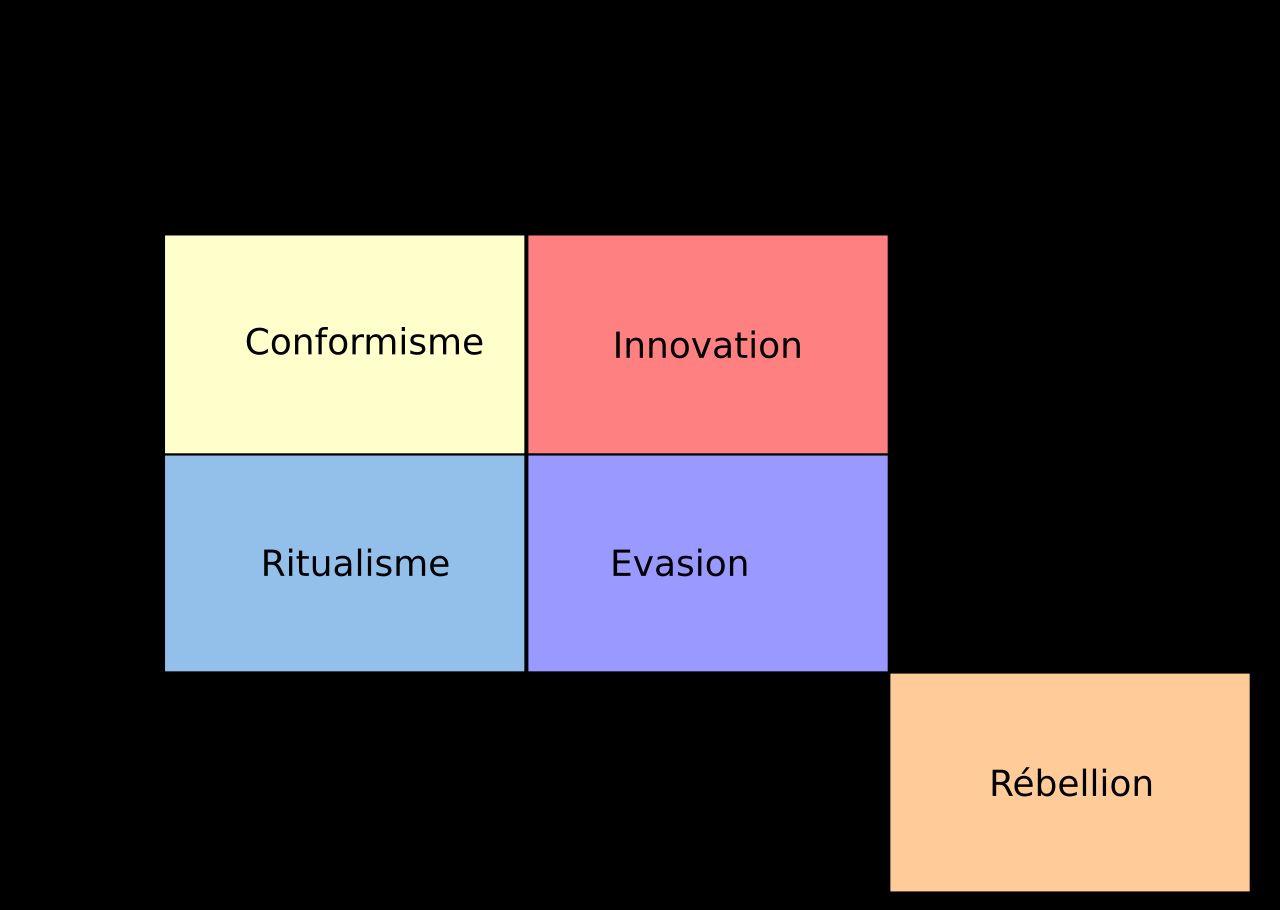
Robert K. Merton took Durkheim's anomie and rooted it in the structure of society. His strain theory begins with an observation about culture: a society such as the United States loudly promotes certain cultural goals (wealth, success, the "American Dream") while distributing the legitimate means to reach them — good schools, decent jobs, connections — very unequally. The gap between the goals everyone is told to want and the means available to reach them produces strain. People adapt to that strain in five ways, and only the first is fully conforming.
| Adaptation | Cultural goals | Legitimate means | Example |
|---|---|---|---|
| Conformity | Accept (+) | Accept (+) | Works hard through school and a job to get ahead |
| Innovation | Accept (+) | Reject (–) | Wants wealth but pursues it illegally — theft, fraud, drug dealing |
| Ritualism | Reject (–) | Accept (+) | Abandons the dream but rigidly follows the rules — the burned-out bureaucrat |
| Retreatism | Reject (–) | Reject (–) | Drops out of the whole game — some addiction and chronic homelessness |
| Rebellion | Replace | Replace | Rejects both goals and means and works to build a new system |
Strain theory's great strength is that it locates the source of much deviance not in bad individuals but in a social structure that dangles universal goals while denying many people the means to reach them. It explains why property crime concentrates where legitimate opportunity is scarce — innovation is the predictable response of someone who has fully absorbed the goal of success but has been shut out of the ladder.
Subcultures and differential opportunity
Later functionalists asked where people learn deviant adaptations, and answered: in subcultures — groups whose values and norms differ from the mainstream. Albert Cohen argued that working-class boys, judged by a "middle-class measuring rod" they cannot meet, experience status frustration and band together to invert those standards, prizing exactly what the school condemns. Richard Cloward and Lloyd Ohlin added differential opportunity theory: just as legitimate opportunity is unequally distributed, so is illegitimate opportunity. Whether a strained neighborhood produces organized criminal enterprise, violent conflict, or drug-focused retreat depends on which illegitimate paths are actually available there. Deviance, in this view, is learned in groups — a bridge to the interactionist theories of the next section.
- Durkheim: deviance is normal and performs functions — affirming norms, clarifying boundaries, building cohesion, and enabling change; anomie is normlessness.
- Merton's strain theory: deviance flows from the gap between cultural goals and legitimate means.
- The five adaptations are conformity, innovation, ritualism, retreatism, rebellion.
- Subcultural theories (Cohen; Cloward & Ohlin) show deviance is learned in groups and shaped by unequal illegitimate opportunity.
Section 3Conflict and labeling
Conflict theory: deviance and power
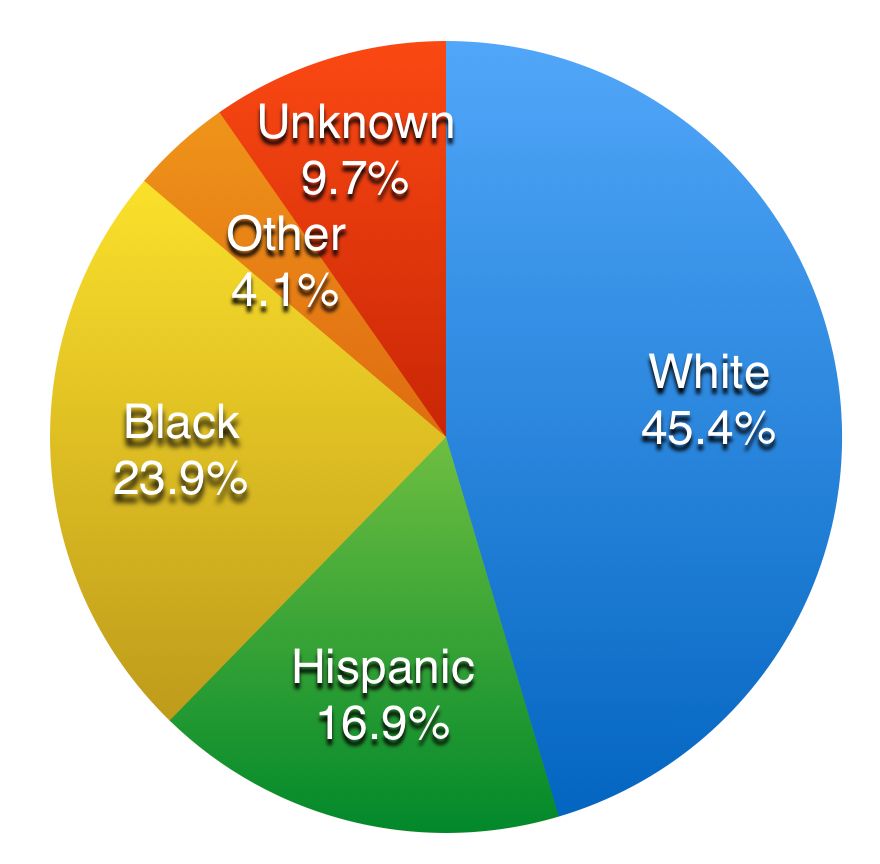
Where functionalists ask what deviance does for society, conflict theorists ask a sharper question: who benefits from defining it? Drawing on Karl Marx, the conflict paradigm holds that the norms and laws a society enforces are not a neutral consensus but reflect the interests of its most powerful groups. Those with wealth and power shape what gets written into law, whose behavior gets watched, and whose gets excused. The result is a system that comes down hard on the "street crime" of the poor — theft, drugs, disorder — while treating the far costlier "suite crime" of the powerful — wage theft, financial fraud, environmental harm — with fines and settlements. A hungry person who shoplifts is arrested; an executive whose fraud costs thousands their savings may never see a cell. Conflict theory also underwrites feminist analyses of how deviance is gendered and critical-race analyses of how enforcement is racialized.
Labeling theory: deviance is a social response
Labeling theory, an offshoot of symbolic interactionism, makes the most radical move of all: it says deviance is not a quality of the act but a consequence of the label. In Howard Becker's formulation, social groups create deviance by making rules whose violation constitutes deviance, and then applying those rules to particular people. The same act — smoking cannabis, a teenage fight — may be ignored in one person and prosecuted in another; what differs is the reaction. Erving Goffman analyzed the stigma that attaches to a spoiled identity, and how a deviant label can become a master status — the one trait through which everything else about a person is now seen. "Ex-convict" or "addict" can eclipse every other identity a person holds.
The theory's key distinction comes from Edwin Lemert. Primary deviance is an initial rule-breaking act that provokes little reaction and no change in self-concept — nearly everyone commits some. Secondary deviance begins when society reacts, applies a label, and the person reorganizes their identity and behavior around that label. The labeled shoplifter, treated as a thief and shut out of legitimate opportunity, may come to see themselves as a thief and offend again. The reaction, not the original act, produces the durable deviant career — a self-fulfilling prophecy.
| Question | Functionalism | Conflict theory | Symbolic interactionism / labeling |
|---|---|---|---|
| Level of analysis | Macro | Macro | Micro |
| What is deviance? | A normal feature that helps society function | A definition imposed by the powerful | A label produced by social reaction |
| Why does it exist? | Structural strain; it serves functions | Inequality; laws protect elite interests | People learn and are labeled into it |
| Key thinkers | Durkheim, Merton | Marx and successors | Becker, Lemert, Goffman |
| Reform implies | Restore norms & opportunity | Redistribute power | Reduce labeling & stigma |
- Conflict theory (from Marx) argues laws and enforcement reflect the interests of the powerful; "street crime" is punished, "suite crime" excused.
- Labeling theory (Becker) holds deviance is created by the social reaction, not by the act itself.
- Primary deviance provokes little reaction; secondary deviance follows labeling and reorganizes identity around the label.
- A deviant label can become a master status and a self-fulfilling prophecy.
Section 4Crime and how we count it
The many kinds of crime
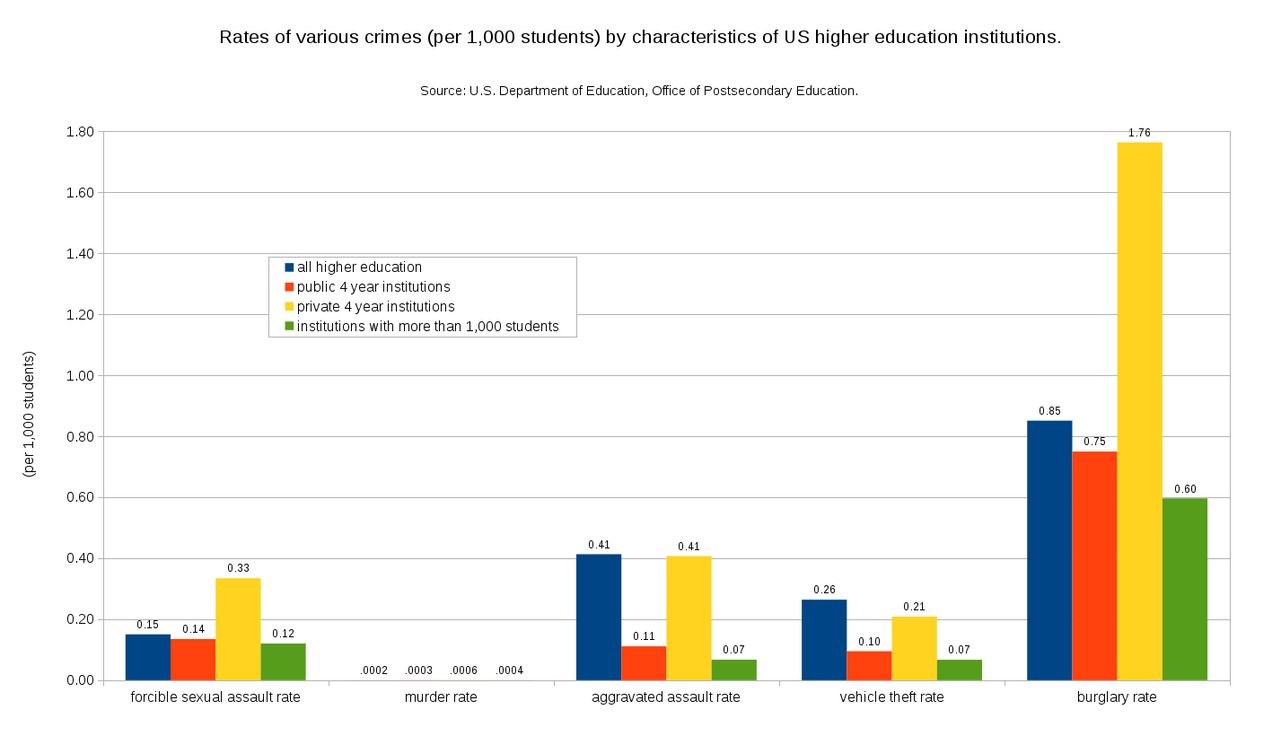
Crime is the subset of deviance that violates a law and is subject to formal punishment by the state. It is far from uniform. Violent crime uses force or its threat against a person — homicide, assault, robbery, rape. Property crime takes or destroys property without force against a victim — burglary, larceny, motor-vehicle theft, arson. White-collar crime, a term coined by Edwin Sutherland, is committed by respectable people of high status in the course of their occupations — embezzlement, insider trading, tax evasion, fraud. Though it rarely fills the evening news, it drains far more money from society than all street crime combined. Corporate crime extends this to illegal acts by companies themselves. Organized crime is the ongoing business of supplying illegal goods and services. And consensual or "victimless" crimes — some drug use, gambling, sex work — involve willing participants and no direct complainant, which is exactly why they are so hard to police and so contested to define.
| Category | What it involves | Examples |
|---|---|---|
| Violent crime | Force or threat against a person | Homicide, assault, robbery |
| Property crime | Taking/destroying property, no force on a victim | Burglary, larceny-theft, arson |
| White-collar crime | Committed by high-status people at work | Fraud, embezzlement, insider trading |
| Corporate crime | Illegal acts by organizations | Price-fixing, pollution, unsafe products |
| Organized crime | Ongoing supply of illegal goods/services | Trafficking, extortion rackets |
| Consensual (victimless) crime | Willing participants, no direct complainant | Some drug use, gambling, sex work |
Measuring crime — and the dark figure
Everything we claim to know about crime rates depends on how crime is measured, and no single measure is complete. The Uniform Crime Reports (UCR) — now being replaced by the more detailed NIBRS — compile offenses reported to and recorded by police. They are national and long-running, but they miss everything never reported and everything police choose not to record. The National Crime Victimization Survey (NCVS) instead asks a large sample of households whether they have been victimized, capturing much crime that never reached the police — but it relies on memory and omits homicide (the victim cannot answer) and crimes against businesses. Self-report surveys ask people to confess their own offending anonymously, which is invaluable for hidden and juvenile deviance but depends on honesty. The gap between all the crime that happens and the crime that shows up in official statistics is called the dark figure of crime, and for some offenses — sexual assault, domestic violence, corporate wrongdoing — it is enormous.
- Crime is deviance that breaks a law; major types include violent, property, white-collar, corporate, organized, and consensual crime.
- White-collar crime (Sutherland) costs far more than street crime yet is punished far more lightly.
- The three main measures are the UCR/NIBRS (police reports), the NCVS (victim survey), and self-report surveys — each with distinct blind spots.
- The dark figure of crime is the large share of offenses that never enter official statistics.
Section 5The criminal justice system
Police: the gatekeepers
The criminal justice system is the formal apparatus a society uses to enforce its laws, and it has three interlocking branches. The first is the police. Because officers cannot act on every violation they encounter, their defining feature is discretion — the power to decide whom to stop, question, cite, or arrest, and whom to let go. That discretion makes police the gatekeepers of the whole system: a person only becomes a "criminal case" if an officer decides to make one. Where and how that discretion falls — which neighborhoods are patrolled, which behaviors are treated as suspicious — shapes everything downstream, which is why conflict and labeling theorists watch policing so closely.
Courts: adjudication and the bargain
Once charged, a case moves to the courts, built in principle on an adversarial contest between prosecution and defense before a neutral judge, with the accused protected by due process — the presumption of innocence, the right to counsel, the right to a jury. In practice, the dramatic trial is the exception. The overwhelming majority of criminal convictions are obtained through plea bargaining, in which the accused pleads guilty, usually to a reduced charge, in exchange for a lighter sentence. Plea bargaining keeps a crowded system moving, but critics note it pressures even innocent defendants to plead, and it shifts real power from judges and juries to prosecutors.
Corrections: what punishment is for
The third branch, corrections, carries out the sentence — through incarceration, community supervision on probation or parole, fines, or, in some jurisdictions, death. Sociologists organize the debate over corrections around four competing justifications for punishment. Retribution punishes because the offender deserves it. Deterrence punishes to discourage future crime, whether by the individual (specific deterrence) or by society watching (general deterrence). Incapacitation simply removes the offender's ability to reoffend by confining them. Rehabilitation aims to reform the offender so they can return as a law-abiding member of society. These goals often pull in different directions, and which one dominates shapes an entire penal culture. The United States now incarcerates one of the largest shares of its population of any nation — a phenomenon called mass incarceration — and high rates of recidivism, the tendency of released offenders to reoffend, raise a hard question about whether prisons rehabilitate or merely warehouse and label.
| Justification | Logic of punishment | Aimed at |
|---|---|---|
| Retribution | The offender deserves to suffer for the wrong | The past act |
| Deterrence | Punishment discourages future offending | The offender and the watching public |
| Incapacitation | Confinement removes the ability to reoffend | Public safety now |
| Rehabilitation | Treatment reforms the offender to return safely | The offender's future |
- The criminal justice system has three branches: police, courts, and corrections.
- Police discretion makes officers the system's gatekeepers; most convictions come from plea bargaining, not trials.
- Punishment is justified in four ways: retribution, deterrence, incapacitation, rehabilitation.
- Mass incarceration and high recidivism raise whether prisons rehabilitate or simply confine and label.
The chapter in one breath
- Deviance is a norm violation that draws a negative reaction; it is relative and defined by reaction, not by harm.
- Norms run from folkways to mores to taboos to laws, and social control enforces them through positive/negative, informal/formal sanctions.
- Durkheim showed deviance is normal and functional; Merton's strain theory ties it to the gap between cultural goals and legitimate means, with five modes of adaptation.
- Conflict theory (Marx) says the powerful define deviance to protect their interests; labeling theory (Becker, Lemert) says the social reaction creates it, turning primary into secondary deviance.
- Crime is illegal deviance — violent, property, white-collar, corporate, organized, and consensual — and white-collar crime costs the most while being punished least.
- We measure crime with the UCR/NIBRS, the NCVS, and self-report surveys, each blind to a different dark figure.
- The criminal justice system runs on discretion through police, courts, and corrections, and punishment is justified by retribution, deterrence, incapacitation, and rehabilitation.
ReferenceWords worth knowing
A quick reference for the terms in this chapter — skim it now, or circle back whenever a word trips you up.
- Anomie
- A condition of normlessness in which the guiding rules of society weaken or break down, often during rapid change; Durkheim's concept, central to strain theory.
- Conflict theory
- The paradigm, rooted in Marx, that laws and social control reflect the interests of the powerful and are applied unequally across social classes.
- Corrections
- The branch of the justice system that carries out sentences through incarceration, probation, parole, fines, or execution.
- Crime
- Deviance that violates a codified law and is subject to formal punishment by the state.
- Deterrence
- A justification for punishment that aims to discourage future offending, whether by the individual (specific) or by the watching public (general).
- Deviance
- Any behavior, belief, or condition that violates a social norm and provokes a negative reaction.
- Folkways
- Everyday customs and etiquette whose violation is mildly sanctioned as rude or strange rather than immoral.
- Formal social control
- Control exercised by institutions and officials empowered to enforce rules — police, courts, schools — as opposed to informal, everyday control.
- Labeling theory
- The interactionist view that deviance is produced by the social reaction to an act — the label — rather than by the act itself.
- Master status
- A status so dominant it overrides all others in how a person is seen; a deviant label such as "ex-convict" can become one.
- Mores
- Norms with strong moral significance; violating them brings serious condemnation.
- Primary deviance
- An initial norm violation that provokes little reaction and does not alter the person's self-concept.
- Recidivism
- The tendency of a previously punished offender to reoffend; a key measure of whether corrections rehabilitate.
- Sanction
- A reaction that rewards conformity or punishes deviance; sanctions may be positive or negative, informal or formal.
- Secondary deviance
- Deviance that follows labeling, when a person reorganizes identity and behavior around the deviant label.
- Social control
- The mechanisms a society uses to encourage conformity and discourage deviance.
- Social norm
- A shared expectation about how people ought to behave in a given setting.
- Stigma
- A powerfully negative label or "spoiled identity" that discredits a person in the eyes of others; analyzed by Goffman.
- Strain theory
- Merton's theory that deviance arises from the gap between culturally approved goals and the legitimate means available to reach them.
- Subculture
- A group whose values, norms, and lifestyle differ from those of the dominant culture; a common site for learning deviance.
- Uniform Crime Reports (UCR)
- The FBI's long-running compilation of crimes reported to and recorded by police, now transitioning to the more detailed NIBRS.
- White-collar crime
- Crime committed by respectable, high-status people in the course of their occupations; a term coined by Edwin Sutherland.