Food Safety
Nutrition takes for granted that the food supply is safe. Most of the time it is. Yet each year in the United States, about 48 million people get sick from something they ate. About 128,000 go to the hospital, and about 3,000 die. Almost none of that comes from strange or rare contamination. It comes from ordinary time, ordinary temperature and ordinary hands. This chapter walks through the germs that really cause illness from food and how they show themselves. It covers the temperature rules that stop bacteria from multiplying. It covers the handling habits that keep raw foods and ready-to-eat foods apart. And it covers who carries the most risk, and why. It ends with the harder question people ask all the time: what about additives, pesticide traces and processing? It gives you a way to weigh that evidence, instead of a list of foods to fear.
By the end of this chapter you can
- Name the main foodborne pathogens (germs carried in food), and match each to its usual onset time, main symptoms and classic food sources.
- Explain why onset time tells a preformed toxin apart from an infection, and why that changes what you expect to see.
- Give the limits of the temperature danger zone, and use the two-hour rule for holding, cooling and storing food.
- Recall the safe minimum inside cooking temperatures for poultry, ground meat, whole cuts, fish and reheated leftovers.
- Describe the four core safe-handling habits, clean, separate, cook, chill, and explain how each one works.
- Name the four higher-risk groups, and explain the body reasons each one is more at risk.
- List the foods that carry extra risk during pregnancy, infancy, later life and a weakened immune system.
- Tell hazard from risk, and weigh evidence about additives, residues and processing without making too much of single findings.
Section 1Foodborne illness
What “food poisoning” actually is
The phrase covers two events that work in different ways. In an infection, you swallow a living microbe. It survives the stomach. It multiplies in the gut or spreads beyond it. You get sick only after that group of germs has grown, which takes hours to days. In an intoxication, the microbe did its work in the food before you ever picked up a fork. It left behind a preformed toxin, a poison already made. You are poisoned by a chemical, not taken over by a living thing, and symptoms come fast. A third type, toxicoinfection, sits in between. The germ is swallowed alive and makes its toxin once inside you.
That split is why onset time, the time from eating to the first symptom, is the most useful single clue when food may have made someone sick. Vomiting that starts two hours after a meal cannot be an infection. No germ multiplies that fast. So it points to a preformed toxin, classically from Staphylococcus aureus or the vomiting type of Bacillus cereus. Bloody diarrhea three days after a cookout points to a germ that invades and needed time to settle in. And a meal eaten four weeks ago is still a possible source for hepatitis A, a liver infection.
The organisms worth knowing
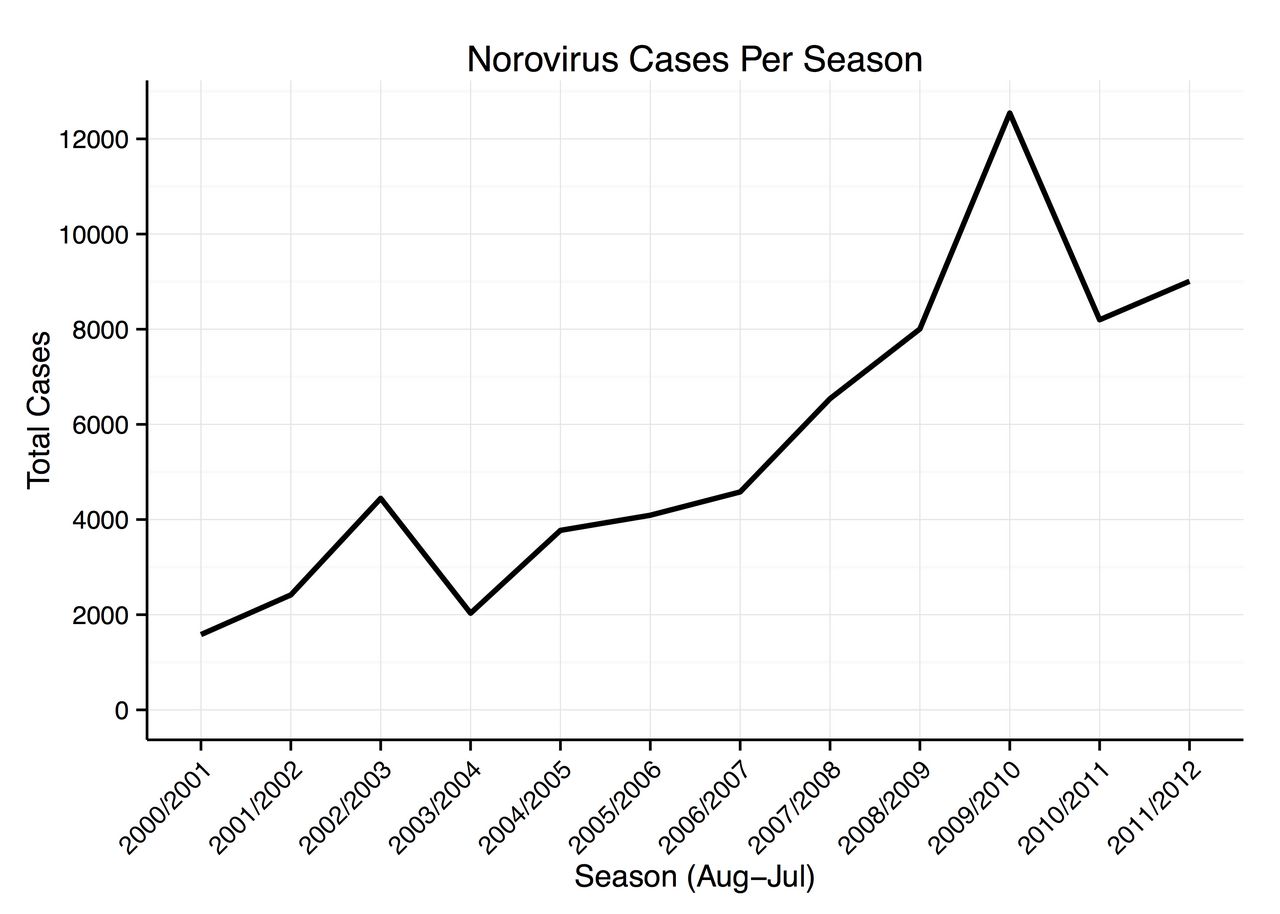
Norovirus leads by a wide margin. It causes about 58 percent of the illness from food in the United States where the cause is known. It spreads extremely easily. As few as about eighteen virus particles can cause infection. People shed huge numbers of it in vomit and stool. It survives on surfaces, and alcohol hand gel does not reliably kill it. It causes one to three days of vomiting and watery diarrhea, and then it lets up. The usual routes are sick food handlers, raw shellfish and contaminated leafy greens.
Among bacteria, nontyphoidal Salmonella causes the most hospital stays and deaths. Symptoms come twelve to seventy-two hours after eating poultry, eggs or produce, or after contact with reptiles and backyard poultry. Campylobacter jejuni is the most common bacterial cause of diarrhea. It takes two to five days to cause symptoms. It is most often traced to undercooked poultry or unpasteurized milk. Once in a while it is followed weeks later by Guillain-Barré syndrome, a condition where the immune system attacks the nerves and causes weakness. Shiga toxin-producing E. coli (STEC, especially the type called O157:H7) causes bloody diarrhea with severe cramps. Often there is no fever. In about five to ten percent of cases, mostly in children under five, it moves on to hemolytic uremic syndrome (HUS). HUS has three parts: red blood cells breaking apart (hemolytic anemia), too few platelets, the cells that help blood clot (thrombocytopenia), and sudden kidney damage. Because of that risk, clinicians are careful about giving antibiotics and anti-diarrhea medicines when STEC is suspected.
Listeria monocytogenes deserves its own paragraph, because it breaks the usual rules. It grows at refrigerator temperature. It handles salt well. And its invasive form can take weeks to cause symptoms. In healthy adults it may cause only a short stomach illness with fever. But in pregnancy, later life and a weak immune system, it gets into the blood and the brain and spinal cord. About one in five people with invasive listeriosis die. Clostridium botulinum is even rarer, but you cannot miss it. It makes a nerve poison that heat can destroy. It comes from low-acid foods that were canned at home the wrong way. It causes paralysis, a loss of muscle movement, that spreads downward on both sides of the body. It starts with nerves of the face and head: double vision, trouble swallowing, slurred speech. The person stays alert and has no fever. Infant botulism happens a different way. That is why honey should not be given to babies under twelve months.
| Germ or cause | Usual onset | Main sign | Classic sources |
|---|---|---|---|
| Staphylococcus aureus | 30 min to 8 h | Sudden vomiting; preformed toxin that heat does not destroy: reheating does not help | Foods handled by hand and kept warm: salads, pastries, sliced meats |
| Bacillus cereus (vomiting type) | 30 min to 6 h | Vomiting; a toxin called cereulide | Cooked rice and pasta left at room temperature |
| Bacillus cereus (diarrhea type) | 6 to 15 h | Watery diarrhea, cramps | Meats, stews, sauces, vegetable dishes |
| Clostridium perfringens | 6 to 24 h | Cramps and diarrhea, little vomiting or fever; gone in a day | Large batches of meat, gravy, beans cooled or held too slowly |
| Norovirus | 12 to 48 h | Vomiting and diarrhea, 1 to 3 days; alcohol gel not reliable | Sick food handlers, raw shellfish, leafy greens |
| Salmonella (nontyphoidal) | 12 to 72 h | Diarrhea, fever, cramps, 4 to 7 days | Poultry, eggs, produce, raw flour, reptiles |
| Campylobacter jejuni | 2 to 5 days | Diarrhea (often bloody), fever; rarely Guillain-Barré later | Undercooked poultry, unpasteurized milk, untreated water |
| STEC / E. coli O157:H7 | 3 to 4 days | Bloody diarrhea, often no fever; risk of HUS in young children | Undercooked ground beef, raw leafy greens, unpasteurized juice |
| Vibrio species | 2 to 48 h | Diarrhea; V. vulnificus can cause blood infection in people with liver disease | Raw oysters and shellfish, warm coastal waters |
| Listeria monocytogenes | 1 day to 10 weeks | Stomach illness with fever, or invasive blood or brain infection; grows at 4°C | Deli meats, soft cheeses from raw milk, smoked seafood, melon, sprouts |
| Clostridium botulinum | 12 to 72 h | Paralysis that spreads downward, weak face and head muscles, no fever | Low-acid foods canned at home the wrong way; honey in babies |
| Hepatitis A | 15 to 50 days | Tiredness, nausea, jaundice (yellow skin and eyes); a vaccine prevents it | Sick food handlers, shellfish, frozen berries |
| Scombroid (histamine) | Minutes to 1 h | Flushing, headache, rash; a chemical, not an infection | Tuna, mahi-mahi or mackerel left too warm |
What the body loses, and what it needs back
Most illness from food in an otherwise healthy adult goes away on its own. The real danger is not the germ but the loss of fluid and electrolytes. Diarrhea carries away sodium, potassium, chloride and bicarbonate. Oral rehydration, drinking a special salt-and-sugar fluid, works because the gut absorbs glucose and sodium together through a shared carrier, and water follows them. That is why the World Health Organization's standard oral rehydration solution pairs sodium at 75 mmol/L with glucose at 75 mmol/L. Its total osmolarity, the count of dissolved particles, is near 245 mOsm/L. It works better than just offering water. Plain water does not put back sodium. And very sugary soft drinks can make diarrhea worse by pulling water into the gut.
This is general learning, not medical instructions. Some signs call for a medical exam right away instead of care at home. These include bloody stools, high fever, nerve symptoms, and signs of dehydration. They also include any illness in a baby, an older adult, a pregnant person or someone with a weak immune system.
- An infection (the germ multiplies in you, slower onset) is different from an intoxication (a preformed toxin, fast onset).
- Norovirus causes the most illness. Among bacteria, Salmonella causes the most hospital stays and deaths.
- STEC can lead to hemolytic uremic syndrome, especially in children under five. Listeria is the one that grows at refrigerator temperature.
- In most cases the main danger is losing fluid and electrolytes. That is why a glucose-plus-sodium drink works better than plain water.
Section 2Temperature control
The danger zone and the two-hour rule
Bacteria are not mysterious. They are math. In good conditions, a single bacterial cell divides about every twenty minutes. So one becomes more than a million in about seven hours. The temperature danger zone is the range where that math runs fast. The U.S. Department of Agriculture (USDA) sets it at 40°F to 140°F (4°C to 60°C). The FDA Food Code, used by stores and restaurants, uses a slightly narrower 41°F to 135°F (5°C to 57°C). The two numbers differ because they were set for different settings, not because anyone disagrees about the science.
The rule that follows is the two-hour rule. Perishable food should not sit in the danger zone for more than two hours in total. That counts time on the counter, on the buffet and in the car. Above 90°F (32°C), such as at a summer picnic or in a hot car, the limit drops to one hour. "In total" is the part people miss. An hour thawing on the counter plus ninety minutes on a serving table has already used up the limit, even though neither step felt long.
Cooking: the kill step
Cooking is the one step in the chain that reliably lowers the number of germs, instead of just keeping it the same. But it only works if the coldest point inside reaches the right temperature. Color and texture cannot tell you that. Browning comes from a surface chemical reaction called the Maillard reaction. It is not a thermometer. A ground beef patty can look gray and still be under temperature. A well-cooked steak can look pink because of the chemistry of myoglobin, the red protein in muscle. Use a food thermometer in the thickest part, away from bone and fat. Check it now and then in a cup of ice water. It should read 32°F (0°C).
| Food | Safe minimum inside temperature | Note |
|---|---|---|
| Poultry: all forms | 165°F (74°C) | Whole birds, pieces, ground poultry and stuffing alike |
| Ground meats (beef, pork, lamb, veal) | 160°F (71°C) | Grinding moves surface bacteria all through the inside |
| Whole cuts: steaks, chops, roasts | 145°F (63°C) | Plus a 3-minute rest before cutting or eating |
| Fish and shellfish | 145°F (63°C) | Or until the flesh is not see-through and pulls apart easily |
| Egg dishes; eggs cooked for holding | 160°F (71°C) | Cook plain eggs until yolk and white are firm |
| Leftovers, casseroles, reheated dishes | 165°F (74°C) | Reheat until steaming all through, not just warm at the edge |
| Hot holding / cold holding | ≥135°F (57°C) / ≤41°F (5°C) | Holding keeps food safe; it does not make it safe |
Cooling, thawing, and storage
Cooling is where home and restaurant kitchens fail most often. A big pot cools from the outside in. Its middle can sit in the danger zone for hours while the surface feels cold. So the Food Code calls for two-stage cooling. First, cool from 135°F to 70°F within two hours. Then cool from 70°F to 41°F within four more hours. That is six hours in all, and the first stage is the strict one. You get that speed by adding surface area. Split food into shallow pans no more than about two inches deep. Use an ice bath. Stir with an ice paddle. Leave the container open or loosely covered until it is cold.
There are exactly four safe ways to thaw. Thaw in the refrigerator. Thaw under cold running water, or in cold water that is changed often. Thaw in the microwave and then cook right away. Or thaw as part of cooking. The counter is not on the list. The outside layer warms into the danger zone long before the middle thaws. Keep the refrigerator at or below 40°F (4°C) and the freezer at 0°F (−18°C). Check with a thermometer made for appliances, not the dial. Leftovers in the refrigerator are usually best used within three to four days. Freezing keeps them safe for as long as you like, though quality drops.
Two limits are worth saying plainly. Freezing does not kill most bacteria. It pauses them, and they start growing again when thawed. (It does reliably kill some parasites, small creatures that live off a host. That is why some fish meant to be eaten raw must be frozen first.) And refrigeration is a brake, not a stop. Listeria monocytogenes multiplies happily at 4°C. That is the whole reason long-stored, ready-to-eat refrigerated foods act differently from everything else in this chapter.
- The danger zone is 40 to 140°F (4 to 60°C) by USDA rules, and 41 to 135°F (5 to 57°C) in the FDA Food Code.
- The two-hour rule counts total time, and it drops to one hour above 90°F (32°C).
- Key temperatures: poultry 165°F, ground meat 160°F, whole cuts 145°F plus a 3-minute rest, leftovers reheated to 165°F.
- Two-stage cooling: 135→70°F in 2 hours, then 70→41°F in 4 more.
- Freezing pauses bacteria instead of killing them, and Listeria grows at refrigerator temperature.
Section 3Cross-contamination and hygiene
Clean, separate, cook, chill
Public health agencies squeeze the whole field into four verbs. Each one has a reason behind it. Clean removes germs from hands and surfaces before they can be moved. Separate keeps raw animal foods away from anything that will not be cooked to kill germs. Cook does that killing, to a checked inside temperature. Chill takes away the time and warmth germs need to multiply. Sections 1 and 2 covered cook and chill. This section is about the other two. That is where most spreading of germs at home really happens.
Hands, and why twenty seconds
Handwashing works by physically removing germs, not by chemistry. Soap is a surfactant. Its molecules have a water-loving head and a fat-loving tail. So they lift oils, dirt and microbes off the skin and hold them in the water. Running water then carries them down the drain. Twenty seconds of rubbing is the time that reliably reaches the places people skip: thumbs, fingertips, under the nails and the backs of the hands. Then a clean towel finishes the job, because damp hands pass on germs far more easily than dry ones.
Alcohol hand sanitizer with at least 60 percent alcohol is a real tool, but a limited one. It breaks down proteins and the fatty outer coats of some germs. So it handles many bacteria and viruses that have such a coat. It is not reliable against norovirus, which has a tough shell with no fatty coat. It is not reliable against Clostridioides difficile spores, the hardy resting form of that germ. And it does not work on hands that are visibly dirty or greasy, because it does not remove anything. In a kitchen, sanitizer adds to soap and water. It does not replace them.
Wash before you start making food. Wash after handling raw meat, poultry, seafood, eggs or flour. Wash after using the bathroom, after handling trash or pets, after changing diapers, and after coughing, sneezing or blowing your nose. The same logic decides who should be in a kitchen at all. Anyone with vomiting, diarrhea, jaundice, a sore throat with fever, or an open, infected sore on the hands should not make food for others. Gloves do not change this. They are a barrier for ready-to-eat food, not a replacement for clean hands. They must be changed between tasks, just as hands would be washed between tasks.
Keeping raw and ready-to-eat apart
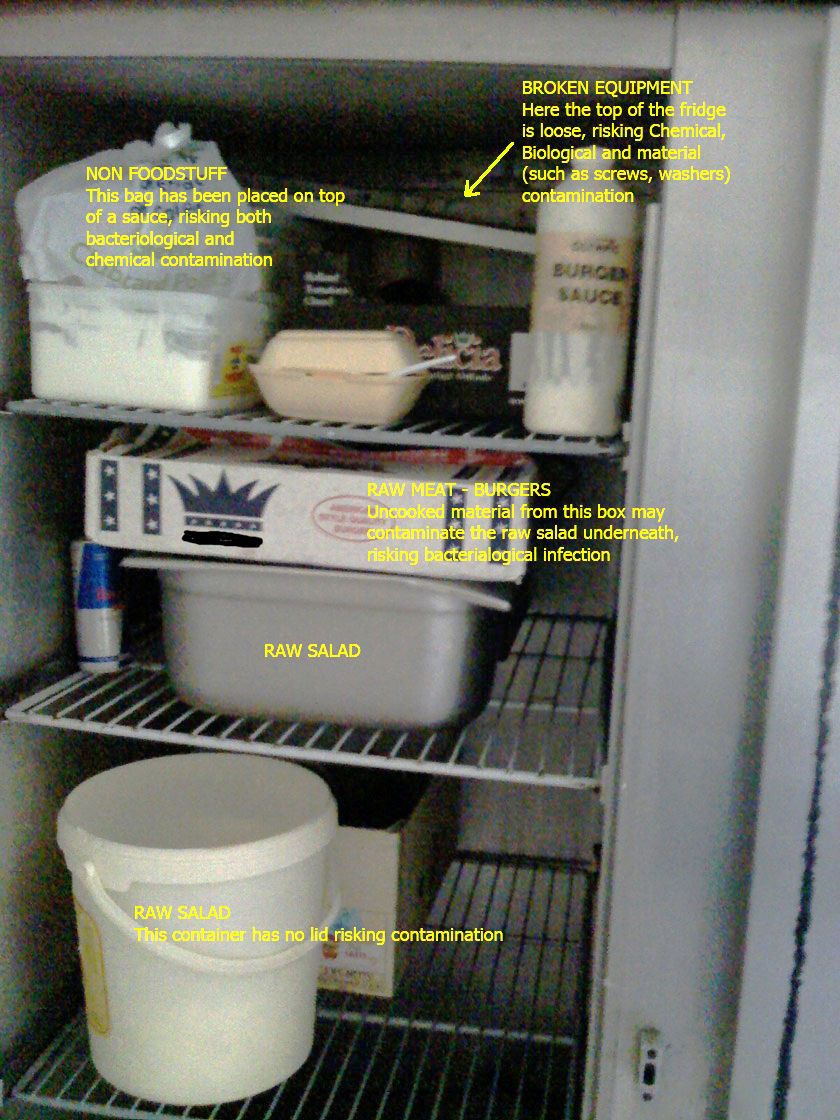
Cross-contamination is moving germs from one food, surface or hand to another. The classic path runs from raw chicken to a cutting board to a salad. The classic mistake is thinking a quick rinse in between was enough. Use separate boards for raw animal foods and for produce and other ready-to-eat foods. Wash boards, knives and counters with hot, soapy water and then sanitize them. Never put cooked food back on the plate that held it raw. In the refrigerator, store raw meat, poultry and seafood on the bottom shelf in sealed containers, so nothing can drip onto foods below.
Two rules that seem backward are worth learning well. First, do not wash raw poultry or meat. Rinsing does not really remove germs. Kitchen studies that tracked harmless test germs have shown again and again that rinsing splashes bacteria around the sink and onto nearby surfaces and foods. Cooking to 165°F is the step that works. Second, do wash produce, but only with running water. Rub firm produce under the tap or scrub it with a clean brush. Wash melon skins before cutting, so the knife does not carry surface germs into the fruit. Skip soap, detergent, bleach and store-bought produce washes. They are not approved for this use and can leave traces behind. Bagged greens marked “washed” or “ready to eat” do not need washing again. Washing them in a home sink can add germs instead of removing them.
| Habit | What to do | Why it works |
|---|---|---|
| Clean: hands | Soap and running water, 20 seconds of rubbing, dry with a clean towel | Soap lifts microbes; rubbing and rinsing physically remove them |
| Clean: surfaces | Wash with hot soapy water, then sanitize; wash cloths hot; replace sponges often | Washing removes dirt so the sanitizer can actually touch the surface |
| Separate: boards | Boards just for raw animal foods vs. ready-to-eat foods | Ready-to-eat foods get no later kill step |
| Separate: fridge | Raw meat, poultry, seafood sealed on the bottom shelf | Gravity: drips can only fall onto things below |
| Separate: plates | Never reuse the raw-meat platter or marinade for cooked food | The plate carries the same germs the raw food did |
| Do not do | Washing raw chicken; washing produce with soap or bleach | Rinsing splashes germs; detergents are not approved for produce |
| Cook | Check inside temperature with a thermometer | Looks come from Maillard chemistry, not from germs being killed |
| Chill | Refrigerate within 2 hours (1 hour above 90°F); use shallow containers | Takes away the time and warmth bacteria need to multiply |
- The four core habits are clean, separate, cook, chill, and each one has a reason.
- Handwashing is physical removal: soap plus rubbing plus running water plus a dry towel, for 20 seconds.
- Alcohol sanitizer (≥60%) adds to soap but fails against norovirus, spores and dirty hands.
- Do not wash raw poultry. Do wash produce under running water only, including melon skins before cutting.
- Store raw animal foods sealed on the bottom shelf, and keep boards and plates for raw and ready-to-eat foods apart.
Section 4High-risk foods and populations
Who is more vulnerable, and why
Four groups face much more risk from the same contaminated meal: pregnant people, children under five, adults over sixty-five, and people whose immune system is weakened. A weakened immune system is called being immunocompromised. The reasons are about the body, not about behavior. It is worth knowing them instead of just memorizing the list.
Pregnancy shifts one part of the immune system, called cell-mediated immunity. The shift protects the baby from being rejected by the parent's body. But it leaves the pregnant person less able to hold back germs that live inside cells. The result is a risk of listeriosis about ten times that of the general public. Listeria can cross the placenta even when the pregnant person feels only a little unwell. It can cause miscarriage, stillbirth, early birth, or blood and brain infections in the newborn. Toxoplasma gondii, a parasite picked up from undercooked meat or from dirt and cat litter, carries a similar risk to the baby.
Children under five have an immune system that is still learning, and babies have a weaker stomach-acid barrier. Their bodies are also small. So it takes fewer germs to make them sick, and they have less fluid to spare. This is the age group in which STEC infection most often leads to hemolytic uremic syndrome. It is also the age at which dehydration from any stomach illness gets worse fastest. Babies under twelve months can also get infant botulism. Their gut bacteria are not yet settled enough to hold back C. botulinum spores that start to grow. Hence the honey rule.
Adults over sixty-five face immunosenescence, the weakening of the immune system with age. They also make less stomach acid, have a slower-moving gut that keeps germs in contact longer, have more other illnesses and take more medicines. Many conditions and treatments that weaken the immune system blunt these same defenses. They include cancer chemotherapy, medicines to prevent transplant rejection, advanced HIV, long-term steroid medicines, diabetes, liver disease and kidney disease. One often-missed group cuts across all of these. People taking medicines that lower stomach acid, such as proton pump inhibitors, lose much of the stomach's acid barrier. Watching studies steadily link these medicines to more Salmonella, Campylobacter and Vibrio infections. This fits with fewer germs being needed to cause illness, though how big the effect is gets debated. And people with liver disease or too much iron are at special risk from Vibrio vulnificus in raw oysters, because this germ thrives on available iron.
| Group | Body reason | Main concerns |
|---|---|---|
| Pregnancy | Shift in cell-mediated immunity; germs can cross the placenta | Listeria (about 10× risk), Toxoplasma, methylmercury, too much preformed vitamin A |
| Under 5 years | Immune system still learning, low stomach acid, little fluid to spare | STEC/HUS, Salmonella, fast dehydration; botulism under 12 months |
| 65 and older | Weaker immunity with age, less stomach acid, slower gut, other illnesses | Listeria, Salmonella, higher rates of hospital stays and death |
| Immunocompromised | Weaker cell-mediated immunity and weaker germ-eating cells | Invasive Listeria and Salmonella, blood infection, meningitis |
| On acid-lowering medicine | Stomach acid barrier is weaker | More Salmonella, Campylobacter, Vibrio seen |
| Liver disease / too much iron | Available iron helps the germ | Vibrio vulnificus blood infection from raw shellfish |
Meningitis, in the table, is an infection of the coverings of the brain and spinal cord.
The foods that carry disproportionate risk
A food makes this list for one of two reasons. Either it is eaten without a kill step, or its structure protects germs from one. Raw and undercooked animal foods are obvious. Less obvious ones include raw sprouts. They are sprouted in warm, damp conditions that act like an incubator for any germ on the seed. Precut melon and leafy greens are on the list, because cutting spreads germs from the surface and the food is never heated. Raw flour is a raw farm product. It has caused both Salmonella and STEC outbreaks in raw dough. And refrigerated ready-to-eat foods such as deli meats, patés and smoked seafood sit for weeks at exactly the temperature Listeria can handle.
Unpasteurized milk deserves a direct answer, because the claims made for it are about nutrition. Pasteurization does not really lower the nutrition of milk. Protein, fat and calcium are not affected. A cup of milk gives about 300 mg of calcium either way. Compare that with an RDA of 1,000 mg/day for adults aged 19 to 50 and for men up to 70. It rises to 1,200 mg/day for women 51 and older and for everyone over 70. Losses are limited to a small share of a few vitamins that heat can harm, and milk is not an important source of those. There is no good evidence that raw milk eases lactose intolerance or prevents asthma. There is plenty of evidence that it spreads Campylobacter, Salmonella, STEC and Listeria. Standard high-temperature short-time (HTST) pasteurization heats milk to 161°F (72°C) for 15 seconds. It is one of the best-paying public health steps ever taken.
Two nutrient warnings belong here too. In pregnancy, fish is good. The long-chain omega-3 fat DHA supports the baby's brain and eye growth. Joint FDA and EPA advice is to eat two to three servings a week of lower-mercury “best choices.” These include salmon, sardines, canned light tuna, shrimp, tilapia and cod. Avoid the fish highest in methylmercury: shark, swordfish, king mackerel, tilefish from the Gulf of Mexico, bigeye tuna, marlin and orange roughy. The message is which fish, not whether fish. Separately, too much preformed vitamin A (retinol) causes birth defects. Its adult upper limit is 3,000 μg RAE/day. Liver is very rich in it, which is why liver is limited in pregnancy. Beta-carotene from plant foods does not carry this risk, because the body controls how much it turns into retinol.
- The four higher-risk groups are pregnancy, under five, sixty-five and older, and immunocompromised, for clear body reasons.
- Pregnancy carries about ten times the listeriosis risk. Children under five carry the highest HUS risk from STEC.
- High-risk foods lack a kill step: raw animal foods, raw sprouts, precut melon, raw flour and refrigerated ready-to-eat foods.
- Pasteurization (161°F/72°C for 15 s) removes germs without really lowering milk’s nutrition.
- In pregnancy, choose lower-mercury fish instead of avoiding fish, and limit preformed vitamin A (UL 3,000 μg RAE/day).
Section 5Additives, residues, and processing
Who regulates what
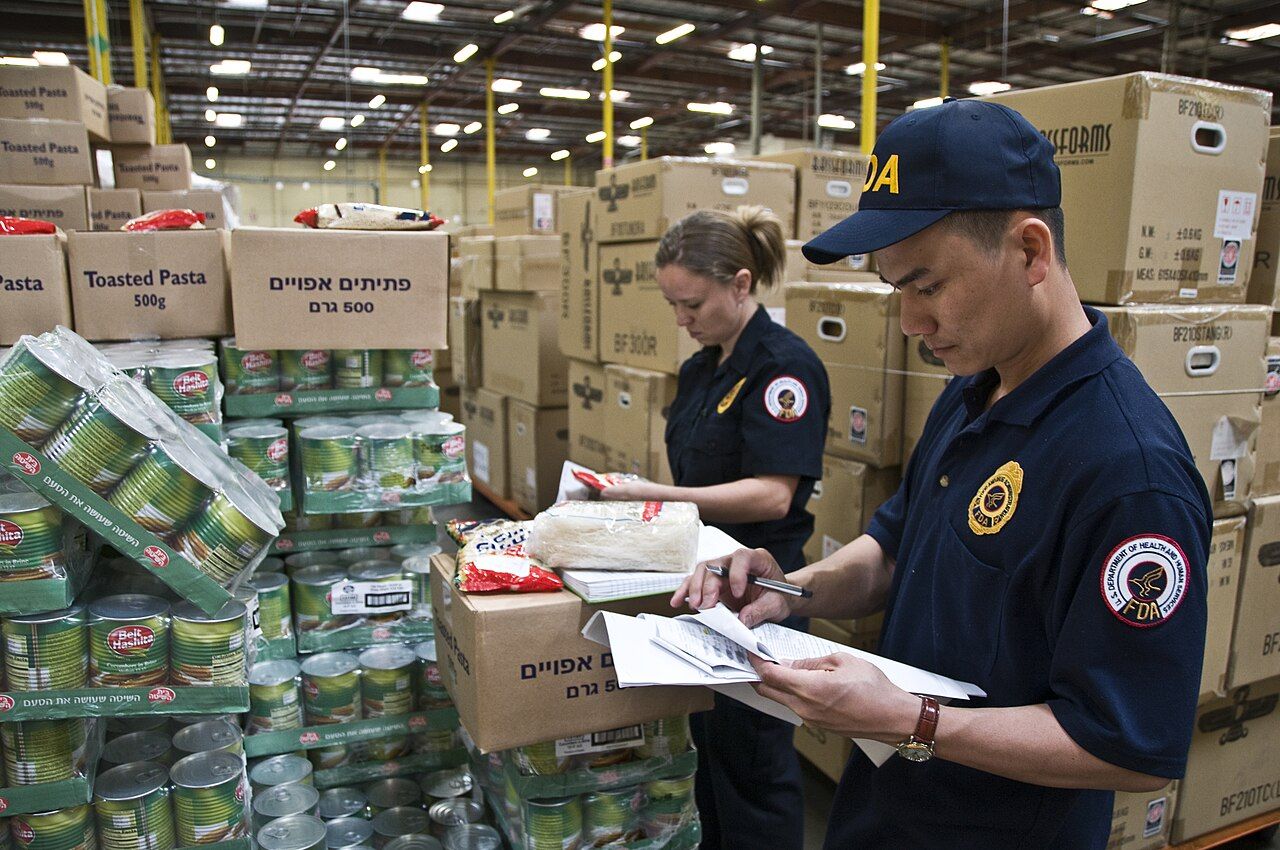
In the United States, the job is split up. The Food and Drug Administration (FDA) oversees most of the food supply, including additives, labels and produce safety. The USDA Food Safety and Inspection Service (FSIS) handles meat, poultry, catfish and processed egg products. It inspects slaughter and processing plants all the time. The Environmental Protection Agency (EPA) sets the legal top level of each pesticide on each crop. That level is called the tolerance. The FDA and USDA enforce those tolerances in testing programs. The Food Safety Modernization Act (FSMA) of 2011 moved the FDA from reacting to outbreaks toward requiring steps that prevent them. Most food companies now run a HACCP plan, which stands for Hazard Analysis and Critical Control Points. It finds the points in a process where a danger can be controlled, and it checks those points all the time.
Additives are approved under the Federal Food, Drug, and Cosmetic Act, as changed in 1958. A substance either goes through formal approval as a food additive, or it counts as GRAS: Generally Recognized As Safe. GRAS is based on agreement among scientists or long safe use. The Delaney Clause in that law bans approval of any food additive shown to cause cancer in humans or animals. That is why the FDA removed approval of FD&C Red No. 3 in food in January 2025. The reason was thyroid tumors in rats, even though the way it caused them is not thought to work in humans. It is fair to state honestly the system's most-criticized feature. Companies can declare their own substance GRAS without telling the FDA. That loophole is a real topic of scientific and policy debate.
How safety limits are actually set
The core idea is the Acceptable Daily Intake (ADI). It is the amount, in milligrams per kilogram of body weight per day, that a person can eat over a lifetime without real risk. It starts from the highest dose that caused no harm seen in animal studies, called the NOAEL (No Observed Adverse Effect Level). That dose is divided by a safety factor of 100. That is a factor of ten for possible differences between animals and humans, times another ten for differences among humans. Real intakes usually fall far below the ADI. Aspartame, a low-calorie sweetener, is the standard teaching case. The FDA sets its ADI at 50 mg/kg body weight per day. The WHO/FAO Joint Expert Committee on Food Additives (JECFA) sets it at 40 mg/kg body weight per day. In 2023, the International Agency for Research on Cancer (IARC) listed aspartame as “possibly carcinogenic to humans” (Group 2B), based on limited evidence. Carcinogenic means able to cause cancer. At the same time, JECFA looked at the same studies for risk instead of hazard. It kept its 40 mg/kg ADI the same.
That seeming conflict is the single most important idea in this section. Hazard asks whether a substance can cause harm under some conditions. Risk asks whether it will, at the doses people really meet. IARC sorts hazards, not risks. That is why processed meat sits in Group 1 (enough evidence) next to tobacco, even though its real-life risk is far smaller. The processed-meat finding is itself a good lesson in reading a number. It is about an 18 percent higher relative risk of colorectal cancer per 50 g/day eaten. Relative risk compares two groups. To see the real change, apply it to the starting risk. The lifetime risk of colorectal cancer is about four to five percent. So the change is well under one percentage point. That is real and worth knowing, but it is not like smoking. It is also a link from watching studies, so the size of the effect should be held loosely. Note also that nitrite in cured meat is there partly to prevent botulism. And “uncured” products kept with celery powder still deliver nitrite, just from a natural source.
| Concern | What is known | Strength of evidence |
|---|---|---|
| Pesticide residues | EPA sets tolerances for each crop; USDA testing keeps finding more than 99 percent of samples at or below tolerance; washing and peeling lower residues more | Strong that exposures are low; limited that they cause harm at those levels |
| Organic produce | Reliably lowers measured pesticide residues | Strong for fewer residues; early for health effects |
| Processed meat | IARC Group 1; about 18% higher relative colorectal cancer risk per 50 g/day | Strong link; modest absolute effect |
| Aspartame | IARC Group 2B (2023); JECFA kept its ADI of 40 mg/kg body weight/day (FDA uses 50) | Limited and disputed; the label warning is for phenylketonuria |
| Man-made food dyes | Red No. 3 approval removed (2025) under the Delaney Clause; some children may react with behavior changes | Early for behavior; the rule change came from the law, not from risk |
| Acrylamide | Forms above about 120°C in starchy foods (from asparagine plus sugars); IARC Group 2A | Strong in animals; mixed in human studies |
| Heavy metals | Arsenic in rice, traces of lead and cadmium in some foods; FDA limits getting tighter | Strong that exposure can be measured; advice is to be safe, focused on babies and young children |
| Ultra-processed foods | Cohort studies link eating more to heart and metabolic problems; one small randomized trial in a research ward found people ate about 500 kcal/day more on their own | Steady in watching studies; how it works is unsettled |
Absolute risk, in the table, is the real chance of the outcome, not a comparison. Acrylamide is a chemical that forms when starchy foods are cooked at high heat.
Processing: neither villain nor neutral
“Processed” is not one thing. Pasteurizing, canning, freezing, refrigerating, fortifying and milling are all processing. Several of them are among the most powerful public health steps in the history of food. Iodized salt mostly ended widespread goiter. Adding folic acid to enriched grains was followed by a large drop in neural tube defects. Pasteurization removed a whole group of illnesses spread by dairy. Frozen and canned vegetables are about as nutritious as fresh. They are often cheaper and easier to get.
Current research is focused more narrowly on ultra-processed foods, as defined by the NOVA system. These are factory-made products built mostly from refined substances and additives instead of from foods you would recognize. Cohort studies steadily link eating more of them to heart and metabolic problems. A small randomized crossover trial kept twenty adults in a research ward. On an ultra-processed diet, they ate about 500 kcal/day more on their own, even though the menus offered matching amounts of macronutrients. That is a real finding. But it is one trial in twenty people, and how it works is unsettled. Possible reasons include energy density, softer texture and faster eating, foods built to taste extra good, and less fullness per calorie. Energy density itself is math. Fat gives 9 kcal/g, carbohydrate and protein each give 4 kcal/g, and alcohol gives 7 kcal/g. So a food's fat and water content mostly decide how many calories come in each bite. Treat the idea that additives are the cause as early. Do not turn a link into a claim about any one ingredient.
When you see the next headline, ask five questions. What kind of study was it: test tube, animal, cohort watching study, or randomized trial? Was the dose realistic, or hundreds of times what people normally eat? Is the number a relative or an absolute risk? Is this a hazard rating or a risk estimate? And does one study overturn a body of earlier evidence, or just add to it? That method lasts longer than any list of ingredients to avoid. It also keeps a small, uncertain risk from crowding out a benefit with much better evidence. Diets richer in fruits and vegetables are among the most steadily supported patterns in nutrition, backed by large cohorts and by trials of eating patterns. So worry about residues that makes you eat less produce trades a well-supported benefit for a guess.
- The FDA covers most foods, USDA-FSIS covers meat, poultry and egg products, and the EPA sets pesticide tolerances. HACCP and FSMA made prevention the way the system runs.
- The ADI comes from the animal NOAEL divided by a safety factor of 100, and normal intakes fall far below it.
- Hazard is not risk. IARC sorts hazards, so Group 1 processed meat and Group 1 tobacco differ hugely in absolute risk.
- Processing includes protective steps, such as pasteurizing, fortifying and freezing. The ultra-processed research is steady in watching studies, but how it works is unsettled.
- Energy density follows the yields: fat 9 kcal/g, carbohydrate and protein 4 kcal/g each, alcohol 7 kcal/g.
The chapter in one breath
- Illness from food is either an infection (the germ multiplies in you, slower onset) or an intoxication from a preformed toxin (fast onset). Onset time is the quickest way to tell them apart.
- Norovirus causes the most illness. Salmonella causes the most bacterial hospital stays and deaths. STEC risks HUS in young children. Listeria is the one that grows at refrigerator temperature.
- The danger zone is 40 to 140°F (4 to 60°C). The two-hour rule counts total time, and it drops to one hour above 90°F.
- Cook poultry to 165°F, ground meat to 160°F and whole cuts to 145°F with a 3-minute rest. Reheat leftovers to 165°F. Cool 135→70°F in 2 hours, then 70→41°F in 4 more.
- Clean, separate, cook, chill. Wash hands for 20 seconds with soap and running water. Keep raw animal foods on the bottom shelf and on their own board. Wash produce under running water only, and never rinse raw poultry.
- Higher risk falls on pregnancy, children under five, adults 65 and older, and people with a weak immune system, for reasons of immunity, stomach acid and reserves. It also falls on anyone taking medicine that lowers stomach acid.
- Pasteurization removes germs without really costing nutrition. In pregnancy, the fish advice is which fish, not whether fish.
- For additives, residues and processing, keep hazard apart from risk and relative apart from absolute. Weigh evidence by the type of study, and let strong evidence count for more than early evidence.
ReferenceWords worth knowing
A quick list of the terms in this chapter. Skim it now, or come back whenever a word trips you up.
- Acceptable Daily Intake (ADI)
- The amount of a substance, in mg per kg body weight per day, judged safe to eat every day over a lifetime. It comes from the animal NOAEL divided by a safety factor, usually 100.
- Acrylamide
- A chemical formed from asparagine and sugars when starchy foods are cooked above about 120°C. IARC lists it as probably causing cancer in humans, based mostly on animal data.
- Cross-contamination
- Moving germs from one food, surface, tool or hand to another. The classic case is from raw animal foods to ready-to-eat foods.
- Danger zone
- The temperature range in which bacteria multiply fast: 40 to 140°F (4 to 60°C) by USDA rules, and 41 to 135°F (5 to 57°C) in the FDA Food Code.
- Delaney Clause
- The part of U.S. food law that bans approval of any food additive shown to cause cancer in humans or animals, at any dose.
- GRAS
- Generally Recognized As Safe. A rule status that allows a substance to be used without formal additive approval, based on scientific agreement or long safe use.
- HACCP
- Hazard Analysis and Critical Control Points. A food-safety system that finds where dangers can be controlled in a process and checks those points all the time.
- Hazard
- The ability of a substance or agent to cause harm under some conditions, no matter what dose people really meet.
- Hemolytic uremic syndrome (HUS)
- A complication of Shiga toxin-producing E. coli infection: red blood cells breaking apart, too few platelets and sudden kidney damage. It is most common in children under five.
- Immunosenescence
- The weakening of the immune system with age. It helps explain why illness from food is more serious in older adults.
- Infection (foodborne)
- Illness caused by swallowing a living germ that multiplies in the body. Onset is usually hours to days.
- Intoxication (foodborne)
- Illness caused by a toxin already in the food before it was eaten. Onset is usually minutes to a few hours.
- Listeriosis
- Infection with Listeria monocytogenes, which grows at refrigerator temperature. It causes invasive illness mainly in pregnancy, older adults and people with a weak immune system.
- NOAEL
- No Observed Adverse Effect Level: the highest tested dose that caused no harm seen in safety studies. It is the starting point for setting an ADI.
- Pasteurization
- Controlled heating that destroys germs without making food fully sterile. The high-temperature short-time standard for milk is 161°F (72°C) for 15 seconds.
- Preformed toxin
- A toxin made by microbes in the food itself. Staph toxin is not destroyed by heat, so reheating does not make the food safe.
- Relative risk
- How the risk in one group compares with the risk in another. It must be applied to the starting risk to show the real change that matters in practice.
- Risk
- The chance that harm really happens at the levels people meet: hazard combined with dose.
- Tolerance (pesticide)
- The legal top level of a certain pesticide allowed on a certain food. The EPA sets it, and the FDA and USDA enforce it.
- Two-hour rule
- The advice that perishable food should spend no more than two hours in total in the danger zone, or one hour above 90°F (32°C).
- Two-stage cooling
- Cooling cooked food from 135°F to 70°F within two hours, then from 70°F to 41°F within four more hours.
- Ultra-processed food
- In the NOVA system, a factory-made product built mostly from refined substances and additives instead of foods you would recognize.
Check yourself
Want the longer wording? Read this chapter in the full textbook.