How Microbes Cause Disease
A pathogen does not cause disease by magic. It follows a script. Get in. Hold on. Multiply. Do damage. Then dodge the immune system long enough to reach the next host. Every step of that script runs on a specific molecular tool. And every one of those tools is a target. Drugs, vaccines, and hygiene are built to block them. This chapter takes the machinery of disease apart. What makes one microbe a killer and another a harmless bystander. How germs cross the body's borders and anchor themselves there. The toxins and enzymes they use to wreck tissue. The disguises they wear to stay hidden. And the stages an infection moves through, from the moment of exposure to recovery. Learn the script, and the reasons behind infection control stop being a list of rules.
By the end of this chapter you can
- Tell pathogenicity apart from virulence, and say what virulence factors are.
- Read ID₅₀ and LD₅₀ as measures of how infectious or how deadly a microbe is.
- Name the main portals of entry. Explain why one microbe can be harmless at one portal and deadly at another.
- Describe how adhesins let pathogens attach, and why attachment is a drug and vaccine target.
- Compare exotoxins and endotoxin by source, chemistry, strength, and effect.
- Explain how capsules, antigenic variation, and intracellular hiding let microbes slip past host defenses.
- List the five stages of infection and say when a sick person is most contagious.
- Link each step of the disease process to a way of blocking it.
Section 1Pathogenicity and virulence
Two words that are not the same
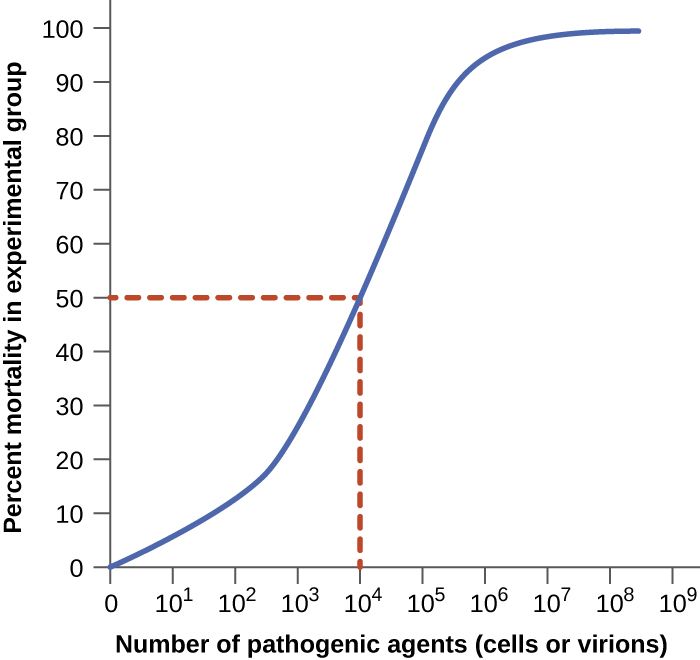
In everyday speech, "pathogenic" and "virulent" get swapped around. Microbiology draws a sharp line between them. The line is worth keeping straight. Pathogenicity is the ability of a microbe to cause disease at all. It is a yes or no trait. Virulence is the degree of that ability. How much harm it does, how fast, and at how small a dose.
Two organisms can both be pathogens. They can still sit at opposite ends of the virulence scale. Clostridium botulinum is one of the most virulent organisms known. Roughly a nanogram of its toxin per kilogram of body weight can kill. A common cold rhinovirus is a true pathogen too. It rarely does more than make you miserable for a week.
It also matters whose pathogen you mean. A primary pathogen can cause disease in a healthy host with working defenses. Influenza, Salmonella, and Mycobacterium tuberculosis all qualify. An opportunistic pathogen causes disease only when it gets an opening. A broken barrier. Normal flora wiped out by a drug. A weakened host. Catheter infections, ventilator pneumonia, and Candida overgrowth are all opportunistic disease. The organisms behind them sit harmlessly on a healthy body.
Virulence factors: the toolkit of harm
So what makes one strain more virulent than another? It comes down to its virulence factors. They are the genes and molecules that let a microbe settle in and cause damage. They are not vague qualities. They are concrete structures and secreted products. The rest of this chapter is a tour of them.
The factors sort into four jobs. Tools for attaching, which are the adhesins. Tools for spreading through tissue. Those are invasins and tissue-cutting enzymes. Tools for damaging the host. Those are the toxins. And tools for evading defenses. Capsules and antigenic variation are two. A microbe needs a tool from each stage to cause real disease. Lose the right one and the attack stalls.
Each factor is a separate molecule. So each one is also a possible target. A vaccine can raise antibodies against an adhesin or a capsule. A drug can block an enzyme. An antitoxin can mop up a toxin that is already loose in the blood. This is why naming the tool matters. The tool tells you how to fight it.
Measuring virulence: ID₅₀ and LD₅₀
Virulence can be put into numbers. That is how organisms get compared fairly. The ID₅₀ is the median infectious dose. It is the number of microbes needed to infect half of an exposed group. The LD₅₀ is the median lethal dose. It is the amount of microbe or toxin needed to kill half of them.
A lower number means a more virulent agent. Fewer organisms are enough to do the damage. Shigella has an ID₅₀ of only 10 to 100 cells. That is exactly why it moves so easily from person to person. It is also why handwashing decides outbreaks. Vibrio cholerae needs roughly a hundred million organisms. So it usually takes contaminated water to deliver a dose that big.
| Term | What it measures | Low number means |
|---|---|---|
| Pathogenicity | Whether a microbe can cause disease (yes/no) | — |
| Virulence | How severe the disease it causes | — |
| ID₅₀ | Dose that infects 50% of a population | Very infectious (spreads at low dose) |
| LD₅₀ | Dose that kills 50% of a population | Very deadly (lethal at low dose) |
- Pathogenicity is the ability to cause disease. Virulence is how much harm it does.
- Primary pathogens sicken healthy hosts. Opportunistic pathogens need a breach, lost flora, or a weakened host.
- Virulence factors are the molecules for attaching, spreading, damaging, and evading. Each one is a drug or vaccine target.
- ID₅₀ and LD₅₀ put virulence into numbers. A lower value means a more dangerous organism.
Section 2Getting in and attaching
Portals of entry
A microbe cannot cause infection until it reaches tissue it can live in. It gets there through a portal of entry. A portal is a specific route into the body. Most pathogens come in through the mucous membranes. The respiratory tract is by far the most common. Influenza, tuberculosis, and colds all take that route. The gastrointestinal tract is next. It is used by Salmonella, hepatitis A, and norovirus. Then come the genitourinary tract, used by gonorrhea and chlamydia. Last is the conjunctiva of the eye.
Others enter through the skin. Intact skin is an excellent barrier. Cuts, bites, burns, and surgical wounds break it. A special case is the parenteral route. Here an organism is placed straight into deeper tissue or into the blood. A needlestick. An IV line. A puncture wound. The surface defenses never get a turn.
Here is the key point. The same organism can be harmless at one portal and dangerous at another. Escherichia coli is a peaceful resident of the colon. Delivered to the bladder it causes a urinary tract infection. Reaching the bloodstream, it can cause fatal sepsis. Every invasive device works the same way. A urinary catheter, a central line, or a breathing tube is a new portal of entry. It hands a microbe a shortcut past the body's borders. So these devices go in under sterile technique. And taking one out promptly is among the most reliable ways to prevent infection.
| Portal of entry | Route | Example diseases |
|---|---|---|
| Respiratory tract | Inhaled droplets/aerosols | Influenza, TB, COVID-19, colds |
| GI tract | Ingested (fecal–oral, food, water) | Salmonellosis, hepatitis A, norovirus |
| Genitourinary tract | Sexual contact, ascending | Gonorrhea, chlamydia, UTIs |
| Skin / mucous breaks | Cuts, bites, burns, wounds | Cellulitis, tetanus, rabies |
| Parenteral | Directly into tissue/blood | Line infections, hepatitis B, HIV |
Adhesion: sticking around
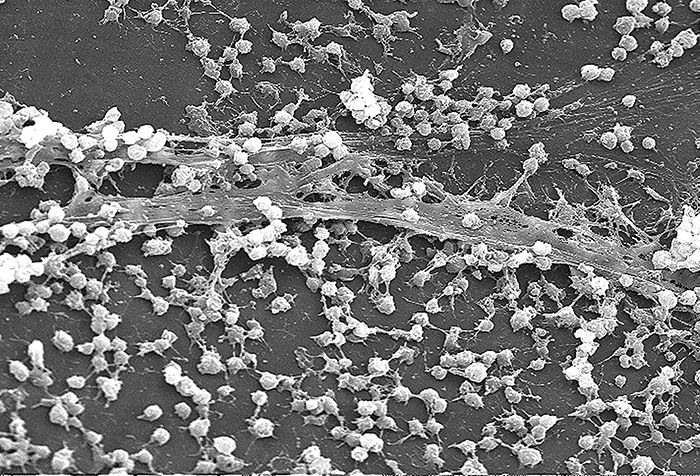
Getting in is not enough. A microbe that cannot anchor itself is swept away. Mucus moves it along. Urine flushes it out. Peristalsis pushes it through. Tears and saliva rinse it off. So the next step is attachment, and it is done with adhesins. These are surface molecules that bind like a key into a lock. They sit on fimbriae, on pili, or in the capsule and glycocalyx. Their locks are receptor molecules on host cells.
That fit is precise, and it often explains a pathogen's tropism. Tropism is why a given microbe infects one tissue and not another. Many organisms stick down together and wrap themselves in slime. That is a biofilm. Antibiotics and immune cells struggle to get into a biofilm. Biofilms grow on catheters, artificial joints, and heart valves. They are a big reason device infections are so stubborn.
Attachment is a required first move. So it is a favorite target for prevention. Some vaccines raise antibodies against a pathogen's adhesins. The microbe then never gets a foothold. Hand hygiene, catheter care, and mouth care all work partly the same way. They wipe organisms off before a biofilm can form.
Infectious dose
So how many organisms does it actually take? That number is the infectious dose. The ID₅₀ from Section 1 is the way it gets measured. It depends on two things at once. The microbe's virulence factors, and the host's defenses. An exposure that does nothing to a healthy adult can still seed a serious infection. The host at risk is a newborn, or someone whose immune system is suppressed. A pathogen with strong adhesins and a good evasion kit wins with far fewer organisms. That loops straight back to why low-dose organisms call for such strict precautions.
- Pathogens enter through portals of entry. Those are the respiratory, GI, and genitourinary tracts. Then the conjunctiva, skin breaks, and the parenteral route.
- The same microbe can be harmless at one portal and lethal at another. E. coli in the colon, the bladder, and the blood is the clearest example.
- Adhesins anchor microbes to specific host receptors. Clumped, slime-wrapped communities become drug-resistant biofilms.
- Invasive devices are artificial portals of entry. Sterile insertion and early removal are the core defenses.
Section 3Causing damage: exotoxins and endotoxin
Exotoxins: precision weapons
Much of the harm a pathogen does comes from its toxins. There are two families, and the more dramatic one is the exotoxin. Exotoxins are proteins that bacteria build and then secrete. Both Gram-positive and Gram-negative organisms make them. Being proteins, they are exact in what they hit. They can also be shockingly strong. The toxins of tetanus, botulism, and diphtheria are the deadliest known.
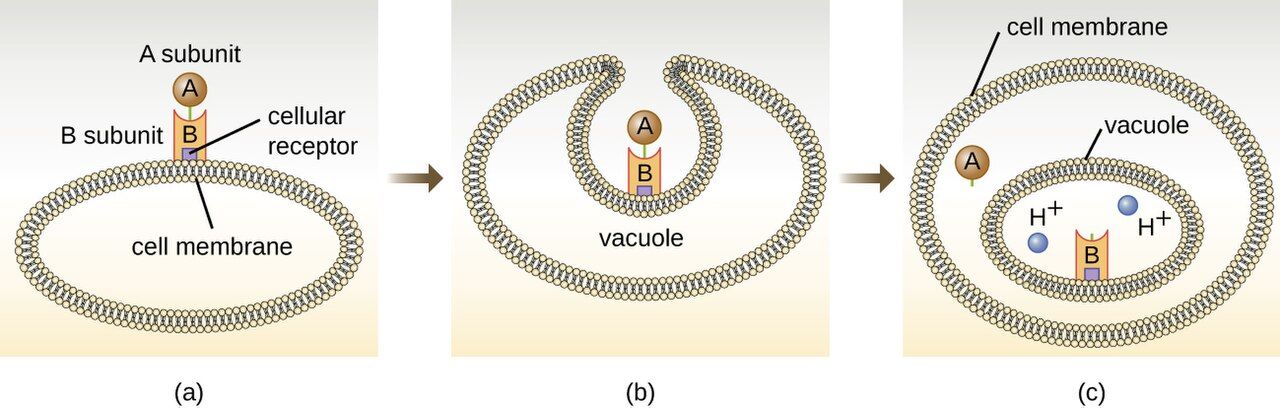
Exotoxins come in three broad styles. A-B toxins have two parts. The B, or binding, subunit latches onto a target cell. The A, or active, subunit slips inside. It then wrecks one specific process. Diphtheria toxin halts protein building. Cholera toxin drives the massive fluid loss of rice-water diarrhea. Botulinum and tetanus toxins block neurotransmitter release and so paralyze muscle.
Membrane-disrupting toxins work in a blunter way. They punch holes in host-cell membranes. The hemolysins burst red blood cells and the leukocidins kill white blood cells. Superantigens are the third style. They short-circuit the immune system itself. The body dumps out a huge, untargeted flood of cytokines. The result is the shock of toxic shock syndrome.
Two useful facts follow from exotoxins being proteins. First, they are usually heat-labile. Cooking destroys them. So careful food handling prevents many toxin illnesses. Second, a protein toxin can be treated chemically into a toxoid. A toxoid no longer harms, but it still provokes protective antibodies. The tetanus and diphtheria parts of routine vaccines are toxoids. Ready-made antitoxin antibodies can also be given. They soak up toxin that is already loose in the blood.
Endotoxin: the Gram-negative alarm
The second toxin is not secreted, and it is not a protein. Endotoxin is the lipid A part of lipopolysaccharide (LPS). LPS is a fixed part of the outer membrane of Gram-negative bacteria. So endotoxin is only released when the bacterial cell is damaged or dies. That includes the moment antibiotics burst a mass of them at once.
One molecule of endotoxin is far weaker than one of a strong exotoxin. But the body's reaction to it is broad and powerful. Fever. Blood vessels widen and blood pressure falls. Clotting switches on all over the body. A bloodstream infection floods the body with endotoxin. That reaction becomes septic shock. Blood pressure drops to dangerous levels. Tiny clots form all over the body in disseminated intravascular coagulation (DIC). Unlike a protein exotoxin, endotoxin is heat-stable. It survives an autoclave, and it cannot be made into a toxoid. So there is no vaccine against it.
| Feature | Exotoxin | Endotoxin |
|---|---|---|
| Chemistry | Protein, secreted | Lipid A of LPS (outer membrane) |
| Source | Gram-positive & Gram-negative | Gram-negative only |
| Released | Actively secreted by living cell | Only when the cell is damaged/lysed |
| Potency | Very high; specific effect | Lower per molecule; general effect |
| Heat stability | Usually heat-labile | Heat-stable |
| Toxoid / vaccine? | Yes (tetanus, diphtheria) | No |
| Typical effect | Specific (paralysis, diarrhea, etc.) | Fever, hypotension, shock, DIC |
- Exotoxins are secreted proteins. They are strong, specific, usually heat-labile, and can be turned into protective toxoids.
- The three exotoxin styles are A-B toxins, membrane-disrupting hemolysins and leukocidins, and superantigens.
- Endotoxin is the lipid A of LPS from Gram-negative cells. It is released on lysis, is heat-stable, and has no toxoid.
- A flood of endotoxin drives fever, low blood pressure, septic shock, and DIC.
Section 4Evading the body's defenses
Capsules: the invisibility cloak
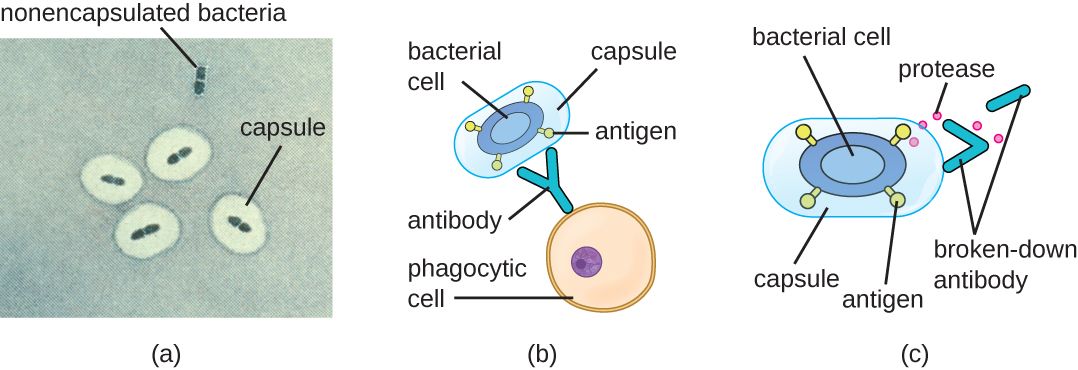
Getting in, holding on, and doing damage still is not enough. Not if the immune system mops the microbe up. So successful pathogens carry tools for immune evasion. The classic one is the capsule, a thick and slippery polysaccharide layer around the cell.
A capsule works two ways at once. A phagocyte cannot get a grip on it. It also hides the surface molecules that antibodies and complement latch onto. The capsule is the master virulence factor of several feared pathogens. Streptococcus pneumoniae. Neisseria meningitidis. Haemophilus influenzae type b. Klebsiella pneumoniae. The capsular vaccines aim straight at that coat. Teach the immune system to see the capsule and the cloak stops working. Licensed vaccines cover S. pneumoniae, N. meningitidis, and H. influenzae type b. Klebsiella pneumoniae leans just as hard on its capsule. No vaccine against it is licensed. The candidates are still experimental.
Antigenic variation: the costume change
Another strategy is to keep changing the disguise. In antigenic variation, a microbe alters its surface molecules. The immune system had already learned the old ones. Yesterday's antibodies no longer fit. Influenza does this every year through small mutations. That is antigenic drift. Now and then it swaps whole gene segments instead. That is antigenic shift. That is why the vaccine is remade every year. It is also why a truly new shift can cause a pandemic.
Other organisms run the same trick. Neisseria gonorrhoeae constantly reshuffles the proteins on its pili. So gonorrhea leaves no lasting immunity. It can reinfect the same person again and again. So do the trypanosomes of African sleeping sickness. So does the Borrelia of relapsing fever. Each new variant outruns the antibody response. The illness comes in waves.
Hiding and sabotage
Pathogens have more moves than that. Some turn intracellular and live inside host cells. Circulating antibodies cannot reach them there. Mycobacterium tuberculosis survives inside the very macrophages sent to destroy it. Listeria and Salmonella do the same thing.
Others attack the defenses directly. IgA proteases chop up the antibodies that guard mucous membranes. Coagulase walls the organism off inside a clot of the host's own fibrin. That one is a Staphylococcus aureus specialty. Some microbes coat themselves in host proteins so they look like "self." That trick is antigenic masking. The standard example is S. aureus protein A, which grabs the tail of IgG.
Keep antigenic masking separate from molecular mimicry. In mimicry, the microbe's own antigens happen to look like host tissue. Antibodies made against the microbe then attack the host's own cells. Streptococcal M protein resembling cardiac myosin in rheumatic fever is the classic case. Each trick explains something you see in the clinic. TB needs months of therapy because the organism hides inside cells. Staph abscesses often need draining. Drugs cannot reach into a walled-off pocket.
| Evasion strategy | How it works | Example |
|---|---|---|
| Capsule | Blocks phagocytosis; hides surface antigens | S. pneumoniae, N. meningitidis |
| Antigenic variation | Changes surface molecules to dodge antibodies | Influenza, N. gonorrhoeae |
| Intracellular hiding | Lives inside host cells, out of antibody reach | M. tuberculosis, Listeria |
| IgA protease | Destroys mucosal antibodies | N. gonorrhoeae, H. influenzae |
| Coagulase | Walls the microbe inside a fibrin clot | Staphylococcus aureus |
- Capsules block phagocytosis and hide antigens. Capsular vaccines target exactly that coat.
- Antigenic variation changes surface molecules so old antibodies no longer fit. Influenza and gonorrhea are the examples.
- Intracellular hiding keeps microbes out of antibody reach and forces long therapy, as in TB.
- Coagulase and abscess walls are why source control is often essential. Source control means drainage or device removal.
Section 5The stages of an infection
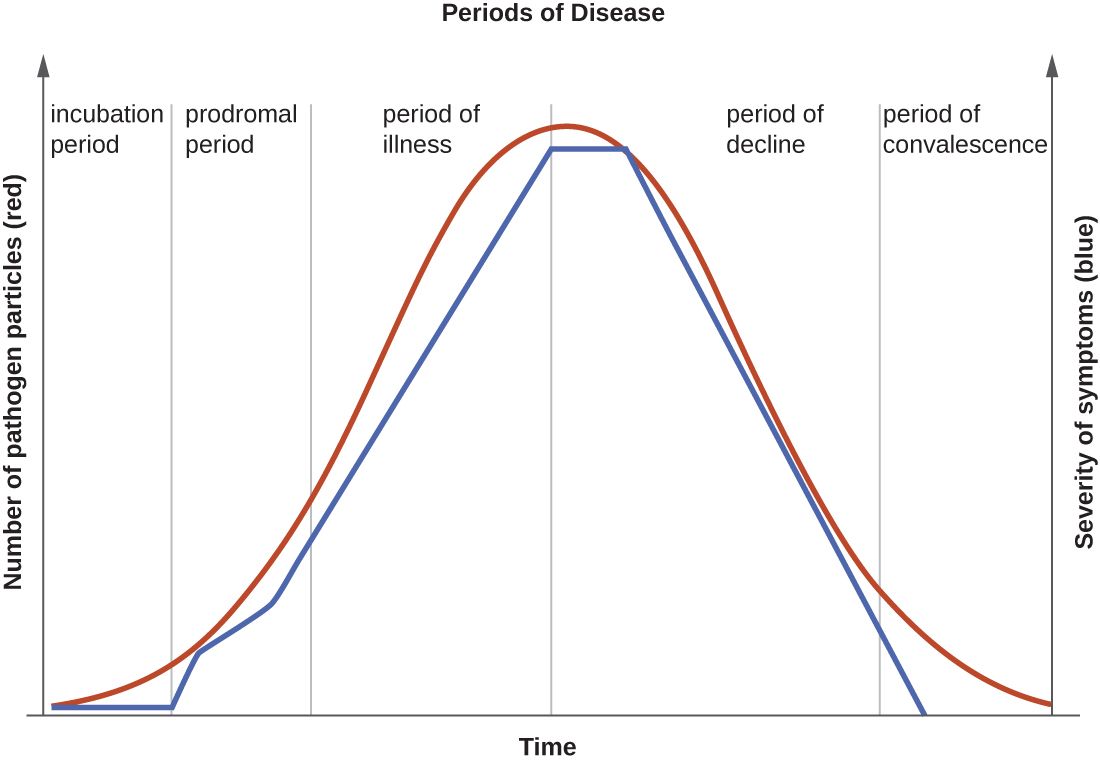
Five predictable stages
Most acute infections unfold along the same timeline. Knowing the stages tells you what to expect. It also tells you when a sick person is most dangerous to others. The incubation period runs from the moment of exposure to the first symptoms. The microbe is multiplying. The host still feels fine. This stretch can last hours, as in staph food poisoning. Or it can last years, as in HIV and tuberculosis.
Next comes the prodromal period. It is a short phase of vague complaints. Mild fever. Fatigue. General achiness. The microbe count and the immune response are both climbing. Then the period of illness is the peak. The microbe is at its most numerous. The signs and symptoms of that disease are at their worst. Without treatment, this is when the risk of dying is highest.
Then the period of decline arrives. The immune system, often helped by treatment, gains the upper hand. Symptoms fade. But the host is worn down and open to a second infection. Finally the convalescence period is recovery. The body repairs itself and strength returns.
Why the stages matter
The payoff is understanding communicability. That means when the infection can spread. It does not line up neatly with how sick someone looks. For many illnesses, shedding starts in the prodromal stage. Sometimes it starts late in incubation. So a person is contagious before they feel truly ill. They are shedding before anyone suspects infection.
Measles is the clean example. It is most contagious through the three to four day catarrhal prodrome. Someone can seed an outbreak in a waiting room while feeling only a little off. Influenza shows a milder version of the same thing. Shedding starts about a day before symptoms. It peaks in the first one to two days of illness.
The other half matters just as much. Some people keep shedding organisms into the decline and convalescence stages. A few become long-term carriers. They feel completely well and still pass the organism on. So isolation precautions are timed to the organism's shedding pattern. They are not set by how bad the symptoms look right now.
| Stage | What is happening | Symptoms |
|---|---|---|
| Incubation | Microbe multiplying after exposure | None yet |
| Prodromal | Load and immune response building | Mild, vague (fatigue, low fever) |
| Illness | Microbe at peak; disease fully expressed | Most severe, disease-specific |
| Decline | Immune system gaining control | Subsiding; host weakened |
| Convalescence | Recovery and tissue repair | Resolving; strength returns |
- Acute infections move through incubation, prodromal, illness, decline, and convalescence.
- Symptoms peak during the period of illness, when the microbe is most numerous.
- Communicability often begins in the prodromal stage, so people spread infection before they seem sick.
- Some shed during decline or convalescence, and a few become long-term carriers. Isolation is timed to shedding, not to symptoms.
The chapter in one breath
- Pathogenicity is whether a microbe causes disease. Virulence is how much harm it does. It is measured by ID₅₀ and LD₅₀, where lower means more dangerous.
- Virulence factors are the molecules for attaching, spreading, damaging, and evading. They are the concrete tools of disease and the targets of drugs and vaccines.
- Microbes enter through portals of entry. Those are the respiratory, GI, and genitourinary tracts, the skin, and the parenteral route. They then anchor with adhesins. Invasive devices are artificial portals.
- Exotoxins are strong secreted proteins. The styles are A-B toxins, hemolysins and leukocidins, and superantigens. They can be turned into protective toxoids.
- Endotoxin is lipid A of LPS from Gram-negative cells. It is released on lysis and drives fever, low blood pressure, septic shock, and DIC.
- Pathogens evade defenses with capsules, antigenic variation, and intracellular hiding. That explains capsular vaccines, yearly flu shots, and the need for drainage or long therapy.
- Infections pass through five stages. People are often most contagious in the prodromal phase, before they look sick.
ReferenceWords worth knowing
A quick reference for the terms in this chapter. Skim it now, or circle back whenever a word trips you up.
- Adhesin
- A surface molecule, often on fimbriae or pili, that binds a pathogen to specific receptors on host cells so it is not washed away.
- Antigenic variation
- A pathogen's ability to change its surface molecules so antibodies made earlier no longer recognize it.
- Antitoxin
- Ready-made antibody given to neutralize a toxin that is already loose in the body.
- Biofilm
- A slime-encased community of attached microbes that resists antibiotics and immune cells; common on catheters and implants.
- Capsule
- A thick polysaccharide layer around a cell that blocks phagocytosis and hides surface antigens.
- Carrier
- A person who harbors and can pass on a pathogen while showing no symptoms.
- Convalescence period
- The final stage of infection, during which the body recovers and repairs.
- Endotoxin
- The lipid A portion of LPS in the Gram-negative outer membrane; released on cell lysis, causing fever, low blood pressure, and shock.
- Exotoxin
- A secreted protein toxin, often strong and specific; made by both Gram-positive and Gram-negative bacteria.
- ID₅₀ (median infectious dose)
- The number of microbes needed to infect 50% of an exposed population; a lower value means a more infectious organism.
- Incubation period
- The stretch of time from exposure to the first appearance of symptoms.
- LD₅₀ (median lethal dose)
- The dose of microbe or toxin that kills 50% of a population; a lower value means a deadlier agent.
- Lipopolysaccharide (LPS)
- A molecule of the Gram-negative outer membrane whose lipid A component is endotoxin.
- Molecular mimicry
- A microbe's own antigens resembling host tissue, so antibodies against the microbe also attack the host.
- Opportunistic pathogen
- A microbe that causes disease only when defenses are breached, normal flora are lost, or the host is weakened.
- Pathogenicity
- The ability of a microbe to cause disease.
- Portal of entry
- The route by which a pathogen enters the body: respiratory, GI, genitourinary, conjunctival, skin, or parenteral.
- Primary pathogen
- A microbe that can cause disease in a healthy host with working defenses.
- Prodromal period
- An early stage of mild, nonspecific symptoms as microbial load and immune response build.
- Superantigen
- An exotoxin that triggers a massive, untargeted cytokine release, producing shock.
- Toxoid
- A chemically inactivated exotoxin that no longer harms but still brings out protective antibodies; used in vaccines.
- Tropism
- The tissue a given pathogen prefers, set largely by which host receptors its adhesins fit.
- Virulence
- The degree of harm a pathogen is capable of causing.
- Virulence factor
- A specific molecule or structure that helps a microbe attach, spread, damage tissue, or evade defenses.