Microbial Genetics & How Resistance Spreads
Every drug-resistant infection starts as a change in a microbe's DNA. One changed gene, copied millions of times overnight, can turn a drug that cures into a drug that does nothing. This chapter opens up the genetics behind that story. You will see how bacteria store and use their genetic code. You will see how that code mutates. You will see how bacteria pass useful genes sideways, even to other species. And you will see how all of it adds up to the spread of antibiotic resistance. Once you know the mechanisms, "finish your antibiotics" stops being a rule to recite. It becomes a rule you can explain.
By the end of this chapter you can
- Describe the structure of DNA and show how a gene is expressed through the central dogma (replication, transcription, translation).
- Explain why several major antibiotic classes work by blocking replication, transcription, or translation.
- Define mutation and tell point mutations (silent, missense, nonsense) apart from frameshift mutations.
- Name common mutagens and explain how chance mutation seeds antibiotic resistance.
- Compare transformation, transduction, and conjugation as forms of horizontal gene transfer.
- Explain what plasmids are and how R plasmids carry and spread resistance genes.
- Describe how selective pressure and everyday care choices drive resistance, and name the steps that slow it down.
Section 1DNA, genes & the central dogma
The molecule that runs the cell
Everything a microbe can do is written in its DNA (deoxyribonucleic acid). That includes building a cell wall, digesting a sugar, and surviving a drug. DNA is a long molecule with two strands. It twists like a ladder, and that twisted shape is the famous double helix. The rungs of the ladder are pairs of nucleotide bases, and they pair by a strict rule. Adenine (A) pairs with thymine (T). Guanine (G) pairs with cytosine (C). Because the pairing never varies, one strand is a perfect pattern for rebuilding the other. That feature matters a great deal when the cell needs to copy itself.
A gene is just a stretch of DNA. It holds the instructions for one product, and that product is usually a protein. The whole set of an organism's genetic material is its genome. Most bacteria keep their genome as one circular chromosome. It floats in the cytoplasm, since bacteria have no nucleus. Many bacteria also carry small extra loops of DNA called plasmids. You will meet those little rings again in Section 4. That is exactly where many resistance genes ride.
Copying the code: replication
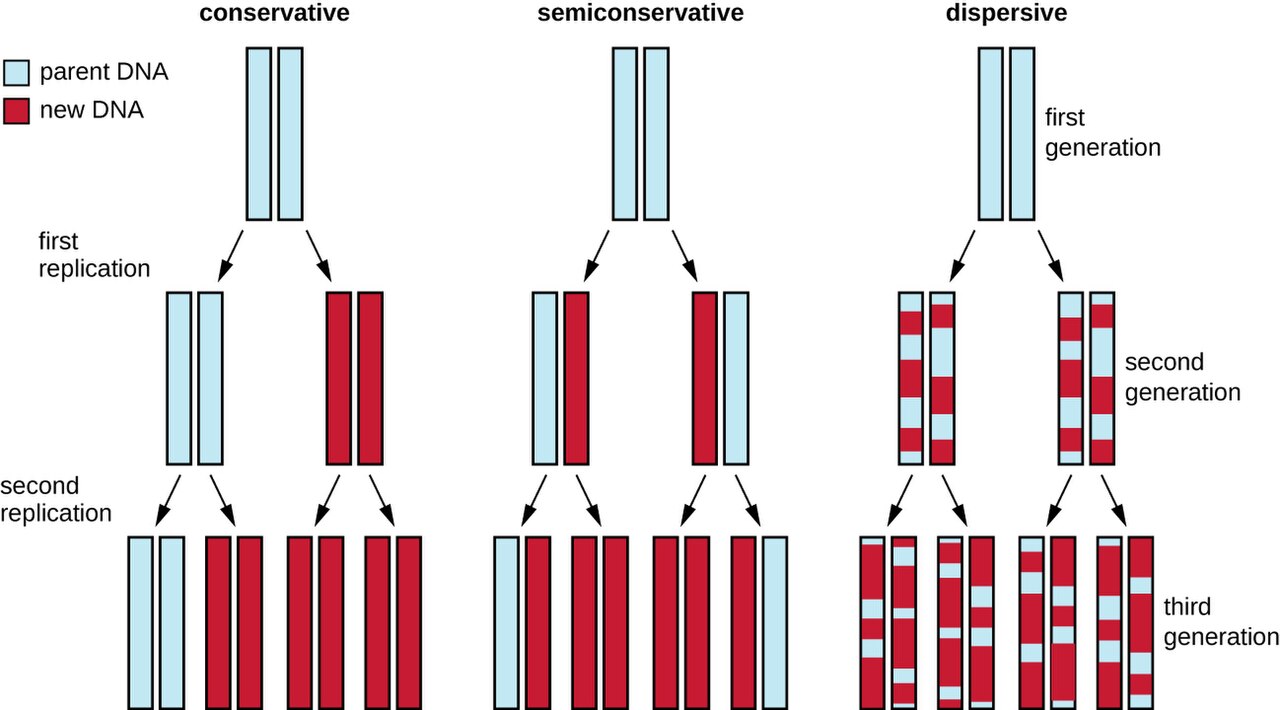
Before a bacterium divides, it has to make a full second copy of its DNA. That way each daughter cell gets a complete set of instructions. This copying is DNA replication. The double helix unzips into two single strands. An enzyme called DNA polymerase reads each old strand and builds a new partner strand across from it. It follows the A–T and G–C rule as it goes. One molecule becomes two identical double helices. Each new molecule keeps one old strand and one new strand, so replication is called semiconservative. Bacteria work fast. Some divide every 20 minutes. That speed is the engine behind this whole chapter, because fast copying means any gene spreads fast. A resistance gene is no exception.
From gene to protein: transcription & translation
Holding the instructions is not the same as carrying them out. To use a gene, the cell runs the central dogma: DNA to RNA to protein. Transcription comes first. An enzyme called RNA polymerase reads a gene and writes a working copy of it. That copy is a strand of messenger RNA (mRNA). Translation comes next. A ribosome reads the mRNA three bases at a time. Each three-base group is a codon, and each codon names one amino acid. The ribosome links those amino acids into a protein. The finished protein folds up and goes to work. It may serve as an enzyme, a structural part, or a pump. Change the DNA and you change the protein. Change the protein and you change what the microbe can do.
| Step | Input → output | Key enzyme/machine | Antibiotic that blocks it |
|---|---|---|---|
| Replication | DNA → two identical DNAs | DNA polymerase, DNA gyrase | Fluoroquinolones (block gyrase) |
| Transcription | DNA → mRNA | RNA polymerase | Rifampin (blocks RNA polymerase) |
| Translation | mRNA → protein | Ribosome | Aminoglycosides, tetracyclines, macrolides |
- DNA stores instructions as base pairs (A–T, G–C); a gene codes for one product, and the whole set is the genome.
- Replication copies DNA so each daughter cell gets a full genome, and bacteria do it fast.
- The central dogma runs DNA → (transcription) → mRNA → (translation) → protein.
- Many antibiotics work by blocking replication, transcription, or translation in bacteria only.
Section 2Mutation
What a mutation is
A mutation is any change in the DNA sequence. Most mutations are copying errors. DNA polymerase is remarkably accurate, but it is not perfect. When a bacterium divides billions of times, rare mistakes are guaranteed. A mutation may do nothing at all. It may harm the microbe. Once in a while it hands the microbe a brand new ability. What a mutation does depends on how it changes the protein that the gene builds. That is why the type of mutation is worth knowing.
Types of mutation
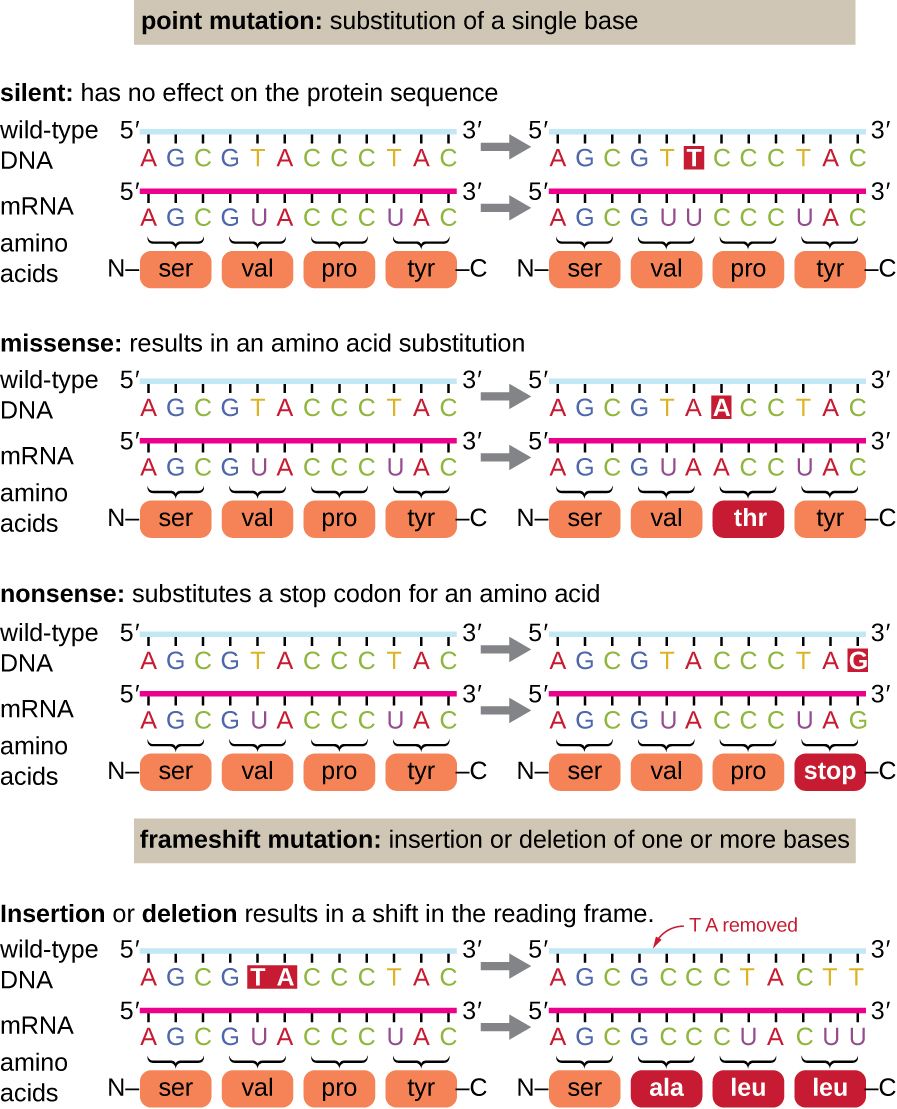
The simplest change is a point mutation, where one base is swapped for another. The result varies a lot. A silent mutation changes a codon, but the new codon still names the same amino acid. The protein comes out unchanged. A missense mutation changes one amino acid. The protein may work a little differently, or a lot differently. This is the classic route to a drug target that no longer binds its drug. A nonsense mutation turns an amino-acid codon into a stop signal. The protein is cut short, and it usually breaks.
The frameshift mutation does more damage. Here a base is inserted or deleted. The ribosome reads mRNA in fixed groups of three. Adding or removing one base shifts the whole reading frame. Every codon after the change is garbled. Frameshifts almost always destroy the protein.
Mutagens
Mutations that happen on their own during replication are spontaneous. The rate climbs sharply when a mutagen is present. A mutagen is an agent that damages DNA or causes copying errors. Chemical mutagens include certain reactive molecules and base analogs. A base analog slips into DNA in place of a normal base. Radiation is a powerful physical mutagen. Ultraviolet (UV) light fuses neighboring thymine bases into thymine dimers, and those kinks distort the helix. X-rays and gamma rays break strands outright. The same damage that causes mutations will kill the cell at a high enough dose. That is why radiation is used for microbial control. Be precise about which kind. Ionizing radiation (gamma rays, electron beam) goes through packaging. It is a true sterilization method for heat-sensitive supplies such as sutures, gloves, and plastic syringes. UV light does not go through things. Glass, plastic, dust, organic soil, and any shadow all block it, and UV does not reliably kill endospores. So UV is used for surface and air disinfection only, never sterilization.
| Mutation | What changes | Effect on protein |
|---|---|---|
| Silent (point) | One base; codon still means the same amino acid | None |
| Missense (point) | One base; codon now means a different amino acid | One amino acid changed — may alter function (e.g., a drug target) |
| Nonsense (point) | One base; codon becomes a "stop" | Protein cut short — usually nonfunctional |
| Frameshift | Base inserted or deleted | Reading frame shifts — protein usually destroyed |
- A mutation is any change in the DNA sequence, and most arise as rare replication errors.
- Point mutations swap one base: silent (no change), missense (one amino acid changed), nonsense (early stop).
- Frameshift mutations (insertion or deletion) shift the reading frame and usually wreck the protein.
- Mutagens such as chemicals, UV, and X-rays raise the mutation rate; chance mutation is the raw material of resistance.
Section 3Horizontal gene transfer
Sideways, not just downward
Mutation is slow and random. If it were the only way bacteria gained new genes, resistance would spread far more slowly than it does. Bacteria have a second trick, and it is much faster. They trade genes sideways. Vertical gene transfer is the ordinary kind of inheritance, where genes pass from a parent cell to its daughters. Horizontal gene transfer (HGT) moves genetic material between separate cells. Those cells are not parent and offspring, and they may not even be the same species. HGT is why a resistance gene that arose in one organism can turn up months later in a completely unrelated one. There are three routes.
Transformation, transduction, conjugation
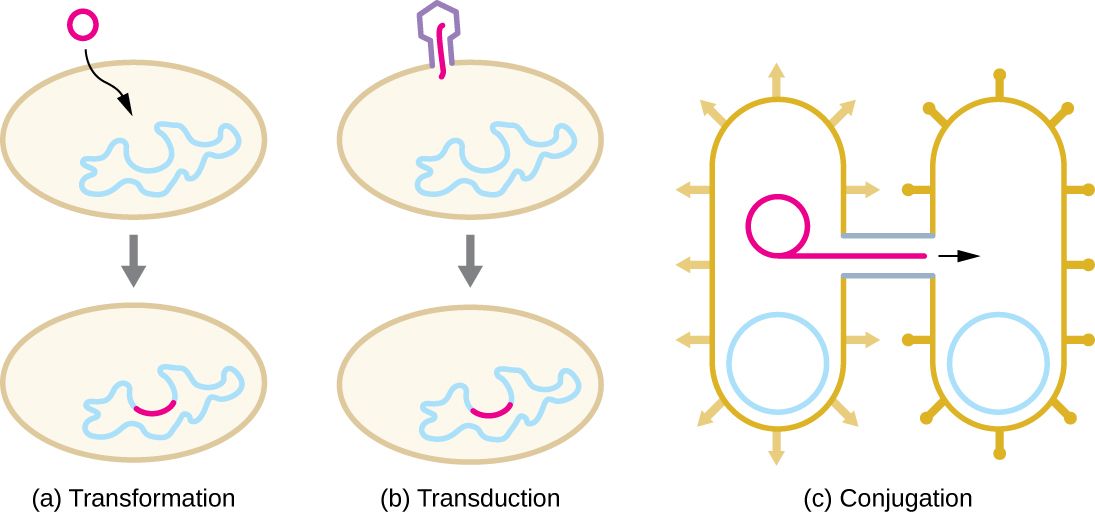
Transformation is the uptake of naked DNA from the environment. When a bacterium dies and breaks apart, it spills its DNA. A nearby cell in a state called competence can pull those fragments across its membrane. It then stitches them into its own genome. If a fragment carried a resistance gene, the recipient is now resistant. It never had to meet the original owner alive.
Transduction uses a bacterial virus as an accidental delivery truck. That virus is a bacteriophage. When a phage infects a bacterium and builds new virus particles, it sometimes packs a piece of the host's DNA by mistake. That phage then goes on to infect another bacterium. It injects the stray host gene along with its own, and the new host may keep it.
Conjugation is the most efficient of the three, and it is the one that matters most for resistance. Two living bacteria make contact through a tube called a sex pilus. A copy of a plasmid then crosses from donor to recipient, and that plasmid often holds a whole packet of resistance genes. Conjugation is the closest thing bacteria have to direct sharing. It can move genes between species that would never mix otherwise.
| Mechanism | How DNA moves | Vehicle | Clinical relevance |
|---|---|---|---|
| Transformation | Cell takes up free DNA from a dead microbe | Naked environmental DNA | Spreads genes released by lysed bacteria |
| Transduction | A virus carries bacterial DNA to a new cell | Bacteriophage | Moves genes, including some toxins & resistance |
| Conjugation | Direct cell-to-cell transfer through a pilus | Sex pilus + plasmid | Major driver of multidrug-resistance spread |
- Vertical transfer is parent-to-daughter inheritance; horizontal gene transfer (HGT) moves genes between separate cells, even across species.
- Transformation is uptake of free DNA, transduction is delivery by a bacteriophage, and conjugation is direct transfer through a pilus.
- Conjugation is the biggest driver of multidrug-resistance spread, because it moves whole plasmids of genes at once.
- HGT lets resistance jump between unrelated organisms far faster than mutation alone can.
Section 4Plasmids & resistance genes
Little rings of optional DNA
Besides its main chromosome, a bacterium often carries one or more plasmids. A plasmid is a small circular loop of DNA that sits apart from the chromosome, so it is extrachromosomal. The cell copies its plasmids and passes them to daughter cells. Even so, plasmids are not strictly required for survival. They carry bonus genes that come in handy under stress. Some let the cell use an unusual nutrient. Some build a toxin. And some let the cell survive antibiotics. That last group is the one that drives hospital outbreaks and keeps infection control busy.
R plasmids: resistance to go
A plasmid that carries one or more antibiotic-resistance genes is called a resistance plasmid, or R plasmid. R plasmids are dangerous for two reasons. First, one plasmid can carry resistance genes against several different antibiotics. Picking it up in one step makes a bacterium multidrug-resistant (MDR). Second, R plasmids often carry their own conjugation machinery, so they are built to copy themselves into neighboring cells. Put those two facts together and you get a mobile, self-spreading package of multidrug resistance. That is a major reason why organisms like VRE and the multidrug-resistant gram-negatives are behind so many hospital outbreaks. Not every resistant organism works this way. In MRSA, for instance, the key methicillin-resistance gene sits on the chromosome, not on a plasmid.
Jumping genes that build the package
How does one plasmid come to hold so many resistance genes? Often the work is done by transposons, nicknamed jumping genes. A transposon is a short DNA segment that can cut or copy itself out of one spot and paste into another. It can carry a gene from a chromosome onto a plasmid. Related elements called integrons can capture resistance gene cassettes and line them up side by side. Over time these shuffling elements build a multidrug-resistance plasmid one gene at a time. Then conjugation shares the finished package.
| Feature | Chromosome | Plasmid |
|---|---|---|
| Size | Large; the main genome | Small loop of extra DNA |
| Essential? | Yes — carries the genes for survival | No — carries optional/"situational" genes |
| Copied & inherited? | Yes, with each division | Yes, and can also be shared by conjugation |
| Typical cargo | Core metabolism, structure | Resistance, toxins, special nutrients |
- Plasmids are small, circular, extrachromosomal loops of DNA that carry optional but useful genes.
- R plasmids carry antibiotic-resistance genes, often against several drugs at once (multidrug resistance).
- R plasmids frequently carry conjugation machinery, so they copy themselves into neighboring cells.
- Transposons and integrons shuffle resistance genes onto plasmids and build the multidrug package.
Section 5How resistance spreads
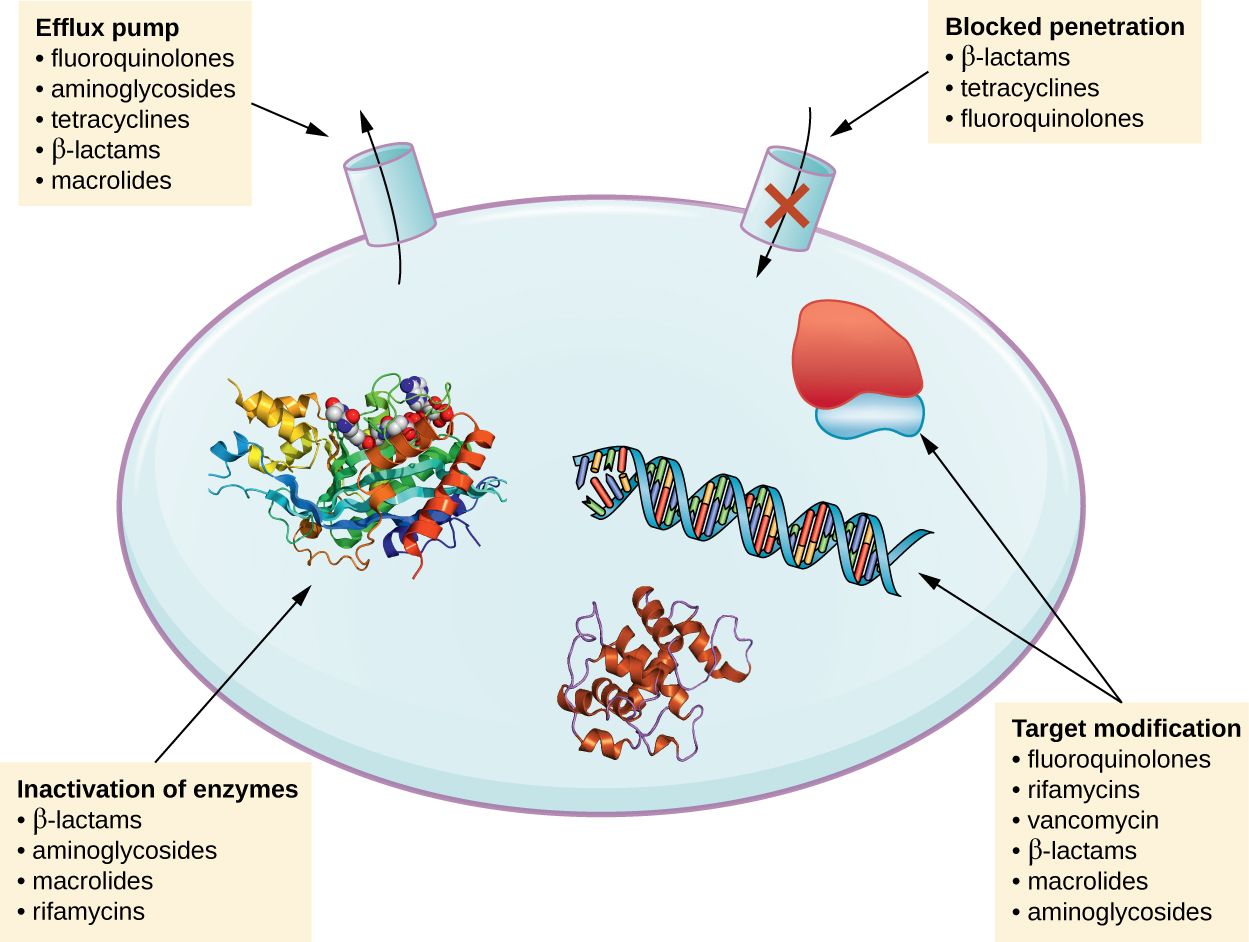
Selective pressure: the drug does the choosing
Antibiotics do not create resistance. They select for it. Picture a population of bacteria. By chance, a few cells already carry a resistance gene, either from a mutation or from a plasmid. Give an antibiotic and the susceptible cells die. The resistant few survive. Those survivors then divide, and their offspring refill the site. The population is resistant from top to bottom. Notice what did not happen. No cell changed its genes the moment the drug arrived. The drug simply cleared the field for the cells it could not kill. That is selective pressure. Every dose of antibiotic given anywhere nudges the microbial world a little further toward resistance, whether that dose was needed or not. So an antibiotic given just in case is not a harmless choice.
Where the spreading happens
Resistant organisms spread the way any microbe spreads, and that is mostly by contact. In health care, contact means hands, equipment, and surfaces carrying flora from one person to the next. Several forces speed it up. Antibiotics get prescribed too often, including for illnesses caused by viruses. Courses get stopped early, which kills the weak cells and leaves the tough survivors behind. Heavy antibiotic use in agriculture seeds resistant organisms into the food supply and the environment. International travel carries resistant strains around the globe in days. The genetics from the earlier sections is what makes each of these routes so potent. Once a resistance gene sits on a mobile plasmid, contact spread and conjugation do the rest.
What actually slows it down
Slowing resistance is not mainly a laboratory problem. It is settled where care happens, one choice at a time. Hand hygiene and contact precautions stop resistant organisms from moving between people. Antimicrobial stewardship lowers the selective pressure in the first place. Stewardship means asking whether an antibiotic is truly needed. It means pushing for cultures before drugs are started. It means narrowing broad-spectrum therapy once the organism is known. And it means stopping antibiotics that are no longer indicated. Teaching matters just as much. Explain why to finish the full course. Explain why leftover antibiotics should never be shared. Explain why a cold will not respond to antibiotics. That turns the person taking the drug into a partner rather than a driver of the problem.
| Driver of spread | What happens | What slows it |
|---|---|---|
| Contact transmission | Resistant flora ride hands, equipment, surfaces between patients | Hand hygiene; contact precautions; dedicated equipment |
| Overprescribing | Antibiotics given when not needed (e.g., for viruses) select for resistance | Stewardship; culture first; question the indication |
| Incomplete courses | Stopping early leaves the toughest survivors to repopulate | Teach adherence; explain the "why" |
| Broad-spectrum overuse | Wide kill flattens flora and selects widely for resistance | De-escalate to a narrow agent once the organism is known |
- Selective pressure: antibiotics do not create resistance, they kill the susceptible cells and let the already-resistant few survive and multiply until they take over.
- Resistance spreads mainly by contact, amplified by overprescribing, incomplete courses, agricultural use, and travel.
- The genetics of Sections 1–4 (mutation, HGT, R plasmids) is what makes each route so fast.
- Hand hygiene, contact precautions, stewardship, and teaching are the levers that slow resistance.
The chapter in one breath
- DNA stores a microbe's instructions as base pairs; a gene is expressed through the central dogma, so DNA is replicated, transcribed to mRNA, and translated to protein.
- Several antibiotic classes work by blocking replication, transcription, or translation in bacteria only.
- A mutation changes the DNA sequence. Point mutations (silent, missense, nonsense) swap one base, frameshifts shift the reading frame, and mutagens raise the rate.
- Chance mutation seeds resistance, which is why serious infections like TB are treated with several drugs at once.
- Horizontal gene transfer moves genes sideways between cells, even across species, by transformation, transduction, and conjugation.
- R plasmids are mobile loops of DNA that carry resistance to several drugs at once, and conjugation spreads them efficiently.
- Selective pressure from antibiotic use plus contact spread drives resistance through health care and the community. Hand hygiene, stewardship, and teaching are the countermeasures.
ReferenceWords worth knowing
A quick reference for the terms in this chapter. Skim it now, or circle back whenever a word trips you up.
- Central dogma
- The flow of genetic information in a cell: DNA → RNA → protein (replication, transcription, translation).
- Codon
- A group of three mRNA bases that names one amino acid during translation.
- Competence
- The state in which a cell can take up free DNA from around it, which is what makes transformation possible.
- Conjugation
- Horizontal gene transfer by direct cell-to-cell contact through a sex pilus, often moving a plasmid.
- DNA (deoxyribonucleic acid)
- The double-stranded molecule that stores genetic instructions as paired bases (A–T, G–C).
- Frameshift mutation
- A mutation from inserting or deleting a base, which shifts the reading frame and usually destroys the protein.
- Gene
- A stretch of DNA that codes for one product, usually a protein.
- Genome
- The complete set of an organism's genetic material.
- Horizontal gene transfer (HGT)
- Movement of genetic material between separate cells that are not parent and offspring, even across species.
- Integron
- A genetic element that captures resistance gene cassettes and lines them up, often on a plasmid.
- Missense mutation
- A point mutation that changes one amino acid in a protein and may alter how it works.
- Multidrug-resistant (MDR)
- Resistant to several different antibiotics at the same time.
- Mutagen
- A physical or chemical agent (e.g., UV light, X-rays, certain chemicals) that raises the mutation rate.
- Mutation
- Any change in the DNA sequence.
- Nonsense mutation
- A point mutation that turns an amino-acid codon into a stop codon, cutting the protein short.
- Plasmid
- A small, circular, extrachromosomal loop of DNA that carries optional genes and can be shared between cells.
- Point mutation
- A mutation that swaps a single base; it may be silent, missense, or nonsense.
- R plasmid (resistance plasmid)
- A plasmid carrying one or more antibiotic-resistance genes, often against several drugs at once.
- Replication
- The copying of DNA before cell division, producing two identical double helices.
- Selective pressure
- The way antibiotic use favors the survival and multiplication of cells that are already resistant.
- Semiconservative
- The pattern of DNA replication in which each new double helix keeps one old strand and one new strand.
- Transcription
- Copying a gene from DNA into messenger RNA by RNA polymerase.
- Transduction
- Horizontal gene transfer in which a bacteriophage carries bacterial DNA to a new cell.
- Transformation
- Horizontal gene transfer in which a cell takes up free DNA released by a dead microbe.
- Translation
- Building a protein from an mRNA sequence at the ribosome, one codon at a time.
- Transposon
- A "jumping gene," a DNA segment that can move between locations, including onto plasmids.