Middle Childhood
Somewhere around the sixth birthday, childhood settles into its long, steady middle. Growth slows to a patient two or three inches a year, the baby teeth loosen and fall, and the body that once toddled now runs, climbs, and writes its own name. Inside, thought is being rebuilt: the school-age child learns to reason about the concrete world with a logic that finally holds still. This is the age of the schoolyard and the classroom, of best friends and spelling tests, of the first serious question — Am I good at this? This chapter follows the six-to-eleven-year-old through body, mind, conscience, and the widening world of peers and family.
By the end of this chapter you can
- Describe the pattern of physical growth in middle childhood and the gross and fine motor skills that mature during it.
- Identify the most common health concerns of the school years, including obesity, asthma, and unintentional injury.
- Explain Piaget's concrete operational stage — conservation, reversibility, classification, and seriation.
- Contrast major theories of intelligence (Spearman, Cattell, Gardner, Sternberg) and describe how IQ is measured and distributed.
- Summarize Kohlberg's three levels and six stages of moral reasoning and the main critiques of his theory.
- Explain Erikson's crisis of industry versus inferiority and how self-concept and self-esteem develop.
- Describe how friendships, peer status, and the family shape the school-age child.
Section 1Growth and health
Steady growth and a changing body
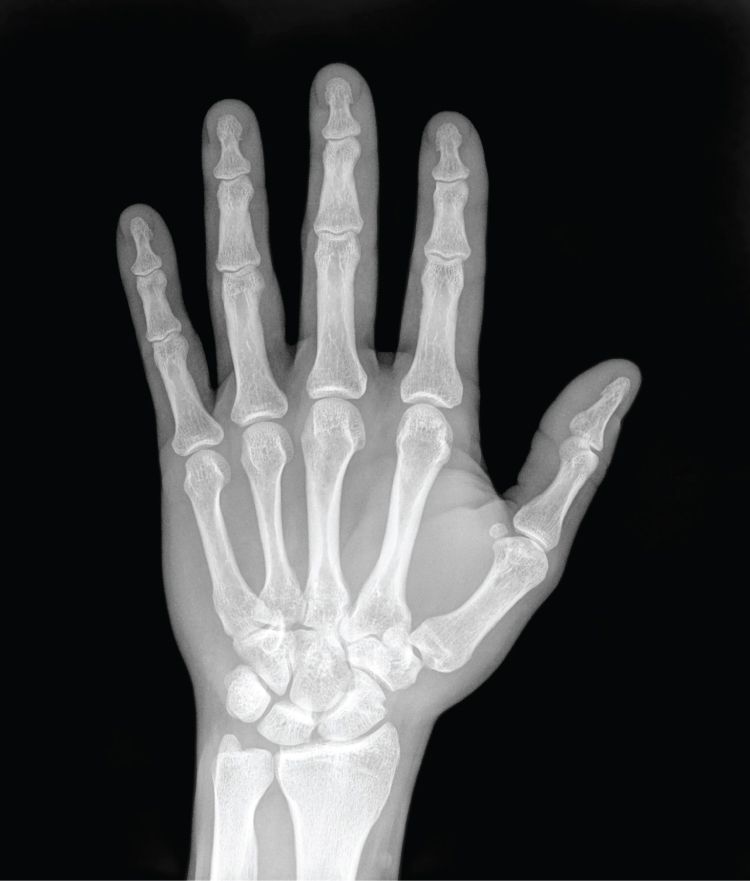
After the headlong sprint of the first two years and the slower stretch of the preschool period, growth in middle childhood — roughly ages six to eleven — becomes calm and predictable. A school-age child gains about two to three inches (5–7 cm) and five to seven pounds (2–3 kg) each year, thinning out and stretching up so that the round preschool silhouette gives way to a leaner, longer-limbed frame. The baby (deciduous) teeth loosen and fall out on a rolling schedule and the first permanent teeth erupt, a small landmark that families and dentists both watch. Long bones lengthen at the growth plates (epiphyseal plates), and because those plates ossify on a reliable timetable, a physician can read a child's bone age from a single hand X-ray.
The brain has already reached roughly 90–95% of its adult size by age six, but it is far from finished. Behind the scenes, unused synapses are pruned and heavily used pathways are wrapped in myelin, speeding the signals that underlie attention, memory, and self-control. Boys and girls grow at nearly the same rate through most of this period; only near its end do many girls begin the growth spurt that will carry them into puberty a year or two ahead of boys.
Motor skills sharpen
Middle childhood is when movement becomes skilled. Gross motor abilities — running, jumping, skipping, throwing, catching, riding a bike, swimming — grow smoother and better coordinated as balance, strength, and reaction time improve. Fine motor control matures too: handwriting becomes legible and then fluent, shoelaces get tied, an instrument can be learned, and small crafts become possible. Sex differences in motor performance are small in these years and owe as much to practice and encouragement as to biology. What children of this age need most is simply opportunity — unstructured play and physical activity that let coordination consolidate.
The healthiest years, with a few threats
Statistically, middle childhood is the healthiest and safest stretch of the entire lifespan: death rates are lower here than at any other age. The threats that remain are largely preventable. Obesity has become the signature health problem of the school years, driven by diet, sedentary screen time, and shrinking active play; it tracks forward into adolescent and adult disease. Asthma is the most common chronic illness of childhood, and unintentional injury — in cars, on bikes, in the water — is the leading cause of death. Uncorrected vision problems (especially myopia), dental caries, and attention or learning difficulties round out the list of concerns a school and a family watch for.
| Concern | What it is | Why it matters now |
|---|---|---|
| Obesity | Excess body fat, usually judged by age- and sex-adjusted BMI percentile | Most common nutritional problem of the school years; tracks into adulthood |
| Asthma | Chronic airway inflammation causing wheeze and shortness of breath | Most common chronic disease of childhood; a leading cause of missed school |
| Unintentional injury | Car, bicycle, drowning, and playground injuries | Leading cause of death in this age group — and highly preventable |
| Dental caries | Tooth decay in new permanent teeth | Common, painful, and tied to nutrition and access to care |
| Vision problems | Myopia (nearsightedness) most often | Undetected, it masquerades as inattention or poor school performance |
| ADHD / learning difficulties | Attention, activity, or specific learning differences | Usually identified once formal schooling demands sustained focus |
- Growth is slow and steady — about 2–3 inches and 5–7 pounds a year; baby teeth are shed and the brain finishes pruning and myelinating.
- Gross and fine motor skills become smoother and more coordinated with practice; sex differences are small.
- Middle childhood is the healthiest, safest period of life.
- The main threats — obesity, asthma, unintentional injury, vision and dental problems — are largely preventable.
Section 2Concrete operations
Operations: thought becomes reversible
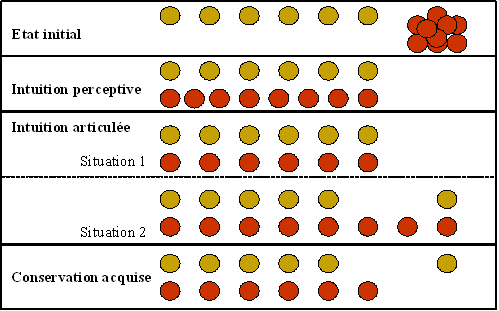
Around age seven a child crosses into what Jean Piaget called the concrete operational stage (roughly ages 7–11), the third of his four stages after the sensorimotor and preoperational periods and before formal operations. The engine of the change is the operation — a mental action that can be performed in the mind and, crucially, undone. The preschooler was trapped by appearances; the school-age child can hold a transformation and its reverse in mind at once. Two new mental habits make this possible: reversibility (mentally running a change backward — pour the water back and it is the same amount) and decentration (attending to several features of a situation at once, rather than centering on just one).
Conservation, class inclusion, and seriation
Conservation is the flagship achievement: the understanding that a quantity stays the same despite a change in its shape or arrangement. Pour water from a short wide glass into a tall thin one and the preoperational child insists there is now “more,” fooled by the rising level; the concrete-operational child knows better, because she can reverse the pour in her mind and because she no longer centers on height alone. Interestingly, the different conservations are not mastered all at once — number comes first, then mass and length, then weight, and finally volume, a staggered pattern Piaget named horizontal décalage.
Two more concrete operations mature alongside conservation. Classification now includes class inclusion — grasping that a subclass is contained within a larger class. Show a child ten roses and five daisies and ask “Are there more roses or more flowers?”; only the concrete-operational thinker reliably answers “more flowers,” because she can hold the whole (flowers) and the part (roses) in mind together. Seriation — arranging items in order along a dimension such as length — also settles in, and with it transitivity: if stick A is longer than B, and B is longer than C, then A must be longer than C, deduced without laying the sticks side by side.
Still tied to the concrete
For all its power, this logic has a ceiling that names the stage: it works on the concrete, on objects and situations the child can picture or handle. Genuinely abstract, hypothetical, “what-if” reasoning — the province of the formal operational stage — does not arrive until adolescence. It is worth pairing Piaget here with Lev Vygotsky, who stressed that a child's thinking grows fastest with guidance: within the zone of proximal development — the gap between what a child can do alone and what she can do with help — a teacher's or peer's scaffolding pulls new competence into reach. Piaget mapped what the mind can do; Vygotsky reminded us that other people are how it gets there.
| Conservation task | What is transformed | Typically mastered |
|---|---|---|
| Number | A row of tokens is spread out or bunched up | ~6–7 years |
| Liquid | Water poured into a taller, thinner glass | ~7 years |
| Mass (substance) | A ball of clay is rolled into a sausage | ~7–8 years |
| Weight | The same reshaped clay, judged for heaviness | ~9–10 years |
| Volume | Displacement of water by the reshaped object | ~11–12 years |
- The concrete operational stage (~7–11) brings mental operations that are reversible and decentered.
- Conservation — quantity is unchanged by a change in appearance — is the hallmark achievement, arriving task by task (horizontal décalage).
- Class inclusion, seriation, and transitivity mark the new logic.
- Reasoning is still tied to the concrete; abstract “what-if” thought awaits adolescence. Vygotsky's ZPD adds that guidance accelerates the whole process.
Section 3Intelligence and schooling
What is intelligence? Competing maps
Everyone knows what intelligence is until they have to define it — and psychologists have offered strikingly different maps. Charles Spearman noticed that people who do well on one mental test tend to do well on others and proposed a single underlying general intelligence, or g, alongside skills specific to each task. Raymond Cattell and John Horn split ability into fluid intelligence (reasoning about novel problems on the spot, which peaks early) and crystallized intelligence (accumulated knowledge and vocabulary, which grows for decades). Against these lumping views, Howard Gardner argued for multiple intelligences — linguistic, logical–mathematical, spatial, musical, bodily–kinesthetic, interpersonal, intrapersonal, and naturalist — each relatively independent. Robert Sternberg's triarchic theory names three: analytical, creative, and practical — the last being the “street smarts” that classroom tests routinely miss.
Measuring the mind: IQ tests
The practical testing tradition began in 1905 when Alfred Binet and Théodore Simon built a test in France to identify schoolchildren who needed extra help, introducing the idea of mental age — the age level a child's performance matched. Lewis Terman at Stanford adapted it into the Stanford–Binet and popularized the intelligence quotient (IQ), originally mental age divided by chronological age times 100. David Wechsler later built the widely used WISC for children. Modern tests abandon the old ratio for a deviation IQ that simply places a child against age-mates on a normal distribution with a mean of 100 and a standard deviation of 15 — so about two-thirds of children score between 85 and 115, and scores below 70 or above 130 are each rare.
What IQ scores can and cannot tell you
A well-built IQ test is reliable (a child scores about the same on retesting) and reasonably valid for one specific job: it predicts school achievement better than almost any other single number. But its reach stops there. IQ says little about creativity, motivation, social skill, or character, and it can badly misjudge a child whose language or culture the test was never designed for. Scores have also drifted steadily upward across the twentieth century — the Flynn effect — and can sag under stereotype threat, the anxiety of confirming a negative stereotype about one's group. Intelligence, in short, is real and partly measurable, but no test captures the whole child.
| Theory | Proposed by | Core idea |
|---|---|---|
| General intelligence (g) | Spearman | A single underlying ability drives performance across tasks |
| Fluid & crystallized | Cattell & Horn | Reasoning-on-the-fly (fluid) vs. accumulated knowledge (crystallized) |
| Multiple intelligences | Gardner | Eight relatively independent intelligences, not one |
| Triarchic theory | Sternberg | Analytical, creative, and practical intelligence |
- Theories of intelligence range from a single g (Spearman) to fluid vs. crystallized (Cattell), multiple intelligences (Gardner), and the triarchic theory (Sternberg).
- Testing runs from Binet's mental age to the Stanford–Binet and Wechsler (WISC); modern deviation IQ has a mean of 100 and SD of 15.
- IQ predicts school achievement well but misses creativity, character, and practical skill.
- Scores are shaped by the Flynn effect, stereotype threat, and cultural bias — interpret them cautiously.
Section 4Moral development
Kohlberg's dilemmas and the three levels
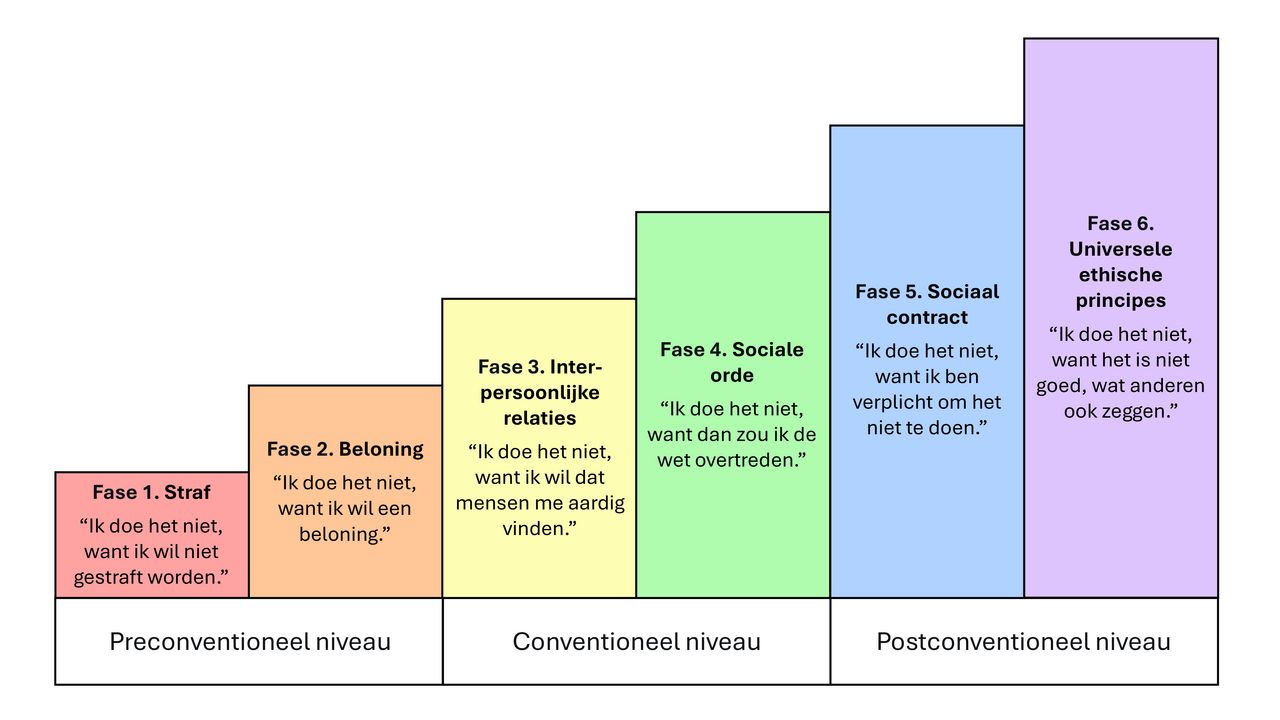
Building on Piaget's earlier work on the child's shift from a rigid heteronomous morality (rules are fixed and handed down) toward a more flexible autonomous one, Lawrence Kohlberg studied moral reasoning by posing dilemmas — most famously the story of Heinz, whose wife will die without a drug he cannot afford, and who must decide whether to steal it. Kohlberg cared little about whether children said “steal” or “don't”; what mattered was the reason behind the answer. From those reasons he mapped three broad levels — preconventional, conventional, and postconventional — each divided into two stages, six in all, moving from self-interest outward toward abstract principle.
The six stages
At the preconventional level, morality is external and self-focused. Stage 1 obeys to avoid punishment; Stage 2 acts out of naked self-interest — “you scratch my back, I'll scratch yours.” This is where most school-age children reason, though many begin moving into the next level. At the conventional level, morality means upholding relationships and rules. Stage 3 seeks approval — the “good boy / nice girl” who wants to be seen as kind; Stage 4 respects law and order and the social system as a whole. At the rarely reached postconventional level, morality rests on principle above rule: Stage 5 weighs the social contract and the greater good, and Stage 6 follows universal ethical principles such as justice and human dignity, even against the law.
Where children land — and the critiques
Most children in middle childhood reason at the preconventional level, sliding gradually into conventional thinking as they grow more attuned to what others expect. Kohlberg's theory has been enormously influential and heavily criticized. Carol Gilligan argued that his justice-focused ladder undervalued an ethic of care — responsibility and relationship — and may have been biased by an all-male original sample. Others note the theory's cultural bias toward Western, individualistic values, and the persistent gap between reasoning and behavior: a child who can explain why cheating is wrong may cheat anyway.
| Level | Stage | What drives the reasoning |
|---|---|---|
| Preconventional | 1 — Obedience | Avoid punishment; defer to power |
| Preconventional | 2 — Self-interest | “What's in it for me?” — fair exchange |
| Conventional | 3 — Approval | Be a good person in others' eyes |
| Conventional | 4 — Law & order | Uphold rules and the social system |
| Postconventional | 5 — Social contract | Rules serve the greater good and can change |
| Postconventional | 6 — Universal principles | Justice and human dignity above any law |
- Kohlberg studied moral reasoning through dilemmas such as the story of Heinz.
- He described three levels — preconventional, conventional, postconventional — and six stages, from punishment-avoidance to universal principles.
- Most school-age children reason at the preconventional level, moving toward conventional thinking.
- Critiques include Gilligan's ethic of care, cultural bias, and the reasoning–behavior gap.
Section 5Peers and self-esteem

Industry versus inferiority
In Erik Erikson's eight psychosocial stages, the school years pose the crisis of industry versus inferiority (roughly ages 6–11), the fourth stage — following trust vs. mistrust, autonomy vs. shame, and initiative vs. guilt, and preceding the identity crisis of adolescence. The child's task now is to become competent: to master the skills their culture values, chiefly through school and productive work. When effort meets success and recognition, the child develops a lasting sense of industry — “I can make things, I can do things well.” When effort meets repeated failure or ridicule, the child instead absorbs a sense of inferiority, a nagging doubt about their own worth and ability. This is why the classroom, the sports field, and the music lesson carry such emotional weight in these years.
The self and self-esteem
The school-age self-concept grows more realistic and more psychological. Where the preschooler described herself by appearance and possessions (“I have a red bike”), the older child describes stable inner traits and compares herself to others (“I'm better at reading than most kids, but not as fast a runner”). That new habit of social comparison is a double-edged gift: it sharpens self-knowledge but can deflate self-esteem. Importantly, self-esteem is not a single number. Following Susan Harter's work, children evaluate themselves separately across domains — academic, athletic, social, physical appearance, and conduct — and only gradually knit these into a global sense of self-worth. A child can feel like a strong reader, a weak athlete, and a good friend all at once.
Friends, peer groups, and the family
Friendship deepens from the “whoever I'm playing with” of early childhood into relationships built on trust, loyalty, and mutual support. Within the peer group, children acquire a sociometric status — popular, rejected, neglected, controversial, or average — and rejected children in particular face real risks of loneliness and later difficulty, especially when rejection tips into bullying. Play is also strikingly gender-segregated in these years, with boys' and girls' groups developing somewhat different styles. Yet the family remains central. The relationship simply matures: parents and children move toward coregulation (a term from Eleanor Maccoby), a shared, transitional control in which parents supervise from a step back while the child manages more of the moment-to-moment. All of this widening social world — family, school, peers, neighborhood — is exactly what Urie Bronfenbrenner's ecological model set out to describe, nested systems that together shape the developing child.
| Sociometric status | Liked by peers? | Typical picture |
|---|---|---|
| Popular | Widely liked | Cooperative, socially skilled (sometimes, instead, dominant) |
| Rejected | Actively disliked | Aggressive or withdrawn; highest risk for later problems |
| Neglected | Neither liked nor disliked | Quiet, low-visibility; often adjusts fine over time |
| Controversial | Both liked and disliked | Visible and assertive; strong reactions in both directions |
| Average | Moderately liked | The largest group; ordinary mix of acceptance |
- Erikson's fourth stage pits industry against inferiority: children build competence — or self-doubt — largely through school and work.
- Self-concept becomes trait-based and comparative; self-esteem is domain-specific before it becomes global (Harter).
- Friendships now rest on trust and loyalty; peers assign a sociometric status, and rejection or bullying carries real risk.
- The family stays central, shifting toward coregulation; Bronfenbrenner's nested systems frame the widening social world.
The chapter in one breath
- Growth in middle childhood (~6–11) is slow and steady; gross and fine motor skills sharpen, and these are the healthiest, safest years — with obesity, asthma, and injury as the main preventable threats.
- Piaget's concrete operational stage brings reversible mental operations: conservation (arriving task by task via horizontal décalage), class inclusion, seriation, and transitivity — but reasoning is still tied to the concrete.
- Vygotsky's zone of proximal development stresses that guidance and scaffolding accelerate a child's thinking.
- Theories of intelligence range from Spearman's g to Cattell's fluid/crystallized, Gardner's multiple intelligences, and Sternberg's triarchic model; IQ (mean 100, SD 15) predicts school achievement but not the whole child.
- Kohlberg's three levels and six stages trace moral reasoning from self-interest to principle; most school-age children reason at the preconventional level, and critiques include Gilligan's ethic of care and the reasoning–behavior gap.
- Erikson's crisis of industry versus inferiority unfolds through school; self-concept and self-esteem grow comparative and domain-specific.
- Friendships, peer sociometric status, and a maturing family (coregulation) — the nested systems of Bronfenbrenner's model — shape the school-age child.
ReferenceWords worth knowing
A quick reference for the terms in this chapter — skim it now, or circle back whenever a word trips you up.
- Class inclusion
- The understanding that a subclass is contained within a larger class (more flowers than roses), a concrete-operational achievement.
- Concrete operational stage
- Piaget's third stage (~7–11), marked by reversible mental operations applied to concrete objects and situations.
- Conservation
- The recognition that a quantity stays the same despite changes in its shape or arrangement.
- Conventional level
- Kohlberg's middle level, where morality means seeking approval (Stage 3) and upholding law and order (Stage 4).
- Coregulation
- A transitional, shared form of control in which parents supervise while the child manages moment-to-moment behavior (Maccoby).
- Crystallized intelligence
- Accumulated knowledge, vocabulary, and skills that grow with experience across the lifespan (Cattell).
- Fluid intelligence
- The ability to reason about and solve novel problems on the spot, largely independent of prior knowledge (Cattell).
- General intelligence (g)
- Spearman's proposed single underlying ability that accounts for correlated performance across mental tests.
- Horizontal décalage
- Piaget's term for mastering related skills (the various conservations) at different ages rather than all at once.
- Industry versus inferiority
- Erikson's fourth psychosocial stage (~6–11), in which children build a sense of competence or of inadequacy.
- Intelligence quotient (IQ)
- A standardized score of mental ability; modern deviation IQ has a mean of 100 and a standard deviation of 15.
- Multiple intelligences
- Gardner's theory that intelligence is not one ability but several relatively independent ones.
- Postconventional level
- Kohlberg's highest level, in which morality rests on the social contract (Stage 5) and universal ethical principles (Stage 6).
- Preconventional level
- Kohlberg's earliest level, where morality is external — avoiding punishment (Stage 1) and serving self-interest (Stage 2).
- Reversibility
- The mental ability to run a change backward, a core feature of concrete operations.
- Self-concept
- The set of beliefs a person holds about themselves; in middle childhood it becomes trait-based and comparative.
- Self-esteem
- The evaluative, feeling side of the self — one's judged worth — which is domain-specific before becoming global (Harter).
- Seriation
- The ability to order items along a dimension such as length or weight.
- Social comparison
- Judging one's own abilities and traits by measuring them against those of others.
- Sociometric status
- A child's standing in the peer group — popular, rejected, neglected, controversial, or average.
- Transitivity
- Inferring a relationship between items from their relationships to a third (if A>B and B>C, then A>C).
- Zone of proximal development
- Vygotsky's gap between what a child can do alone and what she can do with guidance (scaffolding).