Quadratic Equations & Functions
A quadratic is any equation or function in which the highest power of the variable is 2 — x2 shows up, and nothing higher. That one extra power changes everything: instead of a straight line you get a graceful U-shaped curve, and instead of one answer you usually get two. This chapter gives you four reliable tools — factoring, the square root property, completing the square, and the quadratic formula — and shows you exactly when to reach for each one. Then we graph these functions so you can see what the two answers mean, and finally we point the whole toolkit at real problems: how high a ball goes, how big a garden can be, and where profit peaks. Every example here is worked out line by line, with the arithmetic showing, because the steps are where quadratics are won or lost.
By the end of this chapter you can
- Recognize a quadratic equation and write it in standard form ax2 + bx + c = 0.
- State and apply the zero product property to solve quadratics by factoring.
- Solve equations of the form (x − h)2 = k using the square root property, remembering the ±.
- Solve any quadratic by completing the square, including when the leading coefficient is not 1.
- Apply the quadratic formula correctly and use the discriminant to predict the number and type of solutions.
- Graph a quadratic function by finding its vertex, axis of symmetry, intercepts, and direction of opening.
- Convert between standard form and vertex form, f(x) = a(x − h)2 + k.
- Set up and solve applied problems involving projectile height, area, and maximum or minimum values — and reject solutions that make no physical sense.
Section 1Solving by factoring
What makes an equation quadratic
A quadratic equation is one that can be written as ax2 + bx + c = 0, where a, b, and c are numbers and a ≠ 0. That last condition matters: if a were 0 the x2 term would vanish and you would be back to a linear equation. The number a is called the leading coefficient, b is the linear coefficient, and c is the constant term. Writing an equation in this order, with everything on one side and 0 on the other, is called putting it in standard form, and almost every technique in this chapter assumes you have done that first.
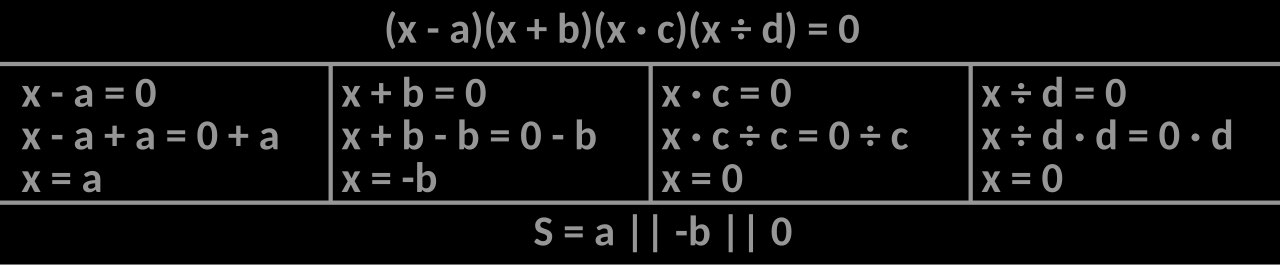
Here is the single most important idea in the whole section. If two numbers multiply to give zero, then at least one of them had to be zero — there is no other way to land on zero. Written formally, this is the zero product property: if A · B = 0, then A = 0 or B = 0 (or both). Nothing like this is true for any other number. If A · B = 12, you learn almost nothing about A and B individually. Zero is special, and that specialness is what lets factoring solve equations.
The method, worked all the way through
The plan is always the same four moves: get 0 alone on one side, factor the other side completely, set each factor equal to zero, and solve those small equations. Let us do x2 + 5x = 24 slowly.
Step 1 — standard form. Subtract 24 from both sides so the right side becomes 0.
x2 + 5x − 24 = 0
Step 2 — factor. Since the leading coefficient is 1, we need two numbers that multiply to −24 and add to 5. Run the pairs: 1 and −24 add to −23; 2 and −12 add to −10; 3 and −8 add to −5; 8 and −3 add to 5. That last pair works.
(x + 8)(x − 3) = 0
Step 3 — zero product property. The product is zero, so one of the two factors is zero.
x + 8 = 0 or x − 3 = 0
Step 4 — solve each. x = −8 or x = 3.
Step 5 — check both. For x = −8: (−8)2 + 5(−8) = 64 − 40 = 24. ✓ For x = 3: 32 + 5(3) = 9 + 15 = 24. ✓ Both work, so the solution set is {−8, 3}.
Three variations you will meet constantly
A common factor first. Solve 2x2 = 8x. Move everything left: 2x2 − 8x = 0. Factor out 2x: 2x(x − 4) = 0. So 2x = 0 or x − 4 = 0, giving x = 0 or x = 4. Check: 2(0)2 = 0 and 8(0) = 0 ✓; 2(4)2 = 32 and 8(4) = 32 ✓. Notice the temptation to divide both sides of 2x2 = 8x by x at the start. Never do that. Dividing by x silently assumes x ≠ 0 and throws away the perfectly good solution x = 0. The danger runs in the other direction too: multiplying both sides by a variable expression — the usual move for clearing a denominator such as (1)/(x − 2), where the excluded value is x = 2 — can manufacture a solution that the original equation never had. Both hazards have the same cure. Any step that is not reversible obliges you to substitute every candidate back into the original equation before you call it a solution, which is why every example in this chapter ends with a check.
A leading coefficient that is not 1. Solve 6x2 − 7x − 3 = 0. Use the ac-method: multiply a · c = 6(−3) = −18, then find two numbers that multiply to −18 and add to b = −7. Those are −9 and 2, since (−9)(2) = −18 and −9 + 2 = −7. Split the middle term and group:
6x2 − 9x + 2x − 3 = 0
3x(2x − 3) + 1(2x − 3) = 0
(2x − 3)(3x + 1) = 0
So 2x − 3 = 0 giving x = (3)/(2), or 3x + 1 = 0 giving x = −(1)/(3). Check x = (3)/(2): 6 · (9)/(4) − 7 · (3)/(2) − 3 = (54)/(4) − (21)/(2) − 3 = 13.5 − 10.5 − 3 = 0 ✓. Check x = −(1)/(3): 6 · (1)/(9) − 7(−(1)/(3)) − 3 = (2)/(3) + (7)/(3) − 3 = (9)/(3) − 3 = 0 ✓.
A repeated solution. Solve x2 − 6x + 9 = 0. This factors as (x − 3)(x − 3) = 0, or (x − 3)2 = 0. Both factors give the same answer, x = 3. We call this a double root or repeated root. There is genuinely only one solution, and Section 4 will show you what that looks like on a graph.
| Pattern | Recognize it by | Factored form | Worked example |
|---|---|---|---|
| Common factor | Every term shares a factor | x(ax + b) | 2x2 − 8x = 2x(x − 4) |
| Difference of squares | Two perfect squares, subtracted | (x − k)(x + k) | x2 − 25 = (x − 5)(x + 5) |
| Trinomial, a = 1 | Leading coefficient is 1 | (x + m)(x + n), mn = c, m + n = b | x2 + 5x − 24 = (x + 8)(x − 3) |
| Trinomial, a ≠ 1 | Leading coefficient other than 1 | Split bx using two numbers with product ac, then group | 6x2 − 7x − 3 = (2x − 3)(3x + 1) |
| Perfect square trinomial | First and last terms are squares; middle is twice their roots | (x ± k)2 | x2 − 6x + 9 = (x − 3)2 |
| Sum of squares | Two perfect squares, added | Does not factor over the real numbers | x2 + 25 stays as it is |
- A quadratic equation can be written ax2 + bx + c = 0 with a ≠ 0.
- The zero product property: if A · B = 0, then A = 0 or B = 0 — and it works only when the other side is zero.
- Procedure: standard form → factor completely → set each factor to 0 → solve → check.
- Never divide both sides by a variable — you lose the solution x = 0. Factoring is fast, but only some quadratics factor, so Sections 2 and 3 cover the rest.
Section 2Square root property and completing the square
The square root property, and why ± appears
Suppose x2 = 49. Most people answer 7 instantly, and they are half right. Both 7 and −7 square to 49, so there are two solutions. The square root property says: if x2 = k, then x = ±√k. The ± symbol is shorthand for "both the positive and the negative version," and forgetting it is the single most common error in this section. If k < 0 there is no real solution at all, because no real number squares to a negative.
This property is powerful because it applies to a whole squared expression, not just to a lone x. Solve (x − 3)2 = 49 step by step:
Step 1. Apply the square root property to the whole quantity in parentheses.
x − 3 = ±√49 = ±7
Step 2. Split into two equations and solve each.
x − 3 = 7 → x = 10 and x − 3 = −7 → x = −4
Step 3 — check. (10 − 3)2 = 72 = 49 ✓. (−4 − 3)2 = (−7)2 = 49 ✓.
One more, with the squared term buried. Solve 2(x + 5)2 − 18 = 0. Add 18 to both sides: 2(x + 5)2 = 18. Divide both sides by 2: (x + 5)2 = 9. Now take square roots: x + 5 = ±3. So x = −5 + 3 = −2, or x = −5 − 3 = −8. Check x = −2: 2(3)2 − 18 = 18 − 18 = 0 ✓. Check x = −8: 2(−3)2 − 18 = 18 − 18 = 0 ✓. If the square root is not a whole number, simplify it: x2 = 12 gives x = ±√12 = ±2√3, and that exact form is the preferred answer.
Completing the square: manufacturing a perfect square
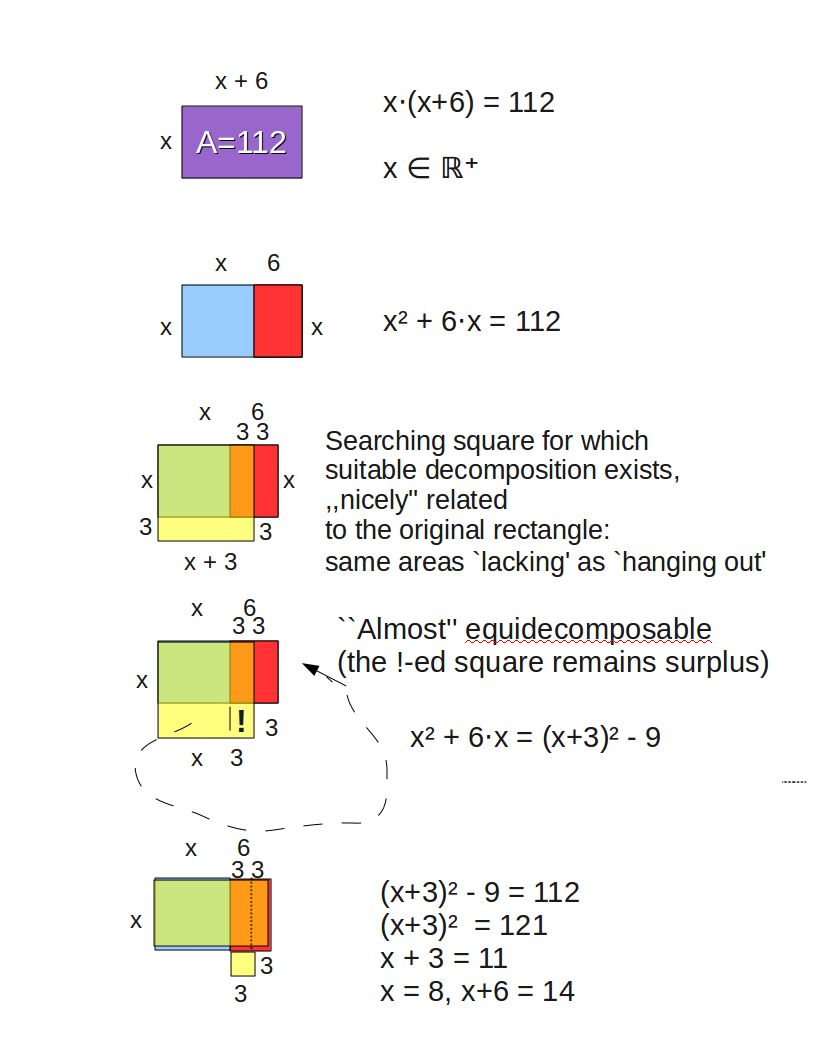
The square root property is wonderful — but only when the equation already contains a perfect square. Completing the square is the technique that forces one to appear. The idea rests on a pattern worth memorizing: x2 + 2kx + k2 = (x + k)2. Read it backwards and it tells you what to add: take the coefficient of x, cut it in half, square that, and add it. That is the whole trick.
Solve x2 + 6x − 7 = 0 by completing the square.
Step 1 — isolate the variable terms. Add 7 to both sides.
x2 + 6x = 7
Step 2 — find the magic number. The coefficient of x is 6. Half of 6 is 3. Three squared is 9.
Step 3 — add it to both sides. This keeps the equation balanced.
x2 + 6x + 9 = 7 + 9
x2 + 6x + 9 = 16
Step 4 — write the left side as a square. It is (x + 3)2, using the same 3 from Step 2.
(x + 3)2 = 16
Step 5 — square root property.
x + 3 = ±4
Step 6 — solve and check. x = −3 + 4 = 1, or x = −3 − 4 = −7. Check x = 1: 1 + 6 − 7 = 0 ✓. Check x = −7: 49 − 42 − 7 = 0 ✓.
When the leading coefficient is not 1
The halve-and-square rule assumes the x2 term has a coefficient of 1, so if it does not, divide the whole equation by that coefficient first. Solve 2x2 − 12x + 10 = 0.
Step 1 — divide every term by 2.
x2 − 6x + 5 = 0
Step 2 — move the constant. Subtract 5.
x2 − 6x = −5
Step 3 — halve and square. Half of −6 is −3; (−3)2 = 9. Add 9 to both sides.
x2 − 6x + 9 = −5 + 9 = 4
Step 4 — factor and solve.
(x − 3)2 = 4 → x − 3 = ±2 → x = 5 or x = 1
Step 5 — check in the original equation. For x = 5: 2(25) − 12(5) + 10 = 50 − 60 + 10 = 0 ✓. For x = 1: 2(1) − 12(1) + 10 = 2 − 12 + 10 = 0 ✓.
Completing the square also handles equations that will not factor at all. Solve x2 + 4x − 6 = 0. Move the constant: x2 + 4x = 6. Half of 4 is 2, and 22 = 4, so add 4 to both sides: x2 + 4x + 4 = 10, which is (x + 2)2 = 10. Then x + 2 = ±√10, so x = −2 ± √10. Numerically √10 ≈ 3.162, so the solutions are about 1.162 and −5.162 — nowhere near the tidy integers factoring would have needed. Leave the exact answer as −2 ± √10.
| Step | What you do | On x2 − 6x + 5 = 0 | Why |
|---|---|---|---|
| 1 | Make the leading coefficient 1 | Already 1 | The halve-and-square rule needs it |
| 2 | Move the constant to the right | x2 − 6x = −5 | Clears room for the new constant |
| 3 | Halve b, then square it | (−6)/(2) = −3; (−3)2 = 9 | This is the missing corner of the square |
| 4 | Add that number to both sides | x2 − 6x + 9 = 4 | Balance must be preserved |
| 5 | Factor the left as (x + b/2)2 | (x − 3)2 = 4 | That was the point of the whole thing |
| 6 | Square root property, with ± | x − 3 = ±2 | Two square roots, always |
| 7 | Solve and check | x = 5 or x = 1 | Catch arithmetic slips |
- Square root property: x2 = k gives x = ±√k. The ± is mandatory; if k < 0 there is no real solution.
- It applies to any squared expression: (x − h)2 = k gives x = h ± √k.
- Completing the square: divide by a, move c, add ((b)/(2))2 — half of the x-coefficient, squared — to both sides, factor, then take roots.
- This method works on every quadratic, factorable or not, and it is where the quadratic formula comes from.
Section 3The quadratic formula
One formula that solves every quadratic
If you complete the square on the general equation ax2 + bx + c = 0 instead of on a specific one, you get a result that works forever. That result is the quadratic formula:
x = (−b ± √(b2 − 4ac))/(2a)
Two things to say about it before we use it. First, it requires standard form. You must have ax2 + bx + c = 0 before you can read off a, b, and c — there is no way to identify the coefficients otherwise. Second, the whole numerator sits over 2a, not just the radical. Dividing only part of the numerator is the classic mistake, and it produces answers that fail every check.
A full worked example
Solve 2x2 + 5x − 3 = 0.
Step 1 — identify the coefficients. The equation is already in standard form, so a = 2, b = 5, c = −3. Carry the sign of c with it.
Step 2 — compute the part under the radical.
b2 − 4ac = (5)2 − 4(2)(−3) = 25 − (−24) = 25 + 24 = 49
Step 3 — substitute into the formula.
x = (−5 ± √49)/(2 · 2) = (−5 ± 7)/(4)
Step 4 — split the ± into two arithmetic problems.
x = (−5 + 7)/(4) = (2)/(4) = (1)/(2) and x = (−5 − 7)/(4) = (−12)/(4) = −3
Step 5 — check. For x = (1)/(2): 2 · (1)/(4) + 5 · (1)/(2) − 3 = 0.5 + 2.5 − 3 = 0 ✓. For x = −3: 2(9) + 5(−3) − 3 = 18 − 15 − 3 = 0 ✓.
Now one that is not already in standard form, and where b is negative. Solve 3x2 = 5x + 2. Subtract 5x and 2 from both sides: 3x2 − 5x − 2 = 0, so a = 3, b = −5, c = −2. Then b2 − 4ac = 25 − 4(3)(−2) = 25 + 24 = 49, and −b = −(−5) = +5. So x = (5 ± 7)/(6). That gives x = (12)/(6) = 2 or x = (−2)/(6) = −(1)/(3). Check x = 2: 3(4) = 12 and 5(2) + 2 = 12 ✓. Check x = −(1)/(3): 3 · (1)/(9) = (1)/(3), and 5(−(1)/(3)) + 2 = −(5)/(3) + (6)/(3) = (1)/(3) ✓.
And one with an irrational answer. Solve 3x2 − 6x + 2 = 0, where a = 3, b = −6, c = 2. Then b2 − 4ac = 36 − 4(3)(2) = 36 − 24 = 12, so x = (6 ± √12)/(6). Simplify √12 = 2√3, giving x = (6 ± 2√3)/(6). Factor 2 from the numerator and cancel: x = (3 ± √3)/(3). Since √3 ≈ 1.732, the solutions are about (4.732)/(3) ≈ 1.577 and (1.268)/(3) ≈ 0.423.
The discriminant: a preview of the answer
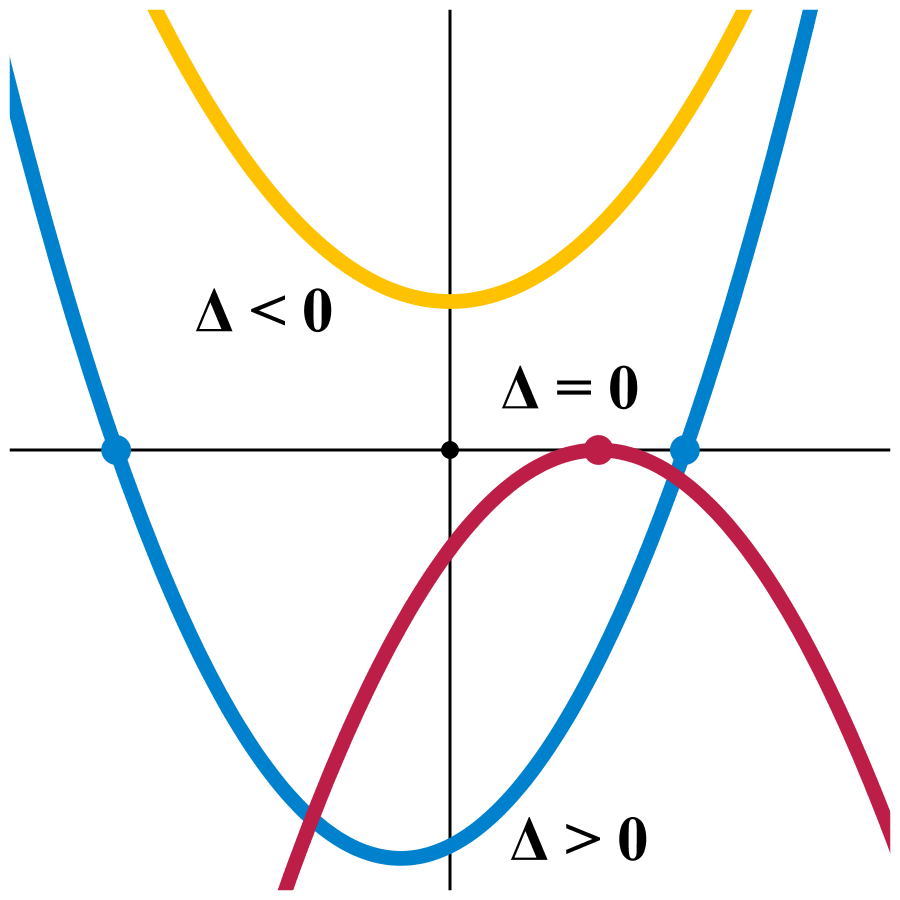
The expression under the radical, b2 − 4ac, is called the discriminant. Its sign alone tells you how many real solutions to expect, before you finish any arithmetic. If it is positive, the ± produces two different numbers. If it is exactly zero, the ± adds and subtracts nothing, so both branches collapse to the single value −b/(2a). If it is negative, you are being asked for the square root of a negative number, and there is no real solution.
Two quick reads. For x2 + x + 3 = 0: b2 − 4ac = 1 − 4(1)(3) = 1 − 12 = −11, which is negative, so there are no real solutions — stop, do not waste effort. For 4x2 − 12x + 9 = 0: b2 − 4ac = 144 − 4(4)(9) = 144 − 144 = 0, so there is exactly one solution, x = −(−12)/(2 · 4) = (12)/(8) = (3)/(2). Sure enough, 4x2 − 12x + 9 = (2x − 3)2.
| Discriminant b2 − 4ac | Number of real solutions | Type of solutions | Graph crosses the x-axis | Example |
|---|---|---|---|---|
| Positive, perfect square | Two | Rational — it would have factored | Twice | 2x2 + 5x − 3 = 0 (49) |
| Positive, not a perfect square | Two | Irrational, containing a radical | Twice | 3x2 − 6x + 2 = 0 (12) |
| Exactly zero | One (a double root) | Rational | Touches once at the vertex | 4x2 − 12x + 9 = 0 (0) |
| Negative | None in the real numbers | Two complex (non-real) | Never | x2 + x + 3 = 0 (−11) |
- Quadratic formula: x = (−b ± √(b2 − 4ac))/(2a), valid for every quadratic with a ≠ 0.
- Put the equation in standard form first, read off a, b, c with their signs, and divide the entire numerator by 2a.
- The discriminant b2 − 4ac predicts the outcome: positive → two real, zero → one real, negative → none real.
- Simplify radicals and reduce fractions; give exact answers unless a decimal is requested.
Section 4Graphing quadratic functions
Shape, direction, and the vertex
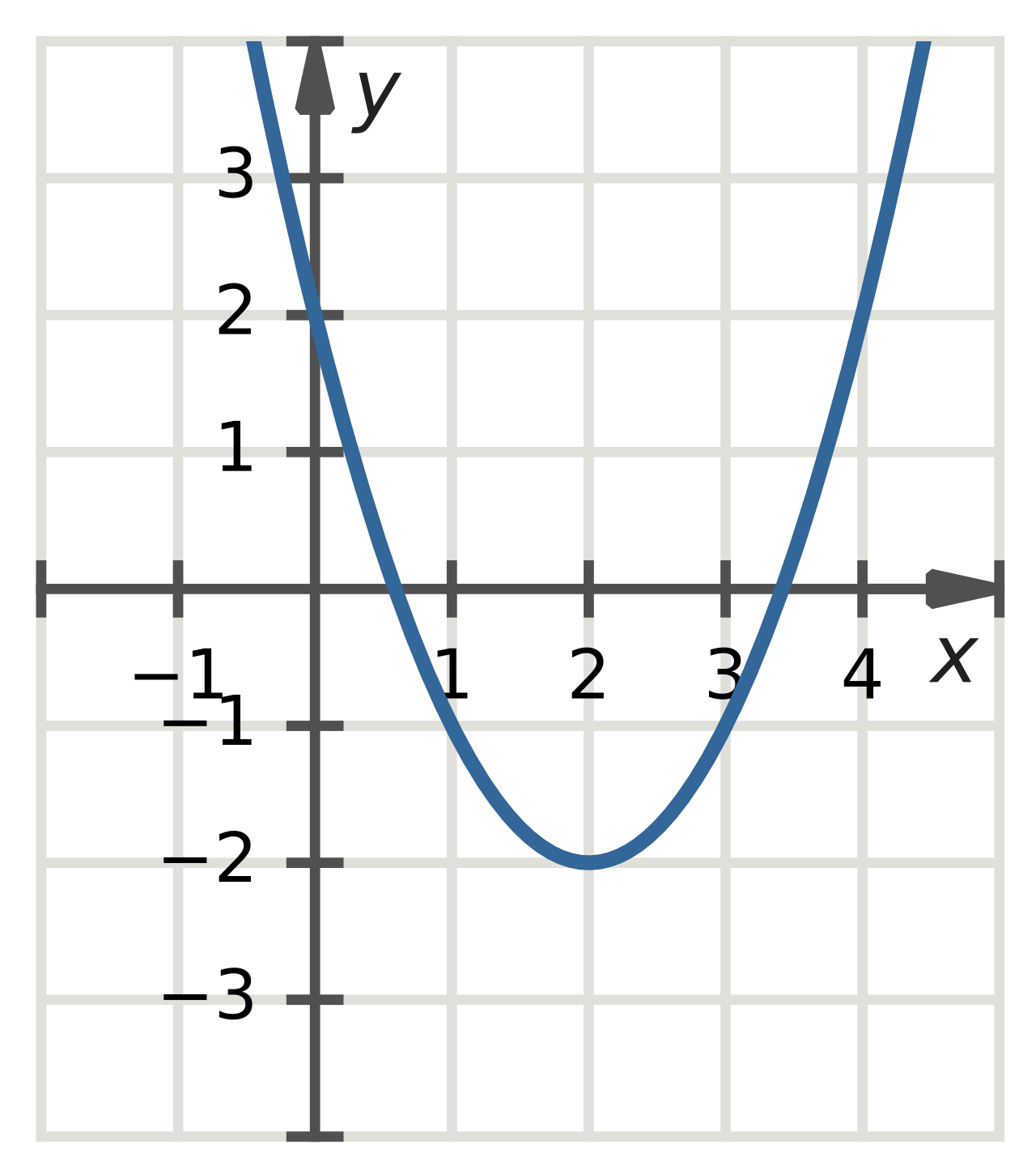
A quadratic function is f(x) = ax2 + bx + c with a ≠ 0, and its graph is always a parabola — a symmetric U-shaped curve. Three facts about a tell you the picture before you plot a single point. If a > 0 the parabola opens upward and its lowest point is a minimum. If a < 0 it opens downward and its highest point is a maximum. And the size of |a| controls the width: |a| larger than 1 makes it narrower and steeper, while |a| between 0 and 1 makes it wider and flatter.
The turning point is the vertex. The vertical line through it is the axis of symmetry, and the parabola is a perfect mirror image across that line. Both come from one formula:
axis of symmetry: x = −(b)/(2a) · vertex: (−(b)/(2a), f(−(b)/(2a)))
In words: compute x = −b/(2a) to get the x-coordinate, then plug that number back into the function to get the y-coordinate. The y-intercept is always easy — set x = 0 and you get (0, c). The x-intercepts, also called the roots or zeros, are wherever f(x) = 0, which is exactly the equation-solving you did in Sections 1 through 3. The discriminant now has a visual meaning: two real solutions means the parabola crosses the x-axis twice, one means it just touches at the vertex, and none means it floats entirely above or below the axis.
An upward parabola, worked completely
Graph f(x) = x2 − 6x + 5.
Step 1 — direction. a = 1, which is positive, so the parabola opens upward and has a minimum.
Step 2 — axis of symmetry. x = −(b)/(2a) = −(−6)/(2 · 1) = (6)/(2) = 3. The axis is the vertical line x = 3.
Step 3 — vertex. Substitute x = 3 back in: f(3) = (3)2 − 6(3) + 5 = 9 − 18 + 5 = −4. The vertex is (3, −4), and −4 is the minimum value of the function.
Step 4 — y-intercept. f(0) = 0 − 0 + 5 = 5, so the graph passes through (0, 5).
Step 5 — x-intercepts. Set the function equal to zero: x2 − 6x + 5 = 0, which factors as (x − 1)(x − 5) = 0, so x = 1 and x = 5. The intercepts are (1, 0) and (5, 0). Notice they sit symmetrically around x = 3, one two units left and one two units right — a free accuracy check.
Step 6 — use symmetry for one more point. Since (0, 5) is three units left of the axis, its mirror image three units right is (6, 5). Verify: f(6) = 36 − 36 + 5 = 5 ✓. Plot (3, −4), (1, 0), (5, 0), (0, 5), (6, 5) and draw a smooth U through them.
Vertex form, and a downward parabola
Vertex form is f(x) = a(x − h)2 + k, and it hands you the vertex directly: it is (h, k), with axis of symmetry x = h. Watch the sign — in f(x) = 2(x + 3)2 − 7, the h is −3, not 3, because x + 3 is x − (−3). You convert to vertex form by completing the square. For our example: x2 − 6x + 5 = (x2 − 6x + 9) − 9 + 5 = (x − 3)2 − 4. The vertex (3, −4) is now readable at a glance, matching Step 3 above.
Now graph g(x) = −2x2 + 8x − 5. Here a = −2, so it opens downward and is narrower than a basic parabola. Axis: x = −(8)/(2(−2)) = −(8)/(−4) = 2. Vertex: g(2) = −2(2)2 + 8(2) − 5 = −2(4) + 16 − 5 = −8 + 16 − 5 = 3, so the vertex is (2, 3) and the maximum value is 3. The y-intercept is (0, −5). For x-intercepts, solve −2x2 + 8x − 5 = 0; multiply through by −1 to get 2x2 − 8x + 5 = 0, whose discriminant is 64 − 4(2)(5) = 64 − 40 = 24. So x = (8 ± √24)/(4) = (8 ± 2√6)/(4) = (4 ± √6)/(2). With √6 ≈ 2.449, the intercepts are near x ≈ 3.22 and x ≈ 0.78. In vertex form: −2x2 + 8x − 5 = −2(x2 − 4x) − 5 = −2(x2 − 4x + 4) + 8 − 5 = −2(x − 2)2 + 3, confirming the vertex (2, 3).
| Feature | How to find it | f(x) = x2 − 6x + 5 | g(x) = −2x2 + 8x − 5 |
|---|---|---|---|
| Direction | Sign of a | a = 1 > 0 → opens up | a = −2 < 0 → opens down |
| Axis of symmetry | x = −b/(2a) | x = 3 | x = 2 |
| Vertex | Plug the axis value into the function | (3, −4) | (2, 3) |
| Min or max value | The y-coordinate of the vertex | Minimum −4 | Maximum 3 |
| y-intercept | Set x = 0; it is (0, c) | (0, 5) | (0, −5) |
| x-intercepts | Solve f(x) = 0 | (1, 0) and (5, 0) | ((4 ± √6)/(2), 0) |
| Vertex form | Complete the square | (x − 3)2 − 4 | −2(x − 2)2 + 3 |
| Domain / range | Domain always all reals | Range y ≥ −4 | Range y ≤ 3 |
- The graph of f(x) = ax2 + bx + c is a parabola; a > 0 opens up (minimum), a < 0 opens down (maximum).
- Axis of symmetry: x = −b/(2a); the vertex is that x together with f of that x.
- The y-intercept is (0, c); the x-intercepts are the real solutions of f(x) = 0.
- Vertex form a(x − h)2 + k displays the vertex (h, k) immediately; get there by completing the square. The domain is always all real numbers, and the range is y ≥ k opening up or y ≤ k opening down.
Section 5Applications
Projectile height
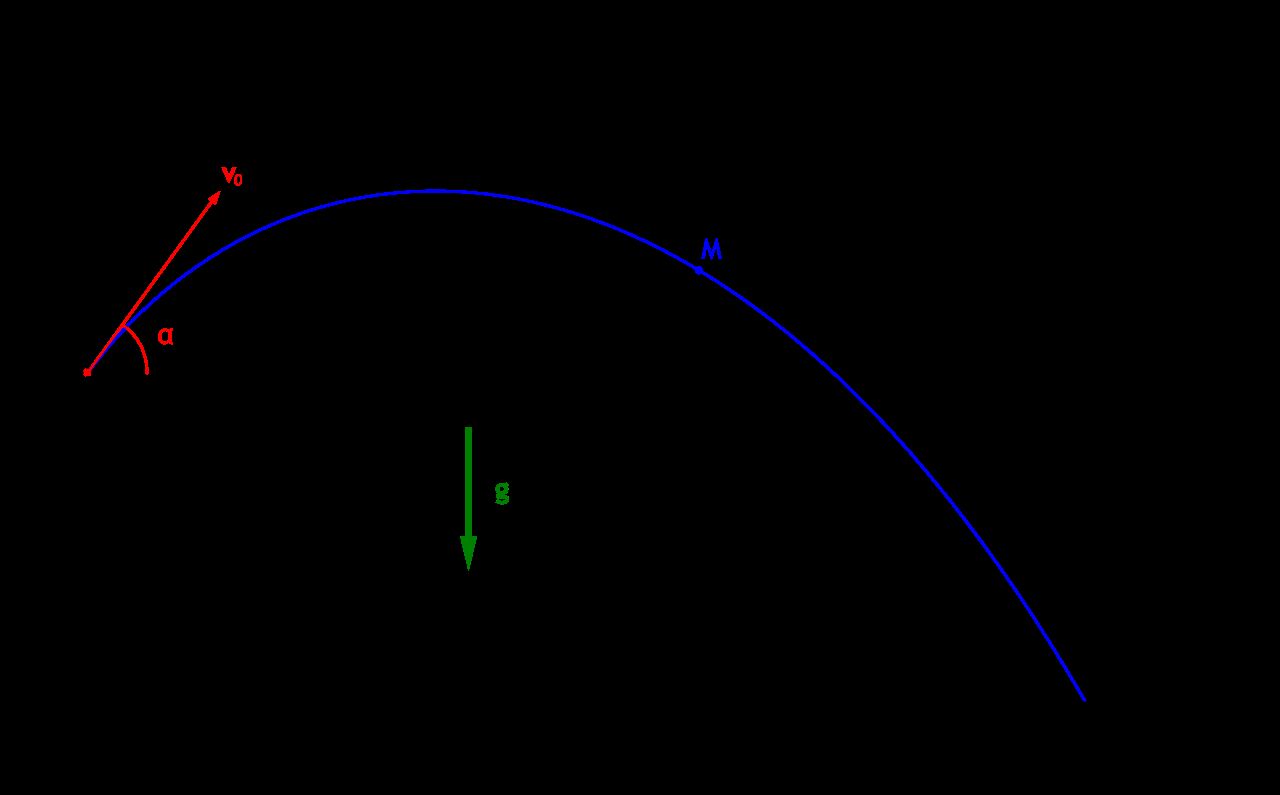
Anything thrown, launched, or dropped near the earth's surface follows a quadratic height model, because gravity supplies a constant acceleration. In feet and seconds the standard model is h(t) = −16t2 + v0t + h0, where t is time in seconds, v0 is the initial upward velocity in feet per second, and h0 is the starting height in feet. The −16 is half of gravity's acceleration and never changes; it is negative, so the parabola opens downward, which is why every throw has a highest point.
A ball is thrown upward from a 6-foot-high platform at 64 feet per second, so h(t) = −16t2 + 64t + 6.
Question A — when does it reach its maximum height, and how high is that? The maximum is at the vertex. t = −(b)/(2a) = −(64)/(2(−16)) = −(64)/(−32) = 2 seconds. Then h(2) = −16(2)2 + 64(2) + 6 = −16(4) + 128 + 6 = −64 + 128 + 6 = 70 feet. It peaks at 70 feet, 2 seconds after release.
Question B — when is the ball 54 feet high? Set h(t) = 54 and solve.
−16t2 + 64t + 6 = 54
−16t2 + 64t − 48 = 0
Divide every term by −16: t2 − 4t + 3 = 0
(t − 1)(t − 3) = 0, so t = 1 or t = 3.
Both answers are real and both are meaningful: the ball passes 54 feet on the way up at 1 second and again on the way down at 3 seconds. Check: h(1) = −16 + 64 + 6 = 54 ✓ and h(3) = −16(9) + 192 + 6 = −144 + 198 = 54 ✓.
Question C — when does it hit the ground? Ground level is h = 0, so −16t2 + 64t + 6 = 0. Multiply by −1: 16t2 − 64t − 6 = 0, then divide by 2: 8t2 − 32t − 3 = 0. This will not factor, so use the formula with a = 8, b = −32, c = −3. The discriminant is (−32)2 − 4(8)(−3) = 1024 + 96 = 1120, and √1120 ≈ 33.47. So t = (32 ± 33.47)/(16), giving t ≈ (65.47)/(16) ≈ 4.09 or t ≈ (−1.47)/(16) ≈ −0.09. Reject the negative root — time cannot run backwards from the moment of release. The ball lands about 4.09 seconds after it is thrown.
Area problems
Area is length times width, and when one dimension is described in terms of the other, that product becomes a quadratic. A gardener has 60 feet of fencing and wants a rectangular plot against the flat side of a barn, so fencing is needed on only three sides.
Step 1 — name a variable and write both dimensions. Let x be the width of each of the two sides perpendicular to the barn. Those use 2x feet of fence, so the side parallel to the barn is 60 − 2x feet.
Step 2 — write the area function and note its restrictions.
A(x) = x(60 − 2x) = −2x2 + 60x
Both dimensions must be positive, so x > 0 and 60 − 2x > 0. Solve that second inequality one step at a time: subtract 60 from both sides to get −2x > −60, then divide both sides by −2. Here the rule that catches everyone applies — multiplying or dividing an inequality by a negative number reverses the inequality sign — so the result is x < 30, not x > 30. (Sanity check with a number: x = 40 would make 60 − 2x = −20, a negative side length, so 40 had better fail the inequality — and it does.) The sensible domain is 0 < x < 30.
Step 3 — find the largest possible area. Since a = −2 < 0, the vertex is a maximum. x = −(60)/(2(−2)) = −(60)/(−4) = 15. Then A(15) = 15(60 − 30) = 15(30) = 450. The biggest plot is 15 feet by 30 feet, with an area of 450 square feet. Fence check: 15 + 15 + 30 = 60 ✓.
Step 4 — a different question: which widths give exactly 400 square feet?
−2x2 + 60x = 400
−2x2 + 60x − 400 = 0
Divide by −2: x2 − 30x + 200 = 0
(x − 10)(x − 20) = 0, so x = 10 or x = 20.
Both fall inside 0 < x < 30, so both are genuine answers: a 10 by 40 plot (10 · 40 = 400 ✓) or a 20 by 20 plot (20 · 20 = 400 ✓). Two shapes, same area.
Maximum and minimum in business
Revenue is price times quantity sold, and since raising the price usually lowers the quantity, revenue is quadratic. A shop currently sells 80 units per week at $15 each. Market research says every $1 increase in price will cost 4 sales per week.
Step 1 — define the variable. Let x be the number of $1 increases. Then the price is 15 + x dollars and the quantity sold is 80 − 4x units.
Step 2 — build the revenue function and expand.
R(x) = (15 + x)(80 − 4x) = 1200 − 60x + 80x − 4x2 = −4x2 + 20x + 1200
Step 3 — locate the vertex. Because a = −4 < 0, the vertex is a maximum. x = −(20)/(2(−4)) = −(20)/(−8) = 2.5.
Step 4 — translate the answer back into the story. Price = 15 + 2.5 = $17.50. Quantity = 80 − 4(2.5) = 80 − 10 = 70 units. Maximum revenue = R(2.5) = −4(2.5)2 + 20(2.5) + 1200 = −4(6.25) + 50 + 1200 = −25 + 1250 = $1225. Direct check: 17.50 · 70 = $1225 ✓. Notice the question asked for a price, not for x — answering "2.5" would be an incomplete answer.
| Question being asked | What to do | Restriction to apply |
|---|---|---|
| Highest or lowest value | Find the vertex; the y-coordinate is the extreme value | Confirm the sign of a matches max vs. min |
| When does it reach a given height or amount | Set the function equal to that number and solve | Expect two times — often both are valid |
| When does it hit the ground / reach zero | Set the function equal to 0 and solve | Discard negative time |
| Dimensions giving a specified area | Write area as a product, expand, set equal, solve | Discard negative or zero lengths |
| Best price for maximum revenue | Revenue = price × quantity; find the vertex | Convert x back into the quantity actually requested |
- Projectile height in feet and seconds: h(t) = −16t2 + v0t + h0; it opens downward, so the vertex is the peak.
- Maximum or minimum questions are vertex questions: t or x = −b/(2a), then substitute back for the value.
- "When is it at height H?" is an equation question: set the function equal to H and solve, usually getting two times. Area problems become quadratic when one dimension is written in terms of the other.
- Reject solutions that do not fit the situation — negative time, negative length, values outside the domain — and answer in the units asked for.
The chapter in one breath
- A quadratic equation is ax2 + bx + c = 0 with a ≠ 0; nearly every method starts by putting it in that standard form.
- The zero product property turns a factored equation into simple linear ones — but only when the other side is exactly zero.
- The square root property solves anything of the form (x − h)2 = k, and the ± is not optional.
- Completing the square manufactures that perfect square: divide by a, move c, add ((b)/(2))2 — half of b, then squared — to both sides (for b = 6 that is 9, not 18).
- The quadratic formula x = (−b ± √(b2 − 4ac))/(2a) always works; the discriminant predicts two, one, or no real solutions.
- Every quadratic function graphs as a parabola: direction from the sign of a, axis of symmetry at x = −b/(2a), vertex there, y-intercept at (0, c), x-intercepts where f(x) = 0.
- Vertex form a(x − h)2 + k shows the vertex (h, k) at a glance and comes from completing the square.
- Applications reduce to two questions: a vertex question (how high, how large, how much) or an equation question (when, what dimensions) — and you must discard answers the situation forbids.
ReferenceWords worth knowing
A quick reference for the vocabulary in this chapter. Skim it now to prime yourself, then come back whenever a word slows you down mid-problem.
- Axis of symmetry
- The vertical line x = −b/(2a) that splits a parabola into two mirror-image halves; it passes through the vertex.
- Completing the square
- Adding ((b)/(2))2 to both sides of x2 + bx = d so the left side becomes a perfect square trinomial that can be solved with the square root property.
- Discriminant
- The expression b2 − 4ac under the radical of the quadratic formula; its sign reveals the number and type of solutions.
- Double root
- A solution that occurs twice because both factors are identical, as in (x − 3)2 = 0; the graph touches the x-axis at the vertex without crossing.
- Excluded value
- A number that a variable is not permitted to take because it would make a denominator zero or otherwise break the expression; excluded values must be stated before solving and can never appear in a final answer.
- Extraneous solution
- A value that satisfies a transformed equation but not the original one, produced by a step that is not reversible — squaring both sides, or multiplying through by a variable expression. It is not the same thing as a root rejected for physical reasons, such as a negative time: that root genuinely satisfies the equation and is discarded only because it falls outside the model's domain. Catch both by substituting every candidate back into the original equation and then back into the situation.
- Factoring
- Rewriting an expression as a product of simpler expressions, which then lets the zero product property finish the job.
- Greatest common factor (GCF)
- The largest factor shared by every term; always pull it out before attempting any other factoring pattern.
- Leading coefficient
- The number a multiplying x2; it must not be 0, and its sign decides whether the parabola opens up or down.
- Maximum value
- The largest output of a quadratic function, equal to the y-coordinate of the vertex when a < 0.
- Minimum value
- The smallest output of a quadratic function, equal to the y-coordinate of the vertex when a > 0.
- Parabola
- The symmetric U-shaped curve that is the graph of every quadratic function.
- Perfect square trinomial
- A trinomial of the form x2 ± 2kx + k2, which factors as (x ± k)2.
- Projectile model
- The height function h(t) = −16t2 + v0t + h0 (feet and seconds) describing an object moving under gravity alone.
- Quadratic equation
- An equation that can be written ax2 + bx + c = 0 with a ≠ 0.
- Quadratic formula
- x = (−b ± √(b2 − 4ac))/(2a) — the solution to every quadratic equation, derived by completing the square in general.
- Quadratic function
- A function f(x) = ax2 + bx + c with a ≠ 0, whose domain is all real numbers.
- Root (zero)
- A value of x that makes the function equal 0; graphically an x-intercept.
- Square root property
- If x2 = k then x = ±√k; there is no real solution when k < 0.
- Standard form
- The arrangement ax2 + bx + c = 0 (or f(x) = ax2 + bx + c) with terms in descending powers and 0 on one side.
- Vertex
- The turning point of a parabola, at (−b/(2a), f(−b/(2a))); it is the minimum or maximum point.
- Vertex form
- The arrangement f(x) = a(x − h)2 + k, which displays the vertex (h, k) directly.
- Zero product property
- If A · B = 0 then A = 0 or B = 0; the reason factoring solves equations.