Linear Equations & Inequalities
Almost everything you will ever do in algebra rests on one small, forgiving idea: whatever you do to one side of an equation, do the same thing to the other side, and the equation stays true. That single rule — the balance rule — is enough to solve every linear equation there is, from x + 3 = 7 to a formula bristling with letters. This chapter walks you through it slowly and out loud: how to isolate a variable, what to do when fractions show up, what it means when an equation has no answer or every answer, how to rearrange a formula for the letter you actually want, how to turn an English sentence into an equation, and how inequalities behave almost identically — with one famous exception. If algebra has ever felt like a bag of tricks, this is the chapter where it becomes a single method you can trust.
By the end of this chapter you can
- Solve a linear equation in one variable by isolating the variable, and check your answer by substitution.
- Clear fractions and decimals from an equation using the least common denominator.
- State restrictions on a variable and recognize an extraneous solution.
- Classify an equation as a conditional equation, an identity, or a contradiction, and state its solution set.
- Solve a literal equation or formula for any chosen variable, including when that variable appears twice.
- Translate an English sentence into an equation and solve applied problems about numbers, money, and travel.
- Solve linear inequalities and apply the sign-flip rule for multiplying or dividing by a negative.
- Solve compound and absolute-value inequalities and write solutions in interval notation.
Section 1Solving linear equations
What "solve" actually means
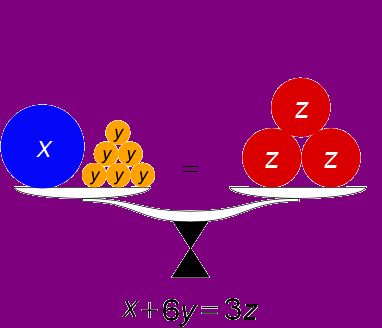
An equation is a claim that two expressions are equal. A linear equation in one variable is one where the variable appears only to the first power — no x2, no √x, no x in a denominator by itself. To solve it is to find every number you could put in place of the variable that makes the claim true. That number is called a solution (or a root), and the collection of all of them is the solution set.
Here is the part that trips people up, so let us say it plainly: you are not "moving things around." You are performing the same operation on both sides of a balance. If the two sides start out equal and you add 5 to each of them, they are still equal. If you divide each of them by 3, they are still equal. Each such move produces a new equation with exactly the same solutions — an equivalent equation — and you keep making moves until the equation reads x = something.
| Legal move | Name | Small example |
|---|---|---|
| Add the same number to both sides | Addition property of equality | x − 5 = 3 → x = 8 |
| Subtract the same number from both sides | Subtraction property of equality | x + 5 = 3 → x = −2 |
| Multiply both sides by the same nonzero number | Multiplication property of equality | (x)/(4) = 3 → x = 12 |
| Divide both sides by the same nonzero number | Division property of equality | 4x = 12 → x = 3 |
| Rewrite one side without changing its value | Distributive property, combining like terms | 2(x + 3) → 2x + 6 |
Notice the word nonzero. Multiplying both sides by zero turns any equation into 0 = 0, which is true but useless; dividing by zero is not defined at all. Those are the only two forbidden moves in this whole chapter.
A worked example, every single step
Solve 5(x − 3) + 2 = 3x + 7. We will not skip anything.
- Clear the parentheses using the distributive property. 5(x − 3) means 5·x − 5·3 = 5x − 15, so the equation becomes 5x − 15 + 2 = 3x + 7.
- Combine like terms on each side separately. On the left, −15 + 2 = −13, so we have 5x − 13 = 3x + 7.
- Collect the variable terms on one side. Subtract 3x from both sides: 5x − 3x − 13 = 3x − 3x + 7, which simplifies to 2x − 13 = 7.
- Collect the constants on the other side. Add 13 to both sides: 2x − 13 + 13 = 7 + 13, which gives 2x = 20.
- Undo the coefficient. Divide both sides by 2: (2x)/(2) = (20)/(2), so x = 10.
- Check. Put 10 back into the original equation. Left side: 5(10 − 3) + 2 = 5(7) + 2 = 35 + 2 = 37. Right side: 3(10) + 7 = 30 + 7 = 37. Both sides are 37, so x = 10 is correct.
That order — parentheses, combine, variables one way, numbers the other way, divide, check — works every time. It is worth memorizing as a rhythm rather than a rule.
Fractions, decimals, and denominators that hold variables
Fractions are not harder, they are just noisier. The fix is to multiply every term on both sides by the least common denominator (LCD), which wipes the denominators out in one stroke. Solve (x)/(3) + (1)/(4) = (x)/(2) − (5)/(6).
- Find the LCD of 3, 4, 2, and 6. The smallest number all four divide into is 12.
- Multiply every term by 12. Term by term: 12·(x)/(3) = 4x; 12·(1)/(4) = 3; 12·(x)/(2) = 6x; 12·(5)/(6) = 10. The equation is now 4x + 3 = 6x − 10 — no fractions left.
- Collect variables. Subtract 4x from both sides: 3 = 2x − 10.
- Collect constants. Add 10 to both sides: 13 = 2x.
- Divide by 2. x = (13)/(2) = 6.5.
- Check with x = 6.5. Left: (6.5)/(3) + (1)/(4) = 2.1667 + 0.25 = 2.4167. Right: (6.5)/(2) − (5)/(6) = 3.25 − 0.8333 = 2.4167. They match, so x = (13)/(2) is correct.
Decimals work the same way in reverse: multiply both sides by 10, 100, or 1000 — whatever clears the longest decimal — and you are back to whole numbers.
If the variable ever sits under a fraction bar, you must first write down the values that would make a denominator zero. Those are restrictions (also called excluded values), and they are off the table before you solve a single step. Solve (3)/(x − 2) = (5)/(x + 4).
- Restrictions. x − 2 = 0 when x = 2, and x + 4 = 0 when x = −4. So x ≠ 2 and x ≠ −4.
- Multiply both sides by (x − 2)(x + 4), the LCD. The left becomes 3(x + 4) and the right becomes 5(x − 2), so 3(x + 4) = 5(x − 2).
- Distribute. 3x + 12 = 5x − 10.
- Collect. Subtract 3x: 12 = 2x − 10. Add 10: 22 = 2x. Divide by 2: x = 11.
- Check against the restrictions and the original. 11 is neither 2 nor −4, so it is allowed. Left: (3)/(11 − 2) = (3)/(9) = (1)/(3). Right: (5)/(11 + 4) = (5)/(15) = (1)/(3). Correct.
Sometimes the algebra hands you a number that a restriction forbids. Solve (x)/(x − 3) = (3)/(x − 3) + 4, where x ≠ 3. Multiply everything by (x − 3): x = 3 + 4(x − 3) = 3 + 4x − 12 = 4x − 9. Subtract 4x: −3x = −9, so x = 3. But x = 3 is exactly the excluded value — it makes the original denominators zero. It is an extraneous solution, and the honest answer is that this equation has no solution.
Checking is not optional busywork. Substituting your answer back into the original equation is the only step that can catch an arithmetic slip, a dropped negative, or an extraneous solution. It takes twenty seconds and it is the difference between "I think it's 10" and "it's 10."
- A linear equation has the variable to the first power only; solving means finding every value that makes it true.
- Every legal move — add, subtract, multiply by a nonzero number, divide by a nonzero number — is done to both sides and produces an equivalent equation.
- Clear fractions by multiplying every term by the LCD; clear decimals by multiplying by a power of ten.
- If the variable appears in a denominator, list the restrictions first and discard any extraneous solution that violates them.
Section 2Identities and contradictions
Not every equation has exactly one answer
Most of the equations you meet have exactly one solution, and it is easy to assume they all do. They do not. A linear equation in one variable has exactly one of three possible outcomes, and which one you get announces itself in the last line of your work.
A conditional equation is true only on the condition that the variable takes one particular value. That is the familiar case: you end with x = 7, and the solution set is {7}. An identity is true no matter what the variable is; the two sides were secretly the same expression all along. You end with something like 4 = 4, and the solution set is all real numbers. A contradiction is true for no value at all; you end with something plainly false like −15 = 1, and the solution set is empty, written ∅ or { }.
| Type | Your last line looks like | Solution set | Picture (graph each side) |
|---|---|---|---|
| Conditional equation | x = a number | One value, e.g. {7} | Two lines crossing at one point |
| Identity | A true statement with no variable, e.g. 4 = 4 or 0 = 0 | All real numbers, (−∞, ∞) | The same line drawn twice |
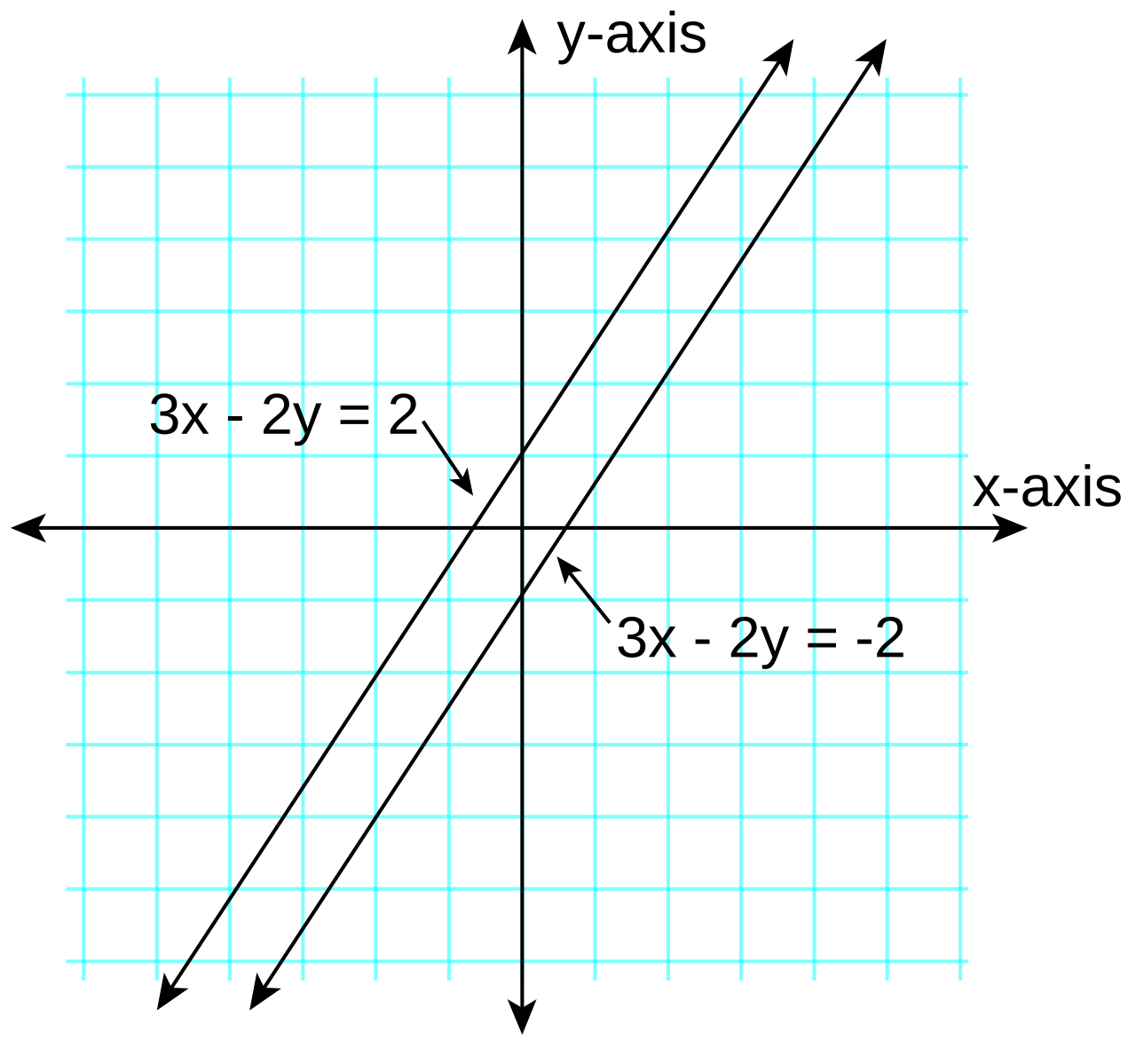
| Contradiction | A false statement with no variable, e.g. −15 = 1 | No solution, ∅ | Two parallel lines — never meet |
Three worked examples, side by side
(a) An identity. Solve 4(x + 1) − 2x = 2x + 4.
- Distribute on the left: 4x + 4 − 2x = 2x + 4.
- Combine like terms on the left: 4x − 2x = 2x, so 2x + 4 = 2x + 4.
- Subtract 2x from both sides: 4 = 4.
- The variable vanished and what is left is true. This is an identity; every real number works. Spot-check with x = 5: left = 4(6) − 10 = 24 − 10 = 14; right = 10 + 4 = 14. Now try x = −1: left = 4(0) + 2 = 2; right = −2 + 4 = 2. Both work, as promised.
(b) A contradiction. Solve 3(2x − 5) = 6x + 1.
- Distribute on the left: 6x − 15 = 6x + 1.
- Subtract 6x from both sides: −15 = 1.
- The variable vanished and what is left is false. This is a contradiction; there is no solution, ∅. Sanity check with x = 0: left = 3(−5) = −15; right = 1. They differ by 16 — and they will differ by 16 for every value of x, because both sides grow at the same rate of 6 per unit.
(c) A conditional equation. Solve 2(x + 6) = 3x + 5.
- Distribute: 2x + 12 = 3x + 5.
- Subtract 2x from both sides: 12 = x + 5.
- Subtract 5 from both sides: 7 = x, that is, x = 7.
- Check: left = 2(7 + 6) = 2(13) = 26; right = 3(7) + 5 = 21 + 5 = 26. One solution, {7}.
Why the picture explains everything
Think of each side of the equation as its own straight line. Case (c) gives the lines y = 2x + 12 and y = 3x + 5. Their slopes differ (2 versus 3), so they must cross somewhere — exactly once — and that crossing point is x = 7. Case (b) gives y = 6x − 15 and y = 6x + 1: identical slopes, different intercepts, so they are parallel and never touch. No crossing point means no solution. Case (a) gives y = 2x + 4 twice — one line lying perfectly on top of the other, touching at every single point, which is why every number is a solution.
When the variable disappears, do not panic — read the sentence. If both variable terms cancel, look at what remains. A true statement (7 = 7) means infinitely many solutions. A false statement (7 = 2) means none. Students often write "x = 0" here, which is wrong in both cases: zero is a specific answer, not "no answer."
- A conditional equation is true for one value; an identity is true for all values; a contradiction is true for none.
- If the variable cancels and leaves a true statement, the solution is all real numbers, (−∞, ∞).
- If the variable cancels and leaves a false statement, there is no solution, ∅.
- Graphically: crossing lines = one solution, the same line twice = infinitely many, parallel lines = none.
Section 3Literal equations and formulas
Same rules, more letters
A literal equation is an equation containing more than one letter — which is to say, a formula. A = lw, d = rt, and F = (9)/(5)C + 32 are all literal equations. To "solve a formula for a variable" means to rewrite it so that your chosen letter stands alone on one side, with everything else on the other.
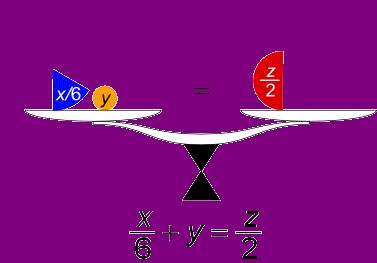
Here is the reassuring news: there is nothing new to learn. You use precisely the same moves from Section 1. The only difference is psychological — the other letters look like they should be doing something, and they are not. They are just numbers you happen not to know yet. If you can solve 3x = 12 by dividing by 3, you can solve bx = 12 by dividing by b.
Worked examples, from easy to genuinely tricky
(a) Solve A = ½bh for h.
- The ½ is in the way. Multiply both sides by 2: 2A = 2 · ½bh = bh.
- h is multiplied by b, so divide both sides by b: (2A)/(b) = h.
- Result: h = (2A)/(b), provided b ≠ 0 (a triangle with no base has no height to find).
- Check with real numbers: if b = 10 and h = 6, then A = ½(10)(6) = 30. Our formula gives h = (2 · 30)/(10) = (60)/(10) = 6. Correct.
(b) Solve F = (9)/(5)C + 32 for C. This is the temperature-conversion formula, and it is the classic exercise because the order of undoing matters.
- C is multiplied by (9)/(5) and then 32 is added, so undo in reverse: subtract 32 first. F − 32 = (9)/(5)C.
- Now undo the multiplication by (9)/(5). Multiplying by a fraction is undone by multiplying by its reciprocal, (5)/(9): (5)/(9)(F − 32) = (5)/(9) · (9)/(5)C = C.
- Result: C = (5)/(9)(F − 32).
- Check with a number you know: water boils at F = 212. Then C = (5)/(9)(212 − 32) = (5)/(9)(180) = 5 · 20 = 100. Water boils at 100 degrees Celsius. Correct.
(c) Solve P = 2L + 2W for W.
- Subtract 2L from both sides: P − 2L = 2W.
- Divide both sides by 2: W = (P − 2L)/(2).
- Check with numbers: a rectangle with L = 9 and W = 4 has P = 2(9) + 2(4) = 18 + 8 = 26. Our formula gives W = (26 − 18)/(2) = (8)/(2) = 4. Correct.
- A common slip: writing W = P − L. You must divide the whole numerator by 2, not just part of it.
(d) The variable appears twice: solve ax + b = cx + d for x. This one looks intimidating and is the most useful pattern in the section.
- Gather every x-term on one side. Subtract cx from both sides: ax − cx + b = d.
- Move the non-x terms to the other side. Subtract b: ax − cx = d − b.
- Factor out x. This is the step people forget: x(a − c) = d − b. Factoring is what turns two x's into one.
- Divide by the whole parenthesis. x = (d − b)/(a − c), provided a ≠ c.
- Check against Section 1: solve 5x + 3 = 2x + 12 the long way and you get 3x = 9, x = 3. Now use the formula with a = 5, b = 3, c = 2, d = 12: x = (12 − 3)/(5 − 2) = (9)/(3) = 3. Same answer.
That restriction a ≠ c is Section 2 in disguise. If a = c, the two sides have the same slope, and the equation is either a contradiction (if b ≠ d) or an identity (if b = d). The algebra warns you by asking you to divide by zero.
| Formula | What it describes | Solved for another variable |
|---|---|---|
| A = lw | Area of a rectangle | w = (A)/(l), l ≠ 0 |
| P = 2L + 2W | Perimeter of a rectangle | W = (P − 2L)/(2) |
| A = ½bh | Area of a triangle | h = (2A)/(b), b ≠ 0 |
| C = 2πr | Circumference of a circle | r = (C)/(2π) |
| d = rt | Distance travelled | t = (d)/(r), r ≠ 0 |
| I = Prt | Simple interest | r = (I)/(Pt), P, t ≠ 0 |
| F = (9)/(5)C + 32 | Fahrenheit from Celsius | C = (5)/(9)(F − 32) |
| A = P(1 + rt) | Balance with simple interest | r = (A − P)/(Pt) |
When the letters confuse you, sneak numbers in. Stuck on how to solve V = πr2h for h? Ask yourself how you would solve 12 = 3h. You would divide by 3. So divide by πr2: h = (V)/(πr2). The letters never change the method — only how it feels.
- A literal equation is a formula with several letters; solving it for one letter uses the same properties of equality as any other equation.
- Undo operations in reverse order: strip away addition and subtraction first, then multiplication and division.
- Undo multiplication by a fraction by multiplying by its reciprocal.
- If the target variable appears twice, gather those terms, factor the variable out, then divide by the whole parenthesis — and note the restriction that keeps that parenthesis nonzero.
Section 4Applications
The five-step method
Word problems frighten people not because the algebra is hard — it is the easiest algebra in the chapter — but because the translation step is unpractised. So do it deliberately, in writing, every time. The method never changes.
- Read it twice and say out loud what is being asked for.
- Name the unknown. Write "Let x = ..." with units. If there are two unknowns, define the second in terms of the first.
- Translate the sentence into an equation, phrase by phrase.
- Solve using Section 1.
- Answer the question asked, in a sentence with units, and check against the original wording — not just against your own equation.
Step 5 has two halves for a reason. You can solve your equation perfectly and still be wrong if you found the brother's age when the question asked for the sister's, or if you solved for the discount when the question asked for the original price.
| English phrase | Translates to | Watch out for |
|---|---|---|
| the sum of a number and 7 | x + 7 | — |
| 7 more than a number | x + 7 | — |
| 7 less than a number | x − 7 | Not 7 − x — the order flips |
| a number decreased by 7 | x − 7 | — |
| twice a number | 2x | — |
| 4 more than twice a number | 2x + 4 | Not 2(x + 4) |
| the quotient of a number and 5 | (x)/(5) | Not (5)/(x) |
| 15% of a number | 0.15x | "of" means multiply; convert the percent |
| is, was, will be, gives | = | This is where the equals sign goes |
| consecutive integers | n, n + 1, n + 2 | — |
| consecutive even or odd integers | n, n + 2, n + 4 | Step by 2 for both even and odd |
Worked examples: ages, money, and travel
An age problem. Maya is 4 years older than twice her brother's age. Together their ages total 40. How old is each?
- Name the unknown. The brother's age is the simpler quantity, so let b = the brother's age in years.
- Express the other unknown. "4 years older than twice her brother's age" means 2b + 4, so Maya's age is 2b + 4.
- Translate. "Together their ages total 40" means b + (2b + 4) = 40.
- Solve. Combine like terms: 3b + 4 = 40. Subtract 4: 3b = 36. Divide by 3: b = 12.
- Answer both parts. The brother is 12. Maya is 2(12) + 4 = 24 + 4 = 28.
- Check against the words. Twice 12 is 24, and 4 more is 28 — Maya is indeed 4 years older than twice his age. And 12 + 28 = 40. Both sentences hold.
A percent problem. A jacket sells for 68 dollars after a 15% discount. What was the original price?
- Name the unknown. Let p = the original price in dollars. Note carefully: the discount is 15% of the original price, not of the 68 dollars.
- Translate. Original price minus the discount equals the sale price: p − 0.15p = 68.
- Combine like terms. p is 1p, so 1p − 0.15p = 0.85p. The equation is 0.85p = 68.
- Solve. Divide both sides by 0.85: p = (68)/(0.85) = 80.
- Check against the words. 15% of 80 is 0.15(80) = 12, and 80 − 12 = 68. Correct. The original price was 80 dollars.
Notice the shortcut hiding in step 3: taking 15% off is the same as keeping 85%, so you could have written 0.85p = 68 straight away. That shortcut is worth owning, because it also runs backwards for markups (a 15% increase is 1.15p).
A distance problem. Two cars leave the same rest stop at the same time and drive in opposite directions, one at 55 mi/h and the other at 65 mi/h. After how many hours are they 360 miles apart?
- Name the unknown. Let t = the time in hours. Both cars travel for the same t.
- Use d = rt for each car. The first covers 55t miles; the second covers 65t miles.
- Translate. They move in opposite directions, so the gap between them is the sum of the two distances: 55t + 65t = 360.
- Solve. Combine like terms: 120t = 360. Divide by 120: t = 3.
- Check against the words. In 3 hours the first car goes 55(3) = 165 miles and the second goes 65(3) = 195 miles. Since they went opposite ways, they are 165 + 195 = 360 miles apart. Correct: 3 hours.
One more pattern worth seeing, because it appears constantly: three consecutive even integers sum to 84. Let n be the smallest; the next two are n + 2 and n + 4. Then n + (n + 2) + (n + 4) = 84 becomes 3n + 6 = 84, so 3n = 78 and n = 26. The integers are 26, 28, and 30, and 26 + 28 + 30 = 84. Correct.
"Less than" reverses the order; "less" does not. "5 less than x" is x − 5, but "5 less x" and "the difference of 5 and x" are 5 − x. When a problem hinges on a phrase like this, test it with a number: is "5 less than 12" equal to 7 or to −7? It is 7 — so the form is x − 5.
- Always define the variable in writing, with units, before translating.
- Express a second unknown in terms of the first so the equation has only one variable.
- "Is" becomes =; "of" becomes multiply; "less than" and "subtracted from" reverse the order of the terms.
- Finish by answering the question that was asked and checking your numbers against the original sentences.
Section 5Linear inequalities
Almost the same rules — with one exception
An inequality uses <, >, ≤, or ≥ instead of =, and asks not "which value works" but "which values work." The answer is usually a whole stretch of the number line, which is why we report it in interval notation.
You solve an inequality with exactly the moves from Section 1 — add, subtract, multiply, divide on both sides — with one rule attached: if you multiply or divide both sides by a negative number, reverse the direction of the inequality symbol. Here is why, in one line you can verify yourself. Start with the true statement −2 < 3. Multiply both sides by −1 and you get 2 and −3. Is 2 < −3? No. Is 2 > −3? Yes. Multiplying by a negative reflects both numbers across zero, which swaps which one is larger, so the symbol must flip to keep the statement true.
Note what does not trigger a flip: adding or subtracting a negative number, or having a negative number sitting somewhere in the problem. The flip happens only when the operation you perform is multiplying or dividing by a negative.
| Inequality | Interval notation | On a number line |
|---|---|---|
| x < a | (−∞, a) | Open circle at a, shaded left |
| x ≤ a | (−∞, a] | Closed circle at a, shaded left |
| x > a | (a, ∞) | Open circle at a, shaded right |
| x ≥ a | [a, ∞) | Closed circle at a, shaded right |
| a < x < b | (a, b) | Both endpoints open, shaded between |
| a ≤ x ≤ b | [a, b] | Both endpoints closed, shaded between |
| x < a or x > b | (−∞, a) ∪ (b, ∞) | Two rays pointing outward |
| every real number | (−∞, ∞) | The entire line shaded |
Two conventions to lock in: a square bracket means the endpoint is included (it goes with ≤ and ≥), a parenthesis means it is excluded (it goes with < and >), and ∞ always gets a parenthesis because infinity is a direction, not a number you can reach.
Here is the flip in action. Solve −3x + 7 ≤ 22 and write the answer in interval notation.
- Subtract 7 from both sides. No flip — subtracting never flips. −3x ≤ 22 − 7, so −3x ≤ 15.
- Divide both sides by −3. This is division by a negative, so the symbol flips from ≤ to ≥: x ≥ (15)/(−3), so x ≥ −5.
- Write the interval. [−5, ∞) — bracket on −5 because ≥ includes it, parenthesis on infinity always.
- Check with two test values. Try x = 0, which is in our answer: −3(0) + 7 = 7, and 7 ≤ 22 is true. Good. Now try x = −10, which is not in our answer: −3(−10) + 7 = 30 + 7 = 37, and 37 ≤ 22 is false. Correctly excluded. Finally test the endpoint x = −5: −3(−5) + 7 = 15 + 7 = 22, and 22 ≤ 22 is true, so the endpoint does belong.
Compare that with an inequality where no flip is needed. Solve 5(x − 2) > 3x + 4: distribute to get 5x − 10 > 3x + 4; subtract 3x to get 2x − 10 > 4; add 10 to get 2x > 14; divide by positive 2, so no flip, giving x > 7, or (7, ∞). Check x = 8: 5(6) = 30 and 3(8) + 4 = 28, and 30 > 28 is true.
Compound inequalities: "and" versus "or"
A compound inequality joins two inequalities. An and statement (also called a conjunction) requires both parts to be true, so its solution is the overlap — usually a single interval sandwiched between two numbers. An or statement requires at least one part to be true, so its solution is everything either part covers — usually two separate rays joined with the union symbol ∪.
An "and" example. Solve −5 ≤ 2x − 1 < 7. Because the variable sits in the middle, work on all three parts at once.
- Add 1 to all three parts. −5 + 1 ≤ 2x − 1 + 1 < 7 + 1, giving −4 ≤ 2x < 8.
- Divide all three parts by 2. Two is positive, so nothing flips: −2 ≤ x < 4.
- Interval notation. [−2, 4) — closed on the left because of ≤, open on the right because of <.
- Check. Test x = 0 (inside): 2(0) − 1 = −1, and −5 ≤ −1 < 7 is true. Test x = 4 (the excluded endpoint): 2(4) − 1 = 7, and 7 < 7 is false, so 4 is correctly left out. Test x = −2 (the included endpoint): 2(−2) − 1 = −5, and −5 ≤ −5 is true, so −2 belongs.
An "or" example. Solve 3x + 2 < −4 or 3x + 2 > 8. Solve each piece separately. From the first: 3x < −6, so x < −2. From the second: 3x > 6, so x > 2. The solution is x < −2 or x > 2, written (−∞, −2) ∪ (2, ∞). Check x = −3: 3(−3) + 2 = −7, and −7 < −4 is true, so the "or" is satisfied. Check x = 0: 3(0) + 2 = 2, which is neither less than −4 nor greater than 8, so 0 is correctly excluded.
Absolute-value inequalities
Absolute value measures distance from zero, and distance is never negative. That single fact generates both rules. If |u| < c for some positive c, then u is within c units of zero, so −c < u < c — an "and," a middle interval. If |u| > c, then u is farther than c from zero, so u < −c or u > c — an "or," two outward rays. A memory hook that has saved many students: less than is an and, greator is an or.
Worked example (less than). Solve |2x − 3| ≤ 7.
- Rewrite without bars using the "and" form: −7 ≤ 2x − 3 ≤ 7.
- Add 3 to all three parts. −7 + 3 ≤ 2x ≤ 7 + 3, giving −4 ≤ 2x ≤ 10.
- Divide all three parts by 2. −2 ≤ x ≤ 5.
- Interval notation. [−2, 5].
- Check both endpoints. At x = 5: |2(5) − 3| = |10 − 3| = |7| = 7, and 7 ≤ 7 is true. At x = −2: |2(−2) − 3| = |−4 − 3| = |−7| = 7, also true. And at x = 6 (outside): |12 − 3| = 9, and 9 ≤ 7 is false, correctly excluded.
Worked example (greater than). Solve |3x + 1| > 5.
- Rewrite without bars using the "or" form: 3x + 1 < −5 or 3x + 1 > 5.
- Solve the left branch. Subtract 1: 3x < −6. Divide by 3: x < −2.
- Solve the right branch. Subtract 1: 3x > 4. Divide by 3: x > (4)/(3).
- Interval notation. (−∞, −2) ∪ ((4)/(3), ∞).
- Check. Test x = 2 (in the right branch): |3(2) + 1| = |7| = 7, and 7 > 5 is true. Test x = −3 (in the left branch): |−9 + 1| = |−8| = 8, and 8 > 5 is true. Test x = 0 (in neither): |0 + 1| = 1, and 1 > 5 is false, correctly excluded.
Finally, three special cases that follow straight from "distance is never negative." |u| < −3 has no solution (∅), because no absolute value can be smaller than a negative number. |u| > −3 is true for all real numbers, (−∞, ∞), because every absolute value already beats a negative. And |u| < 0 is also empty, while |u| ≥ 0 is all reals. Recognize these by inspection rather than by grinding through the algebra — splitting them into cases produces nonsense.
Isolate the absolute value before you split. In 3|x − 1| + 4 < 19, you must first subtract 4 to get 3|x − 1| < 15 and then divide by 3 to get |x − 1| < 5, and only then write −5 < x − 1 < 5, giving −4 < x < 6, or (−4, 6). Splitting too early is the single most common error in this section.
- Inequalities use the same solving moves as equations, except that multiplying or dividing by a negative reverses the symbol.
- Report answers in interval notation: brackets include endpoints, parentheses exclude them, and ∞ always takes a parenthesis.
- A compound and gives an overlap (one interval); a compound or gives a union of two rays.
- |u| < c becomes −c < u < c (an "and"); |u| > c becomes u < −c or u > c (an "or"); isolate the bars first.
The chapter in one breath
- Solving a linear equation means applying the same legal move to both sides — add, subtract, multiply or divide by a nonzero number — until the variable stands alone, then checking in the original.
- Clear fractions by multiplying every term by the LCD and decimals by a power of ten; the equation that remains is an ordinary whole-number problem.
- If a variable sits in a denominator, list the restrictions first and throw out any extraneous solution that lands on one.
- Every linear equation is a conditional equation (one solution), an identity (all real numbers, when the variable cancels leaving a true statement), or a contradiction (no solution, ∅, when it cancels leaving a false one).
- A literal equation is solved for a chosen letter by the same moves; when that letter appears twice, gather its terms, factor it out, and divide by the whole parenthesis.
- Word problems yield to a fixed routine: define the variable, express other unknowns in terms of it, translate phrase by phrase, solve, and answer the question that was actually asked.
- Inequalities behave exactly like equations except that multiplying or dividing by a negative flips the symbol; answers are written in interval notation.
- Compound inequalities are overlaps ("and") or unions ("or"), and absolute-value inequalities convert to one or the other — less than gives an "and," greater than gives an "or."
ReferenceWords worth knowing
A quick reference for the vocabulary in this chapter — read it through now, then come back to it any time a word in a problem stops you cold.
- Absolute value
- The distance of a number from zero on the number line, written |x|; it is never negative, so |−7| = 7 and |7| = 7.
- Coefficient
- The number multiplying a variable. In 5x − 3, the coefficient of x is 5.
- Compound inequality
- Two inequalities joined by and (solution = the overlap) or or (solution = the union).
- Conditional equation
- An equation true only for particular value(s) of the variable — the ordinary case, with exactly one solution for a linear equation.
- Constant
- A term with no variable in it, such as the −3 in 5x − 3.
- Contradiction
- An equation true for no value of the variable; solving it produces a false statement such as 4 = 9, and the solution set is empty (∅).
- Distributive property
- The rule a(b + c) = ab + ac, used to clear parentheses.
- Equivalent equations
- Two equations with exactly the same solution set; every legal move you make produces one.
- Extraneous solution
- A value produced by correct algebra that nevertheless fails in the original equation — typically because it violates a restriction.
- Identity
- An equation true for every allowed value of the variable; solving it produces a true statement such as 6 = 6, and the solution set is all real numbers.
- Inequality
- A statement comparing two expressions with <, >, ≤, or ≥ rather than =.
- Interval notation
- A compact way to write a solution set: brackets [ ] include an endpoint, parentheses ( ) exclude it, and ∞ always takes a parenthesis.
- Least common denominator (LCD)
- The smallest expression every denominator divides into; multiplying an equation by it clears all fractions at once.
- Linear equation
- An equation in which the variable appears only to the first power, with no variable under a radical or alone in a denominator.
- Literal equation
- An equation containing two or more letters — a formula — which can be solved for any one of them.
- No solution (empty set)
- The solution set of a contradiction, written ∅ or { }; it is not the same as the solution x = 0.
- Properties of equality
- The rules permitting you to add, subtract, multiply, or divide both sides of an equation by the same quantity (nonzero for multiplying and dividing).
- Restriction (excluded value)
- A value the variable may not take because it would make a denominator zero or otherwise undefine the expression.
- Solution (root)
- A value that makes an equation a true statement when substituted for the variable.
- Solution set
- The collection of all solutions, written in set or interval notation.
- Term
- A single number, variable, or product of them, separated from its neighbours by + or − signs. In 5x − 3 there are two terms.
- Variable
- A letter standing for an unknown or changing quantity.